Every successful interview starts with knowing what to expect. In this blog, we’ll take you through the top School Program Coordination interview questions, breaking them down with expert tips to help you deliver impactful answers. Step into your next interview fully prepared and ready to succeed.
Questions Asked in School Program Coordination Interview
Q 1. Describe your experience in developing and implementing school programs.
Developing and implementing school programs is a multifaceted process that requires careful planning, collaboration, and ongoing evaluation. It begins with identifying a need or opportunity within the school community – perhaps a gap in student skills, a desire to enhance extracurricular offerings, or a response to a community need. My approach involves a structured process:
- Needs Assessment: This crucial first step involves gathering data from various sources, including student surveys, teacher feedback, parent input, and analysis of existing academic data. For example, if we noticed low scores in science, we’d research the root cause – lack of hands-on experience, insufficient resources, etc.
- Program Design: Based on the needs assessment, I design the program, outlining its goals, objectives, curriculum, timeline, and resources required. This often involves creating detailed lesson plans, securing materials, and identifying potential instructors or facilitators. For instance, for the science program, we might design a project-based learning curriculum incorporating experiments and field trips.
- Implementation: This phase involves putting the plan into action, coordinating schedules, training staff, and managing logistics. Effective communication with teachers, students, and parents is critical during this phase. For the science program, we’d schedule classes, train teachers on the new curriculum, and communicate the program’s goals to parents.
- Evaluation: Continuous monitoring and evaluation are vital to ensure the program’s success. Data collection methods might include pre- and post-tests, student projects, teacher observations, and student surveys. For the science program, we’d track student performance, assess their understanding of key concepts, and solicit feedback from teachers and students to improve the program iteratively.
Throughout the entire process, I ensure strong collaboration with all stakeholders – teachers, administrators, parents, and community members. This collaborative approach fosters buy-in and ensures program sustainability.
Q 2. How do you manage budgets for school programs?
Budget management for school programs demands careful planning and proactive monitoring. I employ a multi-step approach:
- Budget Development: This starts with clearly defining the program’s goals and objectives. Each activity within the program is then assigned a cost, including personnel, materials, equipment, and any external services. I utilize budgeting software to track expenses and create detailed spreadsheets. This allows me to easily see where the funds are allocated.
- Resource Allocation: I prioritize funding based on the program’s objectives and the expected impact. This requires making informed decisions, sometimes involving difficult trade-offs between competing priorities. For example, we may prioritize purchasing new scientific equipment over additional field trips, if the equipment is essential for the learning process.
- Monitoring and Reporting: Regular tracking of expenses is essential. I regularly review actual expenditures against the budget, identifying any variances and investigating the causes. This allows for timely adjustments and prevents overspending. Regular reports are submitted to relevant stakeholders to ensure transparency and accountability.
- Seeking Additional Funding: When needed, I actively seek additional funding through grants, fundraising events, or partnerships with community organizations. I prepare compelling proposals highlighting the program’s value and impact.
Careful budget management is key to program sustainability and efficient use of resources.
Q 3. Explain your process for assessing the effectiveness of school programs.
Assessing program effectiveness is crucial for improving outcomes and justifying continued funding. My process involves a combination of quantitative and qualitative data:
- Establish Clear Measurable Goals: Before implementation, specific, measurable, achievable, relevant, and time-bound (SMART) goals must be defined. For instance, rather than stating ‘improve student writing skills,’ we’d set a goal like ‘increase average student essay scores by 15% within one semester.’
- Data Collection Methods: I utilize various methods to collect data, including pre- and post-tests, student projects, portfolios, observation checklists, teacher feedback, and student and parent surveys. Data should be collected at various points throughout the program to track progress and identify areas for improvement.
- Data Analysis: Collected data is meticulously analyzed to determine the extent to which the program achieved its goals. This often involves statistical analysis of quantitative data and thematic analysis of qualitative data. For instance, we might use statistical tests to determine if the increase in essay scores is statistically significant.
- Reporting and Improvement: Findings are compiled into a comprehensive report that is shared with stakeholders. This report details the program’s effectiveness, identifies strengths and weaknesses, and proposes recommendations for improvement. The findings guide modifications to the program for future iterations.
A robust evaluation process ensures that programs are effective, efficient, and aligned with their stated goals.
Q 4. How do you handle conflicts between teachers and students regarding programs?
Conflicts between teachers and students regarding programs are inevitable. My approach prioritizes open communication, understanding, and a focus on finding solutions that benefit everyone involved:
- Active Listening: I start by listening attentively to both sides, allowing each party to express their concerns and perspectives without interruption. This demonstrates respect and helps establish a foundation of trust.
- Identifying the Root Cause: I work to understand the underlying reasons for the conflict. This may involve asking clarifying questions, identifying misunderstandings, or uncovering deeper issues related to the program’s design or implementation.
- Mediation and Facilitation: I facilitate a constructive dialogue between the teacher and student, encouraging them to find common ground and work towards a mutually agreeable solution. This often involves brainstorming alternative approaches or adjustments to the program.
- Documentation and Follow-Up: It is important to document the conflict, the agreed-upon resolution, and any actions taken to prevent similar conflicts in the future. Follow-up with both parties is necessary to ensure that the agreed-upon solution is implemented and is effective.
Successful conflict resolution requires patience, empathy, and a commitment to fair and equitable outcomes for all involved.
Q 5. Describe your experience with curriculum development or alignment.
My experience with curriculum development and alignment involves ensuring that programs are aligned with state and district standards, while also catering to the diverse needs of students. This involves:
- Needs Assessment: Understanding the current curriculum and identifying gaps or areas for improvement is the first step. This often involves reviewing existing materials, conducting teacher surveys, and analyzing student performance data.
- Standards Alignment: The revised or newly developed curriculum must be meticulously aligned with relevant state and district standards. This ensures that students receive a comprehensive education covering all required learning objectives.
- Curriculum Design: Creating engaging and effective learning experiences requires careful planning. This includes selecting appropriate instructional strategies, choosing relevant resources, and designing assessments that measure student learning.
- Implementation and Evaluation: The new curriculum is implemented and monitored closely. Regular assessment and evaluation are critical to ensure its effectiveness and identify areas for improvement.
- Collaboration: Effective curriculum development requires collaboration with teachers, administrators, specialists, and other stakeholders. This ensures buy-in and allows for valuable input and diverse perspectives.
For example, I recently led a project to revise our school’s math curriculum to incorporate more project-based learning activities, ensuring alignment with new state standards while addressing declining student engagement in traditional math instruction.
Q 6. How do you ensure program compliance with state/federal regulations?
Ensuring program compliance with state and federal regulations is paramount. This involves a proactive approach that begins before program implementation:
- Regulatory Research: Thorough research is crucial to understand all applicable regulations related to the program. This involves reviewing relevant state and federal laws, guidelines, and policies.
- Program Design and Implementation: The program’s design and implementation must adhere strictly to all applicable regulations. This includes considerations regarding student privacy (FERPA), accessibility for students with disabilities (IDEA), and equal opportunity provisions.
- Documentation and Record-Keeping: Maintaining meticulous records is essential to demonstrate compliance. This includes documenting all aspects of the program, from budget allocation to student participation and evaluation data.
- Regular Audits and Reviews: Regular internal audits and reviews are conducted to identify any potential compliance issues. This proactive approach allows for timely corrective actions before any violations occur.
- Professional Development: Staff members involved in the program receive training on relevant regulations to ensure they understand their responsibilities and can effectively implement procedures that promote compliance.
Compliance isn’t just about avoiding penalties; it’s about ensuring the safety, well-being, and fair treatment of every student.
Q 7. How do you prioritize multiple program initiatives?
Prioritizing multiple program initiatives requires a strategic approach that considers various factors:
- Needs Assessment: A thorough assessment of the school’s needs is crucial. This helps identify the most pressing issues and which programs are most likely to have the greatest impact.
- Resource Availability: Consider the resources available – budget, personnel, time, and facilities. Some programs may require more resources than others, influencing their prioritization.
- Alignment with School Goals: Programs should align with the overall goals and strategic plan of the school. Those that best support the school’s mission and vision should be prioritized.
- Stakeholder Input: Consider input from various stakeholders, including teachers, administrators, parents, and community members. Their perspectives can offer valuable insights and help ensure that programs are relevant and meet the needs of the school community.
- Data-Driven Decision Making: Prioritization decisions should be data-driven, using available data to inform choices. This may include data on student performance, resource utilization, and program effectiveness.
- Phased Implementation: Implementing programs in phases can be effective. It allows the school to focus on a manageable number of initiatives while continuously evaluating progress and adjusting priorities as needed.
A well-defined prioritization process allows for effective allocation of resources and ensures the successful implementation of the most impactful programs.
Q 8. What strategies do you use to engage students in school programs?
Engaging students in school programs requires a multifaceted approach that caters to diverse learning styles and interests. It’s not just about delivering content; it’s about creating a compelling and relevant experience.
- Relevance and Choice: Programs should connect to students’ lives and interests. Offering choices within the program allows students to personalize their participation, boosting engagement. For example, in a STEM program, students could choose between robotics, coding, or a science fair project.
- Active Learning: Passive lectures are rarely engaging. I incorporate hands-on activities, group projects, games, and simulations to make learning active and interactive. A history program might involve creating historical reenactments or designing museum exhibits.
- Technology Integration: Technology can enhance engagement. Interactive apps, online simulations, and virtual field trips can make learning more exciting and accessible. For example, using virtual reality to explore ancient civilizations can be far more impactful than reading about it in a textbook.
- Positive Reinforcement and Celebration: Recognizing and celebrating student achievements – both big and small – is crucial. This could involve awarding certificates, showcasing student work, or having a program celebration event.
- Collaboration and Community: Fostering a sense of community and teamwork within the program can increase engagement. Group projects and peer-to-peer learning opportunities promote collaboration and shared responsibility.
Q 9. How do you build and maintain relationships with stakeholders (parents, teachers, administration)?
Building and maintaining strong relationships with stakeholders is the cornerstone of successful program coordination. It requires consistent communication, transparency, and a commitment to collaboration.
- Regular Communication: I utilize various communication channels – newsletters, emails, parent-teacher conferences, and school events – to keep stakeholders informed about program progress, upcoming activities, and important announcements. This ensures everyone is on the same page.
- Open Dialogue and Feedback: I create opportunities for open dialogue and feedback through surveys, focus groups, and informal conversations. This ensures that the program is meeting the needs and expectations of all stakeholders.
- Collaboration and Partnerships: I actively seek opportunities to collaborate with parents, teachers, and administrators. This might involve joint planning sessions, co-teaching opportunities, or parent volunteer programs. For example, inviting parents to participate in a science fair as judges builds a sense of community and ownership.
- Transparency and Accountability: I maintain transparent communication regarding program finances, resources, and progress. I make myself accessible to answer questions and address concerns promptly and professionally.
- Conflict Resolution: When conflicts arise, I prioritize active listening, finding common ground, and seeking mutually agreeable solutions. This may involve mediation or seeking support from school administration.
Q 10. Describe a time you had to make a difficult decision regarding school program resources.
In one instance, our after-school arts program faced budget cuts. We had to make a difficult decision about allocating limited resources between our drama and visual arts components. Both programs were popular and well-attended.
My approach involved a multi-step process:
- Data Analysis: I reviewed enrollment data, student feedback, and teacher input to assess the popularity and impact of each program component.
- Prioritization: Based on the data, we identified that the drama program had a higher student participation rate and a stronger waiting list.
- Creative Solutions: Instead of eliminating the visual arts program entirely, we reduced the frequency of its sessions and repurposed some existing supplies. We also explored potential partnerships with community organizations to supplement resources.
- Communication: We communicated the decision transparently to all stakeholders, explaining the rationale and the steps taken to mitigate the impact of the budget cuts.
While difficult, this experience taught me the importance of data-driven decision-making, creative problem-solving, and effective communication during challenging times.
Q 11. How do you track and report on program progress and outcomes?
Tracking and reporting program progress and outcomes involves utilizing a combination of quantitative and qualitative data.
- Quantitative Data: This includes metrics such as enrollment numbers, attendance rates, test scores (if applicable), and program completion rates. I typically use spreadsheets or databases to track this data.
- Qualitative Data: This comprises student feedback, teacher observations, and anecdotal evidence. Methods for collecting qualitative data include surveys, interviews, focus groups, and journals.
- Reporting: I prepare regular reports summarizing program progress, highlighting key achievements, and identifying areas for improvement. These reports are shared with stakeholders through presentations, written reports, and dashboards.
- Data Visualization: I use charts and graphs to visually represent data, making it easier for stakeholders to understand program performance and outcomes. Examples include bar charts showing enrollment trends or pie charts showing the distribution of student participation in different program activities.
This comprehensive approach ensures a holistic understanding of program effectiveness and informs future planning and improvements.
Q 12. How do you use data to inform program decisions?
Data informs every aspect of program decision-making, from resource allocation to curriculum design. By analyzing data, I can identify program strengths and weaknesses, allowing for evidence-based improvements.
- Needs Assessment: Data helps identify the specific needs of the student population. For example, if data reveals a low literacy rate among a certain demographic, the program can be adapted to address that specific need.
- Curriculum Development: Data informs the development and refinement of the curriculum. For instance, if student performance on assessments is low in a particular area, the curriculum can be adjusted to better address those learning gaps.
- Resource Allocation: Data guides resource allocation decisions. By analyzing data on program participation and student outcomes, I can determine which aspects of the program require more resources or support.
- Program Evaluation: Data provides the foundation for evaluating program effectiveness and demonstrating its impact on student learning and development.
Essentially, data empowers me to make informed decisions, ensuring that the program remains relevant, effective, and aligned with student needs.
Q 13. How do you address program challenges or setbacks?
Program challenges and setbacks are inevitable. A proactive approach to problem-solving is crucial.
- Identify the Problem: The first step is to thoroughly analyze the challenge, identifying its root causes. This involves gathering data, seeking input from stakeholders, and assessing the impact of the setback.
- Develop Solutions: Once the problem is understood, I brainstorm potential solutions with the team. This could involve adjusting the program schedule, seeking additional resources, or modifying program activities.
- Implement and Monitor: I implement the chosen solution and closely monitor its effectiveness. This often involves collecting data to assess whether the solution is addressing the challenge.
- Adapt and Refine: If the initial solution isn’t effective, I am prepared to adapt or refine my approach. Program coordination is an iterative process; continuous improvement is key.
- Learn from Mistakes: Every setback provides a valuable learning opportunity. I use these experiences to improve my planning, decision-making, and problem-solving skills.
Q 14. Explain your experience with staff training and professional development related to programs.
Staff training and professional development are essential for maintaining high-quality programs. I believe in providing ongoing opportunities for staff to enhance their skills and knowledge.
- Needs Assessment: I start by assessing the training needs of the staff. This involves identifying any skill gaps or areas where professional development could enhance program delivery.
- Training Design: I then develop training programs that address these specific needs. These programs may include workshops, online courses, mentoring programs, or job shadowing opportunities.
- Delivery Methods: Training is delivered through a variety of methods – in-person workshops, online modules, peer-to-peer coaching, and participation in professional conferences. The chosen method depends on the training topic and the needs of the staff.
- Evaluation and Feedback: I incorporate mechanisms for evaluating the effectiveness of training programs and gathering staff feedback. This helps to ensure that the training meets the needs of the staff and contributes to improved program quality.
- Ongoing Support: I provide ongoing support and mentoring to staff, encouraging them to implement their new skills and knowledge in the workplace.
This ongoing commitment to professional development ensures that staff are well-equipped to deliver high-quality programs and effectively engage students.
Q 15. How do you ensure program sustainability?
Ensuring program sustainability involves a multifaceted approach focused on securing long-term funding, building strong community partnerships, and demonstrating measurable impact. It’s like building a house – you need a solid foundation (funding), strong walls (partnerships), and a beautiful, functional interior (impact).
Diversified Funding Streams: Relying solely on one funding source is risky. We need a mix of grants, donations, sponsorships, and potentially even earned income through program fees (if appropriate and accessible to all students).
Community Engagement: Building relationships with local businesses, organizations, and parent groups creates a support network. This can involve volunteer recruitment, securing in-kind donations (materials, space), and promoting the program to the wider community.
Data-Driven Evaluation: Regularly assessing program effectiveness through data collection and analysis demonstrates value to funders and stakeholders. This helps justify continued funding and informs program improvements.
Program Adaptability: Staying relevant and responsive to changing student needs and community contexts is crucial. We need to be flexible and adjust our program offerings to meet evolving demands. For example, if technology changes, our program must also adapt.
Career Expert Tips:
- Ace those interviews! Prepare effectively by reviewing the Top 50 Most Common Interview Questions on ResumeGemini.
- Navigate your job search with confidence! Explore a wide range of Career Tips on ResumeGemini. Learn about common challenges and recommendations to overcome them.
- Craft the perfect resume! Master the Art of Resume Writing with ResumeGemini’s guide. Showcase your unique qualifications and achievements effectively.
- Don’t miss out on holiday savings! Build your dream resume with ResumeGemini’s ATS optimized templates.
Q 16. How do you evaluate the impact of school programs on student learning?
Evaluating the impact of school programs requires a robust assessment plan that measures student learning outcomes aligned with program goals. We can’t just assume a program is successful; we need evidence.
Pre- and Post-Tests: Measuring student knowledge or skills before and after program participation provides quantifiable data on learning gains. For example, we might use standardized tests or create specific assessments tailored to the program’s objectives.
Qualitative Data: Gathering feedback through student surveys, teacher interviews, and focus groups provides valuable insights into the program’s impact on students’ attitudes, engagement, and overall experience. This provides a richer understanding than numbers alone.
Benchmarking: Comparing program outcomes to similar programs or national averages helps establish context and identify areas for improvement. This allows us to see if our program is truly effective compared to best practices.
For example, in a reading intervention program, we might track students’ reading levels using standardized assessments and compare the growth of students in the program to a control group. We would also collect qualitative data from students and teachers to understand the program’s impact on their attitudes towards reading and their engagement in literacy activities.
Q 17. What technology or software have you used for program management?
I’ve utilized several technologies for program management, each offering unique advantages. My experience includes using:
Student Information Systems (SIS): These systems (e.g., PowerSchool, Infinite Campus) are invaluable for tracking student participation, attendance, and grades, especially when integrating program data into the overall student record.
Project Management Software: Tools like Asana or Trello are excellent for task management, scheduling, and collaboration among staff and volunteers. They help to keep everything organized and on track.
Spreadsheets (e.g., Google Sheets, Excel): These are essential for data entry, analysis, and reporting. They allow for easy tracking of budgets, attendance, and program outcomes. We can also easily create charts and graphs to visualize progress.
Communication Platforms (e.g., Google Classroom, Slack): These platforms facilitate effective communication between staff, students, parents, and volunteers. This is essential for announcements, updates, and quick information dissemination.
Q 18. How do you handle program logistics such as scheduling and transportation?
Efficient program logistics are crucial for success. This involves careful planning and coordination to ensure smooth operations.
Scheduling: I utilize scheduling software or spreadsheets to create detailed schedules considering classroom availability, instructor availability, and student needs. This might involve coordinating multiple programs or activities simultaneously.
Transportation: Depending on the program, transportation might involve arranging school buses, coordinating carpools, or partnering with community organizations to provide transportation for students. We need to consider safety and accessibility for all participants.
Venue Management: Securing appropriate classroom space, ensuring adequate resources are available (materials, equipment), and managing any necessary facility setup and takedown are important considerations.
Communication: Clear communication with students, parents, and staff regarding schedules, transportation arrangements, and any logistical changes is paramount. We might use email, phone calls, or a school communication system.
Q 19. How do you develop and maintain program marketing materials?
Effective marketing materials are essential to promote program awareness and attract participation. I use a multi-channel approach:
Flyers and Brochures: These provide concise information about the program, its benefits, and how to participate. They can be distributed physically or digitally.
School Website and Social Media: Creating dedicated program pages on the school website and utilizing social media platforms (Facebook, Instagram) allows for wider reach and ongoing engagement.
School Newsletters and Announcements: Incorporating information about the program into regular school communications ensures consistent messaging and visibility.
Email Marketing: Targeted email campaigns can be used to reach specific segments of the school community (parents, students, staff).
Visuals: Using photos and videos showcasing program activities and student successes makes materials more engaging and memorable.
Q 20. Describe your experience in securing funding for school programs (grants, donations).
Securing funding involves a proactive and strategic approach. My experience includes:
Grant Writing: I’ve successfully written and submitted grant proposals to various foundations, organizations, and government agencies. This involves researching potential funders, aligning program goals with funder priorities, and crafting compelling proposals that demonstrate program impact and sustainability.
Fundraising Events: Organizing fundraising events (e.g., auctions, walks, galas) provides opportunities to engage the community and raise funds. This requires careful planning, promotion, and volunteer coordination.
Cultivating Donor Relationships: Building relationships with potential donors (individuals, businesses) through personalized communication and demonstrating program impact strengthens support and increases the likelihood of securing donations.
Budget Management: Creating and managing program budgets helps ensure funds are used effectively and transparently, reinforcing trust with funders.
For example, I secured a grant from a local foundation for a STEM program by highlighting the program’s alignment with the foundation’s commitment to promoting science education in underserved communities. The grant proposal included detailed budget projections, program evaluation methods, and community partnerships.
Q 21. How do you adapt programs to meet diverse student needs?
Adapting programs to meet diverse student needs is essential for inclusivity and equitable outcomes. This involves considering various factors:
Differentiated Instruction: Providing varied learning experiences and support to cater to different learning styles, abilities, and paces. This might involve offering small-group instruction, individualized learning plans, or utilizing assistive technology.
Multilingual Support: Offering resources and support in multiple languages ensures accessibility for students from diverse linguistic backgrounds. This might involve providing translated materials, bilingual instructors, or utilizing translation services.
Accessibility Considerations: Creating a learning environment that accommodates students with disabilities. This could involve adapting materials, providing assistive technology, or adjusting program activities to ensure participation for all.
Culturally Responsive Practices: Incorporating culturally relevant content and teaching methods to create an inclusive learning environment that values and respects students’ diverse backgrounds and experiences. This includes engaging with students’ families and communities.
Individualized Learning Plans (ILPs): Collaborating with teachers, specialists, and parents to develop customized plans that address specific student needs and goals. This personalized approach ensures every student receives the support they need to succeed.
Q 22. How do you collaborate with other departments to achieve program goals?
Effective program coordination relies heavily on cross-departmental collaboration. I approach this by first establishing clear communication channels and shared goals. This often involves regular meetings, shared online platforms (like Microsoft Teams or Google Workspace), and the creation of collaborative documents. For example, when launching a new after-school STEM program, I would work closely with the teaching department to align curriculum with available resources, the facilities department to secure appropriate classroom space and equipment, and the finance department to ensure adequate budgeting and resource allocation. I believe in proactive communication – keeping everyone informed of progress, challenges, and changes – to foster a collaborative and efficient environment. Furthermore, I’m skilled at mediating differing viewpoints and finding solutions that satisfy all stakeholders, always prioritizing the program’s success.
Q 23. Explain your experience in creating program evaluations.
Program evaluation is crucial for demonstrating impact and identifying areas for improvement. My approach is multi-faceted and data-driven. I begin by defining clear, measurable goals and objectives at the outset of the program. Throughout the program’s lifecycle, I collect both quantitative and qualitative data. Quantitative data might include standardized test scores, attendance rates, and survey results, which I analyze using statistical software. Qualitative data comes from student and teacher feedback, observations, and focus groups. For instance, in evaluating a literacy program, I’d analyze pre- and post-test scores to measure reading comprehension improvement, conduct student and teacher interviews to understand their experiences, and analyze attendance data to identify any potential barriers to participation. Finally, I synthesize all this data into a comprehensive report, presenting findings and recommendations for future program development. This allows for evidence-based adjustments to enhance effectiveness and sustainability.
Q 24. How do you ensure equity and access to all programs?
Ensuring equity and access is paramount. This involves a proactive, multi-pronged strategy. First, I assess potential barriers to participation – financial constraints, transportation challenges, language barriers, or disability needs – through comprehensive needs assessments. Secondly, I develop strategies to overcome these barriers. This might involve offering scholarships or financial aid, providing transportation assistance, translating materials into multiple languages, or creating accessible learning environments. For example, when designing a summer camp program, I’d ensure accessibility for students with disabilities by consulting with special education staff and adapting activities accordingly. Thirdly, I actively recruit from diverse populations and engage with community stakeholders to build awareness and inclusivity. Ongoing monitoring and evaluation are key to identifying any emerging inequities and making timely adjustments to ensure equitable access for all students.
Q 25. How do you manage program communication (e.g., newsletters, emails)?
Effective program communication is vital for engagement and success. My strategy employs a multi-channel approach tailored to the specific audience. For instance, I use email for timely updates and announcements, newsletters for more in-depth information and program highlights, and social media platforms to build community and reach a wider audience. I regularly update a central program website or online platform serving as a one-stop shop for information. For parents, this might include weekly progress reports; for teachers, it could be instructional resources and training updates; and for the wider community, it might be event announcements and program achievements. I maintain a consistent brand voice and visual identity across all communication channels. Feedback mechanisms are integrated into all communication strategies to understand what’s resonating and what needs improvement.
Q 26. What is your experience with program accreditation or certification processes?
I have extensive experience navigating program accreditation and certification processes. I understand the requirements and standards of various accrediting bodies, and I can manage the documentation and evaluation processes effectively. For example, I successfully guided a school’s after-school program through the rigorous accreditation process of the National AfterSchool Association, ensuring compliance with all standards and resulting in a successful accreditation. This involved coordinating data collection, writing self-study reports, and hosting site visits. I’m familiar with the complexities of self-evaluation, the importance of aligning programs with best practices, and the value of external validation through accreditation. The process involves meticulous documentation, detailed record-keeping, and a deep understanding of the specific standards and requirements of the accrediting body. It’s a significant undertaking, but vital for demonstrating quality and program excellence.
Q 27. How do you handle unexpected challenges or crises affecting programs?
Handling unexpected challenges requires a proactive and decisive approach. My strategy involves establishing a crisis management plan, identifying potential risks, and developing preemptive strategies. When a crisis does occur – for example, a sudden school closure due to inclement weather, or a critical equipment malfunction – I follow a structured protocol. This includes immediately assessing the situation, communicating clearly and promptly with all stakeholders, implementing contingency plans, and mobilizing resources to mitigate the impact. For example, during a power outage, we’d quickly implement a backup plan using alternate facilities or switching to online learning platforms to minimize disruption. Post-crisis, thorough reviews are conducted to identify areas for improvement and strengthen future preparedness. Regular training and drills further enhance our ability to react effectively and minimize the negative impacts of unexpected events.
Q 28. Describe your experience with developing and managing program budgets.
Budget management is a critical aspect of program coordination. I’m adept at developing comprehensive budgets, tracking expenditures, and ensuring fiscal responsibility. I begin by meticulously outlining anticipated costs – personnel, materials, equipment, and other expenses – aligned with program goals. I then seek funding from various sources, including grants, school budgets, and fundraising initiatives. Throughout the program’s duration, I closely monitor spending, using budget tracking software and regular reports to ensure we stay on track. For example, I’d utilize a spreadsheet or budgeting software like QuickBooks to track revenue and expenses, regularly comparing actual spending to the budget to identify any variances and ensure funds are utilized efficiently and effectively. Any significant deviations are investigated and addressed promptly, maintaining transparency and accountability throughout the entire financial process. This ensures program sustainability and responsible use of resources.
Key Topics to Learn for School Program Coordination Interview
- Program Development & Implementation: Understanding the lifecycle of a school program, from initial concept and planning through to execution and evaluation. This includes budgeting, resource allocation, and timeline management.
- Curriculum Design & Alignment: Knowledge of curriculum development principles and how to align programs with school-wide learning objectives and state/national standards. Practical application includes collaborating with teachers and administrators to integrate programs effectively.
- Stakeholder Management & Communication: Effective communication with teachers, students, parents, administrators, and external partners. This includes conflict resolution, building consensus, and fostering positive relationships.
- Data Analysis & Reporting: Collecting, analyzing, and interpreting data to assess program effectiveness and inform future improvements. This involves using data to demonstrate program impact and make data-driven decisions.
- Program Evaluation & Improvement: Developing and implementing strategies for ongoing program evaluation and improvement. This includes identifying areas for enhancement, adapting to changing needs, and measuring the program’s overall success.
- Compliance & Regulations: Understanding relevant regulations and compliance requirements related to school programs, ensuring adherence to all applicable policies and procedures.
- Budget Management & Financial Reporting: Developing and managing program budgets, tracking expenses, and preparing accurate financial reports.
- Teamwork & Collaboration: Demonstrating experience in working effectively within a team, collaborating with diverse individuals, and contributing to a positive work environment.
Next Steps
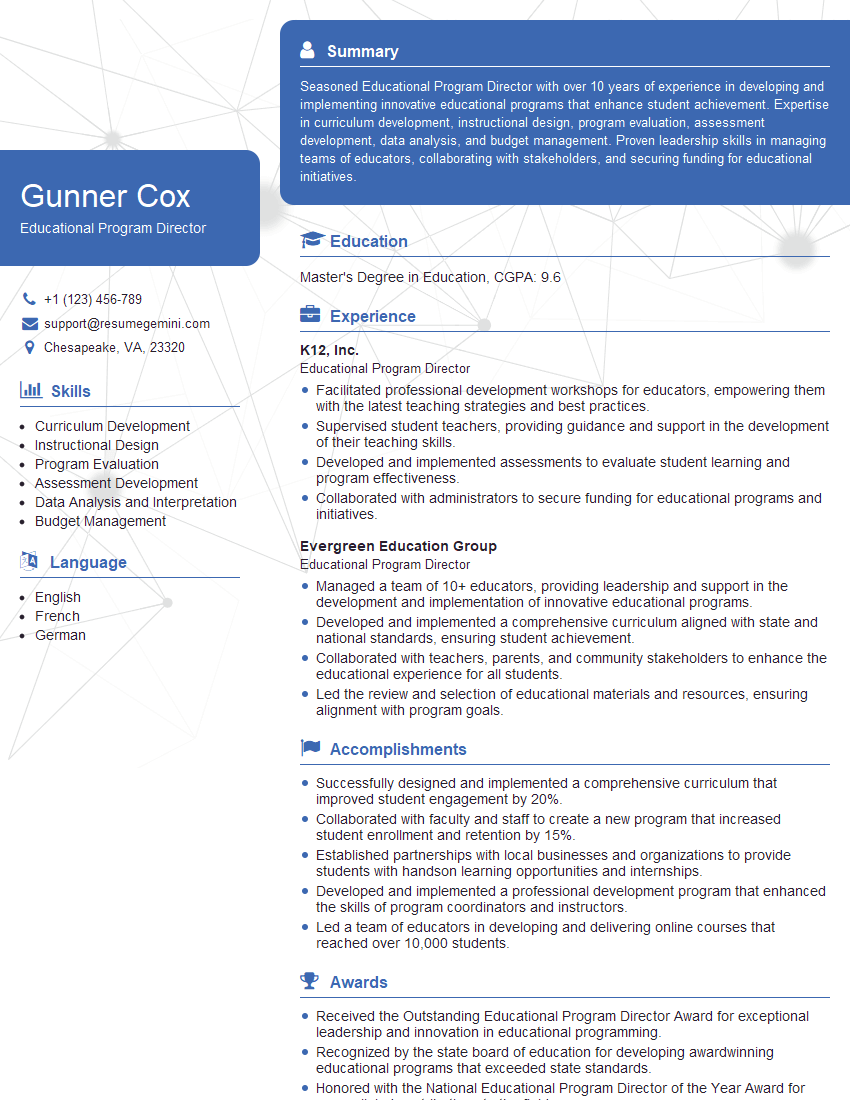
Mastering School Program Coordination opens doors to rewarding careers with significant impact on students’ lives. It showcases strong organizational, communication, and leadership skills highly valued in education and beyond. To maximize your job prospects, crafting an ATS-friendly resume is crucial. This ensures your application gets noticed by recruiters and hiring managers. We highly recommend using ResumeGemini to build a professional, impactful resume. ResumeGemini provides tools and resources to create a compelling document, and we offer examples of resumes tailored to School Program Coordination to help you get started.
Explore more articles
Users Rating of Our Blogs
Share Your Experience
We value your feedback! Please rate our content and share your thoughts (optional).
What Readers Say About Our Blog
To the interviewgemini.com Webmaster.
Very helpful and content specific questions to help prepare me for my interview!
Thank you
To the interviewgemini.com Webmaster.
This was kind of a unique content I found around the specialized skills. Very helpful questions and good detailed answers.
Very Helpful blog, thank you Interviewgemini team.