Interviews are opportunities to demonstrate your expertise, and this guide is here to help you shine. Explore the essential Seam Matching and Finishing interview questions that employers frequently ask, paired with strategies for crafting responses that set you apart from the competition.
Questions Asked in Seam Matching and Finishing Interview
Q 1. Describe the different types of seam finishes and their applications.
Seam finishes are crucial for garment durability, aesthetics, and comfort. They prevent fraying, add strength, and improve the overall look and feel. Different fabrics and garment styles call for different finishes.
- Serging/Overlocking: A fast, efficient method using a special machine that encloses raw edges with a looped stitch. Ideal for knits and woven fabrics requiring durability and a clean finish. Think of your favorite athletic wear – many use serging for its strength and stretch properties.
- Zigzag Stitch: A simple stitch creating a zig-zag pattern over raw edges, preventing fraying. Commonly used on woven fabrics where durability isn’t the top priority, perhaps a simple cotton dress. A basic, yet effective finish.
- Pinked Edges: Using pinking shears creates jagged edges that minimize fraying. Best suited for lightweight, stable fabrics that don’t unravel easily. Suitable for simple projects, or as a temporary fix for delicate materials.
- Bound Seams: Fabric strips are wrapped around raw edges, providing a clean, professional finish, often seen in high-end garments. It’s more time consuming but provides a high-quality, durable finish.
- French Seams: Encapsulate raw edges twice, creating a very neat, durable finish. Perfect for sheer fabrics where raw edges would be visible, or where you need a superior finish for a finer garment.
- Hong Kong Finish: Similar to bound seams, but uses bias binding, providing flexibility and a luxurious finish. Commonly found in high-end tailored garments.
The choice of seam finish depends heavily on the fabric type, garment style, and desired level of quality and durability.
Q 2. Explain the importance of proper seam matching in garment construction.
Proper seam matching is paramount for a professional-looking garment. It ensures consistent lines, enhances the garment’s drape and fit, and reflects the quality of construction. Mismatched seams appear sloppy and detract from the overall aesthetic.
Imagine a perfectly tailored jacket with mismatched seams – the whole effect would be ruined. Matching ensures that patterns align seamlessly, enhancing the overall aesthetic and creating a sense of professionalism. It’s not just about appearance; accurately matching seams contributes significantly to the structural integrity of the garment.
Q 3. What are the common issues encountered in seam matching, and how do you resolve them?
Common seam-matching issues include stretching, shifting of fabric layers during sewing, and inaccurate pattern placement.
- Fabric Stretching: Using pins effectively, avoiding excessive pulling, and using the appropriate stitch length can prevent stretching.
- Shifting Layers: Using careful handling and appropriate stitch length can minimize this issue. Using a walking foot can help with this problem and provide consistent feed of the layers.
- Inaccurate Pattern Placement: Careful attention to markings and precise cutting are essential. Using notches and pattern markings is crucial to maintaining accurate placement.
Troubleshooting involves identifying the cause. For example, if stretching occurs, adjust the tension or stitch length; if layers shift, use a walking foot or change your stitching technique. For inaccurate pattern placement, double-check the pattern markings and cutting before sewing. Often, careful attention to detail in the pre-sewing steps will resolve many common issues.
Q 4. How do you ensure consistent seam allowances throughout the production process?
Maintaining consistent seam allowances requires precision from the start. This involves using a seam gauge or guide to ensure consistent cutting and proper machine settings.
Before sewing, always check your machine’s stitch length and ensure that the needle position is correct in relation to the presser foot. Investing in tools like seam guides and rulers is key to this aspect of garment construction. Proper training of sewing machine operators and regular machine maintenance contribute significantly to maintaining consistent seam allowances across the entire production run.
Regular quality control checks throughout the production process also help catch and correct any inconsistencies early on, preventing large-scale problems.
Q 5. What are your preferred methods for finishing seams on different fabric types?
My preferred seam finishing methods vary depending on the fabric type.
- Lightweight fabrics (silk, chiffon): French seams or Hong Kong finishes offer a clean, professional look and prevent fraying.
- Medium-weight fabrics (cotton, linen): Serging or zigzag stitching provides adequate durability and a neat finish.
- Heavyweight fabrics (denim, canvas): Bound seams or pinked edges are suitable choices.
- Knit fabrics: Overlocking (serging) is the most common and effective method due to its elasticity.
The goal is always to select a method that complements the fabric’s properties while achieving a high-quality, durable finish.
Q 6. How do you identify and correct seam puckering or distortion?
Seam puckering or distortion is often caused by tension issues, improper fabric handling, or differences in fabric stretch. Identifying the cause is crucial for correcting the problem.
Troubleshooting steps:
- Check tension: Adjust the machine’s upper and lower tension to ensure balanced stitching.
- Examine fabric handling: Ensure that the fabric is not being stretched or pulled during stitching.
- Assess fabric properties: Different fabrics have different stretch properties; consider using a walking foot or appropriate stitch length for fabrics prone to distortion.
- Press seams: Careful pressing after stitching can help to reduce puckering. Use a pressing cloth to protect delicate fabrics.
- Re-stitch: If necessary, carefully unpick the seam and re-stitch, paying close attention to the tension and fabric handling.
In some cases, pre-shrinking fabric before cutting can also help minimize puckering. Preventing the problem is far easier than correcting it later; careful planning and attention to detail are key.
Q 7. Explain the process of blind stitching and its applications.
Blind stitching is a technique used to create nearly invisible seams, ideal for joining garment pieces where the seam should be inconspicuous. This is achieved by using a special stitch that only catches a few threads on the visible side of the fabric.
Process: It usually involves using a specialized blind stitch machine setting, or a specialized needle and foot. The stitch is designed to catch only a few threads of the fabric’s surface, leaving the seam largely concealed. The raw edges are usually finished separately, with techniques like serging or zigzag stitch to prevent fraying.
Applications: Common applications are hems, particularly on finished garments (e.g., trousers, skirts). It is also utilized in creating delicate seams where visual appeal is paramount. A blind stitch creates a professional and aesthetically pleasing finish.
Q 8. Describe your experience with different types of sewing machines used in seam finishing.
My experience encompasses a wide range of sewing machines, each suited for specific seam finishing tasks. I’m proficient with industrial sewing machines, crucial for high-volume production, particularly those with specialized stitch types like blind hems or coverstitching. I’m also comfortable using various domestic machines, which are versatile but require more operator finesse for achieving consistent seam quality. For example, a machine with a walking foot is invaluable for working with multiple layers or slippery fabrics, while a serger (which I’ll discuss further in a later answer) is essential for overlocking edges.
For delicate fabrics, I prefer machines with adjustable stitch length and pressure, allowing for precise control and preventing damage. Heavyweight fabrics, on the other hand, demand machines with robust construction and powerful motors capable of handling the increased stress.
- Industrial Sewing Machines: High-speed, durable, and often specialized for specific stitches.
- Domestic Sewing Machines: Versatile, but require more manual dexterity and adjustment.
- Walking Foot Machines: Essential for consistent feeding of multiple layers of fabric.
Q 9. How do you maintain and troubleshoot sewing machine problems?
Maintaining sewing machines is crucial for optimal performance and seam quality. My routine includes regular cleaning—removing lint, dust, and thread buildup from the bobbin area, feed dogs, and shuttle—using a soft brush and compressed air. I lubricate moving parts according to the manufacturer’s recommendations, using the appropriate sewing machine oil. This prevents friction and extends the machine’s lifespan.
Troubleshooting is a key skill. Common problems I encounter include skipped stitches, which often indicate improper tension or a bent needle. I systematically check tension settings and replace the needle if necessary. Jammed needles are usually caused by forcing the fabric through too quickly, which is resolved by slowing down the sewing speed and ensuring proper fabric alignment. Broken needles are typically due to hitting pins or other hard objects in the fabric, reinforcing the importance of careful fabric preparation.
For more complex issues, I consult the machine’s manual or seek assistance from experienced technicians. This proactive approach ensures minimal downtime and maintains a consistent workflow.
Q 10. What quality control measures do you employ to ensure consistent seam quality?
Quality control is paramount in seam finishing. My process starts with careful fabric inspection for flaws before sewing. I utilize consistent stitch length and tension settings, documented for each fabric type and project. I regularly check seam allowances for evenness and consistency, using a seam gauge for precision. This ensures consistent quality across all garments.
After each production run (or significant portion of it), I conduct thorough quality checks on a representative sample of garments, ensuring seam alignment, strength, and overall neatness. I maintain detailed records of any deviations, which informs necessary adjustments to prevent recurrence. A strong quality control system ensures that our final product meets the highest standards.
Q 11. How do you handle discrepancies in seam matching between patterns and finished garments?
Discrepancies in seam matching are addressed through careful pattern grading and cutting. I meticulously pre-check all pattern pieces for alignment before cutting and prioritize using exact measurements. When mismatches occur despite these precautions, I employ various techniques depending on the severity and garment type. For minor discrepancies, slight adjustments during assembly (like easing or stretching the fabric) might be enough. Significant mismatches, however, require more involved solutions such as re-cutting the affected pattern pieces or strategically using interfacing to improve the drape and stability of the garment, minimizing noticeable inconsistencies.
Documentation of the fix is vital to prevent repeating mistakes in future production runs. I maintain a log of encountered issues and implemented solutions to continually improve the accuracy of the patterns and cutting process.
Q 12. What is your experience with different types of seams (e.g., French seams, flat-felled seams)?
I have extensive experience with a variety of seam finishes, each with its advantages and applications. French seams, for instance, are ideal for fine fabrics as they encase all raw edges for a clean, professional finish. They are time-consuming but produce a highly durable and aesthetically pleasing seam.
Flat-felled seams, conversely, are incredibly strong and suitable for heavy-duty garments. Their construction involves one seam allowance being folded and stitched down over the other, resulting in a flat, durable seam particularly appropriate for workwear. Other seams include serged seams (for neatness and preventing fraying), bound seams (for added strength and clean finish), and mock French seams (a simpler alternative to French seams).
The choice of seam depends heavily on the garment’s intended use, fabric weight, and aesthetic requirements. My expertise lies in selecting and executing the most appropriate seam for optimal performance and appearance.
Q 13. How do you adapt your seam finishing techniques to different fabric weights and textures?
Adapting to different fabric weights and textures is a fundamental aspect of seam finishing. Lightweight fabrics require delicate handling to prevent damage; I use smaller stitches, reduced pressure, and appropriate needles. For silks or other delicate materials, I might use a walking foot to ensure even feeding and prevent slippage. Heavier fabrics, such as denim or canvas, require stronger stitches, potentially using heavier-duty needles and potentially higher machine speeds.
The choice of seam itself can also adapt to fabric weight. A heavier fabric might necessitate a flat-felled seam for added durability, while a delicate fabric may warrant a French seam for a clean, unobtrusive finish. I consistently adjust my techniques based on fabric characteristics to ensure both quality and functionality of the finished garment.
Q 14. Describe your experience working with sergers and their applications in seam finishing.
Sergers are indispensable for seam finishing, primarily for their overlocking capabilities. They simultaneously sew and cut fabric edges, preventing fraying and creating a professional-looking finish. I frequently use sergers for finishing seams in knit fabrics, where fraying is a major concern. The use of a serger enhances the durability and aesthetic appeal of the garment while significantly reducing finishing time.
Different serger stitches cater to varied fabric types and seam applications. Some sergers offer specialized stitches for rolled hems, flatlock seams, and decorative edges, providing further versatility. Beyond basic overlocking, the serger allows for a wider range of creative seam finishing techniques, enhancing the garment’s overall quality.
Q 15. How do you manage time effectively to meet production deadlines in seam finishing?
Effective time management in seam finishing is crucial for meeting deadlines. My approach involves a three-pronged strategy: planning, prioritization, and execution. First, I meticulously review the production schedule and break down large tasks into smaller, manageable steps. This allows for better tracking of progress and identification of potential bottlenecks early on. For example, if I’m working on a batch of 100 garments requiring intricate French seams, I’ll divide the work into daily quotas, perhaps 20-25 garments per day, factoring in potential machine downtime or material delays. Second, I prioritize tasks based on urgency and complexity, addressing time-sensitive jobs first. A Kanban board or a simple to-do list can be incredibly helpful here. Finally, I maintain a focused work environment, minimizing distractions and utilizing time-management techniques like the Pomodoro Technique to enhance concentration and efficiency. This structured approach ensures consistent progress and timely completion of projects.
Career Expert Tips:
- Ace those interviews! Prepare effectively by reviewing the Top 50 Most Common Interview Questions on ResumeGemini.
- Navigate your job search with confidence! Explore a wide range of Career Tips on ResumeGemini. Learn about common challenges and recommendations to overcome them.
- Craft the perfect resume! Master the Art of Resume Writing with ResumeGemini’s guide. Showcase your unique qualifications and achievements effectively.
- Don’t miss out on holiday savings! Build your dream resume with ResumeGemini’s ATS optimized templates.
Q 16. How do you prioritize tasks and manage multiple projects in a fast-paced environment?
Managing multiple projects in a fast-paced environment requires a robust system for prioritization and organization. I employ a combination of techniques including creating detailed project timelines, assigning clear deadlines for each task, and utilizing project management software to track progress and resource allocation. Prioritization follows a matrix approach, considering factors such as urgency, complexity, and impact on overall production. High-priority, urgent tasks receive immediate attention, while less critical tasks are scheduled accordingly. Regular communication with colleagues and supervisors is vital to ensure alignment and avoid conflicts. For instance, if I’m working on three different projects – a large order of tailored suits, a smaller batch of wedding dresses, and a rush order of simple blouses – I’d prioritize the rush order first, then allocate time for the wedding dresses based on their deadlines, and finally dedicate time to the suits, strategically managing resources and ensuring no project falls behind.
Q 17. Explain your approach to teamwork and collaboration in a sewing production environment.
Teamwork and collaboration are essential in a sewing production environment. I believe in open communication, mutual respect, and a shared commitment to quality. My approach centers around active listening, clear communication of tasks and responsibilities, and offering support to team members. I proactively identify potential challenges and collaborate with colleagues to find solutions. For example, if a team member is struggling with a particularly complex seam, I’ll offer assistance, sharing my expertise and knowledge to help them succeed. Furthermore, I actively participate in team meetings, contributing ideas and offering constructive feedback to enhance the overall team performance. A positive and supportive atmosphere fostered through collaboration leads to higher quality work and increased productivity.
Q 18. How do you handle constructive criticism and feedback on your seam finishing work?
I view constructive criticism as an opportunity for growth and improvement. I approach feedback with an open mind, actively listening to the points raised and seeking clarification if needed. I focus on understanding the specific areas needing improvement rather than becoming defensive. For example, if feedback indicates inconsistent seam allowances, I’ll analyze my work process to pinpoint the source of the inconsistency and implement corrective measures. I document the feedback, outlining actionable steps to address the concerns. Regular self-reflection coupled with constructive feedback allows for continuous improvement in my skillset and ultimately, contributes to higher quality output.
Q 19. What are your strengths and weaknesses as a seam finisher?
My strengths as a seam finisher include precision, attention to detail, and the ability to adapt to different fabrics and sewing techniques. I possess a strong work ethic and consistently deliver high-quality results. I am also a quick learner and readily adapt to new technologies and techniques. However, my weakness is sometimes getting overly focused on perfection, which can occasionally impact my speed of production. I am actively working on improving my time management skills to better balance quality and efficiency. This awareness of my weaknesses allows me to proactively seek solutions and ensure consistent performance.
Q 20. Describe a time you had to solve a challenging seam matching problem.
In one instance, I was tasked with matching a complex plaid pattern on a tailored jacket. The fabric had a very distinct and intricate weave, and even a slight misalignment would be highly noticeable. The challenge was exacerbated by the garment’s curved seams. To solve this, I started by meticulously preparing the fabric, carefully marking the pattern placement on both pieces. I then used a combination of techniques including precise pinning, slow and deliberate stitching, and frequent checks for alignment throughout the sewing process. I utilized a clear grid system projected onto the fabric to aid in alignment, allowing me to ensure perfect pattern matching on all curves. The final result was a flawless seam, demonstrating the precise pattern matching even in challenging areas like the shoulders and sleeves. This experience reinforced the importance of meticulous preparation and precise execution in achieving perfect seam matching.
Q 21. How do you stay up-to-date with the latest advancements in seam finishing techniques?
Staying updated with advancements in seam finishing requires continuous learning. I regularly attend industry workshops and seminars, and actively participate in online communities dedicated to sewing and garment construction. I subscribe to relevant trade publications and follow industry leaders on social media. I also make an effort to explore new technologies and equipment, for instance, researching advancements in serger technology and their impact on seam finishes. This proactive approach ensures I’m aware of emerging trends and best practices, continuously enhancing my skills and knowledge base.
Q 22. What are your salary expectations for this role?
My salary expectations for this role are in the range of $60,000 to $75,000 annually, depending on the specific benefits package and overall compensation structure. This range reflects my experience and expertise in seam matching and finishing, as well as my understanding of the current market rates for similar positions.
Q 23. Why are you interested in this particular Seam Matching and Finishing position?
I’m highly interested in this Seam Matching and Finishing position because it aligns perfectly with my passion for creating high-quality garments and my extensive experience in this specialized area. I’ve always been fascinated by the intricate details involved in achieving flawless seams and finishes, and I thrive in environments that demand precision and attention to detail. The opportunity to contribute to a company that values craftsmanship and quality resonates strongly with my professional goals.
Q 24. What are your long-term career goals within the apparel industry?
My long-term career goals involve becoming a leading expert in garment construction, specializing in advanced seam finishing techniques. I envision myself mentoring junior technicians and contributing to the development of innovative finishing processes that enhance both garment quality and production efficiency. Ideally, I’d like to progress to a supervisory or management role, where I can leverage my expertise to optimize team performance and contribute to the overall success of the company.
Q 25. Describe your experience with different types of pressing and finishing equipment.
Throughout my career, I’ve gained extensive experience operating a variety of pressing and finishing equipment. This includes industrial steam presses (both stationary and buck-type), vacuum pressing machines, specialized sleeve and collar presses, and various types of hand irons. I’m also proficient in using finishing equipment like automated seam sealing machines and ultrasonic welders, particularly for delicate fabrics. I understand the nuances of each machine and can adapt my techniques based on the fabric type and garment style. For example, I know that delicate silks require lower temperature and pressure settings on the steam press compared to heavier denim fabrics.
Q 26. Explain the importance of proper pressing techniques in achieving high-quality seam finishes.
Proper pressing techniques are paramount in achieving high-quality seam finishes. They’re not just about making the garment look neat; they affect durability and the overall garment’s lifespan. Pressing shapes and sets the seams, preventing puckering and distortion. It also ensures that interfacing is properly adhered, providing structure and support. For instance, incorrect pressing of a set-in sleeve can cause it to hang awkwardly, making the garment look poorly constructed. Moreover, proper pressing helps eliminate wrinkles, which can damage the fabric’s texture. A properly pressed seam is flat, smooth, and shows attention to detail – it’s a hallmark of quality.
Q 27. How do you ensure consistent pressing techniques across different garment styles?
Maintaining consistent pressing techniques across different garment styles relies on a combination of understanding fabric properties and mastering the equipment. First, I meticulously read the garment construction specifications, which often include details on the appropriate pressing techniques for each fabric. Secondly, I use consistent pressing patterns – for instance, always starting at the center back and moving outwards. This structured approach ensures all areas receive proper pressure and attention. Lastly, I periodically check my work against quality control standards to catch and correct any inconsistencies. It’s like baking a cake – following the recipe precisely produces the best results. In this case, the recipe is the garment construction specifications, and my skills are the tools to produce a consistent high-quality finish.
Q 28. What safety measures do you follow when operating sewing machines and other equipment?
Safety is my top priority when operating sewing machines and other equipment. Before starting any task, I always inspect the machinery for any damage or malfunctions. I ensure all guards and safety features are properly in place and functioning correctly. I consistently use the appropriate safety equipment, including safety glasses, and avoid loose clothing that could get caught in moving parts. I also maintain a clean and organized workspace to prevent accidents. Furthermore, I’m well-versed in the emergency shut-off procedures for all equipment and have completed all required safety training. For example, regularly cleaning the lint trap on a steam press is crucial for fire prevention.
Key Topics to Learn for Seam Matching and Finishing Interview
- Seam Types and Construction: Understanding various seam types (e.g., French seams, flat felled seams, overlocked seams) and their appropriate applications in different garment types. Knowing the strengths and weaknesses of each construction method.
- Fabric Properties and Seam Selection: Matching seam construction to the fabric’s weight, drape, and fiber content. Understanding how fabric properties influence seam durability and appearance.
- Seam Finishing Techniques: Mastering different finishing methods like serging, zigzag stitching, binding, and using different types of seam tapes. Knowing when to apply each technique for optimal results.
- Quality Control and Inspection: Identifying common seam defects (e.g., puckering, uneven stitching, skipped stitches). Implementing quality control measures throughout the production process.
- Equipment and Machinery: Familiarity with industrial sewing machines, sergers, and other relevant equipment used in seam finishing. Understanding basic machine maintenance and troubleshooting.
- Production Efficiency and Optimization: Strategies for improving seam finishing speed and efficiency without compromising quality. Understanding workflow optimization techniques.
- Problem-Solving and Troubleshooting: Analyzing seam issues, identifying root causes, and implementing corrective actions. Demonstrating practical problem-solving skills relevant to production challenges.
- Safety Procedures and Regulations: Adherence to safety guidelines and regulations related to sewing machinery and handling of materials.
Next Steps
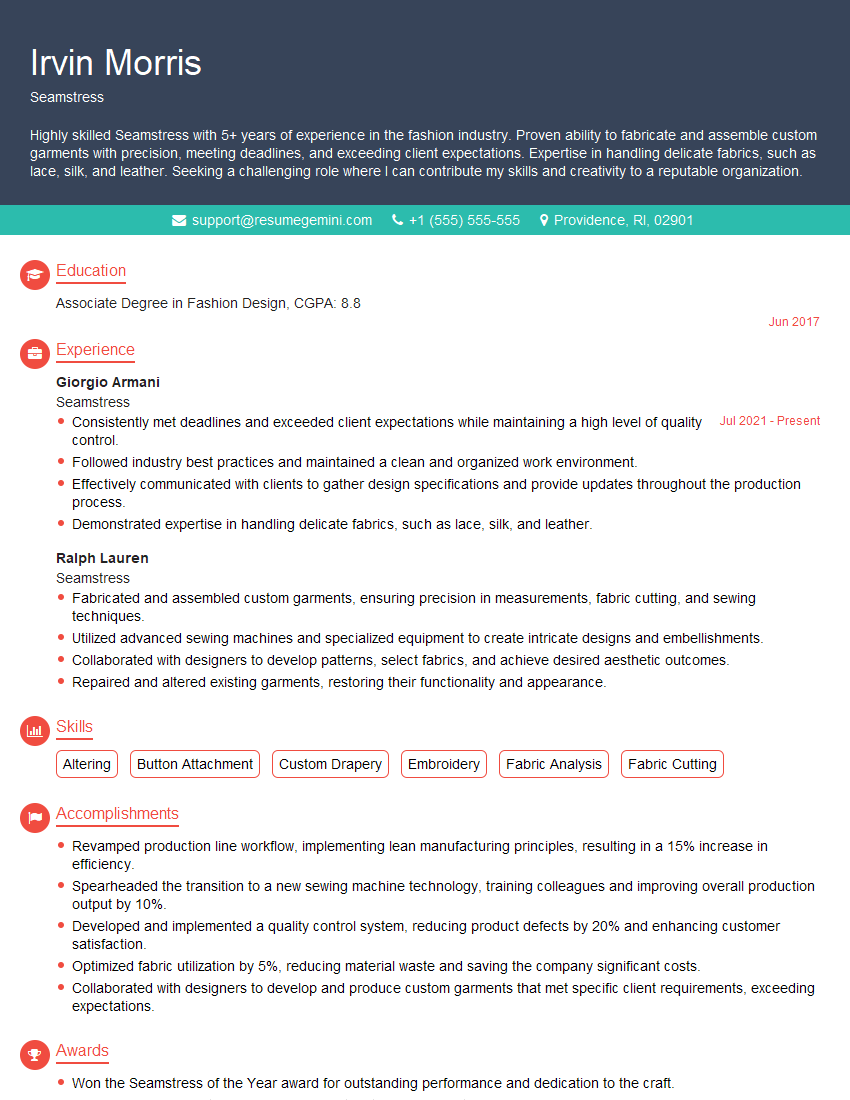
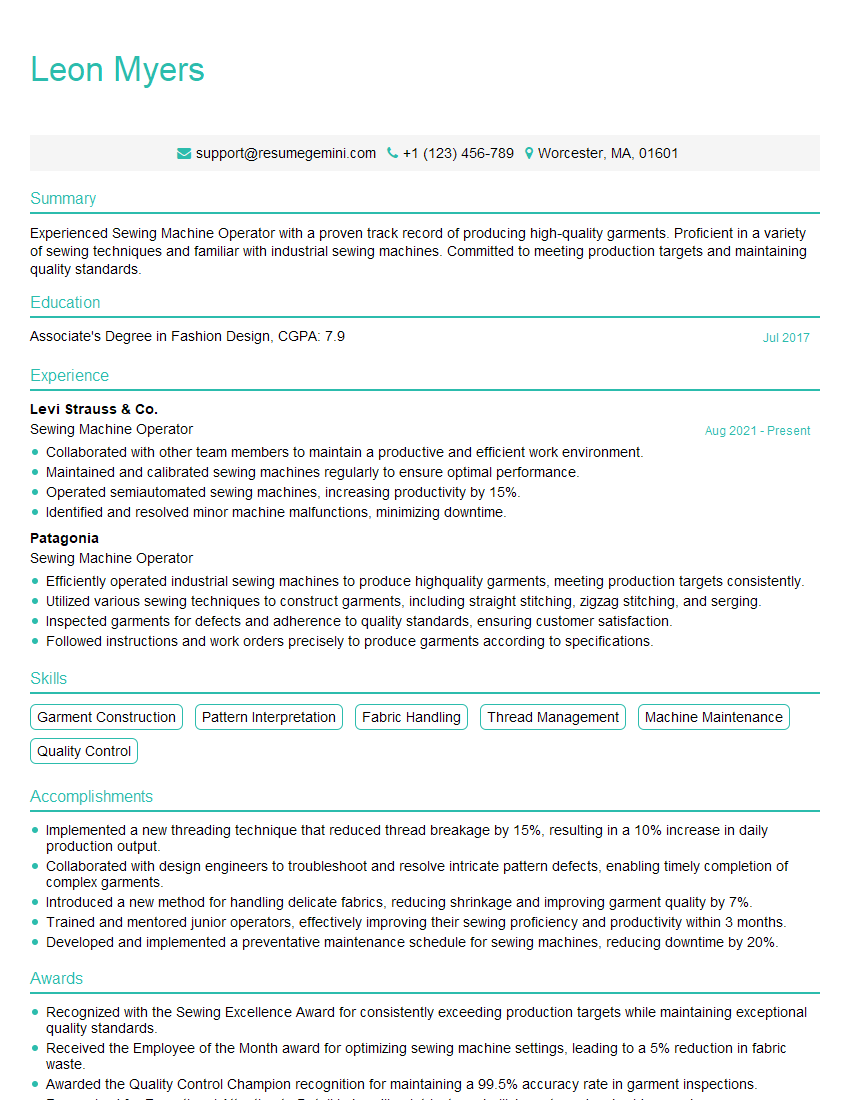
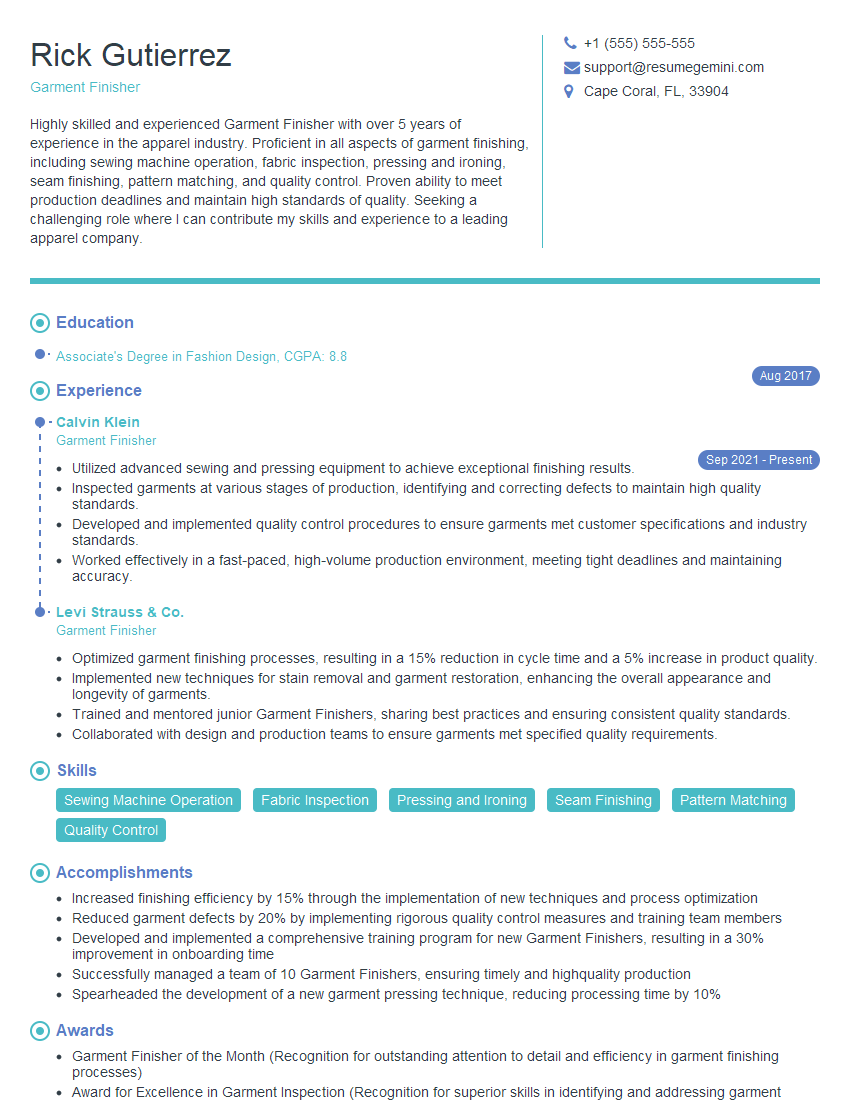
Mastering Seam Matching and Finishing opens doors to rewarding careers in the apparel industry, offering opportunities for advancement and specialization. A strong resume is crucial for showcasing your skills and experience to potential employers. To significantly improve your job prospects, create an ATS-friendly resume that highlights your technical expertise and achievements. ResumeGemini is a trusted resource to help you build a professional and impactful resume. Examples of resumes tailored to Seam Matching and Finishing are available to guide you through the process, helping you present your qualifications effectively.
Explore more articles
Users Rating of Our Blogs
Share Your Experience
We value your feedback! Please rate our content and share your thoughts (optional).
What Readers Say About Our Blog
To the interviewgemini.com Webmaster.
Very helpful and content specific questions to help prepare me for my interview!
Thank you
To the interviewgemini.com Webmaster.
This was kind of a unique content I found around the specialized skills. Very helpful questions and good detailed answers.
Very Helpful blog, thank you Interviewgemini team.