Interviews are opportunities to demonstrate your expertise, and this guide is here to help you shine. Explore the essential Voter Segmentation interview questions that employers frequently ask, paired with strategies for crafting responses that set you apart from the competition.
Questions Asked in Voter Segmentation Interview
Q 1. Explain the importance of voter segmentation in political campaigns.
Voter segmentation is crucial for political campaigns because it allows for the efficient allocation of resources and the tailoring of messages to resonate with specific groups of voters. Imagine trying to sell a product without knowing your target audience – you’d waste a lot of effort and money. Similarly, a blanket campaign approach rarely maximizes impact. By segmenting voters, campaigns can identify key demographics, interests, and concerns, allowing them to create targeted messaging that increases engagement and ultimately, votes.
Effective segmentation allows campaigns to:
- Maximize Resource Allocation: Focus time, money, and manpower on the most receptive voter segments.
- Craft Persuasive Messaging: Tailor messaging to address specific concerns and values of different groups.
- Improve Campaign ROI: Achieve higher engagement and conversion rates through targeted outreach.
- Identify Undecided Voters: Pinpoint segments with the highest potential to swing the vote.
Q 2. Describe different methods for segmenting voters (e.g., demographic, geographic, psychographic).
Voter segmentation employs several methods, often used in combination for a more comprehensive understanding. These methods include:
- Demographic Segmentation: This focuses on readily available population characteristics like age, gender, race, ethnicity, income, education, marital status, and religious affiliation. For example, a campaign might target young voters (18-25) with social media ads focusing on education and climate change.
- Geographic Segmentation: This uses location data to target voters based on region, urban/rural location, and even neighborhood-level details. For example, a candidate might focus on rural areas known for strong support for agriculture policies.
- Psychographic Segmentation: This delves into voters’ values, attitudes, lifestyles, and interests. This data is more challenging to obtain and often relies on surveys, social media analysis, and consumer behavior data. For instance, a campaign might identify a segment of environmentally conscious voters and target them with messaging on sustainable practices.
- Behavioral Segmentation: This examines past voting records, campaign engagement (website visits, email opens), and participation in political events. For example, a campaign could identify frequent campaign volunteers and tailor thank-you notes or special invitations to rallies to them.
Q 3. What are the key data sources used in voter segmentation?
Data sources for voter segmentation are diverse and often require careful integration. Key sources include:
- Voter Registration Databases: These provide demographic information and voting history.
- Commercial Data Providers: Companies like Experian and Nielsen provide detailed consumer data, including psychographic profiles.
- Social Media Data: Publicly available social media profiles offer insights into individuals’ values, political leanings, and affiliations.
- Campaign CRM Data: This includes data collected directly by the campaign, like email subscriptions, donations, and event attendance.
- Census Data: Provides valuable demographic data at different geographical levels.
- Surveys and Polling Data: Directly obtained data offers valuable insights into voters’ opinions and concerns.
Q 4. How do you handle missing data in voter segmentation analysis?
Missing data is an inevitable reality in voter segmentation. Effective strategies include:
- Imputation: Replacing missing values with estimated values. Simple methods include using the mean or median of the available data. More sophisticated techniques use machine learning algorithms to predict missing values based on the patterns observed in other variables.
- Deletion: Removing data points with missing values. This is appropriate if the amount of missing data is small and removing those points doesn’t significantly bias the analysis.
- Data Integration: Combining multiple data sources to minimize missing information. For example, if age is missing from one dataset but present in another, combining them might fill in the gaps.
- Model Selection: Utilizing statistical methods that are robust to missing data, such as multiple imputation or k-nearest neighbors.
The best approach depends on the nature of the missing data, the amount of missing data, and the chosen analytical method.
Q 5. Explain the concept of a voter persona and its role in segmentation.
A voter persona is a semi-fictional representation of an ideal customer (in this case, voter) within a specific segment. It’s more than just demographics; it captures a detailed picture of their values, motivations, concerns, and media consumption habits. For example, a ‘Concerned Suburban Parent’ persona might be 35-50 years old, own a home, have school-aged children, be politically moderate, and get most of their news from local TV and Facebook.
The role of voter personas in segmentation is significant because they humanize the data. They help campaign strategists connect with voters on an emotional level, allowing them to craft more resonant messaging and campaign materials. Personas make abstract data more tangible and actionable, guiding messaging decisions and informing resource allocation.
Q 6. Describe your experience with different statistical methods used in voter segmentation.
My experience encompasses a range of statistical methods frequently used in voter segmentation. These include:
- Clustering Algorithms: Methods like k-means and hierarchical clustering group voters with similar characteristics. This allows for identifying distinct voter segments based on their shared attributes.
- Classification Methods: Techniques like logistic regression and support vector machines help predict the likelihood of a voter belonging to a specific segment or voting a certain way based on their characteristics.
- Regression Analysis: Used to understand the relationships between different variables and how they influence voter behavior. For instance, we could analyze the correlation between income and voting preference.
- Dimensionality Reduction: Techniques like Principal Component Analysis (PCA) reduce the number of variables while retaining most of the information. This simplifies analysis and visualization of voter segments.
The choice of statistical method depends on the research question and the nature of the data. I select the most appropriate method based on data characteristics and the campaign’s objectives.
Q 7. How do you measure the effectiveness of a voter segmentation strategy?
Measuring the effectiveness of a voter segmentation strategy requires a multi-faceted approach. Key metrics include:
- Response Rates: Tracking the engagement levels with targeted messaging (e.g., email open rates, click-through rates on online ads, attendance at targeted events).
- Conversion Rates: Measuring the success of converting engaged voters into supporters (e.g., donations, volunteer sign-ups, votes).
- Cost per Acquisition (CPA): Calculating the cost of acquiring a supporter or vote through different segmentation strategies. This helps in optimizing resource allocation.
- Turnout Rates: Comparing the voter turnout in different segments targeted with tailored campaigns.
- A/B Testing: Comparing the performance of different messages or outreach strategies within the same segment to identify the most effective approach.
Beyond these quantitative metrics, qualitative feedback from focus groups and post-campaign surveys is crucial for understanding voter perceptions and refining future segmentation strategies. By combining quantitative and qualitative data, we obtain a holistic view of the effectiveness of our efforts.
Q 8. How would you identify and prioritize key voter segments for a specific campaign?
Identifying and prioritizing key voter segments is crucial for effective campaign targeting. It involves a multi-step process combining data analysis, strategic thinking, and a deep understanding of the electorate. First, we gather data from various sources – voter registration records, consumer data, survey results, social media activity, and even geographic information systems (GIS) data. This data allows us to create detailed voter profiles.
Next, we segment voters based on shared characteristics. These characteristics can include demographics (age, income, ethnicity), political affiliation, past voting behavior, media consumption habits, and even lifestyle choices. We might identify segments like ‘Young, progressive urban voters,’ ‘Senior citizens concerned about healthcare,’ or ‘Rural conservatives focused on the economy.’ The key is to create segments that are both internally homogeneous (voters within the segment share similar characteristics) and externally heterogeneous (segments differ significantly from one another).
Finally, we prioritize segments based on their size, persuadability, and strategic importance. A large segment of persuadable voters is highly valuable, while a small, highly engaged segment might also be crucial depending on the campaign’s goals. This prioritization informs resource allocation: we’ll dedicate more time, resources, and tailored messaging to the most valuable segments. For example, if a campaign focuses on youth engagement, the segment ‘Young, progressive urban voters’ would likely receive prioritized attention.
Q 9. What is the role of predictive modeling in voter segmentation?
Predictive modeling plays a vital role in voter segmentation by allowing us to forecast voter behavior and identify potential supporters or opponents. We use algorithms that analyze historical voting data, demographic information, and other relevant variables to predict the likelihood of a voter supporting a particular candidate or policy. This allows for a more targeted approach.
For instance, a model might use past voting records, party affiliation, and responses to surveys to predict the probability of a voter supporting a particular candidate. These predictions are then used to refine our segments and allocate resources efficiently. The models themselves can range from simple logistic regressions to more advanced machine learning algorithms, depending on the data available and the complexity of the prediction task. A common example uses a logistic regression model to predict the probability of voting for a candidate given features like age and income, outputting a probability score for each individual voter.
Q 10. How would you handle conflicting segmentation results from different data sources?
Conflicting segmentation results from different data sources are common. The solution involves a systematic approach to data reconciliation and validation. First, we assess the quality and reliability of each data source. This includes evaluating data accuracy, completeness, and potential biases. Next, we examine the discrepancies between the different segmentation results. Are the differences minor variations or major inconsistencies?
If the differences are minor, we might use a weighted average method to combine the results, giving more weight to the more reliable sources. For example, if one source has a higher historical accuracy, we might weight its results more heavily. For more significant discrepancies, we must investigate the root cause. Perhaps one data source is outdated or contains errors. Sometimes, the discrepancy suggests the need to re-evaluate the segmentation criteria themselves. Ultimately, the goal is to create a unified segmentation that reflects the most accurate representation of the electorate.
Q 11. What ethical considerations are involved in voter segmentation?
Ethical considerations are paramount in voter segmentation. Transparency is key; voters should be aware of how their data is being used. We must avoid discriminatory practices based on race, religion, or any other protected characteristic. Furthermore, ensuring data privacy and security is crucial. Data must be handled responsibly and in compliance with relevant regulations like GDPR or CCPA.
A major concern is the potential for manipulation or microtargeting. While sophisticated segmentation allows for tailored messaging, it’s crucial to avoid misleading or deceptive tactics. We must use data to inform, not manipulate, voter choices. It is important to focus on providing accurate information and facilitating informed decision-making instead of exploiting vulnerabilities.
Q 12. Explain your experience using different data visualization techniques for voter segmentation.
Data visualization is essential for understanding complex voter segmentation data. I’ve used various techniques to effectively communicate insights to stakeholders. For example, I’ve used choropleth maps (GIS integration) to visually represent geographic distribution of voter segments, highlighting areas with high concentrations of specific demographics or political leanings.
Bar charts are useful for comparing the size and characteristics of different segments. Scatter plots help illustrate the relationships between different variables. For instance, a scatter plot could show the relationship between age and likelihood to vote. Interactive dashboards, incorporating these different visualizations, allow for dynamic exploration of the data, providing interactive filters that drill down into specific segments. The goal is to use visual tools that are clear, concise, and readily interpretable by both technical and non-technical audiences.
Q 13. How familiar are you with geographic information systems (GIS) and their use in voter segmentation?
I’m very familiar with Geographic Information Systems (GIS) and their application in voter segmentation. GIS allows us to overlay voter data with geographic information, providing a powerful tool for spatial analysis. This allows us to visualize the geographic distribution of voter segments, identify areas with high concentrations of specific voter profiles, and optimize resource allocation for canvassing and other field activities.
For example, we can use GIS to identify geographic clusters of persuadable voters, allowing us to prioritize canvassing efforts in those areas. We can also map voter turnout rates geographically, identifying areas with low turnout that might require specific outreach strategies. GIS tools enable us to make more effective, data-driven decisions regarding resource allocation, improving the efficiency and effectiveness of campaigns.
Q 14. Describe your experience working with large datasets for voter segmentation analysis.
I have extensive experience working with large voter datasets. This involves employing techniques to manage and process these massive data sets efficiently. I regularly utilize tools like SQL and Python with libraries such as Pandas and NumPy to handle data cleaning, transformation, and analysis. My experience includes working with datasets containing millions of voter records, requiring robust data management strategies. This experience involves leveraging distributed computing technologies such as Hadoop or Spark for processing very large datasets.
Data quality is a significant consideration when dealing with large datasets, necessitating rigorous data cleaning and validation processes. I utilize various techniques to address missing data, outliers, and inconsistencies, ensuring the accuracy and reliability of my analyses. The key is a scalable and robust workflow enabling efficient processing and insightful analysis of these large datasets, ensuring meaningful results.
Q 15. What programming languages or statistical software are you proficient in (e.g., R, Python, SQL)?
My core programming skills lie in Python and R, complemented by robust SQL proficiency for data management. Python’s extensive libraries like Pandas, NumPy, and Scikit-learn are crucial for data manipulation, analysis, and machine learning model building, which are essential for advanced voter segmentation. R, with its packages like dplyr and ggplot2, provides excellent data visualization and statistical modeling capabilities, particularly helpful for interpreting results and communicating findings to stakeholders. SQL is my go-to for efficient data extraction and manipulation from large databases, a common requirement in voter data analysis. I am also familiar with other tools like Tableau for data visualization and communication. For example, I recently used Python to build a predictive model that identified likely swing voters based on a combination of demographic and behavioral data.
Career Expert Tips:
- Ace those interviews! Prepare effectively by reviewing the Top 50 Most Common Interview Questions on ResumeGemini.
- Navigate your job search with confidence! Explore a wide range of Career Tips on ResumeGemini. Learn about common challenges and recommendations to overcome them.
- Craft the perfect resume! Master the Art of Resume Writing with ResumeGemini’s guide. Showcase your unique qualifications and achievements effectively.
- Don’t miss out on holiday savings! Build your dream resume with ResumeGemini’s ATS optimized templates.
Q 16. How do you ensure data accuracy and integrity in voter segmentation projects?
Data accuracy and integrity are paramount. My approach is multi-faceted. First, I meticulously examine the data sources, evaluating their reliability and potential biases. This involves understanding data collection methodologies and potential errors. For instance, I might need to account for response rates or known inaccuracies in self-reported data. Next, I perform rigorous data cleaning and validation. This includes handling missing values, identifying and correcting inconsistencies, and ensuring data types are accurate. I employ techniques such as outlier detection and data imputation where appropriate. Finally, I implement robust data governance procedures, including version control and documentation, to maintain data traceability and transparency, ensuring that any changes made are auditable and justifiable. This includes creating detailed metadata and maintaining a complete audit trail of all data transformations.
Q 17. What is your experience with A/B testing different messaging strategies for segmented voters?
A/B testing is a crucial component of my workflow. I have extensive experience designing and executing A/B tests on different messaging strategies for segmented voter groups. This involves creating variations of campaign materials (e.g., email subject lines, website copy, social media ads) tailored to specific segments identified through voter segmentation. The key here is to define clear metrics for success – for example, click-through rates, conversion rates (e.g., voter registration, donation), or engagement levels. After the test, I rigorously analyze the results, using statistical methods to determine the significance of differences between the test groups. The insights gained inform the optimization of messaging strategies, enhancing campaign effectiveness. For instance, in a recent campaign, A/B testing revealed that a message emphasizing local issues resonated significantly better with suburban voters compared to a broader national message.
Q 18. How do you incorporate social media data into voter segmentation?
Social media data significantly enhances voter segmentation by providing real-time insights into voters’ attitudes, preferences, and engagement. I leverage publicly available social media data using APIs and web scraping techniques. This data is analyzed to identify sentiment, topics of interest, and social networks. This allows us to further refine voter segments based on their online behavior and engagement with political issues. For example, analyzing Twitter activity can reveal voters’ opinions on specific candidates or policies, allowing for targeted messaging. This information can help identify influencers and potential opinion leaders within specific segments, which can further improve campaign effectiveness.
Q 19. Describe your experience with developing and implementing targeting strategies based on voter segmentation.
My experience in developing and implementing targeting strategies is extensive. It begins with a thorough understanding of the campaign goals. Based on the voter segments identified, I create tailored messaging and channel strategies. This involves choosing the right platforms and channels to reach each segment effectively. For instance, younger voters might be targeted on platforms like Instagram and TikTok, while older voters might be more receptive to traditional mail or television ads. I constantly monitor campaign performance, making adjustments based on real-time data and feedback. This iterative process ensures that the targeting strategy remains effective and efficient, maximizing the impact of the campaign. For a recent local election campaign, I developed a multi-channel strategy that effectively targeted different voter segments based on their preferred communication channels and political interests resulting in a significant increase in voter turnout.
Q 20. How would you communicate voter segmentation insights to stakeholders?
Communicating voter segmentation insights effectively to stakeholders requires a clear and concise approach. I use a combination of methods tailored to the audience. This includes delivering presentations incorporating compelling visuals, such as charts and graphs that clearly illustrate key findings. I also prepare detailed reports with supporting data, methodology, and interpretations for those who require a more in-depth understanding. Interactive dashboards are another useful tool, allowing stakeholders to explore the data independently. Crucially, I make sure to explain the implications of the findings in plain language, avoiding technical jargon, and focusing on the actionable insights that will drive strategic decision-making. I always emphasize the practical applications of the segmentation analysis, relating them directly to the campaign goals and objectives.
Q 21. What is the role of voter segmentation in microtargeting strategies?
Voter segmentation is fundamental to microtargeting. Microtargeting involves tailoring political messaging and campaign strategies to highly specific subgroups of voters. By identifying these smaller, more homogeneous segments, campaigns can create highly personalized messages that resonate more effectively. This differs from broader targeting approaches, increasing the chances of persuasion and engagement. Voter segmentation provides the foundational data analysis to identify these micro-segments based on demographics, behavioral data, and psychographics, allowing campaigns to effectively allocate resources and focus efforts where they will have the greatest impact. It allows for more efficient resource allocation, increased engagement, and ultimately, higher conversion rates in terms of votes or other desired outcomes.
Q 22. How do you balance the accuracy and efficiency of voter segmentation?
Balancing accuracy and efficiency in voter segmentation is a crucial aspect of the process. High accuracy means precisely identifying voter subgroups, leading to more effective targeting. However, striving for perfect accuracy can be computationally expensive and time-consuming. Efficiency, on the other hand, prioritizes speed and resource optimization. The key is finding an optimal balance. This involves carefully selecting features and models. For instance, using simpler models like logistic regression might be more efficient than complex deep learning models, especially with limited data or computational resources, while sacrificing some accuracy. We can also employ techniques like feature selection to reduce the dimensionality of our data, speeding up processing without significant accuracy loss. Ultimately, the optimal balance depends on the specific project constraints and the importance placed on accuracy versus speed. A common approach is to iteratively test different models and parameters, evaluating their performance using metrics like precision, recall, and F1-score, and choosing the model that best meets the project’s needs within the available time and resources.
Q 23. Describe your experience with various data cleaning and preprocessing techniques.
Data cleaning and preprocessing are fundamental to successful voter segmentation. My experience encompasses a wide range of techniques. This begins with handling missing values – I often use imputation methods like mean/median imputation or k-Nearest Neighbors for numerical data and mode imputation or creating a separate category for categorical data. Outlier detection and treatment is also crucial; I frequently employ techniques like box plots or Z-score to identify and handle outliers, which may be removed or capped based on the context. Data transformation, such as standardization or normalization, is necessary to ensure features are on a comparable scale, preventing features with larger values from disproportionately influencing the model. Furthermore, I regularly deal with categorical data encoding, using techniques like one-hot encoding, label encoding, or target encoding depending on the nature of the data and the modeling technique used. For example, in one project, I addressed inconsistent address formatting by using fuzzy matching techniques to standardize addresses before geographical analysis. Lastly, I always perform data validation to ensure data integrity and identify any potential errors or inconsistencies before model building.
Q 24. How would you adapt your voter segmentation approach for different election cycles or regions?
Adapting voter segmentation to different election cycles or regions requires a flexible and data-driven approach. Firstly, the available data will vary significantly. For instance, data from previous elections might not be relevant to the current cycle, given shifts in political landscape or voter preferences. Thus, I emphasize data collection strategies tailored to each specific election and region. Secondly, the key features used for segmentation might need adjustments. Issues relevant in one region might be completely irrelevant in another. For example, economic concerns might be paramount in a particular state, while social issues might be more prominent in another. Therefore, I conduct thorough exploratory data analysis (EDA) to understand the unique characteristics of each region and identify the most important predictive features. Finally, model selection and parameter tuning will also need to be adjusted to accommodate different data distributions and regional variations. Cross-validation techniques are indispensable in ensuring the model generalizes well to each unique context. In essence, the process demands a robust framework adaptable to evolving circumstances and regional particularities.
Q 25. Explain the challenges of using publicly available data for voter segmentation.
Publicly available data, while valuable, presents several challenges for voter segmentation. The most significant is data sparsity and incompleteness. Public datasets often lack granular details crucial for precise segmentation. For example, publicly available demographic information might be aggregated at the county level, limiting the resolution for precise targeting. Data quality issues are another major problem. Inconsistent data formats, missing values, and inaccuracies can significantly impact model performance. Additionally, data biases are common. Public data may reflect existing societal biases, leading to skewed segmentations. For example, underrepresentation of certain demographic groups in the data can result in inaccurate or incomplete modeling of their political preferences. Finally, data access limitations can restrict the scope of analysis. Some data might be subject to privacy regulations, access restrictions, or availability only at specific intervals. Addressing these limitations often involves employing advanced data cleaning and imputation techniques, incorporating external data sources judiciously to supplement missing information, and applying bias correction methods where appropriate.
Q 26. What are some limitations of voter segmentation?
Voter segmentation, while a powerful tool, has inherent limitations. One major limitation is the reliance on observed data. Models can only learn from the data provided; unobserved factors influencing voter behavior, such as personal experiences or social networks, are not directly captured. This can lead to inaccurate predictions, particularly in predicting shifts in voter preference or the emergence of new political trends. Another limitation is the potential for overfitting. Complex models might capture noise in the training data rather than underlying patterns, leading to poor generalization to unseen data. This is especially true when dealing with smaller datasets. The static nature of segmentation is another concern. Voter preferences are dynamic and can change over time. A segmentation done at one point in time might become obsolete rapidly. Finally, ethical concerns arise, particularly regarding the potential misuse of segmentation for manipulation or microtargeting. Addressing these limitations requires careful model selection, robust validation techniques, and a strong ethical framework guiding the application of the results.
Q 27. How do you ensure compliance with data privacy regulations in your voter segmentation work?
Data privacy is paramount in voter segmentation. My work adheres strictly to relevant regulations, such as GDPR and CCPA. This begins with data anonymization and de-identification. Techniques like data masking, generalization, and aggregation are employed to protect individual identities. Furthermore, data minimization is a core principle. I only collect and process the minimum necessary data required for the analysis, avoiding unnecessary collection of personal information. Access control and security measures are meticulously implemented to restrict access to sensitive data only to authorized personnel. I also employ differential privacy techniques, which add carefully calibrated noise to the data to protect individual privacy while preserving the overall statistical properties. Finally, I maintain meticulous data governance and documentation, clearly outlining data usage, storage, and disposal procedures, ensuring full transparency and accountability in all data handling processes.
Q 28. Describe a time you had to overcome a data challenge in a voter segmentation project.
In one project, we encountered significant challenges with inconsistent data regarding voter registration status. Several data sources contained conflicting information regarding whether individuals were registered or not. Simply removing conflicting records would have led to significant data loss, potentially biasing our results. Our solution involved developing a probabilistic approach. We used a Bayesian network to model the relationships between different data sources, incorporating the reliability of each source based on historical accuracy. This allowed us to estimate the probability of a voter being registered, integrating the sometimes contradictory information from various sources. The Bayesian network, trained on a subset of records where we had ground truth, successfully resolved the inconsistencies and provided a more complete and reliable dataset for segmentation. This experience highlighted the importance of flexible approaches and leveraging probabilistic reasoning when dealing with noisy or incomplete data in voter segmentation projects.
Key Topics to Learn for Voter Segmentation Interview
- Data Sources and Collection: Understanding the various sources of voter data (e.g., voter registration databases, public records, commercial data providers) and the methods used for data collection, ensuring ethical considerations are addressed.
- Data Cleaning and Preprocessing: Mastering techniques for handling missing data, identifying and correcting errors, and transforming data into a suitable format for analysis. This includes understanding the implications of data quality on segmentation accuracy.
- Segmentation Techniques: Familiarizing yourself with various segmentation methods, including demographic segmentation, geographic segmentation, psychographic segmentation, and behavioral segmentation. Be prepared to discuss the strengths and weaknesses of each approach and when to apply them.
- Clustering Algorithms: Gaining a practical understanding of clustering algorithms (e.g., k-means, hierarchical clustering) and their application in identifying distinct voter groups. This includes interpreting cluster results and assessing cluster validity.
- Predictive Modeling: Exploring the use of predictive modeling techniques (e.g., regression, classification) to forecast voter behavior and target specific segments effectively. Understanding model evaluation metrics is crucial.
- Visualization and Communication: Developing the ability to clearly communicate complex data insights through effective visualizations (e.g., charts, maps) and concise written reports, tailored to different audiences.
- Ethical Considerations: Demonstrating an understanding of the ethical implications of voter segmentation, including data privacy, bias in algorithms, and responsible use of data for political campaigning.
Next Steps
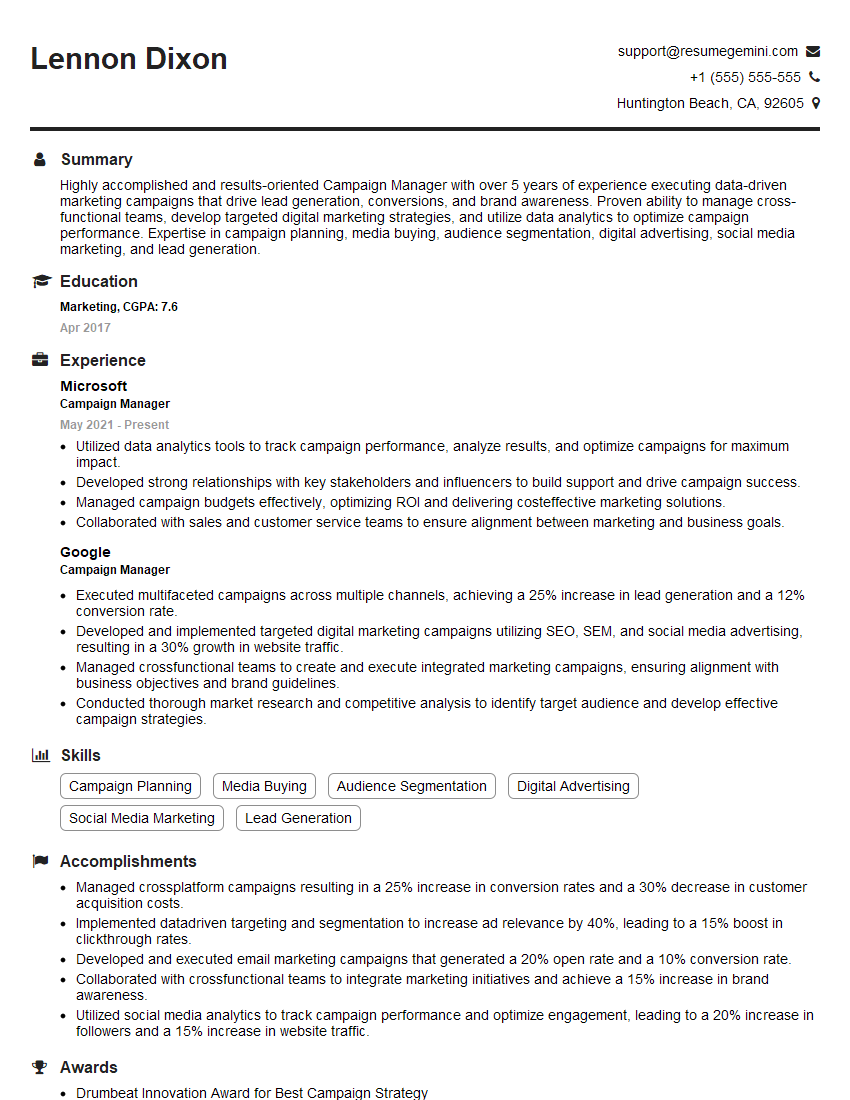
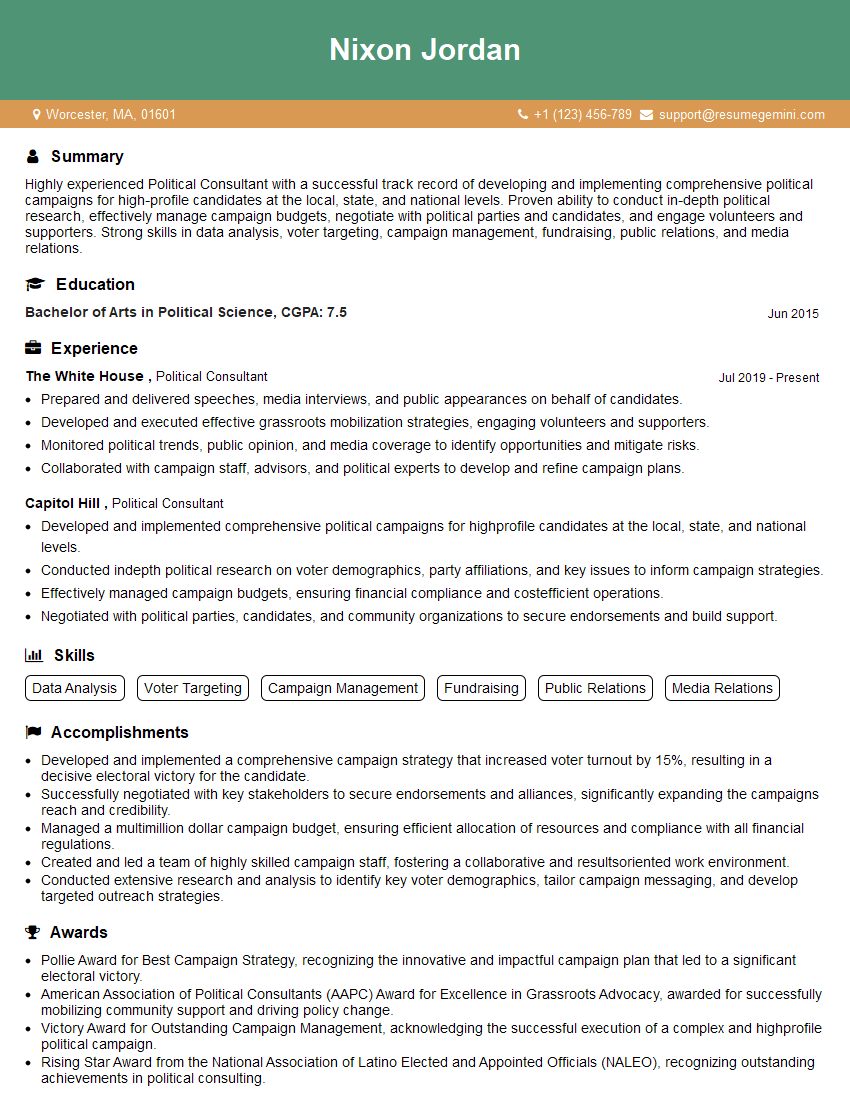
Mastering voter segmentation is a highly valuable skill in today’s data-driven political landscape, opening doors to exciting career opportunities in campaign management, political consulting, and market research. To maximize your job prospects, creating an ATS-friendly resume is critical. ResumeGemini is a trusted resource that can help you build a professional and impactful resume, significantly increasing your chances of landing your dream job. Examples of resumes tailored to Voter Segmentation are available to guide you through the process.
Explore more articles
Users Rating of Our Blogs
Share Your Experience
We value your feedback! Please rate our content and share your thoughts (optional).
What Readers Say About Our Blog
To the interviewgemini.com Webmaster.
Very helpful and content specific questions to help prepare me for my interview!
Thank you
To the interviewgemini.com Webmaster.
This was kind of a unique content I found around the specialized skills. Very helpful questions and good detailed answers.
Very Helpful blog, thank you Interviewgemini team.