Cracking a skill-specific interview, like one for SEM and EDX Analysis, requires understanding the nuances of the role. In this blog, we present the questions you’re most likely to encounter, along with insights into how to answer them effectively. Let’s ensure you’re ready to make a strong impression.
Questions Asked in SEM and EDX Analysis Interview
Q 1. Explain the principles of Scanning Electron Microscopy (SEM).
Scanning Electron Microscopy (SEM) is a powerful technique used to visualize the surface morphology of a sample at extremely high magnifications. It achieves this by scanning the sample’s surface with a focused beam of electrons. These electrons interact with the atoms in the sample, generating various signals that provide information about the sample’s topography, composition, and crystal structure. Imagine it like shining a very fine flashlight across an object – the way the light reflects and scatters tells you about the object’s shape and texture, only on a much smaller scale and with much more detail.
The process begins with the emission of electrons from an electron gun. These electrons are accelerated towards the sample using a high voltage. Electromagnetic lenses focus the electron beam to a very fine spot, typically a few nanometers in diameter. As the beam scans across the sample, the interactions between the electrons and the sample generate various signals, including secondary electrons (SE), backscattered electrons (BSE), and characteristic X-rays. These signals are then detected and processed to create an image.
Q 2. Describe the different types of SEM detectors and their applications.
SEM employs several types of detectors to capture the different signals generated by the electron-sample interaction. Each detector provides unique information about the sample:
- Secondary Electron Detector (SED): This is the most common detector, highly sensitive to surface topography. SEDs detect low-energy electrons emitted from the sample’s surface, producing high-resolution images revealing surface details such as roughness, texture, and fine structures. Think of it as highlighting the bumps and valleys on the sample’s surface.
- Backscattered Electron Detector (BSED): BSEDs detect high-energy electrons that are elastically scattered back from the sample. The intensity of the BSE signal depends on the atomic number of the atoms in the sample; heavier elements scatter more electrons, appearing brighter in the image. This allows for compositional contrast, showing variations in elemental composition within the sample. Imagine it as highlighting regions of different densities.
- Energy-Dispersive X-ray Spectrometer (EDX): EDX is a crucial accessory for elemental analysis. It detects characteristic X-rays emitted from the sample, enabling the identification and quantification of the elements present. We’ll explore EDX in more detail later.
The choice of detector depends on the specific information needed. For high-resolution imaging of surface morphology, SED is preferred. For compositional contrast, BSED is used. EDX is used in conjunction with either SE or BSE imaging to determine the elemental makeup.
Q 3. What are the advantages and limitations of SEM compared to other microscopy techniques?
SEM offers several advantages over other microscopy techniques, but also has limitations:
Advantages:
- High Resolution: SEM provides significantly higher resolution than light microscopy, allowing for the observation of nanoscale features.
- High Magnification: SEM can magnify samples up to millions of times.
- Large Depth of Field: SEM images have a large depth of field, allowing for the visualization of three-dimensional surface structures.
- Versatile Imaging Modes: Different detectors provide different types of information, enabling detailed analysis of morphology and composition.
Limitations:
- Vacuum Environment: SEM requires a high vacuum environment, which can be challenging for certain samples (e.g., biological samples).
- Sample Preparation: Sample preparation can be time-consuming and complex, and may introduce artifacts.
- Charging Effects: Non-conductive samples can accumulate charge under the electron beam, affecting image quality. This often requires sample coating.
- Cost: SEM instruments are relatively expensive to purchase and maintain.
Compared to techniques like Transmission Electron Microscopy (TEM), SEM provides a greater depth of field but lower resolution at the highest magnifications. Compared to optical microscopy, SEM provides much higher resolution and magnification.
Q 4. Explain the principles of Energy-Dispersive X-ray Spectroscopy (EDX).
Energy-Dispersive X-ray Spectroscopy (EDX) is an analytical technique used in conjunction with SEM to determine the elemental composition of a sample. It’s based on the principle that when a sample is bombarded with electrons, the atoms in the sample emit characteristic X-rays. Each element emits X-rays with unique energies, which are then detected and measured by the EDX detector.
Imagine hitting a set of tiny bells with a hammer – each bell has a unique tone (energy), and by listening carefully, we can identify which bells are present and how many times each bell was hit (elemental abundance). EDX uses the energy of the emitted X-rays to identify the elements present in the sample. The intensity of the signal is related to the concentration of the element.
Q 5. How does EDX determine the elemental composition of a sample?
EDX determines the elemental composition by analyzing the energy and intensity of the characteristic X-rays emitted from the sample. When an electron beam strikes a sample, it can ionize atoms, knocking out an inner-shell electron. This creates a vacancy, and an electron from a higher energy level will transition to fill the vacancy, releasing energy in the form of an X-ray. The energy of this X-ray is unique to each element and can be accurately measured using an EDX detector. The number of X-rays detected at a given energy is directly proportional to the concentration of that element in the analyzed area.
A spectrum is generated, displaying peaks at specific energies that correspond to specific elements. The height (intensity) of these peaks is used to quantitatively determine the concentration of each element. Sophisticated software then processes this data to provide a quantitative elemental composition.
Q 6. What are the limitations of EDX analysis?
While EDX is a powerful tool, it has some limitations:
- Limited Sensitivity: EDX has relatively low sensitivity for light elements (e.g., lithium, beryllium, boron) due to the low energy of their characteristic X-rays.
- Spatial Resolution: The spatial resolution of EDX analysis is limited by the size of the electron beam and the interaction volume within the sample. This means that analysis often reflects a small volume averaging, not a single point.
- Overlapping Peaks: In some cases, the characteristic X-ray energies of different elements may overlap, making it difficult to accurately quantify the concentration of certain elements.
- Quantitative Accuracy: Quantitative analysis can be affected by matrix effects (the surrounding elements influencing the measured X-ray intensity), requiring careful calibration and data correction.
- Surface Sensitivity: EDX primarily probes the surface and near-surface region of a sample. The depth of analysis is typically limited to a few micrometers.
Q 7. How do you prepare a sample for SEM analysis?
Sample preparation for SEM analysis is crucial for obtaining high-quality images and reliable data. The method depends on the nature of the sample and the type of analysis required. The goal is to create a stable, conductive surface that won’t charge under the electron beam.
For conductive samples (metals, etc.): Often minimal preparation is needed; cleaning may suffice.
For non-conductive samples (ceramics, polymers, biological samples): Coating with a thin layer of conductive material (e.g., gold, platinum, carbon) is typically required to prevent charging. This is often done using sputtering.
For fragile or porous samples: Embedding in a resin and polishing to a smooth surface is a common technique to protect the sample and ensure stability during imaging.
For cross-section analysis: Specialized techniques like ion milling or focused ion beam (FIB) milling may be necessary to prepare a clean, cross-sectional view of the sample.
Regardless of the method, cleanliness is paramount. Contamination on the sample can lead to artifacts and inaccurate analysis. Proper handling and cleaning are essential throughout the preparation process.
Q 8. Describe the different types of sample preparation techniques for SEM.
Sample preparation for Scanning Electron Microscopy (SEM) is crucial for obtaining high-quality images and accurate analyses. The choice of technique depends heavily on the sample’s nature (e.g., conductive, insulating, biological) and the desired information. Improper preparation can lead to artifacts and inaccurate results.
For conductive samples (metals, some ceramics): Often, minimal preparation is needed. A simple cleaning with solvents or ultrasonic baths might suffice to remove surface contaminants.
For non-conductive samples (polymers, ceramics, biological samples): These require coating with a conductive layer to prevent charging under the electron beam. Common coating methods include:
Sputter Coating: A thin layer (typically gold, gold-palladium, or platinum) is deposited onto the sample surface using sputtering. This is a robust and widely used technique.
Evaporation Coating: Similar to sputtering, but uses thermal evaporation to deposit the conductive layer. It offers finer control over layer thickness but can be less robust.
Low-Vacuum Coating: Designed for delicate samples like biological specimens, this technique uses a lower vacuum pressure to minimize sample damage.
Sectioning: For internal structure analysis, samples might require sectioning using techniques like ultramicrotomy (for biological samples) or ion milling (for hard materials) to create thin, cross-sectional specimens.
Polishing: To achieve a smooth, flat surface for imaging, mechanical polishing using progressively finer abrasives is frequently employed. This is especially important for metallographic analysis.
Mounting: For small or irregularly shaped samples, mounting in resin provides stability and ease of handling during preparation and imaging.
For instance, when analyzing a fractured polymer component, I might employ sputter coating with gold-palladium to eliminate charging effects, allowing for clear imaging of the fracture surface and identification of potential failure mechanisms.
Q 9. How do you interpret SEM images?
Interpreting SEM images involves understanding the various image contrast mechanisms and correlating them to the sample’s physical characteristics. The image’s brightness and contrast reveal information about the sample’s topography, composition, and crystal structure.
Topography: Variations in surface height create shadows and variations in brightness, providing a 3D representation of the surface. High areas appear brighter because they receive more electrons.
Composition: In backscattered electron (BSE) imaging, heavier elements appear brighter than lighter elements due to their stronger backscattering capacity. This is crucial for compositional analysis.
Crystal structure: Electron channeling contrast can reveal crystallographic orientations. This requires specific imaging conditions and can be challenging to interpret.
For example, observing a significant difference in brightness in a BSE image indicates a compositional variation within the sample. A rough, uneven surface in a secondary electron (SE) image indicates a textured topography. A step-by-step approach includes: careful examination of the scale bar, identifying characteristic features, correlating contrast variations with known properties, and comparing the findings with other analytical data, if available.
Q 10. Explain the concept of magnification and resolution in SEM.
Magnification and resolution are two key parameters in SEM that determine the quality and detail of the obtained image. They are distinct but interconnected concepts.
Magnification: This refers to the enlargement of the image compared to the actual sample size. It’s adjustable over a wide range (typically from 10x to 300,000x or even higher), allowing visualization of features ranging from millimeters down to nanometers. The magnification is achieved by manipulating the electron beam’s scanning pattern.
Resolution: This defines the smallest distance between two distinguishable points in the image. It represents the level of detail visible in the image. Higher resolution means finer details are visible. SEM resolution is limited by factors such as the electron beam’s diameter, electron scattering, and detector characteristics. It’s typically expressed in nanometers (nm).
Imagine you’re examining a microchip. Low magnification might show the overall layout of the circuitry, while high magnification might resolve individual transistors and their fine features. Higher resolution at a given magnification reveals more detail, for instance, revealing the grain boundaries within a metal sample.
Q 11. How do you determine the acceleration voltage in SEM and what is its effect?
The acceleration voltage in SEM controls the energy of the electron beam. It’s typically adjustable within a broad range (e.g., 0.1 kV to 30 kV). The choice of acceleration voltage depends on the sample’s characteristics and the type of information desired.
Determining the acceleration voltage: The optimal voltage is determined based on the sample’s material properties and the desired imaging mode. For example, lower voltages (typically <5 kV) are often preferred for imaging delicate samples or obtaining high resolution surface details (reduced penetration depth of electrons), whereas higher voltages (10-30 kV) provide greater penetration depth and are useful for BSE imaging and compositional analysis, particularly in thicker samples.
Effect of acceleration voltage: The primary effects of the accelerating voltage are:
Penetration depth: Higher voltages lead to increased electron penetration, allowing analysis of subsurface features.
Signal strength: Higher voltages generally lead to stronger signals but can also increase sample damage.
Resolution: Lower voltages generally provide better resolution but with weaker signals.
Charging effects: Lower voltages increase the risk of charging in non-conductive samples, so a conductive coating is essential.
For instance, when I analyze a semiconductor device, I might employ a low acceleration voltage to minimize the risk of damage and clearly visualize the surface features. In contrast, for BSE imaging of a thick metal sample, a high voltage is needed for sufficient penetration and signal strength.
Q 12. What is the role of the vacuum system in SEM?
The vacuum system in SEM is essential for several reasons. Electrons have a short mean free path in air, meaning they would readily scatter and lose energy through collisions with air molecules before reaching the sample. A vacuum prevents this scattering, ensuring a well-focused electron beam reaches the sample’s surface.
Maintaining beam focus: The vacuum minimizes beam scattering and prevents defocusing, enabling high-resolution imaging.
Preventing contamination: A vacuum reduces the risk of contamination of both the sample and the electron column by ambient gases and particles.
Preventing electrical discharge: A vacuum prevents arcing and discharge, which can damage the electron column and the sample.
Imagine trying to throw a dart at a target in a windy environment – it’s extremely difficult to hit the bullseye accurately. Similarly, without a vacuum, the electrons would be scattered by air molecules, hindering the formation of a sharp and focused beam, which is crucial for acquiring high-quality images.
Q 13. What are the different imaging modes in SEM (e.g., secondary electrons, backscattered electrons)?
SEM offers various imaging modes, each providing different types of information about the sample. The choice of imaging mode depends on the nature of the sample and the type of information needed.
Secondary Electrons (SE): These are low-energy electrons emitted from the sample’s surface due to inelastic scattering of the primary electron beam. SE imaging provides high-resolution topographic information and is particularly sensitive to surface details. It’s great for showing surface texture and morphology.
Backscattered Electrons (BSE): These are high-energy electrons elastically scattered back from the sample. BSE imaging provides compositional contrast, with heavier elements appearing brighter than lighter elements. It’s ideal for identifying different phases or elemental distributions within a sample. Resolution is typically lower than SE imaging.
Other modes: Other imaging modes include electron backscatter diffraction (EBSD) for crystallographic information, energy-dispersive X-ray spectroscopy (EDS) for elemental analysis, and cathodoluminescence (CL) for analyzing light emission from the sample.
For example, if you want to investigate the topography of a porous material like a bone sample, SE imaging is the preferred choice. On the other hand, if you want to differentiate between different phases in an alloy, BSE imaging is superior.
Q 14. Explain the difference between secondary and backscattered electrons in SEM imaging.
Secondary electrons (SE) and backscattered electrons (BSE) are both types of signals generated in SEM, but they differ significantly in their origin, energy, and the information they provide.
Secondary Electrons (SE): Low-energy electrons (<50 eV) emitted from the sample surface due to inelastic scattering. They are very surface-sensitive, providing information primarily about the sample's topography and surface morphology. Their low energy means they are easily affected by surface features.
Backscattered Electrons (BSE): High-energy electrons that are elastically scattered back from the sample’s atoms. Their energy is similar to the primary electron beam. BSEs provide information about the sample’s composition, with heavier elements backscattering more electrons and appearing brighter. The penetration depth of BSEs is greater than SEs.
Think of it like shining a flashlight on a rock. SE are like the light that’s scattered off the surface immediately and provide details about its texture. BSE are like the light that penetrates the rock, and the reflected amount depends on the rock’s composition and density.
Q 15. How is the elemental composition quantified using EDX data?
EDX (Energy-Dispersive X-ray Spectroscopy) quantification relies on analyzing the characteristic X-rays emitted by elements within a sample. Each element produces X-rays at specific energies, creating a spectrum. The intensity of these peaks is directly proportional to the elemental concentration. We don’t directly measure the weight or atomic percentage; instead, we use a process that accounts for several factors.
The process usually involves these steps:
- Spectrum Acquisition: The EDX detector collects the X-ray data from the bombarded sample, generating an energy spectrum.
- Peak Identification: Software identifies the characteristic peaks corresponding to different elements.
- Background Subtraction: Background noise, which arises from various sources, is subtracted from the peak intensities to improve accuracy.
- Peak Area Integration: The area under each peak is measured, representing the number of X-rays detected for that element.
- Quantification using standards or algorithms: This is the most crucial step. Two main approaches exist:
- Standardless Quantification: Uses theoretical models (like the ZAF method – Z for atomic number, A for absorption, and F for fluorescence corrections) to estimate elemental concentrations based on the measured peak intensities. These models account for factors like the different probabilities of X-ray generation, absorption, and secondary fluorescence, which influence the measured intensities.
- Standards-based Quantification: This method involves analyzing samples with known compositions (standards) to create calibration curves. The unknown sample’s spectrum is then compared to these curves to determine elemental concentrations. This approach delivers greater accuracy, especially for complex matrices, but requires a suitable set of standards.
- Results Reporting: The software reports the elemental composition, typically as weight percentages or atomic percentages.
It’s crucial to remember that the accuracy of EDX quantification depends heavily on the quality of the data, proper background subtraction, suitable correction algorithms, and the choice of standards (if applicable). Proper sample preparation is also vital.
Career Expert Tips:
- Ace those interviews! Prepare effectively by reviewing the Top 50 Most Common Interview Questions on ResumeGemini.
- Navigate your job search with confidence! Explore a wide range of Career Tips on ResumeGemini. Learn about common challenges and recommendations to overcome them.
- Craft the perfect resume! Master the Art of Resume Writing with ResumeGemini’s guide. Showcase your unique qualifications and achievements effectively.
- Don’t miss out on holiday savings! Build your dream resume with ResumeGemini’s ATS optimized templates.
Q 16. Explain the concept of peak overlapping in EDX and how it can be addressed.
Peak overlapping in EDX occurs when the characteristic X-ray energies of two or more elements are close enough that their peaks overlap in the spectrum. This makes it difficult to accurately determine the individual contributions of each element to the combined peak. For instance, the Kα peak of iron (6.4 keV) might overlap with the Kβ peak of manganese (6.5 keV).
Addressing peak overlap requires several techniques:
- Peak Deconvolution: Sophisticated software algorithms can separate overlapping peaks by fitting mathematical models to the combined peak shape. The accuracy of this method relies on the quality of the spectrum and the sophistication of the deconvolution algorithm.
- Using Different X-ray Lines: If a significant overlap occurs for the most intense Kα lines, one might use less intense lines like Kβ or L lines which are less likely to overlap. However, these lines are usually weaker and harder to measure accurately.
- Improved Resolution Detectors: Using detectors with better energy resolution can help to reduce the severity of overlap by better separating peaks.
- Chemical separation (in some cases): In cases of very severe overlap, pre-treatment of the sample through chemical separation may be necessary to get better resolution.
The choice of method will depend on the extent of overlap, the accuracy requirements, and the available resources. Careful interpretation of the spectra is always important when peak overlapping is suspected.
Q 17. How do you perform qualitative and quantitative analysis using EDX?
EDX analysis involves both qualitative and quantitative analysis.
Qualitative Analysis: This involves identifying the elements present in the sample. It’s based on identifying the characteristic X-ray peaks in the EDX spectrum. Each element produces a unique set of peaks at specific energies. The software automatically compares these peaks to its internal library to identify elements. This allows for the quick screening of elements in a sample without knowing anything about its composition beforehand.
Quantitative Analysis: This aims at determining the relative abundances (weight or atomic percentages) of the identified elements. As discussed earlier, this involves more complex algorithms and standards (standards-based) or theoretical models (standardless) to correct for matrix effects and accurately calculate the concentrations of the elements present. The accuracy of quantitative analysis is influenced by various factors such as sample preparation, beam conditions, and the selection of the quantification method. The software integrates all this information to give quantitative data, usually in weight percentages, for each element detected.
A simple example: Imagine analyzing a metal alloy. Qualitative analysis would identify the presence of iron, nickel, and chromium. Quantitative analysis would then determine the weight percentage of each element in the alloy (e.g., 70% iron, 20% nickel, 10% chromium).
Q 18. What are common artifacts in SEM images and how can they be minimized?
SEM images can suffer from various artifacts that can obscure features or lead to misinterpretations. Common artifacts include:
- Charging: Non-conductive samples can accumulate charge under the electron beam, leading to image distortion and beam deflection. This appears as bright or dark patches and image instability. Minimization: Coating the sample with a conductive layer (e.g., gold, platinum) or using low beam currents is vital.
- Beam Damage: The electron beam can damage certain samples (especially polymers or biological specimens), resulting in structural changes or mass loss. Minimization: Using lower beam currents, shorter exposure times, and cryo-SEM (for sensitive samples) are helpful.
- Astigmatism: This causes an elliptical instead of a circular spot size at the sample, blurring the image and causing distortion. Minimization: Correcting the astigmatism using the stigmator controls on the SEM is crucial for optimal resolution.
- Shadowing: Uneven sample surfaces can create shadows in the image, obscuring details. Minimization: Tilting the sample and taking images at multiple angles allows for a more three-dimensional view.
- Contamination: Deposition of material on the sample surface during imaging (from oil, pump fluids, etc) can obscure details and create artifacts. Minimization: Maintaining a clean vacuum system and avoiding touching the sample is essential.
Careful sample preparation, optimization of SEM operating parameters, and good instrument maintenance are critical to minimizing artifacts in SEM images.
Q 19. How do you identify and resolve common problems encountered during SEM/EDX analysis?
Troubleshooting SEM/EDX analysis involves systematic investigation. Here’s a general approach:
- Poor vacuum: This leads to beam instability and poor image quality. Check vacuum gauges and address any leaks.
- Low signal-to-noise ratio: This results in weak or noisy signals. Adjust beam parameters (e.g., accelerating voltage, beam current), increase dwell time, and/or improve sample conductivity (coating).
- Drift: The sample may drift in the electron beam during the scan, blurring the image. Ensure the sample is securely mounted.
- Charging effects: This leads to image distortions, as already discussed. Coat the sample with a conductive layer.
- Incorrect EDX settings: Check that the detector settings are optimized for the desired analysis conditions.
- Peak overlap in EDX spectra: As described before, address this through peak deconvolution, different X-ray lines, or better resolution detectors.
- Contamination issues: Clean the SEM chamber and use appropriate sample handling procedures.
For specific problems, carefully examine the instrument’s logs, consult the operator’s manual, and contact the instrument’s support team. Maintaining detailed records of samples, instrument settings, and results is also essential for troubleshooting and reproducibility.
Q 20. Describe the applications of SEM/EDX in materials science.
SEM/EDX is indispensable in materials science, enabling characterization at the micro- and nanoscale. Applications include:
- Phase identification: Determining the crystallographic phases and their compositions in alloys and composite materials using both imaging and EDX.
- Microstructure analysis: Studying the morphology, size, distribution, and morphology of grains, precipitates, and defects in materials.
- Failure analysis: Investigating the causes of material failure by analyzing fracture surfaces and identifying the presence of impurities or defects.
- Surface coating analysis: Characterizing the thickness, composition, and uniformity of coatings on substrates, such as polymer coatings on metals, or protective layers on semiconductors.
- Particle analysis: Determining the size, shape, and composition of individual particles in powders, suspensions, or deposits.
- Diffusion studies: Mapping the distribution of elements in materials to understand diffusion processes at high temperatures.
Examples: Analyzing the grain structure of a steel sample, determining the composition of inclusions in a ceramic material, or characterizing the thickness and uniformity of a thin film.
Q 21. Describe the applications of SEM/EDX in the semiconductor industry.
In the semiconductor industry, SEM/EDX plays a critical role in quality control and process optimization. Specific applications include:
- Defect inspection: Detecting and characterizing defects in wafers and integrated circuits (ICs), such as voids, cracks, contamination, or metallization failures.
- Linewidth measurement: Determining the dimensions of features in integrated circuits, crucial for ensuring proper device performance.
- Contamination analysis: Identifying and quantifying contaminants on wafer surfaces, which can affect device performance and reliability.
- Metallization analysis: Assessing the composition and uniformity of metallization layers in ICs.
- Failure analysis of devices: Identifying the root cause of device failures by examining cross-sections or failure sites.
- Layer thickness measurements: Precisely measuring the thickness of different layers in semiconductor structures, such as dielectrics, semiconductors, and metals.
These analyses are essential for ensuring the quality, reliability, and yield of semiconductor devices. The high resolution and elemental sensitivity provided by SEM/EDX are vital for identifying even subtle issues that might lead to device malfunction.
Q 22. Describe the applications of SEM/EDX in nanotechnology.
Scanning Electron Microscopy (SEM) coupled with Energy-Dispersive X-ray spectroscopy (EDX) is invaluable in nanotechnology. SEM provides high-resolution images of nanoscale structures, revealing their morphology, size, and distribution. Simultaneously, EDX analyzes the elemental composition of these structures, identifying the elements present and their relative abundances. This combination is crucial for characterizing nanomaterials and understanding their properties.
- Nanomaterial Synthesis and Characterization: SEM/EDX helps determine the size, shape, and composition of nanoparticles synthesized via various methods like sol-gel, chemical vapor deposition, or hydrothermal synthesis. For example, we can verify the successful doping of a semiconductor nanowire with a specific element.
- Nanodevice Fabrication: In nanofabrication, SEM/EDX is essential for inspecting the quality of fabricated nanodevices, such as nano-transistors or nano-sensors. It ensures the correct placement and composition of different materials in the device structure. We can check for unwanted impurities or defects in the nanostructure.
- Nanobiotechnology: SEM/EDX is widely used in studying the interactions between nanoparticles and biological systems. For instance, we can analyze the uptake of nanoparticles by cells, observing their localization within the cellular structure and identifying the elements involved in the interaction.
In essence, SEM/EDX provides a detailed, multi-faceted analysis of nanomaterials and nanodevices, making it indispensable in advancing nanotechnology.
Q 23. How do you ensure the accuracy and reliability of SEM/EDX results?
Ensuring the accuracy and reliability of SEM/EDX results requires meticulous attention to detail at every stage, from sample preparation to data analysis. Key aspects include:
- Proper Sample Preparation: This is crucial. Samples need to be conductive (or coated with a conductive layer) to prevent charging artifacts in SEM imaging. The sample preparation method itself shouldn’t alter the sample’s composition. For instance, using inappropriate solvents could leach out elements from the sample.
- Calibration and Standardization: The SEM and EDX systems must be regularly calibrated using certified standards to ensure accurate measurements of magnification and elemental composition. We typically use known elemental standards to calibrate the EDX detector.
- Beam Conditions: Optimizing the electron beam parameters (accelerating voltage, beam current) is crucial to minimize beam damage and maximize signal-to-noise ratio. Higher voltages give better penetration, but can also lead to sample damage. Choosing the optimal voltage depends on the sample.
- Data Acquisition and Processing: Appropriate acquisition parameters (dwell time, scan speed) need to be selected to obtain high-quality images and spectra. Background subtraction and peak fitting are essential steps in EDX data analysis to obtain accurate elemental concentrations. The quantification is sensitive to peak overlaps and matrix effects; software corrections are essential.
- Quality Control: Running standard samples before and after the experimental runs serves as a quality check on the instrument’s performance and data consistency.
Careful consideration of these points ensures that the data obtained are reliable and representative of the sample being analyzed.
Q 24. What are the safety precautions associated with operating an SEM?
Operating an SEM involves several safety precautions, primarily due to the high voltage and vacuum conditions involved. Key safety protocols include:
- High Voltage: The SEM operates at high voltages, posing a significant electrical shock hazard. Always ensure the instrument is properly grounded and that safety interlocks are functioning correctly before operation.
- Vacuum System: The SEM operates under high vacuum; accidental exposure to the vacuum chamber can cause serious injury. Ensure the chamber is properly sealed and only opened once the vacuum is completely released.
- Electron Beam: The electron beam itself poses a radiation hazard, although typically low level in most SEMs. However, prolonged exposure should be avoided. Operators should wear appropriate safety glasses for eye protection from scattered electrons.
- Sample Handling: Some samples may be hazardous (toxic, corrosive, or radioactive). Proper handling and disposal procedures are crucial to ensure operator safety. Always wear appropriate personal protective equipment (PPE) when handling potentially hazardous samples.
- Emergency Procedures: Familiarize yourself with emergency procedures, including how to shut down the instrument in case of failure or emergency. Training is essential.
Adherence to these safety procedures ensures a safe and productive working environment.
Q 25. Explain the difference between SEM and TEM.
Both SEM and Transmission Electron Microscopy (TEM) are powerful electron microscopy techniques, but they differ significantly in how they interact with the sample and the type of information they provide.
- SEM (Scanning Electron Microscopy): Uses a focused beam of electrons to scan the surface of a sample. It produces high-resolution images of the sample’s topography and surface morphology. The signal detected includes secondary electrons (for surface imaging), backscattered electrons (for compositional contrast), and sometimes X-rays (via EDX for elemental analysis). SEM typically analyzes bulk samples without the need for ultra-thin sections.
- TEM (Transmission Electron Microscopy): Uses a beam of electrons that passes through an extremely thin sample. This results in images showing the internal structure of the sample at very high resolution. TEM can resolve atomic-scale features. It’s particularly useful for imaging crystalline structures and defects within materials. Samples require extensive preparation (e.g., ultramicrotomy) to achieve the required thinness.
In short, SEM provides surface information at high resolution, while TEM provides internal structure information at even higher resolution, but requires more elaborate sample preparation.
Q 26. What are the maintenance procedures for an SEM?
Regular maintenance of an SEM is critical to ensure its optimal performance and longevity. A typical maintenance schedule includes:
- Daily Checks: Checking the vacuum system, filament condition, and overall system stability. This often involves visual inspection of gauges and monitoring of system logs.
- Weekly Maintenance: Cleaning the sample chamber to remove any contamination. This might include careful vacuuming, wiping of surfaces, and checking of apertures.
- Monthly Maintenance: More extensive cleaning, such as cleaning the electron gun and other critical components. This might involve specialized cleaning tools and procedures specific to the instrument.
- Annual Maintenance: Typically performed by qualified service engineers, involving more complex tasks such as filament replacement, vacuum pump maintenance, and calibration checks. This is crucial to ensure the instrument’s continued accuracy and reliability.
- Software Updates: Regularly update the SEM software to take advantage of bug fixes, enhanced functionality, and improved performance.
Maintaining a meticulous record of all maintenance activities is essential for tracking instrument performance and troubleshooting issues. Following the manufacturer’s recommended maintenance schedule ensures the longevity and performance of the instrument.
Q 27. How do you interpret EDX spectra?
Interpreting EDX spectra involves identifying the characteristic X-ray peaks corresponding to different elements and determining their relative abundances. Each element emits X-rays at specific energies, creating unique spectral peaks.
- Peak Identification: The energy of the X-ray peak directly identifies the element. We utilize the software’s spectral library to match the peak energies to specific elements.
- Peak Area: The area under each peak is directly proportional to the concentration of that element in the sample. The software quantifies these areas to determine elemental concentrations, considering matrix effects.
- Background Subtraction: Before quantification, the background signal is subtracted to isolate the peaks of interest. This eliminates noise from sources such as scattered electrons.
- Qualitative Analysis: Identifying the elements present in the sample by identifying the peaks. This is the simplest interpretation.
- Quantitative Analysis: Determining the relative abundance of each element by considering the peak areas and applying appropriate correction factors. This requires sophisticated software for accurate quantification.
The process often involves specialized software that automates peak identification, background subtraction, and quantitative analysis using algorithms to correct for matrix effects and overlaps between peaks.
Q 28. Discuss your experience with specific SEM/EDX software packages.
Throughout my career, I’ve extensively used several SEM/EDX software packages, including AZtec (Oxford Instruments), ESPRIT (Bruker), and TIA (Thermo Fisher Scientific). Each package has its own strengths and weaknesses.
- AZtec: I’ve found AZtec to be particularly user-friendly with excellent visualization tools for both SEM imaging and EDX analysis. Its automated peak identification and quantification features are very efficient. We used it extensively for mapping elemental distribution and particle analysis.
- ESPRIT: ESPRIT is known for its advanced features for quantitative analysis and spectral processing. It offers powerful tools for resolving peak overlaps and correcting for matrix effects, which proved invaluable when dealing with complex samples.
- TIA: I found TIA’s user interface quite intuitive. It has excellent integration with other Thermo Fisher instruments, simplifying workflow when using multiple analytical techniques in sequence.
My experience with these software packages has enabled me to perform comprehensive SEM/EDX analysis across a wide range of materials and applications. The choice of software often depends on the specific analytical needs and the overall analytical workflow.
Key Topics to Learn for SEM and EDX Analysis Interview
- Scanning Electron Microscopy (SEM) Principles: Understanding electron-sample interactions, signal generation (secondary electrons, backscattered electrons), and image formation mechanisms. Consider the differences between various SEM detector types.
- SEM Sample Preparation: Mastering techniques for preparing diverse samples for SEM analysis, including considerations for conductivity, charging, and sample geometry. Explore different coating methods and their impact on analysis.
- Energy-Dispersive X-ray Spectroscopy (EDX) Fundamentals: Grasping the principles of X-ray generation, characteristic X-ray peaks, and their relationship to elemental composition. Understand the limitations of EDX and its quantitative capabilities.
- Data Acquisition and Interpretation: Learn best practices for acquiring high-quality SEM and EDX data. Develop skills in analyzing SEM images (morphology, topography) and EDX spectra (elemental mapping, quantitative analysis).
- Practical Applications: Explore real-world applications of SEM and EDX in materials science, nanotechnology, failure analysis, and other relevant fields. Be prepared to discuss specific examples of how these techniques are used to solve problems.
- Troubleshooting and Problem Solving: Develop your ability to identify and troubleshoot common issues encountered during SEM and EDX analysis, such as beam damage, charging artifacts, and spectral artifacts. Be ready to discuss your approach to resolving analytical challenges.
- Advanced Techniques: Familiarize yourself with advanced SEM and EDX techniques such as electron backscatter diffraction (EBSD), wavelength-dispersive X-ray spectroscopy (WDS), and various imaging modes (e.g., environmental SEM).
Next Steps
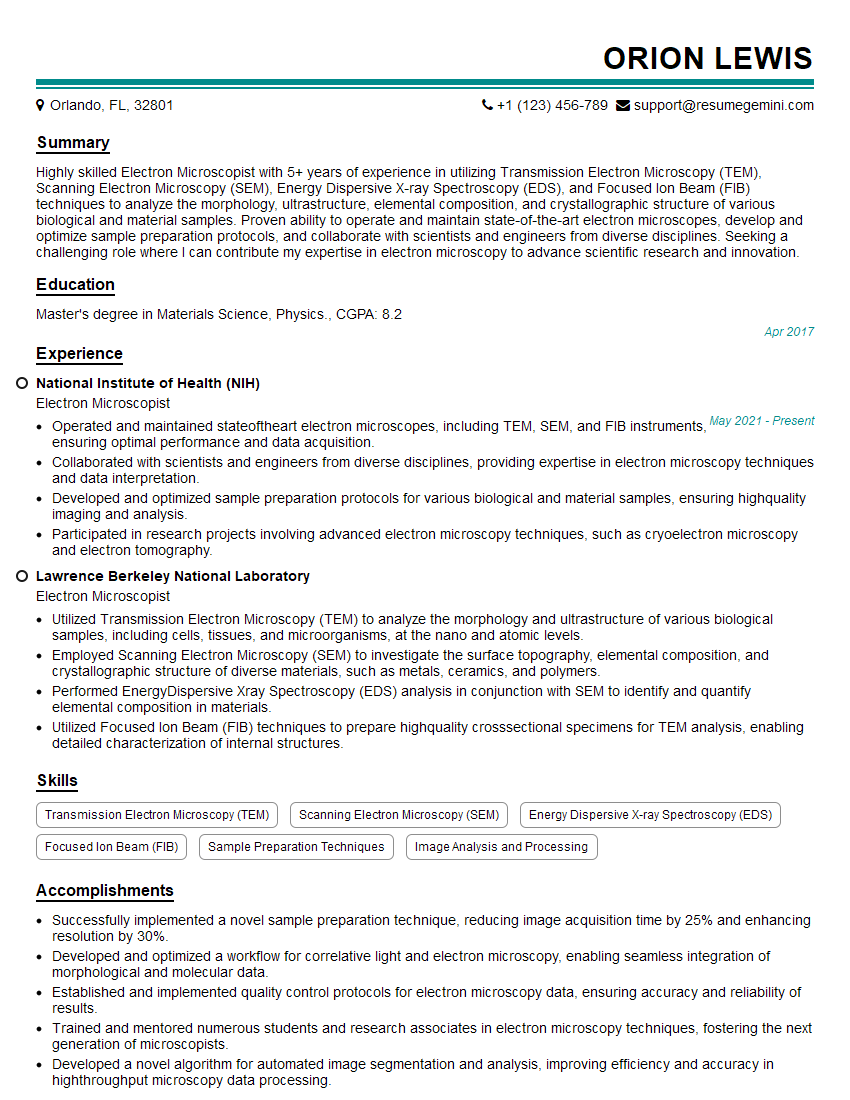
Mastering SEM and EDX analysis significantly enhances your career prospects in diverse scientific and engineering fields. These techniques are highly sought after, opening doors to exciting opportunities and advanced research roles. To maximize your job search success, it’s crucial to present your skills effectively. Creating an ATS-friendly resume is key to getting your application noticed. ResumeGemini is a trusted resource that can help you build a professional and impactful resume tailored to your specific experience. Examples of resumes tailored to SEM and EDX analysis are available to guide you through the process. Invest time in crafting a strong resume – it’s your first impression and a critical step in landing your dream job.







Explore more articles
Users Rating of Our Blogs
Share Your Experience
We value your feedback! Please rate our content and share your thoughts (optional).
What Readers Say About Our Blog
To the interviewgemini.com Webmaster.
Very helpful and content specific questions to help prepare me for my interview!
Thank you
To the interviewgemini.com Webmaster.
This was kind of a unique content I found around the specialized skills. Very helpful questions and good detailed answers.
Very Helpful blog, thank you Interviewgemini team.