The right preparation can turn an interview into an opportunity to showcase your expertise. This guide to Sensor and Platform Knowledge interview questions is your ultimate resource, providing key insights and tips to help you ace your responses and stand out as a top candidate.
Questions Asked in Sensor and Platform Knowledge Interview
Q 1. Explain the trade-offs between different sensor types (e.g., accuracy, precision, cost, power consumption).
Choosing the right sensor involves careful consideration of several factors that often trade off against each other. Accuracy refers to how close a measurement is to the true value, while precision refers to the repeatability of measurements. A highly accurate sensor might be less precise, consistently giving slightly different readings for the same input. Conversely, a precise sensor might be inaccurate if its measurements are consistently off by a certain amount.
Cost is a major consideration; high-accuracy sensors often come with a higher price tag. Power consumption is crucial in battery-powered applications. Low-power sensors extend battery life but may compromise accuracy or precision. For example, a high-precision MEMS accelerometer might be very accurate but consume more power than a less precise, lower-power capacitive sensor. The ideal choice depends on the specific application requirements; a high-accuracy GPS module might be justifiable for autonomous vehicles but overkill for a simple fitness tracker where lower-power and lower-cost accelerometers suffice.
- High Accuracy, High Cost, High Power: A high-end, laboratory-grade pressure sensor.
- Moderate Accuracy, Moderate Cost, Low Power: A typical temperature sensor in a consumer device.
- Low Accuracy, Low Cost, Very Low Power: A simple proximity sensor.
Q 2. Describe your experience with various sensor communication protocols (e.g., I2C, SPI, UART, CAN).
I’ve extensive experience with various sensor communication protocols. Each protocol has its strengths and weaknesses, making it suitable for different applications. I2C (Inter-Integrated Circuit) is a simple, two-wire protocol ideal for short-range communication with multiple sensors, offering a good balance of speed and simplicity. SPI (Serial Peripheral Interface) provides higher speeds than I2C but requires more pins, making it less suitable for densely packed systems. UART (Universal Asynchronous Receiver/Transmitter) is a flexible, robust protocol often used for long-range communication but can be slower than I2C or SPI.
CAN (Controller Area Network) is a high-speed, robust protocol primarily used in automotive and industrial applications, where reliability and noise immunity are paramount. In a recent project involving environmental monitoring, I used I2C for several low-power sensors like temperature and humidity sensors, SPI for a high-speed ADC (analog-to-digital converter), and UART for communication with a remote data logger. Selecting the appropriate protocol is often dictated by factors such as speed requirements, distance to the microcontroller, power consumption targets, and the number of sensors to be connected.
// Example I2C code snippet (pseudocode) Wire.begin(); // Initialize I2C Wire.beginTransmission(sensorAddress); // Start communication with sensor Wire.write(command); // Send command to sensor Wire.endTransmission(); // Stop transmission Wire.requestFrom(sensorAddress, 2); // Request data from sensor // ...read data from sensor...Q 3. How do you handle sensor noise and drift in your applications?
Sensor noise and drift are common challenges. Noise represents unwanted random fluctuations in the sensor readings, while drift refers to gradual changes in sensor output over time even without changes in the measured quantity. Several techniques mitigate these issues. For noise reduction, I often employ digital filtering techniques such as moving averages, Kalman filters, or median filters. A simple moving average smooths out short-term fluctuations by averaging readings over a defined window. Kalman filters are more sophisticated, estimating the true value based on the sensor readings and a model of the system’s dynamics.
To address drift, calibration is essential. This involves taking measurements under known conditions to establish a baseline and compensate for subsequent drift. Regular calibration is needed for sensors prone to drift, particularly temperature sensors. For example, a temperature sensor might drift over time due to aging or environmental changes, requiring frequent recalibration against a known standard. In one project, we used a two-point calibration approach; we measured the sensor output at two known temperatures and used linear interpolation to correct subsequent measurements.
Q 4. Explain your experience with calibrating sensors and validating sensor data.
Sensor calibration involves establishing a relationship between the sensor’s raw output and the actual measured quantity. This is often done using known standards or reference sensors. Validation involves confirming the accuracy and reliability of the calibrated sensor data. I typically perform a multi-step calibration process, starting with a preliminary calibration using known standards. Then, I test the calibrated sensor in various conditions, comparing its readings to reference measurements. This allows me to quantify the accuracy and precision of the sensor system.
For example, when calibrating a pressure sensor, I’d use a pressure calibrator to apply known pressures and record the sensor’s output. A calibration curve—often a polynomial—would be fitted to these data points to convert raw sensor readings into calibrated pressure values. The validation step might involve testing the sensor under dynamic conditions or comparing it against other sensors to assess consistency. Proper documentation of the calibration procedure and results is essential for ensuring traceability and reproducibility.
Q 5. Describe your experience with different sensor platforms and architectures.
My experience spans various sensor platforms and architectures. I’ve worked with microcontrollers like Arduino and ESP32, single-board computers like Raspberry Pi, and embedded systems with custom hardware. Each platform offers unique capabilities and trade-offs. Microcontrollers are ideal for resource-constrained applications due to their low power consumption and small size, suitable for wearable or portable sensors. Single-board computers provide more processing power and memory for complex data analysis and processing, while custom hardware allows for optimized designs to meet specific needs.
I’ve designed systems using both centralized and distributed architectures. Centralized architectures involve collecting data from multiple sensors into a central processing unit, which simplifies data processing but can create a single point of failure. Distributed architectures distribute processing among multiple nodes, improving robustness and scalability but increasing complexity in data synchronization. The choice of platform and architecture depends heavily on the application requirements, such as sensor density, processing needs, and desired levels of robustness and fault tolerance.
Q 6. How do you design a robust and reliable sensor data acquisition system?
Designing a robust and reliable sensor data acquisition system requires careful planning and execution. Key considerations include: sensor selection (accuracy, precision, power, cost), communication protocols, data processing techniques, error handling, and system architecture. A layered architecture with clear separation of concerns is helpful. I usually start with defining clear requirements and specifications, including accuracy, sampling rate, data storage, and communication interfaces. Redundancy plays a crucial role in ensuring reliability; for instance, using multiple sensors to measure the same quantity can help detect and mitigate faulty readings.
Error handling is critical. The system should be able to detect and handle errors gracefully, such as sensor failures, communication problems, or data corruption. Effective data validation checks should be implemented. Real-time considerations are also paramount; data acquisition must be done quickly enough to meet the application needs, often involving real-time operating systems. Proper power management and shielding are essential to prevent interference and noise. Finally, thorough testing and validation are crucial in ensuring the system’s performance and reliability.
Q 7. Discuss your experience with real-time operating systems (RTOS) in sensor applications.
Real-Time Operating Systems (RTOS) are essential in many sensor applications where timely data acquisition and processing are crucial. An RTOS provides a predictable and deterministic environment, enabling precise control over timing and resource allocation. I’ve used several RTOS platforms including FreeRTOS and Zephyr. The choice of RTOS depends on the application’s requirements and the target hardware. FreeRTOS is a popular choice for its lightweight nature and wide adoption, while Zephyr is well-suited for resource-constrained devices and IoT applications. In a project involving autonomous robotics, we used FreeRTOS to manage real-time sensor data acquisition and control algorithms. Using RTOS enabled precise scheduling of sensor reading tasks, ensuring deterministic and timely responses to changing conditions.
Using an RTOS allows for the creation of multiple tasks running concurrently, each responsible for a specific function, such as sensor reading, data processing, communication, and actuator control. The RTOS scheduler manages the execution of these tasks, ensuring that time-critical tasks are given priority and that deadlines are met. This allows for a modular and organized system design, facilitating maintenance and development. Task synchronization and communication mechanisms provided by the RTOS are crucial for ensuring data consistency and avoiding race conditions.
Q 8. Explain your understanding of sensor signal processing techniques (e.g., filtering, averaging).
Sensor signal processing is crucial for extracting meaningful information from raw sensor data, often noisy and imperfect. Key techniques include filtering and averaging.
Filtering removes unwanted noise or frequencies. For example, a low-pass filter allows low-frequency signals (like a slow temperature change) to pass through while attenuating high-frequency noise (like random electrical spikes). A high-pass filter does the opposite, useful for detecting sudden changes or vibrations. The choice of filter type (e.g., Butterworth, Chebyshev) depends on the specific application and desired characteristics. In practice, I’ve used digital filters implemented using libraries like SciPy in Python, applying them to accelerometer data to isolate relevant movement from background vibrations.
Averaging, or smoothing, reduces noise by taking the mean of multiple data points. Simple moving averages are easy to implement, but more sophisticated methods like weighted averages can be more effective depending on the nature of the noise. For instance, in a weather station, averaging temperature readings over a period of time provides a more representative temperature than a single instantaneous reading.
Imagine trying to read a handwritten note covered in coffee stains. Filtering is like cleaning the stains to make the writing clearer. Averaging is like looking at the general trend of the writing rather than focusing on each individual stroke.
Q 9. Describe your experience with data logging and storage for sensor data.
Data logging and storage for sensor data requires a robust system capable of handling large volumes of data at potentially high frequencies. My experience involves selecting appropriate data formats, storage mediums, and databases.
I’ve worked with various methods: CSV files for simple logging, databases like PostgreSQL or MySQL for structured data, and NoSQL databases like MongoDB for handling unstructured or semi-structured data. The choice depends on factors like data volume, required querying capabilities, and scalability needs. For high-frequency data streams, I’ve used message queues like Kafka to efficiently handle and buffer incoming data before processing and storage.
In one project monitoring environmental conditions, we used a combination of a local database for real-time monitoring and archival to a cloud-based storage solution (AWS S3) for long-term retention and analysis. Careful consideration was given to data compression techniques to minimize storage costs and bandwidth usage.
# Example Python code snippet for logging to a CSV file import csv with open('sensor_data.csv', 'a', newline='') as csvfile: writer = csv.writer(csvfile) writer.writerow([timestamp, temperature, humidity])Q 10. How do you ensure data security and integrity in a sensor network?
Data security and integrity in a sensor network are paramount. Several strategies are employed to ensure data is protected from unauthorized access, modification, and loss.
Security involves measures like secure communication protocols (e.g., TLS/SSL) to encrypt data transmitted between sensors and the central system. Strong authentication mechanisms are also vital, preventing unauthorized devices from accessing the network. Access control lists restrict access based on roles and permissions. Regular security audits and penetration testing are crucial to identify and address vulnerabilities.
Integrity involves ensuring data hasn’t been tampered with. This can be achieved through techniques like digital signatures and hash functions to verify data authenticity. Error detection codes (e.g., checksums) can detect data corruption during transmission. Data redundancy and backups provide resilience against data loss.
For example, in a smart city environmental monitoring system, data encryption would protect sensitive pollution levels, while digital signatures would confirm the authenticity of readings submitted from each sensor, preventing fraudulent data injection.
Q 11. Explain your experience with cloud platforms and their role in sensor data management.
Cloud platforms play a significant role in sensor data management, offering scalability, cost-effectiveness, and powerful analytical tools.
I have extensive experience with AWS (Amazon Web Services), Azure, and GCP (Google Cloud Platform). These platforms offer various services relevant to sensor data, including:
- Storage: Cloud storage (S3, Azure Blob Storage, Google Cloud Storage) provides scalable and cost-effective storage for large volumes of sensor data.
- Data Processing: Services like AWS Lambda, Azure Functions, or Google Cloud Functions enable real-time or batch processing of sensor data using serverless computing. I have used these to implement data pipelines for cleaning, transforming, and analyzing sensor data.
- Data Analytics: Cloud-based analytics platforms (AWS EMR, Azure HDInsight, Google Dataproc) allow for advanced analytics using tools like Spark and Hadoop. This enables extraction of insights from large datasets.
- Machine Learning: Cloud-based ML services (AWS SageMaker, Azure Machine Learning, Google Vertex AI) can be used to build predictive models from sensor data, e.g., for predictive maintenance.
In a recent project, we leveraged AWS IoT Core to manage a network of sensors, sending the data to an S3 bucket for storage and using AWS Lambda to process it and send alerts based on pre-defined thresholds.
Q 12. Describe your experience with integrating sensors with different software platforms.
Integrating sensors with different software platforms often involves using APIs (Application Programming Interfaces) and communication protocols.
My experience encompasses integration with various platforms, including:
- SCADA systems: Integrating sensors into supervisory control and data acquisition systems for industrial automation. This often involves using Modbus, Profibus, or other industrial communication protocols.
- IoT platforms: Connecting sensors to IoT platforms like AWS IoT Core or Azure IoT Hub for data management and analysis.
- Custom applications: Integrating sensors with custom-built applications using APIs and libraries specific to the sensor type and communication protocol (e.g., using libraries to interact with serial ports or network interfaces).
- Data visualization dashboards: Integrating data from sensors with tools like Grafana or Kibana to create interactive visualizations.
For instance, I integrated a network of soil moisture sensors with a custom web application using a REST API. The sensors communicated via LoRaWAN, a long-range low-power wide-area network protocol, which then sent data to a cloud-based database. This data was then accessed by the web application to display soil moisture levels and trigger irrigation systems when needed.
Q 13. How do you troubleshoot issues in sensor systems and networks?
Troubleshooting sensor systems and networks involves a systematic approach to identify and resolve issues.
My troubleshooting strategy typically follows these steps:
- Identify the problem: Accurately describe the issue, noting symptoms and their frequency.
- Gather data: Collect relevant data, including sensor readings, log files, network traffic, and error messages.
- Isolate the source: Determine whether the problem lies with the sensor, communication network, data processing system, or software. This may involve using diagnostic tools, network analyzers, or debuggers.
- Formulate hypotheses: Develop potential explanations for the problem based on the gathered data.
- Test hypotheses: Conduct tests to validate or refute each hypothesis.
- Implement a solution: Once the root cause is identified, implement the appropriate fix, which could involve replacing a faulty sensor, updating firmware, modifying software, or changing network configurations.
- Verify the solution: Confirm the problem is resolved and monitor the system to ensure the solution remains effective.
For example, if a sensor consistently reports incorrect readings, I would check for calibration errors, physical damage, faulty wiring, or interference from other devices before considering software issues.
Q 14. Explain your understanding of sensor fusion techniques.
Sensor fusion combines data from multiple sensors to produce a more accurate and comprehensive understanding than any single sensor could provide on its own. This is particularly useful when sensors measure the same or related phenomena but have different strengths and weaknesses.
Several techniques are used in sensor fusion, including:
- Complementary filter: Combines data from sensors with different bandwidths, e.g., combining low-frequency data from a GPS with high-frequency data from an IMU (Inertial Measurement Unit) to estimate position and orientation.
- Kalman filter: A powerful statistical estimation algorithm that uses a mathematical model of the system and sensor noise characteristics to estimate the state of the system. This is often used in navigation and robotics.
- Weighted averaging: A simpler approach that averages sensor readings, possibly weighting them based on their estimated accuracy or reliability.
Consider a robot navigating a room. A single camera might struggle in low light, while a laser rangefinder might be less precise at longer distances. Sensor fusion combines their outputs to achieve a robust and accurate representation of the robot’s environment, regardless of lighting conditions or distance.
Q 15. Describe your experience with different sensor power management strategies.
Sensor power management is crucial for extending battery life in battery-powered sensor applications. The strategies employed depend heavily on the sensor type, its power consumption profile, and the application’s requirements. My experience encompasses several key techniques:
- Duty Cycling: This involves periodically powering the sensor on for a short period to collect data and then powering it off to conserve energy. The duty cycle (the ratio of on-time to total time) is carefully chosen to balance data acquisition needs with power consumption. For instance, in a temperature monitoring application, a sensor might be active for 1 minute every hour, resulting in a duty cycle of 1/60.
- Low-Power Modes: Many modern sensors offer low-power modes, such as sleep or standby modes, that significantly reduce current consumption when the sensor isn’t actively measuring. Switching between active and low-power modes based on events or time triggers is a common approach. For example, an accelerometer might remain in low-power mode until a significant movement is detected, at which point it transitions to active mode to record the data.
- Power Gating: This technique involves selectively powering down individual components of the sensor system when they are not needed, further reducing power consumption. This requires careful design and control of power pathways within the system.
- Energy Harvesting: In some applications, energy harvesting techniques (e.g., solar, vibrational) can be integrated to supplement or even replace batteries. This requires careful consideration of the energy source’s availability and reliability.
In one project, I implemented a duty cycling strategy for a network of environmental sensors, extending the battery life from a few weeks to over six months. Optimizing the duty cycle was key to balancing data resolution and longevity.
Career Expert Tips:
- Ace those interviews! Prepare effectively by reviewing the Top 50 Most Common Interview Questions on ResumeGemini.
- Navigate your job search with confidence! Explore a wide range of Career Tips on ResumeGemini. Learn about common challenges and recommendations to overcome them.
- Craft the perfect resume! Master the Art of Resume Writing with ResumeGemini’s guide. Showcase your unique qualifications and achievements effectively.
- Don’t miss out on holiday savings! Build your dream resume with ResumeGemini’s ATS optimized templates.
Q 16. How do you ensure the accuracy and reliability of sensor measurements?
Ensuring accurate and reliable sensor measurements requires a multi-faceted approach. It starts with careful sensor selection and calibration, continues through robust data acquisition, and culminates in effective data processing and validation.
- Calibration: Regular calibration against known standards is essential to correct for sensor drift and offset. This might involve using a known calibration source or comparing readings against a more accurate reference sensor.
- Data Acquisition: The process of acquiring data must be carefully designed to minimize noise and interference. This includes using appropriate signal conditioning techniques (e.g., filtering, amplification) and ensuring proper grounding and shielding.
- Error Detection and Correction: Implementing error detection and correction mechanisms, such as checksums or parity checks, can help identify and mitigate errors during data transmission and storage.
- Data Validation: Applying data validation techniques to check for outliers or inconsistencies in the sensor readings is crucial for ensuring reliability. Techniques such as moving averages or statistical process control (SPC) can be applied.
- Sensor Fusion: In some cases, combining data from multiple sensors (sensor fusion) can improve accuracy and reliability by compensating for individual sensor limitations.
For example, in a project involving the measurement of water level using ultrasonic sensors, I implemented a Kalman filter to smooth out noisy readings and improve the accuracy of the water level estimate.
Q 17. Describe your experience with developing embedded software for sensor platforms.
My experience in embedded software development for sensor platforms is extensive. I have worked with various microcontrollers and real-time operating systems (RTOS) to develop firmware for diverse sensor applications. My expertise includes:
- Firmware Development: Designing and implementing low-level firmware for sensor data acquisition, processing, and communication.
- RTOS Integration: Working with RTOS (e.g., FreeRTOS, Zephyr) to manage concurrent tasks and resource allocation in resource-constrained environments.
- Driver Development: Developing drivers for various sensors and peripherals, ensuring seamless interaction between hardware and software.
- Power Management: Implementing power-saving strategies to maximize battery life in battery-powered applications, as previously discussed.
- Data Logging and Storage: Developing efficient methods for logging and storing sensor data, either in on-board memory or remotely.
In a recent project, I developed firmware for a network of soil moisture sensors using an ARM Cortex-M4 microcontroller and FreeRTOS. The firmware managed data acquisition, processing, and transmission over a LoRaWAN network, while ensuring optimal power consumption.
Q 18. Explain your experience with different types of microcontrollers and microprocessors used in sensor applications.
My experience spans a range of microcontrollers and microprocessors commonly used in sensor applications. The choice depends heavily on the application’s computational requirements, power constraints, and cost considerations.
- ARM Cortex-M series: These low-power microcontrollers are widely used in battery-powered sensor applications due to their low power consumption and rich peripheral sets. I’ve extensively used Cortex-M0+, M3, and M4 microcontrollers.
- MSP430 series (Texas Instruments): Known for their ultra-low power consumption, these microcontrollers are ideal for applications requiring long battery life.
- AVR microcontrollers (Atmel): Another popular choice for embedded systems, AVR microcontrollers offer a good balance of performance and power consumption.
- Raspberry Pi (and similar single-board computers): For more computationally intensive applications or those requiring significant data processing, single-board computers offer greater processing power but typically consume more power.
For example, in a high-throughput application requiring significant data processing, I opted for a Raspberry Pi, while in a low-power, long-life sensor network, I chose the ultra-low-power MSP430.
Q 19. Discuss your experience with wireless communication technologies for sensor networks (e.g., Wi-Fi, Bluetooth, LoRaWAN).
Wireless communication is essential for many sensor network applications. My experience includes several key technologies:
- Wi-Fi: Suitable for applications requiring high bandwidth and long range, but consumes relatively high power. Ideal for applications where power is less of a concern and high data rates are necessary.
- Bluetooth: A low-power, short-range technology commonly used for connecting sensors to nearby gateways or devices. Excellent for low-power, localized networks.
- LoRaWAN: A long-range, low-power wide-area network (LPWAN) technology suitable for applications requiring long-range communication with minimal power consumption. Ideal for wide-area sensor networks where low power and long range are crucial.
- Zigbee: A low-power, mesh networking protocol suitable for creating robust and self-healing sensor networks.
The choice of technology depends heavily on the application requirements. In a project involving monitoring environmental parameters across a large area, I opted for LoRaWAN due to its long range and low power consumption. For a smart home application, Bluetooth was a more suitable choice due to its low cost and ease of integration.
Q 20. How do you select appropriate sensors for a specific application?
Selecting appropriate sensors is a critical step in any sensor-based system design. It requires careful consideration of several factors:
- Measurement Parameter: What needs to be measured? (e.g., temperature, pressure, humidity, acceleration)
- Measurement Range: What is the expected range of values?
- Accuracy and Precision: What level of accuracy and precision is required?
- Resolution: How fine-grained needs the measurement be?
- Power Consumption: What is the acceptable power consumption?
- Size and Weight: What are the space and weight constraints?
- Cost: What is the budget?
- Environmental Factors: Will the sensor be exposed to extreme temperatures, humidity, or other environmental factors?
For example, if designing a system to monitor temperature in a harsh industrial environment, I might choose a robust, high-accuracy thermocouple sensor with wide temperature range capabilities and sufficient protection against environmental factors. On the other hand, a less demanding application might only require a low-cost, low-power temperature sensor with a suitable accuracy level.
Q 21. Explain your experience with designing and implementing sensor-based algorithms.
Designing and implementing sensor-based algorithms is a core part of my expertise. This process typically involves:
- Algorithm Selection: Choosing the appropriate algorithm based on the application’s requirements and the nature of the sensor data. This might include signal processing techniques (e.g., filtering, Fourier transforms), machine learning algorithms (e.g., classification, regression), or custom algorithms designed specifically for the application.
- Data Preprocessing: Cleaning and preparing the sensor data for analysis. This might involve removing noise, handling outliers, or normalizing the data.
- Algorithm Implementation: Implementing the chosen algorithm in a suitable programming language (e.g., C, C++, Python) and optimizing it for the target platform.
- Algorithm Testing and Validation: Rigorously testing and validating the algorithm’s performance using both simulated and real-world data. This ensures that the algorithm meets the desired accuracy and reliability requirements.
In one project, I developed a predictive maintenance algorithm for industrial machinery based on sensor data from vibration sensors and temperature sensors. The algorithm used machine learning techniques to predict potential equipment failures, allowing for proactive maintenance and minimizing downtime.
Q 22. Describe your experience with different sensor packaging and environmental considerations.
Sensor packaging is critical for protecting sensors from environmental hazards and ensuring reliable operation. My experience spans various packaging approaches, tailored to specific sensor types and deployment environments. For instance, I’ve worked with hermetically sealed packages for high-precision sensors in harsh industrial settings, requiring protection from extreme temperatures, humidity, and corrosive agents. These often involve robust materials like stainless steel or specialized polymers. In contrast, for less demanding applications, like indoor environmental monitoring, simpler, cost-effective packaging using plastics might suffice. Environmental considerations are paramount. We assess factors like temperature range, pressure variations, shock and vibration, dust, and electromagnetic interference (EMI). For underwater applications, waterproof and pressure-resistant housings are crucial. I’ve been involved in projects using pressure-compensated cases and specialized potting compounds to protect sensitive electronics. Selecting the right materials and design is essential to guarantee sensor longevity and data accuracy. For example, in one project involving a network of soil moisture sensors deployed in an agricultural field, we opted for robust, UV-resistant housings that could withstand prolonged exposure to sunlight and water.
Q 23. Discuss your experience with debugging and troubleshooting hardware and software issues in sensor systems.
Debugging and troubleshooting sensor systems requires a methodical approach combining hardware and software expertise. My process typically begins with a thorough examination of the sensor’s output, checking for anomalies or unexpected readings. This often involves using diagnostic tools like oscilloscopes, multimeters, and logic analyzers to pinpoint hardware faults. For example, if a temperature sensor consistently reports inaccurate values, I might check for loose connections, faulty wiring, or sensor drift. Simultaneously, I analyze the software, examining logs, inspecting code, and using debuggers to identify software bugs that might corrupt data or cause misinterpretations. I’ve worked with a range of embedded systems and programming languages, allowing me to effectively diagnose problems across different platforms. One challenging case involved a network of accelerometers where intermittent data loss was occurring. By examining network traffic and sensor logs, we traced the issue to a timing conflict within the firmware, which we resolved by adjusting the interrupt handling routines. Efficient troubleshooting relies on systematically eliminating potential causes, using appropriate testing tools, and understanding the interplay between hardware and software components. Good documentation and version control are also vital for effective debugging.
Q 24. Explain your understanding of different sensor error sources and how to mitigate them.
Sensor errors stem from various sources, broadly categorized as systematic and random. Systematic errors are consistent and predictable, such as sensor bias (a constant offset from the true value) or scale factor error (a constant multiplicative error). These can be mitigated through calibration, using known reference standards to adjust the sensor’s output. Random errors, on the other hand, are unpredictable and fluctuate, arising from noise in the sensor signal or environmental interference. Techniques like averaging multiple readings, applying digital filtering (like moving average or Kalman filters), and using oversampling can significantly reduce random noise. Drift is another significant error source, where the sensor’s output gradually changes over time due to aging or environmental factors. Regular calibration and careful environmental control are crucial to minimize drift. For example, in a project involving precise pressure measurements, we employed a multi-point calibration procedure using a certified pressure calibrator to minimize systematic errors and utilized a Kalman filter to reduce noise and improve measurement accuracy. Understanding the dominant error sources for a particular sensor and its application is essential for selecting appropriate mitigation strategies.
Q 25. How do you ensure the scalability of a sensor network?
Ensuring scalability in a sensor network involves careful consideration of several factors. First, a modular and adaptable architecture is vital. This means designing the network with easily expandable components and communication protocols, allowing for seamless addition of new sensors without disrupting the existing infrastructure. Using a hierarchical network structure, where sensors report to local gateways which then communicate with a central server, improves scalability and reduces communication overhead. Second, efficient data management is crucial. Choosing a suitable database system and implementing data compression and aggregation techniques reduces storage and bandwidth requirements. Third, power management is essential for large-scale deployments. Employing low-power sensors and communication protocols (such as LoRaWAN) is important to maximize battery life and minimize energy consumption. Fourth, selecting robust and reliable communication protocols is vital. Protocols like MQTT, designed for machine-to-machine communication, offer robust scalability and reliability. Finally, using cloud-based data storage and processing platforms provides flexibility and capacity to handle large volumes of data from a growing sensor network. In one project, we scaled a water quality monitoring network by leveraging a modular design using wireless sensors communicating via LoRaWAN to local gateways. Data was aggregated and transmitted to a cloud platform, providing scalable storage and data analysis capabilities.
Q 26. Describe your experience with testing and validating sensor system performance.
Testing and validating sensor system performance involves a multi-step process. It begins with unit testing, where individual components (sensors, actuators, and processing units) are tested independently. Then, integration testing verifies the interaction and performance of multiple components working together. System testing evaluates the complete system’s performance under various operating conditions, including extreme temperatures, vibrations, and electromagnetic interference. We use a combination of simulated and real-world scenarios to assess accuracy, precision, resolution, response time, and reliability. Statistical analysis techniques, such as calculating mean, standard deviation, and confidence intervals, help quantify performance and identify outliers. Data visualization techniques such as histograms and scatter plots facilitate data analysis. For example, in a recent project involving an environmental monitoring system, we conducted extensive testing to ensure the accuracy of temperature, humidity, and light sensors under various conditions. This included comparison with reference instruments and rigorous statistical analysis of the collected data. Documentation of all test procedures and results is essential for quality control and regulatory compliance.
Q 27. Explain your experience with different sensor data visualization techniques.
Effective sensor data visualization is essential for understanding trends, anomalies, and patterns. I have extensive experience with various techniques, including time-series plots to visualize data changes over time, scatter plots to show relationships between variables, geographic information system (GIS) maps to display spatially distributed sensor data, and heatmaps to illustrate data density. Interactive dashboards allow users to explore data dynamically. Choosing the right visualization depends heavily on the data’s nature and the insights to be gained. For example, in a project tracking air quality in a city, we used GIS maps to show the spatial distribution of pollutants, allowing us to identify pollution hotspots. Time-series plots were used to track pollution levels over time, revealing daily and seasonal trends. Properly designed visualizations can highlight important trends and facilitate decision-making. For instance, visualizing sensor data in real-time can enable immediate responses to critical events.
Q 28. Discuss your experience with the lifecycle management of sensor systems, from design to deployment and maintenance.
Lifecycle management of sensor systems encompasses the entire journey, from initial design and development through deployment and eventual decommissioning. The design phase involves selecting appropriate sensors, defining system requirements, and designing the hardware and software architecture. Development includes prototyping, testing, and firmware development. Deployment involves installation, configuration, and integration with existing infrastructure. Maintenance includes regular calibration, data backups, and fault diagnosis. Decommissioning involves safe removal, data archiving, and disposal of the system components in an environmentally responsible manner. Each stage requires careful planning and documentation. Version control for both hardware and software is crucial for traceability and easy updates. Regular monitoring and maintenance reduce downtime and ensure data quality. For example, in a large-scale deployment of environmental sensors, we developed a comprehensive maintenance plan including scheduled calibrations and automated remote diagnostics, ensuring long-term system performance and reliability. This plan included protocols for data backup and recovery as well as procedures for component replacement and upgrades.
Key Topics to Learn for Sensor and Platform Knowledge Interview
- Sensor Fundamentals: Understanding various sensor types (e.g., temperature, pressure, accelerometers, image sensors), their operating principles, and limitations. Consider exploring signal-to-noise ratios and sensor calibration techniques.
- Data Acquisition and Processing: Familiarize yourself with analog-to-digital conversion (ADC), sampling rates, signal filtering techniques (e.g., low-pass, high-pass), and noise reduction strategies. Practical application: Designing a data acquisition system for a specific sensor.
- Platform Integration: Explore different hardware platforms (e.g., microcontrollers, embedded systems, cloud platforms) commonly used for sensor integration. Understand the communication protocols (e.g., I2C, SPI, UART) and data transfer methods.
- Data Analysis and Interpretation: Develop skills in interpreting sensor data, identifying trends, and extracting meaningful insights. This includes statistical analysis and visualization techniques.
- Power Management and Battery Life Optimization: Understand the power consumption characteristics of sensors and platforms. Explore techniques for optimizing power usage and extending battery life in resource-constrained environments.
- Troubleshooting and Debugging: Develop problem-solving skills related to sensor malfunctions, data inconsistencies, and platform integration challenges. Practice diagnosing issues and implementing effective solutions.
- Security Considerations: Explore security vulnerabilities related to sensor data acquisition, transmission, and storage. Understand best practices for securing sensor networks and protecting sensitive data.
Next Steps
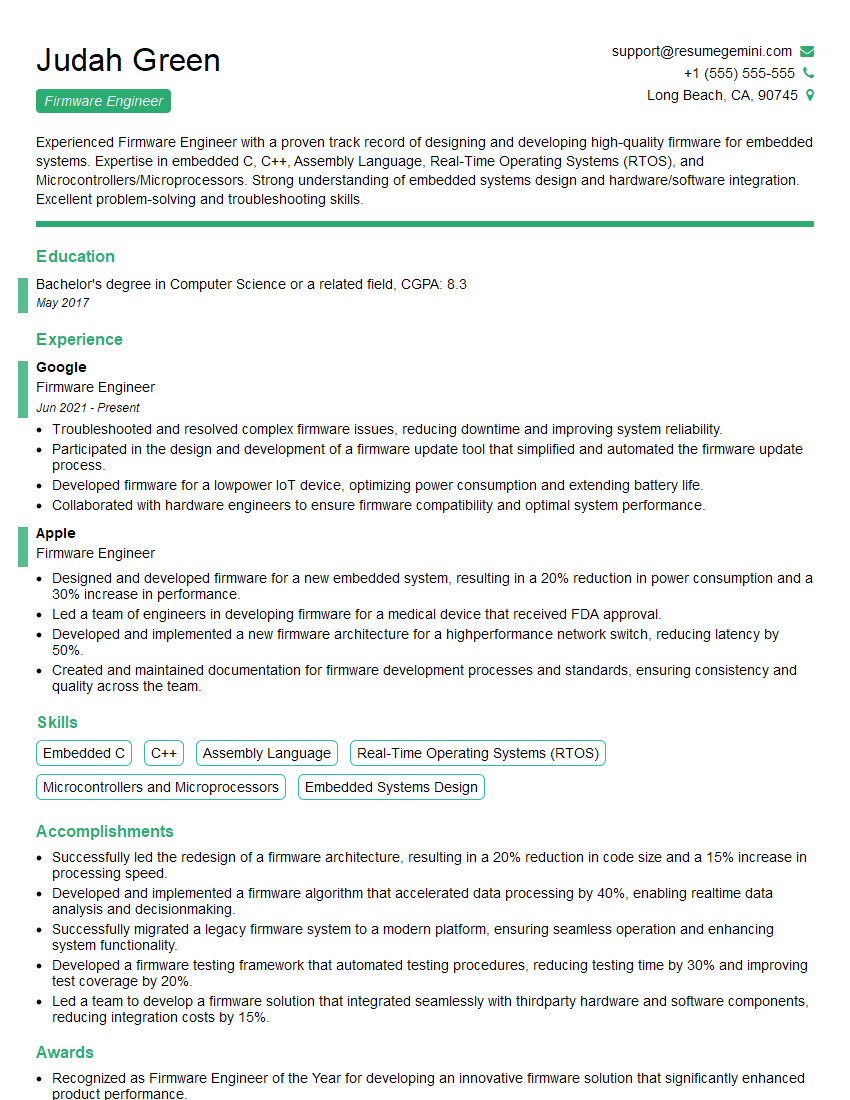
Mastering Sensor and Platform Knowledge is crucial for career advancement in fields like IoT, robotics, and automation. A strong understanding of these concepts significantly enhances your problem-solving abilities and opens doors to exciting opportunities. To increase your chances of landing your dream role, it’s essential to create a resume that showcases your skills effectively. An ATS-friendly resume is key to getting past applicant tracking systems and into the hands of hiring managers. We strongly encourage you to utilize ResumeGemini, a trusted resource for building professional and impactful resumes. ResumeGemini provides examples of resumes specifically tailored to Sensor and Platform Knowledge roles to help guide you.


Explore more articles
Users Rating of Our Blogs
Share Your Experience
We value your feedback! Please rate our content and share your thoughts (optional).
What Readers Say About Our Blog
To the interviewgemini.com Webmaster.
Very helpful and content specific questions to help prepare me for my interview!
Thank you
To the interviewgemini.com Webmaster.
This was kind of a unique content I found around the specialized skills. Very helpful questions and good detailed answers.
Very Helpful blog, thank you Interviewgemini team.