Cracking a skill-specific interview, like one for Silicone Glazing, requires understanding the nuances of the role. In this blog, we present the questions you’re most likely to encounter, along with insights into how to answer them effectively. Let’s ensure you’re ready to make a strong impression.
Questions Asked in Silicone Glazing Interview
Q 1. What types of silicone sealants are commonly used in glazing applications?
Silicone sealants used in glazing are specifically formulated for structural integrity and weather resistance. They are categorized primarily by their cure mechanism and chemical composition. Common types include:
- Acetic-cure silicone: This type cures by releasing acetic acid (vinegar). It’s cost-effective but can sometimes have a slight vinegar smell during curing and may not be suitable for all substrates, particularly those sensitive to acids.
- Neutral-cure silicone: This option cures without releasing any significant byproducts, making it ideal for sensitive substrates like stone and marble. It generally has a longer cure time than acetic-cure but offers superior adhesion and durability.
- Oxime-cure silicone: A newer type known for its very low odor and fast cure time. It’s often preferred for indoor applications where odor control is critical.
- High-modulus silicone: These sealants have a higher elasticity and tensile strength, making them particularly suitable for applications that experience significant movement or stress, such as curtain walls.
The choice of sealant depends on factors such as substrate material, environmental conditions, and the specific requirements of the glazing system. A detailed specification is crucial to selecting the right sealant.
Q 2. Explain the process of applying silicone sealant for structural glazing.
Applying silicone sealant for structural glazing is a precise process that demands meticulous attention to detail. It generally involves these steps:
- Surface Preparation: Thorough cleaning of the substrates (glass, metal frames) is paramount. This involves removing dust, debris, grease, and any existing sealant. Primers may be necessary depending on the substrate to enhance adhesion.
- Backer Rod Installation (If Applicable): For wider joints, a backer rod is inserted to control the sealant’s depth and minimize the amount of sealant needed, improving its efficiency and preventing sagging.
- Sealant Application: Using a caulking gun, apply the sealant in a continuous bead, ensuring full contact with the substrate. Tools like smoothing tools or finishing tools are crucial for creating a neat, uniform finish. Proper tooling is important for aesthetics and structural integrity.
- Tooling: Immediately after application, the sealant is tooled using a suitable tool – plastic, rubber or metal – to achieve a smooth, consistent profile. It helps to spread the sealant evenly and remove air bubbles. This step is crucial for aesthetics and ensures proper adhesion to both sides of the joint.
- Curing: The sealant needs sufficient time to cure according to the manufacturer’s instructions. Factors like temperature and humidity affect curing time. Proper ventilation may be required for some types of sealants.
The entire process demands adherence to strict quality control standards and skilled craftsmanship. Improper application can lead to sealant failure and compromise the integrity of the glazing system.
Q 3. What are the different methods for cleaning silicone sealant during and after application?
Cleaning silicone sealant is essential for both aesthetic and functional reasons. Methods vary depending on the stage of application:
- During Application: Fresh, uncured silicone can be easily removed with a solvent-dampened cloth or a specialized silicone remover. Speed is critical as the sealant cures quickly. Always refer to the manufacturer’s recommendations for specific solvents.
- After Application (Cured Sealant): Once cured, removing silicone is far more challenging. Mechanical methods like scraping with a razor blade, carefully applied, might be necessary, but this risks damaging the surrounding surfaces. Chemical removal is possible but should be done cautiously, always adhering to safety precautions and product instructions, as some chemicals are strong.
It’s worth noting that preventative measures, like precise application and careful tooling, significantly reduce the need for cleaning. The best cleaning strategy is always a combination of precision during application and careful selection of cleaning agents based on the type of sealant and substrate.
Q 4. How do you ensure proper adhesion of silicone sealant to different substrates?
Ensuring proper adhesion of silicone sealant is crucial for a long-lasting and watertight seal. This depends on several factors:
- Substrate Compatibility: The sealant must be compatible with the substrate materials (e.g., glass, aluminum, steel, concrete). Choosing a sealant specifically designed for the substrate is essential. Refer to the manufacturer’s compatibility charts.
- Surface Preparation: As mentioned earlier, a clean, dry surface is critical. Grease, dust, and other contaminants can significantly reduce adhesion. Prime surfaces when recommended by the sealant manufacturer for optimal bonding.
- Joint Design: Proper joint design minimizes movement and stress on the sealant. The width and depth of the joint should be appropriate for the selected sealant and the expected movement. Backer rod and proper joint geometry help distribute stress.
- Temperature and Humidity: Environmental conditions influence both the curing process and the adhesion of the sealant. Extremes of temperature and humidity can hinder adhesion. Following the manufacturer’s recommendations regarding temperature and humidity during application and curing is crucial.
Proper preparation and adherence to manufacturer guidelines are key to ensuring strong, long-lasting adhesion.
Q 5. What are the common failure modes of silicone glazing systems?
Silicone glazing systems, despite their durability, can fail due to various factors:
- Adhesion Failure: Poor surface preparation or incompatibility between the sealant and substrate leads to debonding, allowing water ingress.
- Cohesion Failure: The sealant itself may fail due to poor quality, incorrect application, or excessive stress from movement. This can manifest as cracks or splitting in the sealant.
- Chemical Degradation: Exposure to UV radiation, chemicals, or extreme temperatures can degrade the sealant, reducing its elasticity and adhesion.
- Movement-related failures: Excessive movement in the building structure, exceeding the sealant’s design capabilities, can cause cracking or failure.
- Improper Joint Design: Incorrect joint design or geometry can concentrate stress on the sealant leading to premature failure.
Regular inspection is essential to identify potential problems early on. A proactive approach to maintenance significantly extends the lifespan of silicone glazing systems.
Q 6. Describe your experience with different types of glazing systems (e.g., unitized, stick-built).
My experience encompasses both unitized and stick-built glazing systems. Unitized systems, where the entire glazing unit is pre-assembled off-site, provide excellent quality control and a faster installation process. However, they can be more expensive and less flexible for complex projects. I’ve worked on numerous large-scale projects using unitized systems, from high-rise buildings to stadium facades, gaining expertise in their design and sealant selection. Stick-built systems, where the glazing is assembled on-site, offer greater flexibility in design and are often preferred for smaller or more complex projects. I have hands-on experience in both the challenges and benefits of this approach, from managing sealant application in varied weather conditions to addressing on-site issues.
In both scenarios, proper sealant selection and application are crucial. The specific requirements for sealant properties, like modulus and cure type, vary depending on the system, building movement, and environmental factors. I’ve found that meticulous attention to detail in every step, from planning to execution, is essential for success in either system.
Q 7. How do you inspect silicone glazing for defects?
Inspecting silicone glazing for defects requires a systematic approach. It typically involves a visual inspection combined with close examination. I would look for:
- Cracks or Gaps: Visible cracks in the sealant indicate cohesion failure, compromising the seal’s integrity.
- Debonding: Separation of the sealant from the substrate indicates adhesion failure, often appearing as gaps or lifting of the sealant.
- Sagging or Uneven Application: Uneven application or sagging suggests improper installation techniques.
- Discoloration or Staining: Discoloration might signify chemical degradation or staining from environmental factors.
- Water Staining or Leakage: Evidence of water ingress points to a compromised seal and potential structural issues.
Beyond visual inspection, non-destructive testing methods such as ultrasonic testing may be employed in critical applications to assess the integrity of the sealant bond. A thorough inspection report, including photographic documentation, is crucial for record-keeping and future maintenance planning.
Q 8. What safety precautions are essential when working with silicone sealant?
Safety is paramount when working with silicone sealant. Silicone itself isn’t inherently dangerous, but improper handling can lead to issues. Always wear appropriate personal protective equipment (PPE), including gloves (nitrile is recommended), safety glasses to protect your eyes from splashes, and a respirator, especially in poorly ventilated areas, to avoid inhaling fumes. Proper ventilation is crucial; work in well-ventilated spaces or use exhaust fans. Skin contact should be avoided; if it occurs, wash the affected area thoroughly with soap and water. Finally, always follow the manufacturer’s safety data sheet (SDS) for the specific silicone sealant being used, as formulations can vary.
For example, I once worked on a high-rise project where we were glazing curtain walls. We meticulously followed PPE protocols, ensuring every team member wore respirators because of the confined spaces and the amount of sealant used. This prevented any respiratory issues.
Q 9. What are the limitations of silicone sealants in specific environmental conditions?
Silicone sealants, while versatile, have limitations. Extreme temperatures, both high and low, can affect their performance. Prolonged exposure to high temperatures can lead to premature curing and hardening, while very low temperatures can hinder proper curing and make the sealant brittle. UV exposure can also degrade some silicone sealants over time, causing them to lose flexibility and become discolored. Additionally, certain chemicals, like solvents, can attack and degrade the sealant. Finally, the type of silicone matters. Acetic cure silicone, for instance, can sometimes release a vinegar-like odor during curing that might not be suitable for all environments.
Imagine a project in a desert environment. We would need to select a silicone specifically formulated for high-temperature resistance to prevent premature failure. Conversely, in an arctic climate, a sealant designed for low-temperature flexibility would be essential.
Q 10. Explain the importance of proper surface preparation before silicone glazing installation.
Proper surface preparation is the cornerstone of successful silicone glazing. A clean, dry, and properly primed surface is critical for adhesion. Failure to properly prepare the surface will almost certainly lead to sealant failure. The surface must be free of dust, grease, oil, loose particles, and any other contaminants that could hinder adhesion. This often involves cleaning with a suitable solvent, followed by a thorough drying. Priming, using a primer compatible with both the sealant and the substrate, further enhances adhesion, especially on porous materials. This step is often crucial for long-term durability.
For instance, on a project involving aluminum framing, we meticulously cleaned the surfaces using isopropyl alcohol to remove any manufacturing residue before applying a suitable primer for optimal bonding. This ensured a lasting seal.
Q 11. How do you determine the correct amount of silicone sealant required for a project?
Determining the correct amount of sealant requires careful calculation. This involves measuring the length and width of the joint where the sealant will be applied. The depth of the joint is also crucial. Manufacturers provide bead size recommendations for their products; these are usually expressed in terms of diameter or cross-sectional area. By multiplying the length, width, and depth of the joint, you obtain the volume needed. Always add a small contingency to account for waste or potential errors. Don’t underestimate the importance of precise measurements; too little sealant leads to gaps, while too much can cause extrusion and messy results.
I often use simple geometrical calculations and factor in a 10-15% extra amount to ensure I have enough material and avoid costly delays in the project.
Q 12. What are the different types of tools and equipment used in silicone glazing?
Silicone glazing involves specialized tools. A caulking gun is essential for dispensing the sealant accurately. Various nozzle sizes are available to achieve different bead profiles. A smoothing tool, such as a wet finger or a specially designed silicone smoother, is vital for creating a neat and even bead. Cleaning tools, like solvent-soaked rags or brushes, are necessary for cleaning up spills and excess sealant. Measuring tapes, scrapers, and putty knives are also commonly used. For larger projects, pneumatic caulking guns can significantly increase efficiency. Finally, personal protective equipment (PPE) is also considered a critical tool.
For example, I often prefer using a small, rounded smoothing tool for creating aesthetically pleasing, consistent beads on visible joints.
Q 13. How do you handle challenges like sealant extrusion or uneven bead application?
Sealant extrusion, where the sealant bulges out of the joint, and uneven bead application are common challenges. Extrusion is often caused by applying too much sealant or insufficient joint depth. Uneven application can result from improper technique or using the wrong nozzle size. To address extrusion, ensure the correct amount of sealant is used and that the joint depth is appropriate. Too much sealant can often be removed using a sharp scraper or a solvent (after curing) for cleaning. For uneven beads, practice makes perfect. Use a consistent pressure on the caulking gun and ensure the nozzle is properly aligned. Smoothing tools are crucial for a professional finish. Paying close attention to detail and using the correct tools are key.
In one instance, I addressed extrusion by first carefully removing the excess sealant using a sharp blade and then using a smoothing tool for touch ups. The result was a perfect finish.
Q 14. How do you ensure compliance with building codes and regulations during silicone glazing?
Compliance with building codes and regulations is crucial. These codes specify requirements for sealant type, performance characteristics (e.g., movement capability, adhesion strength), and application methods. These requirements vary depending on the location and building type. Before starting any project, thoroughly review the relevant building codes and standards, and ensure the chosen sealant meets all necessary requirements. This often involves obtaining certifications or test reports demonstrating that the sealant conforms to the specifications. Proper documentation of the materials and installation methods is critical for demonstrating compliance.
On a recent high-rise project, we ensured compliance by using a sealant that met the specific requirements for fire resistance and structural integrity as outlined in the relevant building codes. We also meticulously documented all aspects of the installation process, including the type of sealant, surface preparation, and application method.
Q 15. Describe your experience with different types of silicone sealant tooling.
My experience with silicone sealant tooling spans a wide range, from basic hand tools to specialized pneumatic applicators. Hand tools, like caulking guns, are suitable for smaller projects and allow for precise control, especially in tight spaces. However, for large-scale projects or those demanding high speed and consistency, pneumatic guns are invaluable. These power tools significantly reduce application time and effort, ensuring a uniform bead size. I’ve also worked with specialized nozzles designed to create specific bead profiles – from rounded beads for aesthetic purposes to more angular beads for structural integrity in certain glazing applications. Furthermore, I’m proficient in using backer rods, which are crucial for optimizing sealant performance by controlling the depth and volume of the sealant applied. Finally, I utilize cleaning tools like solvents and scrapers for cleanup and ensuring a professional finish.
- Caulking Guns: Essential for manual application, offering excellent control for intricate details.
- Pneumatic Caulking Guns: Boost efficiency and consistency on large projects, minimizing fatigue.
- Nozzles: Variety of shapes and sizes ensures precise bead formation.
- Backer Rods: Critical for managing sealant depth and optimizing bond strength.
- Cleaning Tools: Solvents, scrapers, and rags ensure a clean and professional final product.
Career Expert Tips:
- Ace those interviews! Prepare effectively by reviewing the Top 50 Most Common Interview Questions on ResumeGemini.
- Navigate your job search with confidence! Explore a wide range of Career Tips on ResumeGemini. Learn about common challenges and recommendations to overcome them.
- Craft the perfect resume! Master the Art of Resume Writing with ResumeGemini’s guide. Showcase your unique qualifications and achievements effectively.
- Don’t miss out on holiday savings! Build your dream resume with ResumeGemini’s ATS optimized templates.
Q 16. What are the key factors to consider when selecting a silicone sealant for a project?
Selecting the right silicone sealant requires careful consideration of several key factors. First and foremost is the application – interior vs. exterior, above or below grade. Exterior applications demand sealants with superior UV resistance and weatherability. The substrate is another critical factor. The sealant must adhere strongly to the materials being joined, whether it’s glass, metal, stone, or concrete. Compatibility testing is often essential here. Movement capabilities are also paramount; the sealant must be able to accommodate the expansion and contraction of building materials without cracking or failing. We need to consider the required elongation and movement capacity. Then we need to consider chemical resistance. Certain sealants resist specific chemicals, which is critical in industrial or chemical settings. Finally, aesthetic considerations such as color and gloss level play a role in choosing a suitable sealant for a project’s overall appearance.
Q 17. How do you troubleshoot common issues encountered during silicone glazing installation?
Troubleshooting silicone glazing installation problems often begins with identifying the root cause. Common issues include poor adhesion, sealant cracking, and excessive bead sagging. Poor adhesion usually stems from inadequate surface preparation – dirt, grease, or moisture can prevent proper bonding. The solution involves thorough cleaning and priming of the surfaces. Cracking can result from using an incompatible sealant or from excessive movement exceeding the sealant’s capabilities. Here, selecting a sealant with higher movement capacity is key, or using movement joints to manage expansion and contraction. Sagging usually occurs when applying too thick a bead or using a sealant with poor slump resistance; proper bead size and the use of backer rods can resolve this. In more complex situations, I might need to conduct further testing to determine the exact cause of failure, potentially involving material analysis or laboratory testing of the sealant.
- Poor Adhesion: Clean and prime surfaces.
- Cracking: Use a sealant with higher movement capacity, or install movement joints.
- Sagging: Use proper bead size and backer rods.
Q 18. Explain the concept of movement joints in silicone glazing systems.
Movement joints are critical in silicone glazing systems, accommodating the expansion and contraction of building materials caused by temperature fluctuations and other environmental factors. Think of them as controlled breaks within the glazing system. If these movements aren’t accommodated, stresses can build, leading to cracking in the sealant or the glazing itself. Movement joints are designed and installed to allow for this movement, preventing damage. They’re typically incorporated at intervals along a glazing run or around corners, where stresses are most likely to accumulate. The size and spacing of these joints depend on the type of materials used, expected thermal movement, and project-specific design requirements. It’s like having expansion joints in a road – they allow the road to move with temperature changes without cracking.
Q 19. What are the different types of testing performed on silicone sealant?
Silicone sealants undergo rigorous testing to ensure they meet performance specifications. Common tests include:
- Tensile Strength Test: Measures the sealant’s ability to withstand pulling forces.
- Elongation Test: Measures the sealant’s ability to stretch before breaking, crucial for movement accommodation.
- Adhesion Test: Evaluates the sealant’s bond strength to different substrates.
- UV Resistance Test: Assesses the sealant’s ability to withstand prolonged exposure to sunlight.
- Water Absorption Test: Measures the amount of water the sealant absorbs, affecting durability and longevity.
- Chemical Resistance Test: Determines the sealant’s resistance to various chemicals and cleaning agents.
- Hardness Test: Measures the sealant’s firmness and resistance to abrasion.
These tests provide critical data confirming the sealant’s suitability for a specific application and guarantee its performance over time.
Q 20. What is the proper curing time for silicone sealant and how does it impact the application?
The curing time for silicone sealant varies depending on the specific product, environmental conditions (temperature and humidity), and the sealant’s depth. Generally, a surface cure occurs relatively quickly, within hours, allowing for handling and further construction. However, full cure – reaching the maximum strength and chemical resistance – can take several days, or even weeks. This full cure is essential for optimal performance and longevity. Premature stress on the sealant before full cure can lead to failure. Therefore, it is crucial to follow the manufacturer’s instructions precisely regarding curing time and any necessary precautions, such as protecting the sealant from extreme temperatures or moisture during the curing phase. Think of it like baking a cake; you need adequate time for the cake to set and reach its full potential.
Q 21. How do you address compatibility issues between different materials and silicone sealant?
Compatibility issues between different materials and silicone sealant can lead to adhesion failure, cracking, or other problems. Before applying the sealant, it’s essential to check the manufacturer’s data sheet for compatibility information. If compatibility is uncertain, a small-scale test should be conducted to assess adhesion and performance. Often, a primer specifically designed for the substrate is used to improve adhesion and compatibility. For example, when using silicone sealant with certain plastics or metals, a primer can provide a better chemical bond, enhancing the durability and longevity of the sealant. Ignoring compatibility issues can result in costly repairs or even system failure, emphasizing the importance of thorough investigation before project commencement.
Q 22. Describe your experience with different types of glazing substrates.
My experience encompasses a wide range of glazing substrates commonly used in silicone glazing applications. This includes various types of glass, from annealed and heat-strengthened to fully tempered and laminated glass. I’ve also worked extensively with various metal substrates, including aluminum, stainless steel, and galvanized steel, each requiring specific considerations regarding surface preparation and sealant adhesion. Furthermore, I’m familiar with working with stone, composite materials, and even certain types of plastics, understanding the unique challenges each presents in terms of expansion and contraction rates and sealant compatibility.
- Glass: Different glass types have varying surface energy and thermal properties, impacting sealant adhesion and long-term performance. Tempered glass, for instance, requires careful handling to prevent damage and ensure proper sealant application.
- Metals: Metal substrates can corrode, requiring proper surface treatment like cleaning and priming to prevent this from compromising the bond. The coefficient of thermal expansion needs to be carefully considered to prevent stress on the sealant.
- Stone & Composites: Porous substrates like stone require specific primers to enhance adhesion. Composite materials demand a thorough understanding of their chemical composition to ensure compatibility with the silicone sealant.
Q 23. What is the importance of maintaining proper documentation during a silicone glazing project?
Maintaining meticulous documentation is crucial for the success and longevity of any silicone glazing project. It serves as a vital record for future maintenance, warranty claims, and liability protection. Comprehensive documentation ensures everyone involved, from the installers to future building owners, understands the system’s specifications and history.
- Material specifications: Detailed records of the silicone sealant used (manufacturer, product code, batch number, and test results) are essential. This allows for easy replacement with the same material in the future.
- Installation details: Photos, drawings, and precise measurements of joint dimensions and locations are key. This helps track the installation process and identify any potential issues.
- Inspection reports: Regular inspection reports documenting the condition of the silicone glazing at various stages of the project are vital for quality control and early detection of potential problems.
- Maintenance logs: A detailed maintenance log tracks cleaning, repair, and replacement activities, allowing for informed decision-making about future maintenance schedules.
Think of it like a medical chart for the building’s facade; it provides a complete history allowing for informed decisions and proactive maintenance.
Q 24. How do you determine the proper joint design for silicone glazing applications?
Designing the proper joint for silicone glazing involves considering several critical factors to ensure structural integrity, water tightness, and longevity. Joint design is a balance between aesthetics and performance.
- Joint width: The joint width should be appropriate for the expected movement and the type of silicone sealant used. Too narrow a joint can restrict movement and lead to sealant failure; too wide a joint can compromise aesthetics and water tightness.
- Joint depth: Sufficient joint depth ensures that the sealant is adequately supported and protected from environmental factors.
- Joint profile: The joint profile impacts the sealant’s ability to withstand movement. A properly designed joint helps accommodate expansion and contraction without stress on the sealant.
- Substrate compatibility: The joint design must account for the properties of the substrates being joined. This includes factors like their coefficient of thermal expansion and surface properties.
- Movement accommodation: Joints must be designed to accommodate expected movement due to temperature fluctuations, wind loading, and building settlement. This often involves using backer rods to control the joint’s geometry.
For example, a large glass panel might require a wider joint than a small one to accommodate greater movement, potentially using a structural silicone with superior movement capabilities. Accurate calculations and adherence to industry standards are crucial.
Q 25. Explain your understanding of the service life of silicone sealant and factors influencing it.
The service life of silicone sealant can vary greatly depending on several factors, making it crucial to choose the right sealant for the specific application and climate. High-quality sealants, properly installed and maintained, can last for decades, while poorly selected or installed sealants may fail within a few years.
- Sealant Quality: High-quality silicone sealants from reputable manufacturers offer superior UV resistance, weather resistance, and durability. The chosen sealant should meet relevant industry standards.
- Environmental Factors: Exposure to UV radiation, temperature extremes, moisture, and pollutants can significantly affect the sealant’s lifespan. Coastal environments, for instance, present more challenges due to salt exposure.
- Substrate Compatibility: Proper surface preparation and primer selection ensure good adhesion and prevent premature sealant failure.
- Joint Design: An improperly designed joint can place excessive stress on the sealant, leading to early failure. Factors like joint width, depth, and profile are critical.
- Installation Techniques: Correct application procedures, including proper tooling and curing time, are essential for optimal performance.
- Maintenance: Regular cleaning and inspection can extend the sealant’s service life by preventing the build-up of dirt, debris, and other contaminants.
For example, a silicone sealant used in a constantly shaded, sheltered location might last significantly longer than one exposed to direct sunlight and harsh weather conditions.
Q 26. How do you manage the waste produced during silicone glazing installation?
Waste management during silicone glazing installation is crucial for environmental responsibility and compliance with local regulations. This involves careful planning and execution to minimize waste and ensure proper disposal.
- Pre-installation planning: Accurate measurements and material ordering reduce excess materials and waste generation. Utilizing pre-fabricated components wherever possible can also help.
- Waste segregation: Separating waste materials (e.g., silicone tubes, packaging, cleaning materials) for proper recycling or disposal simplifies the process and reduces environmental impact.
- Spill control: Spills should be cleaned promptly and properly, using appropriate cleaning agents and following safety protocols.
- Disposal procedures: Used silicone sealant and other waste materials must be disposed of in compliance with local regulations, often involving specialized waste collection services.
- Sustainable practices: Choosing environmentally friendly sealants and using techniques to minimize waste demonstrates a commitment to sustainability.
For instance, we often use reusable containers for cleaning materials to minimize single-use plastic waste, and leftover silicone sealant is carefully stored and used in subsequent projects, whenever possible, to minimise waste.
Q 27. What are the best practices for maintaining and repairing silicone glazing systems?
Maintaining and repairing silicone glazing systems is essential for preserving their performance and extending their lifespan. Regular inspections and proactive maintenance are key to preventing costly repairs.
- Regular Inspections: Visual inspections should be conducted at least annually, checking for cracks, gaps, discoloration, and other signs of sealant degradation.
- Cleaning: Regular cleaning removes dirt, debris, and contaminants that can compromise the sealant’s performance. Gentle cleaning methods and suitable cleaning agents are crucial.
- Minor Repairs: Small cracks or gaps can often be repaired by carefully removing the damaged sealant and applying fresh sealant. This requires skilled workmanship to ensure a proper bond.
- Major Repairs: Extensive damage may require complete sealant replacement, potentially involving removing and reinstalling sections of the glazing system. This requires careful planning and execution.
- Documentation: Maintaining detailed records of all maintenance and repair activities helps track the system’s condition and facilitates future maintenance planning.
Analogy: Think of it like car maintenance. Regular checks and timely minor repairs prevent major problems and expensive overhauls down the line.
Q 28. Describe a challenging silicone glazing project you worked on and how you overcame the challenges.
One challenging project involved installing silicone glazing on a curved glass facade of a high-rise building. The curvature presented several complexities, requiring precise sealant application and careful consideration of movement accommodation. The main challenges included:
- Difficult access: Working at significant heights required specialized equipment and safety precautions.
- Precise sealant application: Ensuring uniform sealant application on a curved surface was crucial for both aesthetics and performance. We utilized specialized tooling and techniques to achieve this.
- Movement accommodation: The curvature and height of the building introduced considerable movement, requiring a sealant with high elongation properties and a joint design that could effectively accommodate this movement. We carefully calculated the joint widths and profiles, incorporating backer rods of appropriate dimensions to mitigate stress on the sealant.
- Weather conditions: Unpredictable weather impacted work progress and required adjustments to scheduling and safety protocols.
We overcame these challenges through meticulous planning, employing experienced and highly skilled installers, utilizing specialized equipment, and consistently adhering to strict quality control measures. Regular progress meetings and close coordination with the project team were critical to successful project completion.
Key Topics to Learn for Silicone Glazing Interview
- Silicone Glazing Chemistry: Understanding the properties of silicone and its interaction with various substrates (glass, metal, etc.). This includes knowledge of curing mechanisms and adhesion characteristics.
- Application Techniques: Mastering different application methods such as beading, caulking, and automated dispensing. Understanding the impact of environmental factors (temperature, humidity) on application and curing.
- Structural Integrity & Failure Analysis: Knowledge of how silicone glazing contributes to the overall structural integrity of a building envelope. Understanding potential failure modes and how to prevent them (e.g., movement joints, stress concentrations).
- Quality Control & Testing: Familiarization with industry standards and testing procedures to ensure the quality and longevity of silicone glazing installations. This includes understanding relevant certifications and compliance requirements.
- Health & Safety: Understanding the health and safety implications associated with handling and applying silicone glazing materials, including proper personal protective equipment (PPE) and waste disposal practices.
- Specific Silicone Types & Applications: Explore the differences between various types of silicone sealants (e.g., neutral cure, acidic cure) and their suitability for different applications (e.g., curtain walls, windows, skylights).
- Troubleshooting & Problem Solving: Developing the ability to identify and address common issues encountered during the installation and maintenance of silicone glazing systems. This could involve understanding adhesion problems, sealant degradation, or movement joint design flaws.
Next Steps
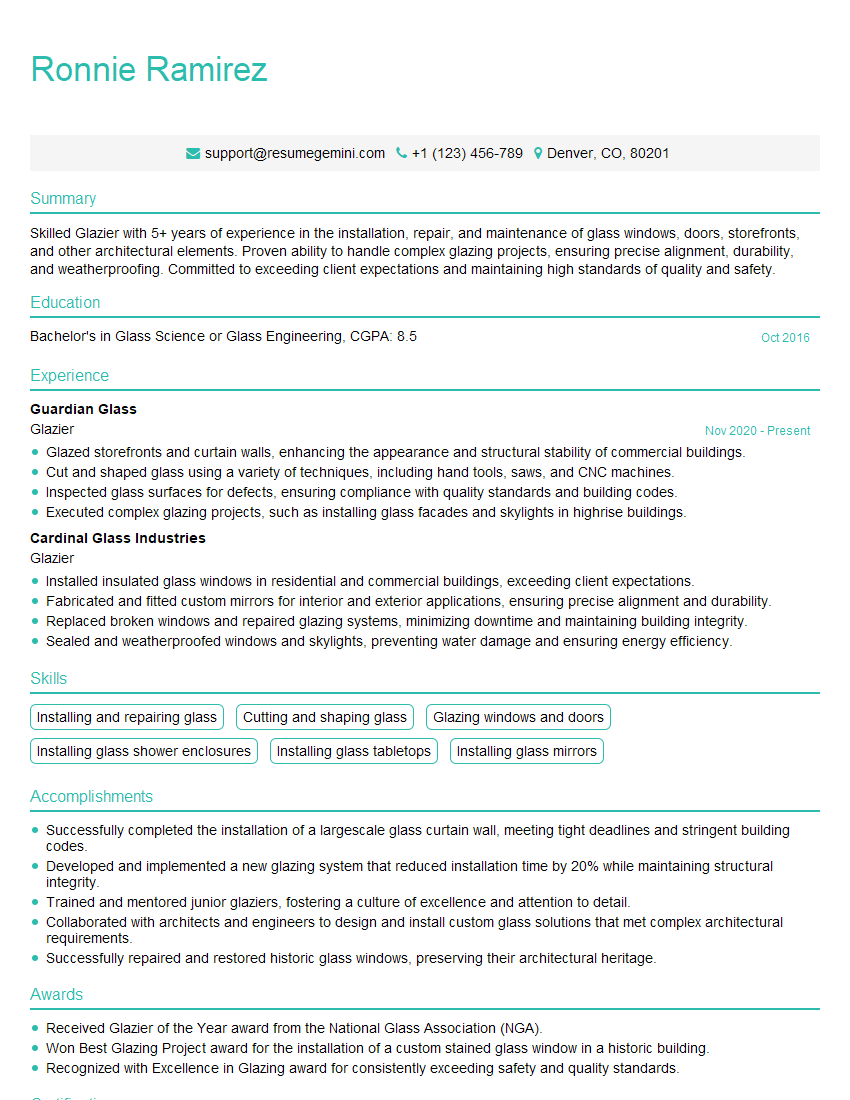
Mastering silicone glazing opens doors to exciting career opportunities in the construction and building envelope industries. A strong understanding of these technical aspects is crucial for securing your dream role. To significantly improve your chances, focus on creating a professional, ATS-friendly resume that highlights your skills and experience effectively. ResumeGemini is a trusted resource to help you build a compelling resume that showcases your expertise. They offer examples of resumes tailored to the Silicone Glazing industry to help you create a winning application.
Explore more articles
Users Rating of Our Blogs
Share Your Experience
We value your feedback! Please rate our content and share your thoughts (optional).
What Readers Say About Our Blog
To the interviewgemini.com Webmaster.
Very helpful and content specific questions to help prepare me for my interview!
Thank you
To the interviewgemini.com Webmaster.
This was kind of a unique content I found around the specialized skills. Very helpful questions and good detailed answers.
Very Helpful blog, thank you Interviewgemini team.