Preparation is the key to success in any interview. In this post, we’ll explore crucial Solar Panel Installation and Wiring interview questions and equip you with strategies to craft impactful answers. Whether you’re a beginner or a pro, these tips will elevate your preparation.
Questions Asked in Solar Panel Installation and Wiring Interview
Q 1. Explain the difference between series and parallel wiring in solar panel arrays.
Series and parallel wiring are fundamental methods for connecting solar panels in an array to optimize voltage and current output. Think of it like adding batteries: series increases voltage, parallel increases current.
Series Wiring: Panels are connected end-to-end, + to -, increasing the total voltage of the array. If each panel produces 36V, three panels in series would output 108V. The current remains the same as a single panel. This is beneficial for systems needing higher voltage, such as those far from the inverter.
Parallel Wiring: Panels are connected + to + and – to -, increasing the total current. Three 36V panels in parallel still output 36V, but the current triples. This is useful when you need higher current at a lower voltage, or when dealing with shading, where a parallel connection helps to mitigate the performance impact of a shaded panel.
The choice depends on the inverter’s requirements and the system design. A system might use a combination of series and parallel connections to achieve the optimal voltage and current for maximum power output.
Q 2. Describe the process of grounding a solar panel system.
Grounding a solar panel system is crucial for safety, protecting against electrical shocks and preventing damage from lightning strikes. It provides a low-resistance path for fault currents to flow to the earth, preventing dangerous voltage buildup.
The process typically involves connecting the system’s metal framework (racks, mounting hardware) and the grounding lug of the inverter (and sometimes individual panels) to a properly sized grounding rod driven deep into the earth. This grounding rod should be connected to the grounding system of the building using appropriately sized copper wire. Local electrical codes will dictate specific requirements for grounding rod placement, depth, and conductor size. Proper grounding is essential and should only be done by qualified personnel.
Think of it like a safety valve – if a surge or fault occurs, the electricity safely goes into the ground instead of causing harm.
Q 3. What safety precautions must be taken when working with solar panels and high-voltage DC systems?
Working with solar panels and high-voltage DC systems requires stringent safety measures. Even seemingly low voltages can be lethal.
Lockout/Tagout (LOTO): Always disconnect the system from the power source and use LOTO procedures to prevent accidental re-energizing. This is non-negotiable.
Personal Protective Equipment (PPE): Use insulated tools, gloves, and safety glasses. Appropriate footwear is critical. Never work on a wet or damp surface.
Arc Flash Protection: High-voltage DC systems can generate potentially deadly arcs. Appropriate PPE including arc flash suits might be needed for certain tasks.
Training and Certification: Only qualified and trained personnel should work on solar panel systems. Proper training is crucial to understand risks and safe working practices.
Voltage Testing: Before any work, use a non-contact voltage detector to verify that the system is de-energized. Always double-check.
Remember: Safety is paramount. A moment of carelessness can lead to severe injury or death.
Q 4. How do you determine the correct size of wire for a given solar panel array?
Determining the correct wire size involves considering the current, voltage, and distance the wire will carry power. The National Electrical Code (NEC) and other relevant standards provide tables to guide this calculation. Oversizing wires is generally preferred to minimize voltage drop and heat buildup.
Key factors:
- Ampacity: The maximum current a wire can safely carry. This is determined by the wire’s material (usually copper), gauge, and insulation type.
- Voltage Drop: The reduction in voltage as electricity flows through a wire. Excessive voltage drop reduces system efficiency. Calculations will account for this.
- Length of Run: Longer wire runs lead to higher voltage drops, requiring thicker wires.
Software or online calculators can simplify the process by inputting factors such as the system’s maximum current, voltage, and wire length. Consult the NEC and local codes for specific requirements.
Q 5. What are the common causes of voltage drop in a solar panel system?
Voltage drop in a solar panel system reduces its efficiency and power output. Several factors contribute:
Undersized Wiring: Using wires with insufficient ampacity leads to higher resistance and increased voltage drop.
Long Wire Runs: The longer the distance electricity travels, the greater the voltage drop.
High Current Loads: Drawing significant current from the system increases voltage drop across the wires.
Corrosion or Loose Connections: Corrosion or loose connections increase resistance at these points and lead to localized voltage drop.
Poor Quality Connectors: Inadequate connectors with high contact resistance contribute to voltage drop.
Regular inspections and maintenance, including checking for corrosion and loose connections, are critical for maintaining optimal system performance.
Q 6. Explain the function of a solar charge controller.
A solar charge controller regulates the flow of electricity from the solar panels to the battery bank. Its primary function is to prevent overcharging, which can damage the batteries, and to ensure that the batteries receive the appropriate amount of charge for optimal performance.
Key functions:
Overcharge Protection: Prevents excess current from damaging batteries once they’re fully charged.
Over-discharge Protection: Prevents batteries from discharging below their minimum voltage, extending their lifespan.
Voltage Regulation: Maintains a consistent voltage to optimize charging efficiency.
Current Limiting: Limits the current flowing to the batteries to prevent overheating and damage.
Different types of charge controllers (PWM, MPPT) exist, each with its own charging profile to optimize battery charging based on the type of battery being used. They’re essential for the longevity and efficiency of the battery system.
Q 7. How do you troubleshoot a solar panel system that is not producing the expected power output?
Troubleshooting a low-performing solar panel system involves systematic checking of all components. Think of it like a detective investigation – you need to gather clues to find the culprit.
A step-by-step approach:
Visual Inspection: Check for obvious issues – shading on panels, damaged wires, loose connections, signs of overheating.
Measure Voltage and Current: Use a multimeter to measure the voltage and current at various points in the system: individual panels, strings, at the input of the charge controller and inverter. This identifies where voltage or current is dropping off.
Check the Inverter: Ensure the inverter is functioning correctly and is receiving power. Check for error codes.
Inspect the Charge Controller: Make sure the charge controller is functioning and not reporting any errors. Verify its settings are appropriate for the battery type.
Test Batteries (if applicable): Check battery voltage and state of charge. Low battery voltage indicates an insufficient charge. Test battery health if possible.
Clean Solar Panels: Accumulated dirt and debris can reduce power output significantly. Clean panels can restore performance.
If the issue persists, seek help from a qualified solar technician. They have the tools and expertise for advanced diagnostics.
Q 8. What are the different types of solar inverters and their applications?
Solar inverters are crucial components in a photovoltaic (PV) system, converting the direct current (DC) electricity generated by solar panels into alternating current (AC) electricity usable in homes and businesses. There are several types, each with its own strengths and weaknesses:
- String Inverters: These are the most common and cost-effective type. They connect multiple solar panels in series (a ‘string’) and convert the DC power from that string to AC. They are simple to install but less efficient if one panel in the string is shaded or faulty, as it affects the entire string’s output. Think of them like a single processing unit for a group of panels.
- Microinverters: Each solar panel has its own microinverter, converting the DC power individually to AC. This offers superior efficiency because shading or faults on one panel don’t impact others. They’re more expensive upfront, but often lead to higher energy production over the system’s lifetime. Imagine each panel having its own tiny power station.
- Power Optimizers: These sit between the panel and the string inverter. They maximize power output from each panel individually, mitigating the effects of shading and panel mismatch. They’re a compromise between string inverters and microinverters in terms of cost and efficiency. Think of them as individual performance boosters for each panel.
- Hybrid Inverters: These combine the functions of a solar inverter with a battery inverter. This allows for energy storage, using solar power to charge batteries and providing backup power during outages. They’re ideal for off-grid or grid-tied systems with battery storage needs. Think of them as a central energy management system combining solar and battery power.
The choice of inverter depends on factors like budget, system size, desired efficiency, and the presence of batteries.
Q 9. Describe the process of installing a solar panel mounting system on a sloped roof.
Installing a solar panel mounting system on a sloped roof involves careful planning and execution to ensure safety and structural integrity. Here’s a step-by-step process:
- Roof Assessment: Inspect the roof for structural soundness, assess the roof’s pitch and material (e.g., asphalt shingles, tiles), and identify any obstacles like chimneys or vents. Ensure proper load bearing capacity for the system weight.
- Design and Planning: Determine the optimal panel layout based on sunlight exposure and roof dimensions using software or manual calculations. This includes the number of panels, their orientation, and spacing.
- Attachment Points: Identify and mark the locations for mounting rails or brackets. Depending on the roof type, this may involve using penetrative fasteners (screws) or non-penetrative methods like adhesive systems or clamps.
- Mounting Rail Installation: Secure the rails or brackets to the roof using appropriate fasteners, ensuring they are level and aligned. Use flashing to seal around penetrations to prevent water leakage.
- Panel Mounting: Mount the solar panels onto the rails, ensuring secure connections and proper spacing for ventilation.
- Grounding and Wiring: Connect the grounding wires to the mounting system and panels to comply with safety regulations. Begin wiring the panels together based on the array design and string configurations.
- System Inspection: Thoroughly inspect the entire installation for any loose connections, potential hazards, or structural issues before connecting to the inverter.
Safety precautions must be strictly followed throughout this process, including using appropriate safety equipment (such as harnesses, fall protection, and safety glasses), adhering to local building codes, and obtaining necessary permits.
Q 10. Explain the importance of proper cable management in a solar panel installation.
Proper cable management is crucial for several reasons in a solar panel installation. It ensures:
- Safety: Neatly organized cables reduce the risk of tripping hazards and accidental damage. Proper routing and securing prevent short circuits and potential fire hazards.
- Efficiency: Well-managed cables minimize signal loss and improve the overall system performance. Keeping cables organized allows for efficient heat dissipation.
- Maintenance: Clean and accessible wiring makes troubleshooting and future maintenance significantly easier. This saves time and reduces repair costs.
- Aesthetics: Neat cabling enhances the overall look of the solar installation. Proper cable management ensures a professional and clean finish.
Strategies for proper cable management include using cable ties, conduits, and cable trays to route and secure cables. Labeling wires clearly helps with identification during maintenance and troubleshooting. Keeping a detailed wiring diagram is also essential for future reference.
Q 11. What are the NEC codes related to solar panel installations?
The National Electrical Code (NEC) provides comprehensive safety standards for electrical installations, including solar PV systems. Key NEC articles relevant to solar installations include:
- Article 690: This covers the requirements for solar photovoltaic systems, addressing topics such as grounding, overcurrent protection, wiring methods, and disconnecting means. It’s the primary reference point for solar installers.
- Article 110: This article outlines general requirements for all electrical installations, including safety precautions, work practices, and examination procedures. It is a foundational set of rules applicable to all electrical projects, including solar.
- Article 250: This addresses grounding and bonding requirements, which are essential to ensuring the safety of a solar PV system. Grounding protects against electrical shocks and short circuits.
Specific requirements within these articles address things like the size and type of conductors, the use of surge protection devices (SPDs), and requirements for equipment grounding conductors. Strict adherence to the NEC is crucial for ensuring the safety and longevity of the system. Always consult the most up-to-date version of the NEC, as codes can be amended periodically. Local codes may also be in effect, and those must be followed as well.
Q 12. How do you calculate the array size and power output for a given solar energy system?
Calculating the array size and power output for a solar energy system requires careful consideration of several factors:
- Energy Demand: Determine the household’s or business’s average daily energy consumption (in kilowatt-hours or kWh). This data is typically obtained from utility bills.
- Solar Irradiance: Determine the average solar irradiance (the amount of sunlight received) at the specific location. This data is available from online resources and solar energy modeling software.
- Panel Efficiency: Determine the efficiency rating of the chosen solar panels. This is typically expressed as a percentage.
- System Losses: Account for various system losses, such as those due to wiring, shading, and inverter efficiency. These losses can range from 10% to 20% of the total generated power.
- Panel Wattage: Choose the wattage rating of each solar panel. This is typically expressed in watts (W) or kilowatts (kW).
Using these factors, the array size (number of panels) and power output can be estimated using equations that consider the energy consumption, panel efficiency, and irradiance data. For example:
Total system power (kW) = (Daily energy consumption (kWh) / Peak sun hours) / (Panel efficiency * (1 - system losses))
This is an estimation. A professional solar energy designer will use specialized software to accurately calculate the ideal system size to fulfill the energy requirements while taking into consideration local regulations and factors like roof space and shading.
Q 13. What are the different types of solar panels and their characteristics?
Solar panels are the heart of a PV system, converting sunlight into electricity. Several types exist, each with distinct characteristics:
- Monocrystalline Silicon: These panels are made from a single, high-purity silicon crystal, resulting in high efficiency (typically 18-22%) and a sleek, black appearance. They are more expensive but generate more power per unit area.
- Polycrystalline Silicon: Made from multiple silicon crystals, these panels are less efficient (typically 15-17%) than monocrystalline panels but are more affordable. They have a characteristic blue appearance.
- Thin-Film Solar Panels: These panels are made by depositing a thin layer of photovoltaic material onto a substrate, such as glass or metal. They are lightweight and flexible, suitable for various applications. However, they generally have lower efficiency than crystalline silicon panels.
- Perovskite Solar Cells: This emerging technology utilizes a perovskite material which shows promise for high efficiency and low manufacturing costs. These are still under development and not widely available yet.
The choice of panel depends on factors like budget, available roof space, aesthetic preferences, and desired energy production.
Q 14. Explain the concept of maximum power point tracking (MPPT).
Maximum Power Point Tracking (MPPT) is a crucial function in solar inverters that maximizes the power harvested from solar panels. Solar panels don’t always operate at their maximum power output. Their voltage and current change based on sunlight intensity and temperature.
An MPPT algorithm constantly monitors the voltage and current output of the solar panels and adjusts the inverter’s input to operate at the maximum power point (MPP) – the point where the product of voltage and current is highest, giving the maximum power. Think of it like finding the ‘sweet spot’ for the most power production.
Without MPPT, the system might not operate near its optimum power and efficiency, resulting in less energy being produced. MPPT significantly improves energy harvesting, especially in situations where the sunlight intensity fluctuates, such as when clouds pass over.
Different MPPT algorithms exist, each with its own strengths and weaknesses, in terms of cost, computational complexity and efficiency. The choice depends on the inverter’s design and desired performance characteristics.
Q 15. How do you test the functionality of a solar panel?
Testing a solar panel’s functionality involves several steps to ensure it’s producing electricity as expected. We primarily assess its voltage and current output under various conditions. Think of it like checking the ‘power’ of a battery.
First, we use a multimeter, a device that measures electrical properties, to check the open-circuit voltage (Voc). This is the voltage produced by the panel when no current is flowing. Then, we measure the short-circuit current (Isc), which is the current produced when the panel’s terminals are shorted (connected directly). These values are crucial benchmarks provided by the manufacturer and should be within acceptable tolerances. We also check for any hotspots on the panel’s surface, which indicate potential cell damage. These are usually identified by infrared cameras. Finally, we assess the panel’s power output under sunlight, comparing the readings to the manufacturer’s specifications. Any significant deviation warrants further investigation.
For instance, if a panel’s Voc is significantly lower than specified, it could indicate shading, cell damage, or a wiring issue. Similarly, a reduced Isc could hint at similar problems. Regular testing helps prevent energy loss and premature system failure.
Career Expert Tips:
- Ace those interviews! Prepare effectively by reviewing the Top 50 Most Common Interview Questions on ResumeGemini.
- Navigate your job search with confidence! Explore a wide range of Career Tips on ResumeGemini. Learn about common challenges and recommendations to overcome them.
- Craft the perfect resume! Master the Art of Resume Writing with ResumeGemini’s guide. Showcase your unique qualifications and achievements effectively.
- Don’t miss out on holiday savings! Build your dream resume with ResumeGemini’s ATS optimized templates.
Q 16. What are the common types of connectors used in solar panel installations?
Solar panel installations utilize a variety of connectors, each with its strengths and weaknesses. The most common are MC4 connectors, which are industry standard due to their reliability and ease of use. These are robust, weatherproof connectors that are designed for quick and secure connections. They’re relatively easy to disconnect and reconnect, which is essential for maintenance. Another type is the MC3, a smaller version of the MC4 connector. While these offer similar weatherproof properties, their smaller size often leads to higher connection resistance. We also see various types of Anderson Powerpoles, predominantly in larger commercial installations. These are also reliable and waterproof but are not as common as MC4 connectors in residential systems. The choice of connector depends on the system’s size and specific requirements. For example, a larger commercial project might use Anderson Powerpoles to handle higher currents.
Q 17. Describe the process of commissioning a solar panel system.
Commissioning a solar panel system is a crucial final step to verify its proper function and compliance with safety standards. It’s like a final inspection before handing over the keys to a newly built house. The process begins with a thorough visual inspection of all components, including panels, wiring, racking, and inverters. Next, we check all connections to ensure they are secure and correctly polarized. Following this, we perform electrical tests to measure voltage, current, and power output at various points within the system. This confirms that everything is working as designed and that there are no significant power losses. The data is then compared with the design specifications, ensuring optimal performance. We also check for ground faults and perform insulation resistance tests to ensure safety. Finally, we generate a detailed commissioning report documenting the entire process and its findings. Any discrepancies or issues are documented here and remedial actions are taken before sign-off. A successful commissioning ensures the system is safe and efficient, maximizing energy generation.
Q 18. How do you ensure the proper installation of surge protection devices in a solar system?
Surge protection devices (SPDs) are critical for safeguarding the solar system from voltage surges that can damage components and create safety hazards. Think of them as lightning rods for your electrical system. Proper installation involves strategically placing SPDs at both the AC and DC sides of the system. On the DC side, SPDs are usually located near the array combiner box, protecting the panels and wiring from lightning strikes and other surges. On the AC side, SPDs are typically placed at the service entrance panel, protecting the inverter and the building’s electrical system. Important considerations include choosing SPDs with appropriate surge current ratings based on the system’s size and location, ensuring proper grounding, and using high-quality SPDs from reputable manufacturers. They should also be readily accessible for inspection and maintenance. Failure to properly install SPDs can lead to significant damage and even fire hazards.
Q 19. What are the potential hazards associated with working at heights during solar panel installations?
Working at heights during solar panel installations presents significant risks, including falls, which can lead to serious injuries or fatalities. Other hazards include exposure to the elements, such as extreme heat or cold, and electrocution risks if not handled carefully. To mitigate these hazards, we strictly adhere to safety regulations and use appropriate fall protection equipment, such as harnesses, lifelines, and anchor points. We regularly inspect the equipment to ensure its proper functionality. In addition to fall protection, we use insulated tools to prevent electrocution and employ safe work practices, such as buddy systems and pre-task planning. We always assess the worksite for any other potential dangers and take steps to mitigate them before commencing work. Proper training and certification for working at heights are critical for minimizing risks.
Q 20. How do you handle damaged or defective solar panels?
Handling damaged or defective solar panels requires careful consideration due to safety and efficiency concerns. First, we identify the extent of the damage and determine whether it’s repairable or needs replacement. Minor damage, such as surface scratches, might not significantly impact performance. However, cracked cells or significant physical damage necessitate replacement. When dealing with damaged panels, safety is paramount. We follow proper safety procedures when handling and disconnecting the panel from the system to avoid potential electric shock. Defective panels are handled according to manufacturer’s guidelines and disposed of responsibly, adhering to local environmental regulations. For larger scale damage, we might coordinate with the manufacturer or their authorized representative for warranty claims or repairs. Replacing defective panels ensures optimal energy production and system longevity.
Q 21. Explain the different types of racking systems for solar panels.
Racking systems provide the structural support for solar panels, ensuring they are securely mounted and optimally angled for sunlight exposure. They need to withstand various environmental factors and must be compatible with the type of roof or ground installation. There are several types, including:
- Roof-mounted racking: These systems are designed for various roof types, including asphalt shingles, tile, and metal roofs. They often involve attaching rails to the roof structure and then using clamps to secure the panels to the rails. Different designs exist for different roof inclinations.
- Ground-mounted racking: Used for large-scale installations, these systems typically involve posts driven into the ground, or concrete foundations, which support the rails and panels. These systems often allow for optimized panel angles and can be easily adjusted.
- Ballasted racking: This type of mounting is common for flat roofs and involves using weights, such as concrete blocks, to secure the racking system to the roof. It’s a non-penetrating system, avoiding the need to drill holes in the roof.
The choice of racking system depends on factors such as roof type, ground conditions, and the scale of the solar installation. Proper installation of the racking is crucial for ensuring the system’s structural integrity and optimal energy production.
Q 22. Describe the process of installing a solar panel system on a flat roof.
Installing a solar panel system on a flat roof is a relatively straightforward process, but safety and precision are paramount. It begins with a thorough site assessment to determine optimal panel placement for maximum sun exposure and considering any structural limitations.
- Roof Assessment: We check the roof’s structural integrity, ensuring it can handle the added weight of the panels and racking system. We also assess the roof’s waterproofing and look for any potential leaks or damage.
- Racking System Installation: This involves securely attaching a mounting system to the roof. The type of racking depends on the roof material and the panel orientation. For flat roofs, we often use ballast racking (weighted feet) or adhesive systems.
- Panel Mounting: Once the racking is in place, we carefully mount the solar panels, ensuring they are properly aligned and securely fastened. We use torque wrenches to guarantee uniform tightness of bolts.
- Wiring and Connections: This crucial step involves connecting the panels in series and parallel to create strings, leading to the inverter. We meticulously label all wires and adhere to strict safety protocols, using appropriate sized wire for the current.
- Inverter Installation: The inverter converts the DC power from the panels into AC power usable in a home. We install the inverter in a well-ventilated location, ensuring easy access for maintenance.
- Electrical Connection: Finally, we connect the system to the main electrical panel, following all local electrical codes and obtaining any necessary permits. This includes installing appropriate safety devices like ground fault circuit interrupters (GFCIs).
For example, on a recent project, we utilized ballast racking on a commercial flat roof to avoid penetration of the roof membrane. This allowed for quick and easy installation, minimizing disruption to the client’s operations.
Q 23. What are the considerations for installing a solar panel system in different climates?
Climate significantly impacts solar panel system design and performance. Different climates require different considerations to ensure optimal efficiency and longevity.
- High Temperatures: In hot climates, panel efficiency can decrease. We choose panels with high temperature coefficients and ensure adequate ventilation to prevent overheating. We might also incorporate shading considerations more carefully.
- High Winds: Strong winds can damage the system. We need robust mounting systems and potentially additional anchoring for panels and racking in such areas.
- Snow and Ice: In colder climates, we select panels and racking systems designed to withstand heavy snow loads. We may also incorporate snow guards to prevent large snow slides from damaging the system.
- Humidity and Salt Spray: Coastal areas present unique challenges with corrosion. We choose corrosion-resistant materials for the mounting hardware and ensure proper grounding to minimize the risk of damage.
- Hail: Hail can damage panels, so we recommend panels with hail-resistant coatings or glass.
For instance, a system in a snowy region of the Northern US would need heavier-duty snow-resistant racking and possibly higher-quality, more durable panels compared to a similar system installed in Southern California.
Q 24. How do you interpret a solar panel system’s performance data?
Interpreting solar panel system performance data involves analyzing several key metrics. This allows for identifying potential problems and optimizing system output.
- Energy Production: We monitor daily, weekly, and monthly energy production (kWh) to assess overall system performance. We compare this data against expected production based on system size, location, and weather conditions.
- Panel Voltage and Current: Individual panel voltage and current are checked to pinpoint underperforming panels. Low voltage or current could indicate shading, malfunctioning diodes, or a failing panel.
- Inverter Performance: We monitor inverter output to detect issues such as clipping, which indicates that the inverter is not processing all the energy produced by the panels. Efficiency checks are crucial.
- Temperature Data: Monitoring panel and inverter temperatures is crucial, especially in hot climates. Overheating can significantly reduce efficiency and shorten the lifespan of components.
- String Monitoring: Sophisticated systems have string-level monitoring, allowing for the identification of problems in specific sections of the array. This improves troubleshooting and maintenance efficiency.
For example, if we notice a consistent drop in energy production from a specific string, we can investigate the panels and wiring in that string to pinpoint the problem, potentially saving on unnecessary replacement of the entire system.
Q 25. What are the best practices for maintaining a solar panel system?
Maintaining a solar panel system is vital to ensure long-term performance and return on investment. Regular maintenance extends the life of your system and minimizes downtime.
- Regular Cleaning: Dust, dirt, leaves, and bird droppings can significantly reduce panel efficiency. Regular cleaning, preferably with water, is crucial (twice a year, at least).
- Visual Inspection: Visual inspections should be performed regularly to check for any damage to panels, wiring, or mounting hardware. Look for loose connections, broken panels, or signs of corrosion.
- Inverter Monitoring: Regularly check inverter performance data for any signs of malfunction or reduced efficiency. Modern inverters often provide remote monitoring capabilities.
- Grounding Check: Periodic checks on grounding is essential for safety. A faulty ground can pose a serious electrical hazard.
- Professional Maintenance: Consider scheduling professional inspections and maintenance at least once a year. Professionals have specialized equipment and expertise for thorough checks.
Think of it like car maintenance; regular checks and cleaning prevent larger, more costly problems down the line. Ignoring maintenance can lead to significantly reduced energy production and potentially expensive repairs.
Q 26. Describe your experience with different types of solar inverters (e.g., string, micro, power optimizers).
I have extensive experience with various inverter types, each with its own advantages and disadvantages.
- String Inverters: These are the most common and cost-effective. They are relatively simple to install and maintain. However, a single fault in one string can affect the whole string, requiring individual panel replacements for diagnostics.
- Microinverters: Each panel has its own microinverter, maximizing energy harvest even with shading or minor damage. This adds to installation cost but greatly improves flexibility and overall system efficiency. Diagnostics and repairs are also much easier.
- Power Optimizers: These are placed between each panel and the string inverter. They enhance energy production in shaded conditions, offering a balance between the benefits of string inverters and microinverters. They’re more expensive than string inverters but less so than microinverters.
The choice of inverter depends on several factors including budget, system size, shading conditions, and desired level of monitoring and fault detection. For example, we would usually recommend microinverters for large systems with shading concerns, while string inverters are suitable for smaller systems with minimal shading.
Q 27. What are your strategies for managing time and resources during a solar panel installation project?
Efficient project management is crucial for successful solar panel installations. My strategies focus on careful planning, resource allocation, and effective communication.
- Detailed Project Planning: We begin with a thorough site assessment, system design, and detailed scheduling. This includes securing necessary permits and coordinating with subcontractors.
- Resource Allocation: We allocate resources – personnel, equipment, and materials – effectively, optimizing labor and material costs. We use project management software for tracking resources and scheduling.
- Communication and Collaboration: Maintaining open communication with the client, engineers, and subcontractors is essential. Regular updates, progress reports, and prompt response to any queries maintain a high level of client satisfaction.
- Risk Management: We identify and mitigate potential risks throughout the project, including weather delays, material shortages, and unforeseen site conditions. Contingency plans are essential.
- Quality Control: We rigorously adhere to quality control procedures at every stage, ensuring adherence to safety regulations and performance standards.
For example, on a recent large-scale project, we used a Kanban board to visualize task progress and efficiently manage the workflow, allowing for quick adaptation to unexpected issues. This resulted in timely completion and minimized delays.
Key Topics to Learn for Your Solar Panel Installation and Wiring Interview
- Solar Panel System Design: Understanding system components (panels, inverters, batteries, racking), sizing calculations, and system architecture. Practical application: Explain how you’d design a system for a specific residential or commercial building.
- Wiring and Electrical Codes: Knowledge of NEC (National Electrical Code) standards, grounding techniques, wire sizing, and safety protocols for DC and AC wiring. Practical application: Describe your approach to ensuring a safe and code-compliant installation.
- Racking and Mounting Systems: Familiarity with different racking systems (ground mount, roof mount, etc.), installation procedures, and considerations for structural integrity and wind load. Practical application: Explain how you choose the appropriate racking system based on site conditions.
- Troubleshooting and Diagnostics: Identifying and resolving common issues with solar panel systems, including electrical faults, shading problems, and performance degradation. Practical application: Describe a challenging troubleshooting situation you encountered and how you solved it.
- Permitting and Inspections: Understanding the process of obtaining permits, adhering to local regulations, and preparing for inspections. Practical application: Explain the steps you take to ensure a smooth permitting and inspection process.
- Safety Procedures and Best Practices: Prioritizing safety during installation and maintenance, including proper use of PPE (Personal Protective Equipment) and adherence to safety regulations. Practical application: Detail your safety protocols when working at heights or with electrical components.
- Inverters and Power Optimization: Understanding inverter types (string, micro, power optimizers), their functions, and how they maximize energy production. Practical application: Explain how you would select the right inverter for a given system.
Next Steps
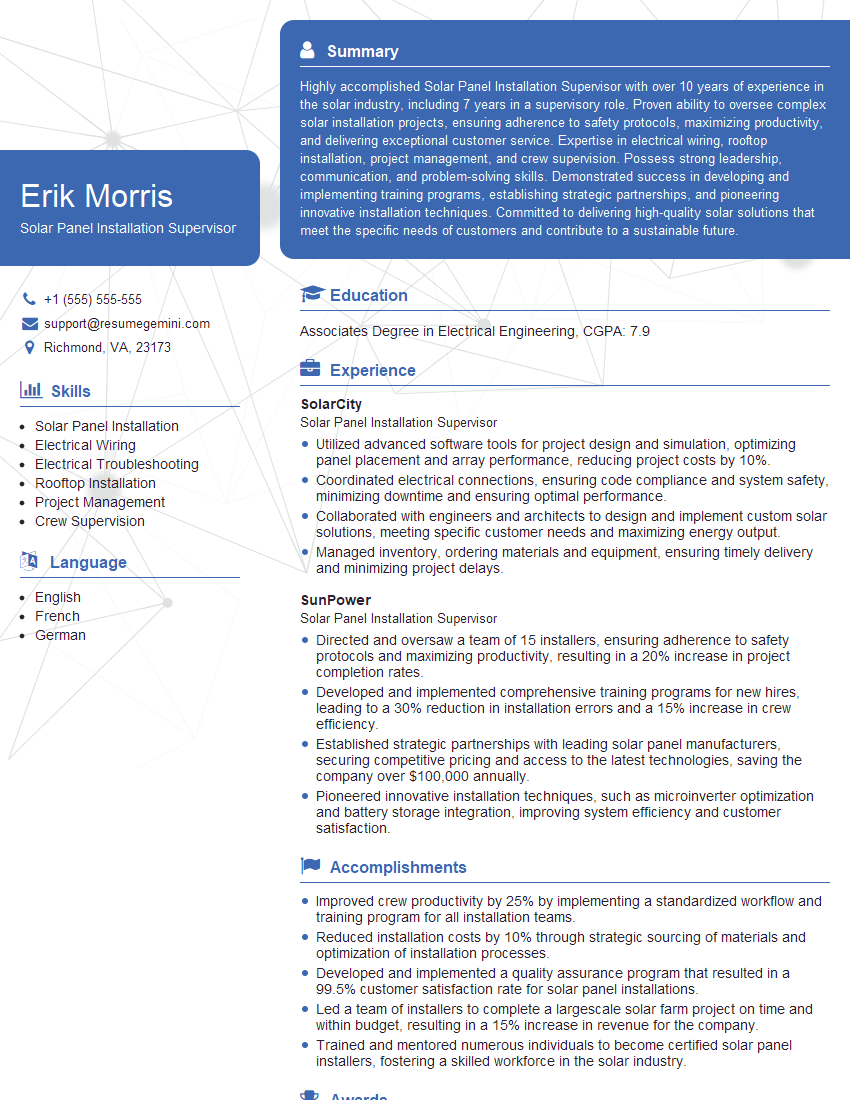
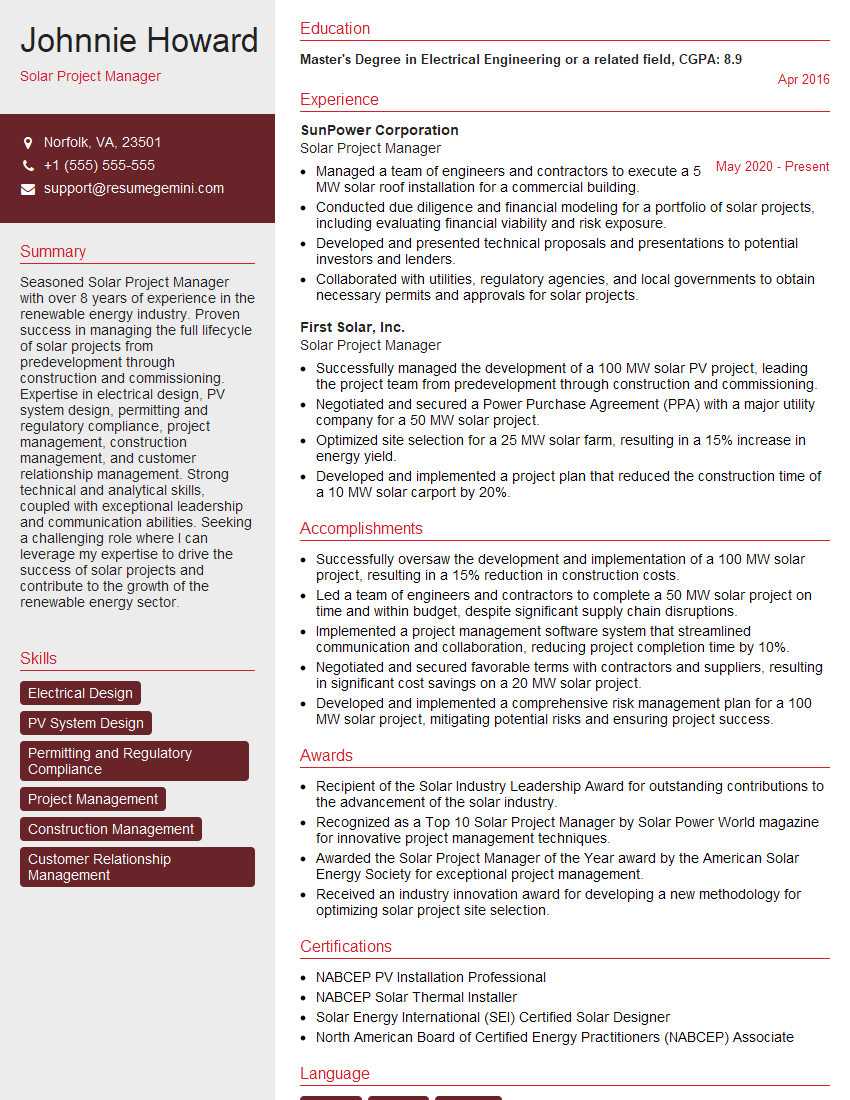
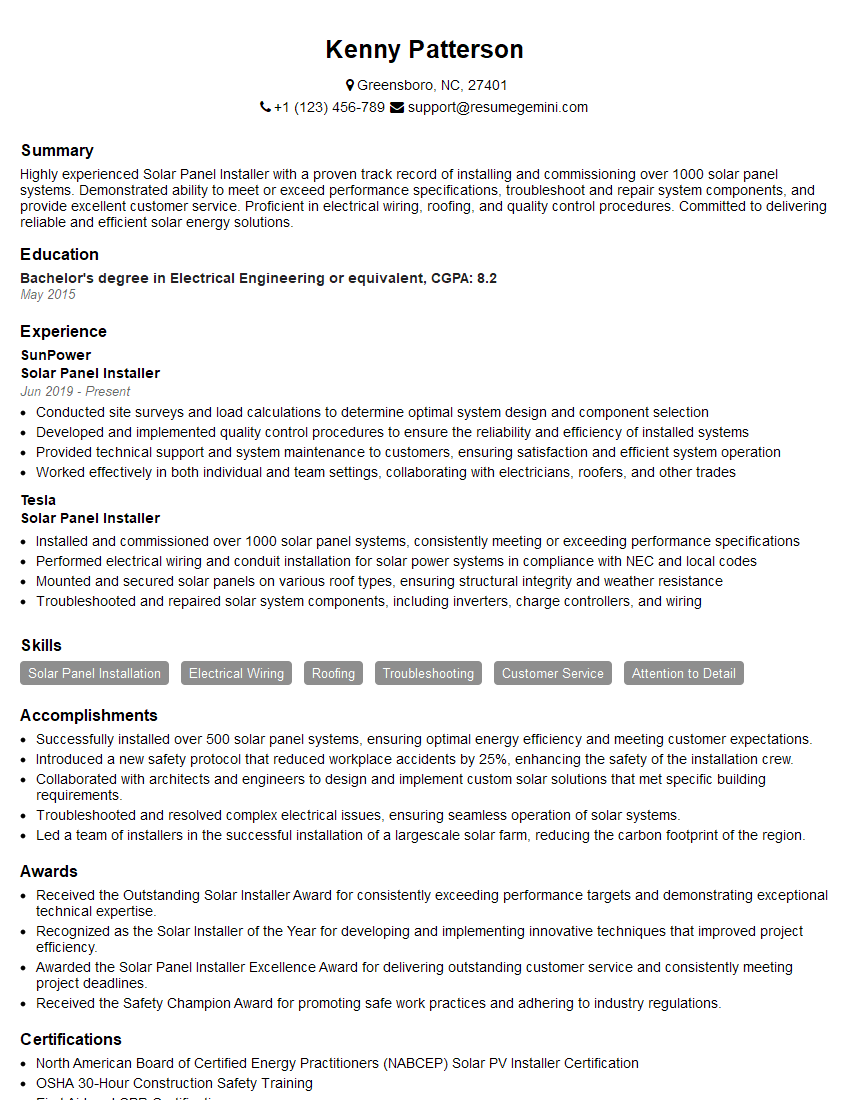
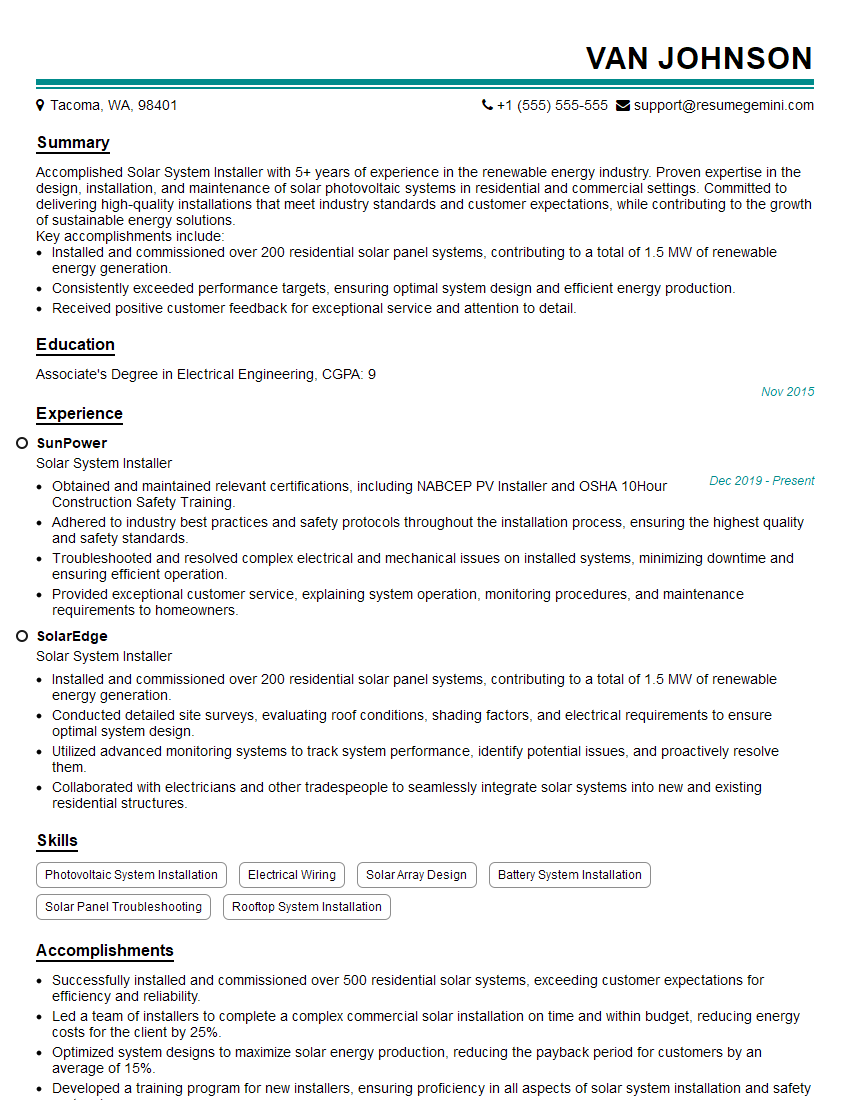
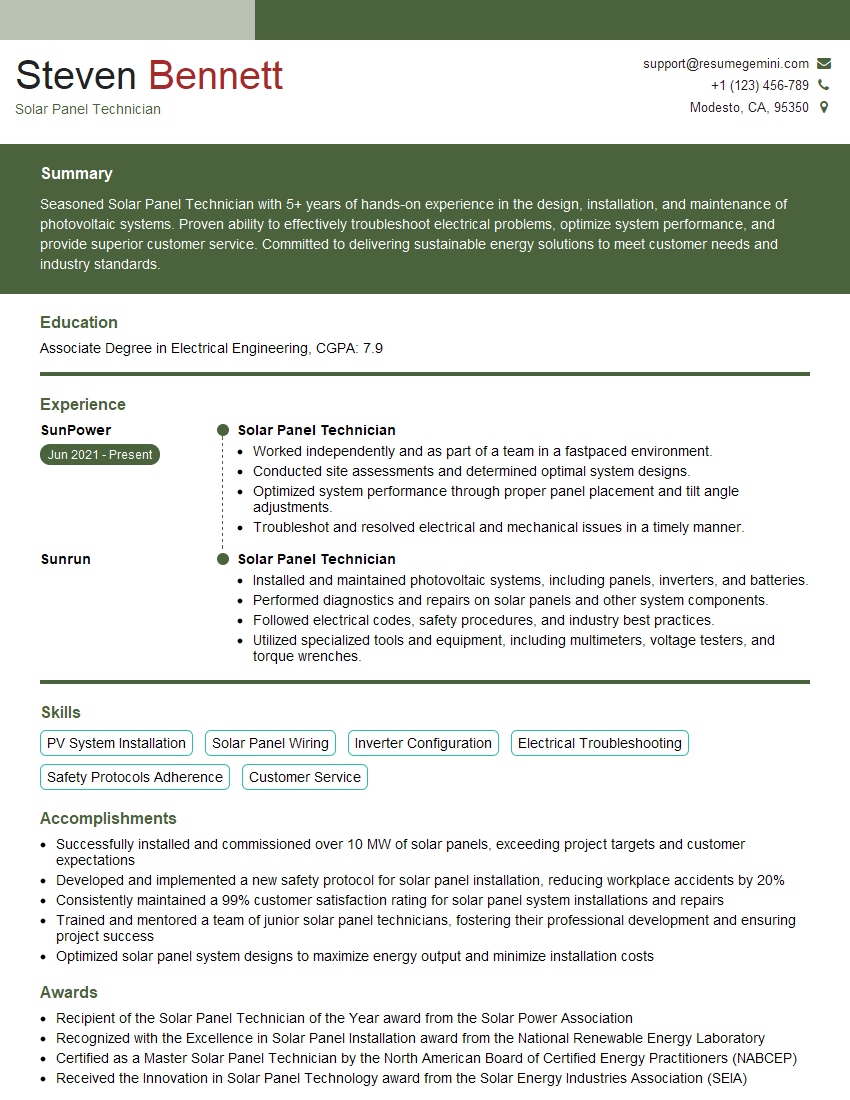
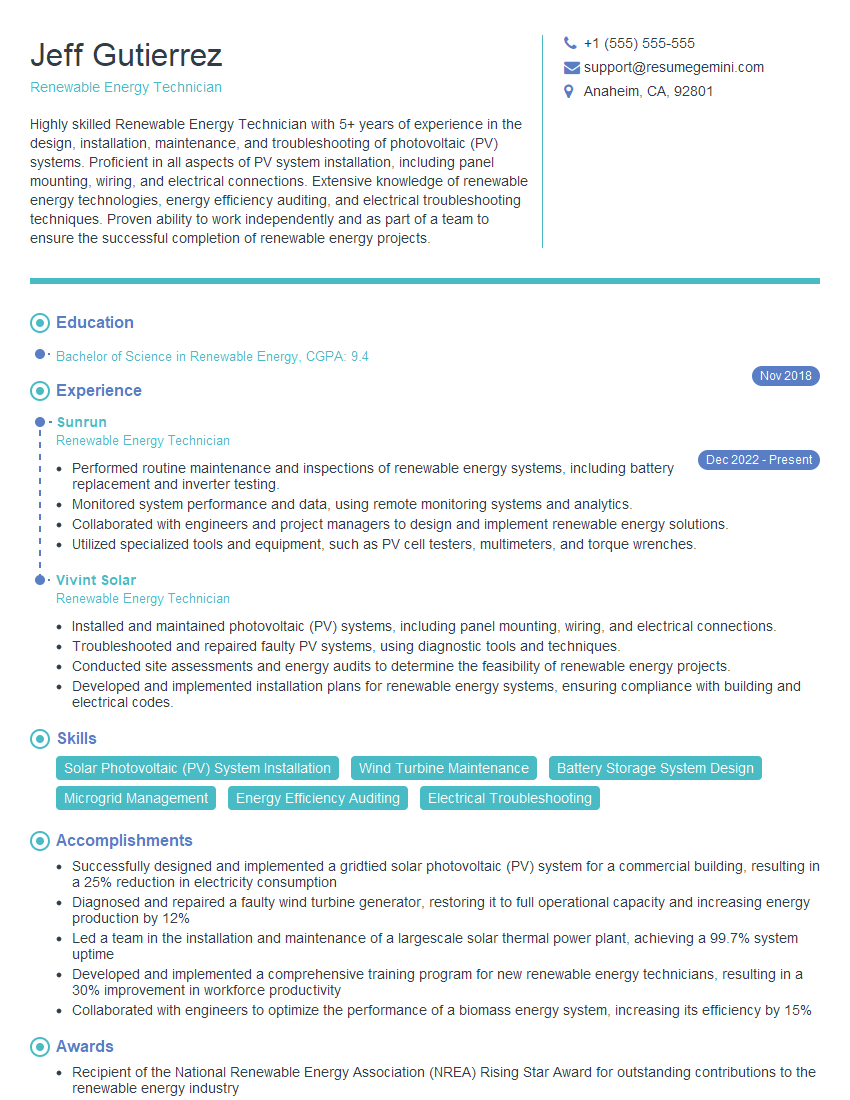
Mastering solar panel installation and wiring opens doors to a rewarding and in-demand career. The renewable energy sector is booming, offering excellent growth opportunities for skilled professionals. To maximize your job prospects, it’s crucial to present yourself effectively. Creating a strong, ATS-friendly resume is your first step towards landing your dream job. ResumeGemini is a trusted resource to help you craft a professional and impactful resume that highlights your skills and experience. We provide examples of resumes tailored specifically to Solar Panel Installation and Wiring positions to guide you through the process. Invest the time to build a compelling resume – it’s an investment in your future.

Explore more articles
Users Rating of Our Blogs
Share Your Experience
We value your feedback! Please rate our content and share your thoughts (optional).
What Readers Say About Our Blog
To the interviewgemini.com Webmaster.
Very helpful and content specific questions to help prepare me for my interview!
Thank you
To the interviewgemini.com Webmaster.
This was kind of a unique content I found around the specialized skills. Very helpful questions and good detailed answers.
Very Helpful blog, thank you Interviewgemini team.