Preparation is the key to success in any interview. In this post, we’ll explore crucial Strategic Planning and Vision Development interview questions and equip you with strategies to craft impactful answers. Whether you’re a beginner or a pro, these tips will elevate your preparation.
Questions Asked in Strategic Planning and Vision Development Interview
Q 1. Describe your approach to developing a strategic plan.
Developing a strategic plan is a systematic process that involves understanding the current state, defining a desired future, and charting a course to get there. My approach is highly collaborative and data-driven, encompassing several key phases:
- Phase 1: Assessment & Analysis: This involves conducting a thorough environmental scan, including market research, competitor analysis, and internal capability assessments. We use tools like SWOT analysis (discussed later) and stakeholder interviews to gain a holistic understanding of the organization’s strengths, weaknesses, opportunities, and threats.
- Phase 2: Vision & Mission Definition: Based on the assessment, we collaboratively define a clear and concise vision statement that paints a picture of the organization’s desired future state. This is followed by crafting a mission statement that outlines how the organization will achieve its vision.
- Phase 3: Goal Setting & Strategy Development: We establish specific, measurable, achievable, relevant, and time-bound (SMART) goals aligned with the vision and mission. We then develop strategic initiatives – the specific actions and projects – required to achieve these goals. This often involves brainstorming sessions and scenario planning to consider different potential futures.
- Phase 4: Implementation & Execution: This phase involves assigning responsibilities, allocating resources, establishing timelines, and implementing the defined strategic initiatives. Regular monitoring and progress reporting are crucial.
- Phase 5: Evaluation & Adjustment: The plan’s performance is continuously monitored against established metrics. Regular reviews enable course correction and adaptation as needed, ensuring the plan remains relevant and effective.
For example, in my previous role, we used this approach to develop a strategic plan for a non-profit focused on environmental conservation. We identified a key opportunity in engaging younger demographics, resulting in a new social media marketing strategy that significantly increased engagement and donations.
Q 2. How do you prioritize strategic initiatives?
Prioritizing strategic initiatives is critical for effective resource allocation. I typically employ a multi-criteria decision analysis (MCDA) approach that considers several factors:
- Alignment with Strategic Goals: Initiatives directly supporting the achievement of key strategic goals receive higher priority.
- Potential Impact: We assess the potential return on investment (ROI) and the overall impact of each initiative on the organization’s success.
- Feasibility: We evaluate the resources (financial, human, technological) required and the likelihood of successful implementation.
- Urgency: Time sensitivity and the need for immediate action are also taken into account.
- Risk Assessment: Potential risks and mitigation strategies are considered, influencing the prioritization.
Often, a weighted scoring system is used to objectively compare initiatives. For example, an initiative with high potential impact and alignment but low feasibility might receive a lower priority than one with moderate impact but high feasibility and urgency. This helps make data-driven, objective decisions rather than relying on gut feelings.
Q 3. Explain your experience with SWOT analysis.
SWOT analysis is a fundamental tool for strategic planning. It’s a structured approach to identifying and analyzing an organization’s internal Strengths and Weaknesses, and external Opportunities and Threats. My experience with SWOT analysis involves facilitating workshops to gather input from diverse stakeholders, ensuring a comprehensive perspective.
The process typically includes:
- Strengths: Internal positive attributes that give the organization a competitive advantage (e.g., strong brand reputation, skilled workforce).
- Weaknesses: Internal limitations or shortcomings that hinder performance (e.g., outdated technology, lack of skilled staff).
- Opportunities: External factors that could benefit the organization (e.g., emerging markets, new technologies).
- Threats: External factors that could negatively impact the organization (e.g., increasing competition, changing regulations).
After identifying these factors, we analyze the interplay between them, identifying strategic options to leverage strengths, mitigate weaknesses, capitalize on opportunities, and address threats. For instance, a SWOT analysis might reveal that a company’s strength in innovation (strength) could be leveraged to enter a new, emerging market (opportunity), while simultaneously addressing the threat of increased competition by differentiating its product offerings.
Q 4. How do you measure the success of a strategic plan?
Measuring the success of a strategic plan requires a well-defined set of Key Performance Indicators (KPIs) that align directly with the strategic goals. These KPIs should be specific, measurable, achievable, relevant, and time-bound (SMART). I typically use a balanced scorecard approach, encompassing financial, customer, internal process, and learning & growth perspectives.
Examples of KPIs include:
- Financial: Revenue growth, profitability, return on investment.
- Customer: Customer satisfaction, market share, customer retention.
- Internal Process: Efficiency, productivity, quality.
- Learning & Growth: Employee satisfaction, employee turnover, innovation rate.
Regular monitoring and reporting against these KPIs are essential. Dashboards and reporting tools provide a clear view of progress and allow for timely intervention if targets are not being met. Qualitative data, such as customer feedback and employee surveys, complement quantitative data to provide a holistic understanding of the plan’s success.
Q 5. What are the key elements of a compelling vision statement?
A compelling vision statement is a concise and inspiring description of the organization’s desired future state. Key elements include:
- Clarity: It should be easy to understand and communicate.
- Conciseness: It should be short and memorable.
- Inspiration: It should evoke a sense of purpose and motivate employees and stakeholders.
- Future-Oriented: It should paint a picture of the desired future, not the present.
- Ambitious yet Achievable: It should be challenging but realistic.
- Values-Driven: It should reflect the organization’s core values.
A good vision statement is more than just a statement; it’s a guiding principle that shapes the organization’s decisions and actions. For example, ‘To be the world’s leading provider of sustainable energy solutions’ is a clear, concise, and inspiring vision statement that guides the actions of a renewable energy company.
Q 6. How do you align strategic goals with organizational values?
Aligning strategic goals with organizational values is crucial for creating a cohesive and purposeful organizational culture. This ensures that the organization’s actions are consistent with its beliefs and principles. The process involves:
- Identifying Core Values: Clearly define the organization’s fundamental beliefs and principles that guide its behavior.
- Reviewing Strategic Goals: Examine each strategic goal to ensure it aligns with the core values. If a goal conflicts with a core value, it needs to be revised or discarded.
- Embedding Values in Decision-Making: Ensure that decisions related to strategic initiatives are evaluated based on their alignment with the organization’s values.
- Communicating Alignment: Clearly communicate the connection between strategic goals and values to all stakeholders, reinforcing the organization’s commitment to its principles.
- Monitoring and Evaluation: Regularly monitor decisions and actions to ensure ongoing alignment between goals and values.
For instance, if an organization values sustainability, its strategic goals should reflect this commitment, perhaps by focusing on reducing its carbon footprint or investing in environmentally friendly technologies.
Q 7. Describe a time you had to adapt a strategic plan due to unforeseen circumstances.
During my time at a marketing agency, we developed a strategic plan centered around expanding into new international markets. The plan included detailed market research, a phased rollout approach, and allocated resources for localized marketing campaigns. However, a major unforeseen circumstance – a global pandemic – significantly impacted our plans. International travel restrictions and economic uncertainty made our initial expansion strategy infeasible.
We had to quickly adapt. We shifted our focus to digital marketing strategies, investing more in online channels and virtual events. We also prioritized markets less affected by the pandemic and adapted our campaigns to reflect the changed economic climate. This required agile decision-making, close monitoring of evolving situations, and open communication with clients and staff. While the original plan wasn’t fully realized, our adaptability prevented significant damage and allowed us to achieve a modified version of our goals. This experience highlighted the critical importance of building flexibility and adaptability into any strategic plan to anticipate and respond to unexpected challenges.
Q 8. How do you facilitate stakeholder buy-in for a new strategic direction?
Securing stakeholder buy-in for a new strategic direction is crucial for successful implementation. It’s not just about informing people; it’s about engaging them in the process and making them feel ownership. I approach this using a multi-faceted strategy:
- Early and Consistent Communication: I initiate transparent communication early on, involving stakeholders in shaping the direction, not just receiving it. This includes town hall meetings, workshops, and smaller focus groups tailored to specific stakeholder needs and concerns.
- Data-Driven Justification: I present a compelling case built on robust data and analysis. This demonstrates the need for change, showcases potential benefits, and preempts concerns. For example, market research data could justify a new product line, while financial projections can illustrate the return on investment.
- Addressing Concerns Proactively: Anticipating and addressing potential objections from stakeholders is key. This requires active listening during discussions and incorporating feedback where possible. I create channels for open dialogue and feedback.
- Demonstrating Value and Alignment: I show how the new strategic direction aligns with the individual goals and values of each stakeholder group. This strengthens their commitment and fosters a sense of shared purpose.
- Building Consensus Through Collaboration: I encourage collaborative discussions to build a shared understanding and consensus around the new direction. This fosters a sense of ownership and eliminates feelings of imposition.
- Pilot Programs and Iterative Approach: Sometimes, a phased implementation with pilot programs helps demonstrate value and build confidence before full-scale adoption. This allows for adjustments based on feedback.
For instance, in my previous role at [Previous Company Name], we were launching a new sustainability initiative. By engaging employees early through surveys, focus groups, and regular updates, we built a sense of shared ownership, resulting in significantly higher adoption rates than anticipated.
Q 9. Explain your understanding of scenario planning.
Scenario planning is a strategic foresight methodology that helps organizations anticipate and prepare for a range of possible futures. Instead of relying on a single forecast, it explores multiple, plausible scenarios, each based on different assumptions about key drivers of change. This enables organizations to develop flexible and resilient strategies.
The process typically involves:
- Identifying Key Drivers of Change: We start by identifying the critical external factors (e.g., technological advancements, geopolitical shifts, economic trends) that could significantly impact the organization’s future.
- Developing Plausible Scenarios: Based on the key drivers, we develop several distinct scenarios, each representing a different combination of possible outcomes. These are often categorized as optimistic, pessimistic, and most likely. For example, a technology company might consider scenarios like rapid technological disruption, slow but steady growth, or a regulatory crackdown.
- Assessing the Implications of Each Scenario: We assess how each scenario could impact the organization’s objectives, strategies, and operations. This involves analyzing potential opportunities and threats within each scenario.
- Developing Strategies for Each Scenario: The core value comes from developing adaptable strategies that can work across a variety of scenarios. These strategies aren’t necessarily optimized for any single outcome but designed to be resilient and effective in most futures.
- Monitoring and Adapting: As the future unfolds, we continuously monitor developments, comparing them against the scenarios. This helps us trigger appropriate adaptations to our strategies.
For instance, during my time at [Previous Company Name], we used scenario planning to navigate the uncertainties around evolving data privacy regulations. We developed different strategies for each scenario—from a highly compliant, conservative approach to a more aggressive, innovative one—ensuring we were prepared for any outcome.
Q 10. How do you identify and mitigate risks to strategic goals?
Identifying and mitigating risks to strategic goals is an ongoing process that requires a proactive and systematic approach. It starts with a thorough risk assessment, which I typically conduct using a combination of qualitative and quantitative methods.
- Risk Identification: This involves brainstorming potential risks using techniques like SWOT analysis (Strengths, Weaknesses, Opportunities, Threats), PESTLE analysis (Political, Economic, Social, Technological, Legal, Environmental), and stakeholder interviews.
- Risk Analysis: We assess the likelihood and potential impact of each identified risk. This can be done using probability matrices or other quantitative models. We prioritize risks based on their potential severity.
- Risk Response Planning: For each significant risk, we develop response strategies. Common responses include risk avoidance (eliminating the risk), risk mitigation (reducing the likelihood or impact), risk transfer (shifting the risk to a third party), and risk acceptance (acknowledging the risk and planning to manage its impact).
- Risk Monitoring and Control: We continuously monitor the identified risks and their potential impact. We adjust our response plans as needed, potentially using key risk indicators (KRIs) to track progress and identify emerging issues.
For example, while working on a large-scale project for [Previous Company Name], we anticipated potential supply chain disruptions. By diversifying our suppliers and establishing contingency plans, we successfully mitigated the risk and avoided significant delays and cost overruns.
Q 11. How do you balance short-term goals with long-term vision?
Balancing short-term goals with long-term vision is a fundamental challenge in strategic planning. It’s about creating a strategic roadmap that enables progress towards the long-term vision while achieving near-term objectives that support that vision. This involves:
- Establishing a Clear Long-Term Vision: The process begins with a well-defined, inspiring vision that sets the direction for the organization. This vision acts as a guiding star for all decisions.
- Defining Strategic Objectives: We break down the long-term vision into specific, measurable, achievable, relevant, and time-bound (SMART) objectives. This creates a roadmap with clear milestones.
- Developing Short-Term Goals: We define short-term goals that directly contribute to the achievement of strategic objectives. These goals should be tangible, achievable within a shorter timeframe (e.g., quarterly or annually), and provide a sense of momentum.
- Resource Allocation: Resources (financial, human, technological) need to be allocated strategically, balancing investments in both short-term goals and long-term projects. This might involve a phased approach, prioritizing immediate needs while safeguarding resources for the long-term vision.
- Regular Review and Adjustment: It’s crucial to regularly review progress against both short-term and long-term goals. This allows for adjustments based on performance and changes in the internal or external environment. A balanced scorecard can be a useful tool here.
Imagine building a house: the long-term vision is the finished house. Short-term goals could be completing the foundation, framing the walls, and installing the roof. Each short-term accomplishment moves you closer to the final vision.
Q 12. What frameworks or methodologies do you utilize for strategic planning?
I utilize a range of frameworks and methodologies for strategic planning, selecting the most appropriate ones based on the organization’s context and needs. These include:
- Balanced Scorecard: This framework helps translate the organization’s vision and strategy into operational goals. It considers perspectives beyond financial performance, including customer, internal processes, and learning and growth.
- Porter’s Five Forces: This model analyzes the competitive forces within an industry to understand the attractiveness of a market and inform strategic decisions.
- SWOT Analysis: A foundational tool for identifying strengths, weaknesses, opportunities, and threats, allowing for a comprehensive assessment of the internal and external environments.
- PESTLE Analysis: This framework assesses the macro-environmental factors (Political, Economic, Social, Technological, Legal, Environmental) that could impact the organization.
- Agile Strategic Planning: This iterative approach involves breaking down the planning process into smaller, manageable cycles, facilitating flexibility and adaptation to changing circumstances.
- Scenario Planning (as discussed earlier): For navigating uncertainty and preparing for multiple possible futures.
The choice of methodology depends on the specific goals and challenges. For a rapidly changing market, an agile approach might be preferred, while a more established organization might benefit from a balanced scorecard framework.
Q 13. Describe your experience with performance management related to strategic objectives.
Performance management related to strategic objectives is crucial for ensuring that the organization is on track to achieve its goals. My approach focuses on establishing clear linkages between individual performance, team performance, and overall strategic objectives.
- Defining Key Performance Indicators (KPIs): We identify specific, measurable KPIs that directly reflect the progress towards strategic objectives. These KPIs should be clearly communicated and understood throughout the organization.
- Setting Performance Targets: Based on the KPIs, we set ambitious yet attainable targets for individuals, teams, and departments. These targets should be aligned with the overall strategic goals.
- Regular Performance Monitoring and Feedback: We implement a system for regular monitoring of performance against the established targets. This includes regular performance reviews, feedback sessions, and progress reports. This allows for proactive adjustments where needed.
- Incentive Alignment: Compensation and reward systems should be aligned with the achievement of strategic objectives. This incentivizes employees to contribute to the overall success of the organization.
- Data-Driven Analysis and Improvement: Performance data is analyzed to identify areas of strength and weakness. This data informs future strategies and improvements in processes or resource allocation.
In my previous role at [Previous Company Name], we implemented a performance management system that directly linked individual bonuses to the achievement of key strategic objectives. This resulted in a significant increase in employee engagement and improved overall performance.
Q 14. How do you ensure effective communication and transparency throughout the strategic planning process?
Effective communication and transparency are the bedrock of a successful strategic planning process. I ensure this through multiple channels and strategies:
- Regular Communication Channels: I establish various communication channels such as regular meetings, newsletters, emails, intranet updates, and presentations to keep stakeholders informed throughout the process.
- Transparent Information Sharing: All relevant information, including the rationale behind decisions, potential challenges, and progress updates, is shared openly and honestly. This builds trust and fosters collaboration.
- Feedback Mechanisms: I create multiple avenues for feedback, including surveys, suggestion boxes, focus groups, and open forums, to encourage two-way communication and gather insights from all stakeholders.
- Storytelling and Visualization: I use storytelling and visual aids (charts, graphs, presentations) to make complex information easier to understand and engage stakeholders more effectively. Simplifying jargon is key.
- Training and Capacity Building: Where necessary, I provide training to ensure that stakeholders understand the strategic plan and their roles in its execution.
- Open-Door Policy: Maintaining an open-door policy fosters an environment of trust and easy access to information and support.
For instance, in a recent project, we used a dedicated project management software to share documents, track progress, and facilitate communication among all team members and stakeholders. This ensured that everyone was always informed and up to date.
Q 15. Explain your experience with data analysis and its role in strategic decision-making.
Data analysis is the backbone of effective strategic decision-making. It allows us to move beyond gut feelings and informed guesses to make choices grounded in evidence. My experience involves leveraging various analytical tools and techniques to translate raw data into actionable insights. This includes using statistical software like R or Python to analyze market trends, customer behavior, and internal operational data.
For instance, in a previous role, we used sales data analysis to identify a previously unseen correlation between a specific marketing campaign and increased sales in a particular demographic. This allowed us to refine our marketing strategy, allocating more resources to that successful campaign and resulting in a 15% increase in overall sales within the next quarter. This wouldn’t have been possible without a robust data analysis process.
Another example involves using predictive modeling to forecast future demand. This allows for proactive inventory management and resource allocation, minimizing waste and maximizing profitability. In essence, data analysis provides the clarity needed to make informed decisions, mitigate risks, and capitalize on opportunities.
Career Expert Tips:
- Ace those interviews! Prepare effectively by reviewing the Top 50 Most Common Interview Questions on ResumeGemini.
- Navigate your job search with confidence! Explore a wide range of Career Tips on ResumeGemini. Learn about common challenges and recommendations to overcome them.
- Craft the perfect resume! Master the Art of Resume Writing with ResumeGemini’s guide. Showcase your unique qualifications and achievements effectively.
- Don’t miss out on holiday savings! Build your dream resume with ResumeGemini’s ATS optimized templates.
Q 16. How do you deal with conflicting priorities in a strategic plan?
Conflicting priorities are inevitable in strategic planning. The key is a structured approach to prioritization. I typically use a combination of techniques including:
- Prioritization Matrix: Using frameworks like Eisenhower Matrix (urgent/important), MoSCoW (Must have, Should have, Could have, Won’t have), or a weighted scoring system to rank initiatives based on strategic alignment, feasibility, and impact.
- Stakeholder Alignment: Facilitating open discussions with key stakeholders to understand their perspectives and reach consensus on which priorities are most critical. This often involves compromise and negotiation.
- Resource Constraints Analysis: Clearly identifying resource limitations (budget, time, personnel) to realistically assess what can be achieved within the given constraints.
- Phased Approach: Breaking down large, complex projects into smaller, manageable phases. This allows for flexibility and adaptation as priorities evolve over time.
For example, in a previous project, we had competing priorities for launching a new product and upgrading our outdated IT infrastructure. Using the prioritization matrix, we determined the IT upgrade was more crucial for long-term sustainability, even though the new product launch seemed more immediate and exciting. This decision, though initially difficult, proved to be vital for the company’s long-term success.
Q 17. How do you involve different departments in the strategic planning process?
Involving different departments is crucial for successful strategic planning. It ensures buy-in, fosters collaboration, and leverages the diverse expertise within the organization. My approach focuses on:
- Cross-functional Teams: Establishing teams composed of representatives from various departments, ensuring diverse perspectives are incorporated into the planning process.
- Open Communication Channels: Utilizing regular meetings, workshops, and updates to keep all departments informed and engaged. This could include presentations, email updates, or even an online collaborative platform.
- Workshops and Brainstorming Sessions: Creating opportunities for collaborative idea generation and problem-solving, ensuring everyone feels heard and valued.
- Clear Roles and Responsibilities: Defining specific roles and responsibilities within the planning process, ensuring accountability and efficiency.
For example, when developing a new market entry strategy, I ensured representatives from marketing, sales, operations, and finance were involved in the planning process. This ensured a holistic approach, considering all the complexities involved in expanding into a new market.
Q 18. Describe your experience with strategic resource allocation.
Strategic resource allocation is the art and science of efficiently and effectively deploying an organization’s resources (financial, human, technological) to achieve its strategic objectives. My experience encompasses:
- Budget Allocation: Developing and managing budgets, aligning resource allocation with strategic priorities.
- Personnel Deployment: Matching skills and expertise with project needs, ensuring optimal team composition.
- Technology Investment: Evaluating and selecting technologies that support strategic initiatives and enhance operational efficiency.
- Risk Assessment: Identifying potential risks associated with resource allocation and developing mitigation strategies.
In a previous project, we used a zero-based budgeting approach to re-allocate resources. This meant justifying every expenditure from scratch, which initially was time-consuming but ultimately resulted in a more efficient and effective allocation of funds towards high-impact initiatives.
Q 19. How do you stay informed about industry trends and their implications for strategic planning?
Staying informed about industry trends is vital for proactive strategic planning. My approach involves a multi-faceted strategy:
- Industry Publications and Reports: Regularly reviewing industry-specific journals, magazines, and research reports to identify emerging trends and potential disruptions.
- Conferences and Networking Events: Attending industry conferences and networking events to gain insights directly from industry leaders and experts.
- Competitive Analysis: Monitoring competitors’ activities and strategies to understand their strengths, weaknesses, and future plans.
- Data Monitoring Tools: Utilizing online tools and databases to track key industry metrics and indicators.
For example, I recently noticed a growing trend toward sustainable practices in my industry through several industry publications and reports. This led us to incorporate sustainability goals into our strategic plan, positioning us favorably for the future.
Q 20. What is your experience with developing key performance indicators (KPIs)?
Developing effective KPIs is crucial for measuring progress toward strategic objectives. My experience includes:
- Alignment with Strategic Goals: Ensuring KPIs directly support and measure progress towards the overall strategic goals.
- SMART Goals: Designing KPIs that are Specific, Measurable, Achievable, Relevant, and Time-bound.
- Data Availability: Selecting KPIs for which data is readily available and reliable.
- Regular Monitoring and Reporting: Establishing systems for tracking KPIs and regularly reporting progress to stakeholders.
For instance, when launching a new marketing campaign, we defined KPIs such as website traffic, conversion rates, and customer acquisition cost. By regularly monitoring these KPIs, we were able to track the campaign’s effectiveness and make necessary adjustments.
Q 21. How do you identify opportunities for innovation and growth within a strategic framework?
Identifying opportunities for innovation and growth within a strategic framework requires a proactive and systematic approach. My process typically involves:
- SWOT Analysis: Conducting a SWOT analysis (Strengths, Weaknesses, Opportunities, Threats) to identify areas for potential innovation and growth.
- Market Research: Analyzing market trends and customer needs to identify unmet needs and potential market gaps.
- Technology Scouting: Exploring emerging technologies and assessing their potential applications within the organization.
- Idea Generation and Evaluation: Facilitating brainstorming sessions and using structured evaluation frameworks to assess the feasibility and potential impact of innovative ideas.
In a past project, a SWOT analysis revealed an opportunity to leverage emerging AI technologies to improve our customer service processes. This resulted in a successful innovation initiative that improved customer satisfaction and reduced operational costs.
Q 22. Explain your process for evaluating the feasibility of strategic initiatives.
Evaluating the feasibility of strategic initiatives is crucial for success. My process involves a multi-faceted approach, moving from high-level assessment to granular detail. It begins with a thorough market analysis to understand competitive landscapes, emerging trends, and potential opportunities. Next, I conduct a comprehensive internal analysis, assessing our capabilities, resources, and limitations. This often involves SWOT (Strengths, Weaknesses, Opportunities, Threats) analysis and resource mapping.
Then, I develop financial projections, including cost-benefit analysis and return on investment (ROI) estimations for each initiative. Crucially, I also assess risk factors, identifying potential hurdles and developing mitigation strategies. This might involve scenario planning to explore various potential outcomes. Finally, I present a feasibility report summarizing the findings, highlighting risks and rewards, and making a clear recommendation regarding each initiative’s viability. For example, during a recent project for a tech startup, a detailed market analysis revealed a saturation in their intended niche. This led us to pivot towards a less competitive yet equally lucrative area, ultimately increasing the project’s feasibility and probability of success.
Q 23. How do you manage change effectively during strategic implementation?
Managing change effectively during strategic implementation requires a structured approach built on communication, collaboration, and strong leadership. I utilize a phased approach, starting with clear communication of the change initiative, its purpose, and its impact on different teams and individuals. This frequently involves town hall meetings, regular updates, and transparent communication channels.
Next, I emphasize employee involvement and participation throughout the process. This fosters a sense of ownership and reduces resistance to change. Training and development programs are vital to equip employees with the necessary skills and knowledge to adapt to new processes or technologies. I also implement change management tools, like project management software and regular progress reviews, to monitor progress and address any issues proactively. Finally, I ensure consistent recognition and celebration of successes along the way to maintain morale and momentum. In my experience leading a large-scale organizational restructuring, focusing on open communication and addressing employee concerns directly significantly reduced resistance and accelerated the adoption of new workflows.
Q 24. What are your strengths and weaknesses in strategic planning?
My strengths in strategic planning lie in my ability to synthesize complex information, build consensus among diverse stakeholders, and effectively communicate complex strategies. I am adept at identifying both opportunities and potential threats, and I possess strong analytical and problem-solving skills. My experience in leading and delivering numerous successful projects across various industries provides me with a solid foundation.
However, my weaknesses include a tendency to be detail-oriented, sometimes causing delays in decision-making. I am also working on delegating tasks more effectively, as I sometimes tend to micromanage projects when under pressure. I actively address these weaknesses through continuous professional development and seeking feedback from trusted colleagues.
Q 25. How do you ensure alignment between strategic planning and operational execution?
Ensuring alignment between strategic planning and operational execution is paramount for achieving organizational goals. I achieve this through a combination of clear key performance indicators (KPIs), regular performance monitoring, and robust feedback loops. KPIs are established at both the strategic and operational levels, ensuring everyone understands how their individual contributions align with the overall strategic direction.
Regular performance reviews and progress reports provide opportunities to track performance against KPIs, identify deviations, and make necessary adjustments. Establishing transparent and frequent communication channels between strategic planning teams and operational teams is crucial for real-time information exchange. Furthermore, I believe in integrating strategic objectives into operational plans, creating a direct link between long-term vision and daily tasks. In a previous role, we implemented a system of cascading goals, where high-level strategic goals were systematically broken down into smaller, more manageable tasks for individual teams, resulting in remarkable alignment and high levels of success.
Q 26. Describe a successful strategic project you led.
One successful strategic project I led involved developing and launching a new product line for a consumer goods company. The project faced significant challenges, including intense competition and a tight deadline. I employed a phased approach, starting with market research to identify unmet customer needs and a competitive analysis to determine our strategic advantage. We then developed a comprehensive product development plan, including detailed timelines, resource allocation, and risk mitigation strategies.
Throughout the process, we utilized agile methodologies, allowing us to adapt quickly to changing market conditions and customer feedback. We also fostered a collaborative environment, actively involving key stakeholders from different departments. The project was delivered on time and within budget, resulting in a significant increase in market share and exceeding sales projections. The success was largely attributed to a strong project team, meticulous planning, agile methodology, and consistent communication throughout the process.
Q 27. How do you handle criticism and feedback during the strategic planning process?
I view criticism and feedback as invaluable opportunities for learning and improvement. I actively solicit feedback from stakeholders at various stages of the strategic planning process, utilizing both formal and informal channels. During presentations or meetings, I encourage open discussion and welcome dissenting opinions.
I approach criticism constructively, focusing on understanding the underlying concerns and using the feedback to refine the strategy. I view critical feedback not as a personal attack, but as valuable input for improving the overall strategic direction. I always thank individuals for their feedback and demonstrate how their input will be incorporated into future decisions. This approach has fostered a culture of open communication and trust in my previous projects.
Q 28. How do you build consensus and collaboration among stakeholders?
Building consensus and collaboration among stakeholders requires a proactive and inclusive approach. I begin by clearly defining the objectives and goals of the strategic planning process, ensuring that all stakeholders understand the shared vision. I then facilitate open and transparent communication, creating a safe space for discussion and dialogue.
I actively seek input from all stakeholders, utilizing various methods such as workshops, surveys, and one-on-one meetings. I ensure that all perspectives are heard and valued. Finally, I strive to find common ground and develop solutions that address the concerns of all stakeholders. Successful consensus-building requires active listening, empathy, and a willingness to compromise. In practice, this might involve using collaborative tools, scheduling regular meetings, and ensuring that all decisions are documented and transparent. This approach ensures that the final strategic plan reflects the collective intelligence and commitment of all stakeholders involved.
Key Topics to Learn for Strategic Planning and Vision Development Interview
- Vision & Mission Definition: Understanding the nuances of crafting compelling vision and mission statements that guide strategic decision-making. Practical application: Analyzing existing statements and proposing improvements for a hypothetical organization.
- SWOT Analysis & Environmental Scanning: Mastering the art of identifying internal strengths and weaknesses, as well as external opportunities and threats. Practical application: Conducting a SWOT analysis for a specific industry or company and outlining strategic implications.
- Strategic Goal Setting & Prioritization: Developing SMART (Specific, Measurable, Achievable, Relevant, Time-bound) goals aligned with the overall vision. Practical application: Creating a prioritized list of strategic goals for a given scenario, justifying the rationale behind the choices.
- Resource Allocation & Budgeting: Understanding how to effectively allocate resources (financial, human, technological) to support strategic goals. Practical application: Developing a hypothetical budget allocation plan for a new initiative.
- Implementation & Monitoring: Developing action plans, setting key performance indicators (KPIs), and monitoring progress towards strategic goals. Practical application: Designing a monitoring system to track the success of a specific strategic initiative.
- Risk Management & Contingency Planning: Identifying and mitigating potential risks that could impede the achievement of strategic goals. Practical application: Developing a contingency plan for a potential market disruption.
- Stakeholder Management & Communication: Effectively communicating the strategic vision and plans to stakeholders at all levels. Practical application: Developing a communication strategy to gain buy-in from key stakeholders.
- Change Management Principles: Understanding and applying principles of effective organizational change management to drive strategic initiatives. Practical application: Analyzing a case study of organizational change and identifying best practices.
Next Steps
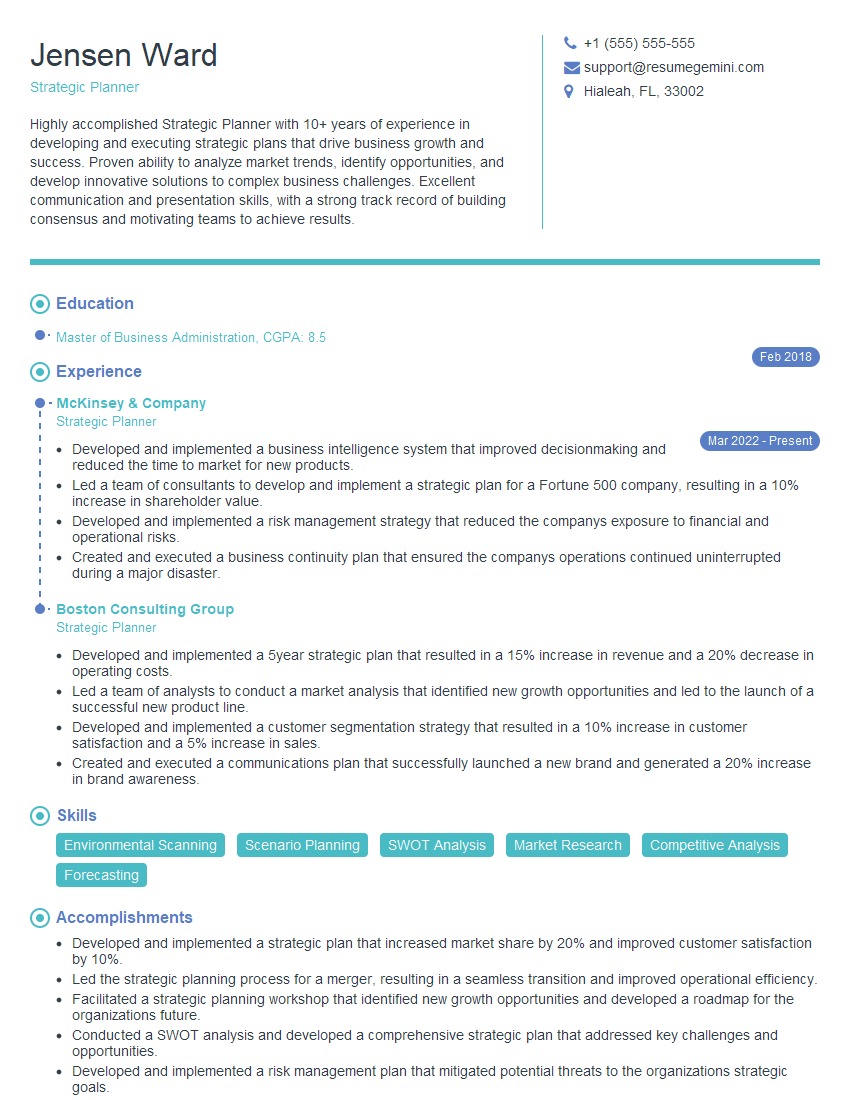
Mastering Strategic Planning and Vision Development is crucial for career advancement, opening doors to leadership roles and high-impact positions. A well-crafted resume is your key to unlocking these opportunities. An ATS-friendly resume, optimized for applicant tracking systems, significantly increases your chances of getting your application noticed. ResumeGemini is a trusted resource to help you build a professional and impactful resume that showcases your skills and experience effectively. Examples of resumes tailored to Strategic Planning and Vision Development are available to guide you. Invest in your future – build a resume that reflects your potential.
Explore more articles
Users Rating of Our Blogs
Share Your Experience
We value your feedback! Please rate our content and share your thoughts (optional).
What Readers Say About Our Blog
To the interviewgemini.com Webmaster.
Very helpful and content specific questions to help prepare me for my interview!
Thank you
To the interviewgemini.com Webmaster.
This was kind of a unique content I found around the specialized skills. Very helpful questions and good detailed answers.
Very Helpful blog, thank you Interviewgemini team.