Interviews are opportunities to demonstrate your expertise, and this guide is here to help you shine. Explore the essential Teaching Experience (Teaching Assistant) interview questions that employers frequently ask, paired with strategies for crafting responses that set you apart from the competition.
Questions Asked in Teaching Experience (Teaching Assistant) Interview
Q 1. Describe your experience supporting instructors in a classroom setting.
My experience supporting instructors involved a multifaceted approach encompassing various classroom duties. In my role as a Teaching Assistant for Introduction to Psychology, I facilitated small group discussions, answered student questions during office hours, and prepared supplementary materials like practice quizzes and study guides. I also assisted the professor in setting up and managing classroom technology, ensuring a smooth learning environment. For example, I proactively troubleshooted projector issues during lectures, preventing disruptions to the flow of the class. Furthermore, I helped with the administration of exams, ensuring fair and efficient proctoring and grading procedures.
In another instance, while assisting in a large introductory Biology course, I created and delivered short, focused lectures on particularly challenging topics, acting as a bridge between complex concepts and student understanding. This allowed the professor to focus on broader thematic discussions, benefiting both the instructor and the students.
Q 2. How have you managed challenging student behaviors in a teaching assistant role?
Managing challenging student behaviors required a combination of proactive strategies and reactive responses, always prioritizing a calm and respectful approach. In one case, a student consistently disrupted class by talking loudly and interrupting. Instead of immediate confrontation, I first attempted to engage the student in a friendly way during class breaks, gauging their reasons for the behavior. It turned out the student felt overwhelmed by the material. We discussed their concerns, suggesting study strategies and providing additional support. The disruption significantly decreased after providing this extra support.
However, for more serious or persistent issues, I followed established departmental protocols. If a student’s behaviour disrupted learning for others or created an unsafe environment, I reported it to the instructor, initiating a formal discussion about interventions, which might involve referring the student to the university’s student support services.
Q 3. What strategies have you used to help students who are struggling in the course?
Helping struggling students involved employing a variety of strategies, tailored to individual needs. I started by establishing clear communication channels: open office hours, readily available email, and proactive outreach to those who showed signs of falling behind. I created supplementary learning materials such as practice problems and concise summaries of complex concepts. These were often created collaboratively, using students’ input and feedback to identify specific areas of difficulty. Furthermore, I often encouraged peer learning by creating collaborative study sessions, providing a supportive environment for students to help one another.
For example, in a Calculus course, I noticed several students struggled with a particular concept. I created a series of short video tutorials explaining the key principles, using visual aids to clarify the process. I also held individual tutoring sessions for those who requested additional help, addressing their specific questions and clarifying misconceptions.
Q 4. Explain your experience with grading assignments and providing feedback.
My experience with grading assignments and providing feedback emphasized both efficiency and clarity. I developed a rubric that outlined specific grading criteria for each assignment, ensuring consistency and fairness in evaluating student work. I strived to provide constructive feedback that was specific, actionable, and encouraging. Instead of simply stating a grade, I highlighted strengths, weaknesses, and areas for improvement. This involved citing specific examples from their work, demonstrating how their strengths could be further developed, and suggesting concrete steps to overcome weaknesses.
For instance, when grading essays, I provided comments not only on the overall argument but also on the clarity of writing, the use of evidence, and the organization of ideas. For programming assignments, I included both test cases and explanations about why specific code segments were incorrect, offering solutions and suggestions for debugging.
Q 5. Describe your experience using various teaching technologies (e.g., learning management systems).
My experience with teaching technologies is extensive, encompassing various learning management systems (LMS) such as Canvas and Blackboard. I’m proficient in utilizing these platforms for tasks such as posting announcements, uploading course materials (including lecture slides, assignments, and rubrics), and managing grades. I’ve also used these platforms to facilitate online discussions, offering support and creating a sense of community among students. Furthermore, I have experience using collaboration tools like Google Docs and shared online whiteboards to promote group work and real-time interactions.
For example, in an online course, I used Canvas to create interactive quizzes and polls to engage students during asynchronous learning. The data collected provided valuable insights into student understanding, informing my subsequent teaching support strategies.
Q 6. How do you ensure inclusivity and accessibility in your teaching support?
Ensuring inclusivity and accessibility in my teaching support involved understanding and addressing diverse learning styles and needs. I proactively used various methods to make course materials accessible to all students. This included providing alternative formats for readings, using clear and concise language, and ensuring adequate captioning or transcripts for any audio or video resources. I also made efforts to create an inclusive classroom environment where students from all backgrounds felt comfortable participating and asking questions.
For instance, when assisting with a lecture series, I made sure that all materials were available in multiple formats including text, audio and large print versions. When working with visually impaired students, I cooperated with the instructor and the university’s disability services office to provide alternative learning materials and support as required by the student’s individual learning plan.
Q 7. How would you handle a situation where you disagree with the instructor’s teaching methods?
Handling disagreements with an instructor’s teaching methods requires a delicate balance of professionalism and respect. My first step would be to carefully consider the reasons for my disagreement, ensuring my concerns are grounded in evidence and pedagogical principles. Then, I would choose a private and appropriate time to discuss my concerns with the instructor. The conversation would focus on specific examples, and would center around student learning outcomes and finding the most effective methods to achieve those outcomes. I would frame my suggestions as collaborative efforts aimed at improving student learning rather than criticizing the instructor’s approach.
If a resolution isn’t reached through discussion, and my concerns remain unaddressed, I might consider consulting with a mentor or senior teaching assistant for advice on navigating the situation further. My ultimate priority would be to ensure the best possible learning experience for students, while maintaining a respectful and professional relationship with the instructor.
Q 8. Describe a time you had to adapt your approach to meet the needs of diverse learners.
Adapting my teaching approach to diverse learners is crucial for effective instruction. It involves recognizing that students learn in different ways, have varying learning speeds, and possess unique backgrounds and experiences. My approach centers around differentiated instruction, a strategy that provides various avenues for students to access and demonstrate their understanding.
For instance, during my time assisting with an introductory physics course, I noticed some students struggled with complex mathematical derivations. While some excelled with traditional lecture-based explanations, others needed a more hands-on approach. To address this, I created supplementary materials: simplified step-by-step guides for the derivations, alongside interactive simulations using online tools like PhET Interactive Simulations. This allowed students to engage with the material in ways that catered to their individual learning styles, ultimately improving their comprehension and confidence.
Further, I actively incorporated peer learning activities, encouraging students to explain concepts to one another. This facilitated a deeper understanding, fostered collaborative learning, and benefitted both those who excelled and those who needed more support. I also made myself readily available for one-on-one tutoring, tailoring my explanations to each student’s specific challenges. Through this multi-faceted approach, I was able to meet the diverse learning needs of the class, fostering a more inclusive and successful learning environment.
Q 9. How do you prioritize tasks and manage your time effectively as a teaching assistant?
Effective time management and task prioritization are essential for a teaching assistant. I employ a combination of planning tools and strategies to stay organized and meet deadlines. I start by creating a weekly schedule, outlining tasks associated with each course I assist with, like preparing tutorial materials, grading assignments, holding office hours, and attending lectures.
I utilize a task management system, prioritizing tasks based on urgency and importance using methods like the Eisenhower Matrix (urgent/important). Time-sensitive tasks, such as grading assignments before deadlines, take precedence. I break down large tasks into smaller, more manageable sub-tasks to avoid feeling overwhelmed. For example, rather than simply listing ‘Prepare tutorial materials,’ I’ll break it down into steps: research the topic, create example problems, prepare solutions, and design engaging activities.
Furthermore, I allocate specific time blocks for each task, aiming for focused work sessions with short breaks in between. Regularly reviewing my schedule and adjusting it as needed helps maintain flexibility and responsiveness to unexpected events. By combining proactive planning with flexible adjustments, I manage my workload effectively and ensure I can provide the best possible support to my students and instructors.
Q 10. How familiar are you with different learning styles and teaching methodologies?
I am very familiar with a range of learning styles and teaching methodologies. My understanding extends beyond simply knowing the names of different learning styles (visual, auditory, kinesthetic) and encompasses how to apply this knowledge practically. I believe that effective teaching involves recognizing that students learn in diverse ways and adapting my approach accordingly.
For example, I’m adept at using visual aids like diagrams, charts, and videos for visual learners. I utilize discussions and group work for auditory learners. For kinesthetic learners, I incorporate hands-on activities, experiments, or interactive simulations. In addition to this, I understand the principles of various teaching methodologies like collaborative learning, problem-based learning, inquiry-based learning, and direct instruction. I’ve observed and applied these methods effectively in diverse classroom settings, adapting my techniques to match the course content and student needs.
My experience has taught me that a blended approach, incorporating elements from several methodologies, is often the most effective strategy for maximizing student engagement and learning outcomes.
Q 11. Explain your understanding of course objectives and how you align your support with them.
Understanding course objectives is paramount for aligning my support with the instructor’s goals. I carefully review the syllabus, learning outcomes, and assessment criteria at the beginning of each semester. This allows me to tailor my assistance to directly support student achievement of those specific goals.
For instance, if a course objective is for students to understand a particular concept thoroughly, I’ll design tutorial sessions that focus on that concept, including practice problems, explanations, and various approaches to problem-solving. If the course emphasizes critical thinking skills, I would incorporate activities that challenge students to analyze information, evaluate arguments, and formulate their own conclusions during office hours or workshops.
I maintain ongoing communication with the instructor, regularly checking in to discuss student progress and ensure my support is aligned with the overall course direction. By aligning my efforts with the course objectives, I can significantly contribute to the students’ overall learning and success.
Q 12. Describe your experience in preparing and leading tutorial sessions or workshops.
I have extensive experience preparing and leading tutorial sessions and workshops. My approach centers around creating engaging and interactive learning experiences. I begin by analyzing the material, identifying key concepts and common areas where students tend to struggle. I then develop activities that cater to various learning styles.
For example, in a biology course, I prepared a workshop on cellular respiration, utilizing interactive models of the process and small group discussions focused on real-world applications. For a mathematics course, I led tutorial sessions where students worked on problems in small groups, allowing me to provide personalized feedback and guidance. I always aim to create a supportive environment where students feel comfortable asking questions and participating actively.
I carefully structure my sessions, starting with a brief review of key concepts and then moving onto practice problems or activities. I provide clear instructions, regular feedback, and opportunities for students to check their understanding throughout the session. Post-session, I often provide written summaries or additional resources to reinforce the learning.
Q 13. How do you maintain effective communication with both instructors and students?
Maintaining effective communication with both instructors and students is fundamental to my role as a teaching assistant. With instructors, I prioritize regular updates on student progress, highlighting any concerns or successes. I utilize email for routine communication and schedule brief meetings to discuss more complex issues or to gain clarification on course policies. I actively seek feedback on my performance and adjust my approach as needed.
With students, I encourage open communication. I maintain consistent office hours, providing a dedicated time for questions and assistance. I respond promptly to emails and use learning management systems (LMS) to disseminate information and announcements. I strive to create a welcoming and approachable environment, where students feel comfortable seeking help without fear of judgment. I also actively solicit student feedback to assess the effectiveness of my support and adjust my methods accordingly. This two-way communication ensures a positive and supportive learning experience.
Q 14. How have you used technology to enhance the learning experience for students?
Technology has become an integral part of my teaching practice. I have utilized various technological tools to enhance the learning experience for students. For instance, I’ve employed online platforms like Canvas or Blackboard to distribute course materials, post announcements, and collect assignments. These platforms allow for easy access to information, improving organization and communication.
I’ve integrated educational software and online simulations, like PhET Interactive Simulations, into tutorial sessions to provide interactive and engaging learning experiences. These tools allow for hands-on practice and immediate feedback, beneficial for students who prefer kinesthetic or visual learning. In addition, I’ve utilized video conferencing tools for online tutoring sessions, providing remote support to students who are unable to attend in-person office hours.
I also explore the use of educational apps and online resources to supplement classroom learning, providing students with additional learning opportunities. By embracing technology, I create a more dynamic, accessible, and efficient learning environment for students.
Q 15. Describe a time you had to resolve a conflict between students.
Conflict resolution among students is a crucial aspect of being a teaching assistant. My approach prioritizes understanding the root cause of the disagreement before implementing a solution. I remember a situation where two students, let’s call them Alex and Ben, were arguing vehemently about a group project. Alex felt Ben wasn’t contributing equally, while Ben felt Alex was being overly critical and controlling.
- Step 1: Facilitate open communication: I created a safe space for them to express their feelings without interruption. I used active listening techniques, paraphrasing their points to ensure understanding.
- Step 2: Identify the core issue: Through careful listening, I determined the core issue was a lack of clear communication and defined roles within the group.
- Step 3: Collaborative problem-solving: I guided them towards a solution by suggesting strategies like creating a detailed project plan with assigned tasks and regular check-in meetings. I emphasized the importance of teamwork and mutual respect.
- Step 4: Monitoring and follow-up: I checked in with them regularly to ensure they were working effectively together and addressed any recurring issues promptly.
The conflict was successfully resolved, and the project was completed successfully. The experience highlighted the importance of active listening, empathy, and providing a structured framework for conflict resolution.
Career Expert Tips:
- Ace those interviews! Prepare effectively by reviewing the Top 50 Most Common Interview Questions on ResumeGemini.
- Navigate your job search with confidence! Explore a wide range of Career Tips on ResumeGemini. Learn about common challenges and recommendations to overcome them.
- Craft the perfect resume! Master the Art of Resume Writing with ResumeGemini’s guide. Showcase your unique qualifications and achievements effectively.
- Don’t miss out on holiday savings! Build your dream resume with ResumeGemini’s ATS optimized templates.
Q 16. How do you provide constructive criticism to students without discouraging them?
Constructive criticism is about providing feedback that helps students improve without damaging their confidence. I focus on the ‘sandwich method’: starting with positive reinforcement, followed by specific areas for improvement, and ending with another positive note and encouragement.
For instance, if a student’s essay lacked strong thesis statement, I would say something like, ‘I really appreciate your insightful analysis of the topic and your well-organized supporting arguments. However, the thesis statement could be more concise and clearly articulate your main point. Perhaps try rephrasing it to explicitly state your argument. Keep up the good work; your ability to develop your ideas is impressive!’
This approach ensures the feedback is specific, actionable, and delivered in a supportive manner. I always avoid generalizations and focus on specific examples, using ‘I’ statements to avoid sounding accusatory. For example, instead of saying ‘Your writing is confusing,’ I would say ‘I found it challenging to follow the flow of your ideas in this section because…’
Q 17. Explain your experience with administering exams or quizzes.
My experience with administering exams and quizzes includes everything from preparing the test materials to ensuring a fair and secure testing environment. I’ve administered both paper-based and online assessments, using various platforms like Canvas and Blackboard.
- Preparation: This involves clearly outlining the instructions, reviewing the questions for clarity and accuracy, and ensuring sufficient copies are available.
- Administration: During the exam, I maintain a calm and professional demeanor, monitoring students to prevent cheating and promptly addressing any queries. I follow established procedures for invigilation to maintain academic integrity.
- Grading and Feedback: After the assessment, I’ve helped in grading the exams, using rubrics to ensure consistency and providing students with timely and detailed feedback.
For online assessments, I’ve also monitored students’ activity during the exam to prevent unauthorized access and ensure compliance with academic honesty policies. In every situation, maintaining a fair and consistent approach is paramount.
Q 18. How familiar are you with the principles of effective classroom management?
I am very familiar with the principles of effective classroom management. These principles revolve around creating a structured, supportive, and engaging learning environment where students feel safe, respected, and motivated to learn. Key elements include:
- Establishing clear expectations: Students need to understand the rules and consequences from the outset. This includes setting clear guidelines for behavior, participation, and assignments.
- Creating a positive classroom climate: A welcoming and inclusive environment fosters a sense of belonging and encourages active participation. This involves actively building rapport with students and addressing their individual needs.
- Proactive strategies: Anticipating potential disruptions and establishing routines helps maintain order. This could include assigning clear seating arrangements, using visual cues, and having well-structured lesson plans.
- Responsive strategies: When issues arise, I use a range of strategies, from gentle reminders to more formal interventions, always prioritizing fairness and consistency.
I believe that effective classroom management is less about control and more about building a positive and productive learning community.
Q 19. How would you handle a situation where a student accuses you of bias or unfairness?
Accusations of bias or unfairness are serious. My approach would be to listen carefully and empathetically to the student’s concerns, without interrupting or becoming defensive. I would then ask clarifying questions to fully understand their perspective and the specific instance they’re referring to.
For example, if a student claimed I graded their assignment unfairly, I would review my grading rubric and my notes on their work, explaining my assessment process clearly and objectively. If there was a genuine mistake, I would correct it immediately and apologize.
If the student’s concerns were unfounded, I would explain my reasoning calmly and respectfully, reiterating the established grading criteria and procedures. Documenting the interaction and my actions would be crucial. Involving a supervisor or mentor might also be necessary to ensure transparency and fairness. The goal is to address the student’s concerns in a way that maintains their trust and respects their feelings, even if their claims are not substantiated.
Q 20. How do you maintain confidentiality when dealing with sensitive student information?
Maintaining student confidentiality is paramount. I strictly adhere to all relevant privacy regulations and institutional policies regarding the handling of sensitive student information. This includes:
- Only accessing necessary information: I would only access student information directly relevant to my responsibilities as a teaching assistant.
- Secure storage and disposal: Any paperwork containing sensitive information is stored securely and disposed of properly.
- Restricted discussion: I would only discuss student information with authorized personnel, such as my supervisor or other teaching staff involved in the student’s education, and only when necessary for their support.
- Digital security: When working with electronic student data, I would always follow established protocols and use secure systems.
Breaching confidentiality is unethical and potentially illegal; therefore, rigorous adherence to these guidelines is non-negotiable. I understand the importance of protecting student privacy and ensuring their trust.
Q 21. Describe your experience with record-keeping and administrative tasks related to teaching.
Record-keeping and administrative tasks are an essential part of a teaching assistant’s role. My experience encompasses a range of tasks including:
- Maintaining student attendance records: This includes accurate recording of student attendance in class and reporting any absences to the appropriate personnel.
- Grading and feedback: I am proficient in using various grading systems and providing timely and constructive feedback to students.
- Managing course materials: This includes organizing course materials, distributing handouts, and maintaining an updated online course site (if applicable).
- Data entry and reporting: I’m comfortable with using various software programs to input and manage student data, generating reports as needed.
I am adept at managing multiple tasks efficiently and accurately, ensuring all information is properly documented and readily available. Attention to detail and organizational skills are critical for these responsibilities.
Q 22. How do you identify and address plagiarism in student work?
Identifying plagiarism requires a multi-pronged approach combining technological tools and pedagogical strategies. I begin by educating students about academic integrity, emphasizing the importance of proper citation and paraphrasing. Then, I utilize plagiarism detection software like Turnitin to compare student submissions against a vast database of online sources. However, software isn’t foolproof. I also analyze the writing style and argumentation for inconsistencies. For instance, a sudden shift in writing tone or vocabulary might indicate copied content. If plagiarism is suspected, I follow my institution’s established procedures, initially speaking to the student privately to understand the situation and guide them toward appropriate remediation. This might involve rewriting the assignment or completing additional work to demonstrate understanding. Severe cases are reported to the relevant faculty member for further action.
Q 23. What are some strategies you employ to foster a positive and engaging learning environment?
Creating a positive and engaging learning environment involves cultivating a sense of community, encouraging active participation, and differentiating instruction to meet diverse learning styles. I start by creating a welcoming classroom atmosphere where students feel comfortable asking questions and participating in discussions. I use a variety of active learning strategies such as group work, in-class activities, and interactive games to keep students engaged. For example, in a large lecture class, I might incorporate think-pair-share activities to encourage student-to-student interaction. I also provide opportunities for students to give feedback on the class format, helping ensure that the environment is responsive to their needs. I always make sure to be approachable and respond to individual needs, recognizing that students learn differently. Finally, celebrating successes (both individual and collective) and fostering a culture of mutual respect are crucial elements for a thriving learning environment.
Q 24. How do you stay current with best practices in education and pedagogy?
Staying current with best practices involves ongoing professional development and a commitment to lifelong learning. I regularly attend workshops and conferences related to teaching and pedagogy. I also actively participate in professional organizations like the Association for College and University Educators (ACUE) or relevant subject-specific organizations. Furthermore, I actively read peer-reviewed research articles in educational journals to stay informed about the latest advancements in teaching methodologies and learning technologies. I also regularly review the latest resources and publications from organizations like the National Council of Teachers of Mathematics or similar professional bodies. Finally, reflecting on my teaching practice through self-assessment, peer observation and student feedback allows me to identify areas for improvement and refine my approach constantly.
Q 25. Describe your experience working collaboratively with other teaching assistants or instructors.
Collaboration is essential for effective teaching. In my previous role as a teaching assistant, I worked closely with the instructor and other TAs to develop and implement course materials. We held regular meetings to discuss student progress, address challenges, and coordinate grading rubrics. For example, we collaboratively created a common grading rubric to ensure fair and consistent assessment. We also shared best practices in teaching techniques and student support. For instance, we developed a system for tracking student attendance and engagement, and jointly devised strategies to support students who were falling behind. This collaborative environment fostered mutual support and allowed for a more comprehensive approach to teaching and mentoring students.
Q 26. How do you adapt your teaching support to different subject areas?
Adapting my teaching support to different subject areas requires flexibility and a willingness to learn new content. The core principles of effective teaching remain consistent, but the specific strategies employed vary widely depending on the subject matter. For example, when assisting with mathematics, I focus on clarifying concepts and providing individualized tutoring. For humanities courses, I might support students with research and writing, providing feedback on essays and helping them develop critical thinking skills. In science courses, I may assist with lab work, helping students design experiments and interpret data. In each case, I first understand the subject’s core concepts and learning objectives before tailoring my support to the students’ specific needs.
Q 27. How would you approach a student who is consistently disruptive in class?
Addressing disruptive behavior requires a calm and consistent approach. My first step is to understand the root cause of the disruption. Is the student bored, confused, overwhelmed, or seeking attention? I would privately talk to the student to address any underlying concerns. If the behavior is related to academic difficulties, I’d offer extra help and support. If it’s behavioral, I would work with the student to establish clear expectations and consequences. This might involve using positive reinforcement techniques, creating a behavior plan, or referring the student to the appropriate support services. Consistent communication with the instructor is crucial, particularly if the behavior is persistent or escalating. The goal is to create a supportive and respectful learning environment for all students.
Q 28. Describe your understanding of FERPA regulations and student privacy.
FERPA (Family Educational Rights and Privacy Act) protects the privacy of student education records. I understand that I cannot disclose any student information to unauthorized individuals, including parents, without the student’s consent (except under specific circumstances outlined by FERPA). This includes grades, attendance records, disciplinary actions, and any personal information shared by students. I am careful to maintain the confidentiality of student data, ensuring that all records are stored securely and accessed only by authorized personnel. I am aware of my institution’s policies regarding data security and follow them strictly. Furthermore, I ensure that all my interactions with students are conducted with respect for their privacy and confidentiality.
Key Topics to Learn for Teaching Assistant Interview
- Classroom Management Techniques: Understanding and applying strategies for creating a positive and productive learning environment. This includes techniques for managing student behavior, engagement strategies, and creating a sense of community within the classroom.
- Curriculum Support & Lesson Planning: Practical application of assisting teachers in lesson planning, preparing materials, and delivering curriculum content effectively. This includes understanding different learning styles and adapting teaching methods accordingly.
- Student Interaction & Support: Developing effective communication and rapport with students, providing individual and group support, and identifying students who may require additional assistance. This includes understanding child development and recognizing signs of learning difficulties or emotional distress.
- Collaboration & Communication: Demonstrating effective communication with teachers, other staff members, and parents. This includes actively participating in team meetings, sharing observations, and contributing to the overall school environment.
- Differentiated Instruction: Understanding and applying techniques to cater to the diverse learning needs of students. This includes adapting materials and strategies to meet individual learning styles and abilities.
- Assessment & Feedback: Understanding and assisting with various assessment methods, providing constructive feedback to students, and documenting student progress. This includes understanding the importance of data-driven decision-making in education.
- Special Needs Awareness (if applicable): Familiarity with inclusive teaching practices and supporting students with diverse learning needs, including those with IEPs or 504 plans. Knowing basic terminology and strategies related to specific learning disabilities is valuable.
Next Steps
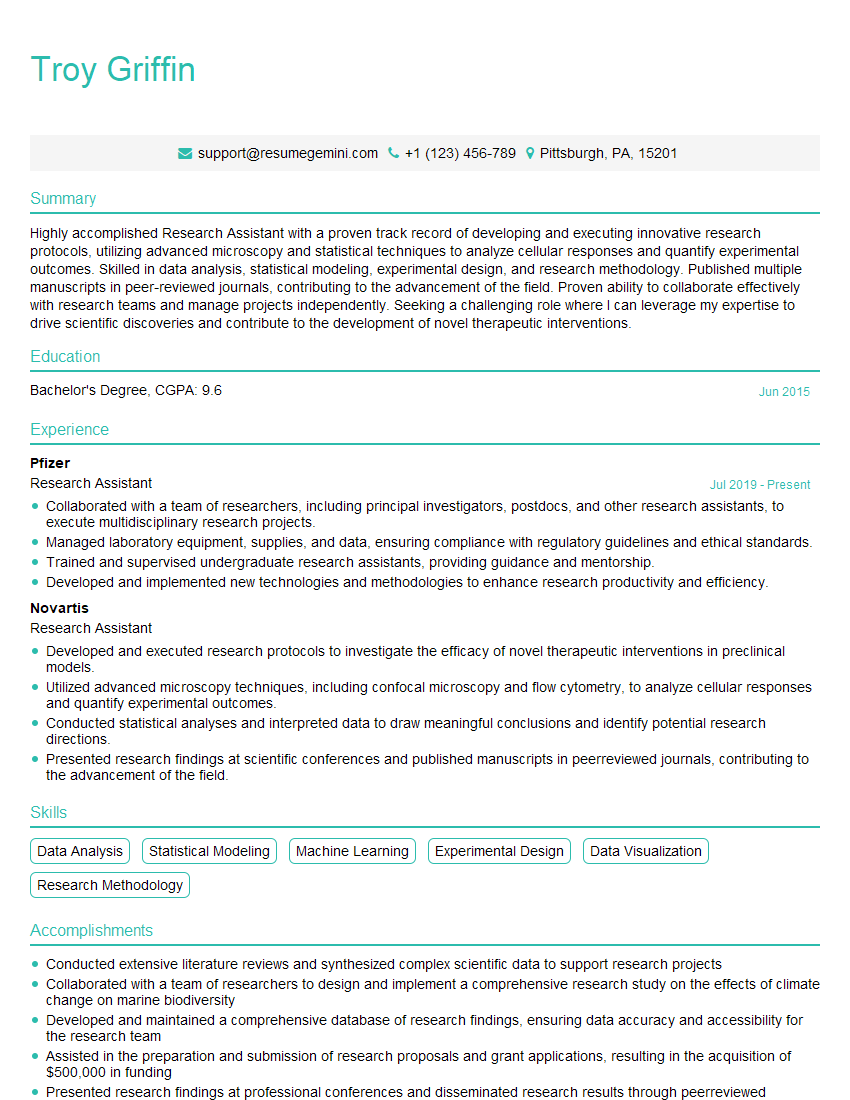
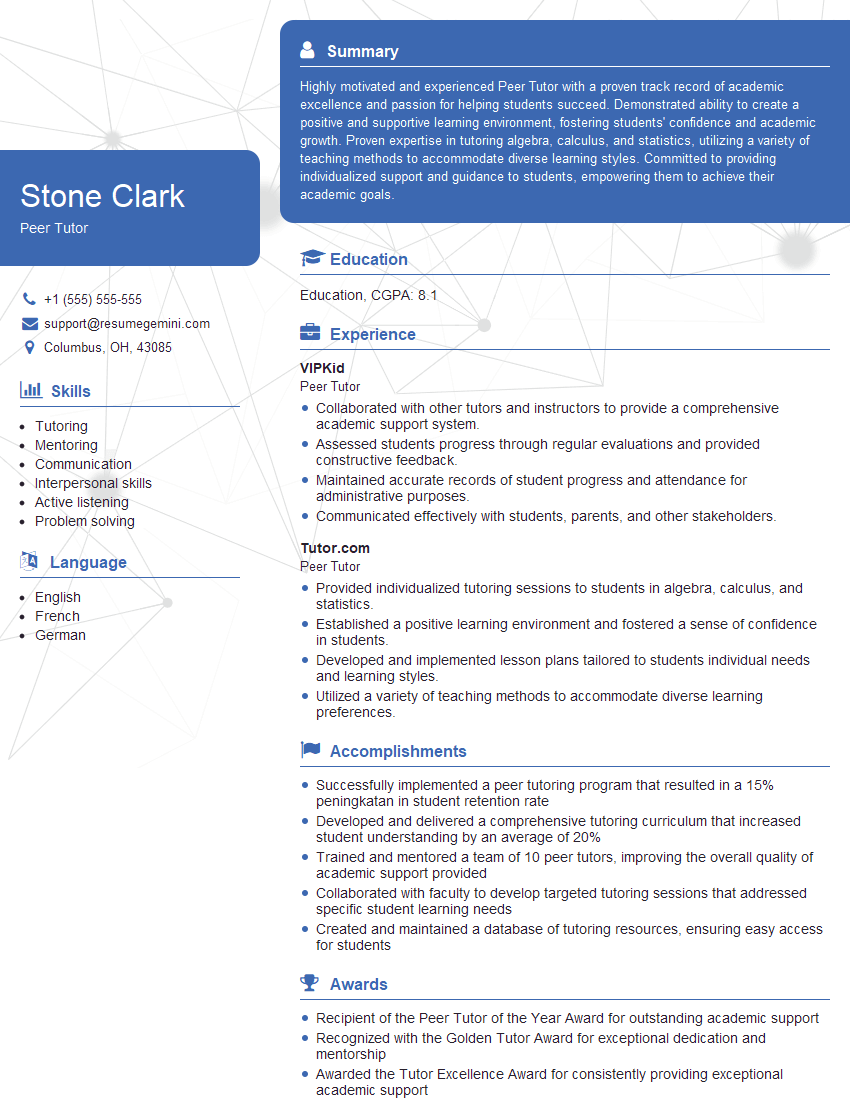
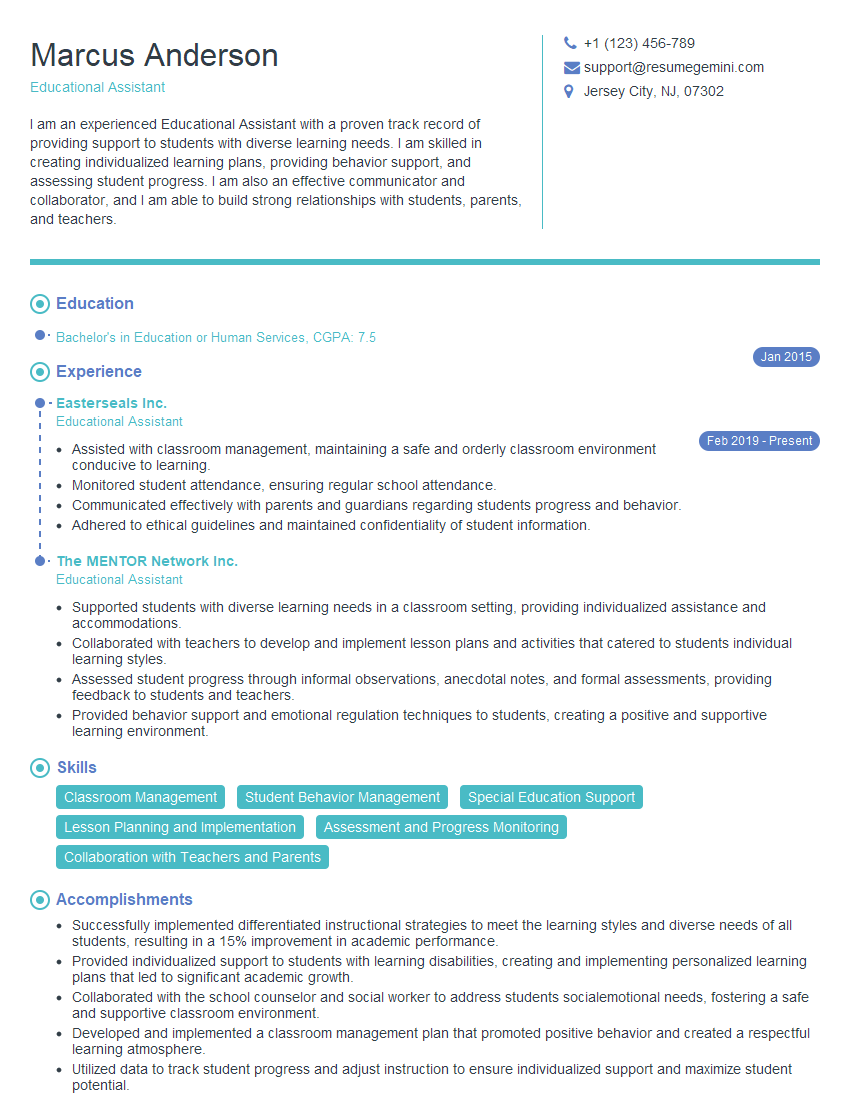
Mastering the skills and knowledge related to a Teaching Assistant role is crucial for career progression within education. A strong foundation in these areas opens doors to future opportunities such as becoming a lead teacher, curriculum specialist, or pursuing advanced degrees in education. To maximize your job prospects, it’s essential to create an ATS-friendly resume that highlights your relevant skills and experiences. ResumeGemini is a trusted resource that can help you build a professional and impactful resume, ensuring your application stands out. Examples of resumes tailored specifically to Teaching Assistant experiences are available through ResumeGemini.



Explore more articles
Users Rating of Our Blogs
Share Your Experience
We value your feedback! Please rate our content and share your thoughts (optional).
What Readers Say About Our Blog
To the interviewgemini.com Webmaster.
Very helpful and content specific questions to help prepare me for my interview!
Thank you
To the interviewgemini.com Webmaster.
This was kind of a unique content I found around the specialized skills. Very helpful questions and good detailed answers.
Very Helpful blog, thank you Interviewgemini team.