Every successful interview starts with knowing what to expect. In this blog, we’ll take you through the top Winder Operations interview questions, breaking them down with expert tips to help you deliver impactful answers. Step into your next interview fully prepared and ready to succeed.
Questions Asked in Winder Operations Interview
Q 1. Describe your experience with different types of winding machines.
My experience encompasses a wide range of winding machines, from simple, single-spindle units used for smaller-scale operations to highly automated, multi-spindle machines employed in large-scale manufacturing. I’ve worked extensively with both traverse winding machines, which create cylindrical packages by moving the yarn or wire back and forth across the bobbin, and precision winding machines, used for applications requiring extremely tight tolerances, such as in the electronics industry. I’m also familiar with different winding patterns such as helical, spiral and cross-winding, each suited to different materials and applications. For example, I’ve used high-speed winders for textile yarn and slower, more precise winders for winding fine copper wire for transformers. The choice of winder always depends on the material properties, desired package geometry, and production speed requirements.
Q 2. Explain the process of setting up a winder for a new product.
Setting up a winder for a new product involves a systematic approach. First, I carefully review the product specifications, including the material type, desired package dimensions, winding tension, and speed. Then, I select the appropriate winding machine and tooling, considering factors like bobbin size, winding pattern and available sensors to monitor tension and winding quality. Next comes the critical stage of parameter optimization. This involves experimenting with different tension settings, winding speeds, and traverse lengths to achieve the optimal balance between package quality, winding speed, and material integrity. For instance, delicate materials like silk would necessitate a lower winding speed and gentler tension compared to robust materials like steel wire. I always document the settings used for each parameter, making it easier to replicate the setup and troubleshoot any problems later. Throughout the process, I closely monitor the winding quality using visual inspection and often employing automated sensors to monitor winding parameters in real time, and adjusting settings as needed. Finally, I conduct a thorough quality check on the finished product, ensuring it meets all specified requirements before moving to full-scale production.
Q 3. How do you troubleshoot common winding problems such as birdnesting or broken threads?
Troubleshooting winding problems requires a methodical approach. ‘Birdnesting,’ where the yarn or wire becomes tangled, often stems from inconsistent tension, incorrect winding parameters, or faulty guides. I’d begin by carefully examining the machine’s settings and looking for any irregularities in the yarn feed, such as breaks or knots. Sometimes, a simple adjustment of the tension control or a slight realignment of the guides solves the issue. For broken threads, the cause could range from a weak point in the material itself to excessive tension or friction. I would inspect the material for defects and check all the moving parts of the machine for any potential points of friction or damage. If the problem persists, I may need to replace worn-out parts or consult the machine’s manual for more advanced troubleshooting steps. I maintain detailed records of all troubleshooting activities, helping identify recurring problems and prevent them in the future. It’s all about systematic observation, methodical elimination of potential causes, and careful documentation.
Q 4. What are the key quality control parameters you monitor during the winding process?
Key quality control parameters during winding include package density, winding tension, winding speed, and package dimensions. I consistently monitor the uniformity of the winding layers, ensuring the absence of gaps or overlaps. Using appropriate measuring tools like calipers and scales, I check the final dimensions of the package against the specifications. Throughout the process, automated systems often monitor and record the tension and speed of the winding process, and these data are analyzed for consistency. Inconsistent tension can lead to defects like loose or tight winding, affecting the final product quality. Regular checks on winding speed and its consistency are crucial for efficient production and consistent product quality. Any deviations from the established parameters trigger an immediate investigation to identify and rectify the root cause.
Q 5. How do you ensure consistent tension during winding?
Maintaining consistent tension is paramount for high-quality winding. Modern winding machines often incorporate sophisticated tension control systems, which use sensors to continuously monitor the tension and automatically adjust it to maintain a constant level. However, even with advanced technology, fine-tuning is often needed. For example, I might adjust the brake settings or the dancer roll system to achieve the desired level of tension. The choice of tension control system depends on the material properties and the required precision. For instance, a load cell-based system might be preferred for high-precision applications, while a simpler friction-based system might suffice for less demanding applications. I regularly calibrate the tension control system to ensure its accuracy. It’s a continuous monitoring and adjustment process, focusing on achieving the optimal tension for the specific material being wound while preventing damage to the material and maintaining a constant production rate.
Q 6. Describe your experience with different types of winding materials (e.g., yarn, wire, film).
My experience encompasses winding diverse materials, including yarns (cotton, polyester, silk), wires (copper, aluminum, steel), and films (plastic, metallic). Each material presents unique challenges. For example, winding delicate yarns requires gentle handling to prevent breakage, necessitating lower winding speeds and precise tension control. Conversely, winding stiff wires demands robust machinery capable of withstanding the higher forces involved. With films, maintaining consistent tension is critical to prevent wrinkles or creases. The material’s properties dictate the machine parameters, the choice of winding pattern, and the type of tooling required. I adapt my approach depending on the specific material, always prioritizing safety and optimal winding quality. Understanding material behavior and properties is crucial for optimizing the winding process and preventing defects.
Q 7. How do you maintain and perform preventative maintenance on winding machinery?
Preventative maintenance is crucial for ensuring the reliable and efficient operation of winding machinery. My routine includes regular lubrication of moving parts, cleaning of dust and debris buildup, and inspection of belts, gears, and sensors. I follow a scheduled maintenance plan, which outlines specific tasks and their frequency. This ensures early detection of potential problems, preventing costly downtime and extending the lifespan of the equipment. This also involves documenting all maintenance actions and keeping a record of parts replacement to optimize scheduling and resource allocation. Additionally, I perform regular safety checks to ensure that all safety guards are in place and functioning correctly. A well-maintained winding machine is more efficient, produces higher quality output, and contributes to the overall productivity and safety of the winding operation.
Q 8. Explain your understanding of winding speed and its impact on product quality.
Winding speed, simply put, is how fast the material is being wrapped onto a core or spool. It’s a critical parameter directly impacting product quality. Too fast, and you risk uneven winding, creating loose sections or potentially damaging the material. Too slow, and production efficiency plummets, increasing costs.
The ideal winding speed depends on several factors: the material’s properties (e.g., its elasticity, thickness, and tendency to stretch), the core diameter, the desired winding tension, and the desired final product density. For instance, winding delicate materials like thin films requires a significantly slower speed compared to winding sturdy materials like cables. An improperly set winding speed can lead to defects like birdnesting (tangled winding), loose layers, or even material breakage, rendering the finished product unusable or sub-standard. In my experience, we use sophisticated winding machines with programmable speed controllers allowing for precise adjustment based on the specific material and product requirements. We often perform test runs to fine-tune the winding speed to achieve optimal results.
Q 9. What are the safety precautions you follow when operating winding machinery?
Safety is paramount in winder operations. My approach adheres to a strict protocol including regular machine inspections, ensuring all safety guards are in place and functioning correctly. I always wear appropriate personal protective equipment (PPE), including safety glasses, gloves, and hearing protection. Before starting any operation, I thoroughly check the machine for any potential hazards like loose parts, frayed cables, or oil leaks.
Furthermore, I strictly follow lockout/tagout procedures whenever performing maintenance or repairs, ensuring the machine is completely de-energized before any work commences. I also ensure that the work area is clean and organized to prevent trips and falls. Regular training on safe operating procedures and emergency protocols is essential, and I actively participate in these sessions to maintain a high level of safety awareness.
Finally, I always report any safety concerns or near misses immediately to my supervisor, facilitating a proactive safety culture within the team.
Q 10. How do you handle material jams or other production stoppages?
Material jams or production stoppages require a methodical approach. My first step is to safely stop the machine, following established lockout/tagout procedures. Then, I carefully assess the situation to identify the cause of the jam. This might involve examining the material for kinks or tangles, checking the winding tension, or inspecting the rollers and guides for any obstructions.
Once the root cause is identified, I carefully remove the jam, making sure not to damage the material. If the jam is complex or involves a malfunctioning component, I’ll consult the machine’s operating manual or seek assistance from a maintenance technician. After clearing the jam, I thoroughly inspect the machine and the material before restarting the process, checking for any damage or potential issues. Preventing future jams involves regular maintenance, ensuring proper material handling, and monitoring the winding process closely. For example, we maintain detailed records of material properties and processing parameters to identify patterns and prevent recurring problems.
Q 11. Describe your experience with different winding patterns.
I’m proficient in various winding patterns, including parallel winding, spiral winding, and cross-winding. Parallel winding is suitable for applications requiring high-density packing, like yarn spools. Spiral winding, where the material is wrapped in a helical pattern, is commonly used for cables and hoses, offering good tension distribution. Cross-winding, involving alternating layers at different angles, provides superior stability and reduces the risk of slippage or unraveling.
The choice of winding pattern depends heavily on the application and material. For instance, I’ve worked with delicate fabrics requiring gentle spiral winding to avoid wrinkles, while in other projects, I’ve utilized cross-winding for robust applications requiring maximum structural integrity. My experience includes using machines with programmable logic controllers (PLCs) that allow for precise control over winding patterns, enabling the creation of complex and customized windings for specialized products.
Q 12. How do you ensure accurate measurement and counting of wound product?
Accurate measurement and counting of wound product are crucial for maintaining quality and efficiency. We employ a combination of techniques to achieve this. Many modern winders have integrated length and diameter measurement systems; these systems use sensors to precisely track the amount of material wound onto the core. The data is then displayed on the machine’s control panel and recorded for quality control purposes.
We also use electronic counters that precisely track the number of turns or layers. For specific products, we might use additional techniques such as weighing the finished product to verify the amount of material used. Regularly calibrated measuring instruments and sensors are critical for accuracy. Regular calibration and preventative maintenance ensure the consistency and reliability of our measurement methods. In situations where high precision is paramount, we might employ techniques like laser measurement for more accurate dimensions.
Q 13. Explain your understanding of different winding tensions (e.g., constant, variable).
Winding tension is the force applied to the material during the winding process. Constant tension maintains a consistent force throughout the winding operation, ideal for uniform winding. However, variable tension allows adjusting the force based on the winding diameter, preventing issues like excessive tension on the inner layers and loose tension on outer layers.
The choice between constant and variable tension depends on the material and application. Constant tension is suitable for many applications, but variable tension offers advantages when winding materials prone to stretching or those with varying thicknesses. For instance, I’ve used variable tension winding for applications involving materials with high elasticity, ensuring even distribution of the winding tension and preventing the outer layers from being too loose. A well-controlled winding tension is crucial for product quality and avoids defects like birdnesting or loose windings.
Q 14. How familiar are you with PLC programming and its role in winder operation?
I have considerable experience with PLC programming and its crucial role in winder operations. PLCs (Programmable Logic Controllers) are the brains of modern winding machines, controlling various aspects like winding speed, tension, pattern, and safety functions. I’m proficient in reading, modifying, and troubleshooting PLC programs using programming software specific to the type of PLC used in our machines.
My experience includes using PLCs to implement complex control algorithms for variable tension winding, optimizing winding patterns for specific products, and integrating various sensors to monitor the winding process. Troubleshooting PLC programs is a critical aspect of my role, often involving diagnosing errors through analysis of the program code and sensor readings. I’ve found that a solid understanding of PLC programming significantly enhances my ability to optimize the winding process, troubleshoot issues quickly, and maintain high-quality standards in the production process.
Q 15. How do you identify and address defects in the wound product?
Identifying and addressing defects in wound products requires a multi-faceted approach combining proactive measures and reactive troubleshooting. It begins with rigorous quality checks at every stage of the winding process.
Visual Inspection: A primary method involves visually inspecting the wound product for irregularities such as loose ends, uneven winding, gaps, or damaged insulation. This is often aided by magnification tools for finer details.
Dimensional Measurement: Using calipers or other precision measuring devices, we verify that the diameter, width, and length of the wound product meet specifications. Inconsistencies here point to potential problems with the winding tension or core dimensions.
Electrical Testing (if applicable): For products requiring electrical functionality, tests like insulation resistance and continuity are performed to detect short circuits or other electrical faults.
Defect Analysis: Once a defect is identified, we analyze the root cause. This might involve checking winding machine settings (tension, speed, etc.), examining the quality of the material being wound, or assessing the condition of the winding core. A root cause analysis helps prevent future occurrences.
Corrective Actions: Depending on the nature and severity of the defect, corrective actions range from simple adjustments to machine settings to more extensive repairs or material replacements. In serious cases, a complete production run might need to be scrapped.
For instance, in one project involving the winding of high-precision magnetic coils, we noticed inconsistent coil resistance in a batch. Through careful analysis, we found that a slight variation in the wire diameter, coupled with fluctuating winding tension, caused the issue. Adjusting the machine parameters and implementing stricter wire diameter checks resolved the problem.
Career Expert Tips:
- Ace those interviews! Prepare effectively by reviewing the Top 50 Most Common Interview Questions on ResumeGemini.
- Navigate your job search with confidence! Explore a wide range of Career Tips on ResumeGemini. Learn about common challenges and recommendations to overcome them.
- Craft the perfect resume! Master the Art of Resume Writing with ResumeGemini’s guide. Showcase your unique qualifications and achievements effectively.
- Don’t miss out on holiday savings! Build your dream resume with ResumeGemini’s ATS optimized templates.
Q 16. What is your experience with different types of winding cores or bobbins?
My experience encompasses a wide range of winding cores and bobbins, each tailored to specific applications and product requirements. The choice of core depends heavily on factors such as the material being wound, the desired product shape, and production volume.
Plastic Bobbins: These are common for applications requiring high-volume production and cost-effectiveness. Different plastics offer varying levels of strength and dimensional stability.
Metal Spools: Used when high strength and heat resistance are needed, often for applications involving heavy gauge wire or high temperatures.
Paper Tubes: These are lightweight and readily available, but their structural integrity can be a limiting factor, particularly for large or heavy windings.
Custom Cores: For specialized applications, custom-designed cores may be necessary to meet unique geometrical or performance requirements. I’ve worked on projects involving the development and implementation of unique core designs for highly specialized medical devices.
The selection process often involves considering factors like core diameter tolerances, material compatibility with the winding wire, and ease of handling during the winding process. Improper core selection can directly impact winding efficiency and product quality.
Q 17. Describe your experience with documenting and reporting production data.
Documenting and reporting production data is crucial for maintaining quality, identifying trends, and improving efficiency. My approach involves a combination of manual and automated methods.
Production Logs: Maintaining detailed logs that track key parameters such as machine settings (speed, tension, etc.), material usage, and any identified defects. This information is crucial for troubleshooting and identifying potential issues.
Data Acquisition Systems: Many modern winding machines integrate with data acquisition systems that automatically collect and record critical parameters in real time. This significantly reduces manual data entry and minimizes the potential for human error.
Spreadsheets and Databases: Collected data is often organized using spreadsheets (like Excel) or databases (like Access or SQL) for better analysis and reporting. This allows for easy data sorting, filtering, and reporting.
Reporting: Generating regular reports summarizing key performance indicators (KPIs), such as production yield, defect rates, and machine downtime. These reports help identify areas for improvement and track progress toward quality and efficiency goals. I frequently use visual aids such as charts and graphs to make data more accessible and understandable.
In my previous role, I implemented a new database system that automated the collection and analysis of production data, resulting in a 20% reduction in manual data entry time and a significant improvement in the accuracy of our performance reports.
Q 18. How do you adapt to changing production requirements or schedules?
Adapting to changing production requirements is a fundamental skill in this industry. My approach involves a combination of flexibility, communication, and careful planning.
Understanding the Changes: Clearly understand the nature of the changes—are they related to product specifications, production volume, or deadlines?
Assessing the Impact: Evaluate how the changes will affect different aspects of the winding process, including machine settings, material requirements, and personnel allocation.
Planning and Implementation: Develop a detailed plan to implement the changes effectively, minimizing disruptions to production. This might involve adjusting machine settings, retraining personnel, or procuring new materials.
Communication: Maintain open communication with all relevant stakeholders, including engineers, supervisors, and other team members, to ensure everyone is aware of the changes and their impact.
Monitoring and Adjustment: Monitor the production process closely after implementing the changes to identify and address any unforeseen issues.
For example, we once had an urgent request to increase production volume for a specific product by 50%. We responded by optimizing machine settings, implementing a second shift, and prioritizing the production of that particular product. Close monitoring ensured the quality wasn’t compromised despite the rapid increase in output.
Q 19. What are your methods for optimizing winding efficiency and reducing waste?
Optimizing winding efficiency and reducing waste requires a holistic approach that focuses on several key areas.
Process Optimization: Analyzing the winding process to identify bottlenecks and inefficiencies. This might involve adjusting machine speeds, improving material handling, or streamlining workflow.
Material Management: Implementing strategies to minimize material waste, such as using accurate material forecasting, optimizing coil lengths, and implementing efficient scrap management procedures. Careful attention to material handling can prevent spoilage and reduce waste.
Preventive Maintenance: Regular maintenance of winding machines is vital for minimizing downtime and maximizing efficiency. This helps avoid costly emergency repairs and keeps the machines operating at peak performance.
Operator Training: Well-trained operators are more efficient and less prone to errors, leading to reduced waste and higher quality products. Training programs should focus on best practices, problem-solving, and safety procedures.
Automation: Automation, where feasible, can improve consistency, reduce human error, and increase production speed. This can range from automated material handling systems to advanced machine controls.
In one instance, we implemented a new material-handling system that reduced waste by 15% by minimizing material spillage and optimizing the use of leftover materials. We achieved this using conveyor belts, robotic arms, and improved storage procedures.
Q 20. How do you handle situations where you need to make a quick decision to avoid a production issue?
Quick decision-making in crisis situations is crucial to avoid production issues. My approach is rooted in a structured, yet agile methodology.
Assess the Situation: Quickly assess the nature and severity of the problem. Is it a machine malfunction, a material shortage, or an operator error?
Gather Information: Collect relevant data to understand the root cause of the problem. This often involves consulting with other operators and technicians.
Identify Potential Solutions: Brainstorm potential solutions, considering both short-term and long-term fixes. Prioritize solutions based on their effectiveness and potential risks.
Choose and Implement: Select the most appropriate solution based on the available resources and time constraints. Implement the solution swiftly and effectively.
Monitor and Evaluate: Monitor the results of the implemented solution to ensure it is effective. If the problem persists, reassess the situation and consider alternative solutions. Document the entire process for future reference and to improve response strategies.
For example, during a night shift, a critical winding machine suddenly malfunctioned. By quickly diagnosing the problem as a loose belt, and having a spare readily available, we resolved the issue within 15 minutes, minimizing production downtime. This was achieved because of prior preventive maintenance and a well-stocked parts inventory.
Q 21. Explain your understanding of different types of winding machine controls.
My understanding of winding machine controls spans several types, each with its own advantages and limitations.
Programmable Logic Controllers (PLCs): PLCs are widely used in industrial automation, providing precise control over various machine parameters, including speed, tension, and winding patterns. They allow for complex control sequences and automated processes.
Human-Machine Interfaces (HMIs): HMIs provide a user-friendly interface for operators to monitor and control the winding machine. They typically display real-time data, allow for parameter adjustments, and provide alerts for any issues or deviations from set parameters. I’m experienced in using various HMI interfaces such as touchscreens and industrial PCs.
Computer Numerical Control (CNC): CNC systems offer highly precise control over winding parameters, particularly for complex winding geometries and patterns. This technology is often used in advanced winding applications, such as those used in aerospace and medical device manufacturing.
Servo Drives: Servo drives are used for precise control of motor speed and position, crucial for maintaining consistent winding tension and achieving accurate winding patterns. These provide accurate and responsive control over critical parameters. I’ve worked extensively with servo-driven winding machines across several projects.
Understanding the strengths and limitations of these control systems is crucial for both troubleshooting and optimizing the winding process. My experience allows me to adapt quickly to different control systems and leverage their capabilities to achieve the desired results.
Q 22. How do you ensure the accuracy of winding parameters?
Ensuring the accuracy of winding parameters is paramount in achieving consistent product quality and preventing costly errors. This involves a multi-faceted approach encompassing meticulous planning, precise execution, and rigorous quality control.
Precise Parameter Setting: We begin by carefully calculating the required parameters based on the product specifications, material properties (like wire diameter, tensile strength, and insulation thickness), and desired coil geometry. This often involves using specialized software and formulas to determine optimal tension, speed, and winding patterns.
Calibration and Verification: Regular calibration of winding machines is crucial. We use standardized testing procedures and calibrated instruments (like tension gauges, speedometers, and micrometers) to verify that the machine’s readings accurately reflect the set parameters. Any deviations are promptly addressed through adjustments or maintenance.
Real-time Monitoring and Adjustment: During the winding process, we continuously monitor key parameters using machine sensors and data acquisition systems. This allows for immediate detection and correction of any deviations from the set points. For instance, if the tension drops below the specified range, we can adjust the tension control system accordingly.
Post-Winding Inspection: After the winding process is complete, a thorough inspection is conducted. This includes visual checks for irregularities, dimensional measurements, and often destructive testing (e.g., tensile strength tests) to ensure the final product meets all specifications. This data is meticulously documented and analyzed to identify trends and improve future processes.
For example, in a recent project involving the winding of high-precision transformers, we implemented a closed-loop control system that automatically adjusted the winding tension based on real-time feedback from a load cell. This reduced variations in coil density by over 15%, leading to a significant improvement in transformer performance.
Q 23. Describe your experience working in a team environment in a winding operation.
My experience in team environments within winding operations has been extensive and rewarding. Effective teamwork is the backbone of successful winding, demanding seamless collaboration between different roles.
Operator Collaboration: I’ve worked closely with machine operators, sharing knowledge, troubleshooting issues, and ensuring consistent adherence to procedures. Open communication is key; we regularly discuss challenges, identify potential improvements, and support each other to meet production targets.
Maintenance and Engineering Liaison: I’ve forged strong relationships with maintenance technicians and engineers. Proactive communication regarding machine performance, identifying potential maintenance needs, and participating in preventative maintenance planning has minimized downtime and improved machine longevity.
Quality Control Collaboration: Close cooperation with quality control personnel is vital. We frequently discuss quality standards, review inspection data, and collaborate on implementing corrective actions to address any non-conformances. This iterative process ensures consistent product quality.
Leadership and Mentorship: I’ve actively mentored newer team members, sharing my expertise, training them on safe operating procedures, and fostering a positive and supportive team dynamic. This has resulted in improved team performance and reduced errors.
One memorable instance involved a complex troubleshooting situation where the team, through collaborative brainstorming and methodical investigation, successfully identified and resolved a recurring winding defect, significantly reducing waste and improving efficiency. This highlighted the power of effective teamwork and clear communication in overcoming operational challenges.
Q 24. What are your strategies for continuous improvement in winding operations?
Continuous improvement in winding operations is a continuous journey, not a destination. My strategies focus on data-driven decision making, process optimization, and technological advancements.
Data Analysis and Process Monitoring: We collect and analyze data from various sources, including machine sensors, quality control inspections, and production records. This data helps us identify bottlenecks, areas for improvement, and potential root causes of defects. Statistical Process Control (SPC) charts are a valuable tool in this process.
Lean Manufacturing Principles: Implementing lean manufacturing principles like 5S (sort, set in order, shine, standardize, sustain), Kaizen (continuous improvement), and value stream mapping helps to eliminate waste, optimize workflows, and improve overall efficiency.
Automation and Technology: We actively explore and implement automation solutions to improve efficiency, reduce human error, and enhance precision. This includes incorporating advanced winding machines with automated tension control, automatic wire feeding systems, and sophisticated monitoring systems.
Employee Engagement and Training: Investing in employee training and encouraging continuous learning creates a culture of improvement. We empower employees to propose improvements and provide the necessary resources to support their initiatives. This fosters a collaborative environment where everyone contributes to optimizing processes.
Regular Process Reviews: We conduct regular reviews of our winding processes, evaluating their effectiveness and identifying areas for further optimization. This includes brainstorming sessions, process mapping, and the use of various quality improvement tools (e.g., Six Sigma).
For example, by implementing a new automated wire feeding system, we reduced material waste by 10% and increased production efficiency by 15%.
Q 25. How do you stay updated on the latest technologies and advancements in winding machinery?
Staying updated on the latest technologies and advancements in winding machinery is crucial for maintaining a competitive edge and ensuring optimal operational efficiency. My approach is multifaceted.
Industry Publications and Conferences: I regularly read industry publications, attend trade shows and conferences, and participate in webinars to learn about new technologies, best practices, and emerging trends. This provides exposure to innovative solutions and allows networking with industry experts.
Manufacturer Websites and Documentation: I frequently review the websites and technical documentation of major winding machine manufacturers to stay informed about their latest product releases and technological advancements. This often includes attending online demonstrations and product training sessions.
Professional Networks and Online Forums: I am actively involved in online forums and professional networks related to winding operations, engaging in discussions, sharing knowledge, and learning from the experiences of others. This fosters a collaborative learning environment and provides exposure to diverse perspectives.
Continuing Education: I actively pursue professional development opportunities, including attending workshops, taking online courses, and obtaining relevant certifications. This demonstrates a commitment to ongoing learning and enhances my expertise in the field.
For instance, recently I learned about a new type of high-speed winding machine with advanced tension control and a reduced footprint. This technology could significantly improve efficiency and reduce space requirements in our facility, offering a strong return on investment. I’m currently leading the effort to evaluate its suitability for our operations.
Q 26. Describe a time you successfully solved a complex winding problem.
During a critical production run, we encountered a recurring problem with inconsistent coil tightness in a specific type of motor winding. This resulted in significant variations in motor performance and an unacceptable failure rate.
The problem initially seemed multifaceted, potentially stemming from issues with the wire, the winding machine, or the process itself. We embarked on a structured troubleshooting process:
Data Collection: We meticulously documented the problem, gathering data on the winding parameters, production logs, and failure rates.
Root Cause Analysis: We used a 5-Why analysis to systematically identify the root causes. We discovered that vibrations from a nearby machine were affecting the winding process, leading to inconsistent tension.
Solution Development: We explored multiple solutions, including replacing the machine and implementing vibration dampening measures. We opted for a cost-effective solution by installing vibration isolators on the problematic machine and adding additional tension control features to the winding equipment.
Implementation and Verification: We implemented the chosen solution, closely monitoring the winding parameters and final product quality. The vibration isolators proved highly effective, significantly reducing inconsistencies in coil tightness. We also refined our tension control procedures based on our findings.
Documentation and Prevention: We documented the problem, the troubleshooting steps, and the solution in detail. This ensured we could prevent similar issues in the future. This case study also served as a valuable training tool for the team.
The successful resolution of this problem not only improved product quality and reduced waste, but also strengthened the team’s problem-solving skills and fostered a more proactive approach to troubleshooting.
Q 27. How do you prioritize tasks and manage your time effectively during a busy production shift?
Effective task prioritization and time management are essential during busy production shifts in winding operations. My approach combines planning, prioritization techniques, and proactive problem-solving.
Shift Planning and Prioritization: At the start of each shift, I review the production schedule, prioritize tasks based on urgency and importance, and allocate time accordingly. I use techniques like the Eisenhower Matrix (urgent/important) to categorize tasks.
Proactive Problem Solving: I anticipate potential problems and take preemptive measures to prevent delays. This might involve checking machine readiness, ensuring adequate supplies, and proactively communicating with other team members.
Time Blocking and Task Chunking: I utilize time blocking to allocate specific time slots for various tasks. Breaking down larger tasks into smaller, manageable chunks allows for greater focus and helps prevent feeling overwhelmed.
Continuous Monitoring and Adjustment: Throughout the shift, I continuously monitor progress, adapt to changing circumstances, and re-prioritize tasks as needed. This ensures that I remain flexible and responsive to unforeseen events.
Delegation and Teamwork: Where appropriate, I delegate tasks to other team members, ensuring they have the necessary training and resources. This leverages the team’s collective skills and increases overall efficiency.
For example, during a period of high demand, I used a Kanban system to visually manage workflows, track progress, and identify potential bottlenecks. This allowed us to streamline our processes and meet the increased demand without compromising quality.
Key Topics to Learn for Winder Operations Interview
- Winder Mechanics: Understanding the fundamental principles of winding processes, including tension control, speed regulation, and material handling. This includes knowledge of different winding techniques and their applications.
- Troubleshooting and Maintenance: Practical experience identifying and resolving common winding issues, performing preventative maintenance, and understanding the importance of safety procedures within a winding operation.
- Quality Control: Knowledge of quality control measures relevant to winding operations, including defect detection, material inspection, and adherence to quality standards. This includes understanding the impact of winding parameters on final product quality.
- Process Optimization: Ability to analyze winding processes, identify areas for improvement, and suggest solutions to increase efficiency, reduce waste, and improve product quality. This may involve data analysis and process improvement methodologies.
- Safety Protocols: Deep understanding and adherence to all safety regulations and best practices within a winding operation environment. This includes recognizing and mitigating potential hazards.
- Material Science: Familiarity with the properties of different materials commonly used in winding processes and their impact on winding parameters and final product characteristics.
- Automation and Controls: Understanding the role of automation and control systems in modern winding operations, including PLC programming (if applicable) and HMI interaction.
Next Steps
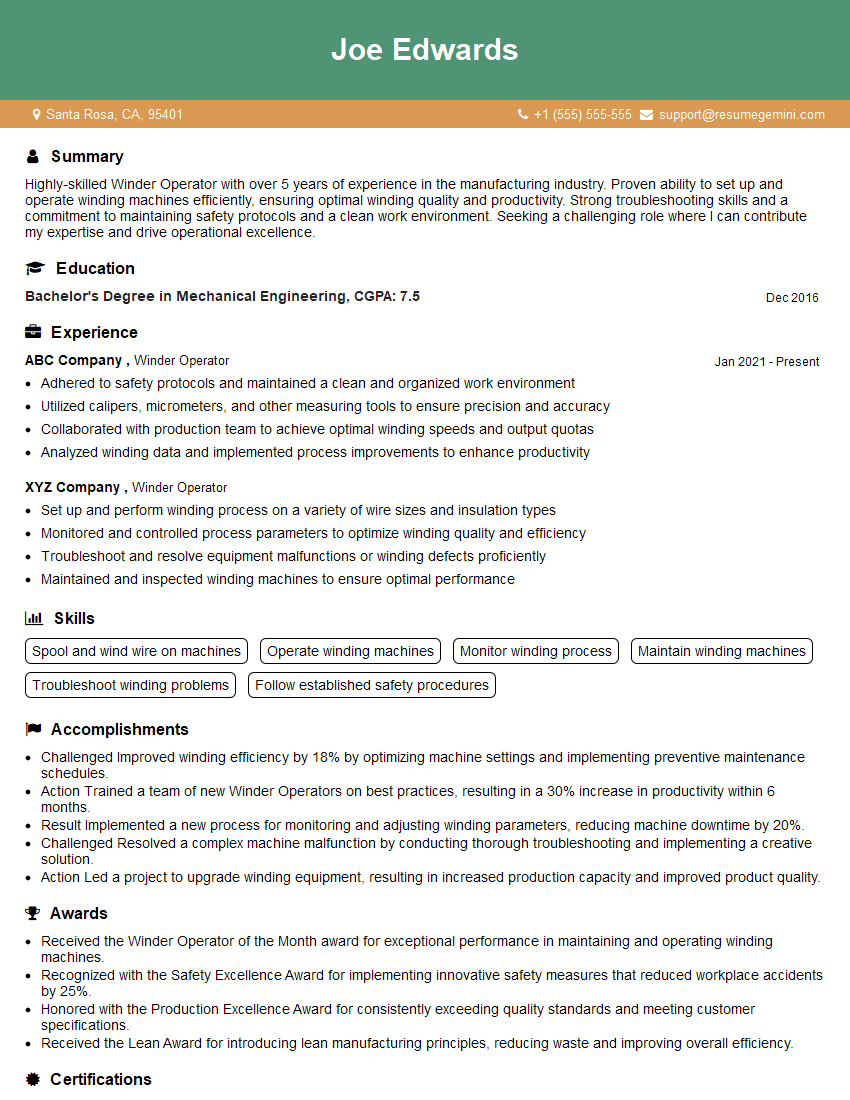
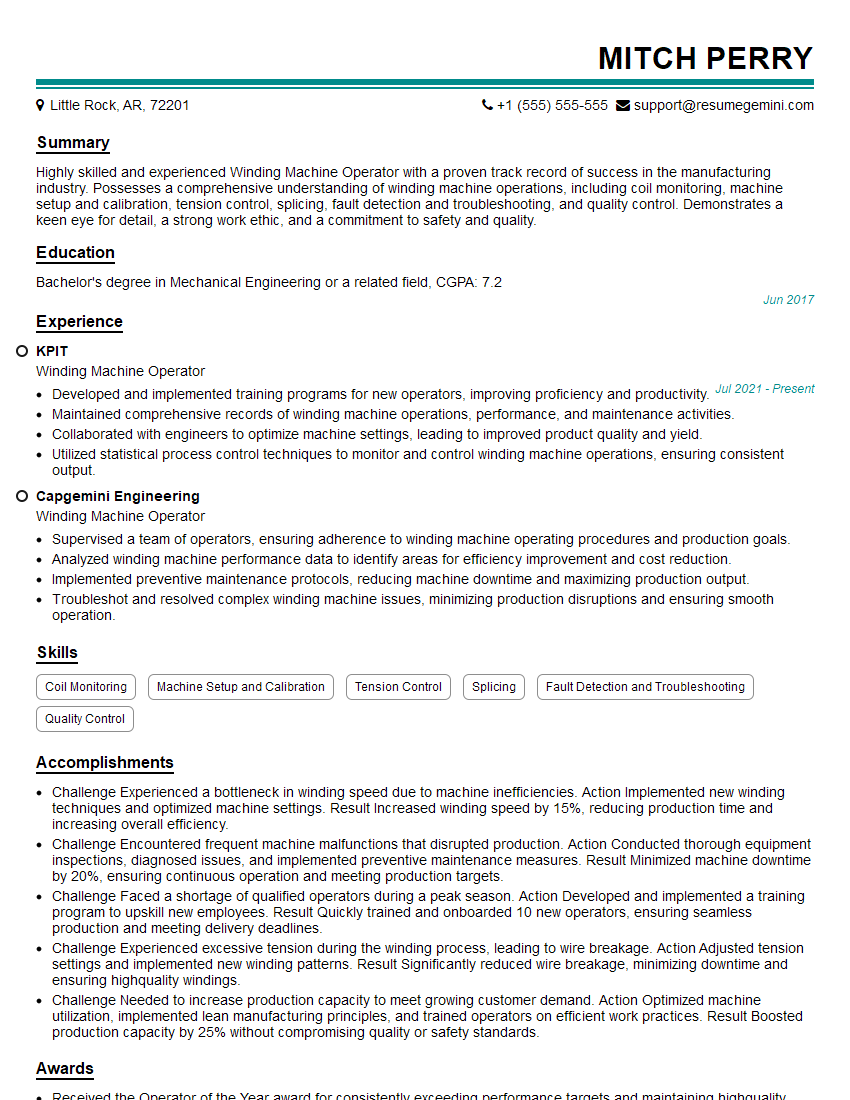
Mastering Winder Operations opens doors to exciting career opportunities in manufacturing, providing a strong foundation for advancement and specialization. To maximize your job prospects, it’s crucial to present your skills effectively. Creating an ATS-friendly resume is key to getting your application noticed. ResumeGemini is a trusted resource that can help you build a professional and impactful resume, tailored to highlight your Winder Operations expertise. Examples of resumes specifically tailored to Winder Operations are available to further guide your preparation.
Explore more articles
Users Rating of Our Blogs
Share Your Experience
We value your feedback! Please rate our content and share your thoughts (optional).
What Readers Say About Our Blog
To the interviewgemini.com Webmaster.
Very helpful and content specific questions to help prepare me for my interview!
Thank you
To the interviewgemini.com Webmaster.
This was kind of a unique content I found around the specialized skills. Very helpful questions and good detailed answers.
Very Helpful blog, thank you Interviewgemini team.