Every successful interview starts with knowing what to expect. In this blog, we’ll take you through the top Trailblazing and Backcountry Navigation interview questions, breaking them down with expert tips to help you deliver impactful answers. Step into your next interview fully prepared and ready to succeed.
Questions Asked in Trailblazing and Backcountry Navigation Interview
Q 1. Explain the difference between a compass and a GPS device in backcountry navigation.
A compass and a GPS device are both crucial tools for backcountry navigation, but they work in fundamentally different ways. A compass is a magnetic instrument that shows you your bearing – the direction you are traveling relative to magnetic north. It’s completely independent of external factors like satellite signals and relies solely on the Earth’s magnetic field. This makes it a reliable backup in situations where GPS fails (battery depletion, signal loss in canyons or heavily forested areas).
A GPS (Global Positioning System) device uses signals from satellites to determine your precise location on the Earth’s surface. It provides latitude and longitude coordinates, altitude, and often other features like speed and track recording. While immensely helpful for identifying your position and plotting routes, GPS devices require a clear view of the sky to receive satellite signals and are susceptible to malfunction if the battery dies or the signal is interrupted.
Think of it this way: the compass is like a reliable map in your hand, always giving you direction. The GPS is like having an exact address, telling you exactly where you are. Ideally, you use both together for the most robust navigation.
Q 2. Describe your experience using a topographic map and compass.
I have extensive experience using topographic maps and compasses, honed through years of guiding and personal backcountry exploration. My proficiency spans various terrains, from high-alpine environments to dense forests. I’m comfortable with both traditional methods of resection and intersection for determining location, as well as planning routes and calculating bearings using map and compass.
For example, during a recent trip in the San Juan Mountains, we encountered unexpected fog that completely obscured visibility. Relying on my pre-planned route on a detailed topographic map, I was able to use the compass to maintain our bearing and safely navigate through the whiteout conditions until the visibility improved. This prevented us from becoming lost or disoriented. Accurate map reading, understanding contour lines, and precise compass work were crucial in that situation.
Q 3. How do you calculate pace count and why is it important?
Pace counting is a method of estimating distance traveled by counting your steps. To calculate your pace count, you need to first determine your pace length – the average distance covered in one stride. This is best done on a level surface by measuring a known distance (e.g., 100 meters) and counting the number of steps you take. Divide the distance by the number of steps to get your pace length.
For example, if you take 70 steps to cover 100 meters, your pace length is approximately 1.43 meters. Multiply your pace length by the number of steps you take to estimate the distance you’ve travelled. This is invaluable when GPS is unavailable or unreliable.
The importance of pace counting lies in its ability to provide a reliable estimate of distance in conditions where other methods fail. It’s a crucial backup navigation technique and allows you to track progress along your planned route and identify if you’re deviating. It’s also useful for estimating travel times and planning for rest stops. Regularly calibrating your pace count across different terrains and carrying loads is essential for accuracy.
Q 4. What are the key elements of a successful navigation plan?
A successful navigation plan is built on several key elements:
- Thorough pre-trip planning: This includes studying topographic maps, weather forecasts, and potential hazards. Knowing the terrain, understanding the elevation changes, and identifying potential risks is paramount.
- Defining clear objectives and routes: Specify your start and end points, and outline a detailed route, including alternate routes in case of unexpected situations.
- Selecting appropriate equipment: This includes a reliable compass, a topographic map, a GPS device, a first-aid kit, appropriate clothing, and sufficient water and food.
- Communicating your plans: Share your itinerary and expected return time with someone who can raise the alarm if you are delayed.
- Regular navigation checks: Employ a system of regularly checking your location on the map and compass, confirming you’re on track, and adapting as needed.
- Flexibility and adaptability: Be prepared to adjust your plans based on unforeseen circumstances like weather changes or trail conditions.
A solid plan mitigates risks and improves the safety and efficiency of your trip. Even experienced adventurers should carefully plan their routes.
Q 5. Describe your method for identifying and mitigating navigation errors.
Identifying and mitigating navigation errors is a critical aspect of backcountry travel. My approach is proactive and involves several steps:
- Regular checks: I frequently compare my current position with the map and compass, and cross-reference with my GPS device.
- Redundancy: I utilize multiple navigation tools (map, compass, GPS) to increase accuracy and reduce the chance of error.
- Back bearings: After reaching a significant point along the route, I take a back bearing to verify that my route is correct. This eliminates cumulative errors.
- Natural landmarks: I use prominent natural features as checkpoints to confirm location and direction.
- Recognizing signs of error: Signs of deviation may be a significant difference between planned and actual distance covered or a mismatch between compass bearing and terrain features.
If an error is identified, I immediately pause to reassess my position, re-plan my route if necessary, and double-check all my tools. It’s always better to spend extra time resolving a navigational issue than to continue on a wrong course.
Q 6. How do you choose a safe and efficient route in unfamiliar terrain?
Choosing a safe and efficient route in unfamiliar terrain requires a methodical approach:
- Map study: A thorough examination of the topographic map identifies potential obstacles, hazards, and the best route based on elevation changes, water sources, and trail conditions.
- Terrain assessment: Understanding slope angles, vegetation density, and soil types helps in determining the feasibility and safety of various routes.
- Weather considerations: Taking into account wind, precipitation, and temperature forecasts is essential for planning a safe and comfortable route, especially in high-altitude areas.
- Time constraints: Factor in the amount of daylight and your pace to ensure you reach your destination before nightfall.
- Risk assessment and mitigation: Identify potential hazards (e.g., river crossings, steep slopes, avalanche terrain) and devise strategies to navigate these safely or avoid them altogether.
For example, I might choose a longer but less steep route to avoid risky scree slopes or select a route closer to water sources to minimize carrying weight. Prioritizing safety over speed is paramount.
Q 7. What are some common backcountry hazards, and how do you avoid them?
Backcountry hazards are numerous and vary greatly based on the terrain and weather conditions. Common hazards include:
- Weather: Sudden changes in weather (whiteouts, thunderstorms, extreme temperatures) can quickly create dangerous situations.
- Terrain: Steep slopes, unstable ground, rockfalls, and river crossings pose significant risks.
- Wildlife: Encounters with potentially dangerous animals (bears, mountain lions) require awareness and appropriate precautions.
- Navigation errors: Getting lost is a serious hazard, potentially leading to hypothermia, exhaustion, or injury.
- Injuries: Falls, sprains, or other injuries can leave you vulnerable in the backcountry.
Avoiding these hazards involves thorough planning, preparation, and risk management. This includes being well-equipped, having a strong understanding of weather patterns, understanding animal behavior, and practicing robust navigation skills. Never underestimate the power of nature; always leave a margin for error and be prepared for unexpected events.
Q 8. Describe your experience with route finding in challenging weather conditions.
Navigating in challenging weather is crucial for safe trailblazing and backcountry travel. Reduced visibility due to fog, snow, or rain significantly impacts landmark recognition and compass accuracy. My experience involves adapting navigation strategies based on the specific weather conditions. For instance, during a heavy snowfall in the Cascades, I relied heavily on my GPS, regularly checking its signal strength and battery life. I also used contour lines on my topographic map to anticipate changes in elevation and terrain, which were less visible due to the snow cover. Furthermore, I slowed my pace, focusing on staying on well-marked trails or following my previously planned route very carefully. In high winds, I’d ensure I have a secure handhold on my compass to prevent misreading. Whiteout conditions necessitate staying put if possible or using a highly sensitive GPS device with a good signal, and confirming its location with any alternative means if possible.
Essentially, it’s about redundancy and risk mitigation. I never rely on a single navigation tool in challenging weather. Instead, I cross-reference data from my map, compass, GPS, and altimeter, always prioritizing safety and avoiding unnecessary risk-taking.
Q 9. How do you use landmarks for navigation?
Landmarks are essential for navigation, especially when electronic devices fail or are unavailable. My approach to using landmarks involves a combination of pre-trip planning and on-the-ground observation. Before heading out, I study topographic maps to identify prominent features – distinctive peaks, valleys, rivers, and even unusual rock formations. This allows me to anticipate them and use them as checkpoints along my route.
On the trail, I consistently check my position against these pre-identified landmarks. For example, I might plan my route to pass a specific ridge at a certain elevation, then confirm that I am indeed following the right path once I reach it. I also pay attention to less obvious clues: a change in tree species, a particular kind of soil, or even the direction of a prevailing wind can all provide supplementary navigational cues. I constantly compare my current observation with my map and compass bearings.
It’s also important to be aware that landmarks can be deceiving, especially in unfamiliar terrain. I always cross-reference different clues to confirm my position and avoid relying on a single landmark for critical decisions.
Q 10. What are the different types of compasses and their uses?
There are several types of compasses, each with its own strengths and weaknesses. The most common is the baseplate compass, which is lightweight and easy to use for basic orienteering. It’s ideal for shorter hikes and relatively open terrain. The lensatic compass, with its built-in magnifying lens, offers greater accuracy and is often preferred for more challenging navigation tasks. Its built-in sighting mechanism is excellent for taking accurate bearings. Clinometers, integrated into some compasses, allow for measuring angles of inclination, useful for determining slopes and elevations.
More advanced compasses include those with features like declination adjustments (to account for magnetic variations), mirrors for improved sighting, and even digital displays. The choice of compass depends on the specific needs of the trip. For example, I’d use a lensatic compass for backcountry navigation while a simple baseplate compass would suffice for shorter, less challenging hikes. I always ensure that my compass is calibrated correctly and that I understand its limitations.
Q 11. How do you interpret contour lines on a topographic map?
Contour lines on a topographic map represent points of equal elevation. They are the key to understanding the three-dimensional shape of the terrain. Closely spaced contour lines indicate a steep slope, whereas widely spaced lines show a gentle slope. A contour line forming a closed circle represents a hilltop or peak if the numbers increase towards its center. A closed circle with numbers decreasing towards its center represents a depression or sinkhole.
For example, if you see a series of closely spaced contour lines running up a mountainside, you know to expect a steep climb. Conversely, widely spaced contour lines show that the terrain is relatively flat. By understanding the spacing and patterns of contour lines, you can visualize the terrain, plan your route, and anticipate challenges like steep ascents or descents or potential hazards.
Learning to read contour lines is a crucial skill for safe and efficient navigation, allowing for accurate route planning and hazard identification before venturing into the wilderness.
Q 12. Explain the concept of triangulation for determining location.
Triangulation is a fundamental technique for determining your location using at least two known reference points. Imagine you have two landmarks visible from your location, each with known coordinates on your map. You take a compass bearing to each landmark. On your map, you draw lines from each landmark in the direction of your bearings. The point where these lines intersect is your approximate location.
The accuracy of triangulation depends on several factors, including the distance between the landmarks, the accuracy of your compass bearings, and the precision of the map itself. Using a third landmark improves accuracy significantly; three lines intersecting will usually give a much smaller and more accurate location. I frequently utilize triangulation as a way to double-check my location obtained from other navigation tools like my GPS, especially in areas with poor GPS reception.
Q 13. Describe your experience with GPS device troubleshooting.
GPS devices, while reliable, can malfunction. My experience with GPS troubleshooting includes various scenarios. Common problems include loss of signal, battery issues, incorrect settings, and software glitches. Troubleshooting steps typically involve first checking the obvious: ensuring the device is turned on and has adequate battery power. I then examine the antenna to make sure it’s not obstructed by any objects.
If the GPS still isn’t functioning, I check the device’s settings to ensure that the correct map data is loaded and that the GPS mode is accurate. If the problem persists, I might attempt to reset the device, which often fixes minor software errors. If this still fails, I’ll try rebooting the device. In remote areas, I always carry backup navigation tools such as a map, compass, and altimeter to avoid total dependence on my GPS. In the case of complete GPS failure, I always have alternative navigation methods as a backup, as mentioned before.
Q 14. How do you use celestial navigation techniques?
Celestial navigation uses the positions of celestial bodies (sun, moon, stars) to determine latitude and longitude. While less commonly used in everyday backcountry navigation due to the need for specialized equipment and knowledge, it’s a valuable skill to have in emergency situations. It requires a sextant to measure the angle of a celestial body above the horizon and a nautical almanac or similar tool that lists the positions of the celestial bodies at specific times. The process involves calculating your position using the measured angle and the body’s known position from the almanac.
I’ve used this method during a survival training exercise; It’s a challenging but rewarding skill that demands practice and a thorough understanding of astronomical concepts. However, relying on celestial navigation in the backcountry requires substantial experience, practice, and the right tools, so it’s usually a less frequently used option compared to others.
Q 15. How do you handle an unexpected navigational challenge or equipment failure?
Unexpected navigational challenges and equipment failures are an inevitable part of backcountry travel. My approach is based on a combination of thorough preparation, adaptable planning, and a systematic problem-solving process. If my compass fails, for example, I’d immediately revert to using my map and a reliable backup compass. If I encounter an unexpected obstacle, like a washed-out trail, I’d assess the situation – checking for alternate routes using my map, utilizing my altimeter to determine elevation changes and potentially finding a higher vantage point for better visibility, and relying on my knowledge of terrain and weather patterns to make an informed decision. I always prioritize safety; if unsure, I’ll backtrack to a known safe point or activate my personal locator beacon (PLB).
For equipment failure, I always carry redundant systems. This includes a backup compass, a physical map in addition to digital maps on my GPS device, extra batteries, and a first-aid kit with essential tools. Carrying a lightweight repair kit for common equipment malfunctions, like a patching kit for my pack or a multi-tool, allows me to fix minor issues quickly in the field.
Career Expert Tips:
- Ace those interviews! Prepare effectively by reviewing the Top 50 Most Common Interview Questions on ResumeGemini.
- Navigate your job search with confidence! Explore a wide range of Career Tips on ResumeGemini. Learn about common challenges and recommendations to overcome them.
- Craft the perfect resume! Master the Art of Resume Writing with ResumeGemini’s guide. Showcase your unique qualifications and achievements effectively.
- Don’t miss out on holiday savings! Build your dream resume with ResumeGemini’s ATS optimized templates.
Q 16. What is your experience with creating and interpreting altimeters?
I am proficient in creating and interpreting altimeters, both through using a dedicated device and by understanding how to read contours and spot elevations on topographic maps. An altimeter shows elevation, but understanding its limitations is key. For example, an altimeter’s reading can be affected by atmospheric pressure changes; a sudden storm could significantly alter its reading. Therefore, I always cross-reference altimeter readings with topographic map data. I know how to use contour lines to estimate elevation gains and losses, to plan my route in relation to steep ascents and descents and to avoid unexpected changes in terrain.
When creating an altimeter profile for a planned route, I’ll use a combination of the topographic map, GPS data, and elevation information found in guidebooks or online resources. This allows for a comprehensive understanding of the elevation changes along the trail, enabling better preparation for potential challenges. I can visually interpret this profile to anticipate steep ascents and descents, allowing for efficient pacing and energy management during the trip.
Q 17. How do you plan for emergencies during a backcountry trip?
Emergency planning is paramount for any backcountry trip. My planning process begins long before the trip itself. This involves assembling a comprehensive first-aid kit tailored to the specific environment and activities of the trip, which includes a comprehensive first aid kit, sufficient food and water for unexpected delays, a survival kit with fire starters and shelter materials, and a personal locator beacon (PLB) or satellite messenger. Crucially, I always leave a detailed itinerary with a trusted contact, including my planned route, expected return time, and emergency contact information.
During the trip itself, I regularly check weather forecasts, monitor my supplies, and maintain communication whenever possible. Team members should be aware of each other’s location and condition. We use established protocols for communication and address any potential issues immediately. Regular route checks against our map and GPS device, coupled with risk assessment of the terrain and weather, ensure we are always aware of our situation.
Q 18. What safety precautions do you take when navigating in remote areas?
Safety in remote areas is a multifaceted process demanding thorough planning and vigilance. The most important aspects are: informing others about my plans, carrying sufficient supplies, and regularly communicating my progress. I always inform trusted contacts about my route and expected return time. I ensure all group members are skilled in navigation and first aid. We conduct regular safety checks, monitoring each other’s condition and equipment. I always employ the buddy system, avoiding solo travel unless very experienced and comfortable with the risks.
Specific precautions include carrying a fully-charged GPS device and extra batteries, maintaining awareness of weather conditions, and avoiding travel during periods of high risk (e.g., thunderstorms). Knowing the terrain is also critical; I familiarize myself with the area through detailed maps and guidebooks before embarking. Having knowledge of local wildlife and how to respond to encounters is also vital.
Q 19. Explain your knowledge of different map projections and their limitations.
Map projections are crucial for understanding the limitations of a map. A map projection is a systematic transformation of the three-dimensional surface of the Earth onto a two-dimensional plane. There are various types, each with its strengths and weaknesses. For example, the Mercator projection is widely used, but it distorts areas, particularly towards the poles, making landmasses appear larger than they actually are. The Lambert Conformal Conic projection, on the other hand, is better suited for showing large areas of mid-latitude regions with minimal distortion. I understand the limitations of each projection and choose the most appropriate map for the specific terrain and location of the trip. For instance, a UTM (Universal Transverse Mercator) grid is ideal for GPS mapping due to its consistent coordinate system.
Choosing the right projection greatly affects navigation accuracy. Using a projection unsuitable for the area can lead to significant errors in distance and bearing calculations. A deep understanding of projections allows for selecting the best option to minimize these distortions, leading to safer and more efficient navigation. I often compare information from multiple map sources to cross-check data and minimize error due to projection differences.
Q 20. How do you utilize GPS waypoints and tracks effectively?
GPS waypoints and tracks are essential tools for efficient navigation. Waypoints are specific locations marked on a GPS device. Tracks record the path taken during a trip. I use them to plan routes in advance, create checkpoints along a trail, and mark potential hazards. Before a trip, I’ll create waypoints for key locations such as campsites, water sources, and trail junctions. These waypoints provide a clear reference, ensuring accurate progress tracking. I also use waypoints to mark potential dangers or areas requiring extra attention. Then, during the trip, the tracks provide a record of our route. This is crucial if visibility is impaired, or if we need to retrace our steps.
For example, creating waypoints for each bend on a challenging river crossing and recording the route taken helps in retracing the steps on the return, ensuring safety. Comparing the recorded track with the planned route helps in identifying deviations from the intended path and making necessary adjustments. This information is invaluable for future trips, allowing for route refinement and better trip planning.
Q 21. How do you maintain your navigation equipment and supplies?
Maintaining navigation equipment and supplies is vital for safe and reliable navigation. This starts with regular cleaning and inspection of all equipment after each use, particularly checking for damage, corrosion, and proper functionality. GPS devices require regular battery checks and software updates. Maps should be stored properly to prevent damage and moisture. A routine check of batteries and functionality before any trip is standard practice.
I keep detailed records of equipment usage, maintenance, and any repairs undertaken. I store all equipment in a dry, cool place to prevent damage from moisture or extreme temperatures. I also regularly test equipment before each trip to ensure proper functionality and replace worn-out components as needed. For example, I regularly calibrate my compass against a known magnetic north reference to maintain its accuracy. Proper maintenance of equipment translates to confidence in the equipment’s reliability during critical moments.
Q 22. Describe your experience navigating at night.
Night navigation demands a fundamentally different approach than daytime travel. It relies heavily on pre-trip planning and meticulous execution. My experience involves utilizing a combination of tools and techniques, prioritizing redundancy and safety.
Firstly, I always have multiple light sources – a headlamp with extra batteries, a backup flashlight, and ideally, a chemical light stick. Secondly, I rely heavily on my compass and map, constantly cross-referencing my position. I use a technique called ‘terrain association’ where I identify prominent landmarks visible even at night (ridges, valleys, streams) to maintain my bearing. For example, I might use the silhouette of a distant mountain peak to confirm my direction.
Thirdly, I significantly reduce my pace, focusing on precise foot placement to avoid tripping hazards. I also utilize GPS devices, but understand their limitations in challenging terrain, such as dense forest canopies that block satellite signals. I always have a backup plan in place, considering potential scenarios like equipment failure, unexpected weather changes, or getting lost. This might involve establishing a predetermined fallback route or having a pre-arranged check-in time with a partner.
Q 23. What are the advantages and disadvantages of using different types of maps?
Different map types offer various advantages and disadvantages. Topographic maps, for example, provide detailed elevation information, essential for assessing terrain difficulty and planning routes that avoid steep ascents or descents. However, their detail can be overwhelming for beginners and they lack the overview provided by a larger-scale map.
On the other hand, simpler recreational maps might offer a clearer, less cluttered view but lack the precise detail of topographic maps. Their scale might also be less precise for detailed route planning in challenging terrain. Using a GPS map on a handheld device offers immediate location data and can be overlaid with topographic data, but it relies on battery power and satellite reception, which can be unreliable in remote areas.
Ultimately, the best choice depends on the specific needs of the trip. For a challenging backcountry expedition, a combination of topographic maps and GPS is recommended, while a less demanding hike might only require a recreational map. I typically carry multiple map types as a redundancy measure.
Q 24. How do you adapt your navigation strategies based on terrain?
Terrain adaptation is crucial for safe and efficient navigation. My strategies change significantly depending on the environment. For example, in steep, rocky terrain, I would choose a more cautious route, prioritizing safety over speed, and paying close attention to my footing. I would use handholds where necessary and perhaps even use a trekking pole for additional stability.
In dense forest, visibility is significantly reduced. My navigation would rely heavily on compass and map, constantly taking bearings and checking my location against features identified on the map. I would also be particularly mindful of potential hazards like fallen trees or undergrowth. In flat, open terrain, my pace might increase, but I would still maintain situational awareness, monitoring for changes in wind or weather that could affect visibility or my ability to maintain my bearing.
Water crossings require special attention. I’d assess the depth and current before crossing, looking for the safest and most stable route. In snow or ice, I might use snowshoes or crampons and need to be extremely cautious of hidden crevasses or slippery surfaces. Adaptability is key – the best navigator can effectively adjust their plans based on the specific challenges of the environment.
Q 25. Explain your understanding of declination and its effect on compass readings.
Declination refers to the angular difference between magnetic north (indicated by a compass) and true north (the geographic North Pole). Understanding declination is crucial for accurate navigation, as a compass alone will not point directly to true north. The amount of declination varies depending on your location on Earth.
To account for declination, you need to either adjust your compass bearing before taking a measurement (applying the declination correction) or use a map that already incorporates this correction. Maps usually display the declination for the area they cover, often indicated by an arrow or a stated number of degrees east or west. Ignoring declination can lead to significant errors in your position, especially over long distances. For example, if the declination is 10 degrees east, and you are navigating on a bearing of 0 degrees (north), you would need to adjust your compass bearing to 10 degrees west to actually walk north.
I always check the declination for my area before any trip and incorporate it into my navigation planning. Many modern GPS devices automatically account for declination, reducing the risk of error.
Q 26. Describe your experience teaching or guiding others in backcountry navigation.
I have extensive experience teaching and guiding others in backcountry navigation. My approach focuses on building a solid foundation in fundamental skills, gradually progressing to more advanced techniques. I emphasize hands-on practice and real-world application. I typically start with map and compass basics, teaching students how to orient maps, take bearings, and plot routes. Then, I introduce them to advanced techniques like pacing, triangulation, and GPS use.
Safety is paramount. I stress the importance of risk assessment, planning contingencies, and understanding personal limitations. I encourage open communication and teamwork, ensuring that participants feel comfortable voicing concerns or asking questions. My goal is not only to teach navigation skills but to foster a sense of confidence and responsibility in the backcountry. I’ve led numerous workshops and guided trips, witnessing the growth and confidence in participants as they develop their skills.
For example, in one workshop, a participant initially struggled with map orientation. Through patient instruction and guided practice, she eventually mastered the skill and even helped others in the group. This experience highlighted the importance of personalized instruction and building confidence.
Q 27. What are some best practices for leaving no trace while navigating in the backcountry?
Leaving no trace is essential for preserving the beauty and integrity of the backcountry. In navigation, this translates to several key practices. Firstly, sticking to established trails minimizes environmental impact. If you must venture off-trail, do so with minimal disturbance, avoiding trampling vegetation or disturbing wildlife.
Secondly, proper waste disposal is crucial. Pack out everything you pack in, including food scraps and toilet paper. Dispose of waste responsibly, preferably burying human waste at least 200 feet from water sources and trails. Thirdly, minimize campfire impact. Use existing fire rings or stoves instead of starting new fires whenever possible. If you do build a fire, ensure it is completely extinguished before leaving.
Finally, respect wildlife and their habitats. Avoid disturbing animals or their nests. Observe them from a distance and never approach or feed them. By adhering to these principles, we can help protect the backcountry for future generations.
Key Topics to Learn for Trailblazing and Backcountry Navigation Interview
- Map and Compass Skills: Understanding map symbols, scales, declination, and using a compass for accurate bearings and navigation. Practical application: Demonstrating proficiency in plotting a course on a map and following it using a compass in varied terrain.
- GPS Navigation: Utilizing GPS devices effectively, understanding GPS limitations (signal loss, accuracy), and employing backup navigation methods. Practical application: Explaining the process of waypoint creation, route planning, and track logging using a GPS device, including troubleshooting common issues.
- Terrain Association: Correlating map features with real-world terrain, identifying landmarks, and using natural features for navigation. Practical application: Describing how to use terrain features to confirm your location and adjust your course if necessary.
- Route Planning and Decision-Making: Developing safe and efficient routes considering terrain, weather, and potential hazards. Practical application: Explaining the process of risk assessment and contingency planning for backcountry navigation.
- Emergency Procedures: Knowledge of wilderness first aid, search and rescue protocols, and effective communication strategies in emergency situations. Practical application: Describing appropriate actions in case of injury, getting lost, or encountering severe weather.
- Navigation Techniques: Understanding various navigation techniques such as pacing, triangulation, and using celestial navigation (sun/stars). Practical application: Comparing and contrasting different navigation methods and their suitability for specific scenarios.
Next Steps
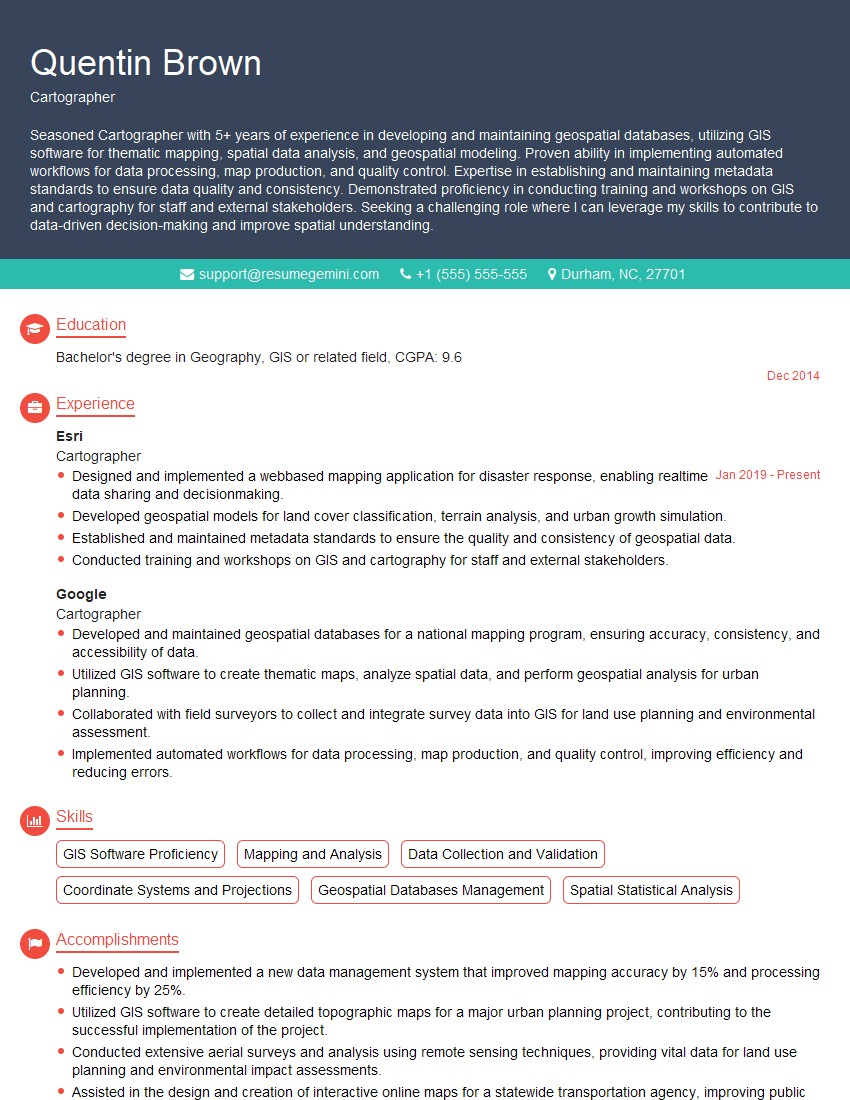
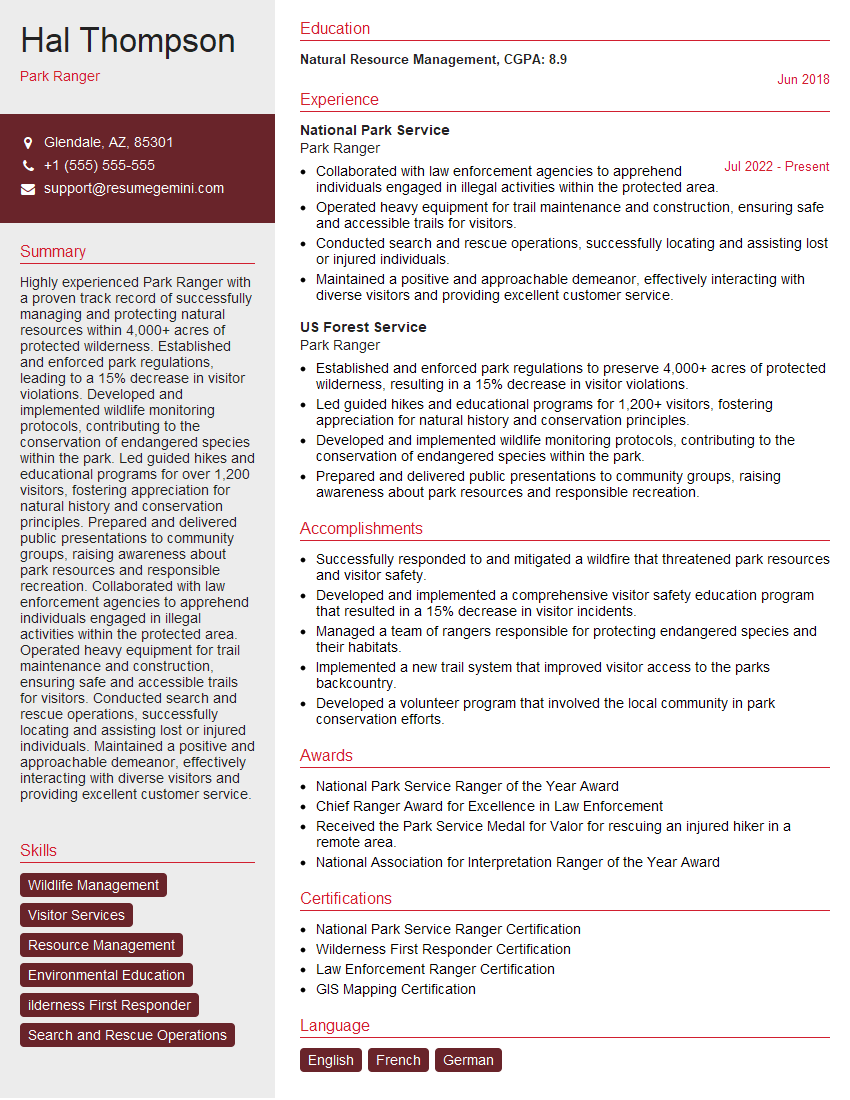
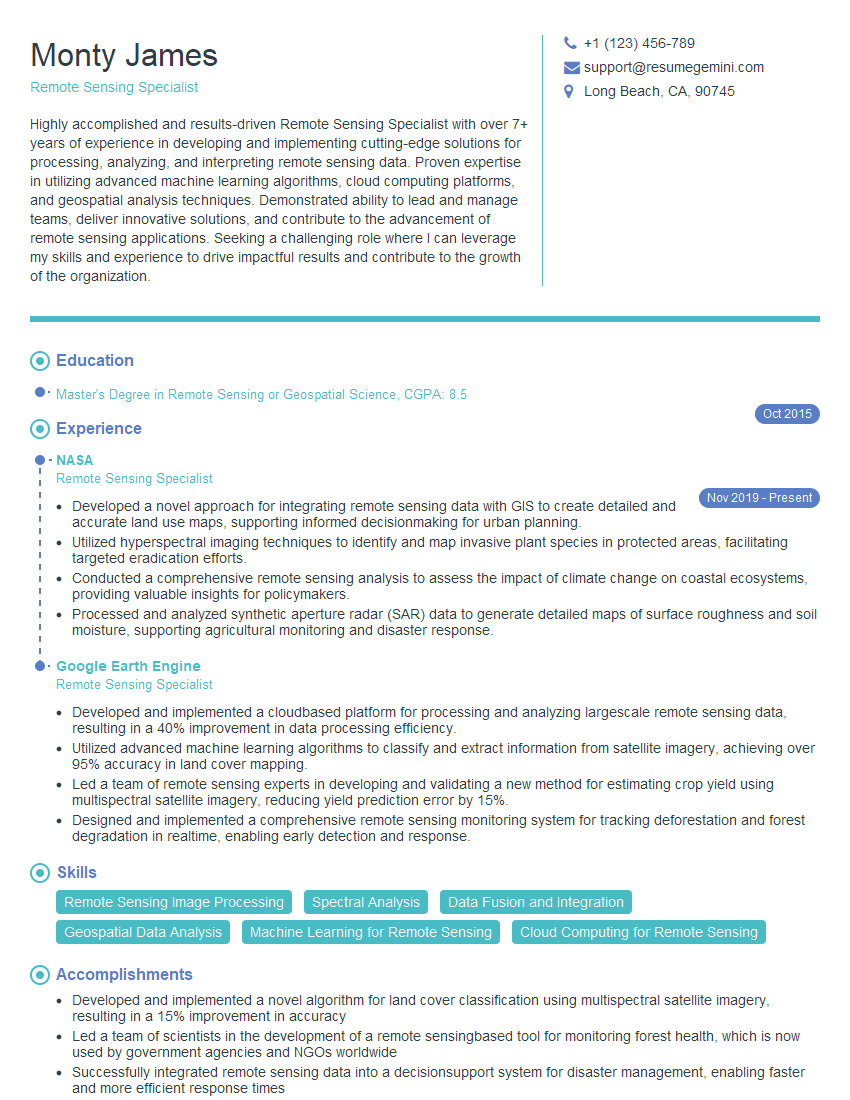
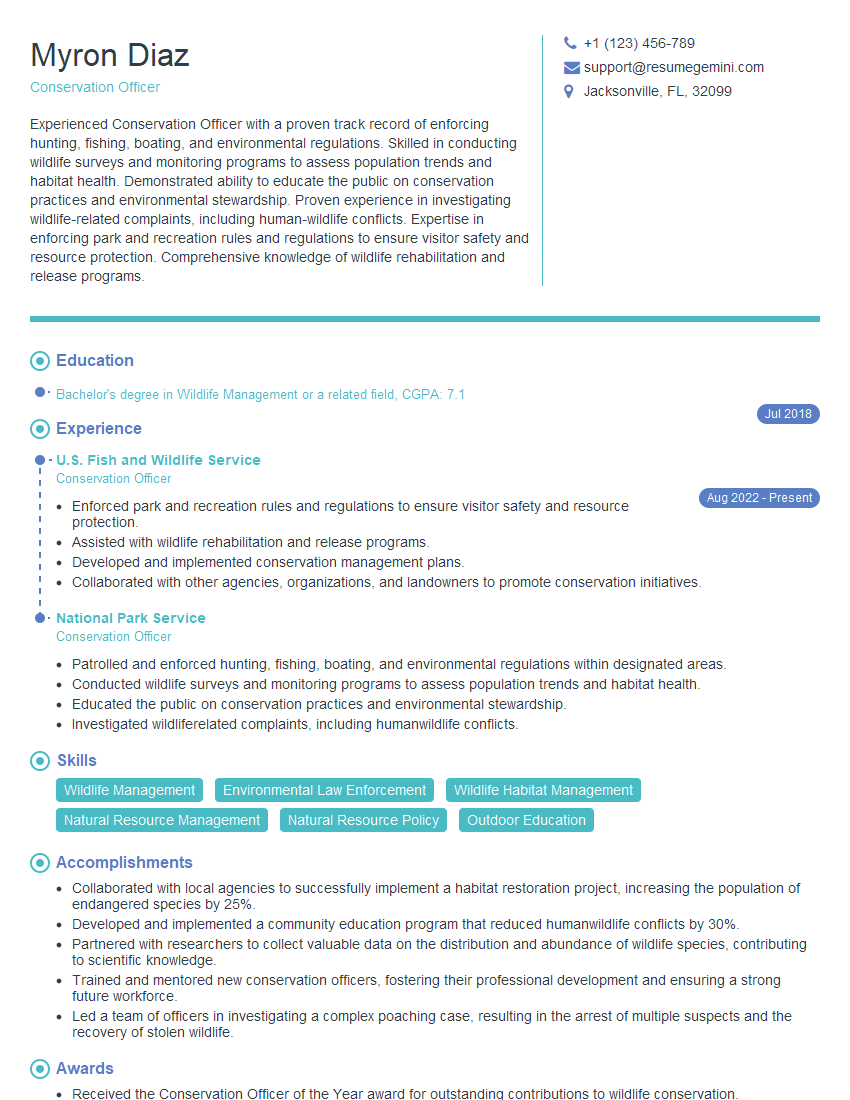
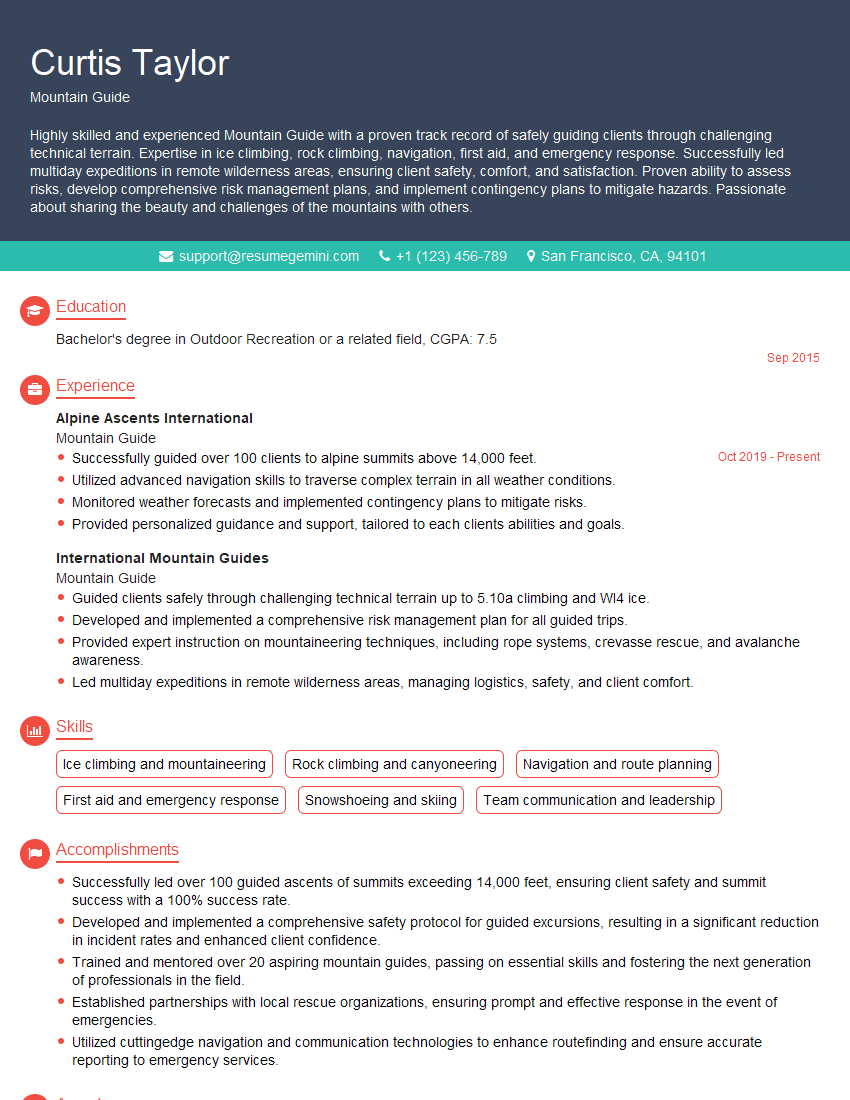
Mastering Trailblazing and Backcountry Navigation is crucial for career advancement in outdoor-related fields, showcasing your expertise and commitment to safety. A strong resume is your first step toward securing your dream role. Building an ATS-friendly resume is essential for getting noticed by potential employers. ResumeGemini can significantly enhance your resume-building experience, helping you create a document that highlights your skills effectively and catches the recruiter’s eye. ResumeGemini offers examples of resumes tailored to Trailblazing and Backcountry Navigation positions to help you craft a compelling application.
Explore more articles
Users Rating of Our Blogs
Share Your Experience
We value your feedback! Please rate our content and share your thoughts (optional).
What Readers Say About Our Blog
To the interviewgemini.com Webmaster.
Very helpful and content specific questions to help prepare me for my interview!
Thank you
To the interviewgemini.com Webmaster.
This was kind of a unique content I found around the specialized skills. Very helpful questions and good detailed answers.
Very Helpful blog, thank you Interviewgemini team.