Preparation is the key to success in any interview. In this post, we’ll explore crucial Transformer Operations interview questions and equip you with strategies to craft impactful answers. Whether you’re a beginner or a pro, these tips will elevate your preparation.
Questions Asked in Transformer Operations Interview
Q 1. Explain the principle of operation of a power transformer.
A power transformer operates on the principle of electromagnetic induction. It uses two or more coils of wire, called windings, wound around a common ferromagnetic core. When an alternating current (AC) flows through the primary winding, it creates a fluctuating magnetic field in the core. This changing magnetic field induces a voltage in the secondary winding, according to Faraday’s Law of Induction. The ratio of the number of turns in the primary and secondary windings determines the voltage transformation ratio. For example, if the primary has 1000 turns and the secondary has 100 turns, the voltage in the secondary will be 1/10th of the primary voltage. This allows us to step up (increase) or step down (decrease) voltage levels efficiently, crucial for power transmission and distribution.
Imagine it like a lever: a small force applied at one end can create a larger force at the other. Similarly, a smaller voltage can induce a larger voltage (and vice-versa) with the right winding ratio. This fundamental principle underpins the entire power grid.
Q 2. Describe different types of transformer cooling systems.
Transformer cooling systems are vital to prevent overheating and ensure longevity. Several types exist, each suitable for different transformer sizes and power ratings.
- Oil-Natural Air Cooled (ONAN): The simplest type, relying on natural air convection to cool the transformer oil. Suitable for smaller transformers.
- Oil-Forced Air Cooled (OFAN): Uses fans to force air across the cooling surfaces, increasing heat dissipation. More efficient than ONAN.
- Oil-Water Cooled (OW): Circulates water through a heat exchanger to cool the transformer oil. Effective for larger transformers with higher power ratings.
- Forced Oil-Forced Air Cooled (FOFAN): Pumps oil through the core and windings and uses fans to cool the oil-air heat exchanger. Provides robust cooling capacity.
- Forced Oil-Water Cooled (FOW): Combines forced oil circulation with a water-cooled heat exchanger. Ideal for very large transformers in high-power applications.
The choice of cooling system depends on factors like transformer size, location, ambient temperature, and the desired level of reliability.
Q 3. What are the common causes of transformer failures?
Transformer failures can stem from various causes, often interlinked. Common culprits include:
- Overheating: Due to overloading, poor cooling, or internal faults. This leads to insulation degradation and potential short circuits.
- Insulation Failure: Aging, moisture ingress, or excessive temperature can weaken the insulation between windings, leading to breakdown.
- Short Circuits: Internal or external short circuits can cause catastrophic failures. Internal shorts are often due to insulation breakdown.
- Tap Changer Problems: Malfunctioning tap changers can damage the windings and disrupt operation.
- External Factors: Lightning strikes, over-voltages, and physical damage can also lead to transformer failure.
- Oil Degradation: Contaminated or degraded transformer oil loses its insulating properties and can accelerate other forms of failure.
Regular maintenance and monitoring, including DGA testing, are crucial to mitigate these risks.
Q 4. How do you perform a transformer oil test?
Transformer oil testing is crucial for assessing its condition and preventing catastrophic failures. Tests typically include:
- Dielectric Strength: Measures the oil’s ability to withstand high voltage without breaking down. A low dielectric strength indicates contamination or degradation.
- Interfacial Tension: Measures the oil’s purity and its ability to separate from water. Low interfacial tension suggests contamination.
- Moisture Content: Determines the amount of dissolved water in the oil. Excess moisture reduces the dielectric strength.
- Acidity: Measures the level of acidic components in the oil. High acidity indicates degradation.
- Dissolved Gas Analysis (DGA): Detects gases produced by faults within the transformer (discussed in more detail below).
These tests are performed using specialized equipment and should be carried out by trained personnel adhering to safety protocols.
Q 5. Explain the significance of Dissolved Gas Analysis (DGA) in transformer maintenance.
Dissolved Gas Analysis (DGA) is a powerful diagnostic tool used to detect and identify internal faults within a transformer. When insulation deteriorates or arcing occurs, gases like hydrogen, methane, ethane, and carbon monoxide are produced. The types and quantities of these gases provide valuable clues about the nature and severity of the fault. For instance, high levels of hydrogen might indicate partial discharges, while high levels of methane suggest overheating.
DGA interpretation often relies on established methods like the Duval Triangle or IEC 60599 standards, which provide a systematic approach to diagnosing potential problems. Early detection through DGA allows for timely preventative maintenance, avoiding costly and potentially dangerous failures.
Q 6. What are the safety precautions when working with high voltage transformers?
Working with high-voltage transformers demands strict adherence to safety precautions. These include:
- Lockout/Tagout Procedures: Always lock out and tag out the transformer before performing any work. This ensures that power cannot be inadvertently reapplied.
- Personal Protective Equipment (PPE): Use appropriate PPE, including insulated gloves, safety glasses, and protective clothing.
- Grounding: Properly ground the transformer to prevent electric shock. This involves connecting grounding wires to designated points on the transformer.
- Arc Flash Protection: Arc flash hazards are significant when working on energized equipment. Use appropriate arc flash protective gear and follow established safety protocols.
- Trained Personnel: Only qualified and trained personnel should work on high-voltage transformers.
- Permit-to-Work Systems: Follow established permit-to-work systems to ensure all safety procedures are followed.
Ignoring these precautions can lead to serious injury or even death.
Q 7. Describe the process of transformer commissioning.
Transformer commissioning is a critical process that ensures the transformer is installed and operates correctly. It involves several key steps:
- Pre-Commissioning Inspection: Verify that the transformer and its accessories are delivered undamaged and meet specifications.
- Installation: Carefully install the transformer according to the manufacturer’s instructions, ensuring proper grounding and connections.
- Insulation Resistance Test: Measure the insulation resistance of the windings to confirm their integrity.
- Turns Ratio Test: Verify that the transformer’s turns ratio matches the design specifications.
- Induced Voltage Test: Check the induced voltage on the windings under different load conditions.
- Oil Tests: Conduct the necessary oil tests to verify its quality and purity.
- No-Load Test: Measure the no-load current and losses to assess the transformer’s efficiency.
- Load Test: Test the transformer under various load conditions to confirm its performance and stability.
- Protection System Testing: Verify the correct functioning of the transformer’s protection relays and devices.
Thorough commissioning ensures a safe and reliable operation of the transformer throughout its service life. Any issues detected during this process should be addressed before energizing the transformer.
Q 8. How do you interpret transformer nameplate data?
Transformer nameplate data provides crucial information about the transformer’s characteristics and operating parameters. Think of it as the transformer’s identity card. Interpreting this data accurately is fundamental for safe and efficient operation. Key parameters include:
- Rated Power (kVA): The maximum apparent power the transformer can handle without overheating.
- Primary and Secondary Voltages: The voltage levels on the high-voltage and low-voltage sides respectively. For example, a 138kV/13.8kV transformer steps down voltage.
- Frequency (Hz): The frequency of the power system (typically 50Hz or 60Hz). Using the wrong frequency can damage the transformer.
- Connection Group (Vector Group): This indicates the winding connections and phase shift between the primary and secondary windings (explained in more detail in answer 3).
- Impedance (%): Represents the transformer’s internal resistance and reactance, influencing voltage regulation and short-circuit current.
- Tap Changer Range: Indicates the voltage adjustment range available through the tap changer. This allows for voltage regulation under varying load conditions.
- Cooling Method (e.g., ONAN, ONAF): Specifies the type of cooling system employed, impacting the transformer’s ability to dissipate heat.
For instance, a nameplate might read: “1000 kVA, 138 kV/13.8 kV, 60 Hz, Dyn11, 5.7%, ±5% Taps, ONAN.” By understanding each parameter, you can determine the transformer’s suitability for a specific application and assess its operational limits.
Q 9. What are the different types of transformer tap changers?
Tap changers allow for adjustment of the transformer’s turns ratio, thereby regulating the output voltage. There are two main types:
- Off-Circuit Tap Changers (OCBC): These require de-energizing the transformer before changing taps. This is safer but less convenient since it requires a planned outage. They’re like changing a tire – you need to stop the car first.
- On-Load Tap Changers (OLTC): These allow tap changes while the transformer is energized. This is crucial for maintaining voltage stability under fluctuating load conditions. They are more complex but provide continuous voltage regulation without interruptions.
OLTCs have further sub-categories based on their switching mechanism, including selector switches, diverter switches, and various combinations. The choice depends on factors like the size of the transformer, voltage level, and required switching speed.
Q 10. Explain the concept of transformer vector group.
The transformer vector group defines the winding connections (e.g., star or delta) and the phase shift between the primary and secondary windings. It’s essential for ensuring correct phase relationships when connecting transformers in parallel or to other equipment. Imagine a three-phase system; the vector group dictates how the phases are connected and how they shift.
For example, ‘Dyn11’ indicates:
- D: Delta connection on the primary side.
- Y: Star connection on the secondary side.
- n: Neutral point on the secondary side is available.
- 11: A phase shift of 30 degrees between primary and secondary windings.
Different vector groups result in different phase relationships. Incorrect vector group connections can lead to circulating currents, system instability, and even equipment damage. When paralleling transformers, they *must* have the same vector group to prevent these issues. It’s like ensuring that all the puzzle pieces have the same alignment for a proper fit.
Q 11. How do you perform a transformer turns ratio test?
The turns ratio test verifies the actual turns ratio of a transformer compared to its nameplate value. It’s a simple yet crucial test for confirming the transformer’s proper winding configuration. The method uses a low-voltage AC source and a voltmeter.
- Apply a low-voltage AC signal: Connect a low-voltage AC source (e.g., from a variable autotransformer) to the primary winding.
- Measure voltages: Measure the voltage on both primary (Vp) and secondary (Vs) windings using a voltmeter.
- Calculate the turns ratio: The turns ratio (Np/Ns) is approximately equal to the ratio of the measured voltages (Vp/Vs).
- Compare to nameplate: Compare the calculated ratio to the nameplate value. A significant discrepancy indicates a potential problem, such as a winding fault.
Example: If Vp = 10V and Vs = 1V, the turns ratio is 10:1. If the nameplate specifies a 10:1 ratio, the test passes.
This test is performed during transformer commissioning and routine maintenance to ensure the transformer is operating within its designed parameters.
Q 12. What are the different types of transformer protection relays?
Transformer protection relays are essential for safeguarding transformers from various faults. Common types include:
- Overcurrent Relays: Detect excessive current flow indicating short circuits or overloading.
- Differential Relays: Compare currents entering and leaving the transformer. Any significant difference suggests an internal fault.
- Buchholz Relays: Detect gas accumulation or excessive pressure inside the transformer (explained in more detail below).
- Temperature Relays: Monitor winding and oil temperatures. High temperatures signal overheating and potential damage.
- Inrush Current Relays: Differentiate between inrush current during energization and fault currents.
- Ground Fault Relays: Detect ground faults in the transformer windings.
The specific relays used depend on the transformer’s size, voltage, location, and criticality within the power system.
Q 13. Describe the function of a Buchholz relay.
A Buchholz relay is a gas-actuated protective relay installed in the conservator tank of a transformer. Think of it as the transformer’s ‘early warning system’. It detects faults that produce gas within the transformer, such as overheating or internal arcing. The relay’s primary function is to detect two types of faults:
- Gas Accumulation: Slow gas generation due to insulation breakdown or overheating. The relay triggers an alarm.
- Sudden Gas and Pressure Rise: Rapid gas generation and pressure buildup indicate a major fault, such as an internal arc. The relay will immediately trip the transformer to prevent further damage.
It’s a critical component in protecting the transformer against potentially catastrophic internal faults. It provides timely alerts and automatic tripping, thus reducing the risk of fire or explosion.
Q 14. How do you troubleshoot a transformer with a high temperature reading?
A high temperature reading in a transformer is a serious issue that requires immediate attention to prevent damage. The troubleshooting process involves identifying the cause and implementing corrective actions. Here’s a step-by-step approach:
- Identify the location: Determine the specific component (windings, oil, bushings, etc.) experiencing the high temperature.
- Verify the reading: Check the accuracy of the temperature sensor and measurement system.
- Assess the load: High load can lead to overheating. Check the transformer’s load and compare it to its rating.
- Inspect for loose connections: Poor connections create resistance and generate heat. Check all connections on the transformer and its associated equipment.
- Check the cooling system: Ensure fans, pumps, and radiators are operating correctly. A problem in the cooling system will result in overheating.
- Analyze oil condition: Oil testing can reveal contamination, degradation, or other issues affecting heat transfer.
- Inspect for signs of insulation damage: Look for visual clues indicating internal faults (e.g., discoloration, charring).
- Perform additional tests: Depending on the findings, further tests might be necessary (e.g., Dissolved Gas Analysis (DGA), insulation resistance test).
If the problem is not immediately correctable, the transformer might need to be de-energized and repaired to prevent further damage. A systematic approach, combined with thorough testing, is essential for effective troubleshooting.
Q 15. What are the different methods for transformer oil filtration?
Transformer oil filtration is crucial for maintaining the dielectric strength and overall health of a transformer. Several methods exist, each with its strengths and weaknesses. The choice depends on factors like the severity of contamination, the size of the transformer, and the available resources.
- Vacuum Filtration: This is a common method where the oil is passed through a filter under vacuum. This helps remove solid particles and moisture. Imagine it like a powerful vacuum cleaner for your oil, sucking out all the unwanted debris.
- Centrifugal Filtration: This method uses centrifugal force to separate contaminants from the oil. It’s particularly effective for removing fine particles and water, even better than simple vacuum filtration in some cases. Think of a spin cycle in a washing machine, but for oil, separating the dirt from the clean oil.
- Full-Flow Filtration: This involves installing a filter on the transformer’s oil circulation system, continuously filtering the oil as it circulates. It’s like having a purifier constantly running to keep your oil clean.
- Offline Filtration: This involves removing a portion of the oil from the transformer and filtering it separately before returning it. This is less disruptive to the transformer’s operation than full-flow filtration, but may not clean as much.
For instance, a large power transformer might employ a combination of offline and full-flow filtration for comprehensive oil purification, while a smaller distribution transformer might use only offline filtration for periodic cleaning.
Career Expert Tips:
- Ace those interviews! Prepare effectively by reviewing the Top 50 Most Common Interview Questions on ResumeGemini.
- Navigate your job search with confidence! Explore a wide range of Career Tips on ResumeGemini. Learn about common challenges and recommendations to overcome them.
- Craft the perfect resume! Master the Art of Resume Writing with ResumeGemini’s guide. Showcase your unique qualifications and achievements effectively.
- Don’t miss out on holiday savings! Build your dream resume with ResumeGemini’s ATS optimized templates.
Q 16. Explain the importance of insulation resistance testing in transformers.
Insulation resistance testing is a critical diagnostic tool for assessing the condition of a transformer’s insulation system. It measures the resistance to the flow of current through the insulation, which is crucial for the safe and reliable operation of the transformer. Lower insulation resistance indicates deterioration or damage to the insulation, potentially leading to failure.
The test involves applying a DC voltage to the windings and measuring the leakage current. A lower resistance value points towards a problem that could range from moisture ingress to internal damage. Regular insulation resistance testing helps us predict potential failures before they happen, preventing costly downtime and safety hazards. Imagine it as a health check-up for your transformer, identifying potential problems before they become major issues.
For example, consistently low insulation resistance readings might prompt further investigation, including taking oil samples to check for moisture content or conducting other diagnostic tests like dissolved gas analysis (DGA).
Q 17. What is the significance of power factor in transformer operation?
Power factor in a transformer signifies the efficiency of power utilization. A power factor of 1 indicates perfect efficiency (all power is real power), while a lower power factor (closer to 0) indicates a significant portion of the apparent power is reactive power, which doesn’t contribute to useful work. This reactive power causes unnecessary current flow, leading to increased losses and reduced efficiency.
In transformers, a low power factor increases I²R losses (heating losses) in the windings and core, reducing efficiency and potentially overheating the equipment. Improving the power factor through power factor correction (PFC) methods, such as using capacitor banks, is essential to minimize losses, reduce the burden on the power system, and extend the transformer’s lifespan. Think of it like a car’s fuel efficiency – a higher power factor means more efficient energy use.
For example, in an industrial setting with many inductive loads (motors, etc.), the overall power factor might be low. Installing capacitor banks near the transformer can improve the power factor, reducing energy costs and improving the operational efficiency of the entire system.
Q 18. Describe the process of transformer maintenance and inspection.
Transformer maintenance and inspection are crucial for ensuring safety and reliability. A comprehensive program includes both routine and periodic inspections and maintenance activities. Routine checks might be daily or weekly, while more thorough inspections are conducted annually or at longer intervals, depending on the transformer size and criticality.
- Visual Inspection: Checking for signs of damage, leaks, overheating, or unusual noises.
- Oil Sampling and Analysis: Testing the oil’s dielectric strength, moisture content, and the presence of dissolved gases.
- Insulation Resistance Testing: Measuring the insulation resistance of windings to the core and ground.
- Temperature Monitoring: Tracking winding and oil temperatures to identify potential overheating.
- Cleaning: Removing dust, dirt, and debris from the transformer and its surroundings.
- Tightening Connections: Ensuring all connections are secure and properly tightened.
For example, a routine visual inspection might reveal loose connections or signs of arcing, prompting immediate attention. An annual inspection might involve oil sampling to check for the presence of dissolved gases that could indicate partial discharges or other internal faults.
Q 19. How do you identify and address potential transformer overloading issues?
Transformer overloading occurs when the transformer carries a current exceeding its rated capacity. This can lead to overheating, reduced efficiency, and ultimately, failure. Identifying and addressing overloading is vital for safe and reliable operation.
Identifying Overloading:
- Monitoring Current: Using current transformers (CTs) to monitor the actual current flowing through the transformer windings. A consistently high current exceeding the rated value signals overloading.
- Temperature Monitoring: Elevated winding or oil temperatures indicate significant heat generation, often a sign of overloading.
- Oil Analysis: Changes in the oil’s properties, like increased acidity, can reflect the effects of prolonged overloading.
Addressing Overloading:
- Load Management: Redistributing loads to other transformers or reducing the demand on the overloaded unit.
- Upgrade: Replacing the transformer with a larger capacity unit if the load consistently exceeds the capacity.
- Cooling Improvements: Installing additional cooling equipment (fans, radiators) to enhance heat dissipation.
For example, if monitoring reveals that a transformer’s current consistently exceeds its rated value, a load redistribution plan might be implemented, or the transformer might be upgraded.
Q 20. What are the environmental considerations for transformer operation?
Environmental considerations play a significant role in transformer operation, focusing on minimizing environmental impact and ensuring safe disposal at the end of life.
- Oil Spills: Preventing oil leaks through regular inspections, prompt repairs, and proper containment measures is crucial to avoid soil and water contamination.
- PCB Contamination: Transformers containing polychlorinated biphenyls (PCBs) require special handling and disposal procedures due to their toxicity and environmental persistence.
- Greenhouse Gas Emissions: Minimizing energy losses through efficient operation and maintenance reduces the carbon footprint.
- Noise Pollution: Transformer noise can be mitigated through proper design, installation, and noise barriers.
- End-of-Life Disposal: Responsible disposal of transformers, including oil recycling and proper handling of hazardous materials, is essential.
For example, a power company might implement a rigorous oil spill prevention and response plan, invest in energy-efficient transformers, and use noise-reduction techniques during transformer installation.
Q 21. Explain the difference between a single-phase and three-phase transformer.
The fundamental difference between single-phase and three-phase transformers lies in the number of phases they handle. Single-phase transformers have one primary and one secondary winding, while three-phase transformers have three primary and three secondary windings.
Single-Phase Transformers: Used in lower-power applications, such as residential power distribution. They are simpler and less expensive but are not as efficient for high-power applications.
Three-Phase Transformers: Used in high-power applications, such as industrial power distribution and transmission. They are more efficient and compact for high-power needs. They can be connected in various configurations like delta-delta, wye-wye, or delta-wye, each configuration having different characteristics regarding voltage and current relationships. Think of it like comparing a small engine to a large engine. A single-phase is sufficient for a single appliance, while a three-phase powers the complex machinery in a factory.
In essence, the choice between single-phase and three-phase depends on the power requirements of the application. Three-phase is more efficient and robust for high power needs, while single-phase suffices for lower power applications.
Q 22. What is the role of a transformer in a power distribution system?
Transformers are essential components in power distribution systems, acting as voltage converters. They efficiently step voltage up or down to accommodate the needs of different parts of the grid. Imagine a power plant generating electricity at a high voltage – it’s impractical to transmit this high voltage directly to homes and businesses. Transformers step this voltage down to a safer and more usable level for consumers. Conversely, transmission lines operate at very high voltages for efficient long-distance power delivery, and transformers step the voltage up at the generating station before transmission. This voltage transformation is crucial for minimizing transmission losses and ensuring safe and reliable power delivery.
Q 23. Describe the concept of transformer efficiency.
Transformer efficiency refers to the ratio of the output power to the input power. It essentially tells us how much of the input power is successfully converted into useful output power. Ideally, we want a transformer with an efficiency as close to 100% as possible. However, due to inherent losses (discussed in the next question), real-world transformers always have some level of inefficiency. A typical high-efficiency power transformer might have an efficiency exceeding 99%, meaning only a small fraction of the input power is lost during transformation. The efficiency is vital for economic reasons – higher efficiency translates directly to reduced energy waste and lower operational costs.
Q 24. How do you calculate transformer losses?
Transformer losses are broadly categorized into two types: copper losses (I2R losses) and core losses (iron losses). Copper losses are due to the resistance of the windings, and they are proportional to the square of the current flowing through the windings. Core losses are due to hysteresis and eddy currents in the transformer core. Hysteresis loss is the energy dissipated due to the magnetization and demagnetization of the core material during each cycle of the AC current. Eddy current losses are caused by circulating currents induced in the core material by the changing magnetic flux. The total losses are the sum of copper losses and core losses. Calculating these losses often involves using equivalent circuit models of the transformer and measuring the relevant parameters.
For example, if we know the resistance of the windings (R), the current (I) flowing through them, and the core loss measurements at a specific operating point, we can calculate the losses:
Copper Losses = I2RCore losses are usually determined experimentally or from manufacturer’s data.
Q 25. What are the different types of transformer windings?
Transformers use different types of windings depending on their application and design. Some common types include:
- Primary Winding: This is the winding that receives the input voltage from the source.
- Secondary Winding: This is the winding that provides the output voltage. The number of turns in the primary and secondary windings determines the voltage transformation ratio.
- Autotransformer Winding: This uses a single winding with a common portion, offering advantages in some applications such as voltage regulation.
- Tertiary Winding: Some large transformers have a third winding for various purposes, such as providing power at a different voltage level or improving voltage regulation.
The configuration and number of windings are crucial in determining the transformer’s voltage ratio, impedance characteristics, and overall performance.
Q 26. Explain the concept of transformer impedance.
Transformer impedance is a measure of its opposition to the flow of current. It’s represented as a complex number, considering both resistance and reactance. The impedance is crucial in determining the transformer’s voltage regulation and short-circuit current capacity. A higher impedance means the voltage at the secondary winding will drop more significantly under load, indicating poorer voltage regulation. It also means a lower short-circuit current. Impedance plays a significant role in system protection and coordination – circuit breakers need to be properly sized to handle the short-circuit current, which is partially determined by the transformer impedance.
For example, a transformer with a high impedance might be suitable for applications where a lower short-circuit current is desirable, while a low impedance transformer is suitable for applications requiring robust voltage regulation under heavy load.
Q 27. Describe the procedure for replacing a transformer bushing.
Replacing a transformer bushing is a specialized task requiring safety precautions and adherence to strict procedures. It’s crucial to de-energize the transformer completely and ensure proper grounding before commencing any work. The process typically involves:
- Safety Procedures: Lockout/Tagout procedures must be strictly followed to ensure the transformer is completely de-energized and isolated from the power system.
- Preparation: The old bushing is inspected to identify its type and specifications for proper replacement.
- Removal: Using specialized tools, the old bushing is carefully removed, taking precautions to avoid damage to surrounding components.
- Installation: The new bushing, of the same specifications, is carefully installed, ensuring proper alignment and sealing.
- Testing: After installation, thorough testing is conducted to ensure proper insulation resistance and functionality of the new bushing.
- Commissioning: Once testing is completed successfully, the transformer can be re-energized, and its operation monitored to ensure it is functioning optimally.
Failure to follow proper procedure during bushing replacement can result in serious safety hazards or equipment damage.
Q 28. What are the regulatory compliance requirements for transformer operation?
Regulatory compliance for transformer operation varies depending on location and applicable standards. Generally, it involves adherence to safety regulations, maintenance standards, and environmental regulations. For example, regulations might cover aspects like:
- Safety Standards: Compliance with relevant safety standards (e.g., IEEE, IEC) to ensure safe operation and prevent accidents.
- Maintenance Programs: Regular maintenance and testing schedules to ensure the transformer operates within specified parameters and to prevent failures.
- Environmental Regulations: Adherence to environmental regulations regarding oil management, disposal of insulating fluids, and minimization of environmental impact.
- Documentation: Maintaining thorough records of inspections, testing, maintenance, and any repairs.
Failure to comply with these regulations can result in penalties, safety hazards, and operational disruptions.
Key Topics to Learn for Transformer Operations Interview
- Transformer Principles: Understanding the fundamental principles of transformer operation, including voltage transformation, turns ratio, and efficiency calculations.
- Transformer Types and Applications: Familiarity with different transformer types (power, distribution, instrument) and their specific applications in power systems.
- Transformer Testing and Maintenance: Knowledge of various testing procedures (e.g., insulation resistance, turns ratio test) and routine maintenance practices to ensure optimal performance and safety.
- Troubleshooting and Fault Diagnosis: Ability to identify and diagnose common transformer faults (e.g., winding faults, tap changer issues) and implement effective solutions.
- Protection and Safety: Understanding transformer protection schemes (e.g., differential protection, Buchholz relay) and adhering to safety protocols during operation and maintenance.
- Cooling Systems: Knowledge of different transformer cooling methods (e.g., oil-cooled, air-cooled) and their impact on transformer performance and lifespan.
- Power System Integration: Understanding how transformers integrate within a larger power system, including their role in voltage regulation and power flow control.
- Vector Group and Phasing: Understanding the significance of vector groups and how to correctly phase transformers for safe and efficient operation.
- Practical Problem Solving: Ability to apply theoretical knowledge to solve real-world problems related to transformer operation and maintenance. This includes analyzing data, interpreting test results, and proposing effective solutions.
Next Steps
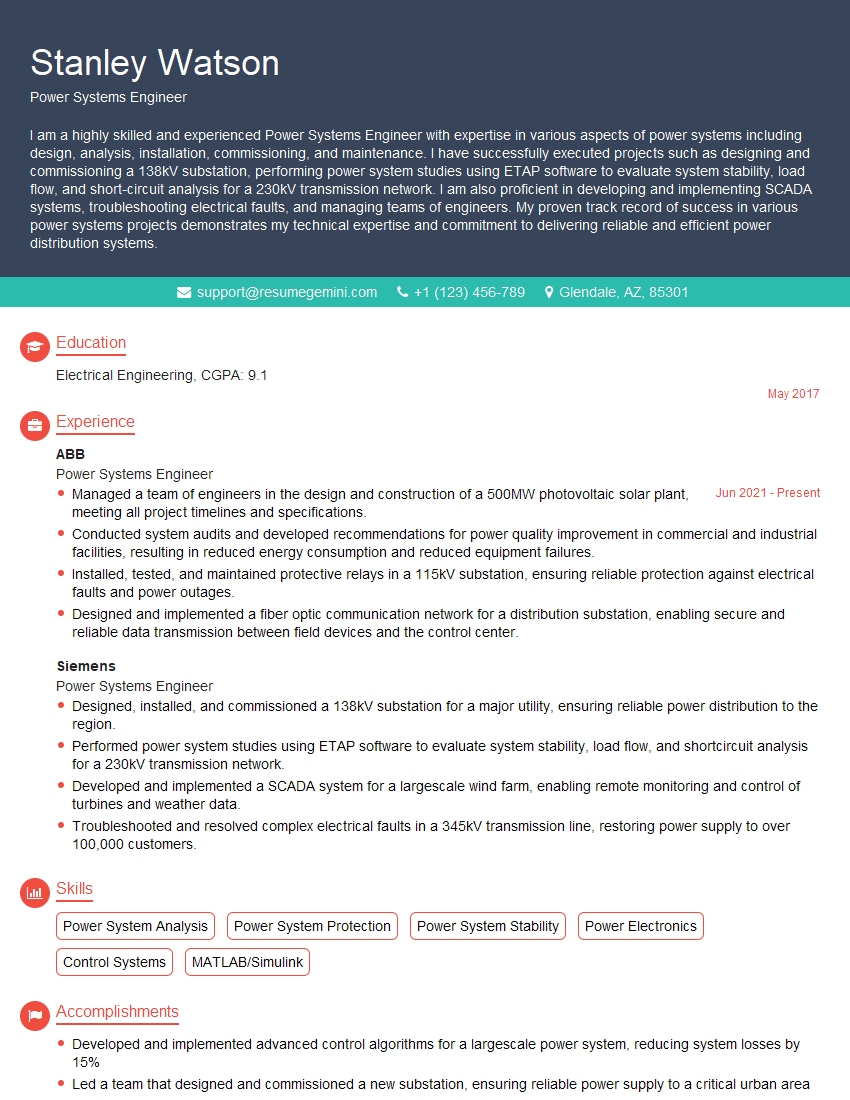
Mastering Transformer Operations opens doors to exciting career opportunities within the power industry, offering growth potential and high earning potential. To maximize your chances of landing your dream job, invest time in crafting an ATS-friendly resume that highlights your skills and experience effectively. ResumeGemini can help you build a professional and impactful resume that showcases your expertise in Transformer Operations. We provide examples of resumes tailored to this field to guide you through the process. Take the next step towards your successful career transition by creating a resume that truly reflects your abilities.
Explore more articles
Users Rating of Our Blogs
Share Your Experience
We value your feedback! Please rate our content and share your thoughts (optional).
What Readers Say About Our Blog
To the interviewgemini.com Webmaster.
Very helpful and content specific questions to help prepare me for my interview!
Thank you
To the interviewgemini.com Webmaster.
This was kind of a unique content I found around the specialized skills. Very helpful questions and good detailed answers.
Very Helpful blog, thank you Interviewgemini team.