Interviews are opportunities to demonstrate your expertise, and this guide is here to help you shine. Explore the essential Transportation Planning and Policy interview questions that employers frequently ask, paired with strategies for crafting responses that set you apart from the competition.
Questions Asked in Transportation Planning and Policy Interview
Q 1. Explain the difference between transportation planning and transportation engineering.
Transportation planning and transportation engineering are closely related but distinct disciplines. Think of it like this: transportation planning is about what to build and why, while transportation engineering is about how to build it.
Transportation planning focuses on the long-term vision for a transportation system. It involves forecasting future travel demands, identifying transportation needs, developing strategies to meet those needs (e.g., new roads, transit lines, bike lanes), and evaluating the environmental and social impacts of different transportation options. It’s a more policy-oriented and strategic field.
Transportation engineering, on the other hand, deals with the design, construction, and operation of transportation facilities. This includes detailed design work, material selection, construction management, and traffic operations. It’s more focused on the technical aspects of implementation.
For example, a transportation planner might develop a plan to reduce congestion in a city by expanding public transit. A transportation engineer would then design the new light rail line, determine the optimal track alignment, and oversee its construction.
Q 2. Describe your experience with transportation demand modeling software (e.g., VISUM, TransCAD).
I have extensive experience using transportation demand modeling software, specifically VISUM and TransCAD. I’ve utilized these tools in numerous projects, from small-scale traffic impact studies to large-scale regional transportation plans.
In VISUM, I’m proficient in building and calibrating network models, running assignment routines (e.g., user equilibrium, stochastic user equilibrium), and analyzing the results to understand traffic flow patterns and congestion levels. I’ve also used VISUM’s visualization tools to effectively communicate complex data to stakeholders. For instance, in a recent project, we used VISUM to model the impact of a proposed bus rapid transit (BRT) system on traffic congestion and travel times in a rapidly growing suburban area. The model helped us demonstrate the significant reduction in congestion and improve travel times for BRT users.
My experience with TransCAD is equally strong. I’ve used it for similar network modeling tasks, but also leveraged its capabilities for geographic information system (GIS) integration and data management. TransCAD’s integrated GIS functionality allowed for seamless integration of land use data with transportation networks, enabling more accurate demand modeling. For instance, in another project, we used TransCAD to link land use projections with transportation network models to predict future traffic demands and inform the expansion of a highway network.
Q 3. What are the key components of a comprehensive transportation plan?
A comprehensive transportation plan is much more than just a list of projects. It’s a strategic document that integrates various elements to create a coherent and sustainable transportation system.
- Goals and Objectives: Clearly defined, measurable goals and objectives, such as reducing congestion, improving safety, or enhancing accessibility.
- Demand Forecasting: Accurate projections of future travel demand based on population growth, economic activity, and land use changes.
- Inventory of Existing Infrastructure: A detailed assessment of the current transportation network, including its capacity, condition, and operational efficiency.
- Network Analysis: Evaluation of the performance of the existing network under current and projected demand levels, identifying bottlenecks and areas for improvement.
- Proposed Improvements: Identification and prioritization of transportation improvements, including road widening, new transit lines, and bike lanes, along with justification for each project.
- Financial Planning: Development of a funding strategy to implement the proposed projects, identifying potential funding sources and cost estimates.
- Implementation Plan: A detailed schedule for project implementation, including timelines, responsibilities, and milestones.
- Monitoring and Evaluation: A framework for monitoring the effectiveness of implemented projects and making necessary adjustments.
A strong transportation plan is dynamic and adaptable, regularly reviewed and updated to reflect changing conditions and priorities.
Q 4. How do you evaluate the effectiveness of a transportation project?
Evaluating the effectiveness of a transportation project involves a multi-faceted approach, combining quantitative and qualitative measures. It’s not enough just to say it’s ‘better’ – we need concrete data.
Quantitative Measures: These involve using data to assess the project’s impact. Examples include:
- Travel Time Savings: Did the project reduce travel times for users? This is often measured using before-and-after studies using travel time surveys or simulations.
- Congestion Reduction: Did the project alleviate congestion? This can be assessed through changes in traffic volume, speed, and density.
- Accident Reduction: Did the project improve safety, leading to a reduction in accidents? This requires analyzing accident data before and after implementation.
- Transit Ridership: For transit projects, measuring ridership is crucial to see if people are actually using the improved service.
Qualitative Measures: These consider the less tangible impacts, such as:
- Community Satisfaction: Surveys and public forums can help gauge community opinions on the project’s impact.
- Environmental Impacts: Assessing changes in air quality, noise levels, and habitat loss.
- Economic Impacts: Measuring the project’s effect on local businesses and employment.
A comprehensive evaluation combines these quantitative and qualitative measures to provide a holistic understanding of the project’s success.
Q 5. Explain the concept of Level of Service (LOS) in transportation planning.
Level of Service (LOS) is a qualitative measure describing operational conditions within a transportation system. It’s essentially a grading system that reflects how well a roadway or transit system is performing, based on factors like speed, density, and delay.
LOS is typically expressed on a scale of A to F, with A representing excellent conditions (free-flowing traffic, minimal delays) and F representing unacceptable conditions (severe congestion, significant delays). Each letter grade corresponds to specific ranges of performance measures, which can vary depending on the type of facility (highway, arterial street, etc.).
LOS is used in transportation planning and design to:
- Assess existing conditions: Determine the current performance of a roadway or transit line.
- Evaluate the impact of proposed improvements: Predict how a new road or transit project will affect LOS.
- Set design standards: Ensure that new facilities meet desired levels of service.
For instance, a highway segment with LOS F would be considered severely congested, requiring improvements to increase its capacity and improve traffic flow. Understanding LOS is crucial in prioritizing transportation projects and making data-driven decisions.
Q 6. Discuss various transportation demand management strategies.
Transportation Demand Management (TDM) strategies aim to reduce reliance on single-occupancy vehicles (SOVs) by providing alternatives and incentives for more sustainable modes of transportation.
Here are some examples:
- Transit-Oriented Development (TOD): Creating mixed-use communities centered around transit stations, reducing the need for driving.
- High-Occupancy Vehicle (HOV) Lanes: Providing dedicated lanes for carpools, buses, and other high-occupancy vehicles.
- Bike-Sharing Programs: Making bicycles readily available for short trips.
- Ride-Sharing Incentives: Offering subsidies or discounts for ride-sharing services.
- Telecommuting Policies: Encouraging employees to work remotely, reducing the number of commuters.
- Congestion Pricing: Charging drivers a fee for entering congested areas during peak hours.
- Parking Management: Implementing strategies such as higher parking fees or limited parking spaces to discourage driving.
- Transportation Demand Modeling and Forecasting: Using data and analytics to anticipate congestion and plan for more efficient transportation systems. A critical part of developing targeted TDM strategies.
Successful TDM often involves a combination of strategies tailored to specific local conditions and needs. It is a holistic approach aimed at changing travel behavior and encouraging more sustainable transportation choices.
Q 7. How do you incorporate sustainability principles into transportation planning?
Incorporating sustainability principles into transportation planning is paramount for creating a responsible and environmentally conscious transportation system. This involves a holistic approach that considers environmental, social, and economic factors.
Key strategies include:
- Reducing Greenhouse Gas Emissions: Promoting the use of electric vehicles, improving fuel efficiency, and investing in public transit and active transportation (walking and cycling).
- Improving Air Quality: Reducing reliance on SOVs helps diminish air pollution in urban areas. Strategies include the encouragement of cycling, walking, and electric vehicles.
- Minimizing Land Consumption: Prioritizing transit-oriented development, improving the efficiency of existing infrastructure, and reducing the need for new road construction.
- Protecting Natural Habitats: Careful consideration of environmental impacts during project planning, including avoiding or mitigating harm to sensitive ecosystems.
- Promoting Equity and Accessibility: Ensuring that all members of the community have access to affordable and reliable transportation, regardless of income or location.
- Lifecycle Assessment: Considering the environmental impact of transportation projects throughout their entire lifecycle, from construction to demolition.
- Use of Sustainable Materials: Employing environmentally friendly materials in construction projects whenever feasible.
Sustainability in transportation planning is not just an add-on; it’s a fundamental aspect that should be integrated into every stage of the planning process.
Q 8. Describe your experience with GIS and its application in transportation planning.
Geographic Information Systems (GIS) are indispensable tools in transportation planning. They allow us to visualize, analyze, and manage geographically referenced data, providing a powerful platform for informed decision-making. My experience spans various applications, from network analysis for optimizing traffic flow to suitability analysis for identifying optimal locations for new infrastructure.
For instance, in a recent project, we used GIS to model the impact of a proposed light rail line on existing traffic patterns. By integrating traffic volume data, road network data, and demographic information, we were able to predict congestion changes and identify potential mitigation strategies. We also used GIS to assess the accessibility of public transportation to various demographics, ensuring equitable access was factored into the project planning.
Another application involved using spatial analysis tools within GIS to identify areas with high crash rates. This allowed us to prioritize locations for safety improvements, leading to a targeted and effective allocation of resources.
Q 9. How do you assess the environmental impact of transportation projects?
Assessing the environmental impact of transportation projects requires a multi-faceted approach. We typically employ Life Cycle Assessment (LCA) methodologies, considering impacts across the project’s entire lifespan, from construction to operation and eventual decommissioning. Key environmental factors include greenhouse gas emissions (GHGs), air and water quality, noise pollution, habitat disruption, and land use change.
For example, when evaluating a highway expansion project, we would analyze the increase in GHG emissions from increased vehicle miles traveled, offset by potential fuel efficiency improvements. We’d also model changes in air quality, assessing potential increases in particulate matter and nitrogen oxides, along with the use of mitigation strategies such as noise barriers and landscaping to reduce the project’s ecological footprint. We utilize environmental impact assessment software and models to quantify these impacts and compare various alternatives.
Q 10. Explain the different types of transportation data and their applications.
Transportation data comes in many forms, each with its own application. We can categorize them broadly as:
- Network Data: This describes the physical transportation infrastructure, including road networks, rail lines, and public transit routes. This is crucial for routing, network analysis, and capacity planning. Examples include shapefiles representing road networks and schedules for public transport.
- Demand Data: This represents the travel patterns and needs of users. Sources include traffic counts, origin-destination matrices (OD matrices) derived from surveys or GPS data, and public transit ridership data. This is essential for forecasting demand, route optimization, and service planning.
- Performance Data: This encompasses metrics reflecting the efficiency and effectiveness of the transportation system. Examples include travel times, speeds, congestion levels, on-time performance of transit, and accident rates. This data is crucial for monitoring, evaluating, and improving system performance.
- Attribute Data: This includes demographic data, socioeconomic data, and land use information. Connecting this to network and demand data allows for equity analyses, accessibility assessments, and tailored transportation solutions.
The combination of these data types allows for a comprehensive understanding of the transportation system and supports evidence-based decision-making.
Q 11. What are the key performance indicators (KPIs) for evaluating transportation systems?
Key Performance Indicators (KPIs) for evaluating transportation systems vary depending on the specific goals and context. However, some common KPIs include:
- Travel Time Reliability: Consistency of travel times, reflecting predictability and reducing uncertainty for users.
- Average Travel Speed: Reflecting the overall efficiency of the network.
- Congestion Levels: Measured by metrics like Vehicle Miles Traveled (VMT) or Person Miles Traveled (PMT).
- Accident Rates: Number of accidents per million vehicle miles traveled (MVMT), crucial for safety evaluations.
- Transit On-Time Performance: Percentage of trips arriving on schedule, important for public transit.
- Accessibility: Measures how easily people can reach destinations via different modes of transportation.
- Environmental Impact: GHG emissions, air quality, noise pollution.
- Economic Impact: Job creation, cost-effectiveness of projects.
By monitoring these KPIs, we can track the performance of the transportation system and identify areas needing improvement. Data visualization tools are crucial in making sense of these metrics.
Q 12. Describe your understanding of transportation equity and social justice.
Transportation equity and social justice are paramount in transportation planning. It’s not just about building infrastructure; it’s about ensuring that all members of society have equitable access to safe, efficient, and affordable transportation options, regardless of race, ethnicity, income, age, or disability.
For example, transportation projects should not disproportionately impact low-income communities or communities of color. We need to consider the location of transportation infrastructure, ensuring it serves underserved areas and promotes connectivity. Accessibility features for people with disabilities are also crucial. We might use equity analyses to evaluate the distribution of transportation benefits across different communities, and design strategies to address disparities. This might involve targeted investments in public transportation in underserved areas or improving pedestrian and cycling infrastructure in neighborhoods with limited access to cars.
Q 13. How do you address public concerns and stakeholder engagement in transportation projects?
Addressing public concerns and stakeholder engagement is critical for successful transportation projects. This involves a multi-pronged approach:
- Public Forums and Meetings: Providing opportunities for the public to voice their opinions and concerns.
- Surveys and Online Feedback Mechanisms: Gathering feedback from a wider range of stakeholders.
- Community Workshops: Engaging in focused discussions with specific groups.
- Transparency and Communication: Providing clear and accessible information about project plans and progress.
- Active Listening and Addressing Concerns: Showing genuine responsiveness to public input.
In a recent project, we used a combination of public forums, online surveys, and focus groups to gather input on a proposed highway widening project. This proactive engagement helped us address concerns about noise pollution and traffic disruption, ultimately leading to a more acceptable project design.
Q 14. Explain your experience with transportation safety analysis and improvement strategies.
Transportation safety analysis involves identifying high-crash locations, understanding the contributing factors, and implementing effective countermeasures. We use various techniques, including crash data analysis, roadway safety audits, and traffic simulation modeling.
For instance, we might use crash data to identify locations with a disproportionately high number of accidents. Further investigation might reveal contributing factors such as poor visibility, inadequate signage, or dangerous intersection design. We’d then propose and evaluate improvements, such as installing traffic signals, adding pedestrian crossings, improving lighting, or modifying the road geometry. Before and after studies of these safety improvements are then undertaken to assess their effectiveness.
Traffic simulation modeling allows us to test different safety improvement strategies virtually before implementing them in the real world, optimizing resource allocation and maximizing impact.
Q 15. Describe your experience with the development and implementation of transportation policies.
My experience in transportation policy development and implementation spans over 15 years, encompassing various roles from policy analyst to project manager. I’ve been involved in crafting and implementing policies at both the local and regional levels, focusing on areas such as sustainable transportation, traffic management, and public transit improvements. For example, in my previous role, I led the development of a comprehensive cycling infrastructure plan for a mid-sized city, which involved stakeholder engagement, budget allocation, and overseeing construction projects. This involved extensive data analysis of existing cycling networks, public opinion surveys, and collaboration with various city departments, including engineering and public works. Another significant project involved the implementation of a congestion pricing pilot program, requiring intricate modeling of traffic flow, public outreach to address concerns, and careful monitoring of its impacts on various demographic groups and businesses.
This experience has equipped me with a deep understanding of the policy-making process, from initial research and needs assessment to implementation and evaluation. I’m adept at navigating complex political landscapes, securing funding, and building consensus amongst diverse stakeholders.
Career Expert Tips:
- Ace those interviews! Prepare effectively by reviewing the Top 50 Most Common Interview Questions on ResumeGemini.
- Navigate your job search with confidence! Explore a wide range of Career Tips on ResumeGemini. Learn about common challenges and recommendations to overcome them.
- Craft the perfect resume! Master the Art of Resume Writing with ResumeGemini’s guide. Showcase your unique qualifications and achievements effectively.
- Don’t miss out on holiday savings! Build your dream resume with ResumeGemini’s ATS optimized templates.
Q 16. Discuss the role of technology in improving transportation efficiency and sustainability.
Technology is revolutionizing transportation, boosting efficiency and sustainability. Think of it like this: Transportation used to be a relatively static system; now, it’s becoming dynamic and responsive. This is largely thanks to the integration of various technologies.
- Intelligent Transportation Systems (ITS): These systems use sensors, cameras, and data analytics to optimize traffic flow, reducing congestion and emissions. For example, adaptive traffic signal control systems can adjust signal timing in real-time based on traffic conditions, minimizing delays.
- Connected and Autonomous Vehicles (CAVs): CAVs promise to improve safety, reduce congestion, and enhance mobility, especially for vulnerable populations. Data collected from these vehicles can also be used to improve transportation planning and management.
- Data Analytics and Modeling: Advanced data analytics allows us to better understand travel patterns, predict future demand, and optimize transportation networks. We can use this data to model the impacts of different policy scenarios and make data-driven decisions.
- Electric and Alternative Fuel Vehicles: The transition to electric vehicles and other alternative fuel sources is crucial for reducing greenhouse gas emissions and improving air quality. Smart charging infrastructure and incentives are playing a critical role in this transition.
These technologies, when implemented effectively and ethically, can contribute significantly to building a more sustainable and efficient transportation system.
Q 17. Explain the concept of Complete Streets and its implementation challenges.
Complete Streets is a design approach that prioritizes the safety and accessibility of all users – pedestrians, cyclists, transit riders, and drivers – within a shared roadway. Imagine a street that’s not just for cars, but a comfortable and safe place for everyone. That’s the vision of Complete Streets.
Implementing Complete Streets, however, faces several challenges:
- Funding limitations: Reconstructing existing roadways to accommodate multiple modes of transportation can be expensive, requiring substantial funding.
- Political opposition: Some stakeholders, particularly those prioritizing car-centric design, may resist changes that reduce road space for automobiles.
- Lack of public awareness: Educating the public about the benefits of Complete Streets is crucial to gain support for these initiatives.
- Design complexities: Balancing the needs of all users while maintaining traffic flow requires careful planning and design expertise.
- Right-of-way issues: Securing sufficient right-of-way for sidewalks, bike lanes, and transit stops can be challenging, especially in densely populated areas.
Overcoming these challenges requires strong political will, community engagement, innovative funding strategies, and skilled professionals who can navigate complex design and implementation processes.
Q 18. How do you handle conflicting priorities in transportation planning?
Conflicting priorities are inevitable in transportation planning, as different stakeholders have varying needs and preferences. For instance, improving public transit might conflict with minimizing traffic congestion for private vehicle users. To handle these conflicts, I use a structured, multi-step approach:
- Identify and prioritize stakeholders: Clearly define all involved parties, understanding their interests and concerns.
- Data-driven analysis: Utilize data to quantify the impacts of different options on various stakeholders. For example, using traffic simulation models to compare travel times under different scenarios.
- Multi-criteria decision analysis (MCDA): Employ MCDA techniques to weigh and rank different alternatives based on multiple criteria (e.g., cost, environmental impact, accessibility).
- Stakeholder engagement: Facilitate transparent communication and collaboration amongst stakeholders, using methods like public forums and workshops to foster consensus and compromise.
- Adaptive management: Recognize that plans are dynamic, and implement a monitoring and evaluation framework to adjust strategies based on performance data and feedback.
This systematic process allows for informed decision-making, balancing competing interests while striving for optimal outcomes.
Q 19. Describe your understanding of the transportation planning process from initial assessment to project completion.
The transportation planning process is iterative and involves several key phases:
- Initial assessment and problem definition: Identifying transportation needs and challenges, including data collection, needs assessments, and stakeholder consultation.
- Forecasting and demand modeling: Predicting future travel demand using various models and considering factors such as population growth and economic development.
- Development of alternatives: Generating different transportation solutions, including infrastructure improvements, service enhancements, and policy changes.
- Evaluation of alternatives: Assessing the impacts of each alternative using various criteria, such as cost-effectiveness, environmental impact, and social equity.
- Selection and refinement: Choosing the preferred alternative based on evaluation results and stakeholder feedback, followed by design refinements.
- Implementation: Putting the selected plan into action, involving project management, construction, and stakeholder coordination.
- Monitoring and evaluation: Tracking the performance of the implemented project and making adjustments as needed based on performance data and feedback.
This cyclical approach allows for continuous improvement and adaptation throughout the entire project lifecycle.
Q 20. What are the major challenges facing transportation planning today?
Transportation planning faces numerous challenges today:
- Climate change: Reducing greenhouse gas emissions from transportation is critical, demanding a shift towards sustainable modes and fuels.
- Infrastructure aging and funding constraints: Many transportation systems are aging and require significant investment, but funding sources are often limited.
- Growing urbanization and population density: Rapid urbanization puts pressure on existing infrastructure and necessitates innovative solutions for managing congestion and accommodating growth.
- Equity and accessibility: Ensuring equitable access to transportation for all population segments, regardless of income, race, or disability, remains a key challenge.
- Technological disruption: The rapid evolution of technologies, such as autonomous vehicles and shared mobility services, requires careful planning to manage their integration into the system.
- Safety concerns: Reducing traffic fatalities and injuries requires continuous improvements in infrastructure design, traffic safety education, and enforcement.
Addressing these interconnected challenges requires innovative thinking, interdisciplinary collaboration, and effective policy implementation.
Q 21. Explain your familiarity with relevant transportation legislation and regulations.
My familiarity with transportation legislation and regulations is extensive. I have a thorough understanding of federal laws such as the Fixing America’s Surface Transportation (FAST) Act and various state and local ordinances related to transportation planning and project implementation. This includes knowledge of regulations concerning environmental impact assessments (NEPA), accessibility for people with disabilities (ADA), and procurement procedures. I’m well-versed in the legal frameworks governing transportation funding, permitting, and project delivery. For example, I’ve been directly involved in navigating the complexities of securing federal grants, complying with environmental regulations during project development, and ensuring that all projects adhere to accessibility standards. This understanding allows me to develop and implement transportation plans that are not only effective but also legally sound and compliant.
Q 22. How do you balance the needs of different transportation modes?
Balancing the needs of different transportation modes requires a holistic approach that considers the unique characteristics and demands of each mode while optimizing the overall transportation system. It’s not about favoring one mode over another, but rather finding the right mix to create an efficient, equitable, and sustainable network.
- Modal Integration: This involves designing systems that allow for seamless transfers between different modes. For example, creating well-integrated bus rapid transit (BRT) systems that connect with rail lines and provide convenient access to other modes like cycling and walking.
- Demand Management: Strategies like congestion pricing (charging drivers for entering congested areas), incentivizing public transit use, and promoting active transportation (walking and cycling) can help shift demand from congested modes to less congested ones, improving overall system efficiency.
- Infrastructure Investments: Smart investments are crucial. This means prioritising projects that improve connectivity between modes and cater to the needs of various users. For instance, constructing dedicated bus lanes alongside major roads, creating safe cycling infrastructure, and improving pedestrian accessibility around transit stations.
- Policy Coordination: Effective transportation planning requires cooperation across different agencies and levels of government. This helps to align incentives and ensures a coordinated approach to investing in and managing different modes.
For instance, in a city facing traffic congestion, a balanced approach might involve expanding BRT networks, improving cycling infrastructure, implementing congestion pricing, and investing in smarter traffic management systems, rather than solely focusing on highway expansion.
Q 23. Describe your experience with cost-benefit analysis in transportation planning.
Cost-benefit analysis (CBA) is a crucial tool in transportation planning, helping us determine whether a project is economically justifiable. It involves systematically comparing the costs and benefits of a project over its lifespan, usually expressed in monetary terms.
My experience includes conducting CBAs for a range of projects, from highway expansions and light rail systems to improvements in pedestrian infrastructure. This involves:
- Identifying Costs: This includes construction costs, maintenance costs, operating costs, and any indirect costs like traffic disruption during construction.
- Identifying Benefits: This is often more complex, encompassing things like reduced travel time, improved safety, reduced emissions, increased property values, and economic development opportunities. Benefits can be difficult to quantify, and often require sophisticated modelling techniques.
- Discounting: Future benefits and costs are discounted to their present value, accounting for the time value of money. A higher discount rate favors projects with immediate benefits over those with long-term benefits.
- Sensitivity Analysis: Because of uncertainties, sensitivity analysis is crucial to explore how changes in key assumptions (like discount rate or traffic growth) affect the overall cost-benefit ratio.
For example, in evaluating a new highway, a CBA would weigh the cost of construction against the benefits of reduced travel time, decreased fuel consumption, and increased economic activity in the region. The results inform decision-making, guiding us to projects that offer the highest economic return and best serve the public interest.
Q 24. Explain your understanding of different transportation funding mechanisms.
Transportation funding is a complex issue, relying on a variety of mechanisms to generate the necessary resources for planning, construction, and maintenance.
- Federal Funds: In many countries, the federal government provides substantial funding for transportation projects, often allocated based on formulas that consider factors like population and road mileage. Examples include the Highway Trust Fund in the United States.
- State and Local Funds: State and local governments also contribute significantly to transportation funding, often through taxes on fuel, vehicle registration fees, and sales taxes earmarked for transportation purposes.
- Tolls and Congestion Pricing: These user fees directly charge drivers for using specific roads or entering congested areas, providing a dedicated revenue stream for transportation improvements. This also encourages alternative modes.
- Public-Private Partnerships (PPPs): PPPs leverage private sector investment to fund and manage infrastructure projects. The government typically provides some form of guarantee or subsidy to attract private investment.
- Bonds: Governments can issue bonds to finance large-scale transportation projects. Investors purchase the bonds, and the government repays them with interest over a specific period.
The choice of funding mechanism often depends on the type of project, the availability of funds, and political considerations. For example, a large highway expansion might be financed through a combination of federal funds, state bonds, and potentially a PPP, while smaller-scale transit projects might rely more heavily on local funding and user fees.
Q 25. How do you incorporate future population growth and economic development projections in transportation plans?
Incorporating future population growth and economic development projections into transportation plans is essential for ensuring that the transportation system can meet the future needs of the community. This involves a multi-step process:
- Obtain Projections: Obtain reliable population and economic forecasts from relevant sources like demographic agencies, economic development organizations, and regional planning authorities. These projections should consider various scenarios, such as low, medium, and high growth scenarios.
- Develop Travel Demand Models: Sophisticated travel demand models are used to project future traffic volumes and transit ridership based on population, employment, and land use projections. These models consider factors like income levels, household car ownership, and accessibility of different transportation modes.
- Land Use Planning Integration: Close coordination with land use planners is crucial. Transportation plans must be aligned with land use plans to avoid building infrastructure that doesn’t support future development patterns. This might involve considering transit-oriented development around transit stations.
- Scenario Planning: Exploring different future scenarios helps to adapt transportation planning to various possible outcomes. This allows for building flexibility into transportation infrastructure and policies.
- Infrastructure Capacity Planning: Based on the travel demand projections, the capacity of the transportation system (roads, transit lines, etc.) can be evaluated, and necessary investments can be planned to accommodate future growth.
For example, if a region is expected to experience significant population growth and an increase in employment in a specific area, the transportation plan should include strategies to expand road capacity, improve public transit service, or encourage alternative transportation modes, to meet the anticipated travel demand.
Q 26. Describe your experience with travel behavior analysis and forecasting.
Travel behavior analysis and forecasting are critical components of transportation planning. It involves understanding how people make travel choices and using this understanding to predict future travel patterns.
My experience involves using various techniques, including:
- Household travel surveys: These surveys collect detailed information about household travel patterns, including trip purpose, mode choice, and trip characteristics. This provides rich data on individual choices.
- Activity-based models: These sophisticated models simulate individual travel decisions based on factors like household characteristics, activity locations, and transportation choices. They go beyond simply forecasting trips to predict activity patterns.
- Four-Step Travel Demand Models: These models are a classical approach to forecasting transportation demand by modelling trip generation, trip distribution, modal split, and route assignment. They’re more traditional but still relevant.
- Stated Preference Surveys: These surveys directly ask people about their travel choices under hypothetical scenarios (such as changes in travel time or cost). This data is useful for modelling reactions to policy changes.
For example, by analyzing household travel surveys and using an activity-based model, we can predict how changes in land use, transit service, or pricing policies would affect travel behavior. This information is crucial for designing effective transportation systems.
Q 27. How do you use data analytics to inform transportation decision-making?
Data analytics plays an increasingly vital role in informing transportation decision-making. It allows us to move beyond traditional methods, leveraging the power of large datasets to gain insights that would be impossible through traditional methods.
My experience includes using various data analytic techniques:
- GPS and Smartphone Data: Analyzing location data from GPS devices and smartphones provides real-time insights into traffic patterns, travel speeds, and route choices. This helps in optimizing traffic signal timing, identifying congestion hotspots, and evaluating the effectiveness of transportation improvements.
- Smart Card Data: Transit agencies collect data from smart cards to understand ridership patterns, identify popular routes and times, and adjust service frequencies to better meet demand. This can help assess the success of transit improvements.
- Social Media Data: Social media platforms can provide valuable information about public perception of transportation services, incidents, and other issues. This is an emerging and exciting field for data-driven decision making.
- Predictive Modelling: Advanced statistical techniques and machine learning can be used to forecast future travel patterns, predict incidents, and optimize resource allocation. For example, predictive modelling can anticipate potential delays on transit routes based on historical data and weather forecasts.
For example, using real-time traffic data, we can develop dynamic traffic management systems that adjust signal timing to reduce congestion. This shows how data analytics can lead to significant improvements in transportation efficiency and safety.
Q 28. Explain your approach to resolving conflicts between transportation projects and environmental protection goals.
Resolving conflicts between transportation projects and environmental protection goals requires a careful balancing act. The goal is not to choose between development and the environment, but to find sustainable solutions.
My approach involves:
- Environmental Impact Assessments (EIAs): Conducting thorough EIAs to identify and assess the potential environmental impacts of transportation projects. This should identify both positive and negative impacts (like reduced emissions from shifting to transit).
- Mitigation Strategies: Developing and implementing strategies to mitigate negative environmental impacts. This might include measures to reduce noise pollution, minimize habitat disruption, and improve air quality.
- Sustainable Design: Incorporating sustainable design principles into transportation projects, such as using green building materials, promoting energy efficiency, and minimizing resource consumption. This can make the project environmentally friendly by design.
- Stakeholder Engagement: Engaging with environmental groups, local communities, and other stakeholders to address their concerns and incorporate their perspectives into project design and implementation. This creates buy-in and avoids conflicts.
- Alternatives Analysis: Carefully considering alternative project designs and locations to minimize environmental impacts. This could involve choosing a less impactful route or employing sustainable technologies.
For example, when planning a new highway, we might explore alternatives that minimize habitat fragmentation, incorporate noise barriers, and use sustainable construction methods. This demonstrates commitment to finding environmentally responsible solutions while still addressing the need for improved transportation.
Key Topics to Learn for Transportation Planning and Policy Interview
- Transportation Demand Modeling: Understanding different modeling techniques (e.g., four-step model, activity-based models) and their applications in forecasting travel demand and evaluating transportation projects. Practical application: Analyzing the impact of a new light rail line on traffic congestion.
- Transportation System Analysis: Evaluating the efficiency and effectiveness of existing transportation systems, identifying bottlenecks, and proposing improvements. Practical application: Assessing the performance of a highway network and recommending capacity upgrades.
- Transportation Policy and Planning: Understanding the principles of transportation policy development, including equity, sustainability, and economic considerations. Practical application: Analyzing the environmental impacts of different transportation modes and proposing strategies for emissions reduction.
- Data Analysis and Visualization: Proficiency in using data analysis tools and techniques to interpret transportation data and communicate findings effectively. Practical application: Creating visualizations to present complex transportation data to stakeholders.
- Intelligent Transportation Systems (ITS): Understanding the role of technology in improving transportation efficiency and safety. Practical application: Evaluating the potential benefits of implementing adaptive traffic signal control.
- Transportation Finance and Funding: Understanding different sources of funding for transportation projects and methods for project evaluation. Practical application: Analyzing the financial feasibility of a proposed highway expansion project.
- Accessibility and Equity: Analyzing how transportation systems impact different demographic groups and developing strategies to ensure equitable access to transportation services. Practical application: Evaluating the accessibility of public transit for people with disabilities.
Next Steps
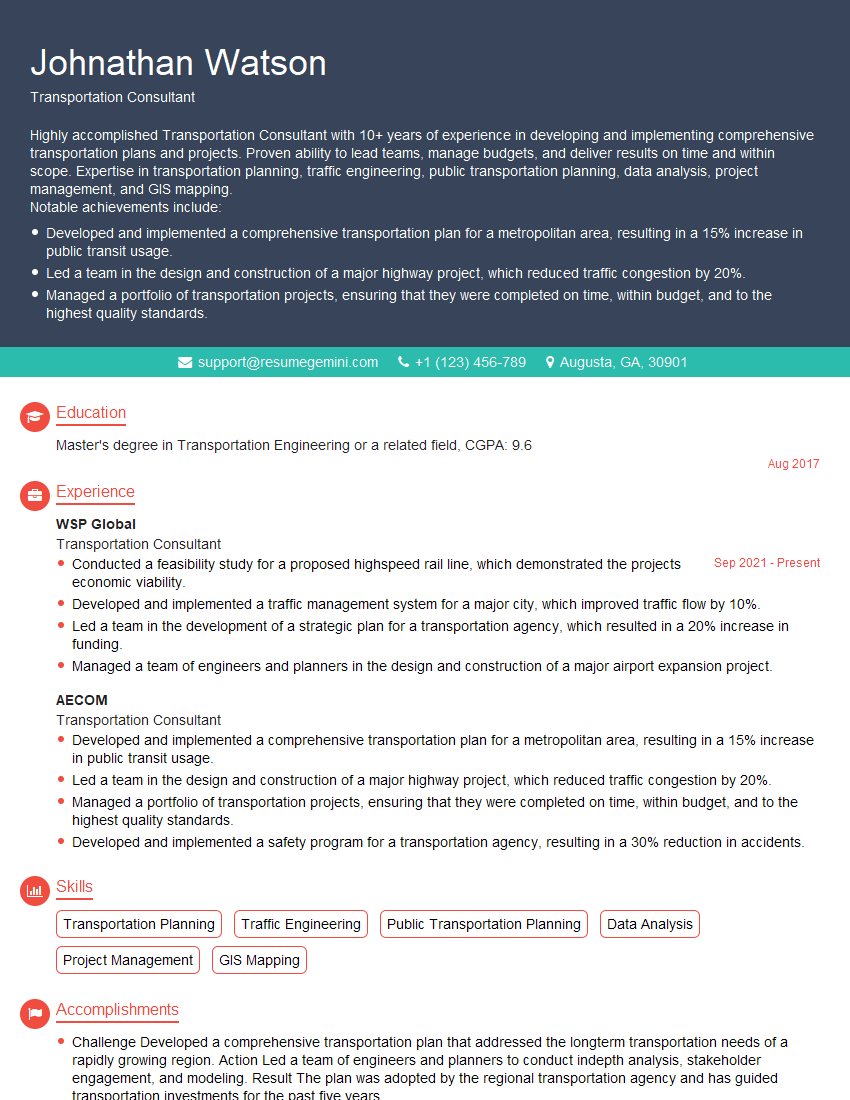
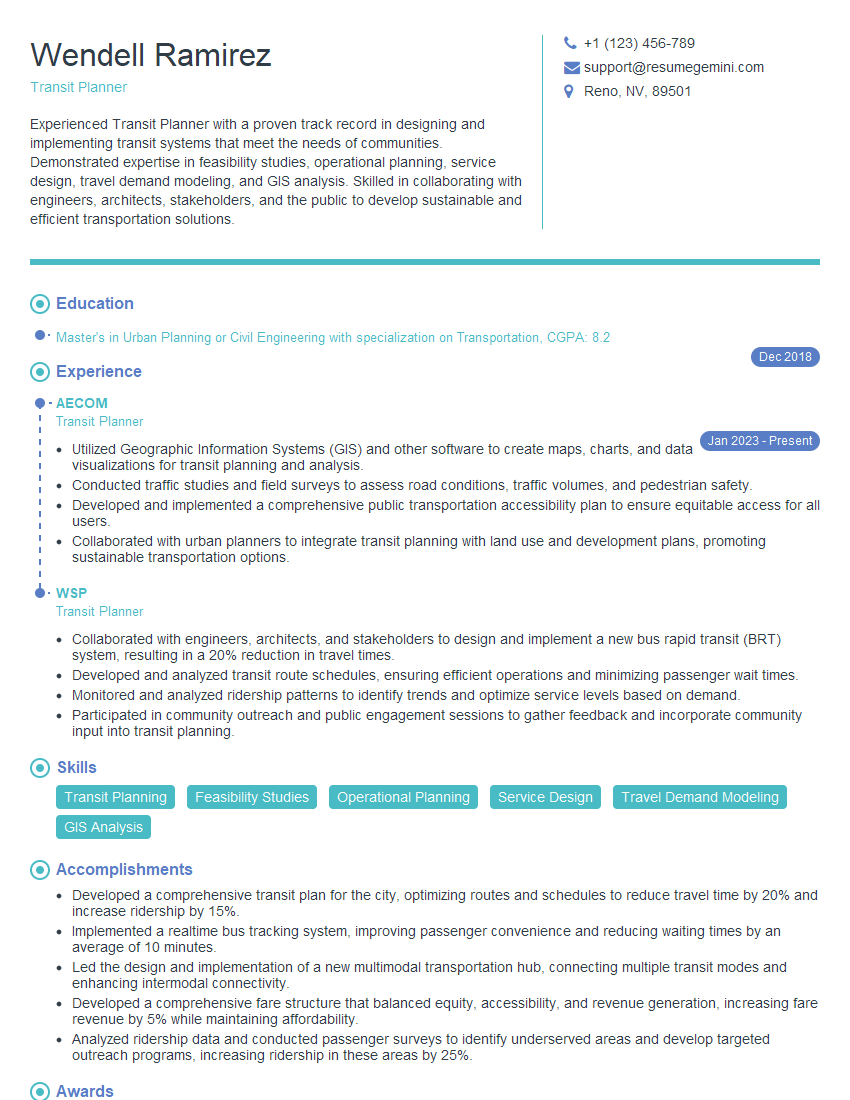
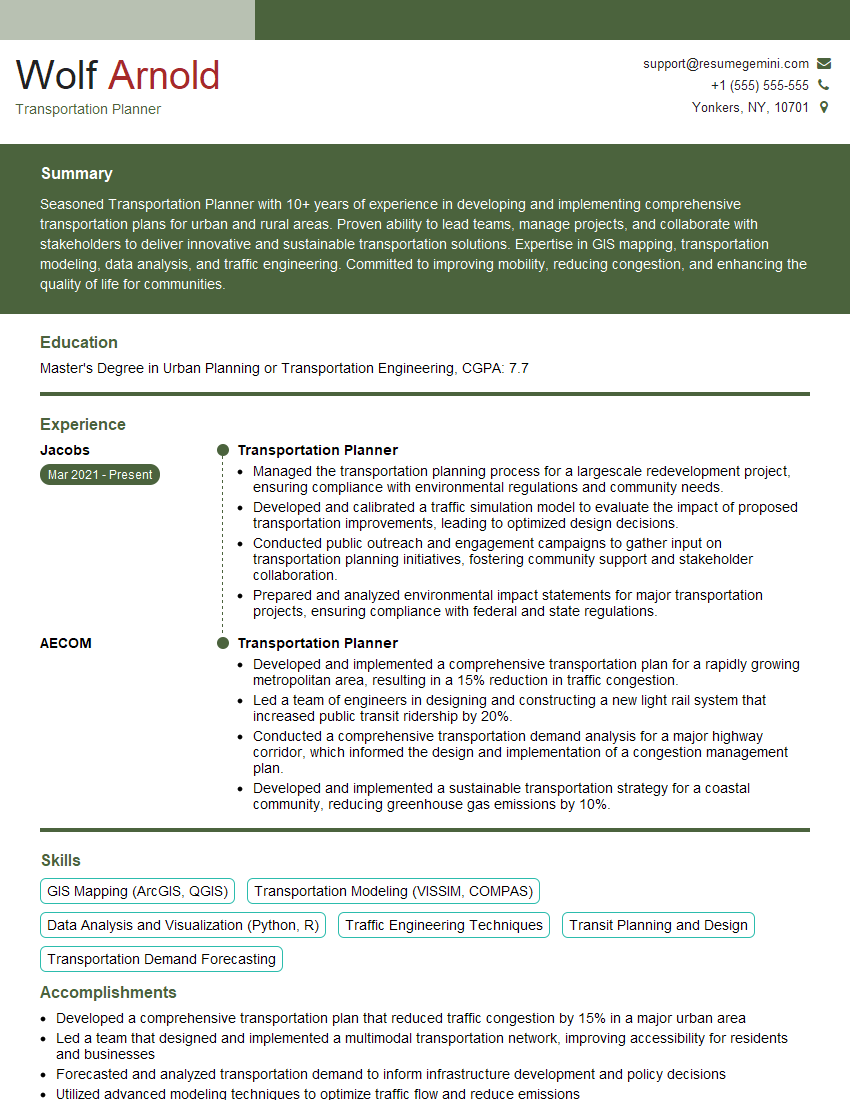
Mastering Transportation Planning and Policy opens doors to exciting and impactful careers, allowing you to shape the future of mobility and contribute to sustainable urban development. A strong resume is crucial for showcasing your skills and experience to potential employers. Creating an ATS-friendly resume significantly increases your chances of getting your application noticed. We highly recommend using ResumeGemini to build a professional and effective resume that highlights your qualifications in this competitive field. ResumeGemini provides examples of resumes tailored to Transportation Planning and Policy, giving you a head start in crafting a compelling application. Invest in your future; invest in your resume.

Explore more articles
Users Rating of Our Blogs
Share Your Experience
We value your feedback! Please rate our content and share your thoughts (optional).
What Readers Say About Our Blog
To the interviewgemini.com Webmaster.
Very helpful and content specific questions to help prepare me for my interview!
Thank you
To the interviewgemini.com Webmaster.
This was kind of a unique content I found around the specialized skills. Very helpful questions and good detailed answers.
Very Helpful blog, thank you Interviewgemini team.