Preparation is the key to success in any interview. In this post, we’ll explore crucial Trowel Proficiency interview questions and equip you with strategies to craft impactful answers. Whether you’re a beginner or a pro, these tips will elevate your preparation.
Questions Asked in Trowel Proficiency Interview
Q 1. What are the different types of trowels and their specific applications?
Trowels come in a variety of shapes and sizes, each designed for specific tasks. Think of them as specialized tools in a craftsman’s toolbox.
- Pointing Trowels: These small, narrow trowels are ideal for precise work like pointing mortar between bricks or applying grout in narrow spaces. Their pointed end allows for accurate application in tight corners.
- Brick Trowels (or Margin Trowels): These are larger and more robust, perfect for applying mortar to bricks or blocks efficiently. The flat blade ensures a consistent layer.
- Finishing Trowels: These have smooth, flat blades, often made of stainless steel, used for creating smooth, even surfaces on plaster or cement. They’re crucial for achieving a professional finish.
- Notch Trowels: These feature a notched blade that helps create consistent spacing and depth for tiles or other materials, ensuring proper adhesion and preventing uneven settling.
- Hawk Trowels: These aren’t used for applying materials directly, but as a portable platform to hold mortar or plaster close to the worker, enhancing efficiency.
The choice of trowel depends entirely on the job. For example, I wouldn’t use a pointing trowel to apply mortar to a large brick wall – it would be far too slow and inefficient. Selecting the right tool is key to both speed and quality.
Q 2. Explain the importance of proper trowel angle and pressure.
Proper trowel angle and pressure are paramount for achieving a consistent, even application and preventing issues like sagging or uneven thickness. Imagine trying to paint a wall with a brush held at the wrong angle – you’d get streaks! It’s the same principle with trowels.
The ideal angle typically ranges from 30-45 degrees, depending on the material and surface. Holding it too flat can cause excessive pressure and lead to unevenness. Too steep, and you’ll apply the material too thinly. The pressure needs to be consistent and controlled, avoiding excessive force that could damage the underlying surface or cause the material to be over-applied.
Years of experience have taught me to adjust my angle and pressure based on the material’s consistency and the specific application. For example, applying a thick, heavy mortar mix would require a slightly different approach compared to working with a thin, lightweight plaster.
Q 3. Describe your experience with various mortar mixes and their suitability for different applications.
My experience encompasses a wide range of mortar mixes, from standard cement-sand blends to specialized mixes for specific applications. Understanding the properties of different mixes is critical for successful results.
- Cement-Sand Mortars: These are versatile and commonly used for bricklaying, blocklaying, and plastering. The strength and workability depend on the cement-to-sand ratio. A higher cement content leads to greater strength but can be less workable.
- Ready-mix Mortars: These pre-mixed mortars are convenient and often provide consistent quality. They are readily available in various types, each designed for a specific application like tile setting or pointing.
- Polymer-modified Mortars: These enhanced mortars offer improved flexibility, adhesion, and water resistance. They are particularly useful in demanding applications or challenging climates.
Choosing the right mix is essential. Using a high-strength mortar where a standard mix would suffice is wasteful, while using a weak mix for a structurally demanding application is dangerous. I always consider the project’s requirements and select the appropriate mortar accordingly.
Q 4. How do you ensure a smooth and even finish when applying plaster or cement?
Achieving a smooth, even finish is a matter of technique and practice. It’s a blend of skill and precision.
First, ensure the underlying surface is clean and level. Then, apply the plaster or cement in even layers, working in manageable sections. Use a broad steel trowel to initially smooth the surface, then progressively switch to smaller finishing trowels. The key is to use long, even strokes, avoiding pressure that might cause inconsistencies. Frequent checking for evenness is vital, using a long straight edge or level to identify any imperfections. For extra smoothness, I often use a final light pass with a damp sponge float for a truly polished finish.
Think of it like painting a wall – several thin coats create a more even surface than one thick one.
Q 5. What techniques do you use to achieve a specific texture or pattern?
Creating textures and patterns adds a level of artistry to the trade. A plain wall is functional, but a textured one can be both beautiful and practical.
- Sponge Floats: These create a slightly textured surface by pressing a damp sponge against the wet plaster. The level of texture is controlled by the pressure and technique.
- Wooden Floats: These are excellent for creating rustic, textured finishes. The grain of the wood imparts a unique, organic pattern.
- Metal Stamps: Specialized metal stamps can create repeating patterns or decorative designs. This requires precision and practice to ensure a consistent and even application.
I’ve worked on several projects requiring specific textures, ranging from subtle stippling to deeply textured designs. Each requires a different approach and a keen eye for detail to ensure uniformity. It’s about combining creativity with a solid understanding of the material’s properties.
Q 6. How do you handle challenging surfaces or difficult angles?
Challenging surfaces and angles demand adaptability and the right tools. It’s where experience truly shines.
For intricate angles, I use smaller trowels, such as pointing trowels, allowing precise application. For curved surfaces, I might use flexible trowels or even specialized tools designed for that purpose. On uneven surfaces, I often work in smaller sections, ensuring each section is properly leveled before moving to the next. It’s sometimes necessary to use additional techniques like using cornering tools or applying the material in stages.
One project involved applying plaster to a severely irregular stone wall. I had to work methodically, building up the plaster in layers and carefully smoothing out the transitions to create a cohesive finish. It required patience and adaptability, but the end result was a beautiful, well-finished wall.
Q 7. What safety measures do you follow when working with trowels and related materials?
Safety is paramount. Trowel work involves potentially hazardous materials and tools, so a proactive approach is essential.
- Eye Protection: Wearing safety glasses is non-negotiable to protect against flying debris or dust.
- Respiratory Protection: Dust masks or respirators are vital when working with dry materials like cement or plaster to prevent inhalation of harmful particles.
- Hand Protection: Gloves protect hands from irritants in the materials and prevent cuts from the trowel.
- Footwear: Steel-toed boots protect feet from dropped objects.
- Proper Lifting Techniques: Using proper lifting techniques prevents strain and injury when handling bags of materials.
Beyond the obvious, maintaining a clean and organized workspace minimizes the risk of tripping hazards or accidental cuts. Regular tool maintenance prevents accidents from dull or damaged tools. Safety is not an option; it’s a core part of my working practice.
Q 8. Describe your experience with different types of bricks and blocks.
My experience encompasses a wide range of brick and block types, each demanding a unique approach. I’ve worked extensively with common clay bricks – differing in size, color, and texture – understanding their varying strengths and absorption rates is crucial for successful application. Engineering bricks, known for their superior strength and durability, require a slightly different technique due to their denser nature. I’m also proficient with concrete blocks, which require a different mortar mix for optimal adhesion and handling, particularly their larger size and weight. Furthermore, I have experience with facing bricks, which require a more delicate touch to maintain their aesthetic appeal, and with reclaimed bricks, which necessitate careful assessment for soundness and cleaning before installation. Understanding the properties of each material is key to achieving a structurally sound and aesthetically pleasing wall.
For example, when working with porous clay bricks in a damp environment, I would adjust the mortar mix to prevent excess water absorption, thereby preventing efflorescence (salt deposits) and ensuring a stronger bond.
Q 9. How do you ensure proper bonding and adhesion of materials?
Ensuring proper bonding and adhesion is paramount in trowel work. It’s a multifaceted process involving several key factors. Firstly, the correct mortar mix is crucial. The ratio of cement, sand, and water needs to be precise, depending on the materials being bonded and environmental conditions. Too much water weakens the bond, while too little makes it difficult to work with. Secondly, proper surface preparation is vital. Any loose debris or dust must be removed from both the brick/block and the substrate before applying the mortar. A clean, even surface provides the best possible contact.
Finally, the application technique itself is key. Using the trowel efficiently to create a full bed of mortar ensures complete contact with the material, leading to a strong bond. I always ensure the mortar is fully compacted between the bricks, eliminating air pockets that weaken the structure. Think of it like building with LEGOs; a strong structure needs complete connections between each brick. Inconsistent application or poor surface preparation leads to weak points and potential failure later.
Q 10. What are the common problems encountered during trowel work, and how do you address them?
Common problems in trowel work often stem from inadequate planning or poor execution. One frequent issue is uneven mortar application, leading to unsightly gaps and structural weakness. This can be avoided with meticulous attention to detail and consistent application. Another issue is efflorescence, the white crystalline deposits that can appear on brickwork due to moisture and salts. Preventing this involves using the correct mortar mix and ensuring proper drainage around the structure. I address these problems through careful preparation and execution. For instance, I meticulously inspect my work at each stage, ensuring consistent mortar coverage and immediately rectifying any unevenness.
Another problem is incorrect tooling, leading to damaged bricks or inconsistent joints. Selecting the appropriate trowel for the job and using it effectively is paramount. For efflorescence, I use specialized cleaners and sometimes, preventative treatments during construction.
Q 11. Explain the importance of jointing and pointing.
Jointing and pointing are crucial for both the aesthetic appeal and the structural integrity of brickwork. Jointing refers to the way the mortar is applied between the bricks, influencing the visual appearance of the finished wall. Proper jointing improves the overall look and can make a significant difference to the aesthetic appeal. Different joint types, such as concave, weathered, or flush, offer different aesthetic outcomes. Pointing, the process of finishing the mortar joints after they’ve set, is essential for weatherproofing and preventing water ingress.
Well-pointed joints prevent water penetration, safeguarding the bricks from damage and enhancing the wall’s durability. This process requires precise techniques to ensure a neat and consistent finish, preventing water damage over time. Think of it as carefully sealing the gaps to protect the wall against the elements, much like sealing a window frame.
Q 12. Describe your experience with different tiling methods.
My tiling experience spans various methods, each suited to different substrates and tile types. I’m proficient in both wet-fix and dry-fix systems. Wet-fix tiling involves applying adhesive directly to the substrate before placing the tiles, requiring precise application and levelness for optimal adhesion and a smooth surface. Dry-fix methods, which might utilize spacers or clips, are often used for specific tile types and for larger projects. I’ve worked with various tile sizes and materials, including ceramic, porcelain, and natural stone, understanding the unique properties and installation techniques for each. For example, larger format tiles require a more robust support system than smaller ones and demand extra attention to leveling. Different substrates (wood, concrete, plasterboard) also require adjusted methodologies.
Furthermore, I am skilled in specialized applications, such as mosaic tiling, which requires exceptional precision and patience. The preparation and selection of appropriate adhesive are critical to ensure the longevity and stability of the finished tiled surface, regardless of the tiling method employed.
Q 13. How do you calculate the amount of materials needed for a given project?
Calculating material quantities for a project requires careful measurement and planning. First, I precisely measure the area to be covered. For brickwork, this involves calculating the number of bricks needed, accounting for wastage (typically 5-10%). Similarly, for tiling, I calculate the total area and add extra to account for cuts and breakage. Then, I determine the quantity of mortar or adhesive needed, based on the manufacturer’s recommendations and the area to be covered. I often consult product datasheets and use online calculators to aid in accurate estimation. It is always better to overestimate slightly to ensure sufficient materials rather than falling short during the project. Accurate calculations save time, money, and potential delays.
For example, when tiling a bathroom wall, I would measure the area, deduct the space occupied by fixtures, and calculate the number of tiles required, adding a 10% buffer for cuts and breakage. I would then consult the adhesive manufacturer’s instructions to determine the required quantity of adhesive per square meter.
Q 14. What are your preferred methods for cleaning and maintaining trowels?
Maintaining trowels is crucial for their longevity and effectiveness. My preferred cleaning method involves immediately cleaning the trowel after use, before the mortar has a chance to fully dry. I use a stiff brush or sponge to remove excess mortar and then rinse the trowel thoroughly with water. For stubborn dried mortar, I soak the trowel in water with a specialized cleaning agent, then scrub it again with a brush. After cleaning, I ensure the trowel is completely dry to prevent rust. Regular oiling of the trowel’s metal parts prevents corrosion and maintains the trowel’s sharpness. Proper storage, in a dry place away from moisture, is also important to extend the life of my trowels. This simple maintenance ensures the trowels remain in excellent condition and ready for the next job, maintaining efficiency and quality of my work.
Neglecting cleaning can lead to rust and damage, rendering the trowel unusable. Regular maintenance is a small effort with significant long-term benefits.
Q 15. Describe your experience with power trowels and their applications.
Power trowels are essential for achieving smooth, level concrete surfaces. My experience spans various models, from smaller, walk-behind units ideal for smaller projects to larger, ride-on trowels used for large-scale commercial projects. I’m proficient in operating both gasoline and electric models, understanding the nuances of each. Applications range from residential driveways and patios to industrial flooring and warehouse slabs. For instance, on a recent warehouse project, I used a ride-on power trowel with a variable-speed control to achieve a highly polished finish on a 10,000 square foot concrete floor. The variable speed allowed for precise control over the finishing process, ensuring an even surface free from imperfections. I’m also experienced in using different blades, including pan blades for initial smoothing and finishing blades for achieving a final level of smoothness or a specific texture.
My experience also extends to understanding the importance of proper concrete preparation before troweling. This includes ensuring the concrete has reached the appropriate level of slump and is free from debris before beginning the finishing process. This prevents issues such as pitting or uneven surfaces later on.
Career Expert Tips:
- Ace those interviews! Prepare effectively by reviewing the Top 50 Most Common Interview Questions on ResumeGemini.
- Navigate your job search with confidence! Explore a wide range of Career Tips on ResumeGemini. Learn about common challenges and recommendations to overcome them.
- Craft the perfect resume! Master the Art of Resume Writing with ResumeGemini’s guide. Showcase your unique qualifications and achievements effectively.
- Don’t miss out on holiday savings! Build your dream resume with ResumeGemini’s ATS optimized templates.
Q 16. How do you ensure the structural integrity of your work?
Structural integrity in my work starts long before I even pick up a trowel. It begins with understanding the project’s specifications and ensuring the concrete pour itself is properly executed, adhering to the specified mix design and placement procedures. This includes proper consolidation and curing to prevent cracking and shrinkage.
During the troweling process, I pay close attention to avoiding any actions that could compromise the integrity of the concrete. This includes using appropriate troweling techniques to prevent damage or creating stress points. For instance, I avoid excessive pressure in one area which could create cracks or uneven settling. After the troweling, I ensure proper curing practices are followed, such as keeping the concrete moist for the specified period to prevent premature drying and cracking. I also frequently inspect the finished product to ensure everything is up to the required standard.
Q 17. What are your experiences with different types of pointing mortars?
My experience encompasses a variety of pointing mortars, each with its own properties and applications. I’m familiar with cement-based mortars, lime-based mortars, and polymer-modified mortars. Cement-based mortars are strong and durable, ideal for structural applications; however, they can be quite rigid and susceptible to cracking in movement prone areas. Lime-based mortars are more flexible and breathable, excellent for historic buildings where movement is expected, yet they possess less compressive strength than cement mortars. Polymer-modified mortars offer a blend of strength and flexibility, making them suitable for a wider range of applications.
The choice of mortar depends heavily on the specific application and the substrate. For instance, when repointing brickwork on an old building, I would use a lime-based mortar to ensure the preservation of the historic integrity and minimize cracking due to natural settlement. For a more modern structure where strength is paramount, a cement-based or polymer-modified mortar might be the more appropriate choice.
Q 18. How do you read and interpret construction drawings related to trowel work?
Reading construction drawings is crucial for successful trowel work. I’m adept at interpreting drawings to understand the dimensions, levels, and specifications of the concrete surfaces. I pay close attention to details like:
- Elevations: Precise height measurements ensure accurate leveling.
- Dimensions: Accurate measurements guarantee the correct size and shape of the concrete areas.
- Tolerances: Understanding acceptable variations in measurements is essential for avoiding costly rework.
- Surface finishes: Drawings often specify the required surface finish (e.g., smooth, broom finished, etc.), guiding the selection of troweling techniques.
- Reinforcement details: Knowledge of reinforcement locations helps prevent damage to the underlying structure during troweling.
I always cross-reference the drawings with the site conditions to ensure everything aligns correctly before commencing any work. I also use laser levels and other tools to confirm that the concrete has been poured correctly and meets the specifications mentioned on the drawings before starting the trowelling operation.
Q 19. Describe a time you had to troubleshoot a problem during a trowel-related task.
During a large-scale paving project, we encountered a problem with laitance (a layer of weak cement paste) forming on the surface of the concrete. This compromised the desired level of smoothness and strength. Instead of simply continuing, I stopped the work and investigated the cause. We determined that inadequate consolidation during the initial pour and too rapid drying were the main factors contributing to the laitance.
To troubleshoot, we implemented several solutions. We first removed the laitance using a wire brush and pressure washer. Then we adjusted the concrete mixing process to ensure adequate compaction. Finally, we implemented stricter curing procedures, including using a curing compound and regularly misting the concrete to prevent rapid evaporation. This systematic approach solved the issue, and the final result was a flawless surface.
Q 20. What are your methods for achieving accurate alignment and levelling?
Accurate alignment and leveling are fundamental to high-quality trowel work. I achieve this through a combination of techniques.
- Laser levels: These provide a highly accurate reference point for leveling, crucial for ensuring a perfectly flat surface.
- Straightedges and levels: These are used to check the levelness and straightness of smaller sections, supplementing laser measurements.
- Screeds: These guides help create the initial level surface, from which the final finishing is done with power trowels.
- String lines: These are used to establish reference lines for alignment, especially over longer distances.
- Measuring tapes and other tools: Accurate measuring tools are essential for verifying dimensions and elevations.
My approach is methodical and always begins with verifying the plans and making sure the initial pour and screeding stage is done meticulously. This makes sure that we have an even base to work from.
Q 21. How do you ensure consistency in your work across large areas?
Consistency across large areas requires a planned approach and meticulous execution.
- Systematic work patterns: I work in logical sections, ensuring smooth transitions between each area. This might involve overlapping passes or dividing the area into grids.
- Regular checks and adjustments: Frequent checks with levels and straightedges help maintain consistency. Adjustments are made as needed to prevent any build-up of discrepancies.
- Maintaining equipment: Ensuring that the power trowel blades are sharp and properly adjusted is crucial for a uniform finish.
- Consistent concrete mix: Working with a consistent concrete mix, with the correct slump and water content, is critical for consistent troweling results.
- Teamwork: On larger projects, effective team coordination is key. Clear communication and designated roles ensure a uniform approach.
In essence, achieving consistency is about having a solid plan, attention to detail, and ensuring good communication between the team members, if applicable.
Q 22. What are your strategies for working efficiently and effectively?
Efficiency and effectiveness in trowel work hinge on meticulous planning and execution. My strategy begins with a thorough understanding of the project scope – blueprints, material specifications, and the desired finish. This allows me to accurately estimate time and material needs, preventing costly delays and waste.
Next, I prioritize organization. Tools are prepped and readily accessible, materials are staged strategically, and the work area is kept clean and clutter-free. This minimizes wasted movement and increases the speed and precision of my work. For example, I might pre-mix grout to the correct consistency in batches to avoid interruptions during application.
Finally, I leverage efficient techniques. This includes using the right tools for the job—from different trowel sizes to specialized smoothing tools—and mastering techniques like float finishing and feather-edging to minimize rework. I constantly evaluate my processes and identify areas for improvement, such as experimenting with different application methods to find the most effective one for a specific material.
Q 23. Describe your experience working as part of a team on trowel-related projects.
Teamwork is essential in trowel work, especially on large-scale projects. My experience involves seamless collaboration with fellow tradespeople, including electricians and plumbers, ensuring coordinated efforts to avoid conflicts and achieve a unified finish. On a recent project restoring a historic building, we had to carefully coordinate the application of lime plaster with the installation of new electrical conduits. Effective communication and open dialogue allowed us to synchronize our actions and avoid any damage to the newly applied plaster.
In addition to inter-trade collaboration, effective teamwork within the trowelling team itself is key. This means clear delegation of tasks based on individual strengths and experience, consistent quality control through regular inspections, and a collaborative problem-solving approach. We often work in pairs, one applying the material while the other follows to smooth and finish, allowing for a more efficient workflow. This approach also facilitates learning and the sharing of best practices within the team.
Q 24. What are some common causes of cracking in plaster or cement work?
Cracking in plaster or cement work can stem from several causes, broadly categorized into material-related issues and application-related issues. Material issues include using incorrect proportions of mix, using poor-quality materials (like aged cement), or insufficient curing time. For example, using too much water in a cement mix can lead to a weaker, more prone-to-cracking finish.
Application-related issues are equally important. These include insufficient substrate preparation (poorly cleaned or primed surfaces), rapid drying due to extreme weather or inadequate curing practices, and stress caused by movement in the underlying structure. For instance, if you apply plaster over a wooden substrate that’s not properly primed and allowed to expand and contract with the changes in humidity, cracks are likely to form.
Another cause is thermal shock – rapid temperature changes causing expansion and contraction that the material can’t withstand. Finally, not allowing proper curing time before introducing stresses, such as adding heavy tiles, causes cracks.
Q 25. How do you prepare surfaces before applying materials?
Surface preparation is crucial for the longevity and aesthetic appeal of any trowel-applied material. It involves several steps, starting with a thorough cleaning to remove dust, dirt, loose debris, and any existing coatings that may prevent proper adhesion. This might involve brushing, vacuuming, or even pressure washing, depending on the surface and the level of contamination.
Next, I assess the surface for imperfections. Any significant cracks, holes, or unevenness need to be repaired using appropriate patching compounds and allowed to cure fully before proceeding. Finally, I apply a suitable primer or bonding agent to ensure optimal adhesion between the substrate and the new material. The type of primer selected depends on the material being applied and the nature of the substrate. For example, a porous surface like brick might require a deep penetrating primer, whereas a smooth surface like concrete might only need a bonding agent.
Q 26. Explain the difference between different types of grout and their applications.
Grout comes in several types, each suited to different applications. Cement-based grout is the most common, offering good strength and durability, suitable for floors, walls, and exterior applications. However, it’s more porous and requires sealing to resist staining.
Epoxy grout is a high-performance option, prized for its superior stain resistance, strength, and impermeability. It’s ideal for wet areas like showers and pools, but it has a shorter working time and requires more careful mixing. Unsanded grout is for narrow grout lines, while sanded grout is better for wider gaps. Unsanded grout needs to be used for tiles thinner than 1/8” to prevent cracking.
Furthermore, there are specialty grouts, such as those containing additives to enhance certain properties like flexibility or resistance to chemical attack. Choosing the right grout hinges on factors such as the type of tile, the location of the installation, and the desired aesthetic effect. For instance, a kitchen backsplash might use a stain-resistant epoxy grout, while a patio might use a more durable, weather-resistant cement-based grout.
Q 27. How do you handle variations in weather conditions when working outdoors?
Working outdoors requires careful consideration of weather conditions. Extreme heat can cause materials to dry too quickly, leading to cracking and poor adhesion. To mitigate this, I might work during cooler parts of the day or use shade cloths to reduce direct sun exposure. I also adjust the water content in my mixes to account for faster evaporation rates.
Conversely, cold and damp conditions can slow down the curing process and even lead to frost damage. I would delay work until temperatures are above freezing and avoid applying materials in freezing rain or snow. Using frost-resistant materials and covering newly applied work to protect it from freezing is essential. In excessively windy conditions, temporary windbreaks can prevent premature drying and material loss. Accurate weather forecasting is vital for effective planning and execution.
Q 28. What are the newest techniques or technologies you are familiar with in trowel work?
The trowel work field is seeing advancements in materials and techniques. One notable trend is the increased use of polymer-modified mortars and cements, which enhance flexibility, strength, and crack resistance. These advanced materials can improve durability and minimize the risk of cracking, particularly in challenging environments like seismic zones.
Laser-leveling tools are becoming more common, improving accuracy and consistency in larger projects. These tools help ensure a perfectly level surface for tile installation, reducing the amount of material needed and decreasing the occurrence of uneven surfaces and cracks. Moreover, there is increasing use of pre-mixed, bagged materials. This saves time on-site and ensures consistency in the mix, reducing variations in quality.
Key Topics to Learn for Trowel Proficiency Interview
- Material Selection and Properties: Understanding the characteristics of various materials (cement, mortar, etc.) and their suitability for different applications. This includes knowledge of their workability, strength, and durability.
- Trowel Techniques: Mastering different troweling techniques for achieving various finishes (e.g., smooth, textured, etc.). Practical experience applying these techniques to different surfaces is crucial.
- Joint Finishing and Grouting: Understanding the importance of proper joint finishing and grouting for both aesthetic appeal and structural integrity. This includes knowledge of different joint types and grouting materials.
- Health and Safety: Demonstrating a thorough understanding of relevant health and safety regulations and practices related to trowel work, including the use of personal protective equipment (PPE).
- Problem-Solving and Troubleshooting: The ability to identify and resolve common problems encountered during troweling, such as uneven surfaces, cracking, or air pockets. This showcases practical experience and quick-thinking skills.
- Tools and Equipment: Familiarity with various trowels, floats, and other tools used in trowel work, along with an understanding of their proper maintenance and use.
- Estimating and Project Planning: The ability to estimate materials needed and plan projects effectively for timely and efficient completion. This demonstrates organizational skills and a practical approach to work.
Next Steps
Mastering trowel proficiency opens doors to numerous opportunities in construction and related fields, leading to career advancement and higher earning potential. To maximize your job prospects, it’s vital to present your skills effectively. Creating an ATS-friendly resume is key to getting your application noticed. ResumeGemini is a trusted resource to help you build a professional and impactful resume that highlights your trowel proficiency. Examples of resumes tailored to Trowel Proficiency are available to help guide you.
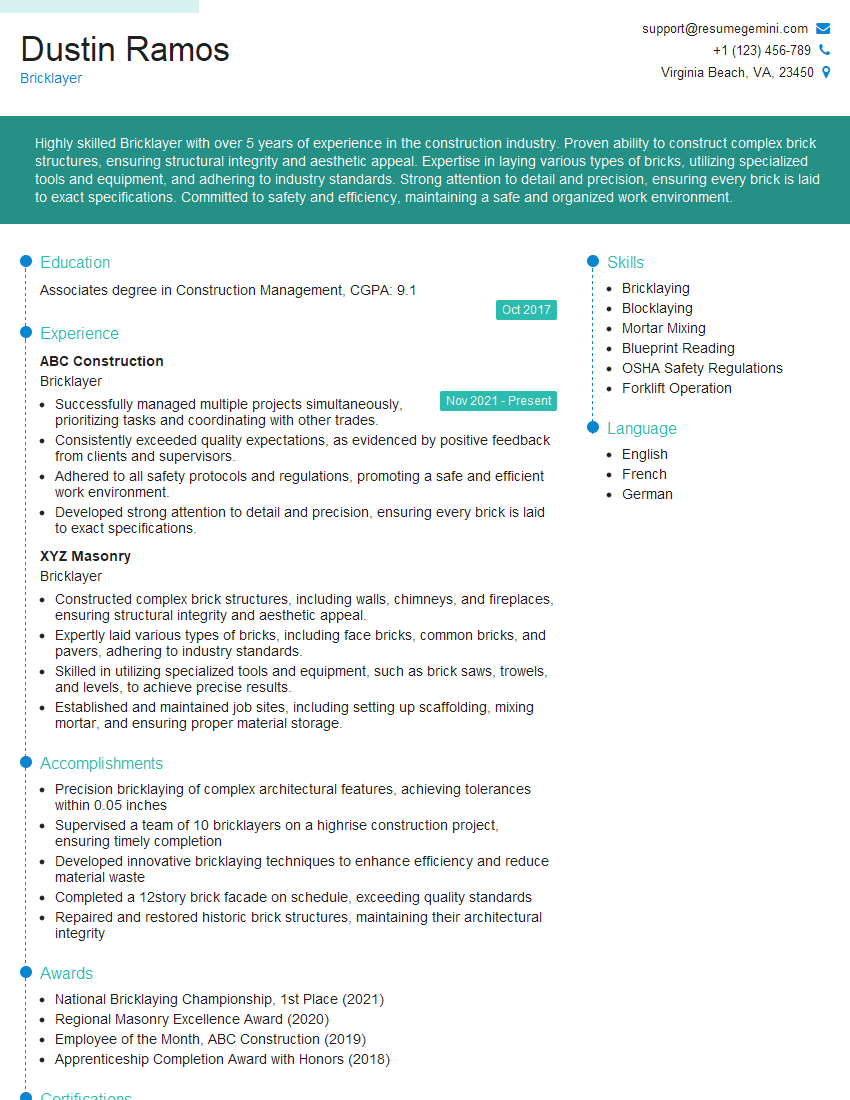
Bricklayer Resume Sample
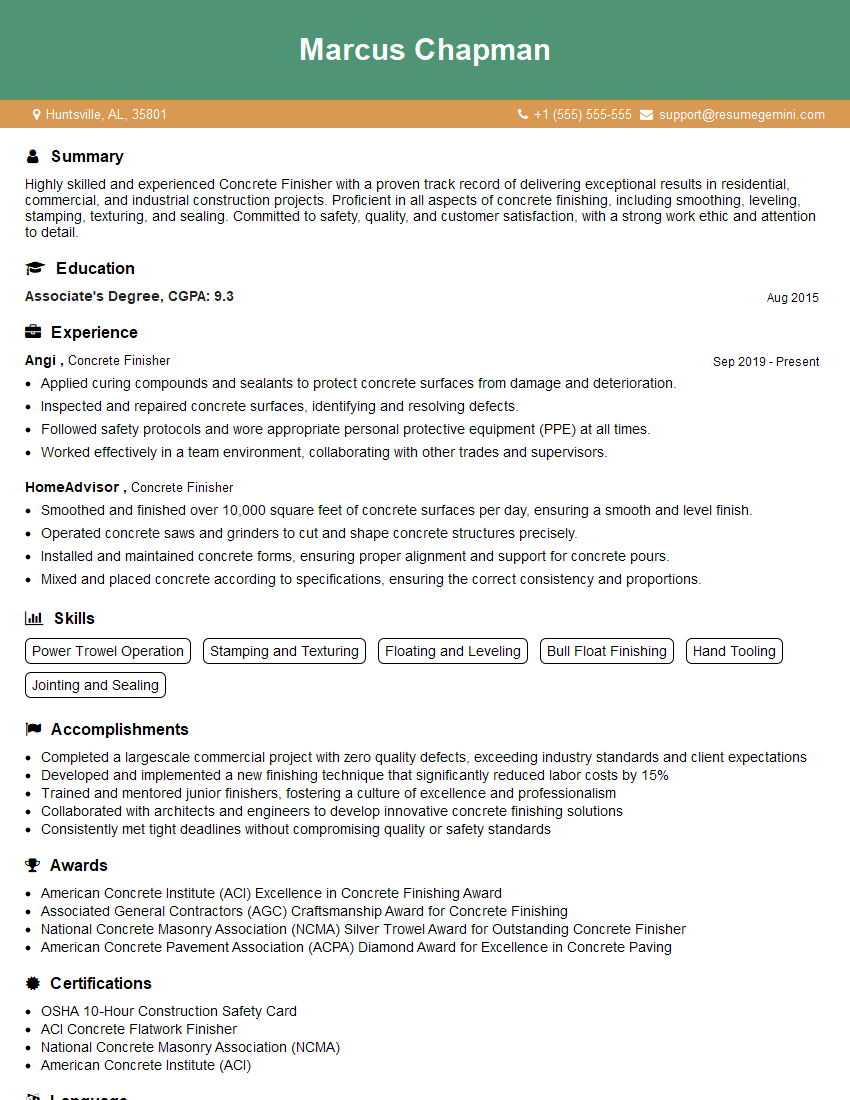
Concrete Finisher Resume Sample
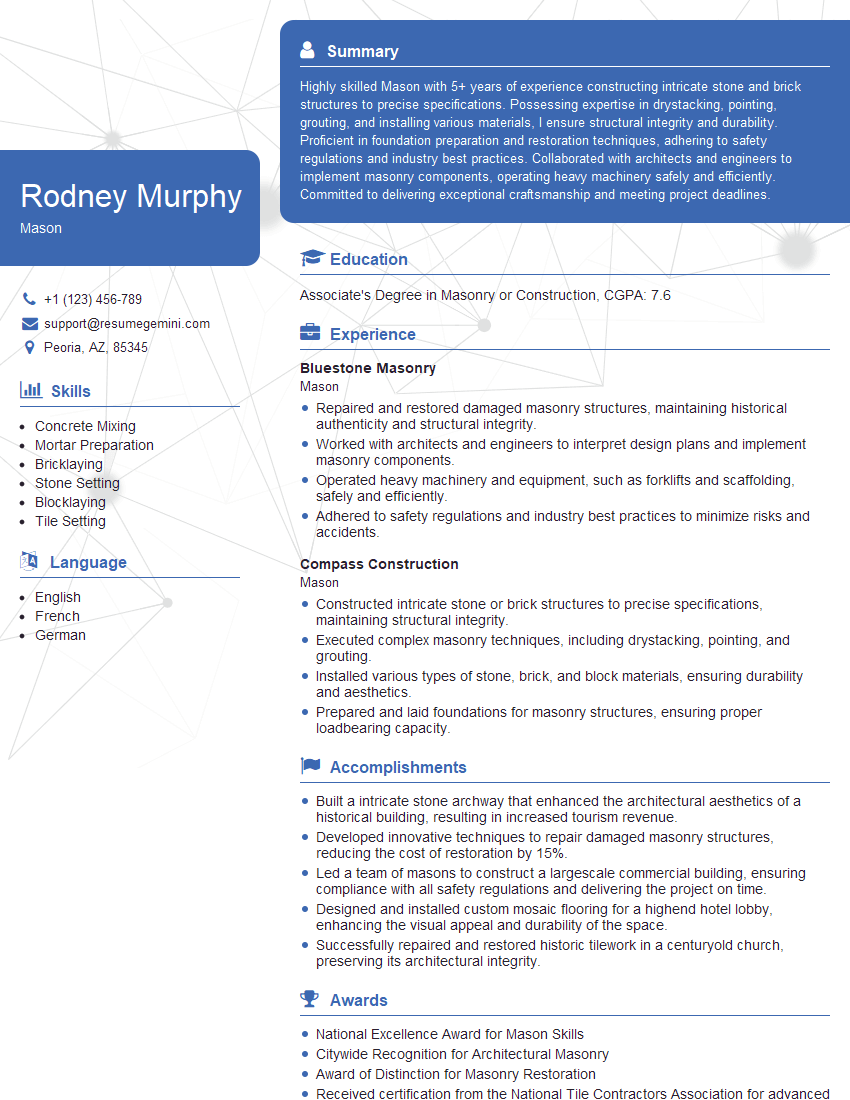
Mason Resume Sample
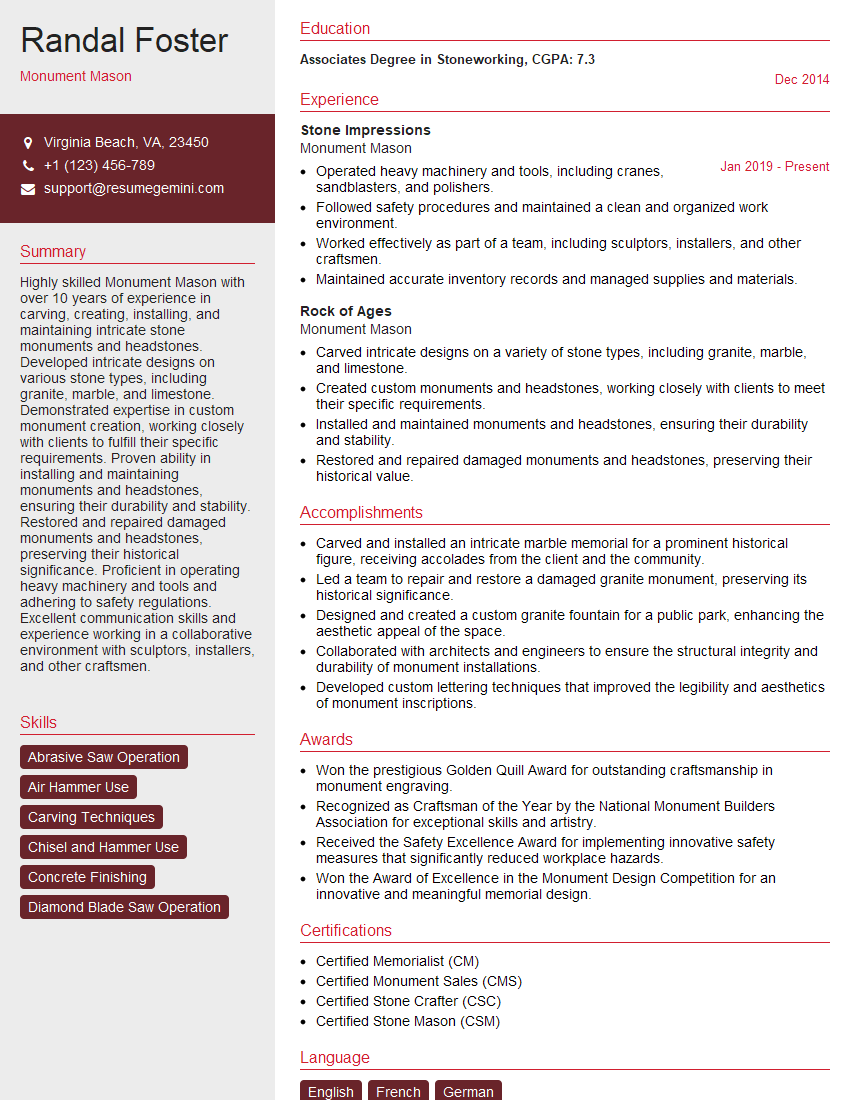
Monument Mason Resume Sample
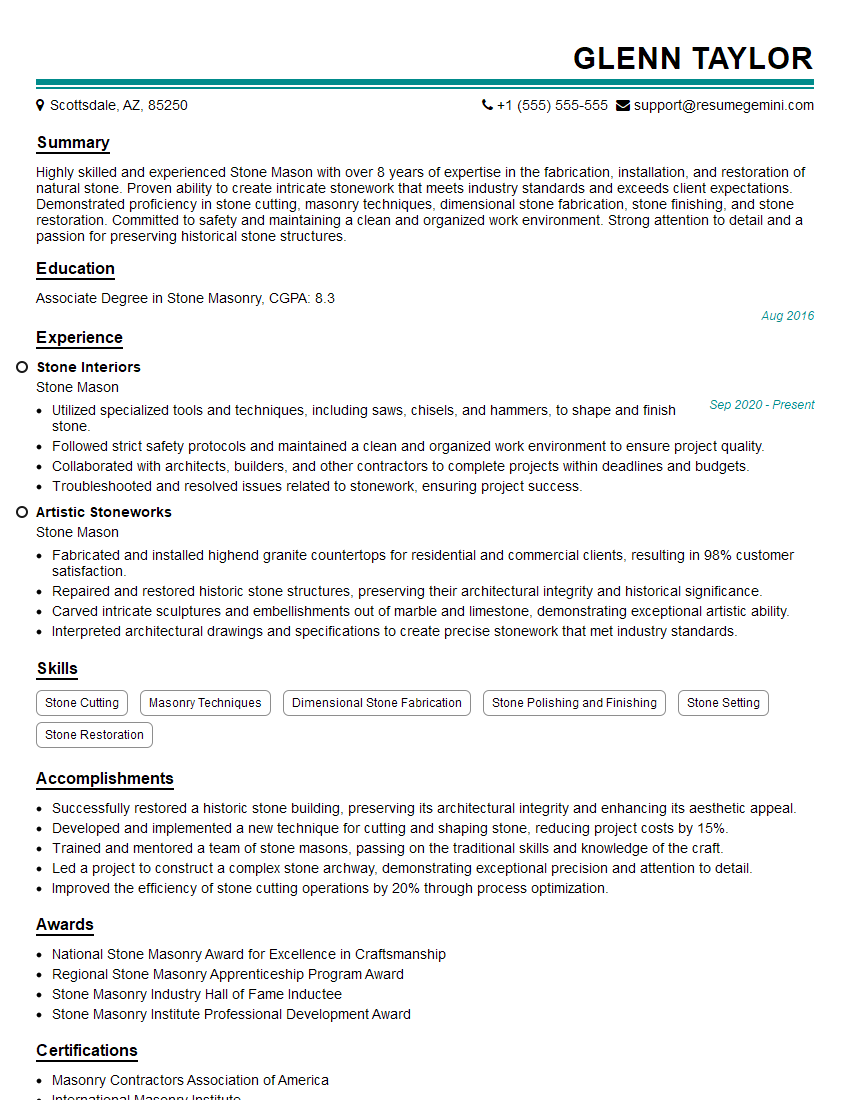
Stone Mason Resume Sample
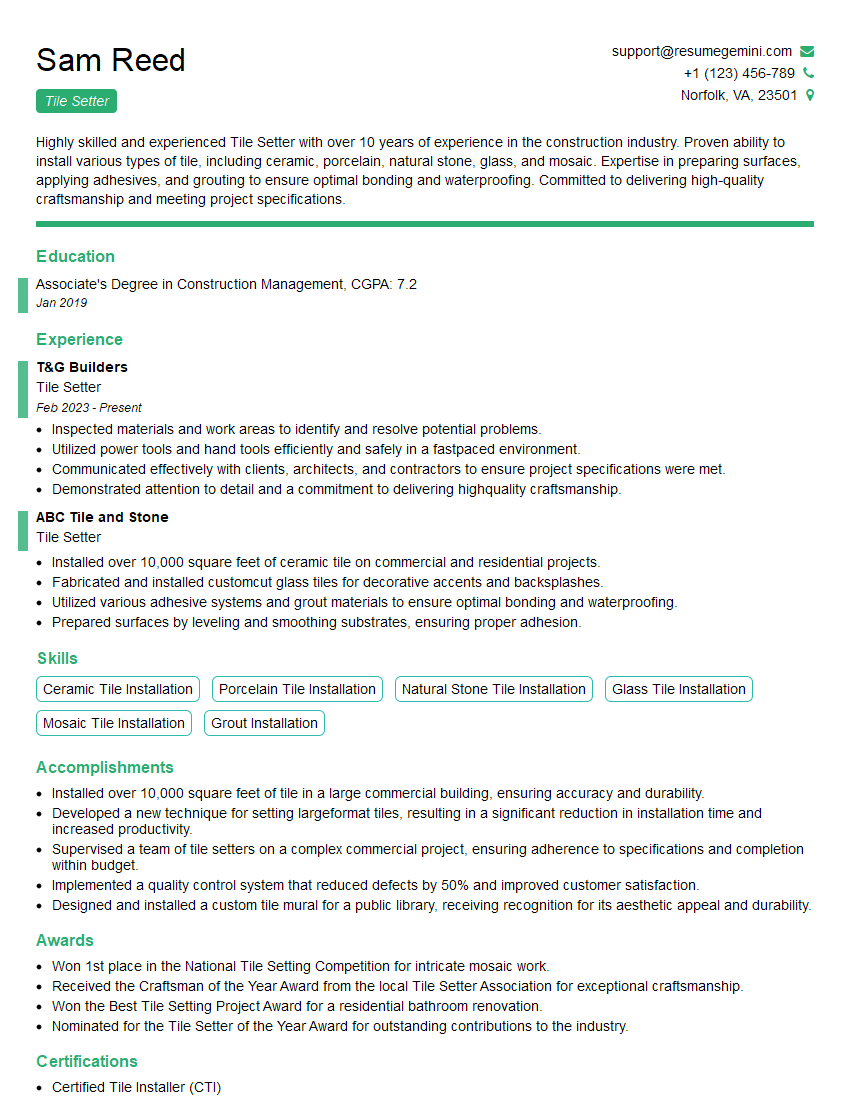
Tile Setter Resume Sample
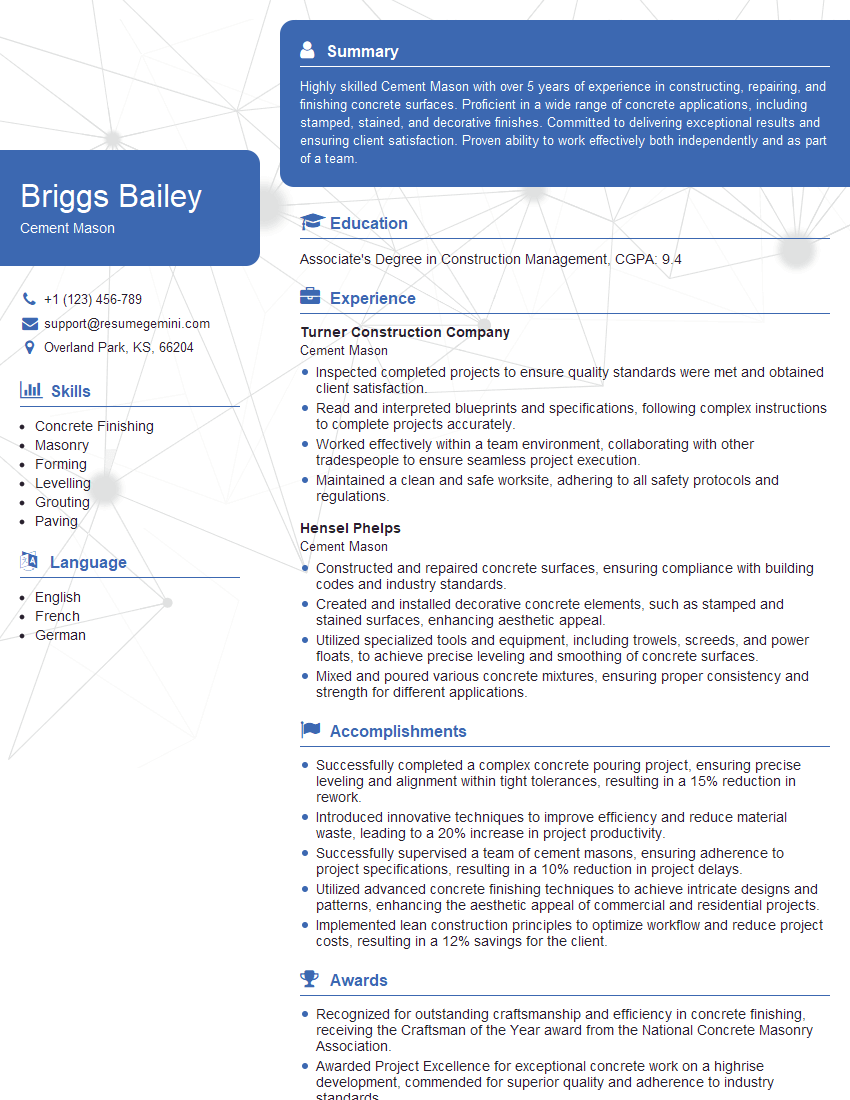
Cement Mason Resume Sample
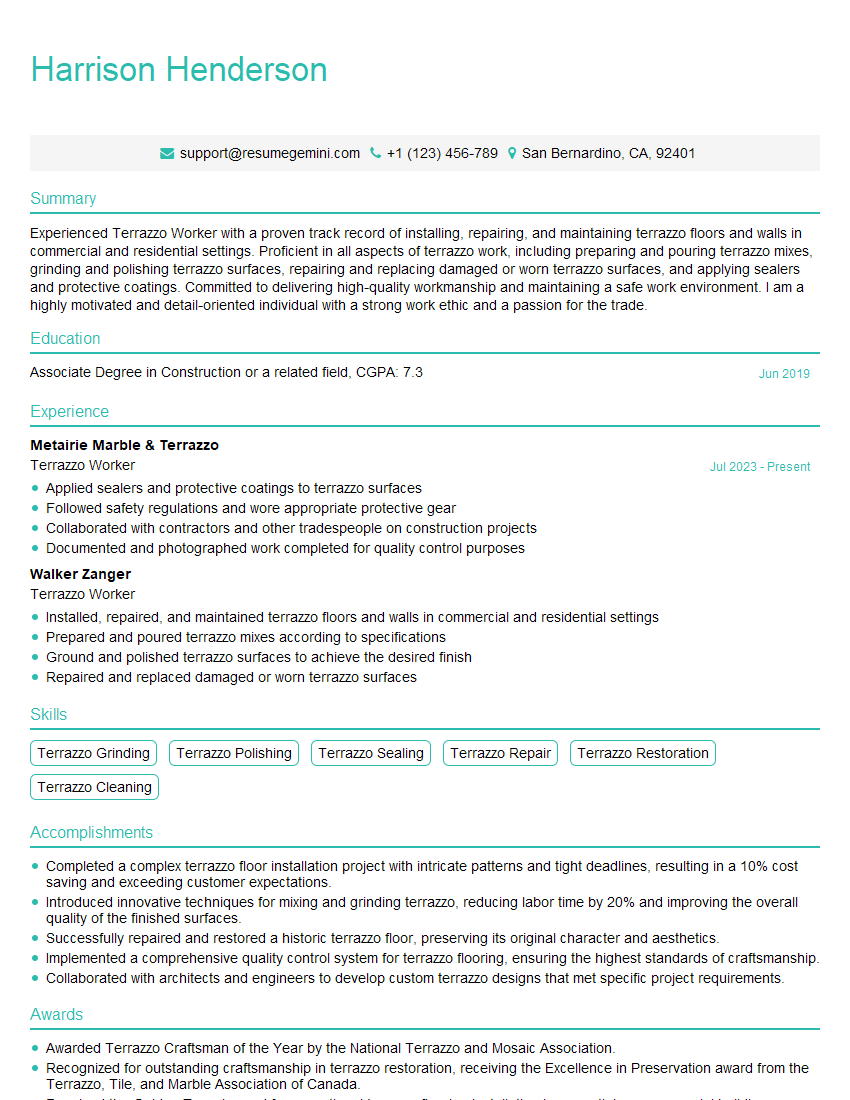
Terrazzo Worker Resume Sample
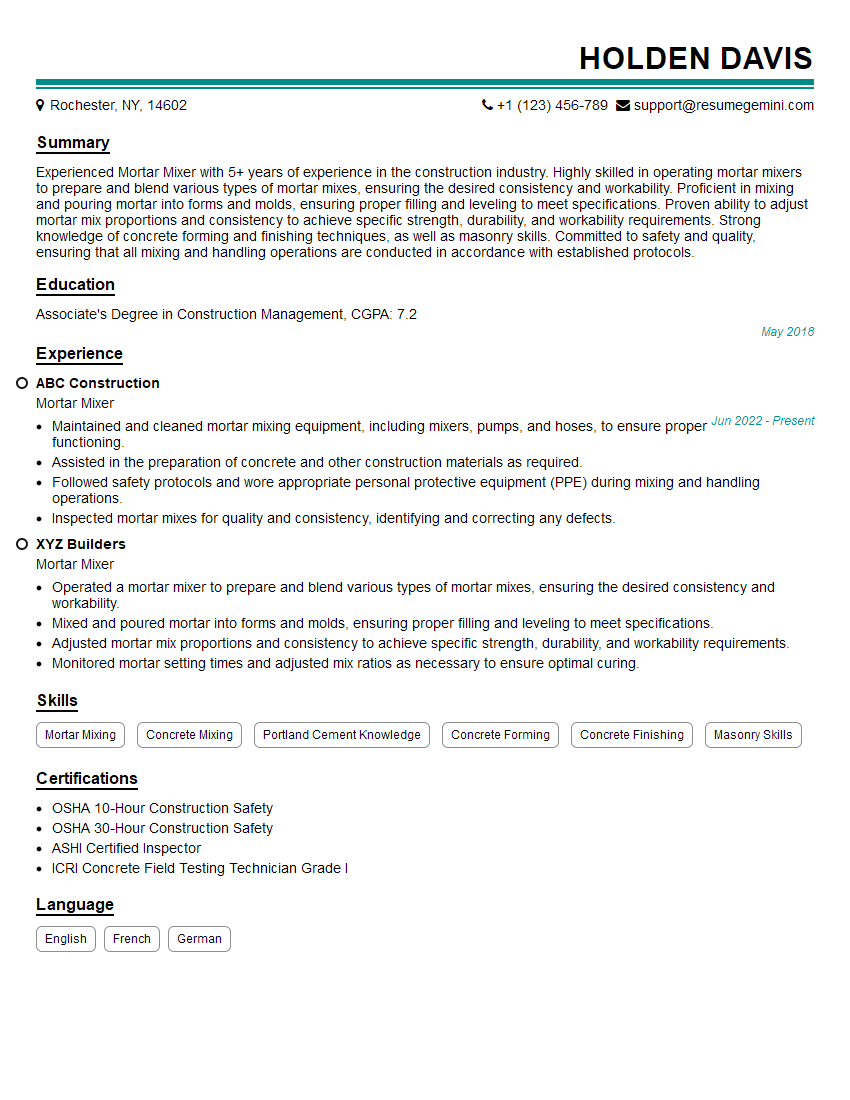
Mortar Mixer Resume Sample
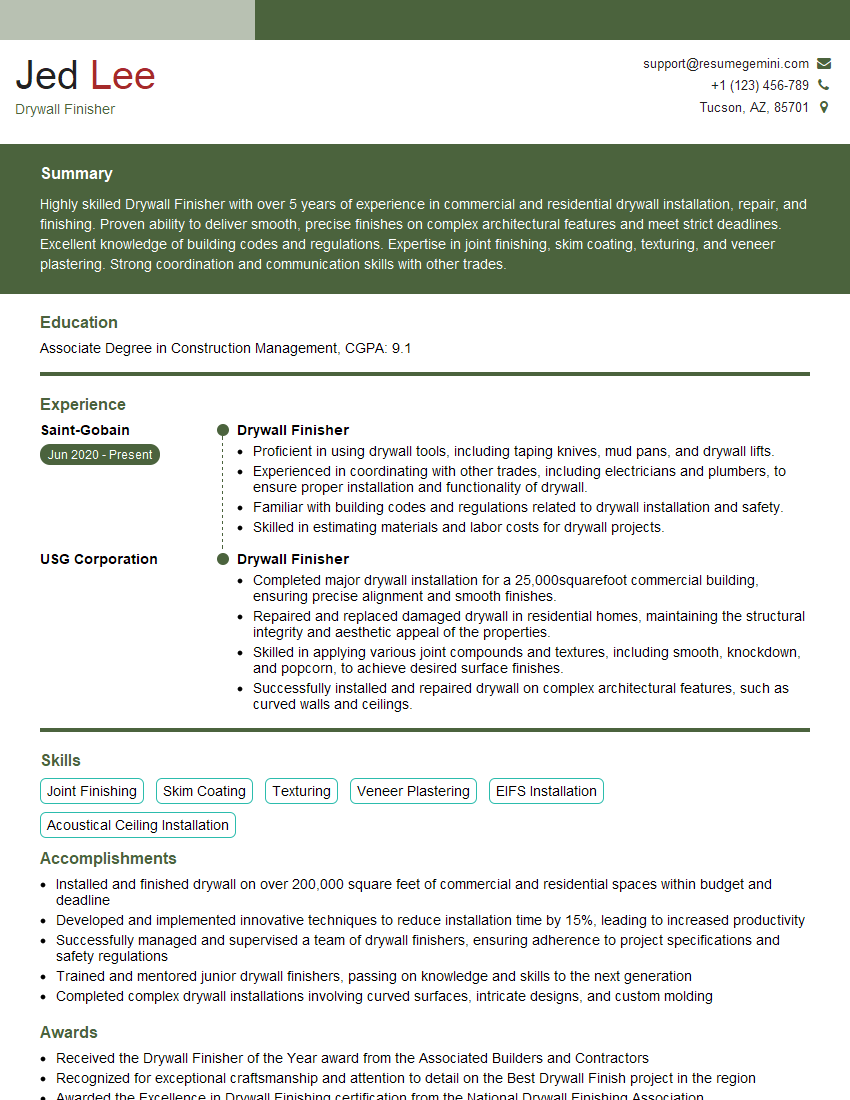
Drywall Finisher Resume Sample
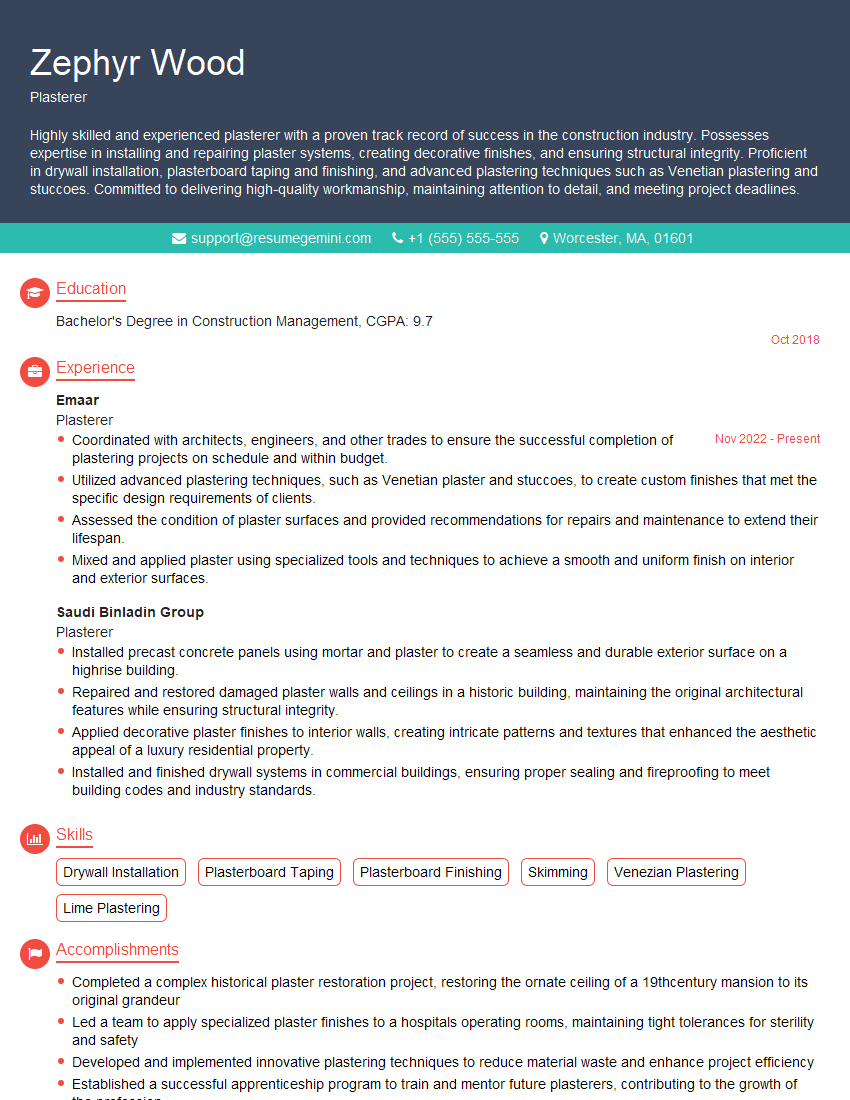
Plasterer Resume Sample
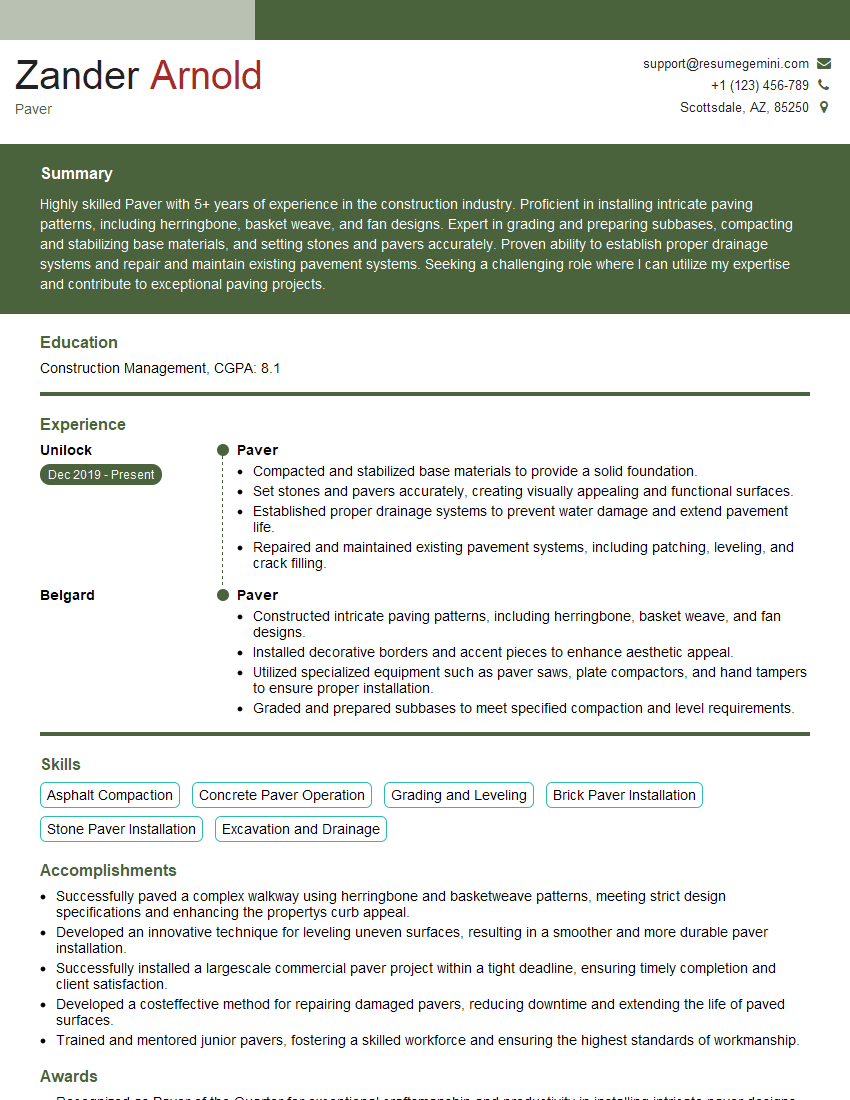
Paver Resume Sample
Explore more articles
Users Rating of Our Blogs
Share Your Experience
We value your feedback! Please rate our content and share your thoughts (optional).
What Readers Say About Our Blog
To the interviewgemini.com Webmaster.
Very helpful and content specific questions to help prepare me for my interview!
Thank you
To the interviewgemini.com Webmaster.
This was kind of a unique content I found around the specialized skills. Very helpful questions and good detailed answers.
Very Helpful blog, thank you Interviewgemini team.