Are you ready to stand out in your next interview? Understanding and preparing for Understanding of Heat Transfer and Moisture Management interview questions is a game-changer. In this blog, we’ve compiled key questions and expert advice to help you showcase your skills with confidence and precision. Let’s get started on your journey to acing the interview.
Questions Asked in Understanding of Heat Transfer and Moisture Management Interview
Q 1. Explain the three modes of heat transfer: conduction, convection, and radiation.
Heat transfer, the movement of thermal energy, occurs through three primary mechanisms: conduction, convection, and radiation. Imagine heating a metal rod on one end – you’ll feel the heat travel along its length. That’s conduction: heat transfer through direct contact. In convection, heat is transferred by the movement of fluids (liquids or gases). Think of boiling water – the hot water rises, carrying heat with it. Finally, radiation is heat transfer through electromagnetic waves; you feel this when you stand near a fire, even without touching the flames or air. Each method has unique characteristics and governing principles.
- Conduction: Heat travels directly through a material. The efficiency depends on the material’s thermal conductivity.
- Convection: Heat transfer involves fluid motion. It’s faster than conduction and can be natural (due to density differences) or forced (with a fan or pump).
- Radiation: Heat transfer doesn’t need a medium. It’s the fastest method and is highly dependent on surface temperature and emissivity.
Q 2. Define thermal conductivity and its significance in heat transfer.
Thermal conductivity (k) is a material’s ability to conduct heat. It quantifies how efficiently a substance transmits thermal energy. A high thermal conductivity means heat travels easily through the material (like metals), while a low thermal conductivity means heat transfer is slower (like insulation). Imagine touching a metal spoon and a wooden spoon both submerged in hot soup – the metal spoon will feel much hotter due to its higher thermal conductivity. The unit for thermal conductivity is typically W/m·K (Watts per meter-Kelvin).
Its significance in heat transfer is paramount because it dictates the rate of heat flow in conductive systems. In engineering design, choosing materials with appropriate thermal conductivity is critical for efficient heat management in applications such as heat exchangers, building insulation, and electronic cooling.
Q 3. Describe Fourier’s Law of heat conduction and its applications.
Fourier’s Law of heat conduction states that the rate of heat transfer through a material is proportional to the area, the temperature difference across the material, and inversely proportional to the material’s thickness. Mathematically, it’s expressed as:
q = -k * A * (dT/dx)
where:
qis the heat transfer rate (Watts)kis the thermal conductivity (W/m·K)Ais the cross-sectional area (m²)dT/dxis the temperature gradient (K/m)
The negative sign indicates that heat flows from higher to lower temperatures. Fourier’s Law is fundamental to solving numerous heat transfer problems, from determining the heat loss through a building wall to designing efficient heat sinks for electronics. For example, a thicker wall (larger dx) leads to a lower heat transfer rate.
Q 4. Explain the concept of convective heat transfer coefficient.
The convective heat transfer coefficient (h) represents the rate of heat transfer between a surface and a moving fluid per unit area and per unit temperature difference. It essentially quantifies how effectively heat is transferred from a solid surface to a surrounding fluid (or vice-versa). Think of boiling an egg – the higher the heat transfer coefficient between the pan and the water, the faster the egg will cook. It’s measured in W/m²·K.
The value of h is influenced by many factors, including the fluid properties (viscosity, density, thermal conductivity), fluid velocity, and the surface geometry. Determining h often requires empirical correlations or computational fluid dynamics (CFD) simulations.
Q 5. What are the different types of convective heat transfer (e.g., natural, forced)?
Convective heat transfer is categorized into several types:
- Natural convection: Driven by density differences caused by temperature variations within the fluid. Warm air rising and cool air sinking is an example. This type is often slower than forced convection.
- Forced convection: Heat transfer is accelerated by external means like fans or pumps, creating a higher fluid velocity and enhancing heat transfer. Examples include air conditioning systems and car radiators.
- Mixed convection: A combination of natural and forced convection, where both mechanisms contribute to heat transfer. This is often found in situations where both density differences and forced flow exist.
Understanding the type of convection is crucial in designing efficient heat transfer systems. For instance, designing a heat sink for a computer processor often involves forced convection for faster cooling.
Q 6. Describe the Stefan-Boltzmann Law and its application in radiation heat transfer.
The Stefan-Boltzmann Law describes the power radiated from a black body in terms of its temperature. A black body is an idealized object that absorbs all incident radiation. The law states that the total energy radiated per unit surface area of a black body across all wavelengths is proportional to the fourth power of its thermodynamic temperature.
The formula is: q = σ * A * T⁴
where:
qis the radiative heat flux (W/m²)σis the Stefan-Boltzmann constant (5.67 x 10⁻⁸ W/m²·K⁴)Ais the surface area (m²)Tis the absolute temperature (Kelvin)
This law is crucial in various applications, including designing solar thermal systems, estimating heat loss from furnaces, and understanding radiative heat transfer in space applications. Note that for real surfaces, emissivity (a factor representing the ability of a surface to radiate energy compared to a black body) is incorporated into the equation.
Q 7. What is the view factor in radiation heat transfer and how is it determined?
In radiation heat transfer, the view factor (Fij), also known as the configuration factor or shape factor, represents the fraction of radiation leaving surface i that directly strikes surface j. Imagine two surfaces facing each other; the view factor quantifies how much radiation from one surface ‘sees’ the other. A value of Fij = 1 means all radiation leaving surface i hits surface j.
Determining view factors can be complex, depending on the geometry of the surfaces involved. Analytical solutions exist for simple shapes (parallel plates, concentric spheres), but for complex geometries, numerical methods or computational software are often used. The reciprocity theorem (AiFij = AjFji) and summation rule (∑j=1N Fij = 1) are valuable tools in calculating view factors and simplifying the calculations involved.
Q 8. Explain the concept of thermal resistance and its role in heat transfer analysis.
Thermal resistance, often denoted as R, represents a material’s opposition to the flow of heat. Think of it like resistance in an electrical circuit – a higher resistance means less heat flows for a given temperature difference. It’s calculated as the thickness of the material divided by its thermal conductivity (R = L/k, where L is thickness and k is thermal conductivity). In heat transfer analysis, thermal resistance is crucial because it allows us to model the heat flow through various layers of materials in a building wall, for instance, or through different components of an engine. By summing up the individual thermal resistances of each layer, we can determine the overall thermal resistance of the system and thus predict the total heat flow. A higher overall thermal resistance indicates better insulation.
Example: Imagine a wall with an inner layer of gypsum board (Rgypsum), an insulation layer (Rinsulation), and an outer layer of brick (Rbrick). The total thermal resistance of the wall is simply Rtotal = Rgypsum + Rinsulation + Rbrick. This allows engineers to calculate heat loss through the wall and design efficient insulation systems.
Q 9. How do you solve steady-state heat conduction problems using finite difference methods?
Solving steady-state heat conduction problems using finite difference methods involves discretizing the governing equation (Laplace’s equation or Poisson’s equation, depending on the presence of heat generation) into a set of algebraic equations. We divide the domain into a grid of nodes, and at each node, we approximate the temperature gradient using finite difference approximations. For a two-dimensional problem, we might use a central difference scheme:
Ti,j = (Ti+1,j + Ti-1,j + Ti,j+1 + Ti,j-1) / 4This equation assumes no internal heat generation. The equation states that the temperature at a node (Ti,j) is the average of its four neighboring nodes. For more complex geometries or boundary conditions, more sophisticated schemes might be needed. Boundary conditions (e.g., specified temperature, convective heat transfer) are incorporated into the algebraic equations. The resulting system of equations is then solved using numerical methods such as Gaussian elimination, Gauss-Seidel iteration, or more advanced solvers available in software packages like MATLAB or Python’s NumPy and SciPy. The solution provides the temperature distribution throughout the domain.
Iterative Methods: Iterative methods, like Gauss-Seidel, are often preferred for large systems because they require less memory and can be more efficient. They involve repeatedly updating the temperature at each node until the solution converges to a desired accuracy.
Q 10. Explain the concept of thermal diffusivity and its importance.
Thermal diffusivity (α) is a material property that describes how quickly temperature changes propagate through a material. It’s defined as the ratio of thermal conductivity (k) to the product of density (ρ) and specific heat capacity (cp): α = k / (ρcp). A high thermal diffusivity indicates that the material will heat up or cool down rapidly, while a low thermal diffusivity suggests slower changes. Think of it like this: if you place a hot object on two different materials, the one with higher thermal diffusivity will feel hotter (or colder, if the object is cold) faster. In practical applications, thermal diffusivity is crucial for predicting transient heat transfer problems, such as those encountered during building heating and cooling cycles or in the manufacturing processes involving heating and cooling of components.
Importance: Understanding thermal diffusivity is essential in designing efficient heating and cooling systems, predicting the thermal response of buildings to changing environmental conditions, and controlling the temperature profiles in various industrial processes. For example, in the design of electronic components, materials with low thermal diffusivity are often chosen to reduce heat buildup and prevent overheating.
Q 11. Describe different types of insulation materials and their thermal properties.
Insulation materials are designed to minimize heat transfer. Different types offer varying thermal properties:
- Fiberglass: Common, relatively inexpensive, and offers good insulation value. It’s lightweight but can be itchy to handle.
- Mineral Wool (Rock Wool & Glass Wool): Made from recycled materials, offering good thermal and sound insulation. It’s durable and fire-resistant.
- Cellulose: Made from recycled paper, offering good insulation and is environmentally friendly. It can absorb moisture, potentially impacting its performance.
- Polyurethane Foam (PU): High R-value for its thickness, making it an efficient insulator, but can be less environmentally friendly than other options during manufacturing.
- Polyisocyanurate (PIR): Excellent insulation, often used in roofing and wall panels, known for its high R-value and dimensional stability.
- Aerogel: A highly porous material, known for its exceptional insulation properties, but is more expensive than other options.
The thermal properties, primarily thermal conductivity (k) and R-value (thermal resistance), vary depending on the material and its density. Lower thermal conductivity and higher R-value indicate better insulation performance. The choice of insulation depends on factors such as cost, environmental impact, fire safety requirements, and the specific application.
Q 12. How does moisture affect the thermal performance of building materials?
Moisture significantly degrades the thermal performance of building materials. When moisture enters a material, it disrupts its microstructure and reduces its ability to insulate. This is because water has a much higher thermal conductivity than air trapped within the pores of insulating materials. The presence of water effectively reduces the effective thermal resistance of the material, increasing heat transfer. For example, wet fiberglass insulation will have a lower R-value than dry fiberglass insulation. Additionally, moisture can lead to issues such as mold growth, which further compromises the material’s structural integrity and can pose health risks.
Example: Consider a wall with wet insulation. The water in the insulation increases its thermal conductivity, resulting in increased heat transfer through the wall. This leads to higher energy consumption for heating or cooling the building, and in cold climates, it can lead to freezing and damage.
Q 13. Explain the concept of relative humidity and its impact on building performance.
Relative humidity (RH) is the ratio of the partial pressure of water vapor in the air to the equilibrium vapor pressure of water at a given temperature, expressed as a percentage. It indicates how much moisture is present in the air compared to the maximum amount it can hold at that temperature. High relative humidity in buildings can lead to several issues:
- Increased Condensation: High RH increases the likelihood of condensation on cold surfaces, leading to mold growth and deterioration of building materials.
- Reduced Thermal Comfort: High humidity can make occupants feel uncomfortable, as it makes it harder for sweat to evaporate, reducing the body’s ability to cool itself.
- Material Degradation: Excessive moisture can damage building materials through swelling, rotting, and weakening of structural components.
Impact on Building Performance: RH directly affects the moisture content of building materials, influencing their thermal performance, as explained in the previous answer. Maintaining optimal RH levels is crucial for energy efficiency, occupant comfort, and the durability of the building.
Q 14. What are the different methods used to control moisture in buildings?
Controlling moisture in buildings involves a combination of strategies:
- Proper Design & Construction: This includes using moisture-resistant materials, implementing vapor barriers in appropriate locations, ensuring adequate ventilation, and creating a continuous air barrier to prevent air leakage.
- Ventilation Systems: Controlled mechanical ventilation systems can remove excess moisture from the air, regulating RH and preventing condensation.
- Dehumidification: Dehumidifiers can actively remove moisture from the air, especially beneficial in humid climates or spaces prone to high moisture buildup.
- Moisture Barriers & Membranes: These are layers integrated into the building envelope to prevent moisture penetration and reduce the risk of water damage.
- Drainage Systems: Effective drainage systems around the building foundation are essential to prevent water from entering the building.
- Proper Landscaping: Grading the land around the foundation to direct water away from the building prevents moisture from accumulating.
The optimal approach depends on the climate, building design, and specific moisture challenges. A comprehensive strategy, integrating multiple methods, is usually the most effective approach.
Q 15. What are the consequences of excessive moisture in building structures?
Excessive moisture in building structures has severe consequences, leading to a cascade of problems affecting both the building’s integrity and the occupants’ health and well-being. Think of it like a sponge constantly saturated – it’s not going to last long!
- Mold and Mildew Growth: Moisture provides the perfect breeding ground for mold and mildew, leading to unsightly stains, structural damage, and serious health issues like allergies and respiratory problems. Imagine a damp basement transforming into a moldy haven, a real health hazard.
- Rot and Decay: Wood framing, flooring, and other organic materials become susceptible to rot and decay when exposed to prolonged moisture, weakening the structure and potentially leading to costly repairs or even collapse. Think of a water-damaged wooden beam – its structural integrity is seriously compromised.
- Material Degradation: Moisture can damage building materials like plaster, paint, and insulation, causing them to deteriorate, crack, peel, or become less effective. Picture peeling paint and crumbling plaster – not only unsightly but indicative of a moisture problem.
- Increased Energy Costs: Damp materials are poor insulators, leading to higher heating and cooling costs as the building loses energy inefficiently. Imagine constantly having to crank up the heater to compensate for a cold, damp house.
- Pest Infestations: Moisture attracts insects and rodents, creating unsanitary conditions and potentially leading to further structural damage. A damp environment is essentially an invitation for unwelcome guests.
Career Expert Tips:
- Ace those interviews! Prepare effectively by reviewing the Top 50 Most Common Interview Questions on ResumeGemini.
- Navigate your job search with confidence! Explore a wide range of Career Tips on ResumeGemini. Learn about common challenges and recommendations to overcome them.
- Craft the perfect resume! Master the Art of Resume Writing with ResumeGemini’s guide. Showcase your unique qualifications and achievements effectively.
- Don’t miss out on holiday savings! Build your dream resume with ResumeGemini’s ATS optimized templates.
Q 16. Explain the concept of dew point and its relevance in moisture management.
The dew point is the temperature at which the air becomes saturated with water vapor, meaning it can no longer hold any more moisture. Think of it like a glass of iced tea on a humid day – condensation forms on the outside because the air around the glass cools below its dew point, releasing the excess moisture.
In moisture management, understanding the dew point is crucial because it helps predict where condensation is likely to occur. If the surface temperature of a building component (like a wall or window) falls below the dew point of the surrounding air, moisture will condense on that surface. This can lead to the problems mentioned earlier, like mold growth and material damage. For example, if the dew point is 60°F and an exterior wall cools down to 55°F at night, condensation will form, potentially creating a moist environment within the wall cavity.
Q 17. How do you determine the heat load for an HVAC system?
Determining the heat load for an HVAC system involves calculating the amount of heating or cooling required to maintain a desired indoor temperature. It’s like figuring out how much fuel you need to keep your car at a certain speed.
The process considers several factors:
- Building characteristics: Size, insulation levels, window area, orientation, and construction materials all affect heat gain and loss.
- Climate data: Outdoor temperature extremes, humidity levels, and solar radiation impact the heating and cooling needs.
- Occupancy: Number of occupants, their activities, and lighting all generate heat.
- Internal heat loads: Appliances, equipment, and even the presence of people all contribute to the internal heat generation.
- Ventilation requirements: The amount of fresh air needed impacts the heating/cooling load as outside air needs to be conditioned.
Software tools and manual calculation methods based on established engineering standards (like ASHRAE standards) are commonly employed to calculate the heat load. The result is expressed in BTUs (British Thermal Units) or kilowatts (kW) and directly informs the selection and sizing of the appropriate HVAC equipment.
Q 18. Describe the different types of HVAC systems and their applications.
Various HVAC systems cater to different needs and building types. Think of them as different vehicles suited for various terrains.
- Split Systems: These consist of an outdoor unit (compressor/condenser) and an indoor unit (evaporator), connected by refrigerant lines. Common in residential and small commercial buildings, they are relatively cost-effective and efficient.
- Packaged Systems: All components (compressor, condenser, evaporator, etc.) are housed in a single unit, typically placed on the roof or ground. Simpler installation but less flexible in placement.
- Variable Refrigerant Flow (VRF) Systems: These systems use variable refrigerant flow to regulate temperature in multiple zones independently, offering greater control and efficiency. Common in larger buildings where zone control is desired.
- Air Handling Units (AHUs): Large systems usually found in larger commercial and industrial buildings. They condition air using heating/cooling coils, filters, and fans, distributing it through ductwork to multiple zones.
- Geothermal Heat Pumps: These utilize the earth’s stable temperature to provide efficient heating and cooling. Environmentally friendly but higher initial costs.
Q 19. What are the principles of psychrometrics and how are they used in HVAC design?
Psychrometrics is the study of the thermodynamic properties of moist air. It’s the science that helps HVAC engineers design systems that effectively control temperature and humidity. Think of it as the map that guides HVAC system design.
In HVAC design, psychrometric charts and software are used to:
- Determine the properties of air: Temperature, humidity, enthalpy (total heat content), specific volume, and wet-bulb temperature are key parameters determined using psychrometric relationships.
- Analyze air conditioning processes: Psychrometrics helps visualize and understand how processes like heating, cooling, humidification, and dehumidification affect the air’s properties. This allows engineers to predict the performance of HVAC equipment and choose the best options.
- Design efficient HVAC systems: By understanding the relationship between different air properties, engineers can design systems that efficiently meet the desired temperature and humidity levels while minimizing energy consumption.
- Troubleshoot HVAC problems: Analyzing psychrometric data can help diagnose problems in existing systems and determine the cause of poor performance.
Q 20. Explain the concept of sensible and latent heat.
Sensible heat and latent heat are two types of heat energy that affect the temperature and moisture content of air. Think of them as two sides of the same coin.
- Sensible Heat: This is the heat that causes a temperature change without changing the moisture content. For instance, heating a room increases its sensible heat, raising the temperature without changing the humidity. You can feel this change in temperature with a thermometer.
- Latent Heat: This is the heat that causes a change in moisture content without a significant temperature change. For example, evaporating water absorbs latent heat, converting liquid water into water vapor (humidity increases). You won’t necessarily feel this change with a simple thermometer; you’d need a psychrometer or other humidity sensor. This process is crucial in humidification and dehumidification in HVAC systems.
Q 21. How does air infiltration affect building energy performance and indoor air quality?
Air infiltration, the uncontrolled movement of outside air into a building, significantly impacts both energy performance and indoor air quality. It’s like having tiny cracks in your house letting outside air in and out.
- Energy Performance: Infiltration leads to energy loss during both heating and cooling seasons. In winter, warm indoor air escapes, requiring the HVAC system to work harder to maintain temperature. In summer, the influx of hot outside air strains the cooling system. This leads to increased energy bills and a bigger carbon footprint.
- Indoor Air Quality (IAQ): Infiltration can introduce pollutants from outside, such as pollen, dust, vehicle emissions, and industrial pollutants, negatively impacting IAQ. This can trigger allergies, asthma, and other respiratory problems, especially for sensitive individuals. Additionally, insufficient ventilation due to poorly managed infiltration can lead to a buildup of indoor pollutants like carbon dioxide and volatile organic compounds (VOCs).
Proper sealing and weatherization techniques, such as caulking, weather stripping, and the use of high-performance windows and doors, are crucial to minimize air infiltration and improve building performance.
Q 22. Describe different methods for measuring moisture content in building materials.
Measuring moisture content in building materials requires accurate methods to avoid issues like mold growth and structural damage. Several techniques exist, each with its strengths and weaknesses:
Oven-drying method: This is a gravimetric method where a sample is weighed, dried in an oven at a specific temperature (usually 105°C), and weighed again. The difference in weight represents the moisture content. It’s accurate but time-consuming and can alter the sample’s properties.
Moisture meters: These use electrical resistance, capacitance, or nuclear magnetic resonance (NMR) to measure moisture content directly. Electrical resistance meters are common for wood, while capacitance meters are suitable for various materials. NMR offers high accuracy but is more expensive. The accuracy depends on the material and calibration.
Hygrometers: These measure relative humidity, which indirectly indicates moisture content. They’re useful for monitoring ambient conditions but less precise for determining moisture within materials themselves.
Karl Fischer titration: This is a chemical method that provides highly accurate moisture content determination, particularly for low moisture levels. It’s often used for precise laboratory analysis but is less suitable for field testing.
The choice of method depends on the material, required accuracy, and available resources. For instance, a quick check on a timber frame might use a moisture meter, while a detailed analysis of a concrete sample might necessitate oven-drying or Karl Fischer titration.
Q 23. What are the common causes of condensation in buildings?
Condensation in buildings occurs when warm, moist air comes into contact with a colder surface, causing the water vapor to condense into liquid water. Several factors contribute:
Temperature differences: The most crucial factor. Cold surfaces (e.g., exterior walls, windows) in contact with warm, humid air are prone to condensation.
High humidity levels: Increased moisture in the air increases the likelihood of condensation. This can be due to poor ventilation, leaks, or high occupancy levels.
Air leakage: Air infiltration can introduce cold air into the building envelope, increasing the temperature difference and causing condensation.
Lack of ventilation: Inadequate ventilation prevents the removal of moisture-laden air, increasing humidity levels.
Thermal bridging: Thermal bridges – areas where heat readily transfers through the building envelope – create cold spots, which are particularly vulnerable to condensation.
Imagine a cold glass of water on a hot summer’s day; condensation forms on the glass due to the temperature difference. Similarly, in a building, cold surfaces create the same effect, leading to potential mold growth and structural damage if not properly addressed.
Q 24. Explain the role of vapor barriers in moisture control.
Vapor barriers are designed to restrict the movement of water vapor through building assemblies. They play a vital role in moisture control by preventing moisture from entering the building envelope from the interior and migrating to colder areas where it can condense.
Ideally, a vapor barrier should be placed on the warm side of the insulation. In cold climates, this typically means the interior side of the wall. This prevents moisture from inside the building from penetrating the insulation, where it could freeze and damage the building components. In warmer climates, the placement may need to be carefully considered based on climatic conditions and the building’s design.
Common vapor barrier materials include polyethylene sheeting, foil-faced insulation, and certain types of drywall. It’s essential to ensure the vapor barrier is properly sealed to prevent any gaps that could compromise its effectiveness. A poorly installed vapor barrier can be worse than no vapor barrier at all, as it can trap moisture within the wall assembly.
Think of a vapor barrier as a raincoat – it keeps the water (moisture) out without affecting the breathability (air flow) of the underlying structure (insulation). It is a crucial element in managing moisture and preventing problems within a building’s envelope.
Q 25. How do you assess the thermal performance of a building envelope?
Assessing the thermal performance of a building envelope involves evaluating its ability to resist heat flow. Several methods are employed:
Heat transfer calculations: Using software or manual calculations based on building material properties, dimensions, and climate data, we can determine the heat transfer through the building envelope. This allows us to calculate heat loss in winter and heat gain in summer. These calculations often utilize U-values (overall heat transfer coefficient) and R-values (thermal resistance).
Thermal imaging: Infrared cameras can detect temperature differences on the building’s surface, identifying areas of significant heat loss or gain. This provides a visual representation of thermal performance and helps identify thermal bridges.
In-situ measurements: Temperature sensors placed inside and outside the building envelope, combined with weather data, can be used to measure the actual heat flow and verify the accuracy of the calculated values.
Energy modeling: Software like EnergyPlus or TRNSYS simulates the building’s energy performance throughout the year, factoring in various aspects including the building envelope, HVAC systems, and occupancy. This is crucial for optimizing energy efficiency.
A comprehensive assessment involves combining these methods to get a holistic view of the building envelope’s thermal performance. This allows us to identify areas for improvement, design more efficient buildings, and ultimately reduce energy consumption.
Q 26. What software or tools are you familiar with for performing thermal and moisture simulations?
I am proficient in several software tools for thermal and moisture simulations. These include:
WUFI Pro: A sophisticated software package for hygrothermal simulations, which accurately models moisture transport in building components and assemblies under various climate conditions. It’s essential for predicting condensation risk and assessing the long-term performance of building materials.
EnergyPlus: A widely used whole-building energy simulation program. While primarily focused on energy, EnergyPlus incorporates detailed heat transfer calculations which are crucial for assessing the thermal performance of the building envelope and its interaction with the HVAC system.
TRNSYS: A versatile simulation tool capable of modeling various building systems, including hygrothermal performance. Its modular structure allows for the incorporation of custom components and detailed simulations.
COMSOL Multiphysics: A powerful finite element analysis (FEA) software that can be used to simulate complex heat and moisture transfer processes, enabling in-depth analysis of specific components or assemblies.
My expertise extends to utilizing these tools to create accurate models, interpret the results, and make informed recommendations for improving the thermal and moisture performance of buildings.
Q 27. Describe a situation where you had to troubleshoot a heat transfer or moisture-related problem. What was your approach?
I once worked on a project where a new museum experienced persistent condensation on interior walls during winter months. The initial design had incorporated a high-performance insulation system, but the condensation was causing concerns about mold growth and damage to the artwork.
My approach involved a systematic investigation:
Data collection: We conducted on-site measurements of temperature and relative humidity at various locations within the building. We also reviewed the building plans and specifications.
Thermal and moisture simulation: Using WUFI Pro, we modeled the building envelope, incorporating the actual construction details. The simulation helped us pinpoint the areas most susceptible to condensation.
Analysis of results: The simulation revealed that while the insulation was effective, there were significant thermal bridges at the window frames and around certain penetrations. These were causing localized cold spots that triggered condensation.
Recommendations: Based on the analysis, we recommended improvements, including better sealing of the window frames, improved insulation around penetrations, and possibly the installation of a more robust vapor barrier in strategic locations.
The subsequent implementation of these recommendations effectively resolved the condensation problem, preserving the museum’s artifacts and avoiding potential damage. This highlighted the importance of accurate simulation modeling to diagnose and resolve challenging moisture-related issues.
Q 28. Explain the principles behind a heat exchanger and its different types.
A heat exchanger is a device used to transfer heat from one fluid to another, typically without allowing the fluids to mix. This is based on the principle of heat transfer through conduction, convection, and sometimes radiation.
There are various types of heat exchangers, classified based on their configuration and the flow of fluids:
Parallel flow heat exchanger: Both fluids flow in the same direction. This results in a lower overall temperature difference and less efficient heat transfer.
Counterflow heat exchanger: Fluids flow in opposite directions. This provides a larger temperature difference throughout the exchanger, leading to more efficient heat transfer. This is the most common type.
Crossflow heat exchanger: Fluids flow perpendicular to each other. This type offers a compromise between parallel flow and counterflow, with variations based on how the fluids are mixed or unmixed.
Shell and tube heat exchanger: One fluid flows through a bundle of tubes within a shell, where the other fluid flows around the tubes. Common in industrial applications.
Plate heat exchangers: Thin plates with corrugated surfaces create many channels for efficient heat transfer between fluids. These are compact and have low pressure drop.
Examples include car radiators (where hot coolant transfers heat to the air), HVAC systems (where air is heated or cooled), and power plants (where steam transfers heat to water, generating electricity). The choice of heat exchanger type depends on factors like the fluids involved, temperature difference, pressure drop, space constraints, and cost.
Key Topics to Learn for Understanding of Heat Transfer and Moisture Management Interview
- Conduction, Convection, and Radiation: Understand the fundamental mechanisms of heat transfer and their relative importance in different scenarios. Be prepared to discuss the factors influencing each mode (e.g., thermal conductivity, fluid properties, emissivity).
- Moisture Transport Mechanisms: Explain how moisture moves through materials (diffusion, capillary action, etc.). Discuss the interplay between heat transfer and moisture movement.
- Psychrometrics: Demonstrate a strong understanding of psychrometric charts and their use in analyzing air properties (humidity, temperature, enthalpy). Be ready to solve basic psychrometric problems.
- Building Envelope Design: Discuss the practical application of heat and moisture transfer principles in designing energy-efficient buildings. This could include insulation, vapor barriers, and ventilation strategies.
- Material Properties: Understand the thermal and hygroscopic properties of common building materials (e.g., wood, concrete, insulation). Be able to compare and contrast different materials based on their performance characteristics.
- Computational Modeling: Discuss your experience (if any) with software or techniques used to simulate heat and moisture transfer (e.g., finite element analysis).
- Problem-Solving Approaches: Practice identifying and solving heat and moisture transfer problems using appropriate equations and methodologies. Be prepared to discuss your approach to problem-solving in a structured way.
- Industry Standards and Codes: Familiarity with relevant building codes and standards related to heat and moisture control is beneficial.
Next Steps
Mastering the principles of heat transfer and moisture management is crucial for career advancement in numerous fields, including building science, HVAC engineering, and material science. A strong understanding of these concepts demonstrates a valuable skillset to potential employers and opens doors to exciting opportunities. To maximize your job prospects, create an ATS-friendly resume that highlights your skills and experience effectively. ResumeGemini is a trusted resource for building professional resumes, and we provide examples of resumes tailored to Understanding of Heat Transfer and Moisture Management to help you present your qualifications in the best possible light. Take advantage of these resources to build a resume that truly showcases your expertise and helps you land your dream job.

Energy Auditor Resume Sample

Sustainability Consultant Resume Sample

Aerospace Engineer Resume Sample

Construction Engineer Resume Sample

Environmental Engineer Resume Sample
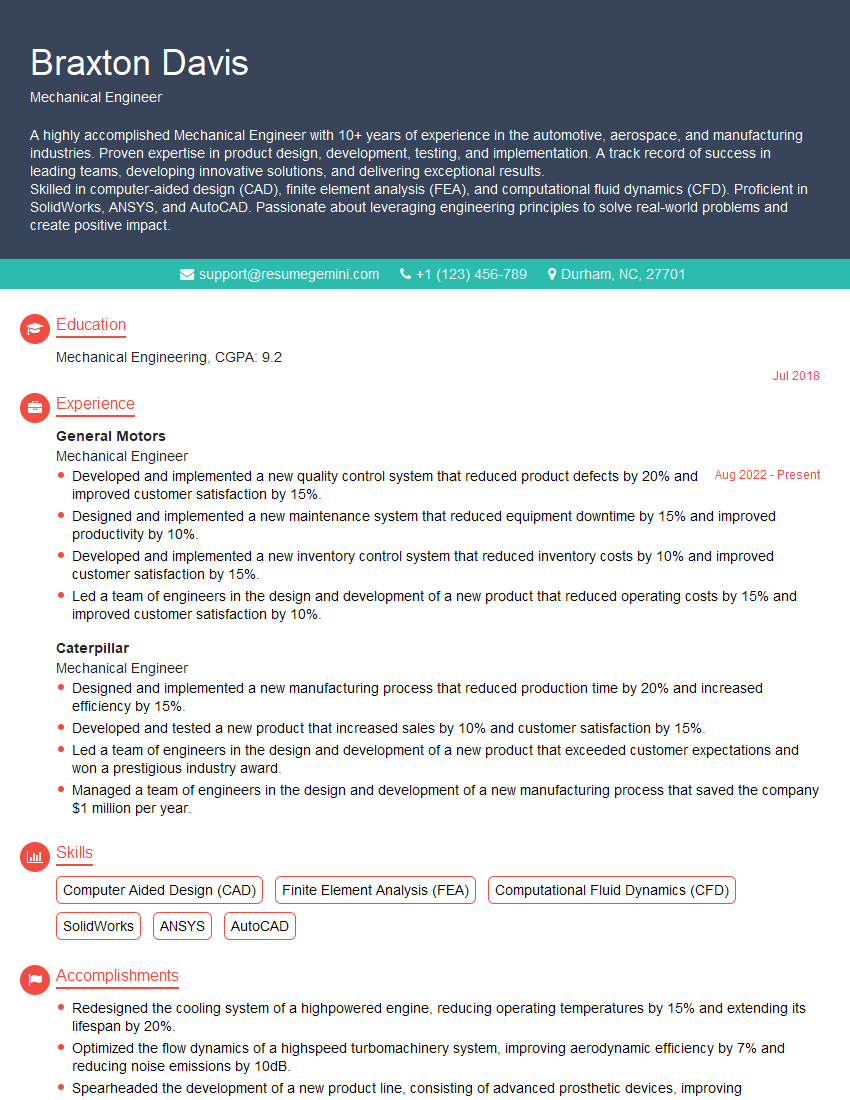
Mechanical Engineer Resume Sample

Refrigeration Engineer Resume Sample

Textile Engineer Resume Sample

Automotive Engineer Resume Sample

Renewable Energy Engineer Resume Sample

Materials Scientist Resume Sample
Explore more articles
Users Rating of Our Blogs
Share Your Experience
We value your feedback! Please rate our content and share your thoughts (optional).
What Readers Say About Our Blog
To the interviewgemini.com Webmaster.
Very helpful and content specific questions to help prepare me for my interview!
Thank you
To the interviewgemini.com Webmaster.
This was kind of a unique content I found around the specialized skills. Very helpful questions and good detailed answers.
Very Helpful blog, thank you Interviewgemini team.