Are you ready to stand out in your next interview? Understanding and preparing for Watershed Modeling System (WMS) interview questions is a game-changer. In this blog, we’ve compiled key questions and expert advice to help you showcase your skills with confidence and precision. Let’s get started on your journey to acing the interview.
Questions Asked in Watershed Modeling System (WMS) Interview
Q 1. Explain the fundamental principles of the Watershed Modeling System (WMS).
The Watershed Modeling System (WMS) is a powerful tool for simulating hydrological processes within a watershed. At its core, WMS relies on the fundamental principles of water balance, considering inputs (precipitation, snowmelt), outputs (evapotranspiration, streamflow, groundwater recharge), and storage within the watershed. It uses physically-based equations to represent these processes, accounting for factors like soil type, land use, topography, and vegetation. Think of it like a giant accounting system for water – tracking every drop as it moves through the landscape.
WMS operates on the principle of conservation of mass; water neither appears nor disappears, it simply changes location and state. The model divides the watershed into smaller units (typically grid cells or subbasins) and simulates the movement of water between these units over time. This allows for a detailed understanding of hydrological dynamics across the entire watershed.
Q 2. Describe the different components of a WMS model.
A WMS model is composed of several interconnected components:
- Pre-processor: This component handles data input and preparation. It reads in spatial data like DEM (Digital Elevation Model), soil maps, and land use data, converting them into a format suitable for the model.
- Hydrological model: The heart of WMS, this component simulates the movement of water through the watershed using a network of interconnected subbasins or grid cells. It incorporates various processes like infiltration, runoff, evapotranspiration, and groundwater flow.
- Routing model: This component simulates the movement of water through the stream network, accounting for channel geometry and flow resistance.
- Post-processor: This component processes model outputs, generating reports, graphs, and maps to visualize the results. This is where you can analyze streamflow, water table levels, and other hydrological variables.
These components work together, taking input data, simulating hydrological processes, and producing informative outputs for analysis and decision-making.
Q 3. How do you define the spatial and temporal scales in a WMS model?
Defining spatial and temporal scales is crucial for WMS model setup. The spatial scale refers to the size of the area being modeled and the resolution of the input data. For example, a large watershed might be modeled with a coarse spatial resolution (e.g., 1km grid cells), while a smaller, more detailed study might use a finer resolution (e.g., 10m grid cells). The choice depends on the available data, computational resources, and the specific research question.
The temporal scale determines the time step used in the simulation. This can range from seconds (for very detailed flood simulations) to years (for long-term climate change impact studies). The time step needs to be fine enough to accurately capture the relevant hydrological processes, but not so fine that it becomes computationally expensive. A common approach is using daily time steps for many applications.
For instance, a regional flood prediction might employ a coarser spatial scale (kilometers) and a shorter temporal scale (hours), while assessing long-term groundwater depletion might use a finer spatial scale (meters) and a longer temporal scale (years).
Q 4. What are the key input parameters required for a WMS simulation?
Accurate input parameters are vital for a reliable WMS simulation. Key inputs include:
- Digital Elevation Model (DEM): Provides the topographic information of the watershed, essential for defining drainage patterns and flow paths.
- Soil maps: Define the soil properties within the watershed (e.g., hydraulic conductivity, porosity), impacting infiltration and runoff.
- Land use/land cover data: Describes the vegetation and land use types (e.g., forest, agriculture, urban), influencing evapotranspiration and runoff patterns.
- Meteorological data: Precipitation, temperature, solar radiation, and wind speed data are essential for driving the hydrological processes within the model.
- Stream network data: Defines the river channels and their characteristics (e.g., channel width, slope), crucial for routing streamflow.
The quality and resolution of these input parameters directly affect the accuracy of the simulation results. Inaccurate or missing data can significantly impact the model’s reliability.
Q 5. Explain the process of calibrating and validating a WMS model.
Calibration and validation are critical steps in ensuring a WMS model’s reliability. Calibration involves adjusting model parameters to match the model’s simulated outputs (e.g., streamflow) with observed historical data. This process often involves trial and error, optimizing parameters until a satisfactory fit is achieved. Techniques like sensitivity analysis can help identify the most influential parameters.
Validation uses independent data (not used during calibration) to assess the model’s ability to predict hydrological behavior under different conditions. A successful validation confirms the model’s transferability and predictive capability. This involves comparing simulated results against another set of observed data – ideally from a different time period or location within the watershed.
For example, you might calibrate the model using streamflow data from 1990-2000, and then validate it against independent data from 2001-2010. If the model accurately predicts the streamflow in the validation period, it’s considered robust.
Q 6. How do you handle missing data in a WMS model?
Missing data is a common challenge in WMS modeling. Several strategies can be employed to address this:
- Spatial interpolation: Techniques like kriging or inverse distance weighting can be used to estimate missing values based on nearby observations.
- Temporal interpolation: Methods like linear interpolation or more sophisticated time series models can fill in missing temporal data points.
- Data imputation: Statistical methods can estimate missing data based on the relationships between variables.
- Using alternative data sources: Sometimes, missing data can be substituted with data from nearby weather stations or other relevant sources.
The choice of method depends on the nature and extent of the missing data. It’s crucial to document how missing data is handled and to assess the potential impact on the simulation results.
Q 7. What are the limitations of WMS?
While WMS is a powerful tool, it has limitations:
- Data requirements: WMS needs extensive input data, which may be unavailable or expensive to obtain, especially for remote or data-sparse regions.
- Computational demands: Running high-resolution WMS models can be computationally intensive, requiring significant processing power and time.
- Model complexity: The complexity of the model can make it challenging to understand and interpret the results, especially for non-experts.
- Uncertainty: Model outputs are inherently uncertain due to uncertainties in input data, model parameters, and the simplification of natural processes.
It’s important to be aware of these limitations and to interpret the results cautiously. Sensitivity analysis and uncertainty quantification techniques can help assess the impact of uncertainties on model outputs.
Q 8. Compare and contrast WMS with other watershed modeling software.
WMS, or the Watershed Modeling System, is a powerful and versatile tool, but it’s not the only game in town. It excels in its integrated approach, combining hydrological, hydraulic, and water quality simulations within a single framework. This contrasts with some other software that might specialize in a single aspect, like HEC-RAS focusing primarily on hydraulics or MIKE SHE strong on hydrological processes. For instance, while HEC-HMS is also a widely used hydrological model, it typically requires additional software for detailed water quality modeling, unlike WMS’s integrated approach. Another difference lies in the input data requirements and pre-processing needs; WMS has specific data structures, which might require more data preparation compared to some other models that offer more flexibility. Ultimately, the best choice depends on the specific project needs and available resources. A large-scale, complex watershed with both hydrological and water quality concerns might benefit from WMS’s comprehensive features, while a simpler project focusing on a single aspect might be better served by a more specialized software.
Q 9. How do you incorporate spatial data (e.g., DEM, land use) into a WMS model?
Incorporating spatial data into WMS is fundamental to creating a realistic representation of the watershed. We primarily use a Geographic Information System (GIS) to pre-process and prepare these data. Digital Elevation Models (DEMs) are crucial for defining the topography, which directly impacts flow pathways and accumulation. We use the DEM to create the flow direction and accumulation grids, essential components for the hydrological simulations. Land use data, often derived from satellite imagery or aerial photographs, determines the parameters like infiltration rates and runoff coefficients, significantly impacting the model’s hydrological response. Soil data, also often GIS-based, provides information on hydraulic conductivity and water retention, further refining the model’s accuracy. The process involves converting these GIS data layers into formats compatible with WMS, often through specific import tools or scripts. For example, we’d convert a raster DEM to an ASCII grid format before importing it into WMS. After importing, we meticulously check the data integrity and ensure spatial alignment between different layers.
Q 10. Describe your experience with different WMS modules (e.g., hydrology, water quality).
My experience with WMS encompasses a wide range of its modules. The hydrology module, focusing on rainfall-runoff processes, has been the cornerstone of many of my projects. I’ve extensively used it to simulate streamflow, both for ungauged and gauged basins, employing various rainfall-runoff models within WMS. My proficiency extends to the water quality module, where I’ve modeled nutrient transport (nitrogen and phosphorus), sediment yield, and the impact of pollutants on water bodies. This often involves calibrating and validating the model against observed water quality data from monitoring stations. I’ve also worked with the hydraulics module, particularly for simulating flow in channels and reservoirs. I’ve found the integrated nature of WMS invaluable, allowing seamless interaction between the hydrological and water quality components – for instance, modeling how changes in land use affect both streamflow and pollutant loading. One memorable project involved integrating the different modules to assess the cumulative effects of agricultural runoff on a downstream estuary.
Q 11. Explain how you would use WMS to assess the impact of a proposed development on a watershed.
Assessing the impact of a proposed development on a watershed using WMS involves a systematic approach. First, I’d create a baseline model representing the current watershed conditions, including land use, topography, and hydrology. Then, I’d modify the model to reflect the proposed development – changing land use classifications within the model to incorporate the new impervious surfaces (roads, buildings) and altered drainage patterns. The altered parameters would automatically reflect changes in infiltration, runoff, and streamflow. The model would then be run to simulate the hydrological responses under the new conditions. By comparing the results of the baseline and developed scenarios, I could quantify changes in peak flows, low flows, sediment yield, and water quality parameters. I would pay particular attention to potential impacts on flood risks downstream and on water quality in receiving water bodies. A sensitivity analysis would then be conducted to ensure the robustness of these predictions. Finally, the results would be presented using maps, graphs, and tables to clearly communicate the findings to stakeholders.
Q 12. How would you use WMS to evaluate the effectiveness of a stormwater management strategy?
Evaluating the effectiveness of a stormwater management strategy with WMS involves a similar process. Again, we’d begin with a baseline model. Then, we’d incorporate the stormwater management strategy into the model – for example, adding a retention pond, green infrastructure elements, or improved drainage systems. This would involve changing parameters related to runoff, infiltration, and pollutant removal. The model would be re-run to simulate the watershed’s response with the implemented strategy. Key performance indicators (KPIs) would be evaluated, including reductions in peak flows, pollutant loads, and potential improvements in water quality downstream. For instance, we might compare the volume and concentration of pollutants reaching a receiving water body before and after implementing the strategy. Statistical comparisons of model results between the baseline and the post-implementation scenarios would then be used to quantify the strategy’s effectiveness. The output would involve graphs showing differences in key parameters and a detailed report for the stakeholders.
Q 13. Describe your experience with sensitivity analysis in WMS.
Sensitivity analysis is a crucial step in any WMS model. It helps us understand how sensitive the model outputs are to variations in the input parameters. In WMS, we can systematically vary individual parameters (e.g., soil hydraulic conductivity, rainfall intensity) within a defined range and observe their impact on streamflow, water quality, etc. We utilize techniques like one-at-a-time (OAT) or more sophisticated methods like Morris’ method or Sobol’ sequences (depending on the complexity and the number of parameters), implemented either within WMS itself or through external scripting tools. This analysis helps to identify critical parameters that most significantly influence the model results. This knowledge guides data collection efforts, focusing on improving the accuracy of critical parameters. A sensitivity analysis also contributes to quantifying the uncertainty associated with model predictions. For example, if the model outputs are highly sensitive to a parameter with high uncertainty, the overall uncertainty in the model predictions will be relatively high, which needs to be reflected in the conclusions.
Q 14. How do you address uncertainty in WMS model predictions?
Addressing uncertainty in WMS model predictions is critical for reliable results. We acknowledge that there are inherent uncertainties in various aspects – input data, model parameters, and the model structure itself. We address these uncertainties through several approaches. First, data uncertainty is addressed by using the best available data and quantifying the uncertainty associated with it (e.g., providing ranges rather than single values). Second, we employ parameter estimation techniques to identify plausible ranges for model parameters based on observed data. Third, we perform sensitivity analysis (as described above) to identify the parameters most responsible for the model’s uncertainty. We often combine these techniques by conducting Monte Carlo simulations. These simulations involve repeatedly running the model with parameters sampled from probability distributions that reflect their uncertainty. The resulting range of model outputs provides a measure of the overall prediction uncertainty. By presenting the results as probability distributions or confidence intervals rather than single point estimates, we provide a more realistic representation of the model’s limitations and uncertainties.
Q 15. What are the different types of output that can be generated from a WMS model?
WMS, or the Watershed Modeling System, generates a rich variety of outputs, providing a comprehensive understanding of hydrological processes within a watershed. These outputs can be broadly categorized into:
- Hydrological Time Series: These include daily, monthly, or yearly data on streamflow, evapotranspiration, groundwater levels, soil moisture, and more. Think of it like a detailed weather report, but for your entire watershed. For example, you might get a time series showing how much water is flowing through a specific river section over a year.
- Spatial Data: WMS can produce maps depicting various aspects of the watershed, such as water table depth, runoff patterns, or areas prone to flooding. These maps are often created using GIS software, allowing for visualization and spatial analysis. Imagine a map highlighting areas that are most susceptible to flooding after a heavy rainfall event.
- Summary Statistics: Beyond individual time series and maps, WMS provides summary statistics like mean annual flow, peak flows, low flows, and total volume of runoff. This summarized data is crucial for understanding long-term trends and overall watershed behavior.
- Calibration and Validation Statistics: During model setup, WMS produces metrics that evaluate how well the model matches observed data. These statistics, such as the Nash-Sutcliffe efficiency and R-squared values, are essential for assessing model accuracy and reliability. It’s like grading your model based on how well it predicts real-world conditions.
The specific outputs generated depend on the model setup and the parameters selected by the user. Experienced users often tailor their output to focus on specific aspects of interest, such as flood prediction or water resource management.
Career Expert Tips:
- Ace those interviews! Prepare effectively by reviewing the Top 50 Most Common Interview Questions on ResumeGemini.
- Navigate your job search with confidence! Explore a wide range of Career Tips on ResumeGemini. Learn about common challenges and recommendations to overcome them.
- Craft the perfect resume! Master the Art of Resume Writing with ResumeGemini’s guide. Showcase your unique qualifications and achievements effectively.
- Don’t miss out on holiday savings! Build your dream resume with ResumeGemini’s ATS optimized templates.
Q 16. Explain the concept of model spin-up in WMS.
Model spin-up in WMS refers to the initial period of simulation where the model’s internal states, such as soil moisture and groundwater levels, adjust to the forcing data (e.g., rainfall, temperature). Imagine filling a bathtub; initially, the water level rises quickly, but then it stabilizes. Similarly, a WMS model needs time to reach a realistic representation of the watershed’s hydrological conditions. Without spin-up, the initial results can be unreliable because they reflect the model’s arbitrary initial conditions, not the actual watershed’s state.
The length of the spin-up period depends on several factors, including watershed characteristics, model complexity, and the length and quality of input data. A too-short spin-up period can lead to inaccurate results, while an excessively long period wastes computational resources. I usually determine the appropriate spin-up period by visually inspecting key model state variables, such as soil moisture, over time and selecting a point where they reach a stable or cyclic pattern. This often involves experimentation and iterative adjustments to reach a reliable simulation.
Q 17. How do you interpret the results of a WMS simulation?
Interpreting WMS results requires a combination of technical understanding and critical thinking. It’s not just about looking at numbers; it’s about understanding what those numbers represent in the context of the watershed. My approach involves the following steps:
- Visual Inspection: I start by visually inspecting time series plots and maps to identify trends, patterns, and anomalies. This helps to get a general overview of the model’s behavior and highlight areas that warrant further investigation. For example, unexpected peaks in streamflow could indicate potential model errors or specific events.
- Statistical Analysis: I use statistical measures such as mean, standard deviation, percentiles, and correlation coefficients to quantify the model’s outputs and compare them to observed data. This provides a more objective assessment of the model’s accuracy and reliability.
- Comparison with Observed Data: I meticulously compare the model’s outputs (e.g., streamflow, soil moisture) to observed data from gauging stations or other monitoring networks. This is crucial to evaluate the model’s performance and identify potential biases or shortcomings. A significant discrepancy warrants further analysis and investigation.
- Sensitivity Analysis: I conduct sensitivity analysis to determine how changes in input parameters affect the model’s outputs. This helps to understand the uncertainties associated with the model’s predictions and prioritize data collection efforts.
- Understanding Limitations: Finally, I acknowledge and document the limitations of the model and its results, recognizing that models are simplified representations of complex reality. This includes aspects like the spatial resolution of the model, uncertainties in input data, and the model’s underlying assumptions.
By combining these approaches, I ensure a comprehensive and thorough interpretation of the WMS results, avoiding misinterpretations and allowing me to draw meaningful conclusions.
Q 18. Describe your experience with post-processing WMS output using GIS software.
I have extensive experience using GIS software like ArcGIS and QGIS to post-process WMS outputs. This involves importing the WMS results (often in raster or shapefile format), integrating them with other spatial datasets (e.g., topography, land use), and creating informative maps and visualizations. For instance, I might overlay a WMS-generated flood inundation map with road networks to assess potential impacts on infrastructure.
My post-processing workflow typically includes:
- Data Import and Cleaning: Importing the data into the GIS software, checking for data inconsistencies, and cleaning up errors.
- Spatial Analysis: Performing spatial operations like overlay analysis, buffering, and zonal statistics to extract relevant information. For example, I might calculate the total volume of runoff within a specific sub-basin using zonal statistics.
- Visualization and Mapping: Creating thematic maps, graphs, and charts to effectively communicate the WMS results to stakeholders. Proper symbology, labeling, and legends are essential for clear communication.
- Data Export: Exporting the processed data in various formats (e.g., PDFs, shapefiles, tables) to meet the needs of different stakeholders and reporting requirements.
This integrated GIS-WMS approach significantly enhances the analysis and interpretation of WMS results, making them more useful for decision-making in water resource management and environmental planning.
Q 19. How do you ensure the accuracy and reliability of your WMS models?
Ensuring the accuracy and reliability of WMS models is a multifaceted process that involves careful planning, execution, and validation. I emphasize the following:
- Data Quality Control: High-quality input data is paramount. I spend considerable time evaluating the quality of datasets, including rainfall, temperature, evapotranspiration, and soil properties. This involves identifying and addressing any inconsistencies or errors in the data. Data cleaning and pre-processing steps are crucial.
- Model Calibration and Validation: I rigorously calibrate the model by adjusting parameters to optimize its fit to observed data (e.g., streamflow at gauging stations). After calibration, the model is validated using independent datasets to evaluate its ability to predict the future. This ensures the model doesn’t just fit the past data but can generalize to new situations.
- Sensitivity Analysis: I conduct sensitivity analysis to determine which parameters have the most significant impact on model predictions. This highlights areas where improved data accuracy is most needed and helps in quantifying the uncertainty associated with model predictions.
- Model Uncertainty Assessment: Acknowledging inherent uncertainties in WMS is essential. I quantify and report model uncertainty through methods like Monte Carlo simulations, using a range of plausible values for uncertain parameters. This provides a more realistic representation of the model’s limitations.
- Peer Review and Expert Consultation: I actively seek peer review and consult with other experts to improve the quality and robustness of my models. This collaborative approach strengthens the credibility of the findings.
By following these steps, I strive to develop reliable WMS models that can provide valuable insights for water resource management and environmental decision-making.
Q 20. What are the common errors encountered when using WMS, and how do you troubleshoot them?
Common errors encountered while using WMS can range from simple data entry mistakes to more complex conceptual issues. Here are some examples and how I troubleshoot them:
- Input Data Errors: Incorrect units, missing data, or inconsistencies in input datasets can lead to erroneous results. I carefully check and validate all input data using quality control techniques, and use data interpolation or gap-filling methods to handle missing data.
- Model Parameterization Issues: Improperly defined parameters can lead to unrealistic model behavior. I carefully review the model parameters, based on literature and expert knowledge, and use calibration to refine them. Sensitivity analysis helps identify parameters with high uncertainty that may require more focus.
- Numerical Instability: In rare cases, numerical instability can occur, leading to unrealistic results. I address this by adjusting model settings, such as time steps or numerical solvers.
- Spatial Discrepancies: Mismatches in spatial resolution between different datasets can impact accuracy. I make sure all spatial datasets are consistently aligned and re-sampled if necessary. Using higher resolution data whenever possible improves accuracy.
- Conceptual Errors: Misunderstanding of the underlying hydrological processes can lead to significant model errors. Careful model setup based on thorough knowledge of the watershed and hydrological principles is critical.
My troubleshooting approach is iterative, starting with simple checks and progressing to more complex investigations, utilizing error messages, model diagnostics, and expert knowledge. Documentation of each step helps in identifying the root cause and preventing future errors.
Q 21. Describe your experience with data management and archiving related to WMS projects.
Effective data management and archiving are critical for WMS projects, ensuring reproducibility, traceability, and future use of the model and its results. My approach involves:
- Data Organization: I establish a clear and consistent file naming convention and directory structure to organize all project-related data, including input data, model parameters, outputs, scripts, and documentation. A well-structured approach avoids confusion and facilitates data retrieval.
- Metadata Management: Comprehensive metadata describing each dataset is crucial. This includes information about the data source, collection methods, quality control procedures, and any limitations. This ensures clarity on the provenance of data, promoting trust and reliability.
- Data Version Control: I use version control systems (e.g., Git) to track changes to the model code and input data, allowing for revisiting previous versions if needed. This is crucial in ensuring reproducibility and providing a record of all modifications.
- Data Backup and Archiving: Regular backups of all project data are essential, stored both locally and remotely to prevent data loss. I use cloud storage or other secure systems for long-term archiving, ensuring data accessibility and preservation.
- Data Documentation: Clear and concise documentation of all aspects of the model setup, calibration, validation, and analysis is essential. This ensures that others can understand and potentially replicate the work.
By adopting a rigorous approach to data management and archiving, I ensure the long-term value and usability of the WMS projects, minimizing future risks associated with data loss or inaccessibility.
Q 22. What are your preferred methods for visualizing WMS model results?
Visualizing WMS model results is crucial for understanding complex hydrological processes. My preferred methods leverage the strengths of both WMS’s built-in visualization tools and external GIS software. Within WMS, I extensively use the time-series plotting capabilities to analyze streamflow, groundwater levels, and other key variables over time. This allows for easy identification of trends, peaks, and anomalies. For spatial visualization, I rely on map outputs showing, for example, the spatial distribution of runoff, water table elevation, or soil moisture. These maps are often exported from WMS and imported into ArcGIS or QGIS for enhanced manipulation and presentation, allowing for advanced cartographic features and overlaying with other spatial data layers like land use or topography. I also frequently use animations to demonstrate the dynamic nature of hydrological processes across a watershed, creating compelling visual representations of model outputs.
For example, in a recent project analyzing the impact of urbanization on flood risk, I generated animations showing the change in flood extent over time under different development scenarios. These animations were incredibly effective in communicating the risks to both technical and non-technical stakeholders.
Q 23. How do you communicate complex hydrological modeling concepts to non-technical audiences?
Communicating complex hydrological modeling concepts to non-technical audiences requires a shift in approach. I avoid jargon and opt for clear, concise language, relying on analogies and visual aids to explain complex ideas. For instance, explaining groundwater flow, I might use the analogy of a sponge absorbing water, demonstrating how the rate and direction of flow are affected by factors like soil type and rainfall. I create simplified diagrams and charts that visually represent model results and key findings. For example, instead of presenting complex statistical data, I might use a bar graph showing the percentage change in flood risk under different scenarios. Interactive elements, such as demonstrations and online tools that allow users to change input parameters and see the effect on the output, are also incredibly useful for explaining how the model works and its implications.
In a project involving a community’s understanding of potential impacts of a dam construction, I used a series of maps showing how the reservoir would change the landscape and impact water access for different communities. This approach allowed them to understand the complexities of the project more readily.
Q 24. How do you stay up-to-date with the latest advancements in WMS and watershed modeling techniques?
Staying current in the field of watershed modeling requires a multi-faceted approach. I actively participate in professional conferences and workshops, such as those organized by the American Geophysical Union (AGU) and the Association of Environmental Professionals, where I attend presentations, network with colleagues, and learn about the latest research and modeling techniques. I regularly read peer-reviewed journals and publications like Water Resources Research and Hydrological Processes to stay informed about advancements in WMS and hydrological modeling methodologies. I also leverage online resources, such as webinars and tutorials offered by universities and software developers, to learn about new features and capabilities of WMS. Furthermore, I actively engage with online communities and forums dedicated to watershed modeling, participating in discussions and learning from the experiences of other professionals.
For example, I recently attended a workshop on incorporating remote sensing data into WMS models and successfully implemented a new technique in a recent project, improving the model’s accuracy substantially.
Q 25. Describe your experience working with different WMS versions.
My experience with WMS spans several versions, starting with WMS 5 and progressing through to the latest versions. Each version offers unique capabilities and improvements. Early versions required more manual data manipulation and preprocessing, while newer versions offer streamlined workflows and improved automation capabilities. I’ve adapted my workflows to take advantage of the enhancements in each version, such as improved data management tools, more sophisticated calibration and validation options, and advanced visualization features. Understanding the evolution of WMS has allowed me to optimize my modeling approaches for efficiency and accuracy, leveraging the best features available in each version I’ve used. I’m proficient in handling the transition between versions and adapting existing models to new software updates.
For example, transitioning from WMS 6 to WMS 7 involved learning how to use the improved pre- and post-processing tools which significantly sped up my model development and analysis time.
Q 26. Explain your experience with model parameter optimization techniques in WMS.
Parameter optimization is crucial for achieving accurate and reliable results in WMS. I have extensive experience using a variety of techniques, including manual calibration, automated optimization algorithms like the Shuffled Complex Evolution (SCE-UA) algorithm and the particle swarm optimization (PSO) algorithm. The choice of technique depends on the complexity of the model and the available data. For simpler models, manual calibration might suffice, but for more complex models, automated algorithms are essential. These algorithms systematically explore the parameter space to find parameter sets that minimize the difference between observed and simulated data. I carefully consider model evaluation metrics, such as the Nash-Sutcliffe efficiency (NSE) and the root mean square error (RMSE), to assess the goodness of fit and guide the optimization process. A critical aspect is ensuring that the optimized parameters are physically meaningful and within reasonable ranges. I always incorporate sensitivity analysis to identify the most influential parameters and to reduce uncertainty in the model’s predictions.
In a recent project, using SCE-UA for parameter optimization in a complex watershed model significantly improved the model’s accuracy, resulting in more reliable predictions of streamflow and groundwater levels.
Q 27. How would you incorporate climate change projections into a WMS model?
Incorporating climate change projections into a WMS model is essential for assessing the long-term impacts of climate change on water resources. This typically involves using projected climate data, such as changes in precipitation, temperature, and evapotranspiration, as input to the WMS model. These projections can be obtained from Global Climate Models (GCMs) or downscaled regional climate models. The projected climate data need to be processed and formatted to be compatible with the WMS model. This might involve temporal and spatial interpolation and aggregation, depending on the resolution of the climate data and the WMS model. I use the processed climate data to drive the WMS model simulations under different climate scenarios, allowing for assessments of the future impacts on streamflow, groundwater recharge, and other hydrological variables. Uncertainty analysis is critical in this process, considering the inherent uncertainty in climate projections.
For example, in a recent study, we used climate change projections from a regional climate model to assess the impacts of climate change on drought frequency and severity in a specific watershed. The results showed a significant increase in drought frequency and intensity under future climate scenarios.
Q 28. Discuss your experience with using WMS for scenario planning and what-if analysis.
WMS is a powerful tool for scenario planning and what-if analysis, allowing for investigation of the impacts of various management strategies and policy decisions. I have extensive experience using WMS for this purpose. This involves developing multiple model scenarios reflecting different land use changes, water management strategies (e.g., reservoir operation rules, irrigation practices), or climate change projections. Each scenario represents a potential future state of the watershed, enabling a comparison of the outcomes of various actions or events. By systematically varying input parameters or model components, we can assess the sensitivity of the model output to different drivers and assess the effectiveness of various management options. This helps in making informed decisions about water resource management and planning for sustainable development. Results are then presented through comparative analyses, tables, and maps, highlighting the differences between scenarios.
In one project, we compared different land-use management scenarios to evaluate their impact on water quality and quantity. The results guided decision-making regarding urban development and agricultural practices in the watershed.
Key Topics to Learn for Watershed Modeling System (WMS) Interview
- Hydrological Processes: Understanding rainfall-runoff relationships, infiltration, evapotranspiration, and their representation within WMS.
- Model Calibration and Validation: Techniques for adjusting model parameters to match observed data and assessing model accuracy. Practical application: Analyzing model sensitivity to different parameter choices.
- GIS Integration: Utilizing GIS data (e.g., DEM, land use, soil type) for model setup and analysis. Practical application: Importing and processing spatial data within WMS.
- Data Management and Analysis: Importing, exporting, and manipulating large datasets within WMS. Practical application: Working with time series data and generating insightful visualizations.
- Scenario Planning and Sensitivity Analysis: Exploring the impacts of different land use changes or climate scenarios on watershed behavior. Practical application: Conducting “what-if” analyses to evaluate management strategies.
- Water Quality Modeling: Integrating water quality components (e.g., nutrients, pollutants) into the WMS framework. Practical application: Simulating the impact of non-point source pollution.
- Model Limitations and Uncertainty: Understanding the inherent uncertainties in watershed models and methods for quantifying and communicating uncertainty.
- Specific WMS functionalities: Gain a deep understanding of the software’s interface, tools, and specific functionalities relevant to your target role.
Next Steps
Mastering Watershed Modeling System (WMS) significantly enhances your career prospects in hydrology, environmental engineering, and related fields. Proficiency in WMS demonstrates valuable problem-solving skills and a deep understanding of complex hydrological systems. To stand out, create an ATS-friendly resume that showcases your skills effectively. ResumeGemini is a trusted resource to help you build a professional and impactful resume. Examples of resumes tailored to Watershed Modeling System (WMS) expertise are provided to guide you in creating your own compelling application materials.

Project Manager Resume Sample
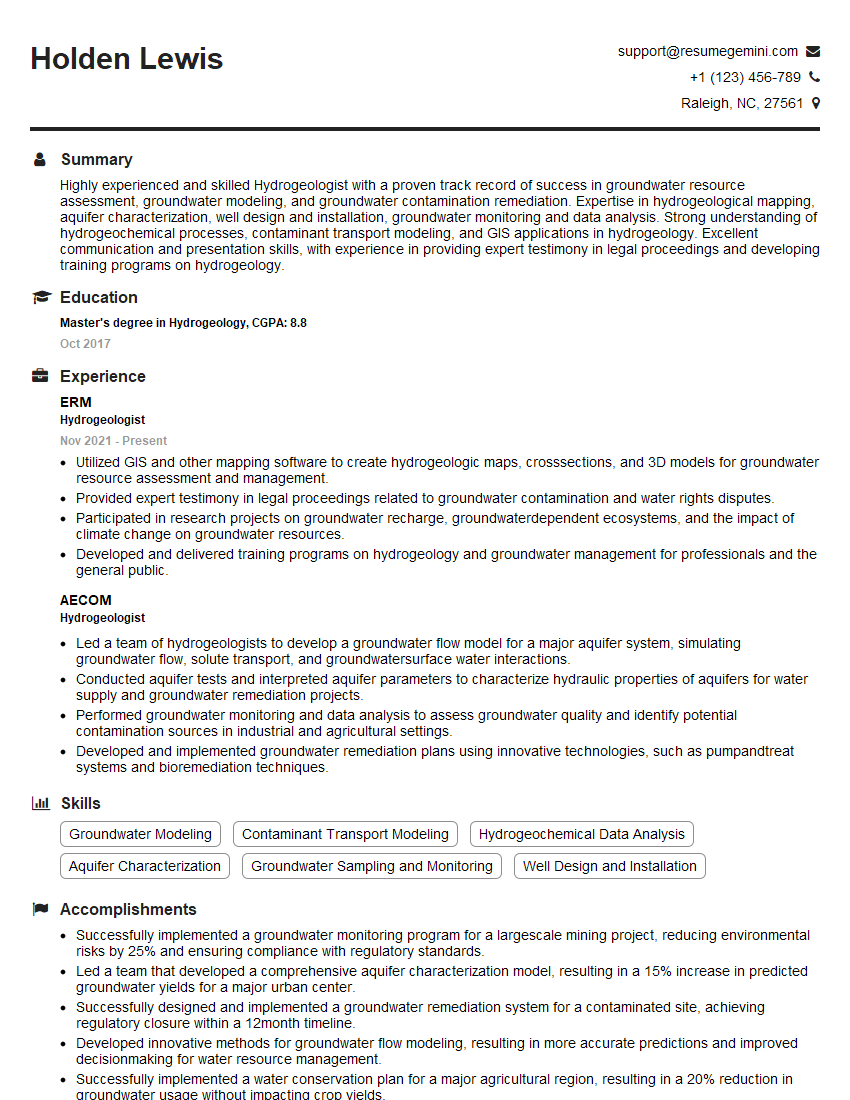
Hydrogeologist Resume Sample
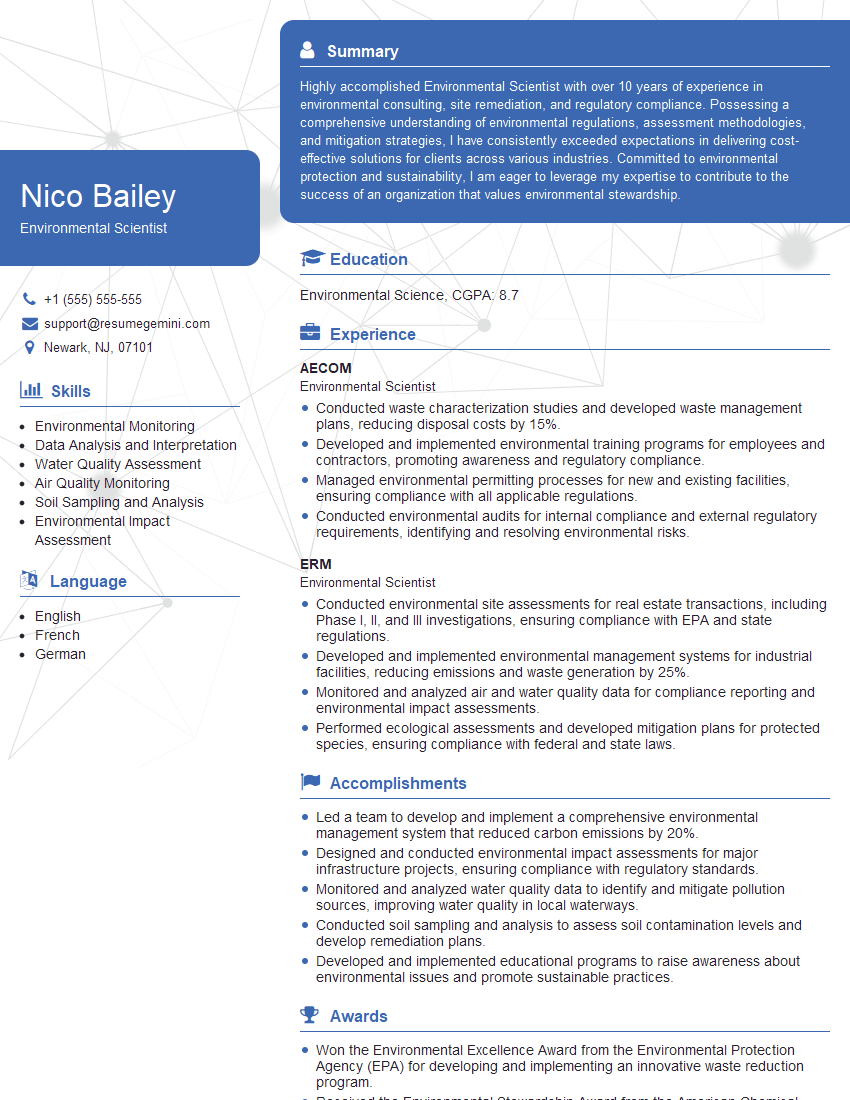
Environmental Scientist Resume Sample

Sustainability Consultant Resume Sample

Data Analyst Resume Sample

Research Scientist Resume Sample
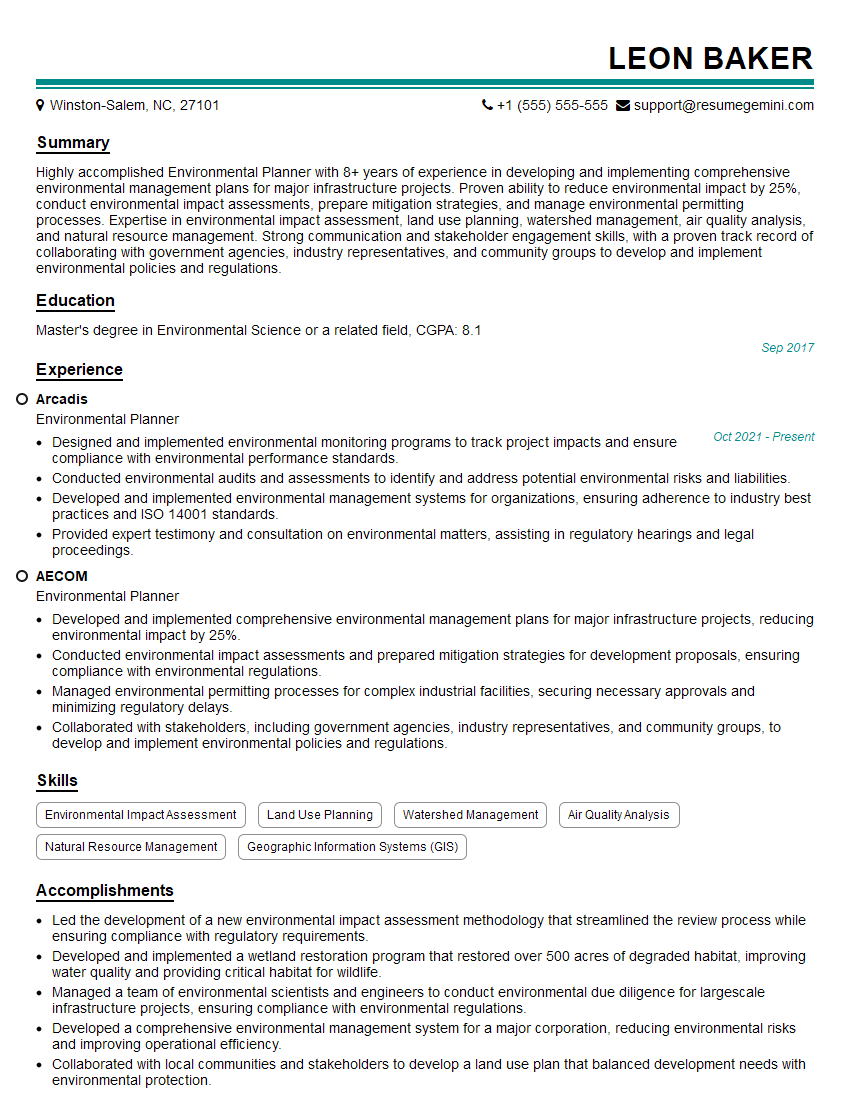
Environmental Planner Resume Sample

Civil Engineer Resume Sample

Hydraulic Engineer Resume Sample

Environmental Consultant Resume Sample
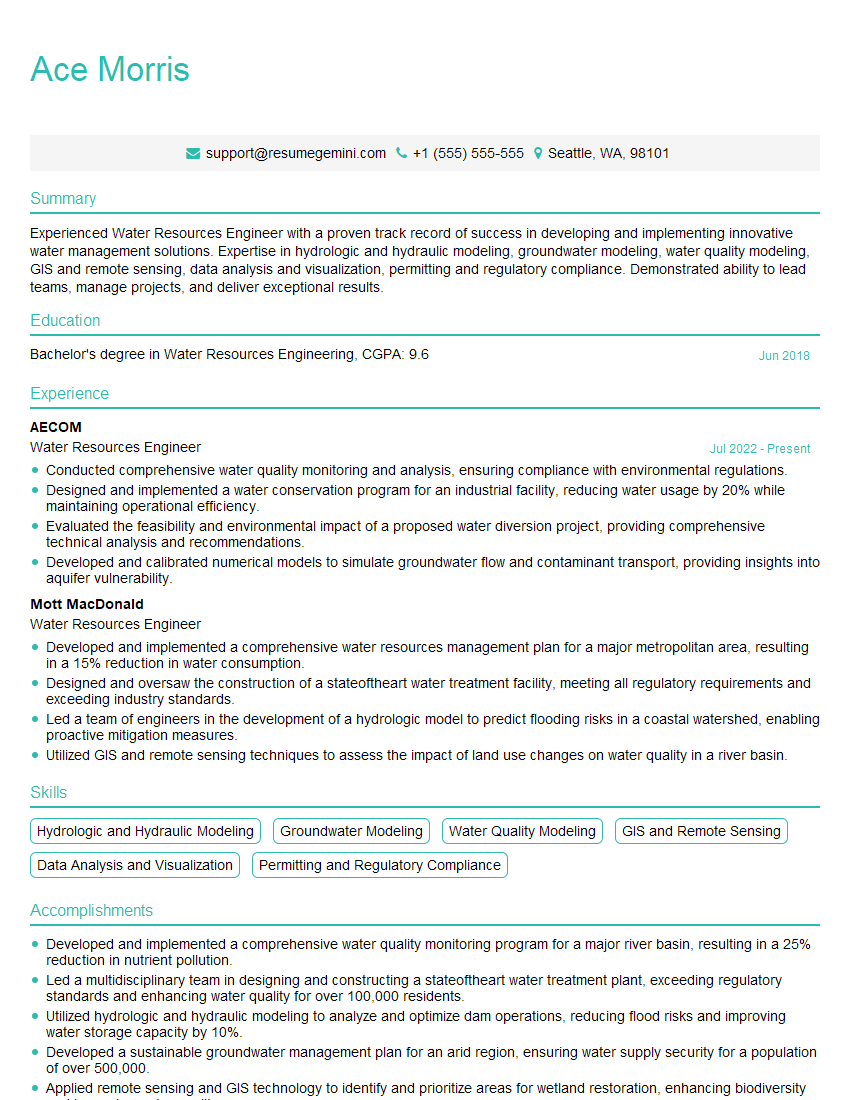
Water Resources Engineer Resume Sample
Hydrologist Resume Sample

Remote Sensing Specialist Resume Sample
Water Quality Analyst Resume Sample
Explore more articles
Users Rating of Our Blogs
Share Your Experience
We value your feedback! Please rate our content and share your thoughts (optional).
What Readers Say About Our Blog
To the interviewgemini.com Webmaster.
Very helpful and content specific questions to help prepare me for my interview!
Thank you
To the interviewgemini.com Webmaster.
This was kind of a unique content I found around the specialized skills. Very helpful questions and good detailed answers.
Very Helpful blog, thank you Interviewgemini team.