Every successful interview starts with knowing what to expect. In this blog, we’ll take you through the top Zoning Compliance Inspection interview questions, breaking them down with expert tips to help you deliver impactful answers. Step into your next interview fully prepared and ready to succeed.
Questions Asked in Zoning Compliance Inspection Interview
Q 1. Describe your experience interpreting zoning ordinances and regulations.
Interpreting zoning ordinances requires a deep understanding of legal language and the ability to apply regulations to specific properties. My experience spans over ten years, involving countless reviews of complex zoning codes, amendments, and related documents. I’m proficient in identifying permitted uses, height restrictions, setbacks, density regulations, parking requirements, and sign regulations. For example, I recently interpreted a particularly nuanced section of our city’s code regarding accessory dwelling units (ADUs), successfully clarifying the allowable square footage and setbacks for a homeowner seeking to build one. This involved not just reading the code but understanding its intended purpose and how it interacted with other sections regarding lot coverage and overall building size.
I approach each interpretation systematically, first identifying the relevant sections of the ordinance, then carefully analyzing their wording, and finally cross-referencing with other regulations and case law to ensure accurate and consistent application. This methodical approach minimizes errors and ensures fairness in enforcement.
Q 2. How do you identify zoning violations during a site inspection?
Identifying zoning violations during a site inspection is a multi-step process combining observation, measurement, and documentation. I begin by thoroughly reviewing the property’s zoning designation on the official zoning map. Then, I systematically compare what I observe on-site with the permitted uses, building height, setbacks, and other relevant regulations. My tools include measuring tapes, cameras, and a detailed checklist.
- Visual Inspection: I look for any obvious deviations, such as unpermitted additions, structures exceeding height limits, or encroachments into required setbacks.
- Measurements: I carefully measure building dimensions, setbacks, and the height of structures to verify compliance.
- Documentation: All observations and measurements are meticulously documented with photographs and detailed notes. This documentation is crucial for building a strong case if a violation is identified.
For example, I recently discovered a violation where a homeowner had extended their deck beyond the permitted setback line. The photographs and detailed measurements I took provided irrefutable evidence of the violation.
Q 3. Explain the process of issuing a zoning violation notice.
The process of issuing a zoning violation notice is formal and follows established procedures. It begins with a thorough investigation, which includes confirming the violation through on-site inspection and reviewing relevant documents like building permits and site plans.
- Notice Preparation: A detailed written notice is prepared, specifying the exact nature of the violation, citing the relevant sections of the zoning ordinance, and explaining the required corrective action. It also includes the deadline for compliance and the potential consequences of non-compliance, such as fines or legal action.
- Notice Delivery: The notice is officially served to the property owner, typically by hand delivery or certified mail. Confirmation of delivery is essential.
- Documentation: The entire process, from the initial inspection to the notice delivery, is carefully documented. This documentation forms a crucial part of the enforcement record.
It’s important to be clear, concise, and factual in the notice. The goal isn’t to be adversarial, but to provide a clear understanding of the situation and what steps are needed for compliance. I always make myself available to answer questions and provide guidance to the property owner.
Q 4. What are the common types of zoning violations you’ve encountered?
Over the years, I’ve encountered a wide variety of zoning violations. Some of the most common include:
- Unpermitted construction or additions: Building structures or making additions without obtaining the necessary permits.
- Setback violations: Structures built too close to property lines.
- Height restrictions violations: Buildings exceeding the maximum allowable height.
- Parking violations: Insufficient parking spaces compared to zoning requirements.
- Sign violations: Signs that exceed size limitations or are not placed in permitted locations.
- Use violations: Using a property for a purpose not allowed under its zoning designation (e.g., operating a business in a residential zone).
The frequency of each violation type varies depending on the specific zoning regulations and the characteristics of the community. For example, in denser urban areas, parking violations are often more common, while in suburban areas, setbacks and unpermitted construction tend to be more prevalent.
Q 5. How do you handle appeals or challenges to zoning violation citations?
Handling appeals or challenges to zoning violation citations requires a thorough understanding of the appeals process as defined in the municipal or county ordinances. This usually involves a formal hearing before a zoning board of appeals or a similar body.
My role in this process is to present the evidence gathered during the inspection, including photographs, measurements, and supporting documentation. I must be prepared to clearly and concisely articulate my findings and answer questions from the board and the property owner.
The appeal process typically involves reviewing the evidence, hearing testimony from both sides, and making a determination. I respect the decision of the appeals board, even if it differs from my initial assessment. Fairness, transparency, and adherence to established procedures are key in this phase.
Q 6. Describe your experience working with property owners and developers.
My experience working with property owners and developers has been predominantly positive. Effective communication is key to a successful collaboration. I strive to build trust by providing clear and accurate information, explaining the zoning regulations in a straightforward manner, and being responsive to their inquiries.
In many cases, I act as a consultant, helping developers understand the zoning requirements early in the project planning phase, preventing violations before they occur. This proactive approach saves both time and money.
On the other hand, when dealing with violations, I maintain a professional and respectful demeanor. My goal is to ensure compliance, not to punish property owners. I often find that a collaborative approach, focusing on finding solutions rather than simply citing violations, leads to better outcomes for everyone involved. For example, I worked with a developer who faced setbacks violations. Instead of immediately issuing a citation, we collaboratively revised the site plan to ensure compliance, resulting in a successful project completion.
Q 7. How familiar are you with zoning maps and their interpretation?
I am extremely familiar with zoning maps and their interpretation. These maps are the foundational documents for understanding zoning regulations at the parcel level. My experience involves using these maps regularly to determine the zoning district of a property, identify permitted uses, and understand other regulations like density, height restrictions, and setbacks that apply to a specific location.
I understand the different symbols, colors, and legends used on zoning maps, and I can interpret them accurately. I can also cross-reference the map information with the written zoning ordinance to ensure complete and accurate understanding. The interpretation of a zoning map is not just about identifying a zoning district but also about understanding the interplay of different regulations and how they apply together. For instance, a property might be in a residential zone, but further analysis of the zoning map might reveal specific overlays that affect building height or density.
Q 8. How do you determine the appropriate zoning classification for a property?
Determining the appropriate zoning classification for a property involves a systematic process. First, I’d identify the property’s location using its address or legal description. Then, I would consult the municipality’s official zoning map. These maps are typically color-coded and show the designated zoning districts for each parcel of land. Each district has a specific zoning code associated with it, outlining permitted land uses, building heights, setbacks, density, and other regulations. For example, a residential zone might allow single-family homes but prohibit commercial activities, while a commercial zone might have restrictions on building height and parking requirements. In some cases, overlay districts might exist, adding further layers of regulation (e.g., a flood plain overlay or a historic preservation overlay). Finally, I would cross-reference the map with the zoning ordinance itself to ensure complete understanding of the allowed uses and restrictions. It’s crucial to account for any amendments or updates to the ordinance to ensure accuracy.
Q 9. What is your experience with variance requests and special use permits?
I have extensive experience handling variance requests and special use permits. A variance is an exception granted to a property owner when strict adherence to zoning regulations would create undue hardship. For example, a property owner might request a variance to reduce the required setback because of a unique topographical feature of their land. The process typically involves submitting a detailed application, demonstrating the hardship and that the variance wouldn’t negatively impact the neighborhood. A public hearing often follows where the applicant and neighbors can present their views. The decision rests with the zoning board of appeals. A special use permit, on the other hand, allows a use that is permitted in a zone but requires additional review and approval because of potential impacts. For instance, a daycare center might need a special use permit in a residential zone to ensure compliance with specific safety and operational requirements. The process for a special use permit also usually involves an application, review by relevant departments, and potentially a public hearing.
Q 10. Explain the process of conducting a site inspection and documenting findings.
Conducting a site inspection involves a meticulous approach. First, I review the permit application and any supporting documentation to understand the proposed project or existing conditions. Then, I visit the site to visually assess the property against zoning regulations. I’d use measuring tools like a tape measure to check setbacks, building heights, and lot coverage. I take photographs and videos as evidence. My documentation would include detailed notes detailing observations – for example, noting if a building is exceeding the allowable height or if landscaping is encroaching on required setbacks. I’d also record the date, time, and location of the inspection, along with the names of any individuals present. Crucially, I document any discrepancies between the permitted plans and the actual conditions on the ground. Finally, all this is compiled into a comprehensive report including supporting photographs and videos. This report is factual, clear, and avoids subjective interpretation, ensuring its accuracy for any future reference.
Q 11. How do you ensure accurate and complete documentation of your inspections?
Accurate and complete documentation is paramount. I use a digital system for all my inspection records. This usually combines a field-based data capture app on a tablet or smartphone, and a cloud-based storage and management system for long-term archival. This ensures that all my notes, photos, and videos are instantly accessible and safely backed up. I also utilize a standardized reporting template to maintain consistency. The template includes sections for the property’s location, date, time, permit number, observations, measurements, and photographs. All photos are clearly labeled with descriptions. This standardized approach minimizes errors and guarantees consistency in my documentation across inspections. A system of internal review ensures consistency and accuracy before reports are finalized.
Q 12. How do you prioritize competing demands and multiple inspection requests?
Prioritizing competing demands and multiple inspection requests requires a well-defined system. I usually prioritize inspections based on several factors, including deadlines (e.g., upcoming permit expirations), public safety concerns (e.g., potential hazards), and the complexity of the projects. A scheduling system, often integrated with the digital record keeping system, helps me manage appointments efficiently. This system might use features like calendar integration, automated reminders, and priority flags. Furthermore, I maintain open communication with applicants, keeping them informed of any delays and estimated timelines. Transparency and proactive communication are vital in managing expectations. In cases of urgent or critical matters, I often re-prioritize my schedule accordingly to address the most time-sensitive issues first.
Q 13. Describe a situation where you had to resolve a complex zoning issue.
I once encountered a situation where a property owner was attempting to convert a residential building into a commercial space without the necessary permits or zoning compliance. The building was located in a mixed-use zone but the proposed commercial use was far beyond what was allowed under the zoning regulations. The case involved several issues, including insufficient parking, inadequate fire safety measures, and potential impacts on neighboring properties. I worked closely with the planning department, fire marshal, and the property owner to explore possible solutions. This involved reviewing the zoning code, assessing the site’s conditions, and discussing alternative plans. Ultimately, we worked with the owner to revise the plans to ensure compliance, which included a smaller scale of commercial use and addressing all the previously mentioned concerns. This collaborative approach facilitated a successful resolution, ensuring compliance while minimizing disruption to the property owner.
Q 14. How do you stay up-to-date on changes in zoning laws and regulations?
Staying current on zoning laws and regulations requires continuous effort. I regularly subscribe to newsletters and updates from relevant government agencies. I actively participate in professional development courses and workshops offered by organizations related to planning and zoning. This often involves attending conferences and webinars focused on emerging trends and regulatory changes. I also closely monitor local government websites and public announcements for any changes in zoning ordinances. Furthermore, I maintain a professional network with other zoning inspectors and planning professionals to exchange information and insights, ensuring I am aware of recent updates. This multifaceted approach ensures that my knowledge remains up-to-date and my inspections are in accordance with current regulations.
Q 15. What software or technology do you use to manage inspections and data?
Managing zoning inspections and the associated data efficiently requires robust software and technology. We primarily utilize a Geographic Information System (GIS) platform integrated with a customized database. This system allows for the geospatial visualization of properties, streamlining the inspection process and data analysis. The GIS maps directly link to inspection reports, photographs, and permit information, giving a complete picture of a property’s compliance status. Furthermore, we utilize mobile data collection apps that allow inspectors to input data directly in the field, eliminating the need for manual data entry and reducing errors. These apps often feature GPS tracking, automated report generation, and the ability to upload photos and videos as evidence. For example, we might use an app that allows me to mark a violation directly on a map, attach a photo showing the infraction, and instantly generate a preliminary report. This immediate feedback loop improves efficiency and transparency.
Beyond GIS and mobile apps, we use project management software to schedule inspections, track progress, and assign tasks. This central hub ensures we maintain organization and meet deadlines. The data is securely stored and accessible to authorized personnel only, maintaining privacy and compliance with data protection regulations.
Career Expert Tips:
- Ace those interviews! Prepare effectively by reviewing the Top 50 Most Common Interview Questions on ResumeGemini.
- Navigate your job search with confidence! Explore a wide range of Career Tips on ResumeGemini. Learn about common challenges and recommendations to overcome them.
- Craft the perfect resume! Master the Art of Resume Writing with ResumeGemini’s guide. Showcase your unique qualifications and achievements effectively.
- Don’t miss out on holiday savings! Build your dream resume with ResumeGemini’s ATS optimized templates.
Q 16. How do you handle situations where you encounter resistance from property owners?
Handling resistance from property owners requires a measured and professional approach. My primary strategy is building rapport and clearly explaining the zoning regulations and the reason for the inspection. I begin by introducing myself and explaining the purpose of the visit, focusing on education rather than confrontation. I always present myself in a courteous manner, showing respect for the property owner and their time. Often, misinterpretations of the zoning code are the root cause of resistance. If this is the case, I take the time to explain the relevant sections clearly and answer their questions patiently.
However, if the resistance persists, I escalate the situation according to established procedures. This may involve offering a written notice of violation, followed by a formal warning. In some cases, it might necessitate pursuing legal action if compliance is not achieved. It is crucial to maintain a clear record of all interactions, including communication attempts, inspection findings, and any legal steps taken. This documentation serves as essential evidence for subsequent actions. Ultimately, the goal is to achieve compliance while upholding the principles of fairness and due process.
Q 17. Describe your understanding of the legal aspects of zoning enforcement.
A deep understanding of the legal aspects of zoning enforcement is crucial for my role. This includes familiarity with local, state, and sometimes federal laws and regulations governing land use and development. I need to understand the legal basis for issuing citations, imposing fines, and initiating legal proceedings against non-compliant properties. This knowledge extends to understanding property rights, due process, and the rights of appeal. For instance, I need to ensure that all notices and citations are legally sound and correctly issued to avoid legal challenges. I also need to be aware of legal precedents and court cases that influence zoning enforcement practices. I regularly review updates to zoning ordinances and related legislation to remain current on changes that might impact my work.
Knowing the legal thresholds for different violations, such as setback requirements or permitted uses, is critical. This knowledge prevents errors and ensures that all enforcement actions are legally sound and defensible. Working within these legal frameworks is key to maintaining the integrity of the zoning enforcement process and avoiding unnecessary disputes.
Q 18. How do you ensure compliance with accessibility requirements during inspections?
Ensuring compliance with accessibility requirements during inspections is a vital part of my job. This involves checking for adherence to the Americans with Disabilities Act (ADA) standards and any other relevant local accessibility codes. I focus on elements such as ramps, curb cuts, accessible entrances, signage, restroom facilities, and parking spaces. During an inspection, I will carefully examine the features listed above, using a checklist to ensure thoroughness. If a feature is non-compliant, I document the issue with a detailed description, photographs, and measurements, if necessary.
My approach is to identify barriers to accessibility and work with property owners to ensure compliance. This may include educating property owners about the requirements and providing resources to assist them in making the necessary modifications. Sometimes, minor adjustments can readily rectify the issue, while other cases may necessitate more significant renovations. Documentation of all findings and communication with the property owner are critical. A detailed report is necessary, often including photos, to support any subsequent actions.
Q 19. What is your experience with environmental regulations related to zoning?
My experience with environmental regulations related to zoning is extensive. Many zoning ordinances incorporate environmental considerations, such as stormwater management, waste disposal, and habitat protection. I’m familiar with regulations related to wetlands, endangered species, and pollution control. These regulations often influence site development plans and construction practices. For example, I might need to review a development plan to ensure that it incorporates adequate measures to prevent stormwater runoff from polluting nearby water bodies. I also need to be aware of any environmental permits or approvals required before construction begins.
In my inspections, I focus on identifying environmental violations, such as improper disposal of construction debris or the illegal clearing of protected wetlands. I work closely with other regulatory agencies, such as environmental protection departments, to ensure compliance with relevant environmental laws and regulations. This collaboration and cross-referencing of regulations ensures a holistic view of a property’s compliance status.
Q 20. Explain your understanding of building codes and their relationship to zoning.
Building codes and zoning ordinances are distinct but interconnected. Building codes dictate the minimum standards for construction and safety, covering aspects such as structural integrity, fire safety, and electrical systems. Zoning ordinances, on the other hand, regulate land use, determining what types of buildings can be constructed in specific areas and how they can be used. The relationship lies in the fact that a building must adhere to both sets of regulations to receive approval and be legally constructed. Imagine a developer wanting to build an apartment building in a designated residential zone. The zoning ordinance determines if this type of building is permitted in that zone. Once permitted, building codes specify the structural requirements, fire safety measures, and other technical details that must be met during construction.
During my inspections, I assess compliance with both zoning and building codes. For example, I might check whether the building’s size, height, and setbacks comply with zoning regulations, and simultaneously check whether the electrical wiring, plumbing, and structural components meet the minimum standards of the building codes. Understanding this interplay is crucial to my role, ensuring that structures are not only in the right place but also constructed safely and to the required standards.
Q 21. How familiar are you with surveying techniques and their application in zoning compliance?
Familiarity with surveying techniques and their application in zoning compliance is essential for accurate enforcement. Surveying helps establish property boundaries, ensuring structures are built within the legally defined limits. I regularly review survey plats to verify that buildings are appropriately set back from property lines, streets, and other features. This helps determine whether there are any zoning violations related to lot coverage, building setbacks, or encroachment on easements. I’m able to interpret survey data to confirm the location of structures and identify potential discrepancies between as-built conditions and approved plans.
For instance, I might use survey information to identify if an addition to a house extends beyond the permitted setback line or encroaches on a neighboring property. Incorrectly positioned structures can lead to zoning violations, and surveying techniques provide the precise measurements needed to determine compliance. This understanding is crucial for resolving boundary disputes and determining whether zoning regulations have been met. It is essential to ensure all measurements and interpretations of survey data align with regulations and professional standards.
Q 22. Describe your experience with using GIS (Geographic Information Systems) for zoning.
GIS, or Geographic Information Systems, is an invaluable tool in zoning compliance. My experience involves extensively using GIS software like ArcGIS to visualize zoning maps, overlay property boundaries, and analyze land use data. This allows for efficient identification of potential zoning violations. For example, I used GIS to pinpoint properties with unpermitted structures by comparing aerial imagery with the approved building plans stored within the GIS database. This allowed me to prioritize inspections and ensure efficient use of resources. Another instance involved using GIS to identify properties potentially impacted by proposed zoning changes, allowing for proactive communication with landowners and businesses.
Specifically, I’m proficient in using GIS to:
- Query parcel data for zoning classification, setbacks, and permitted uses.
- Analyze spatial relationships between properties and zoning boundaries.
- Create maps and reports for visual representation of zoning compliance findings.
- Integrate data from various sources, such as aerial photography, tax assessor records, and utility maps.
Q 23. What is your experience with preparing reports and presenting findings?
Report writing and presentation of findings are crucial aspects of my role. I’ve developed a structured approach to reporting, ensuring clarity and conciseness. My reports include clear statements of the inspection objectives, detailed observations, photographic evidence, and a concise summary of findings and recommendations. I use visual aids like maps and diagrams to enhance understanding. I’m comfortable presenting these findings to diverse audiences, from individual property owners to planning commissions. For example, I presented findings on a major commercial development project to the city council, clearly outlining any discrepancies from the approved plans and recommending corrective actions. The presentation included clear visuals and easily digestible data to ensure the council understood the issues and the required resolutions.
Q 24. Describe your experience in working collaboratively with other inspectors and departments.
Collaboration is essential in zoning compliance. I have a strong track record of working effectively with other inspectors, code enforcement officers, and various city departments (e.g., Public Works, Engineering). A recent project involved coordinating with the Public Works department to verify the legality of a new drainage system built adjacent to a property that was under inspection for zoning compliance. Open communication and shared data through a collaborative GIS platform ensured we could collectively assess the project’s alignment with zoning codes. We jointly provided a comprehensive report on the overall compliance, fostering efficient problem-solving and timely completion of the inspection process.
Q 25. How do you handle stressful situations and meet deadlines under pressure?
The nature of zoning inspections often involves tight deadlines and unexpected challenges. My approach to managing stress and meeting deadlines is multifaceted. I prioritize tasks, utilizing project management techniques to break down complex inspections into manageable components. I’m proficient in time management, consistently meeting deadlines while maintaining attention to detail. For example, I once had to inspect multiple properties for potential violations within a single week due to a sudden influx of complaints, all while handling other regularly scheduled inspections. By prioritizing the most urgent cases and utilizing my team for assistance where possible, I successfully completed all inspections within the required timeframe and met the demanding deadline without compromising the quality of my work.
Q 26. How do you maintain objectivity and impartiality when conducting inspections?
Maintaining objectivity and impartiality is paramount. I adhere strictly to the zoning code and applicable regulations, basing my assessments solely on factual evidence and documented regulations. I meticulously document all observations and findings, with photographs and detailed notes to support my conclusions. If there is any ambiguity, I consult relevant codes and seek clarification from supervisors or legal counsel before making any determinations. I treat all property owners fairly and respectfully, regardless of their circumstances, explaining my findings clearly and professionally. If a situation is particularly challenging, I take a step back, gather all the information I need, and approach the problem with a logical and unbiased mindset.
Q 27. Describe your experience with public speaking and communicating technical information.
I’m experienced in both formal and informal communication of technical information. I regularly present inspection findings to property owners, explaining complex zoning regulations in clear, non-technical language. I adapt my communication style to the audience, using visual aids and examples when necessary to enhance understanding. I’ve also presented technical data at planning commission meetings, clearly outlining the impact of zoning violations and presenting recommendations to remedy these issues. For instance, I recently explained to a community group the benefits of updated zoning regulations designed to improve traffic flow, using maps and charts to illustrate my points and answering questions effectively.
Q 28. What are your salary expectations?
My salary expectations are commensurate with my experience and skills, and align with the industry standard for a Zoning Compliance Inspector with my level of expertise. I am open to discussing a competitive compensation package that reflects my value and contributions to the organization.
Key Topics to Learn for Zoning Compliance Inspection Interview
- Zoning Ordinances and Codes: Understanding the legal framework governing land use and development. This includes interpreting complex regulations and identifying discrepancies.
- Building Codes and Regulations: Knowledge of how building codes relate to zoning requirements and ensuring structures meet both sets of standards. Practical application: Identifying violations related to building height, setbacks, and allowable uses.
- Site Plan Review and Interpretation: Analyzing site plans to ensure proposed developments comply with zoning regulations. This includes understanding surveying principles and interpreting technical drawings.
- Inspection Techniques and Procedures: Mastering the methods for conducting thorough and accurate inspections, including documentation and reporting protocols. Practical application: Utilizing measuring tools and documenting findings with photos and detailed reports.
- Variance and Appeal Processes: Understanding the procedures for requesting variances and handling appeals related to zoning decisions. This includes knowledge of administrative processes and potential legal challenges.
- Communication and Interpersonal Skills: Effectively communicating findings to developers, property owners, and other stakeholders. This involves clear and concise reporting, active listening, and conflict resolution.
- Problem-Solving and Critical Thinking: Analyzing complex situations, identifying potential violations, and proposing solutions that adhere to regulations while considering practical implications.
- Environmental Regulations and Considerations: Understanding how environmental regulations intersect with zoning compliance, such as wetland protection or stormwater management.
- Technology and Data Management: Familiarity with relevant software and databases used for inspection management, data analysis, and reporting.
Next Steps
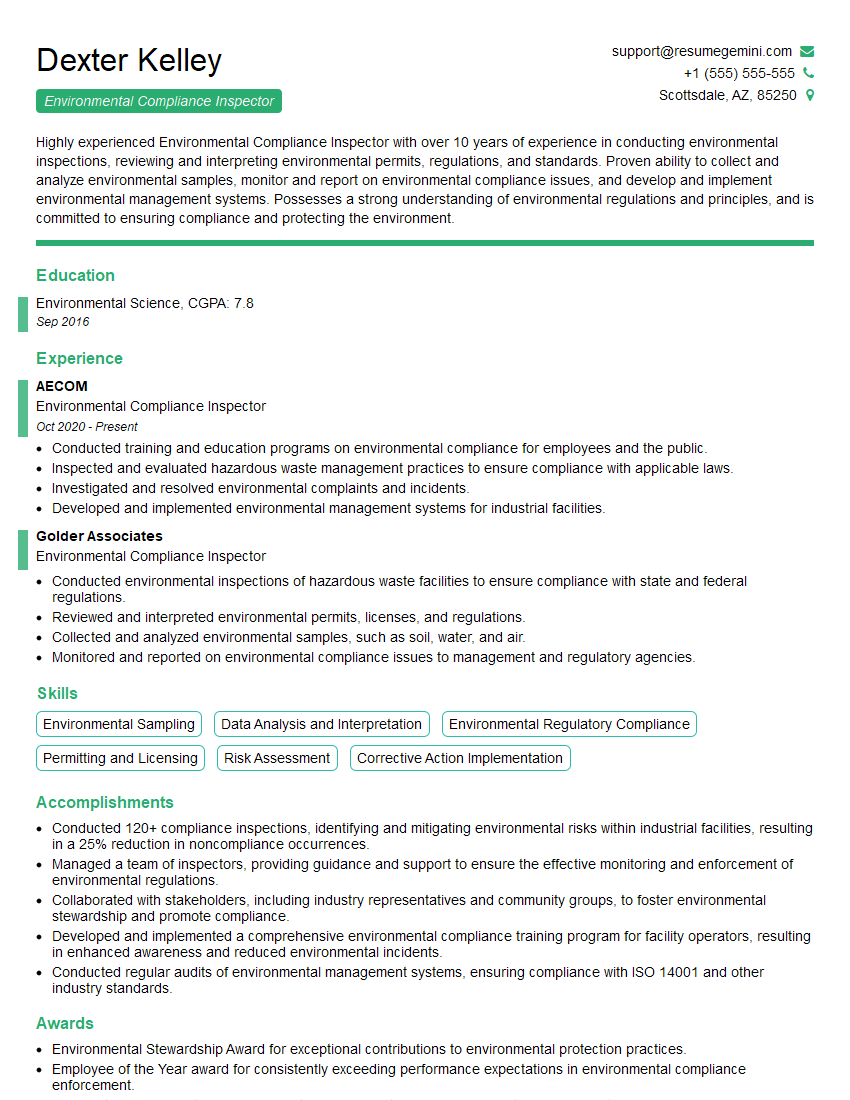
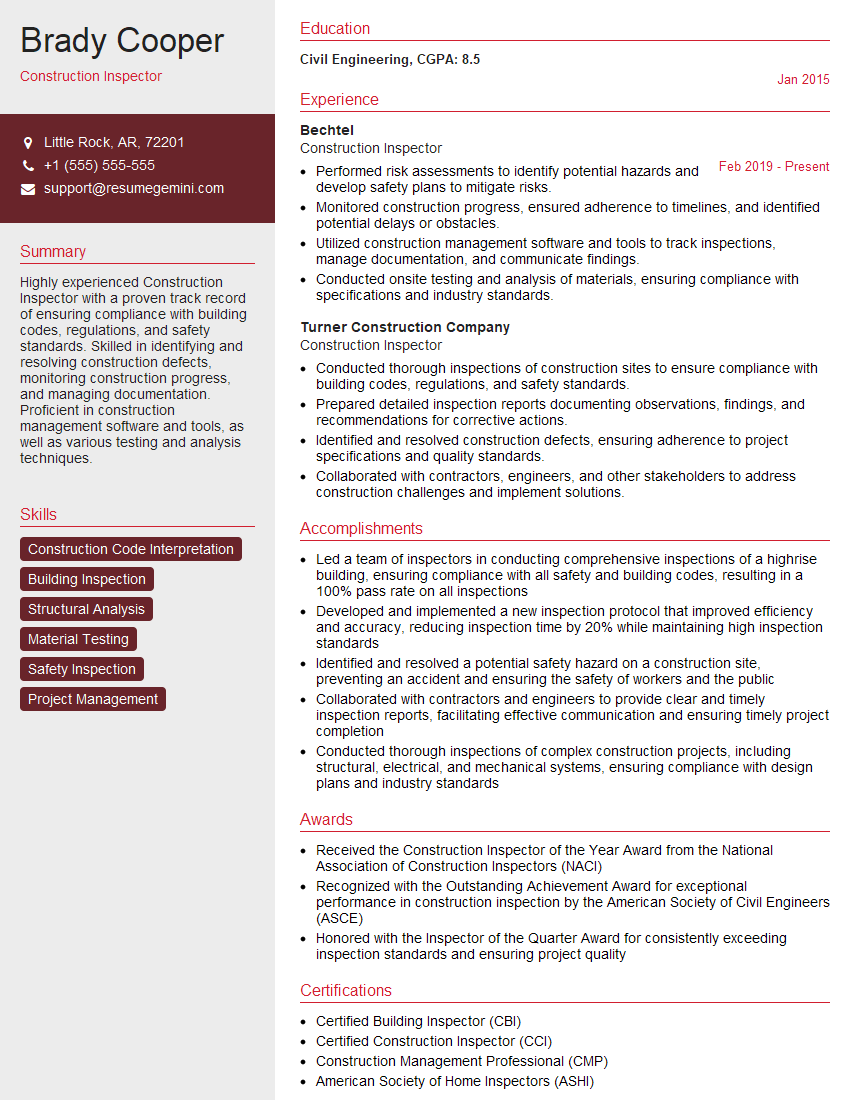
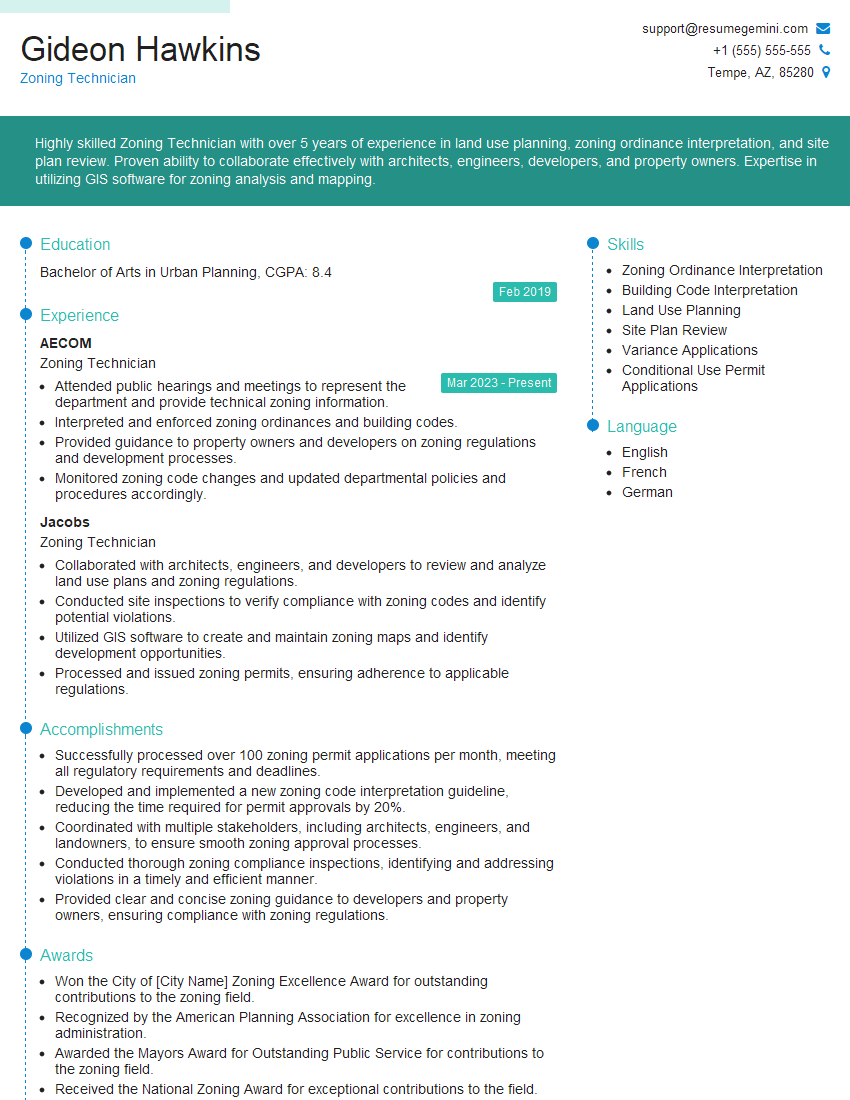
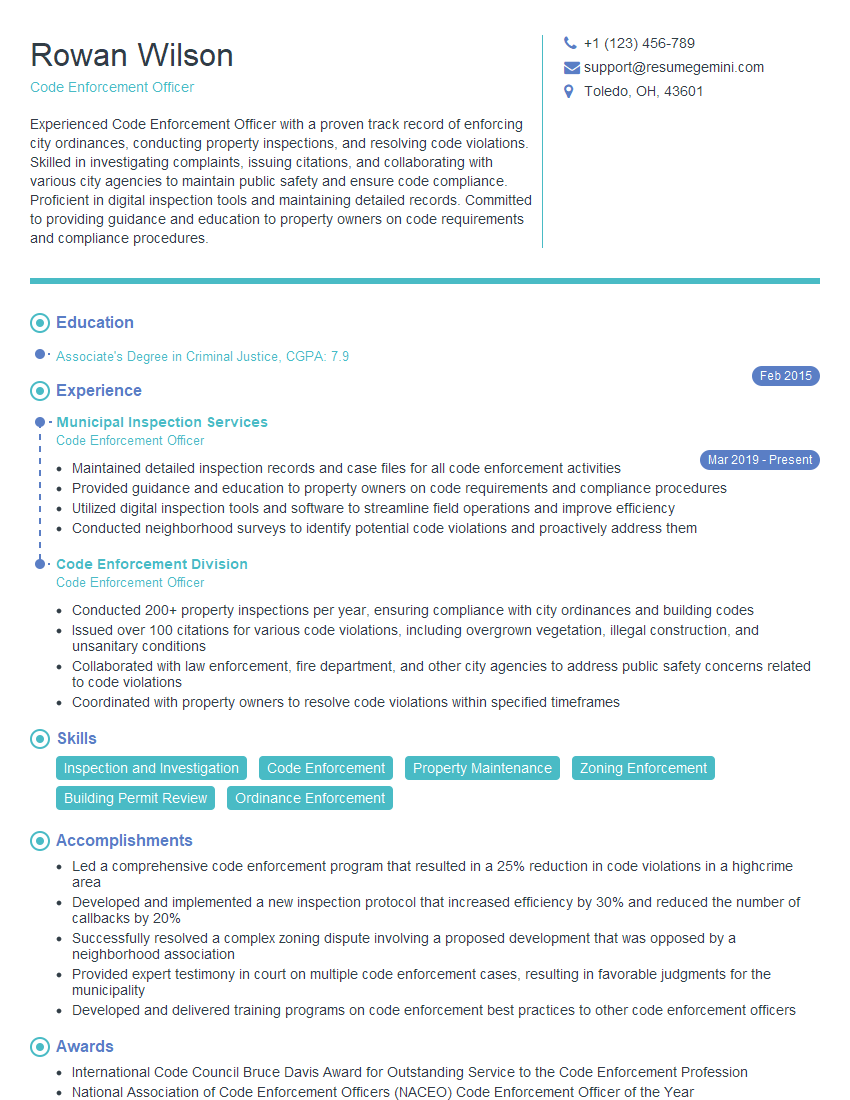
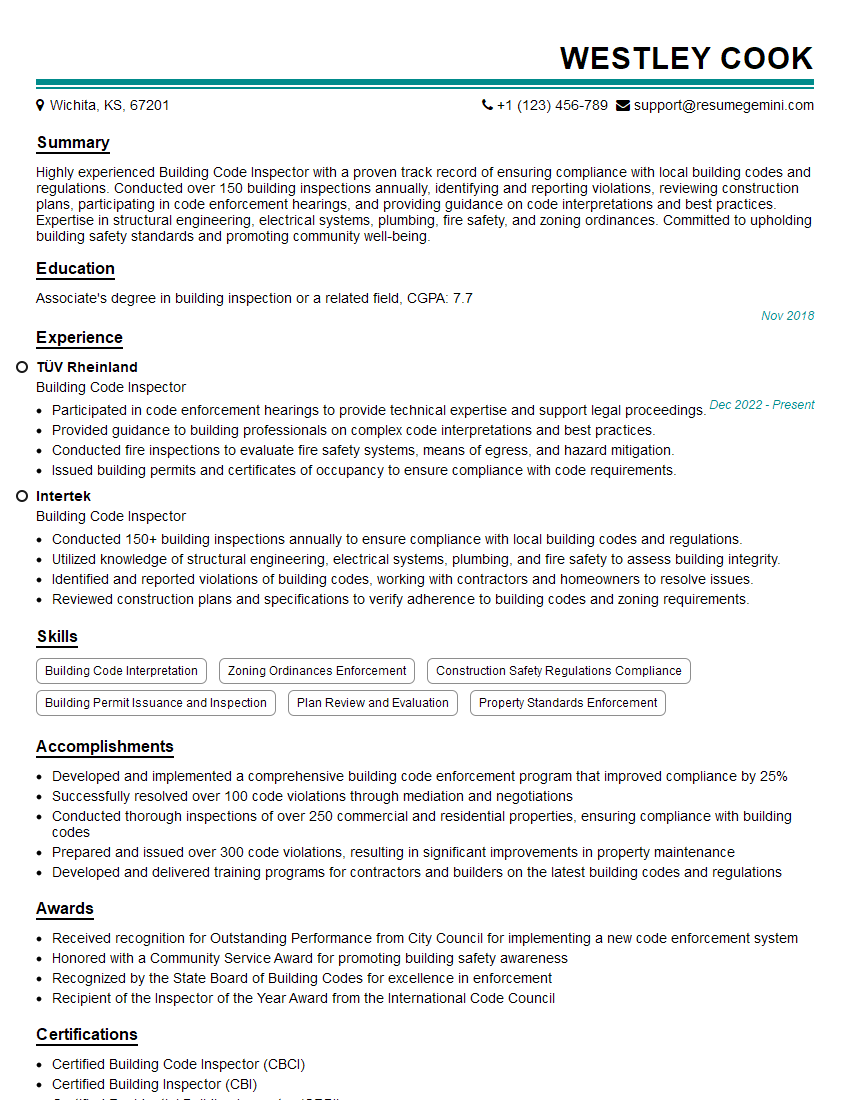
Mastering Zoning Compliance Inspection opens doors to a rewarding career with excellent growth potential. A strong understanding of these principles will significantly enhance your interview performance and future success in this field. To maximize your job prospects, create an ATS-friendly resume that highlights your relevant skills and experience. ResumeGemini is a trusted resource for building professional, impactful resumes that get noticed. We provide examples of resumes tailored specifically to Zoning Compliance Inspection roles to help you get started.

Explore more articles
Users Rating of Our Blogs
Share Your Experience
We value your feedback! Please rate our content and share your thoughts (optional).
What Readers Say About Our Blog
To the interviewgemini.com Webmaster.
Very helpful and content specific questions to help prepare me for my interview!
Thank you
To the interviewgemini.com Webmaster.
This was kind of a unique content I found around the specialized skills. Very helpful questions and good detailed answers.
Very Helpful blog, thank you Interviewgemini team.