The thought of an interview can be nerve-wracking, but the right preparation can make all the difference. Explore this comprehensive guide to Zoning Law Enforcement interview questions and gain the confidence you need to showcase your abilities and secure the role.
Questions Asked in Zoning Law Enforcement Interview
Q 1. Define ‘non-conforming use’ in zoning regulations.
A non-conforming use is a land use or structure that was lawful under previous zoning regulations but no longer conforms to current zoning ordinances. Think of it like a grandfather clause. For example, a small grocery store operating in a now-residential zone might be a non-conforming use if it predates the zoning change. These uses are usually allowed to continue, but with restrictions. These restrictions often limit expansion, alterations, or rebuilding. The specific rules governing non-conforming uses vary significantly between jurisdictions but generally aim to phase them out gradually while protecting property rights.
Crucially, a non-conforming use is not a legal loophole to circumvent current zoning. If the non-conforming use is abandoned, it generally cannot be resumed or replaced with a similar non-conforming use.
Q 2. Explain the process of issuing a zoning violation notice.
Issuing a zoning violation notice involves a multi-step process. It starts with an observation or complaint about a potential violation – this could range from illegal construction to improper signage. Next, a zoning enforcement officer investigates. This involves site visits, reviewing building permits (if any), and comparing the observed use to the applicable zoning code. If a violation is confirmed, a written notice is issued. The notice clearly identifies the violation, cites the relevant section of the zoning ordinance, and specifies the necessary corrective action and a reasonable timeframe for compliance. This notice often includes information about appeal rights and potential penalties for non-compliance. Failure to comply can result in further action, such as fines or legal proceedings.
For example, I once issued a notice for a homeowner who had built an addition exceeding the allowed square footage in their residential zone. The notice detailed the violation, including photographic evidence, and outlined the required steps for bringing the property into compliance, including potential demolition of the excess portion.
Q 3. Describe your experience with zoning code interpretation and application.
My experience in zoning code interpretation and application spans over 10 years. I’ve worked extensively with diverse zoning ordinances, including those in urban, suburban, and rural areas. My expertise goes beyond simple code reading; it encompasses understanding the intent behind the regulations, interpreting ambiguous sections through established case law and legal precedents, and applying these interpretations to specific factual situations. This often involves collaboration with legal counsel, planning departments, and other stakeholders. For instance, I recently interpreted a complex section on accessory dwelling units (ADUs) to determine whether a homeowner’s proposal complied with density and parking requirements. My deep understanding allowed me to guide the homeowner through the necessary amendments to secure approval.
Q 4. How do you handle appeals of zoning decisions?
Appeals of zoning decisions are handled through established procedures, usually involving a formal hearing before a designated board (e.g., Zoning Board of Appeals or Board of Adjustment). My role involves meticulously documenting the initial decision, including all evidence, rationale, and applicable regulations. I then present this documentation at the hearing, clearly explaining the basis for the decision. I answer questions from the board and the appellant, offering a clear and unbiased account of the events. The appeal board reviews the case, considers all evidence, and makes a final determination. I respect their decision, even if it differs from my initial assessment, ensuring compliance with the final ruling. In essence, I act as a neutral arbiter, providing factual information to inform the decision-making process.
Q 5. What are the common types of zoning violations you’ve encountered?
I’ve encountered a wide range of zoning violations. Common ones include illegal structures (unpermitted additions, garages, or sheds), parking violations (exceeding permitted spaces, using non-designated areas), signage violations (size, placement, and lighting), land use violations (operating a business in a residential zone), and density violations (too many dwelling units on a lot). Less common but significant violations include environmental concerns related to land use and issues concerning accessibility for persons with disabilities. Each violation is handled individually, considering the specific circumstances and the severity of the infraction.
Q 6. Explain your understanding of variance procedures.
Variance procedures allow for deviations from strict zoning regulations under certain circumstances. These are typically granted when strict adherence would create undue hardship on the property owner while not being detrimental to the public interest. To obtain a variance, an applicant must demonstrate that the requested deviation is necessary due to unique characteristics of the property (e.g., unusual shape, topography, or existing structures) and that it would not negatively impact neighboring properties or the overall zoning plan. The process usually involves a formal application, review by zoning officials, a public hearing, and a decision by a zoning board or similar body. My role is to evaluate the application, conduct site inspections, and present a recommendation to the decision-making body based on the facts and the applicable zoning code. I would make sure to clearly document all facts of the case and potential legal considerations.
Q 7. How do you prioritize cases when managing a large workload?
Prioritizing cases with a large workload requires a systematic approach. I use a combination of factors, including the severity of the violation, the potential health and safety risks, the urgency of the situation, and the likelihood of successful enforcement. For example, I would prioritize cases involving unsafe structures or significant environmental hazards over minor code violations. I maintain a detailed case management system to track progress and ensure timely action. Regular review of this system allows me to re-prioritize based on changing circumstances. This involves flagging imminent deadlines, coordinating with other departments, and effectively delegating tasks when appropriate. Clear communication is essential to manage expectations and ensure a fair and efficient process.
Q 8. Describe your experience with zoning map interpretation.
Zoning map interpretation is fundamental to zoning law enforcement. It involves understanding the symbols, colors, and designations on a zoning map to determine the permitted uses, height restrictions, setbacks, and other regulations for a given property. Think of it like reading a highly detailed and legally binding blueprint for land use. My experience encompasses years of working with various zoning maps, from simple to complex, including those that incorporate overlays for things like historic districts or floodplains.
For instance, a common scenario involves a property owner seeking to build an addition. By examining the zoning map, I can determine the allowable height, the required setbacks from property lines, and whether the proposed use is permitted in that zone. I’m proficient in using different map scales and interpreting legend information, including deciphering abbreviations and specialized notations. I can also cross-reference the map with zoning ordinances to ensure complete accuracy.
In one instance, a property owner wanted to build a large workshop in a residential zone. While the map initially seemed to allow it, upon closer examination of the zoning text and related ordinances, I discovered a specific restriction on accessory buildings’ size in relation to the main dwelling. This prevented the proposed workshop from being built to the desired dimensions without a variance application.
Q 9. How do you ensure fair and equitable enforcement of zoning regulations?
Fair and equitable enforcement of zoning regulations hinges on consistency, transparency, and due process. This means applying the rules equally to all property owners, regardless of their background or influence. It also involves considering the specific circumstances of each case while remaining firmly grounded in the letter and intent of the zoning code.
We achieve fairness through a standardized procedure for handling complaints. Every complaint is investigated thoroughly, with the findings documented meticulously. We maintain open communication with property owners, explaining the regulations and providing opportunities for them to address concerns or seek necessary approvals. We always strive to resolve issues through education and cooperation before resorting to enforcement actions.
For example, if I receive multiple complaints about illegal parking in a residential zone, I’ll investigate and determine whether a pattern of non-compliance exists. If it does, I will enforce parking regulations fairly and consistently, rather than targeting a single offender. This ensures we’re addressing the root cause of the issue and promoting consistent compliance across the community.
Q 10. Explain your understanding of due process in zoning enforcement.
Due process in zoning enforcement is crucial to ensure fairness and prevent arbitrary actions. It’s the legal principle guaranteeing individuals a fair and impartial hearing before being subjected to any government action that affects their rights. In the context of zoning, this translates to providing property owners with clear notice of alleged violations, an opportunity to present their case, and a fair and impartial review of the evidence.
This often involves a series of steps. First, I’ll issue a written notice, clearly stating the alleged violation and referencing the specific zoning ordinance that’s been broken. Then, I provide the property owner with a reasonable timeframe to respond, potentially offering an opportunity for an informal meeting to discuss the issue. If a resolution can’t be reached informally, a formal hearing may be conducted, allowing the owner to present evidence and appeal the enforcement action.
Imagine a scenario where a property owner is cited for exceeding the allowable building height. Due process would require that they receive proper notification of the alleged violation, a chance to explain the discrepancy (perhaps due to a misinterpretation of the regulations or unforeseen circumstances), and ultimately, a fair adjudication of the case, potentially leading to an appeal process if unsatisfied with the initial decision.
Q 11. Describe your experience investigating zoning complaints.
Investigating zoning complaints is a systematic process. It typically begins with receiving a formal complaint, usually a written statement outlining the suspected violation and its location. Then, I conduct a thorough site investigation, which often involves taking photographs, measurements, and gathering any supporting documentation.
I utilize various methods, including on-site observations, reviewing building permits and plans, consulting with neighboring property owners to gather their perspective, and sometimes even using aerial photography or GIS technology to gain a broader context. The goal is to gather sufficient evidence to determine whether a violation actually occurred and to clearly document the findings.
For example, if a complaint alleges an illegal conversion of a residential property into a commercial space, my investigation might include checking the property’s records for any relevant permits, measuring the square footage of the spaces to compare with zoning regulations on permitted uses, and possibly interviewing neighboring businesses or residents about the use of the property.
Q 12. How do you document and maintain records related to zoning violations?
Maintaining accurate and organized records is paramount in zoning enforcement. This involves a multi-faceted approach employing both physical and digital methods. We use a combination of case files, digital databases, and GIS mapping systems.
Each case file includes the complaint, investigation notes, photographs, measurements, correspondence with property owners, violation notices, and any related legal documents. Digital databases help manage this information efficiently, allowing for keyword searches, quick retrieval, and data analysis to identify trends or problem areas. GIS technology plays a vital role in visualizing violations geographically and identifying patterns of non-compliance within specific zones.
For instance, we might use a database to track the number of parking violations in a specific neighborhood over time, which can help inform enforcement strategies and identify areas needing additional attention or changes in regulations. The digital record-keeping ensures transparency and accountability, while the GIS mapping provides spatial context, making the data far more actionable.
Q 13. How do you communicate effectively with property owners regarding zoning violations?
Effective communication is key to resolving zoning violations amicably. I prioritize clear, respectful, and professional communication with property owners at all stages of the process. My approach involves explaining the regulations in simple, understandable terms, answering questions thoroughly, and being empathetic while upholding the zoning code.
I usually begin with a letter explaining the alleged violation, referencing specific sections of the ordinance, and outlining the next steps. I’m always available to discuss the issue, either in person or by phone, allowing the property owner to present their perspective and seek clarification. If a violation is confirmed, I’ll outline the options for compliance, including possible remedies like securing necessary permits or modifying the property to meet the regulations.
For example, if I discover a homeowner has built a fence too close to the property line, I will start by explaining the specific setback requirements in the ordinance. I might work collaboratively with them to find a solution that achieves both compliance and preserves their property’s aesthetics as much as possible.
Q 14. Describe your experience with using GIS technology in zoning enforcement.
GIS (Geographic Information System) technology is invaluable for modern zoning enforcement. It provides a visual representation of zoning data, allowing us to map property boundaries, zoning districts, and violations geographically. This allows for a more efficient and effective approach to enforcement.
GIS helps in various ways. It simplifies the process of identifying violations by overlaying property data with zoning regulations. It allows for the identification of trends or clusters of violations in specific areas, enabling targeted enforcement. It also assists in creating visual reports to show patterns of non-compliance, which is useful for planning and presenting information to stakeholders, such as city council members or neighborhood associations.
For example, using GIS, I can quickly identify all properties within a floodway zone that have structures in violation of building codes, facilitating targeted inspections and enforcement. This visualization significantly streamlines the process compared to manually reviewing paper maps and property records, making enforcement more efficient and effective.
Q 15. Explain the difference between a variance and a conditional use permit.
Both variances and conditional use permits allow for exceptions to standard zoning regulations, but they address different situations. A variance is granted when strict adherence to the zoning code would impose an undue hardship on a property owner due to unique circumstances related to the property itself, not the applicant’s personal situation. Think of it as a small adjustment to allow for something that would otherwise be impossible due to the property’s unique characteristics. For example, a variance might be granted to reduce setback requirements for a house built on a narrow lot. A conditional use permit (CUP), on the other hand, allows a use that is otherwise prohibited by the zoning code, but which the municipality finds to be compatible with the surrounding area under specific conditions. The permit lays out strict stipulations and limitations ensuring the use doesn’t negatively impact the neighborhood. For example, a CUP might allow a daycare center in a residential zone provided it meets certain noise level, parking, and safety standards.
- Variance: Addresses unique property hardships; minor deviations from regulations.
- Conditional Use Permit: Allows otherwise prohibited uses, but with strict conditions for compatibility.
Career Expert Tips:
- Ace those interviews! Prepare effectively by reviewing the Top 50 Most Common Interview Questions on ResumeGemini.
- Navigate your job search with confidence! Explore a wide range of Career Tips on ResumeGemini. Learn about common challenges and recommendations to overcome them.
- Craft the perfect resume! Master the Art of Resume Writing with ResumeGemini’s guide. Showcase your unique qualifications and achievements effectively.
- Don’t miss out on holiday savings! Build your dream resume with ResumeGemini’s ATS optimized templates.
Q 16. How do you stay up-to-date on changes in zoning regulations?
Staying current on zoning regulations requires a multi-pronged approach. I regularly review official government websites for updated ordinances, amendments, and case law. I subscribe to relevant professional journals and newsletters, and I actively participate in local planning commission meetings and workshops. Networking with colleagues in similar roles is also critical – we share information on recent changes and interpretations. Furthermore, I maintain a comprehensive filing system for all zoning documents and attend relevant continuing education courses to maintain my professional certification.
Q 17. Describe your experience working with different stakeholders (e.g., developers, residents).
My experience working with stakeholders is extensive and varied. I’ve collaborated with developers on large-scale projects, guiding them through the zoning approval process, ensuring compliance and resolving conflicts efficiently. This often involved explaining complex regulations in clear terms, addressing their concerns, and finding mutually acceptable solutions. Working with residents is equally crucial. I’ve mediated disputes between neighbors and developers, addressing concerns about property values, traffic, and noise. I always strive for transparent communication, careful consideration of their viewpoints, and fair application of the zoning regulations.
For instance, I worked with a developer on a project that involved increased density in a quiet residential neighborhood. Residents were concerned about traffic congestion. By working closely with the developer and holding community meetings, we identified compromises, such as widening the road and creating a neighborhood park, resulting in a successful project and satisfied residents.
Q 18. How do you handle situations where there are conflicting interpretations of zoning ordinances?
Conflicting interpretations of zoning ordinances are a common challenge. My approach is systematic and focuses on careful review of the relevant ordinances, case law, and any applicable planning documents. I examine the specific language of the ordinance, its intent, and its context within the broader zoning scheme. When uncertainty remains, I’ll consult with legal counsel or senior colleagues with expertise in legal interpretation. In some cases, seeking a formal interpretation from the planning commission or a court may be necessary for clarity and consistency. The goal is always to reach a legally sound and consistent interpretation that is fair and transparent to all involved.
Q 19. Explain your approach to resolving zoning disputes.
My approach to resolving zoning disputes is rooted in mediation and collaboration. I start by thoroughly understanding each party’s perspective, carefully reviewing the relevant zoning regulations, and identifying the points of contention. I encourage open communication and actively facilitate a dialogue between the parties, striving to identify common ground and mutually acceptable solutions. Mediation often works best, providing a less adversarial way to reach resolution. However, if mediation fails, then formal enforcement processes, which might involve issuance of cease-and-desist orders or other legal actions, become necessary. My goal is always to achieve a fair and equitable outcome while maintaining adherence to the zoning code.
Q 20. Describe a situation where you had to make a difficult decision regarding zoning enforcement.
One particularly challenging case involved a small business owner who sought to expand their operations, requiring a variance due to unique site constraints. The proposed expansion, though technically within the zoning code’s allowances, would impact a significant tree that many residents valued. Denying the variance would have seriously harmed the small business and potentially hurt the local economy. Approving it would upset many residents. After extensive consultation with the residents, the business owner, and the city council, we found a compromise: the business owner agreed to replace the tree with several new ones, and to contribute to the upkeep of a nearby park. This decision considered both the economic impact and the community’s environmental concerns, demonstrating a balanced approach to enforcement.
Q 21. What are the key legal precedents relevant to zoning enforcement in your area?
Key legal precedents in our area related to zoning enforcement include cases involving [Insert relevant case names and a brief, non-technical summary of their impact on zoning law in your area. For example: “Village of Euclid v. Ambler Realty Co., which established the legality of zoning ordinances; and Smith v. Jones, which clarified the standards for granting variances.”]. These precedents provide a framework for interpreting and applying zoning regulations in a fair and consistent manner. A thorough understanding of this case law ensures that enforcement actions are both legally sound and equitable.
Q 22. How do you ensure compliance with the Americans with Disabilities Act (ADA) in your zoning enforcement duties?
Ensuring ADA compliance in zoning enforcement is crucial for creating accessible communities. My approach involves a multi-pronged strategy focusing on proactive review, thorough inspections, and effective communication.
Proactive Review: Before issuing permits, I meticulously review plans to ensure they meet ADA standards regarding accessibility for people with disabilities. This includes checking for features like ramps, accessible parking spaces, appropriate door widths, and accessible restrooms. For example, I would flag a plan that doesn’t provide adequate space for wheelchair turning radii in restrooms or lacks designated accessible parking spaces as required by the local ordinances referencing the ADA.
Thorough Inspections: During site inspections, I conduct detailed checks to verify that the construction adheres to the approved plans and meets all ADA requirements. I use checklists to ensure comprehensive coverage and document any discrepancies with photos and detailed notes. If deviations are found, I work with the property owner to correct them before issuing a certificate of occupancy.
Effective Communication: I provide clear and accessible information to property owners and developers about ADA requirements. This includes offering guidance on best practices, explaining potential violations, and outlining the necessary steps for remediation. I often share resources from the Department of Justice’s ADA website to clarify expectations and provide further support.
Q 23. Describe your experience with preparing reports and presentations related to zoning enforcement.
I have extensive experience preparing reports and presentations related to zoning enforcement. My reports are detailed, objective, and well-organized, providing clear summaries of violations, investigation findings, and recommendations. I tailor my presentation style to the audience, whether it’s a technical briefing for planning commissioners, a concise update for a community meeting, or a detailed explanation for a property owner.
For instance, I recently prepared a comprehensive report on illegal conversions of residential units into multiple dwellings within a specific zone. This report included maps showing the affected properties, photographs of violations, and a detailed analysis of zoning code violations. I then presented these findings to the zoning board, leading to successful enforcement actions.
I utilize various presentation tools, such as PowerPoint, to create visually engaging materials that effectively communicate complex information. I incorporate data visualizations, maps, and charts whenever possible to enhance understanding and improve audience engagement. My reports are meticulously documented and archived for future reference and auditing purposes.
Q 24. How do you maintain confidentiality in dealing with sensitive zoning information?
Maintaining confidentiality of sensitive zoning information is paramount. I adhere to strict guidelines established by the municipality to protect personal information, business strategies, and other sensitive data related to zoning matters. This involves several key strategies:
- Secure Data Storage: All sensitive documents are stored securely in password-protected databases and physical files are kept in locked cabinets. Access is limited to authorized personnel only.
- Data Encryption: Electronic data is encrypted both in transit and at rest. This prevents unauthorized access even if a breach occurs.
- Limited Access Control: Access to zoning databases and physical files is granted only to individuals with a legitimate need-to-know basis. Access privileges are regularly reviewed and updated.
- Confidential Communication: Sensitive communication regarding zoning matters is handled through secure channels, such as encrypted email. I also avoid discussing sensitive information in public spaces.
- Compliance Training: I regularly undergo training on data security best practices and confidentiality protocols to stay informed about evolving threats and regulations.
For example, when reviewing a property owner’s plans for a development project, I understand that the details within may contain business-sensitive information. I treat this information with strict confidentiality, only sharing it with appropriate authorities as required by law or internal processes.
Q 25. Describe your proficiency in relevant software (e.g., permitting systems, GIS).
My proficiency in relevant software is a critical aspect of my role. I am highly skilled in utilizing permitting systems to process applications, track progress, and generate reports. This includes experience with both custom-built municipal systems and commercially available solutions. I am also adept at using Geographic Information Systems (GIS) software to analyze spatial data, map property boundaries, and visualize zoning violations.
For instance, using GIS, I can quickly identify all properties within a specific zone that have building permits that are overdue or show signs of non-compliance, making enforcement more efficient and targeted. I am familiar with using tools like ArcGIS to conduct spatial analysis, create thematic maps, and generate reports on zoning violations based on geographic location. My skills extend to data management and analysis, which aids in tracking compliance patterns and trends over time.
Q 26. What is your experience with conducting site inspections and documenting findings?
Conducting site inspections and documenting findings is a core component of my job. I follow a methodical approach to ensure thoroughness and accuracy. This involves several steps:
- Pre-inspection planning: Reviewing relevant documents, including permits, plans, and previous inspection reports, to understand the context of the inspection.
- On-site investigation: Carefully examining the property to identify any zoning violations, noting measurements, taking photographs, and making detailed sketches where needed.
- Documentation: Creating comprehensive reports that accurately reflect the findings of the inspection, including detailed descriptions of violations, supporting evidence (photos, measurements), and assessment of the severity of the issues.
- Follow-up: Communicating inspection findings to the property owner, providing opportunities for remediation, and monitoring compliance with corrective actions.
For example, during an inspection for a suspected illegal addition, I would take detailed measurements of the addition, compare those to permitted plans, and document any discrepancies with photos and detailed notes. I would then create a thorough report for the zoning board outlining my findings and recommendations.
Q 27. How do you handle situations involving property owners who refuse to comply with zoning regulations?
Handling non-compliant property owners requires a strategic and patient approach. I begin with clear communication, explaining the violation, citing the relevant zoning regulations, and outlining the steps necessary to achieve compliance. I offer guidance and resources where possible to support the owner in rectifying the situation.
If initial communication fails to achieve compliance, I escalate the matter following established protocol. This could involve issuing a formal notice of violation, setting deadlines for compliance, and potentially initiating enforcement actions such as fines or legal proceedings. I maintain detailed records of all communications and actions taken throughout this process.
In some instances, mediation might be an option to resolve disputes. However, I always strive to ensure that the outcome aligns with zoning regulations and upholds fairness for all members of the community. It is crucial to document each step taken and maintain a professional, courteous attitude even in challenging situations.
Q 28. Describe your understanding of environmental regulations related to zoning.
My understanding of environmental regulations related to zoning is extensive. Zoning regulations often intersect with environmental protection laws, particularly regarding issues like stormwater management, hazardous waste disposal, wetland protection, and air quality. Understanding these overlaps is critical for effective enforcement.
For example, I am aware of regulations pertaining to impervious surfaces and their impact on stormwater runoff. When reviewing development plans, I check for compliance with stormwater management regulations, ensuring adequate measures are in place to mitigate potential environmental damage. I also understand regulations concerning protected wetlands and ensure that development projects do not encroach on these sensitive ecosystems.
I regularly review updates to environmental regulations and integrate them into my zoning enforcement duties. Collaboration with environmental agencies is crucial to ensure consistent and effective enforcement, contributing to environmentally sound development practices within the municipality.
Key Topics to Learn for Zoning Law Enforcement Interview
- Zoning Ordinances and Regulations: Understanding the specific codes and regulations relevant to your target jurisdiction. This includes interpreting legal language and applying it to real-world situations.
- Code Enforcement Procedures: Familiarize yourself with the steps involved in investigating violations, issuing warnings, and pursuing legal action. This includes understanding due process and administrative hearings.
- Building Codes and Construction Standards: Knowing how building codes relate to zoning regulations and how to identify violations concerning structural integrity, safety, and compliance.
- Land Use Planning Principles: Understanding the underlying principles of land use planning and how zoning regulations contribute to achieving desired community outcomes (e.g., sustainable development, preservation of natural resources).
- Property Surveys and Mapping: Developing proficiency in interpreting property lines, setbacks, and other spatial information crucial for enforcing zoning regulations.
- Conflict Resolution and Communication Skills: Mastering effective communication strategies for interacting with property owners, developers, and the public, while skillfully navigating disagreements and resolving conflicts.
- Data Analysis and Reporting: Understanding how to collect, analyze, and present data related to zoning violations and enforcement activities. This includes preparing reports and presenting findings clearly and concisely.
- Legal Aspects of Zoning Enforcement: Gaining a strong understanding of relevant case law and legal precedents that impact zoning enforcement actions.
Next Steps
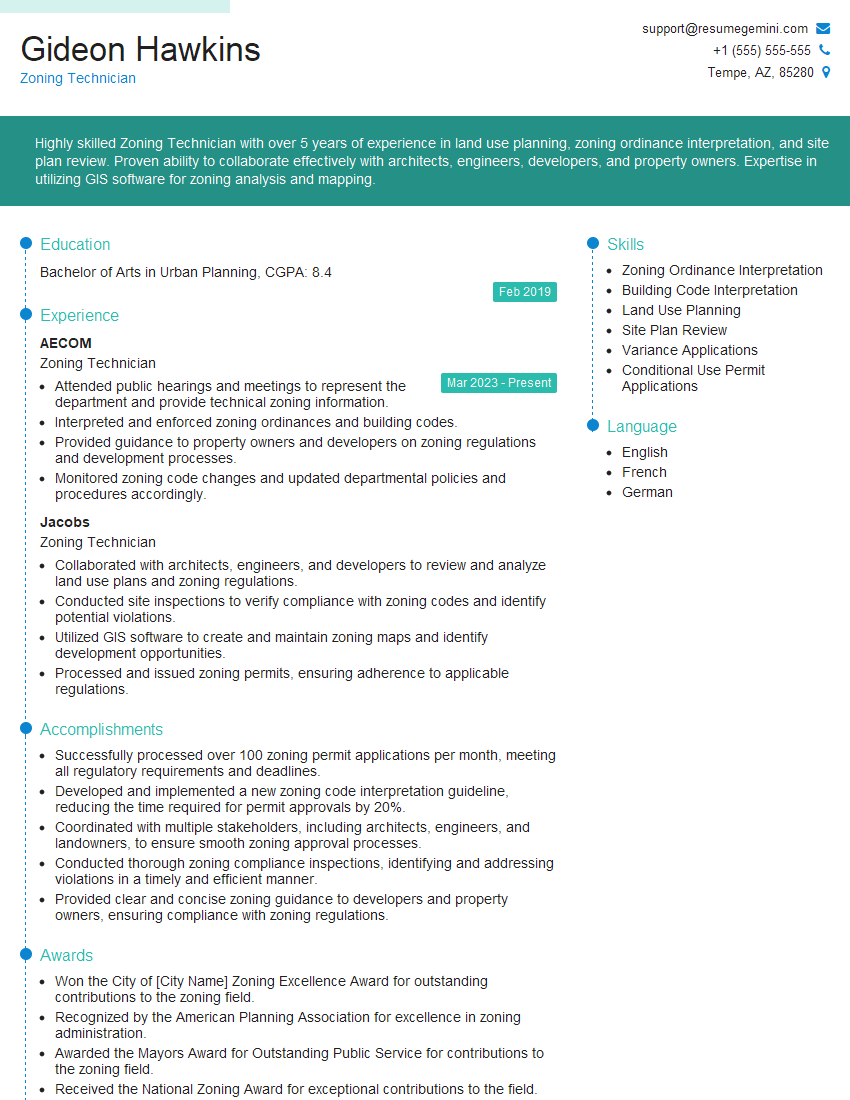
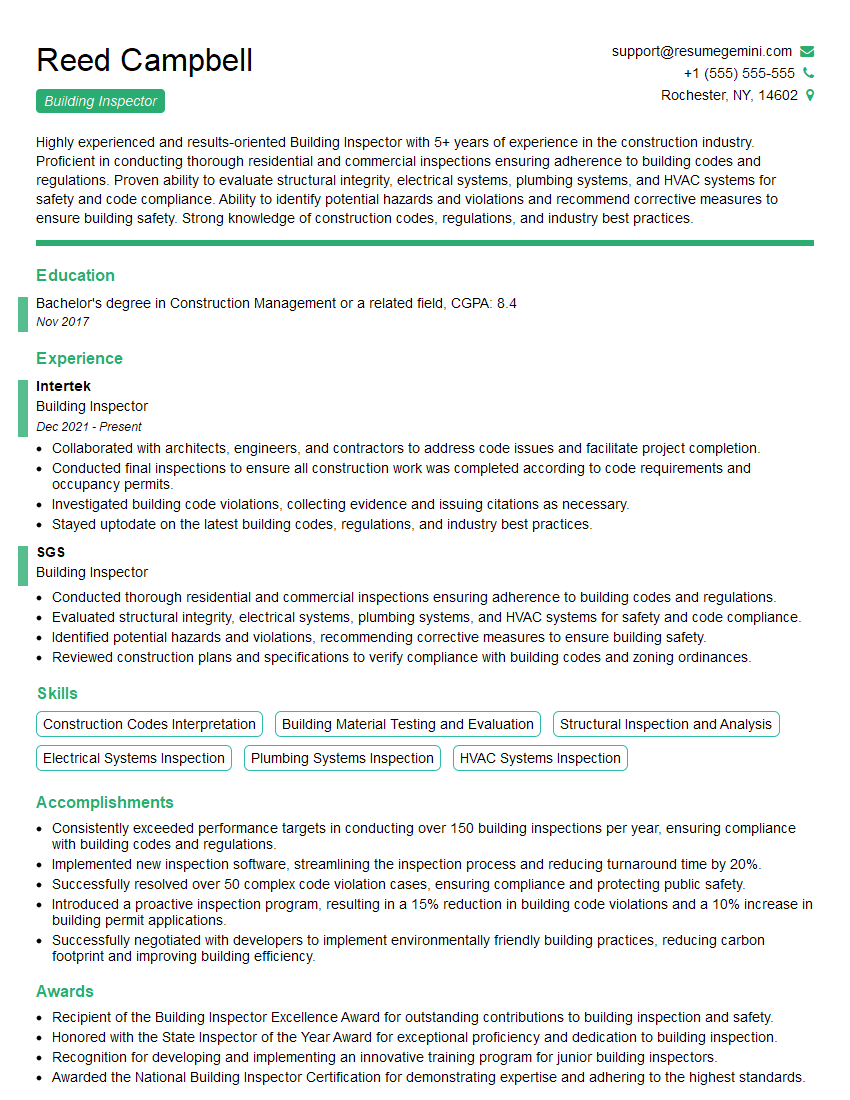
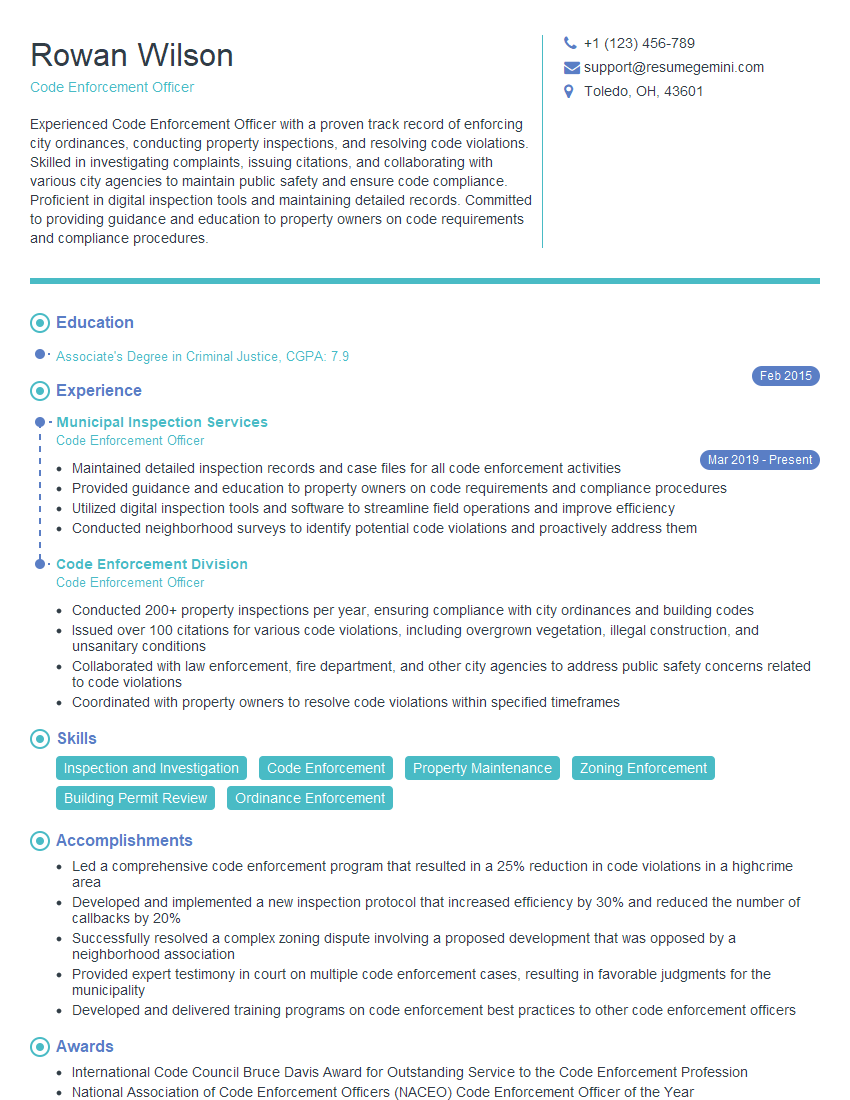
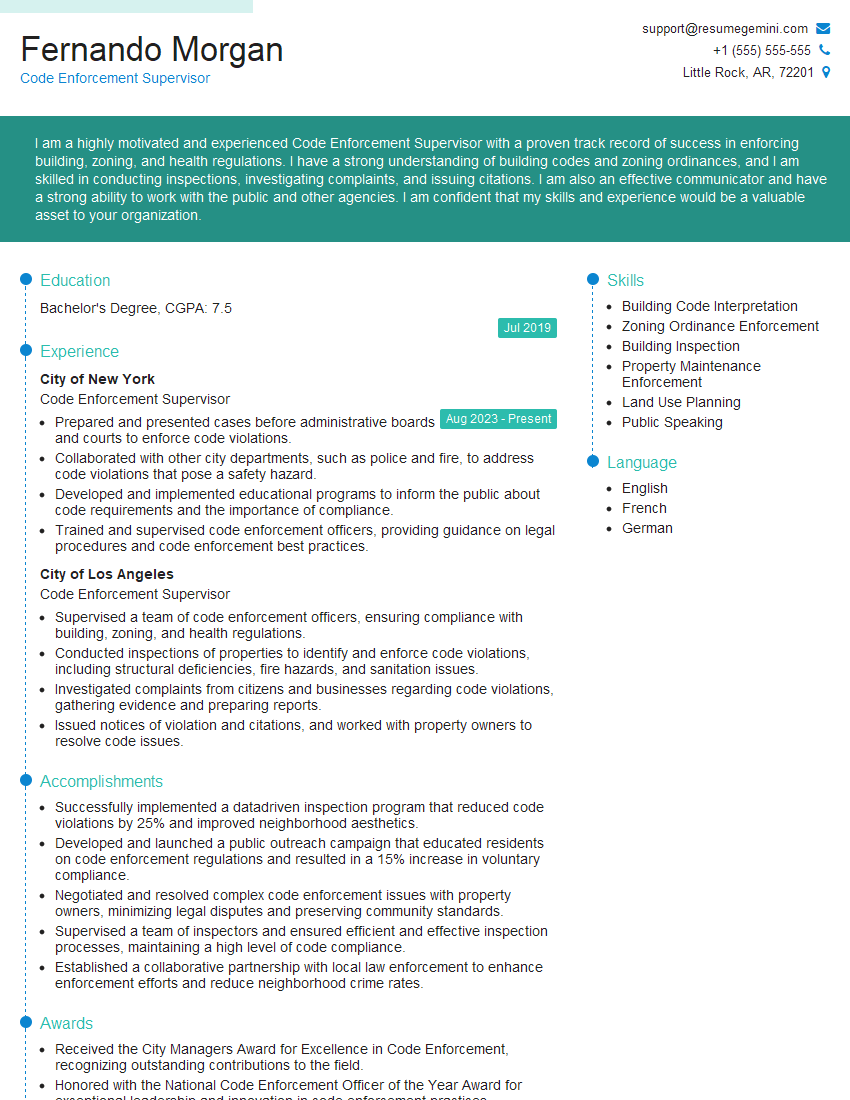
Mastering Zoning Law Enforcement opens doors to a rewarding career with significant opportunities for growth and advancement within local government and related fields. A strong understanding of these principles will set you apart from other candidates. To maximize your job prospects, create an ATS-friendly resume that highlights your skills and experience effectively. ResumeGemini is a trusted resource that can help you build a professional and impactful resume. They offer examples of resumes tailored to Zoning Law Enforcement to help guide you through the process.
Explore more articles
Users Rating of Our Blogs
Share Your Experience
We value your feedback! Please rate our content and share your thoughts (optional).
What Readers Say About Our Blog
To the interviewgemini.com Webmaster.
Very helpful and content specific questions to help prepare me for my interview!
Thank you
To the interviewgemini.com Webmaster.
This was kind of a unique content I found around the specialized skills. Very helpful questions and good detailed answers.
Very Helpful blog, thank you Interviewgemini team.