Cracking a skill-specific interview, like one for Zoning Plan and Map Interpretation, requires understanding the nuances of the role. In this blog, we present the questions you’re most likely to encounter, along with insights into how to answer them effectively. Let’s ensure you’re ready to make a strong impression.
Questions Asked in Zoning Plan and Map Interpretation Interview
Q 1. Explain the difference between a zoning map and a zoning ordinance.
Think of a zoning ordinance as the rule book and a zoning map as the visual representation of those rules on the ground. The zoning ordinance is a legal document—a set of laws and regulations—that dictates how land within a municipality can be used. It defines permitted uses, building heights, setbacks, density, and other development standards. The zoning map is a graphic display showing how land is divided into different zoning districts according to the rules set forth in the ordinance. Each area on the map is assigned a symbol or code that corresponds to a specific zoning designation described in the ordinance. For example, the ordinance might define a ‘Residential Single-Family’ district, and the map would show areas designated with that particular symbol (e.g., ‘R-1’). You can’t fully understand the rules without both; the map shows *where* the rules apply, and the ordinance details *what* those rules are.
Q 2. Describe the process of interpreting zoning symbols and designations on a map.
Interpreting zoning symbols is like deciphering a code. First, obtain a legend, a key that explains the meaning of each symbol on the map. These legends typically list the symbol, the corresponding zoning district name (e.g., ‘Commercial’, ‘Industrial’, ‘Residential’), and a brief description of permitted uses. Next, locate the parcel of land you’re interested in on the map. Once you find it, identify the symbol associated with that parcel. Refer back to the legend to understand the specific zoning designation. The legend will usually provide details about allowable building heights, density (e.g., units per acre), lot sizes, and parking requirements for that district. For instance, a symbol like ‘C-2’ might indicate a general commercial district allowing for retail stores, restaurants, and offices, while ‘I-1’ might represent a light industrial zone with restrictions on noise and emissions. Always cross-reference the map symbol with the written description in the ordinance for complete and accurate information.
Q 3. How do you identify allowable land uses based on zoning regulations and maps?
Identifying allowable land uses is a two-step process. First, locate the property on the zoning map and identify the corresponding zoning district symbol. Then, consult the zoning ordinance. The ordinance will describe the permitted uses for that specific zoning district. For example, if the map shows a property zoned ‘R-1’ (Residential Single-Family), the ordinance will list permitted uses as single-family dwellings, accessory structures like garages, and potentially home occupations with limitations. However, uses like apartment buildings or industrial facilities would likely be prohibited. Always look for detailed descriptions within the ordinance. Some ordinances may also provide tables summarizing permitted uses by district, simplifying the process. Remember, the ordinance is the ultimate authority; the map only visually represents the zoning designations.
Q 4. How do you determine the required setbacks for a building based on zoning regulations?
Determining required setbacks involves carefully reviewing the zoning ordinance for the specific zoning district of the property. Setbacks are the minimum distances buildings must be placed from property lines (front, side, and rear). The ordinance will specify these distances in feet or meters. For instance, a zoning district might require a 25-foot front setback, a 10-foot side setback, and a 15-foot rear setback. These setbacks are crucial for providing sufficient open space, sunlight, and air circulation, as well as maintaining aesthetic harmony within the neighborhood. Sometimes, setbacks may vary depending on the building’s height or use. It’s essential to carefully check all relevant sections of the ordinance to ensure compliance. If there are ambiguities, consulting the zoning department is always advisable.
Q 5. What are the different types of zoning districts, and how do they differ?
Zoning districts are categorized to manage land use effectively. Common types include:
- Residential: These zones are designed for housing, ranging from single-family homes (R-1, R-2) to multi-family dwellings (R-3, R-4), apartments, or townhouses. Density restrictions (units per acre) and building height limits vary depending on the sub-district.
- Commercial: These zones are for businesses and retail activities, further classified into sub-districts based on intensity (e.g., C-1 for local shops, C-2 for larger retail centers).
- Industrial: These zones accommodate manufacturing, warehousing, and other industrial uses. They can be subdivided by intensity (e.g., light industrial, heavy industrial), reflecting limitations on noise, emissions, and hazardous materials.
- Mixed-Use: These zones blend residential and commercial or industrial uses, promoting walkability and diverse urban environments. They often have specific regulations for combining uses to ensure compatibility.
- Agricultural: These zones protect agricultural lands, restricting development to farming and related activities.
Q 6. Explain the concept of zoning variances and how they are obtained.
A zoning variance is an exception to the zoning regulations granted by a local zoning board or similar authority. It allows a property owner to deviate from the strict requirements of the zoning ordinance, usually when strict adherence would create undue hardship. For example, a homeowner might request a variance to build a smaller setback than required due to unusual lot configuration. Obtaining a variance typically involves a formal application process, including a detailed explanation of the hardship, supporting evidence (e.g., surveyor’s report), and a public hearing where neighbors can express their concerns. The zoning board reviews the application and makes a decision based on whether the variance is consistent with the overall intent of the zoning ordinance and won’t negatively affect the surrounding neighborhood. Granting variances is discretionary; they are not guaranteed.
Q 7. How do you identify overlay zones on a zoning map and what are their implications?
Overlay zones are special zoning districts that are superimposed over existing base zones. They add extra regulatory layers for specific purposes. On a zoning map, they are often represented by different colors, hatching, or shading applied over the underlying base zone. For example, a flood plain overlay zone might be overlaid onto a residential zone. This means that any development within that area would need to meet both the standard residential requirements *and* the additional regulations specific to flood plains (e.g., elevated foundations, flood-proofing measures). Other common overlay zones include historic preservation districts, environmental protection areas (wetlands), or noise pollution mitigation zones. The implications are that they add layers of regulations to the already existing zoning requirements, often necessitating more detailed planning and potentially more stringent building standards to account for the unique characteristics or environmental concerns.
Q 8. Explain the role of building codes in relation to zoning regulations.
Building codes and zoning regulations are distinct but interconnected aspects of land use control. Zoning regulations establish the general framework for land use, dictating what types of structures can be built where (residential, commercial, industrial, etc.), while building codes specify the technical requirements for construction and safety within those zones. Think of zoning as setting the stage, and building codes as defining the set design.
For example, a zoning ordinance might permit a three-story apartment building in a particular zone. However, building codes would then dictate the specifics: minimum lot size, fire safety requirements, parking provisions, accessibility standards, structural integrity standards, and material specifications. Failure to comply with both zoning regulations and building codes can result in project delays, fines, and even demolition orders.
Q 9. How do you interpret density regulations shown on a zoning map?
Density regulations on a zoning map typically show the maximum allowable number of dwelling units or people per unit of land area (e.g., units per acre, people per hectare). These regulations are often expressed as numerical values or depicted using color-coded zones. A higher number indicates a higher density.
Interpreting these regulations involves looking for the specific zone designation on the map (e.g., R-2, R-3, etc.) and then referencing the accompanying zoning text or legend. The legend will explain what each zone designation means in terms of density. For instance, an R-3 zone might allow 12 units per acre, while an R-1 zone might only allow 4 units per acre. The map might visually represent this difference through varying colors or shading.
It’s crucial to understand the units used (units per acre, dwelling units per hectare, etc.) and any specific restrictions mentioned in the zoning text. Some regulations might also include minimum lot sizes, which indirectly influence density.
Q 10. Describe different methods used to present zoning information (maps, tables, etc.).
Zoning information is presented through various methods to cater to different user needs and preferences. Zoning maps are the most common visual representation, showcasing zones by color-coding or shading. These maps are typically accompanied by a legend explaining the meaning of each color or symbol.
- Zoning Maps: These are the primary visual tools, showing geographical boundaries of different zones.
- Zoning Text Ordinances: These are legal documents providing detailed descriptions and regulations for each zone. They are essential for clarifying the implications of the map’s visual representation.
- Tables: Summarized tabular data can compare different zoning districts, outlining permitted uses, height restrictions, setbacks, parking requirements, and density limits.
- 3D Models and GIS Data: Advanced methods use 3D models or GIS data to offer interactive visualization and analysis of zoning regulations.
The choice of method depends on the audience and purpose. A quick overview might utilize a simplified map, while detailed planning requires studying both the map and the zoning text ordinance.
Q 11. How do you identify areas subject to special flood hazard areas on a zoning map?
Special Flood Hazard Areas (SFHAs) are typically designated on zoning maps using specific symbols, colors, or labels defined in the map’s legend. Common identifiers include: ‘Floodway’, ‘Floodplain’, ‘X-zone’ (areas with minimal flood risk), ‘A-zone’ (areas with moderate flood risk), or similar notations. Often, these areas are shown as shaded areas, often with cross-hatching or a specific color pattern.
To identify these areas, you must carefully review the zoning map legend. It is crucial to check local, county, and state flood maps for accurate delineation of SFHAs, as the zoning map might not display complete details. Local regulations frequently reference FEMA flood maps, which are authoritative sources for flood hazard information.
Identifying SFHAs is essential because it dictates building codes, construction requirements, and potentially even land use restrictions within those designated areas. Development within SFHAs often necessitates specific mitigation measures like elevated foundations or flood-resistant construction techniques.
Q 12. Explain the significance of zoning in urban planning and development.
Zoning plays a pivotal role in urban planning and development by creating a framework for orderly growth and development. It prevents incompatible land uses from being placed next to each other. This means we don’t want to place a chemical plant right next to a residential neighborhood, for example. It helps maintain property values and overall quality of life. Zoning achieves this through several key functions:
- Land Use Regulation: Defining appropriate uses for land, segregating industrial, commercial, and residential areas.
- Density Control: Managing population density through limits on housing units per acre.
- Aesthetic Considerations: Establishing design standards for buildings, landscaping, and signage to maintain visual appeal.
- Infrastructure Planning: Guiding the provision of essential services such as roads, water, and sewer systems.
- Environmental Protection: Protecting natural resources and preventing environmental hazards through limitations on development in sensitive areas.
Effective zoning is essential for sustainable urban development, ensuring that cities grow in a way that is both economically viable and environmentally responsible.
Q 13. How do you use GIS software to analyze zoning information?
GIS (Geographic Information System) software is invaluable for analyzing zoning information. It allows for spatial analysis, visualization, and integration of diverse datasets. Here’s how GIS is used:
- Data Input: Zoning maps, tabular data, and other related datasets are imported into the GIS.
- Spatial Querying: Identifying properties or areas that meet specific zoning criteria (e.g., finding all parcels zoned for commercial use within a specific radius).
- Overlay Analysis: Combining zoning layers with other datasets like topography, soil conditions, or environmental sensitivity maps to assess development suitability.
- Buffer Analysis: Creating buffer zones around sensitive areas (e.g., wetlands or schools) to assess potential impacts from development.
- Visualization: Creating maps and interactive displays that clearly communicate zoning information to stakeholders.
For example, using GIS, one could easily identify all parcels within a flood plain that are also zoned for residential use, allowing for targeted analyses regarding development constraints and potential flood risks. SELECT * FROM parcels WHERE zone = 'Residential' AND ST_Intersects(geometry, floodplain_polygon); (This is a simplified SQL query example illustrating a spatial query)
Q 14. Describe how zoning impacts property values.
Zoning significantly impacts property values. Positive zoning impacts can increase values, while negative impacts can decrease them. Here’s a breakdown:
- Positive Impacts: Well-planned zoning can lead to increased property values by promoting desirable land uses, preventing incompatible uses, and maintaining a consistent aesthetic quality. For instance, zoning that protects green spaces or restricts high-density development near residential areas can boost property values.
- Negative Impacts: Restrictive zoning can limit development opportunities, potentially reducing property values. Overly strict regulations can constrain property owners’ ability to develop their land to its full potential. Conversely, zoning that allows for undesirable uses near a property (e.g., industrial uses next to residential) can negatively affect property values.
The net effect of zoning on property values is complex and depends on various factors. It requires a nuanced understanding of the specific zoning regulations, the market, and the characteristics of the property in question. A skilled appraiser considers the zoning impacts as a critical element in determining property value.
Q 15. How do you assess the compatibility of proposed development with existing zoning regulations?
Assessing the compatibility of a proposed development with existing zoning regulations involves a meticulous review process. It’s like fitting a puzzle piece into a larger picture – the piece (development) must conform to the picture (zoning regulations).
First, I identify the zoning district of the proposed development site using the zoning map. This map shows how land is divided into zones, each with specific permitted uses, building heights, setbacks, density limits, and other regulations. For example, a site zoned ‘Residential R-1’ might allow only single-family homes, while ‘Commercial C-2’ might permit retail stores and restaurants.
Next, I compare the proposed development’s plans against the regulations for that specific zone. Does the proposed building height exceed the maximum allowed? Does the proposed use fall within the permitted uses? Are the setbacks (distances from property lines) sufficient? Does the proposed density comply with the zoning code? Any discrepancies need thorough examination and potentially require a variance or amendment to the zoning regulations.
Finally, I document my findings in a comprehensive report that clearly outlines any compliance issues or potential conflicts. This ensures transparency and provides a basis for decision-making by the relevant planning authority.
Career Expert Tips:
- Ace those interviews! Prepare effectively by reviewing the Top 50 Most Common Interview Questions on ResumeGemini.
- Navigate your job search with confidence! Explore a wide range of Career Tips on ResumeGemini. Learn about common challenges and recommendations to overcome them.
- Craft the perfect resume! Master the Art of Resume Writing with ResumeGemini’s guide. Showcase your unique qualifications and achievements effectively.
- Don’t miss out on holiday savings! Build your dream resume with ResumeGemini’s ATS optimized templates.
Q 16. How do you identify potential conflicts between zoning and other regulations?
Identifying conflicts between zoning and other regulations requires a holistic approach, considering the overlap and potential contradictions between various legal frameworks governing land use. Think of it as a multi-layered cake, where zoning is one layer, but there are others, like environmental protection laws, historical preservation ordinances, and building codes. A conflict occurs when the requirements of one layer contradict another.
For instance, a zoning ordinance might permit a high-density residential development, but environmental regulations might restrict development due to wetland presence or endangered species habitat. Similarly, a proposed development might comply with zoning but violate historical preservation rules if it’s within a designated historic district.
My approach involves a systematic review of all applicable regulations alongside the zoning ordinance. This might involve consulting environmental impact assessments, reviewing historical preservation plans, checking building codes, and examining any relevant state or federal regulations. Any conflicts are documented and analyzed to determine how to resolve the issues, which might involve modifying the development proposal, seeking waivers, or proposing amendments to the relevant regulations.
Q 17. What are some common challenges faced in interpreting zoning maps?
Interpreting zoning maps presents several common challenges, often stemming from the inherent complexity of urban environments and the evolution of zoning codes over time. Imagine trying to decipher an ancient map – it can be confusing!
- Out-of-date maps: Zoning maps are dynamic documents, updated to reflect changes in land use regulations. Out-of-date maps can lead to misinterpretations and incorrect assessments.
- Inconsistent symbology: Different municipalities use varied symbols and legends on their zoning maps, making it crucial to understand the specific legend for the map being used.
- Overlapping zones: Zoning districts often overlap or have intricate boundaries, requiring careful analysis to determine the exact zoning designation for a specific parcel.
- Scale and resolution: The scale of the map affects its level of detail; a small-scale map may not show fine details necessary for accurate assessment.
- Ambiguous boundaries: Vague or unclear boundaries can create confusion and lead to disputes over zoning classifications.
Addressing these challenges requires meticulous attention to detail, thorough knowledge of the jurisdiction’s zoning regulations, and the ability to utilize multiple resources, including written ordinances, GIS data, and consultations with planning professionals.
Q 18. How do you stay updated on changes to zoning regulations and maps?
Staying current with zoning regulations and map updates is paramount. It’s like being a dedicated gardener – you constantly need to nurture your knowledge.
I utilize several methods to ensure I’m always up-to-date. First, I subscribe to official government newsletters and online portals that provide notices of zoning changes. Many municipalities also provide online access to their zoning ordinances and maps in GIS formats that automatically update. I frequently check these resources for any revisions.
Secondly, I attend professional development workshops and conferences focusing on zoning and land use planning. These provide invaluable insights into emerging trends and regulatory changes. Networking with other professionals within the planning community provides further updates and valuable knowledge sharing.
Finally, I maintain a comprehensive library of zoning codes and relevant legislation, ensuring I have quick access to essential information. I also regularly review case law related to zoning disputes to understand how courts have interpreted ordinances.
Q 19. Describe your experience with reviewing zoning applications.
I have extensive experience reviewing zoning applications, ranging from small residential projects to large-scale commercial developments. My role typically includes reviewing application materials against the relevant zoning regulations, identifying potential compliance issues, and coordinating with applicants to address any deficiencies.
For example, I recently reviewed an application for a new mixed-use building. My review process involved verifying the proposed building’s compliance with height restrictions, setback requirements, parking regulations, and the permitted uses within the zoning district. I also ensured the application included necessary documents, such as architectural plans, site plans, and environmental impact studies.
In cases of non-compliance, I work collaboratively with the applicant to identify potential solutions, which may include modifications to the development proposal or a request for a variance. This ensures a smooth and efficient review process while adhering to the principles of responsible land use planning.
Q 20. How familiar are you with different zoning map scales and projections?
Familiarity with different zoning map scales and projections is fundamental to accurate interpretation. Think of it like choosing the right lens for a camera – different scales provide different levels of detail. A large-scale map (e.g., 1:1000) shows more detail than a small-scale map (e.g., 1:10,000). This is critical for precise measurements of setbacks, lot sizes, and other crucial parameters.
I’m proficient in interpreting maps using various projections, including UTM (Universal Transverse Mercator) and State Plane Coordinate Systems. Understanding the projection is essential because it affects the accuracy of distance measurements and the overall representation of the geographical area. For example, UTM is well-suited for large areas while State Plane systems are better for smaller regions, minimizing distortion.
My experience includes using GIS software, such as ArcGIS, to analyze and manipulate zoning maps across different scales and projections. This enables precise measurement of distances, areas, and identification of boundaries for accurate zoning analysis.
Q 21. How do you handle discrepancies between zoning maps and the written ordinance?
Discrepancies between zoning maps and the written ordinance are a significant challenge requiring careful analysis and resolution. Imagine a discrepancy in a legal document – it needs a clear and justified solution.
My approach is hierarchical: The written ordinance always takes precedence over the map. This is because the ordinance is the legally binding document; the map serves as a visual representation. If a discrepancy arises, I thoroughly review the written ordinance to ascertain the correct zoning classification. The map is then corrected or updated to reflect the legally binding information.
In cases of unclear or ambiguous language in either the ordinance or the map, I consult with legal counsel and planning professionals to provide clarity and ensure accurate interpretation. Documenting all findings and steps taken to resolve the discrepancy is critical for maintaining transparency and accountability.
Q 22. Explain the process of determining the legal non-conforming use of a property.
Determining a legally non-conforming use involves verifying if a property’s use predates current zoning regulations and if it continues to operate under the same use. It’s a situation where a building or land use was lawful when established but is now inconsistent with current zoning ordinances.
The process typically involves:
- Reviewing historical records: Examining old zoning maps, building permits, tax assessments, and other documentation to establish the property’s use before the current zoning regulations were implemented.
- Analyzing the continuity of use: Confirming that the use has remained substantially the same since before the zoning change. Minor modifications are often allowed, but significant alterations could jeopardize the non-conforming status.
- Consulting local zoning authorities: The local zoning department holds the final authority on determining non-conforming status. They’ll provide official interpretation and documentation.
Example: Imagine a small grocery store operating in a residential zone. If the store existed and was legally permitted before the area was rezoned residential, it might be deemed a legal non-conforming use, allowing it to continue operation despite the zoning change. However, if the store undergoes a significant expansion or changes its primary use (e.g., becoming a nightclub), it could lose its non-conforming status.
Q 23. What are the potential legal implications of incorrectly interpreting zoning regulations?
Incorrectly interpreting zoning regulations carries significant legal implications, potentially leading to:
- Legal challenges and fines: Developments undertaken without proper zoning compliance can be challenged by neighbors or environmental groups, leading to costly legal battles and fines imposed by the municipality.
- Project delays and increased costs: Errors in interpretation can lead to project delays as corrections are made or permits are re-issued. This results in significant cost overruns, including fees for consultants and legal assistance.
- Permit revocation and demolition: In severe cases, a project built in violation of zoning regulations may have its permits revoked, requiring demolition of the structure.
- Liability for damages: If an improperly interpreted zoning regulation leads to harm or loss for others, significant liability for damages could result.
It’s crucial to conduct thorough research, consult with experts, and obtain clear guidance from zoning authorities to avoid such consequences. The potential financial and reputational damage can be substantial.
Q 24. How would you explain complex zoning regulations to a non-technical audience?
Explaining complex zoning regulations to a non-technical audience requires clear, concise language and relatable examples. I would use analogies and visual aids to simplify abstract concepts.
For example, I might explain zoning as a set of community rules dictating what types of buildings and activities are permitted in different areas. Think of a neighborhood with designated areas for houses, schools, parks and businesses. Zoning ensures these areas are kept distinct to improve quality of life and avoid conflicts.
I’d use maps and diagrams to visually represent zones, showing the permitted land uses and building heights, density limits and setbacks. I’d provide real-life examples of zoning applications, such as why a factory might not be allowed next to a residential area.
Finally, I’d focus on the impacts of zoning: how it protects property values, ensures public safety, and promotes community character. By using clear, simple language and practical examples, even complex concepts can be made accessible.
Q 25. How do you prioritize different aspects of a zoning review?
Prioritizing aspects of a zoning review depends on the specific project and its goals. However, a typical approach involves a tiered system, focusing on:
- Legal compliance: Ensuring the project meets all applicable zoning regulations is paramount. This is the foundation upon which all other considerations are built.
- Client objectives: Understanding the client’s goals, including desired use, building scale, and budget, guides the review process to identify potential conflicts or opportunities.
- Feasibility analysis: Assessing the project’s viability from a zoning perspective – checking for potential limitations on density, height, or use – is essential before proceeding.
- Environmental impact: Considering environmental factors such as potential impacts on surrounding areas, traffic flow, and ecological sensitivity is crucial for both sustainability and regulatory compliance.
- Community impact: Reviewing the project’s potential effects on neighbors and the community is important to identify potential conflicts or areas for mitigation.
This tiered approach prioritizes compliance first, then balances client objectives with feasibility, environmental and community considerations. The weight given to each factor will vary by project.
Q 26. How do you use zoning information to estimate development feasibility?
Zoning information is crucial for estimating development feasibility. By analyzing zoning regulations, you can determine:
- Permitted uses: Does the zoning allow the intended use? A residential zone wouldn’t permit an industrial factory.
- Density and building height restrictions: What are the limits on the number of units or the building height? These determine the project’s potential scale.
- Setback requirements: How much space must be left between the building and property lines? This impacts the building’s footprint and usable area.
- Parking requirements: How many parking spaces are required? This affects site design and cost.
- Zoning variances or special permits: Are there any opportunities to obtain exceptions to standard regulations? This can expand project possibilities.
By comparing the project’s requirements with zoning allowances, you can quickly identify potential constraints and estimate the feasibility of development. A mismatch between zoning and project goals could indicate the project is not viable unless zoning changes are pursued.
Q 27. How do zoning regulations relate to environmental protection?
Zoning regulations play a vital role in environmental protection by:
- Protecting natural resources: Zoning can designate areas for conservation, preventing development in ecologically sensitive habitats like wetlands or floodplains.
- Controlling pollution: Zoning can regulate the location of potentially polluting industries, keeping them away from residential areas and sensitive ecosystems.
- Managing stormwater runoff: Zoning regulations can require specific designs for stormwater management, reducing the risk of flooding and water pollution.
- Promoting green building practices: Some zoning ordinances incentivize or mandate energy-efficient building designs and the use of sustainable materials.
- Preserving open space: Zoning can establish minimum lot sizes or require preservation of green spaces, promoting biodiversity and mitigating the urban heat island effect.
By strategically integrating environmental considerations into zoning plans, communities can safeguard their natural resources while promoting sustainable development.
Q 28. How have recent changes in technology impacted the interpretation of zoning plans?
Technological advancements have significantly impacted zoning plan interpretation:
- Geographic Information Systems (GIS): GIS software allows for the overlaying of multiple datasets (zoning maps, topography, utilities, etc.), providing a comprehensive understanding of a site’s context and potential constraints.
- Online mapping and databases: Web-based platforms provide easy access to zoning information, streamlining the research process and promoting transparency.
- 3D modeling and visualization: 3D modeling allows for better visualization of proposed developments and their impact on surrounding areas, aiding in community engagement and regulatory review.
- Data analytics and AI: Emerging technologies are being used to analyze large zoning datasets, identifying patterns and potential conflicts more efficiently.
These technological tools have greatly improved the efficiency, accuracy, and accessibility of zoning plan interpretation, leading to more informed decision-making and streamlined development processes.
Key Topics to Learn for Zoning Plan and Map Interpretation Interview
- Zoning District Classifications: Understanding the different zoning districts (residential, commercial, industrial, etc.) and their associated regulations. This includes recognizing symbols and abbreviations used on zoning maps.
- Use Permits and Variances: Knowing the process for obtaining use permits and variances, and the criteria for approval. Be prepared to discuss scenarios requiring these applications.
- Map Interpretation Techniques: Mastering the ability to read and interpret zoning maps effectively, including understanding scale, legend, and boundary lines. Practice identifying permitted uses within specific zones.
- Development Regulations and Setbacks: Familiarize yourself with building setbacks, height restrictions, lot coverage limitations, and other development regulations as depicted on zoning plans and maps.
- Overlay Zones and Special Districts: Understanding the impact of overlay zones (e.g., floodplains, historic districts) and special districts on permitted land uses and development. Be able to explain how they interact with base zoning districts.
- Zoning Ordinances and Codes: Demonstrate a comprehension of how zoning maps relate to the written zoning ordinances and codes, and be able to navigate these documents to find specific information.
- Problem-Solving Scenarios: Practice applying your knowledge to hypothetical development scenarios. Think critically about how zoning regulations would impact proposed projects.
Next Steps
Mastering Zoning Plan and Map Interpretation is crucial for career advancement in urban planning, land development, and related fields. A strong understanding of these concepts demonstrates essential skills for problem-solving and regulatory compliance, making you a highly desirable candidate. To further enhance your job prospects, it’s vital to create an ATS-friendly resume that highlights your key skills and experience. We strongly encourage you to utilize ResumeGemini, a trusted resource for building professional resumes. ResumeGemini provides examples of resumes tailored to Zoning Plan and Map Interpretation to help you showcase your qualifications effectively. Take the next step towards your dream career today!
Compliance Specialist Resume Sample
Regulatory Compliance Officer Resume Sample
Environmental Planner Resume Sample
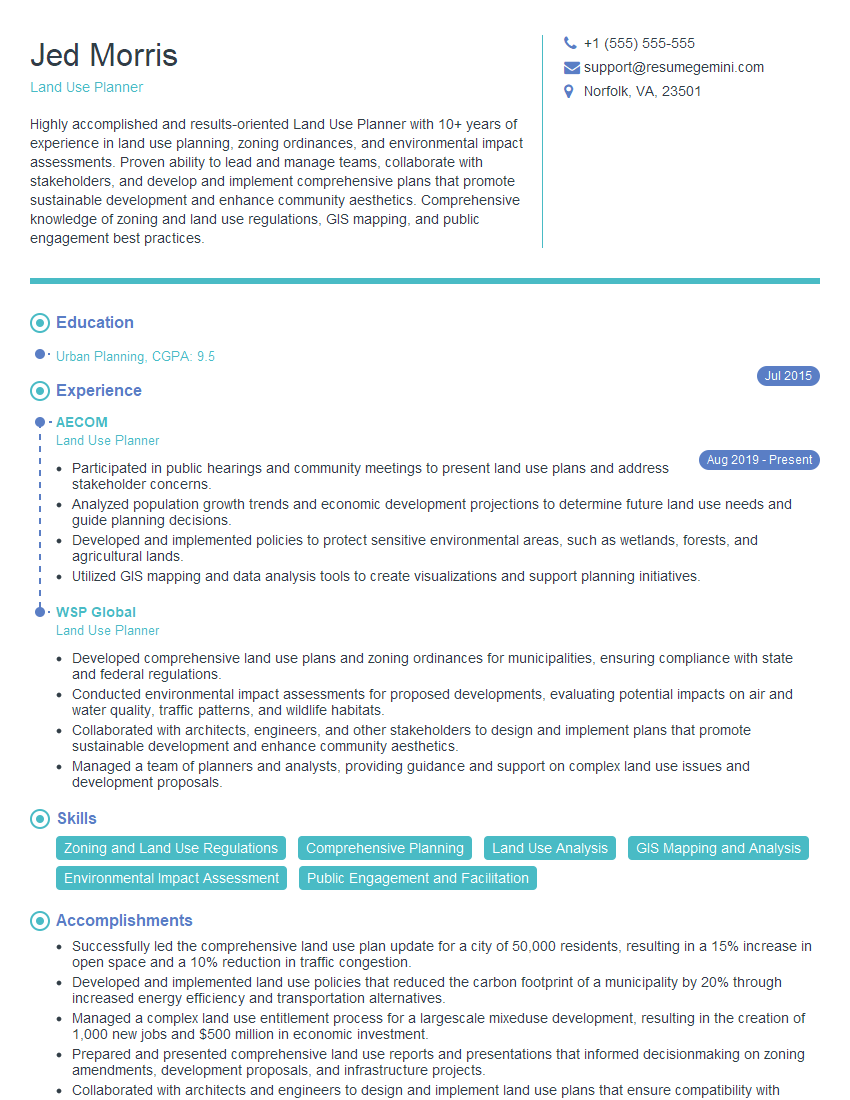
Land Use Planner Resume Sample

Planning Manager Resume Sample
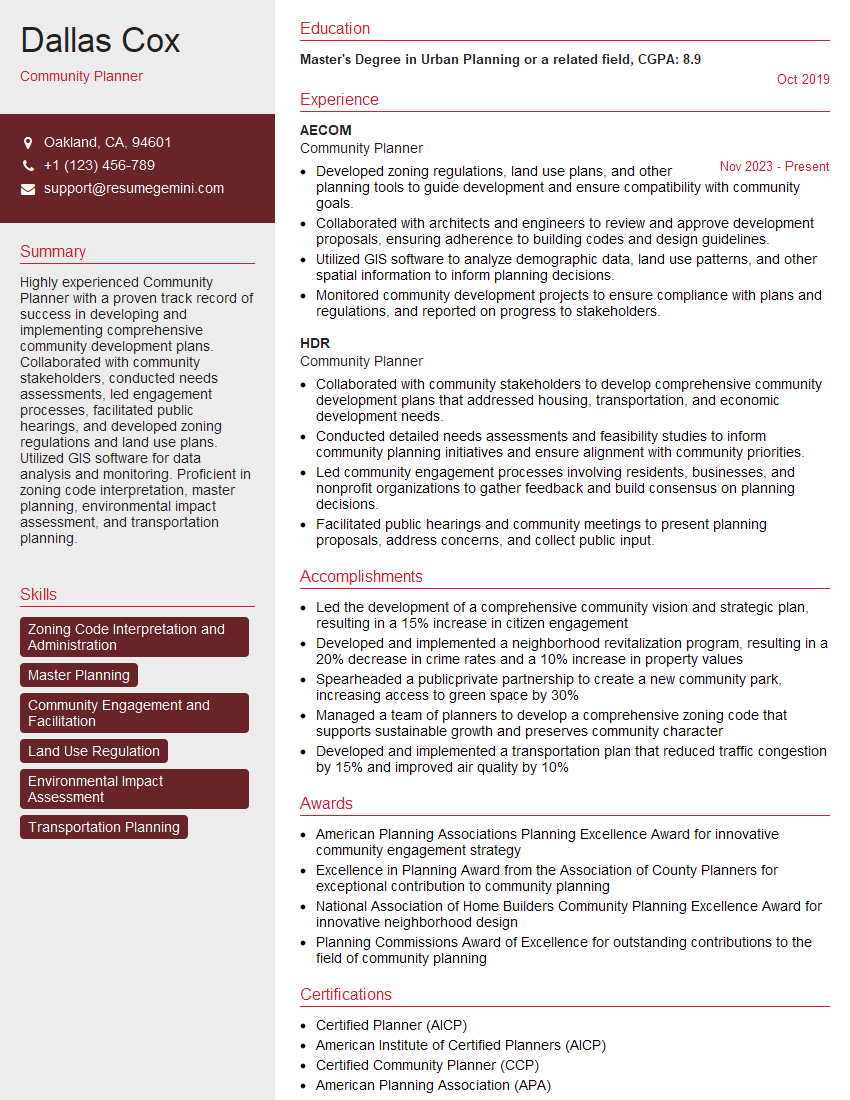
Community Planner Resume Sample
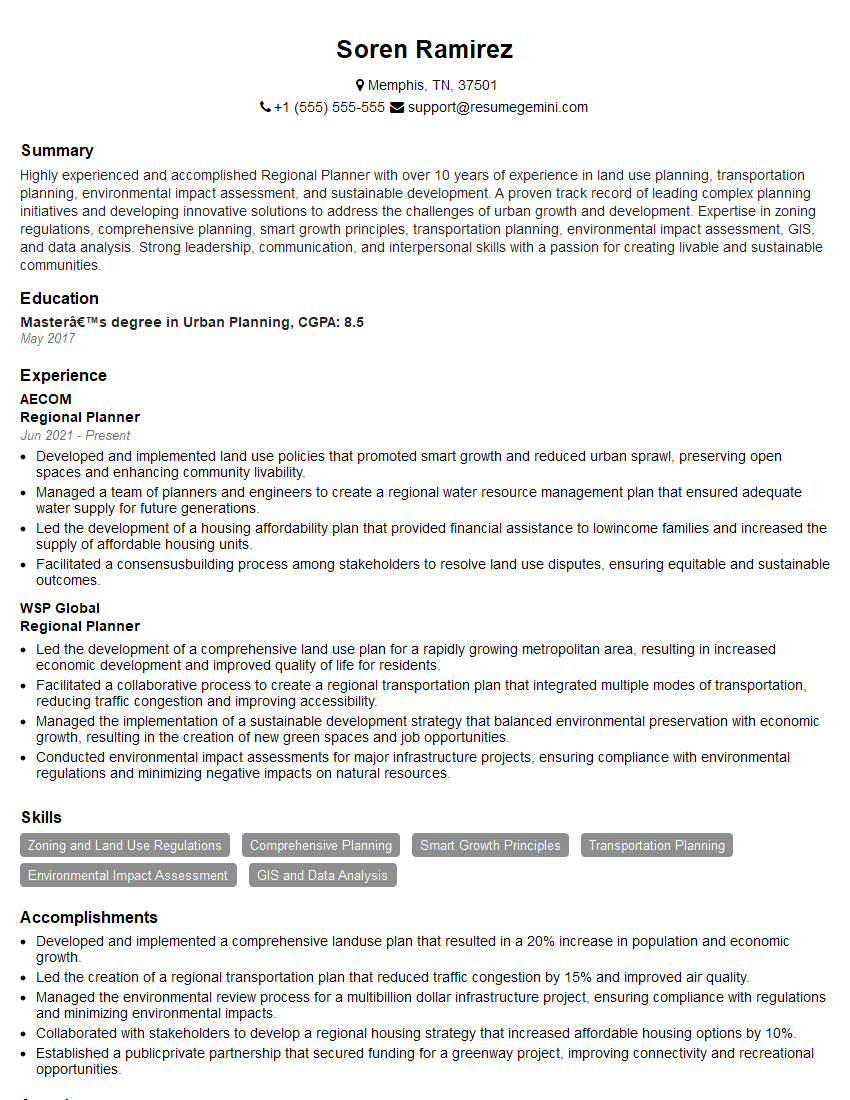
Regional Planner Resume Sample
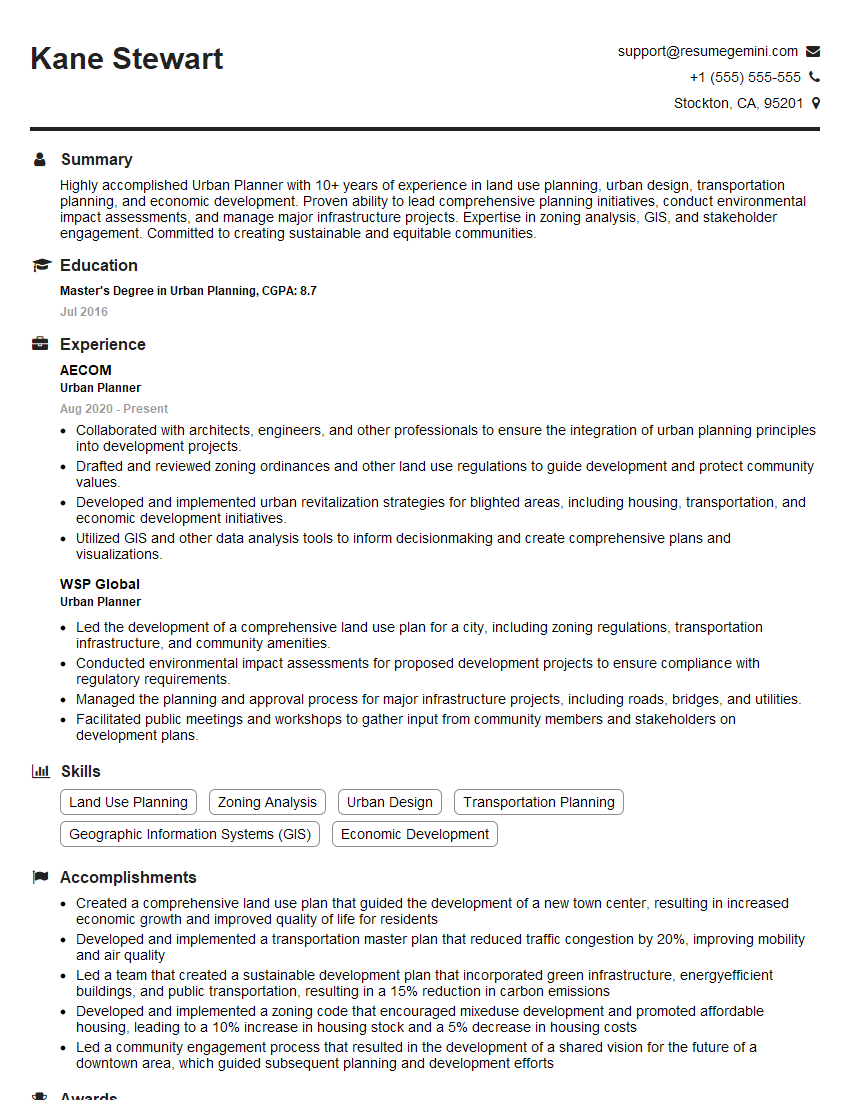
Urban Planner Resume Sample
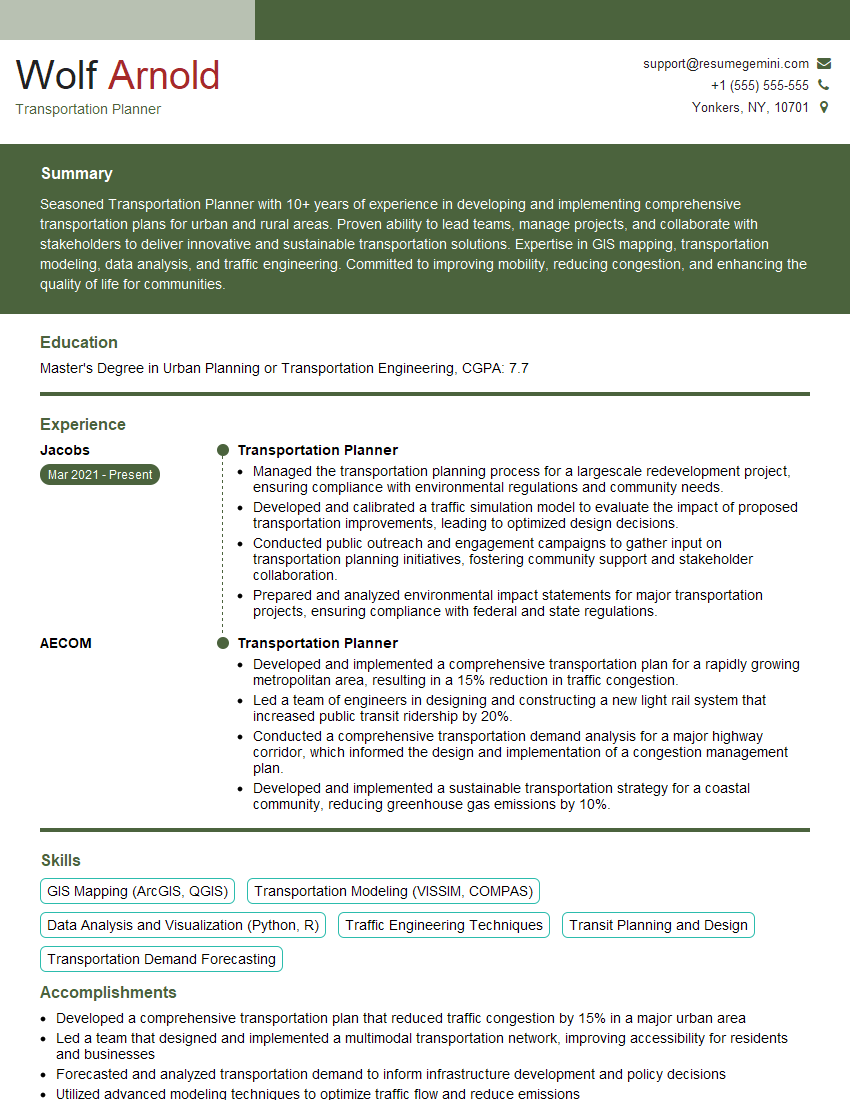
Transportation Planner Resume Sample
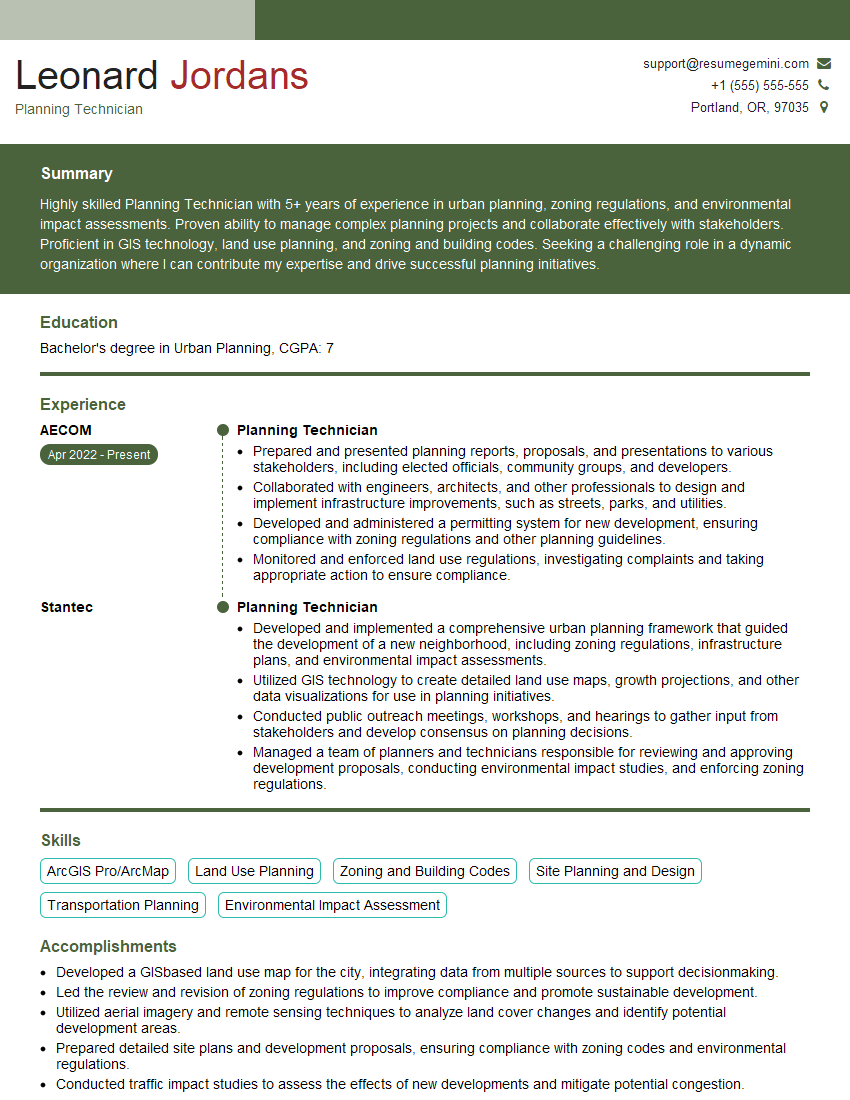
Planning Technician Resume Sample
Explore more articles
Users Rating of Our Blogs
Share Your Experience
We value your feedback! Please rate our content and share your thoughts (optional).
What Readers Say About Our Blog
To the interviewgemini.com Webmaster.
Very helpful and content specific questions to help prepare me for my interview!
Thank you
To the interviewgemini.com Webmaster.
This was kind of a unique content I found around the specialized skills. Very helpful questions and good detailed answers.
Very Helpful blog, thank you Interviewgemini team.