The right preparation can turn an interview into an opportunity to showcase your expertise. This guide to Art Therapy for Creativity and Innovation interview questions is your ultimate resource, providing key insights and tips to help you ace your responses and stand out as a top candidate.
Questions Asked in Art Therapy for Creativity and Innovation Interview
Q 1. Describe your experience utilizing art therapy techniques to foster innovation in a team setting.
In team settings, I’ve utilized art therapy to break down communication barriers and foster collaborative innovation. Imagine a team stuck on a project; traditional brainstorming has yielded little. I might introduce a collaborative mural project. Each team member contributes to a section, representing their ideas visually. This bypasses verbal limitations, allowing introverted team members to express themselves and revealing unexpected connections between seemingly disparate ideas. Another technique is ‘mind mapping’ with visual elements. Instead of just bullet points, we’d use colors, shapes, and images to represent concepts, creating a more engaging and memorable map of ideas. The process itself – the shared creation – builds team cohesion, crucial for innovation.
For example, with a marketing team facing a creative block for a new product launch, we used collage. Each member created a collage representing their ideal target audience, their feelings about the product, and their marketing ideas. Comparing these collages sparked insightful discussions and uncovered unanticipated consumer insights.
Q 2. How do you assess a client’s creative potential and adapt your approach accordingly?
Assessing creative potential involves a multi-faceted approach. It’s not just about technical skill; it’s about openness to experience, willingness to experiment, and the ability to connect seemingly disparate ideas. I begin with a conversational assessment, exploring their art history, preferred mediums, and any past experiences with creative expression. I observe their spontaneous drawings or responses to prompts. For example, I might ask them to draw their ideal work environment or to create a visual representation of a complex problem. Their process – their approach, their choices of materials and colors – often reveals more than the final product. I adapt my approach by considering their comfort level. Someone who is hesitant might begin with less structured activities like doodling or freeform mark-making, gradually progressing to more complex projects as confidence builds.
Q 3. Explain the therapeutic benefits of different art mediums (e.g., painting, sculpture, collage) in promoting creativity.
Different art mediums offer unique therapeutic benefits for creativity. Painting allows for fluidity and emotional expression; the act of mixing colors and applying paint to a canvas can be cathartic and liberating. Sculpture, on the other hand, offers a tactile experience, enabling a deeper connection with the creative process and allowing for three-dimensional representation of ideas. Collage promotes creative problem-solving by combining disparate elements and forcing connections. Think of it like a visual metaphor for innovative thinking. For example, someone struggling with a complex design problem might find sculpting a helpful way to visualize solutions in three dimensions, while someone facing writer’s block might find the free-flowing nature of painting to be more beneficial. The choice of medium should reflect the individual’s needs and preferences.
Q 4. How would you address resistance from a client hesitant to engage in art therapy for innovation?
Resistance to art therapy is common. It’s crucial to approach it with empathy and understanding. I start by acknowledging their apprehension and validating their feelings. We might begin with a conversation about their concerns, exploring their beliefs about art and its therapeutic potential. I would emphasize that there’s no right or wrong way to engage with art; the process is more important than the product. I might offer alternative approaches that feel less intimidating, such as starting with simple exercises or using unconventional materials. For example, I might suggest using found objects for collage instead of drawing. Building trust and rapport is paramount. The goal is to create a safe and non-judgmental space where they feel comfortable exploring their creativity without pressure.
Q 5. Describe your understanding of the relationship between art therapy and cognitive behavioral therapy (CBT) in boosting creativity.
Art therapy and CBT complement each other beautifully in boosting creativity. CBT focuses on identifying and modifying negative thought patterns and behaviors that hinder creativity, while art therapy provides a non-verbal outlet for emotional expression and self-discovery. Imagine someone with performance anxiety impacting their creative output. CBT helps to challenge and reframe their negative self-talk, while art therapy allows them to safely explore and process their anxieties through creative expression. The integration involves using art-making as a tool to practice CBT techniques. For instance, making a series of self-portraits reflecting different emotional states can help identify and manage emotional triggers. The combination fosters a holistic approach, addressing both the cognitive and emotional aspects of creative blocks.
Q 6. What are some key ethical considerations in using art therapy for creativity and innovation in a professional context?
Ethical considerations are paramount. Confidentiality is key. All artwork and discussions remain privileged unless legally required to be disclosed. Informed consent is crucial; clients must fully understand the process, its limitations, and their rights. Maintaining professional boundaries is vital, avoiding dual relationships or exploiting the therapeutic relationship. Cultural sensitivity is also crucial; respecting individual beliefs and values related to art-making and self-expression. Appropriate referrals should be made if the client’s needs exceed the scope of art therapy, for instance, to a psychiatrist or psychologist. Continuous professional development keeps ethical practices current and refined.
Q 7. How do you measure the effectiveness of your art therapy interventions aimed at fostering innovation?
Measuring the effectiveness of art therapy interventions for innovation requires a mixed-methods approach. Quantitative measures could involve pre- and post-intervention assessments of creativity using standardized tests or questionnaires. Qualitative data gathering includes analyzing artwork for shifts in emotional expression, thematic content, and complexity. Client feedback through interviews and journals provides valuable insights into their perceived changes in creative confidence and problem-solving abilities. Observation of changes in team dynamics, such as increased collaboration and improved communication, offers further evidence. A holistic approach using both objective and subjective measures helps to create a comprehensive understanding of the intervention’s effectiveness.
Q 8. Explain your understanding of the connection between emotional expression and creative problem-solving.
The link between emotional expression and creative problem-solving is profound. Unprocessed emotions often act as barriers to innovative thinking, creating mental blocks and limiting our ability to explore alternative solutions. Art therapy provides a safe and non-judgmental space to access and express these emotions, thereby freeing up cognitive resources for creative problem-solving. Think of it like clearing a cluttered workspace – once you’ve tidied up the emotional clutter, you have more space to think clearly and creatively.
For instance, someone struggling with anxiety related to a work project might find themselves stuck in a rut. Through art-making, they might externalize their anxiety by creating a piece that visually represents their feelings of overwhelm. This act of externalization can lead to a shift in perspective, allowing them to identify the root causes of their anxiety and develop more effective coping mechanisms and solutions.
- Emotional regulation: Art helps regulate overwhelming emotions, fostering a calmer mental state conducive to creative thinking.
- Access to unconscious thoughts: Non-verbal expression through art can unlock unconscious patterns and beliefs hindering creativity.
- Enhanced self-awareness: The process of creating art promotes self-reflection, leading to a better understanding of one’s emotional landscape and its impact on creative output.
Q 9. How do you adapt your art therapy approach to different age groups or populations?
Adapting my approach across different age groups and populations is crucial. I tailor my methods to their developmental stage, cognitive abilities, and cultural background. For example, working with children might involve playful activities like sand tray therapy or collage, fostering self-expression through imaginative play. With adolescents, I might use more abstract techniques like painting or sculpting to explore complex emotions and identity issues. Adults might benefit from more introspective methods like journaling alongside their art creation, or focusing on specific techniques related to their goals (e.g., using mandala art for stress management).
For individuals with cognitive impairments, I use simplified techniques and materials, focusing on the sensory experience of creating art. I always ensure that the therapeutic process is respectful of their individual needs and capabilities. Cultural sensitivity also plays a huge role – I am aware of and adapt to the client’s cultural background to ensure the art-making process is meaningful and comfortable.
Q 10. Describe a successful case study where you used art therapy to enhance a client’s creative thinking.
I worked with a young entrepreneur struggling with decision paralysis regarding her startup. She felt overwhelmed by numerous options and unable to choose a clear direction. We started with collaborative brainstorming through visual mapping, where she drew her ideas and interconnected them on a large sheet of paper. This process helped externalize her ideas and see the relationships between them in a clearer way. Next, we used color association: each idea was assigned a color to represent her emotional response towards it. This helped her understand her intuitive preferences better.
Finally, we moved to sculpting with clay, allowing her to physically shape her chosen direction. By the end of the sessions, she had a clearer vision of her path and had gained the confidence to move forward. The tangible nature of the art-making process, and the emotional clarity it provided, empowered her to overcome her initial inertia.
Q 11. What are the limitations of art therapy in fostering innovation, and how do you mitigate them?
While art therapy is powerful, certain limitations exist. Not everyone is artistically inclined or comfortable with self-expression through visual mediums. Also, the subjective nature of art interpretation can make it challenging to objectively measure the impact on innovation. Furthermore, the time required for art therapy can sometimes be a constraint, particularly in fast-paced professional settings.
To mitigate these limitations, I incorporate various techniques. If a client expresses discomfort with visual art, I might explore alternative creative avenues, such as music therapy or creative writing. I also use standardized assessments alongside qualitative observations to gauge progress. For time constraints, I often focus on shorter, targeted interventions that address specific blocks to creative thinking. Collaboration with other professionals, such as business coaches or project managers, can further enhance the effectiveness of art therapy within a broader innovation strategy.
Q 12. How would you integrate art therapy techniques into a team-building workshop focused on enhancing creativity?
Integrating art therapy into a team-building workshop requires a structured approach. I would begin by setting clear objectives related to enhancing team cohesion and creative problem-solving. A simple icebreaker activity, such as collaborative drawing or sculpting, can quickly break down barriers and foster a sense of teamwork. I might use blind contour drawing exercises to encourage observation skills and improve communication within the team. Then, I’d introduce a challenge that requires creative problem-solving, using collaborative art-making techniques to find a solution.
For example, a team might be given the challenge of designing a new product or service using collage. Each team member would contribute their ideas and perspectives through the visual medium, building towards a collective solution. Debriefing after each activity helps to process emotions, analyze the creative process, and consolidate learnings. The emphasis remains on teamwork, communication, and shared experience.
Q 13. Discuss your experience with different art therapy theoretical models (e.g., psychodynamic, humanistic).
My approach integrates elements from various theoretical models. Psychodynamic perspectives help me understand how unconscious conflicts and past experiences influence creative expression. For instance, recurring themes or symbols in a client’s artwork might reveal unresolved issues impacting their creativity. Humanistic approaches, with their focus on self-actualization and personal growth, guide me to foster the client’s intrinsic motivation and self-acceptance, thereby promoting creative exploration. I also draw from cognitive-behavioral therapy (CBT) to help clients identify and challenge negative thought patterns that hinder their creative process.
Integrating these different models allows for a holistic approach. It helps to understand the client’s emotional state, underlying beliefs, and cognitive processes, providing a comprehensive framework for supporting their creative journey.
Q 14. How do you ensure client confidentiality and ethical practices within an art therapy setting?
Client confidentiality is paramount. I adhere to strict ethical guidelines, ensuring all materials and discussions remain confidential. Client artwork is stored securely, and I do not share any personal information without their explicit consent. Informed consent is obtained before commencing therapy, detailing the therapeutic process, limitations of confidentiality (e.g., mandated reporting in cases of child abuse), and the client’s rights. Supervision and ongoing professional development ensures I stay updated on ethical best practices and maintain a high standard of care.
Maintaining a safe and non-judgmental therapeutic environment is also vital. I provide clear boundaries and transparent communication to establish a trusting relationship with the client, enhancing their comfort and willingness to express themselves fully.
Q 15. What are some common challenges you’ve faced in using art therapy to promote creativity, and how did you overcome them?
One common challenge in using art therapy to boost creativity is overcoming clients’ self-doubt and fear of failure. Many individuals, even those with artistic inclinations, harbor anxieties about their abilities. They may believe their work isn’t ‘good enough’ or fear judgment. To overcome this, I build a strong therapeutic relationship based on trust and unconditional positive regard. I emphasize the process over the product, focusing on the exploration and expression inherent in the creative act rather than achieving a predetermined outcome. This shift in focus often alleviates pressure and encourages experimentation. For example, I might suggest a free-form collage activity where the goal isn’t to create a ‘beautiful’ piece but to explore different textures, colors, and materials to unlock hidden ideas. Another challenge is engaging clients who initially resist the art-making process. This might stem from past negative experiences, limited self-perception of artistic ability, or simply a preference for verbal processing. In such cases, I start with gentle, low-pressure activities like guided imagery, mindful coloring, or simple mark-making exercises. These provide a gradual introduction to the therapeutic process, allowing clients to feel safe and comfortable before engaging in more complex art-making. Gradually, I introduce more challenging or expressive techniques as their comfort level increases.
Career Expert Tips:
- Ace those interviews! Prepare effectively by reviewing the Top 50 Most Common Interview Questions on ResumeGemini.
- Navigate your job search with confidence! Explore a wide range of Career Tips on ResumeGemini. Learn about common challenges and recommendations to overcome them.
- Craft the perfect resume! Master the Art of Resume Writing with ResumeGemini’s guide. Showcase your unique qualifications and achievements effectively.
- Don’t miss out on holiday savings! Build your dream resume with ResumeGemini’s ATS optimized templates.
Q 16. Describe your approach to documenting and analyzing client progress in art therapy sessions.
Documenting and analyzing client progress is crucial in art therapy. My approach is multifaceted. I maintain detailed session notes, including descriptions of the artwork created, the client’s emotional state during the session, verbalizations, and any significant symbolic elements in their work. I use a combination of qualitative and quantitative methods. Qualitative data involves analyzing the content, style, and emotional tone of the artwork and verbal expressions using thematic analysis and narrative approaches. For example, I might notice a recurring symbol of a bird in a client’s artwork and explore its potential meaning and relation to their personal narratives, such as feelings of freedom or entrapment. Quantitative data might involve using standardized art therapy assessment tools to measure changes in mood, anxiety levels, or self-esteem over time. These tools provide objective metrics that supplement qualitative observations. Finally, I regularly review these notes to identify patterns and track progress towards therapeutic goals. Visual aids, like photographic records of the client’s artwork (with their consent), assist in this process and offer tangible proof of the journey and transformation. I present this information to the client during sessions, ensuring they are an active participant in interpreting the data, reflecting on their growth and understanding their patterns of expression.
Q 17. How do you incorporate feedback and supervision into your art therapy practice?
Feedback and supervision are vital for maintaining ethical and effective practice. I actively seek regular supervision from experienced art therapists, presenting case studies and discussing challenging situations. This peer review provides valuable perspectives, helping me refine my techniques, address potential blind spots in my approach, and ensure I’m adhering to best practices. For instance, I might present a case of a client struggling with creative blocks, and my supervisor might offer strategies for fostering risk-taking and experimentation. I also incorporate client feedback into my practice through regular check-ins. At the end of each session, or at intervals defined by the therapeutic relationship, I ask clients about their experience, if the session was helpful, and if anything could be adjusted to better support their needs. This collaborative approach strengthens the therapeutic alliance and ensures that the art therapy process aligns with their individual preferences and goals.
Q 18. What are your strategies for managing difficult emotions that may arise during art therapy sessions focused on innovation?
Innovation often involves navigating uncertainty and risk-taking, which can trigger a range of intense emotions. My approach emphasizes creating a safe and validating space where clients feel comfortable expressing their feelings without judgment. If strong emotions arise, I employ strategies like mindfulness techniques to help clients ground themselves in the present moment, using deep breathing exercises or focusing on sensory details. I also utilize verbal processing to help clients understand and label their emotions, connecting them to specific aspects of the creative process or their personal experiences. For example, if frustration emerges during a problem-solving activity, I might help the client articulate the source of their frustration, understanding its relationship to the challenge at hand and reframing it as a natural part of the creative process. Validation is key—acknowledging and normalizing the difficult emotions allows clients to work through them rather than suppressing them. I also might offer alternative activities, such as expressive writing or clay sculpting, if the initial art form feels too triggering or overwhelming. The goal is to help clients manage their emotions as a means of fostering resilience and self-awareness, ultimately empowering them to embrace creative risks.
Q 19. Explain your understanding of the role of symbolism and metaphor in art therapy for creativity.
Symbolism and metaphor are integral to art therapy for creativity. They provide a non-threatening avenue for exploring complex ideas and emotions that might be difficult to articulate directly. In art, symbols represent deeper meanings or unconscious processes. For example, a client repeatedly using the color black in their artwork might be subconsciously expressing feelings of sadness or depression. Metaphors, similarly, translate abstract concepts into tangible forms. A client sculpting a fragile tower might metaphorically represent their own perceived fragility or vulnerability. I help clients identify and interpret these symbols and metaphors through guided questioning, encouraging them to explore the personal significance of their creative choices. The process of unpacking these symbolic representations fosters self-discovery and promotes deeper understanding of their thoughts, emotions, and creative process. This self-awareness acts as a catalyst for innovation, fostering originality and unique problem-solving approaches by tapping into the rich reservoir of unconscious thought and symbolism.
Q 20. How would you create a safe and supportive environment for clients to explore their creative potential?
Creating a safe and supportive environment is foundational to effective art therapy. This involves several key elements. First, establishing a strong therapeutic relationship built on trust and empathy is crucial. This begins by fostering a non-judgmental atmosphere where clients feel comfortable expressing themselves without fear of criticism. The physical space should also be conducive to creativity, offering a sense of privacy, comfortable seating, and adequate space for art-making. Providing a diverse range of art materials allows clients to choose mediums that resonate with them, fostering a sense of agency and ownership. Clear boundaries, confidentiality protocols, and mutual respect are essential components of this safe environment. Finally, I actively engage in reflective listening and collaborative goal setting, ensuring clients have a voice in the therapeutic journey. The focus is on creating a nurturing space where clients can take creative risks without fear of failure and freely explore their potential.
Q 21. What are some specific art techniques you use to encourage creative problem-solving?
Several art techniques can effectively encourage creative problem-solving. One powerful technique is ‘mind mapping’ using visual brainstorming. Clients can visually organize their thoughts and ideas, making connections that might not be apparent through linear thinking. Another technique is collage, which allows clients to combine disparate elements, fostering unexpected juxtapositions and sparking novel solutions. ‘Sculpting’ with clay or other malleable materials enables clients to work three-dimensionally, developing spatial reasoning and creative problem-solving skills. I might ask a client to sculpt a solution to a particular problem, offering a unique sensory experience that can lead to innovative approaches. Additionally, I encourage improvisational techniques like drawing without lifting the pencil from the paper, encouraging spontaneity and unexpected solutions to pre-defined challenges. These activities foster a mindset of experimentation, challenging traditional approaches, and encouraging flexible and innovative thinking.
Q 22. How do you adapt your art therapy approach to individuals with different learning styles or disabilities?
Adapting art therapy to diverse learning styles and disabilities requires a flexible and individualized approach. I begin by assessing the client’s strengths, challenges, and preferred modes of expression. For example, a client with visual impairments might benefit from tactile materials like clay or textured papers, while a client with ADHD might need shorter, more focused sessions with frequent breaks. For clients with cognitive disabilities, I might simplify instructions and use repetitive techniques to build confidence and skill. I might use symbolic representations instead of direct instruction. The key is to create a safe and supportive environment where the client feels empowered to express themselves in a way that feels comfortable and accessible. For instance, if a client has difficulty with fine motor skills, I might focus on larger-scale art forms like painting with large brushes or collage.
- Visual Learners: Using visual aids, demonstrations, and color charts.
- Auditory Learners: Incorporating verbal instructions, music therapy, or sound-based art activities.
- Kinesthetic Learners: Focusing on hands-on activities like sculpting, painting, or dance therapy.
Q 23. Describe your experience working with diverse populations and adapting your approach to meet their cultural needs.
My experience working with diverse populations has highlighted the importance of cultural sensitivity and humility. I’ve worked with clients from various ethnic backgrounds, socioeconomic statuses, and religious beliefs. I always start by creating a safe and non-judgmental space that respects and honors the client’s unique cultural background. This includes adapting my approach to reflect the client’s values and beliefs, taking into account any cultural norms around touch, eye contact, and self-expression. For instance, I’ve found that understanding the symbolic meanings of colors and imagery can vastly impact the interpretation of the client’s artwork and therapy. If a client’s culture typically values nonverbal communication, I might focus more on observational methods and adapt the therapeutic approach to that style. I avoid imposing my own cultural interpretations onto their work, opting instead for collaborative meaning-making. I might also consider incorporating culturally relevant materials or themes into the art-making process.
One example involves a client from a collectivist culture who initially struggled with individual art-making. After learning more about her cultural background, I introduced collaborative art projects, which allowed her to express herself more comfortably and effectively.
Q 24. What are the key elements of a well-structured art therapy session plan?
A well-structured art therapy session plan should be client-centered and include the following key elements:
- Warm-up: Establishing rapport, setting intentions, and easing the client into the session (e.g., mindfulness exercises, gentle stretching).
- Art-Making Process: Guided or open-ended art activities tailored to the client’s needs and goals. This might include specific prompts, material choices, or techniques.
- Processing and Reflection: Facilitated discussion about the client’s artwork, focusing on the emotional, symbolic, and personal meaning. I guide this by asking open-ended questions, such as “What feelings or thoughts came up while you were creating this?” or “What does this piece represent to you?”
- Integration and Closure: Summarizing key insights, setting goals for the following session, and ensuring the client feels supported and heard. This may include assigning a ‘homework’ project relevant to themes that arose.
Flexibility is vital. Sessions might deviate from the plan to accommodate the client’s immediate emotional needs, and this adaptability ensures the effectiveness of the session.
Q 25. How do you utilize art therapy to assist clients in overcoming creative blocks?
Creative blocks often stem from self-criticism, fear of failure, or lack of inspiration. In art therapy, I address these blocks through various techniques that encourage experimentation and self-discovery. I might use techniques like automatic drawing (drawing without conscious thought), collages using unexpected materials, or playful exercises that encourage risk-taking. The focus isn’t on creating a ‘masterpiece,’ but on fostering a sense of play and freedom in the creative process. I also explore the client’s past experiences with art and identify any negative beliefs or associations that might be hindering their creativity.
For example, I might introduce a client to a new medium or technique they haven’t tried before. The novelty of the process can help them break free from ingrained patterns and discover new ways of expressing themselves. I often use metaphors and imagery to help clients understand and overcome their internal barriers to creativity.
Q 26. Explain your proficiency in assessing and addressing countertransference in the context of art therapy for creativity.
Countertransference, the therapist’s unconscious emotional reactions to the client, is an important aspect of art therapy that requires careful attention. My training emphasizes self-awareness and regular supervision to identify and manage my own countertransference reactions. For example, if a client’s artwork evokes strong emotional responses in me, I carefully reflect on my feelings, exploring how my personal experiences might be influencing my interpretation of the art. This self-reflection allows me to avoid projecting my own feelings onto the client and maintain a balanced therapeutic relationship. I also maintain professional boundaries and seek supervision when needed to ensure ethical and effective practice. Regular supervision allows a space for exploring these countertransference reactions and prevents them from compromising the therapeutic process.
Open communication with the client is also key. If appropriate, I might gently discuss my reactions, ensuring that the focus remains on the client’s experience and self-discovery.
Q 27. How do you integrate technology (e.g., digital art programs) into your art therapy practice?
Technology offers exciting opportunities to enhance art therapy. I incorporate digital art programs like Procreate or Photoshop into my practice, allowing clients to explore different mediums and techniques that might not be accessible otherwise. Digital art can be particularly beneficial for clients who struggle with physical limitations, providing greater ease of expression. It allows exploration of animations, interactive art pieces, and digital collage, expanding the range of creative expression. Additionally, digital platforms allow for remote sessions, which is crucial for accessibility and client convenience.
However, I maintain a balance. Technology is a tool, and I prioritize the therapeutic relationship and the client’s individual needs. The choice of medium—traditional or digital—is always guided by the client’s preferences and therapeutic goals.
Q 28. Describe your professional development plan to stay current in the field of art therapy and innovation.
My professional development plan focuses on staying current with the latest research and innovative practices in art therapy and creativity. This includes:
- Continuing Education: Attending workshops, conferences, and webinars on topics such as trauma-informed art therapy, digital art therapy techniques, and innovative applications of art therapy in various settings.
- Supervision: Engaging in regular supervision with experienced art therapists to enhance my clinical skills and address any ethical or clinical challenges.
- Reading and Research: Keeping up-to-date with peer-reviewed journals and books to deepen my understanding of art therapy theory and practice.
- Networking: Participating in professional organizations to connect with colleagues and learn from their experiences.
- Self-Reflection: Regularly evaluating my own practice to identify areas for growth and improvement. This is vital for providing the most ethical and effective therapy.
This ongoing learning is essential to ensure that I provide the highest quality of care to my clients and remain at the forefront of the evolving field of art therapy.
Key Topics to Learn for Art Therapy for Creativity and Innovation Interview
- Theoretical Foundations: Understanding the theoretical underpinnings of art therapy, including its connection to creativity and innovation. Explore diverse theoretical models and their application in different settings.
- Creative Process Facilitation: Mastering techniques to guide clients through the creative process, fostering self-expression and problem-solving. Consider specific methods for encouraging innovative thinking through art.
- Therapeutic Interventions: Become proficient in various art therapy interventions designed to enhance creativity and innovation. This includes understanding the rationale and application of different mediums and techniques.
- Assessment and Evaluation: Develop skills in assessing clients’ creative potential and evaluating the effectiveness of art therapy interventions in fostering creativity and innovation. Learn to document progress effectively.
- Ethical Considerations: Understand the ethical implications of using art therapy for creativity and innovation, including issues of confidentiality, client autonomy, and cultural sensitivity.
- Group Dynamics and Collaboration: Explore how to facilitate group art therapy sessions that promote collaboration and shared creative problem-solving. Understand the dynamics of group creativity.
- Adaptive Art Therapies: Learn about adapting art therapy techniques for diverse populations and various needs, such as individuals with disabilities or specific mental health challenges.
- Integration with Other Therapies: Understand how art therapy can be integrated with other therapeutic approaches to enhance creativity and problem-solving skills in a holistic manner.
- Research and Evidence-Based Practice: Familiarize yourself with current research on the effectiveness of art therapy for creativity and innovation. Be prepared to discuss evidence-based practices.
- Case Study Analysis: Practice analyzing case studies to demonstrate your understanding of applying art therapy principles to real-world scenarios involving creativity and innovation.
Next Steps
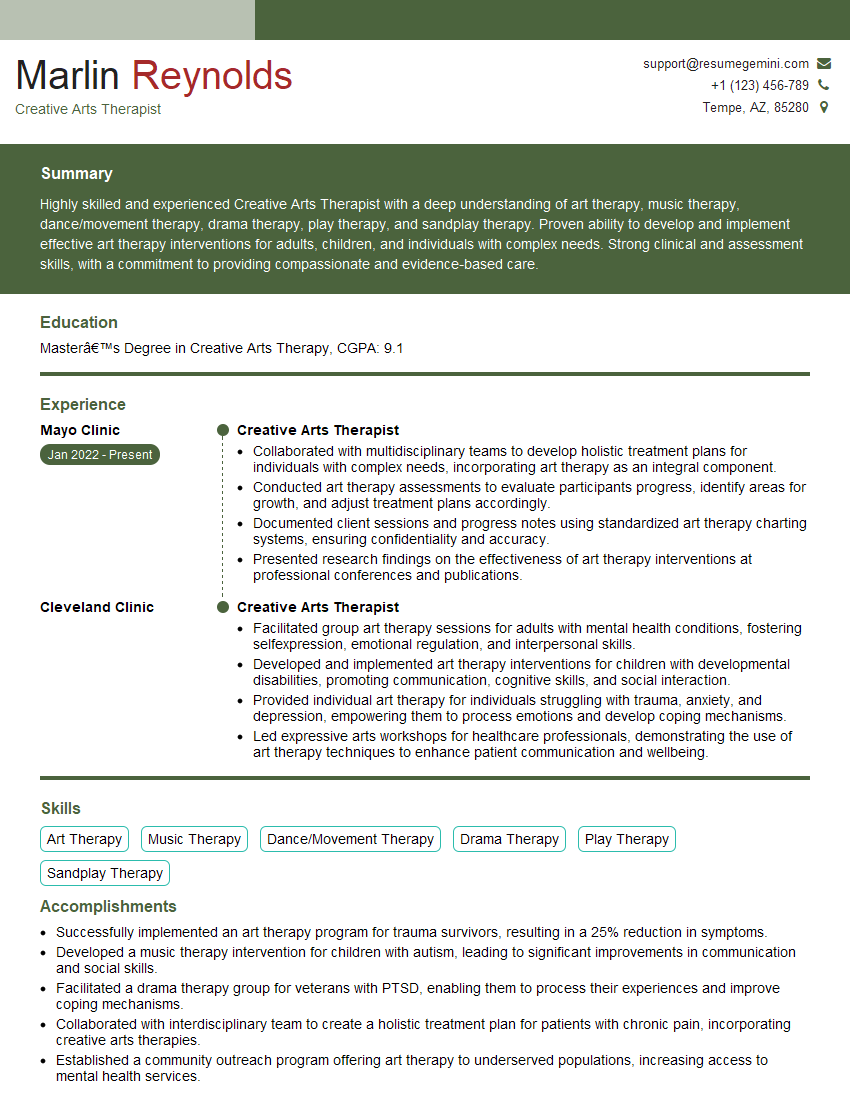
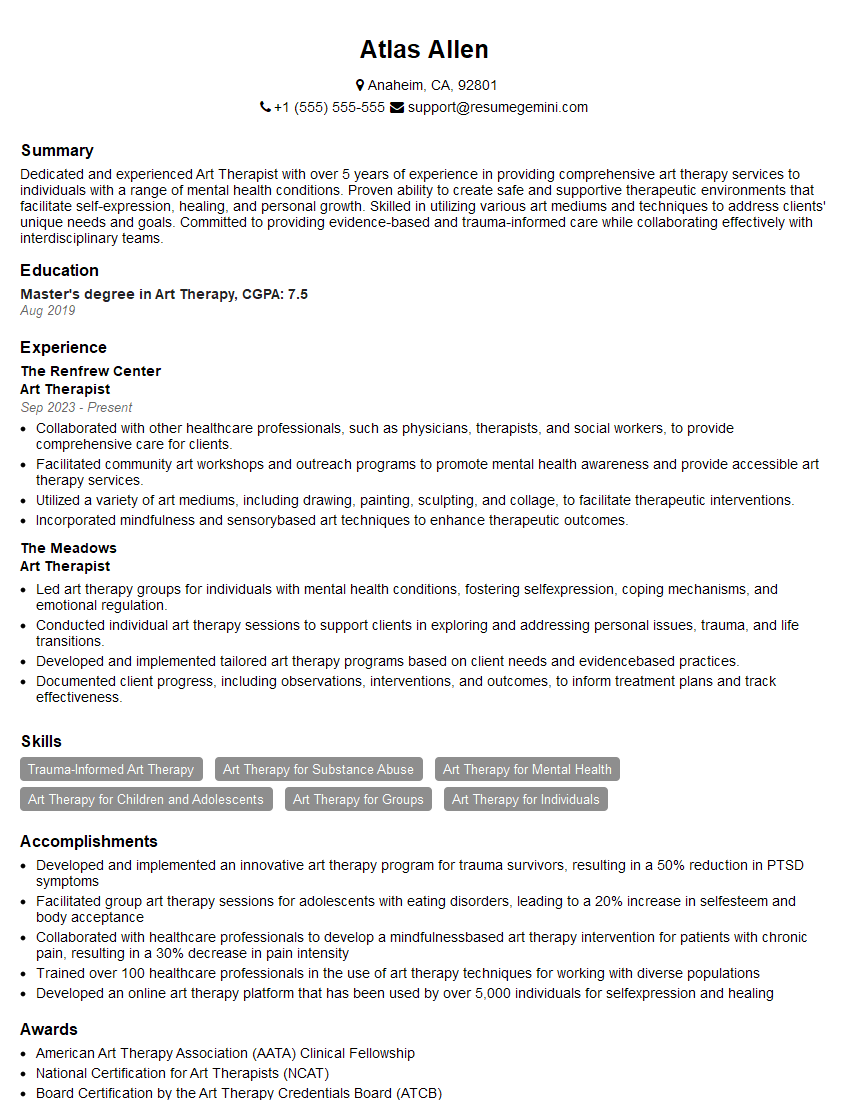
Mastering Art Therapy for Creativity and Innovation opens doors to fulfilling and impactful careers. To maximize your job prospects, a strong, ATS-friendly resume is crucial. ResumeGemini is a trusted resource that can help you craft a compelling resume highlighting your skills and experience. ResumeGemini provides examples of resumes tailored to Art Therapy for Creativity and Innovation, ensuring your application stands out. Invest the time to create a resume that effectively showcases your qualifications – it’s a significant step toward landing your dream role.
Explore more articles
Users Rating of Our Blogs
Share Your Experience
We value your feedback! Please rate our content and share your thoughts (optional).
What Readers Say About Our Blog
To the interviewgemini.com Webmaster.
Very helpful and content specific questions to help prepare me for my interview!
Thank you
To the interviewgemini.com Webmaster.
This was kind of a unique content I found around the specialized skills. Very helpful questions and good detailed answers.
Very Helpful blog, thank you Interviewgemini team.