Unlock your full potential by mastering the most common Conduit Bending and Installation interview questions. This blog offers a deep dive into the critical topics, ensuring you’re not only prepared to answer but to excel. With these insights, you’ll approach your interview with clarity and confidence.
Questions Asked in Conduit Bending and Installation Interview
Q 1. What are the different types of conduit materials commonly used?
Conduit, the protective housing for electrical wiring, comes in various materials, each with its strengths and weaknesses. The most common types include:
- Electrical Metallic Tubing (EMT): Lightweight, thin-walled steel tubing, popular for its flexibility and ease of bending. Ideal for many residential and commercial applications.
- Rigid Metal Conduit (RMC): Heavier, thicker-walled steel conduit offering superior protection. Often used in industrial settings or where greater durability is required. It’s less flexible than EMT and requires more specialized bending tools.
- Intermediate Metal Conduit (IMC): A compromise between EMT and RMC in terms of weight and strength. It offers good protection and is easier to bend than RMC but is more robust than EMT.
- Plastic Conduit (PVC): Lightweight, corrosion-resistant, and cost-effective. Commonly used in underground or damp environments, but less resistant to mechanical damage than metal conduit.
- Flexible Metal Conduit (FMC): Highly flexible, often used for short runs or in areas where tight bends are necessary. It’s typically made of aluminum or steel.
The choice of conduit material depends heavily on the application’s specific requirements, including environmental conditions, mechanical stress, and budget.
Q 2. Explain the process of bending EMT conduit using a hand bender.
Bending EMT conduit with a hand bender is a fundamental skill in electrical work. Here’s the process:
- Measure and mark: Accurately measure and mark the desired bend radius and offset on the conduit using a measuring tape and a marking pencil.
- Set the bender: Position the conduit in the hand bender, ensuring it’s securely held and aligned with the bender’s shoe.
- Apply pressure: Gradually apply pressure to the bender’s handle, smoothly bending the conduit to the marked point. Avoid sudden jerks or excessive force, which can cause kinks or damage.
- Check the bend: Verify the bend radius and offset using a conduit bender, ensuring it meets the required specifications. A slight adjustment may be needed for perfect alignment.
- Repeat as needed: For multiple bends, repeat the process, ensuring that each bend is accurate and does not put stress on previous bends.
Practice is key to mastering this skill. Begin with simpler bends before tackling complex configurations. Remember to always wear safety glasses to protect your eyes from potential metal shavings.
Q 3. How do you determine the correct conduit bend radius?
The conduit bend radius is crucial for maintaining a safe and efficient electrical installation. Incorrect radii can lead to damage to the conductors and difficulty in pulling wires. The minimum bend radius is determined by the conduit’s diameter and material.
Most conduit manufacturers provide charts or tables specifying the minimum bend radius for their products. These charts typically specify the radius in terms of the conduit’s diameter (e.g., a 6x diameter radius for EMT). For example, a 1-inch EMT conduit typically has a minimum bend radius of 6 inches (6 times its diameter).
Always consult the manufacturer’s specifications to determine the correct bend radius for the specific conduit being used. Failing to do so can lead to conduit damage and potential safety hazards.
Q 4. Describe the different types of conduit fittings and their applications.
Conduit fittings are essential for connecting conduit sections, making bends, and terminating runs. Common types include:
- Couplings: Connect two conduit sections of the same size. They provide a continuous run and maintain electrical continuity.
- Elbows: Provide 90-degree bends in the conduit run. They come in various radiuses depending on space constraints.
- Bends: Similar to elbows but can offer bends at angles other than 90 degrees.
- Conduit Bodies (Boxes): Provide space for wire connections and terminations. They are essential for pull boxes or junction boxes.
- Bushings: Protect wires from damage when they enter or exit the conduit. They ensure a smooth transition and provide strain relief.
- Insulating Bushings: Similar to bushings, but they add an extra layer of electrical insulation.
Selecting the right fitting is critical for a safe and efficient installation, considering factors like the conduit material, size, and the specific application’s needs.
Q 5. What safety precautions must be followed when working with conduit?
Safety is paramount when working with conduit. Key precautions include:
- Eye protection: Always wear safety glasses or a face shield to protect your eyes from flying debris during bending or cutting.
- Gloves: Wear work gloves to protect your hands from cuts or abrasions.
- Proper tools: Use appropriately sized and maintained tools to avoid injury or damage to the conduit.
- Lockout/Tagout: Always follow proper lockout/tagout procedures when working near energized electrical systems.
- Fall protection: Use appropriate fall protection equipment when working at heights.
- Proper ventilation: Ensure adequate ventilation when working with certain materials (e.g., paints, solvents).
- Lifting techniques: Use proper lifting techniques to avoid back injuries when handling heavy conduit.
A thorough understanding and adherence to all relevant safety regulations and guidelines is essential for a safe working environment.
Q 6. How do you handle conduit installation in tight spaces?
Installing conduit in tight spaces requires careful planning and specialized techniques. Here are some strategies:
- Use appropriate fittings: Employ fittings designed for tight spaces, such as smaller radius elbows or flexible conduit.
- Pre-fabrication: Fabricate sections of the conduit assembly off-site and then carefully install the pre-assembled sections in the tight space.
- Flexible conduit: Use flexible conduit to navigate around obstacles and tight corners.
- Proper bending techniques: Use appropriate bending techniques to create bends that minimize the overall conduit length.
- Specialized tools: Consider using specialized tools, such as a fish tape or a conduit bender with a smaller radius, to assist with installation.
Often, a combination of these strategies is necessary. Always prioritize safety and take your time to avoid damaging the conduit or injuring yourself.
Q 7. Explain the importance of proper conduit grounding and bonding.
Proper conduit grounding and bonding is crucial for ensuring electrical safety. Grounding provides a path for fault currents to flow to the earth, preventing dangerous voltage buildup and electrical shocks. Bonding connects metallic conduit sections and other metallic components in the electrical system to create a continuous ground path. This prevents voltage differences between metal parts which could lead to hazards.
Improper grounding and bonding can lead to electrical hazards, equipment damage, and even fires. All metallic conduits should be effectively grounded and bonded to the building’s grounding system according to the relevant electrical codes. This typically involves using grounding clamps and connectors at appropriate points in the system. The specific requirements vary depending on the application and local electrical codes. Always follow relevant codes and regulations to ensure safety.
Q 8. What are the common causes of conduit installation errors?
Conduit installation errors stem from various sources, often a combination of improper planning, insufficient skill, and neglecting safety regulations. Common causes include:
- Incorrect Bending Radius: Bending conduit too sharply can damage the internal structure, hindering wire pulling and potentially causing short circuits. Think of it like bending a straw too tightly – it collapses!
- Improper Support and Securing: Insufficient or poorly placed conduit supports can lead to sagging, creating sharp bends and making wire pulling difficult. It’s like trying to hang a heavy picture with only one weak nail.
- Overfilling Conduit: Packing too many wires into the conduit reduces the available space and increases the risk of overheating. Imagine trying to squeeze too many clothes into a small suitcase – it won’t close properly!
- Poor Grounding: Improper grounding can create electrical hazards. Grounding is crucial for safety, like properly grounding appliances to prevent electrical shocks.
- Inadequate Material Selection: Using the wrong type of conduit for the application (e.g., using EMT in corrosive environments) can lead to premature failure. Just like choosing the wrong paint for outdoor use – it’ll peel off quickly.
- Incorrect Installation of Fittings: Improperly installed fittings can create weak points and leaks, compromising the integrity of the system.
Q 9. How do you troubleshoot conduit installation problems?
Troubleshooting conduit installation problems requires a systematic approach. Start by:
- Visual Inspection: Carefully examine the entire conduit run for any obvious issues like kinks, sagging, or loose fittings.
- Identify the Problem Area: Pinpoint the location where the problem occurs (e.g., difficulty pulling wire). You might need a fish tape to check the conduit’s internal condition.
- Check for Obstructions: Use a fish tape or a snake camera to check for obstructions inside the conduit such as debris or incorrectly installed fittings. Sometimes a small piece of debris can cause major problems.
- Verify Conduit Size and Fill: Ensure the conduit is appropriately sized for the number and type of wires being installed. Remember to always consult the fill tables to avoid overcrowding.
- Assess Bending Radii: Check if the bending radii meet the code requirements. Too tight bends can create significant problems in pulling cables.
- Inspect Grounding: Verify that the grounding system is properly installed and functioning. A multimeter can help confirm connectivity.
- Check Support Structures: Make sure all supports are securely fastened and adequately spaced.
If the problem persists, consult the relevant electrical codes and consider seeking help from a qualified electrician.
Q 10. What are the different methods for pulling wires through conduit?
Several methods exist for pulling wires through conduit, each suited to different situations:
- Hand Pulling: For short runs and small wire bundles, this is the simplest method. It’s like pulling a rope through a tube.
- Pulling Grip: These tools attach to the wire bundle, providing a better grip for pulling, particularly useful in long runs or when pulling multiple wires simultaneously. Think of them as extra hands.
- Fish Tape: A flexible steel tape used to navigate bends and obstructions. It acts as a guide for the wire bundle. This is your ‘snake’ to find and clear blockages.
- Pulling Sock: A lubricated sock is pulled through first to reduce friction and ease the pulling process. This reduces friction like a lubricant for a car engine.
- Power Pulling Equipment: For very long runs or large bundles of wires, motorized pulling equipment is often necessary. This is the heavy machinery for the tough jobs.
- Compressed Air: Sometimes, compressed air can help push a bundle of wires through a conduit.
The choice of method depends on factors such as conduit length, number of wires, bend radii, and obstacles.
Q 11. Describe the process of installing a conduit system for a commercial building.
Installing a conduit system in a commercial building is a complex process requiring careful planning and adherence to codes. The steps generally include:
- Design and Planning: This phase involves creating detailed drawings showing the conduit routes, sizes, and locations of all components. It includes considering the future needs of the building.
- Material Procurement: Selecting the appropriate conduit type (rigid, EMT, flexible), fittings, and supports based on the application. This ensures that the right type of material is chosen for the job.
- Conduit Bending and Installation: Using bending tools to create accurate bends, ensuring proper support and securing the conduit to the building structure. This requires precision and adherence to codes.
- Wire Pulling: Employing appropriate pulling methods to safely and efficiently install the wires within the conduit. This might involve the methods mentioned in Question 3.
- Testing and Inspection: Ensuring the system is properly grounded and meets all relevant electrical codes. This final stage is crucial for safety.
- Documentation: Maintaining detailed records of the materials used and installation process. This helps in case of future maintenance.
Thorough planning, precise execution, and adherence to safety regulations are essential for a successful commercial conduit installation.
Q 12. How do you calculate the required conduit size for a given wire fill?
Calculating the required conduit size involves determining the total cross-sectional area of the wires and comparing it to the available space inside the conduit. This is done using fill tables provided in electrical codes such as the National Electrical Code (NEC). These tables consider factors like the number of conductors, their insulation type, and the conduit type. You cannot simply add the area of each individual wire; you need to use the appropriate fill percentage allowed by the code. For example, 40% fill for PVC conduit. The formula is often not directly given, but instead, you consult a table showing the derated ampacity of the wire based on the number of wires and the conduit size. If your total wire area exceeds the allowable fill percentage, you must select a larger size conduit.
A simplified analogy would be packing boxes into a truck. You need to know the size of the boxes (wires) and the space inside the truck (conduit) to ensure there’s enough room and safe transportation.
Q 13. What are the regulations and codes that govern conduit installation?
Conduit installation is governed by several regulations and codes, most prominently the National Electrical Code (NEC) in the United States and equivalent standards in other countries. These codes dictate:
- Conduit Types and Materials: Specifies the acceptable materials for different applications (e.g., rigid metal conduit for hazardous locations).
- Bending Radii: Sets minimum bending radii to prevent damage to the conduit and its contents.
- Support Spacing: Defines the maximum distances between conduit supports to prevent sagging.
- Grounding Requirements: Mandates proper grounding methods to ensure electrical safety.
- Wire Fill: Specifies the maximum percentage of conduit fill to prevent overheating.
- Installation Methods: Outlines proper installation techniques for various conduit types.
Adherence to these codes is crucial to ensure the safety and reliability of electrical systems. Failure to comply can result in significant penalties and risks.
Q 14. Explain the difference between rigid and flexible conduit.
Rigid and flexible conduits differ primarily in their flexibility and applications:
- Rigid Conduit (RMC): Strong, rigid metal conduit offering superior protection against physical damage. It’s like a solid metal pipe. It requires more skilled bending techniques and is generally used for more permanent installations.
- Flexible Conduit (FMC): Made of flexible materials such as metallic or non-metallic materials, allowing easier installation in tight spaces or around curves. It’s like a very strong, flexible hose. It often offers less protection than rigid conduit, especially from physical impact.
The choice between rigid and flexible conduit depends on the specific requirements of the installation. Rigid conduit is better suited for areas requiring high protection, while flexible conduit offers flexibility in challenging installations. Think of it like choosing between a sturdy wooden ladder (rigid) and a flexible rope ladder (flexible) depending on your need for stability versus maneuverability.
Q 15. What tools and equipment are necessary for conduit bending and installation?
Conduit bending and installation requires a range of specialized tools and equipment. The exact tools will vary depending on the job, but here’s a comprehensive list:
- Conduit Benders: These come in various types – hand benders for smaller conduits, hydraulic benders for larger and more precise bends, and even electric benders for increased efficiency on larger projects. The choice depends on conduit size and material.
- Measuring Tools: Accurate measurement is crucial. This includes measuring tapes, bender shoes (for setting the bend radius), and protractors or angle finders for precise bend angles.
- Cutting Tools: A tubing cutter or hacksaw is essential for cutting conduit to the correct length. A sharp blade is important to prevent crushing or damaging the conduit.
- Rethreading Tools: If the conduit needs to be rethreaded after cutting, a die set or thread chaser is required.
- Fish Tape or Rods: These are used to pull wires and cables through the conduit after installation.
- Safety Equipment: This is paramount. Safety glasses, gloves, sturdy work boots, and potentially a hard hat are essential to protect against injuries from sharp edges, falling objects, and other hazards.
- Level: Ensuring the conduit runs are level and plumb is critical for a professional installation.
- Other Useful Tools: A conduit bender’s box, various sizes of connectors and couplings, and possibly a pipe threader depending on the installation.
For example, on a recent job installing EMT conduit in a commercial building, I used a hydraulic bender for the larger runs and a hand bender for tighter spaces. Accurate measurement was paramount to ensure the bends lined up correctly with the electrical boxes.
Career Expert Tips:
- Ace those interviews! Prepare effectively by reviewing the Top 50 Most Common Interview Questions on ResumeGemini.
- Navigate your job search with confidence! Explore a wide range of Career Tips on ResumeGemini. Learn about common challenges and recommendations to overcome them.
- Craft the perfect resume! Master the Art of Resume Writing with ResumeGemini’s guide. Showcase your unique qualifications and achievements effectively.
- Don’t miss out on holiday savings! Build your dream resume with ResumeGemini’s ATS optimized templates.
Q 16. How do you ensure the proper alignment of conduit bends?
Proper alignment of conduit bends is crucial for efficient wire pulling and a professional-looking installation. Here’s how I ensure this:
- Accurate Measurement and Marking: I meticulously measure and mark the conduit before making any bends using a measuring tape and bender shoe. This ensures that each bend is the correct length and radius.
- Use of Bender Shoes: Bender shoes (also called radius benders) are essential for consistent bend radii. Each shoe is designed for a specific bend radius, helping to produce consistent, professional-looking bends.
- Careful Bending Technique: I apply even pressure when bending the conduit to avoid kinks or deformations. A slow, steady hand is crucial here, especially with rigid conduit.
- Reference Points: Using reference points, like pre-installed boxes or existing structures, helps to ensure the bends accurately align with the desired path. This is especially important when making multiple bends in a run.
- Regular Checks and Adjustments: Throughout the bending process, I constantly check the alignment against pre-planned layouts or drawings. Small adjustments are made as necessary to ensure accuracy.
Imagine bending a drinking straw. If you bend it too quickly or unevenly, it’ll kink. The same principle applies to conduit. A slow and controlled bending technique using the proper tools is vital for avoiding kinks and achieving precise alignment.
Q 17. Describe your experience working with different types of conduit benders.
My experience encompasses a variety of conduit benders, each with its strengths and limitations. I’m proficient with:
- Hand Benders: These are excellent for smaller diameter conduits and tight spaces, offering flexibility and portability. They are ideal for quick bends on small projects, but are more physically demanding.
- Hydraulic Benders: These are my go-to tools for larger-diameter conduits and precise bends on bigger projects. They provide greater leverage and consistency, minimizing physical strain, resulting in less error.
- Electric Benders: While less common on smaller projects, electric benders offer efficiency and consistent bends on large-scale installations. The electric motor significantly reduces the physical effort involved in creating bends and allows for consistent bends across numerous runs.
For instance, on a recent renovation project, I used hand benders for the smaller runs within walls, where space was limited. For the main runs in the open ceiling area, I used a hydraulic bender for faster and more accurate bending on the larger diameter conduits.
Q 18. How do you maintain the quality of conduit bends?
Maintaining the quality of conduit bends is crucial for a successful installation. My approach focuses on:
- Proper Tool Selection: Selecting the right bender for the conduit size and material is vital. Using an incorrect bender can lead to crushed or deformed conduit.
- Precise Measurement and Marking: Accurate measurements and clear markings prevent mistakes that could lead to incorrect bend angles or radii.
- Controlled Bending Technique: Applying even pressure and avoiding jerky movements ensures clean bends without kinks or deformations.
- Regular Inspection: Regularly inspecting the bends during the process allows for quick identification and correction of any imperfections.
- Careful Handling: Protecting the bends from damage after they’ve been made prevents crushing or warping during further installation.
Think of it like sculpting. A good sculptor doesn’t rush the process; they carefully plan each step and take their time. The same principle applies to conduit bending. Precision and patience are key to achieving high-quality bends.
Q 19. What are the challenges you have faced while installing conduit?
Conduit installation presents various challenges, some of the most common include:
- Obstructions: Encountering unexpected obstructions like pipes, beams, or other utilities within the wall or ceiling cavities often necessitates creative solutions and sometimes rerouting.
- Difficult Access: Working in cramped or confined spaces can be challenging and requires extra care to avoid damage to the conduit or injury to myself.
- Material Variations: Dealing with different types of conduit (EMT, rigid, flexible) requires adapting techniques to each material’s properties and characteristics.
- Coordination with Other Trades: On-site coordination with plumbers, HVAC technicians, and other trades is crucial to avoid conflicts and ensure a safe and efficient workflow.
- Unforeseen Conditions: Sometimes I encounter unforeseen conditions, such as hidden obstructions or unexpected changes in the building structure, which can cause delays and require on-the-spot problem-solving.
For example, on one project, we discovered an unexpected gas line running precisely where the conduit was planned. We had to carefully reroute the conduit to avoid conflict, requiring detailed planning and careful execution.
Q 20. How do you address issues related to conduit sag or deformation?
Conduit sag and deformation compromise the integrity of the installation. My approach to addressing these issues is:
- Proper Support: Installing adequate support structures such as straps or brackets at appropriate intervals, depending on the conduit’s length and material, prevents sagging. The support should be evenly spaced to ensure even weight distribution.
- Correct Bending Techniques: As discussed earlier, employing proper bending techniques minimizes the risk of conduit deformation.
- Careful Handling: Handling the conduit with care during installation is crucial to avoid accidental damage or stress points leading to deformation or sag.
- Material Selection: Choosing the correct material based on the installation’s requirements ensures durability and prevents sagging due to weight or temperature changes.
- Remediation: If sag or deformation is already present, I assess the severity. Minor sags might be resolved with additional support. Significant deformations may require replacement of the affected conduit section.
Think of a clothesline. Without proper supports, the line sags. Similarly, conduits require adequate support to maintain their integrity and prevent sagging, ensuring proper wire pulling.
Q 21. Explain your approach to resolving conflicts with other trades while on-site
Conflict resolution with other trades is essential for a smooth project. My approach is proactive and collaborative:
- Clear Communication: Open and clear communication is vital. I actively communicate my work schedule and potential conflicts with other trades beforehand.
- Coordination Meetings: Attending coordination meetings where all trades are present is crucial for identifying and resolving potential conflicts early on.
- Respectful Collaboration: Treating other tradespeople with respect and understanding is key to building a positive working relationship. We’re all working towards the same goal.
- Compromise and Problem Solving: When conflicts arise, I prioritize finding mutually acceptable solutions. This may involve adjusting my work schedule or finding alternative routing for the conduit.
- Escalation Protocol: If conflicts cannot be resolved directly, I follow the project’s escalation protocol to involve the project manager or supervisor.
For example, on a recent project, I had to coordinate with a plumber whose pipes were running near my planned conduit route. Through respectful communication, we found a compromise that satisfied both trades, and prevented any conflicts.
Q 22. Describe your understanding of NEC (National Electrical Code) requirements related to conduit.
The National Electrical Code (NEC) is the backbone of safe electrical installations in the US. Regarding conduit, the NEC dictates numerous requirements focusing on safety, durability, and code compliance. This includes specifying appropriate conduit types for different environments (e.g., rigid metal conduit (RMC) for industrial settings, PVC for less demanding applications), minimum bend radii to prevent damage to wires, proper grounding and bonding practices, and the correct methods for supporting and securing the conduit to prevent sagging or accidental damage. For instance, Article 300 addresses general requirements for wiring methods, while Article 358 specifically covers requirements for rigid metal conduit. Ignoring these stipulations can lead to significant safety hazards and potential legal repercussions.
One crucial aspect is the fill percentage of the conduit. The NEC limits the percentage of conduit space that can be occupied by wires to prevent overheating and ensure sufficient airflow. Overfilling can lead to excessive heat buildup, potentially causing fires. Proper sizing of the conduit based on the number and type of wires is therefore critical and requires precise calculations based on NEC tables. I always consult the NEC and utilize reputable calculation tools to guarantee I stay within the prescribed limits.
Q 23. How do you ensure proper ventilation in conduit systems?
Proper ventilation in conduit systems is crucial to prevent overheating and maintain the longevity of the electrical system. Heat buildup within conduits can damage insulation, cause premature failure of wires and connectors, and even pose a fire risk. The methods for ensuring ventilation depend on the type of conduit and the application.
- For long conduit runs: I ensure sufficient pull boxes or junction boxes are incorporated at intervals to allow for heat dissipation. These boxes provide space for air circulation and make pulling wires easier.
- Ventilation fittings: Special ventilation fittings are available for specific conduit types, designed to allow for the flow of air. These are particularly useful in enclosed spaces or areas with limited air circulation.
- Proper conduit sizing: Selecting the right conduit size is also important. Larger diameter conduits allow for more airflow and reduce the risk of overheating.
- Avoid overfilling: Sticking to the NEC’s fill percentage limits ensures there is sufficient space for air circulation. I always carefully calculate the required conduit size to accommodate all wires without exceeding the allowable fill.
Imagine a conduit as a sealed pipe. Without proper ventilation, the heat generated by the wires would be trapped, leading to potential problems. By following these guidelines, we ensure the system operates safely and efficiently.
Q 24. How do you work safely at heights when installing conduit?
Safety at heights is paramount when installing conduit. Falls are a serious risk, and I never compromise on safety procedures. My approach always includes:
- Proper fall protection: Using harnesses, lanyards, and appropriate anchor points is non-negotiable, particularly when working above 6 feet. I always inspect my equipment thoroughly before beginning work at height.
- Scaffolding or lifts: For extensive work at height, scaffolding or lift platforms provide a stable and safe working environment. I prioritize the use of these tools when appropriate.
- Secure footing: Ensuring a solid and stable footing is critical. I avoid working in precarious positions and always have a spotter when necessary.
- Appropriate clothing and footwear: Wearing sturdy, non-slip footwear and clothing that doesn’t hinder movement is essential.
- Regular safety checks: I conduct regular safety checks throughout the work process to identify potential hazards and address them promptly.
Ignoring these procedures can have catastrophic consequences. My dedication to safety is unwavering; I treat every job as if my own life depended on it.
Q 25. What is your experience with different types of wire pulling lubricants?
My experience encompasses various wire pulling lubricants, each suited for different situations. Selecting the right lubricant can significantly impact the ease and speed of pulling wires through conduits. Factors like conduit material, wire type, and the length of the run influence my choice.
- Dry lubricants: These are excellent for clean applications and when compatibility with certain materials is a concern. They minimize residue.
- Wet lubricants: These are generally more effective for long runs and difficult pulls, as they provide better lubrication and reduce friction. However, they can sometimes leave residue.
- Specialty lubricants: These include lubricants designed for specific conduit types or wire materials. For instance, I might use a lubricant formulated for high-temperature applications.
I’ve found that understanding the properties of each lubricant is crucial. For example, a lubricant that works well with PVC conduit might not be suitable for RMC. I’ve also learned to appreciate the importance of applying the lubricant evenly to avoid creating bottlenecks and ensure efficient wire pulling.
Q 26. Describe your experience with using a conduit bender with a power drive.
Operating a power-driven conduit bender requires both skill and caution. It significantly speeds up the bending process, especially for larger conduits, but improper use can lead to inaccurate bends and even damage to the conduit. I’m proficient in using these machines, ensuring that:
- The conduit is properly secured: The bender must be securely clamped to prevent movement or slippage during the bending process.
- The correct bending shoe is used: The size and type of bending shoe must match the conduit diameter to create the correct bend radius and prevent damage.
- The bending operation is gradual and controlled: Rushing the bending process can result in inaccurate bends or kinks.
- Regular maintenance is performed: Keeping the machine well-maintained is crucial to ensure accurate and safe operation.
For example, a power bender is indispensable when working with large diameter conduits or in situations where many bends are needed quickly. However, precision is still key; I rely on my experience to ensure a clean, accurate bend every time.
Q 27. How do you handle situations where conduit needs to be installed around existing obstructions?
Installing conduit around existing obstructions presents unique challenges. My approach involves careful planning and flexibility to ensure a safe and efficient installation. The strategy depends on the nature and location of the obstruction.
- Offsetting the conduit: This is commonly used to bypass small obstructions. Precise measurements and bending techniques are crucial to achieve a smooth, unobstructed path for the wires.
- Using conduit fittings: Various fittings are available that allow for navigating around complex obstructions. These include couplings, elbows, and various adaptors. I select the fitting that best suits the situation.
- Adding pull boxes or junction boxes: These can be strategically placed to provide access points for maneuvering around obstructions, making the pulling of wires much easier.
- Coordinate with other trades: When working around other trades’ installations (such as plumbing or HVAC), coordination and communication are crucial to avoid conflicts and potential damage.
For instance, I once encountered a situation where conduit had to be installed around a large ventilation duct. By using a combination of offset bends and a strategically placed junction box, I was able to navigate the obstruction without compromising the integrity of the electrical system.
Q 28. What are your preferred methods for labeling and identifying conduit runs?
Clear and consistent labeling is critical for troubleshooting and future maintenance of the conduit system. I utilize a combination of methods to ensure proper identification:
- Conduit markers: These are durable, weather-resistant markers that are attached directly to the conduit. I ensure they are clearly visible and include information such as circuit number, wire type, and destination.
- Color-coded conduit: Different colored conduits can be used to identify separate circuits or systems. I maintain a consistent color scheme throughout a project.
- Schematic diagrams and drawings: Detailed drawings are produced before and during the installation. These serve as a comprehensive visual representation of the conduit routing and wiring configuration.
- Digital documentation: I utilize photographic and video documentation to record the exact layout of the conduit and its associated wiring.
Think of it like a road map. Clear labeling makes it much easier for anyone to follow the conduit run and easily identify which wires serve what purpose. This is particularly crucial in complex systems, facilitating quick troubleshooting and repairs.
Key Topics to Learn for Conduit Bending and Installation Interview
- Conduit Material Selection: Understanding the properties of various conduit materials (e.g., PVC, EMT, rigid steel) and their appropriate applications based on project requirements and safety regulations.
- Bending Techniques and Tools: Mastering various bending methods (e.g., hand bending, using a bender) and the proper use of tools to achieve accurate bends and avoid conduit damage. Practical application includes understanding offsets, bends, and saddles.
- Safety Regulations and Best Practices: Familiarity with OSHA and NEC standards related to conduit bending and installation, including proper grounding, bonding, and personal protective equipment (PPE) usage.
- Installation Procedures: Understanding the steps involved in installing conduit systems, including proper support methods, pulling wire/cable, and termination techniques. This includes working with different types of fittings and boxes.
- Troubleshooting and Problem Solving: Ability to identify and resolve common issues encountered during conduit bending and installation, such as kinks, inaccurate bends, or pulling tensions.
- Blueprint Reading and Interpretation: Understanding and interpreting electrical blueprints to accurately plan and execute conduit installations according to specifications.
- Calculating Bend Radii and Distances: Applying mathematical principles to accurately determine bend radii and distances needed for complex conduit runs.
Next Steps
Mastering Conduit Bending and Installation opens doors to a rewarding career in the electrical industry, offering opportunities for advancement and specialization. To maximize your job prospects, a well-crafted, ATS-friendly resume is crucial. ResumeGemini can help you create a professional and effective resume that highlights your skills and experience. We provide examples of resumes tailored to Conduit Bending and Installation to guide you in showcasing your qualifications effectively. Take the next step towards your dream career – build your best resume with ResumeGemini.

Electrical Contractor Resume Sample
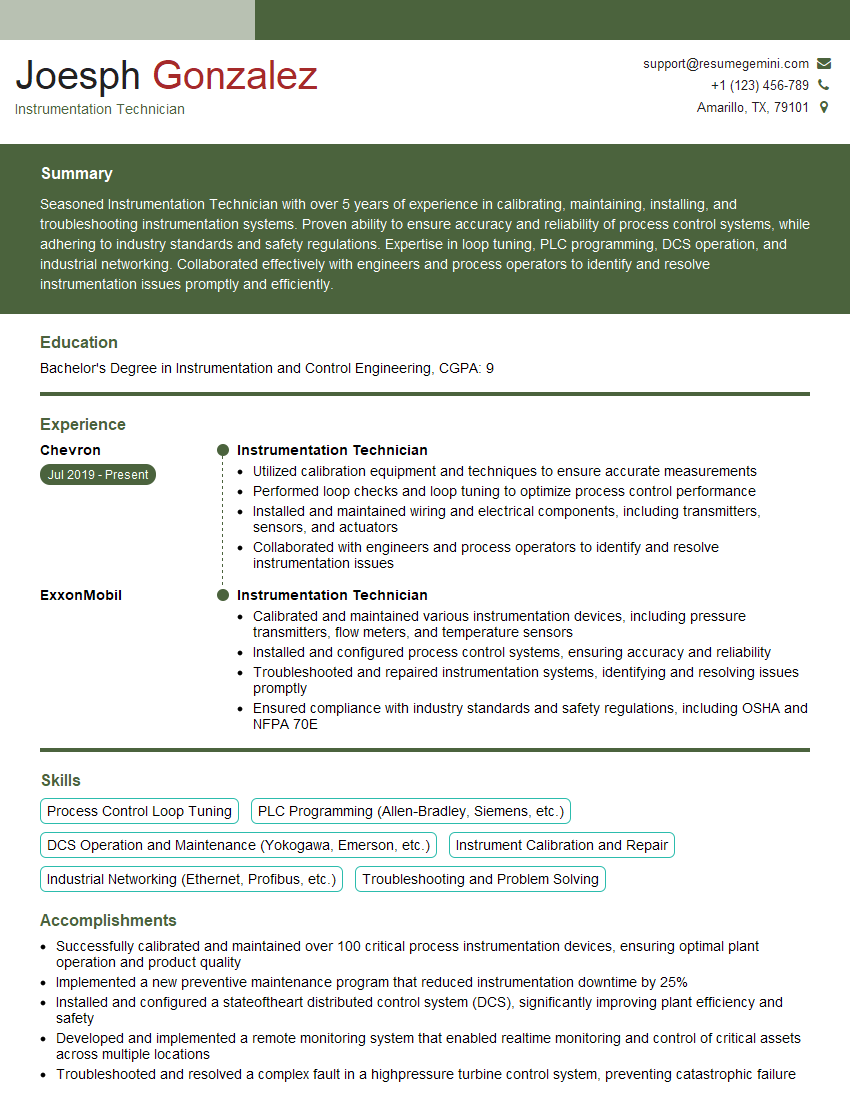
Instrumentation Technician Resume Sample
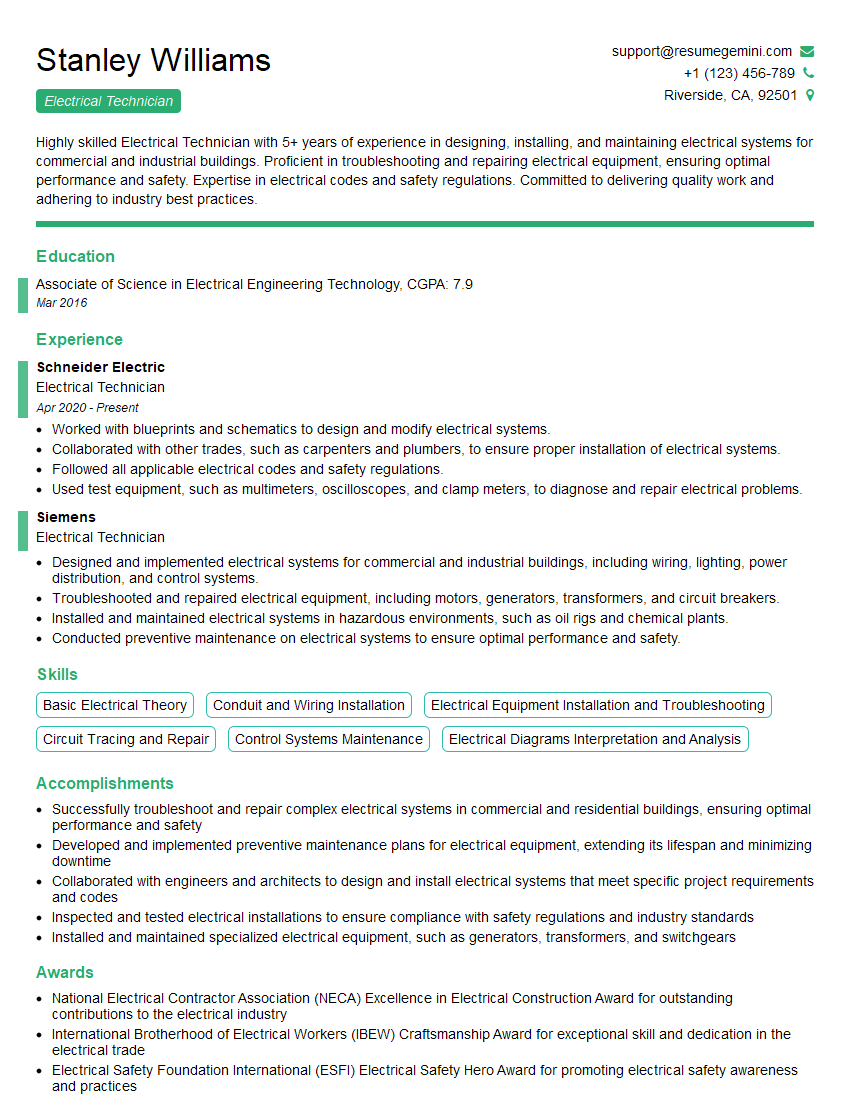
Electrical Technician Resume Sample

Commercial Electrician Resume Sample
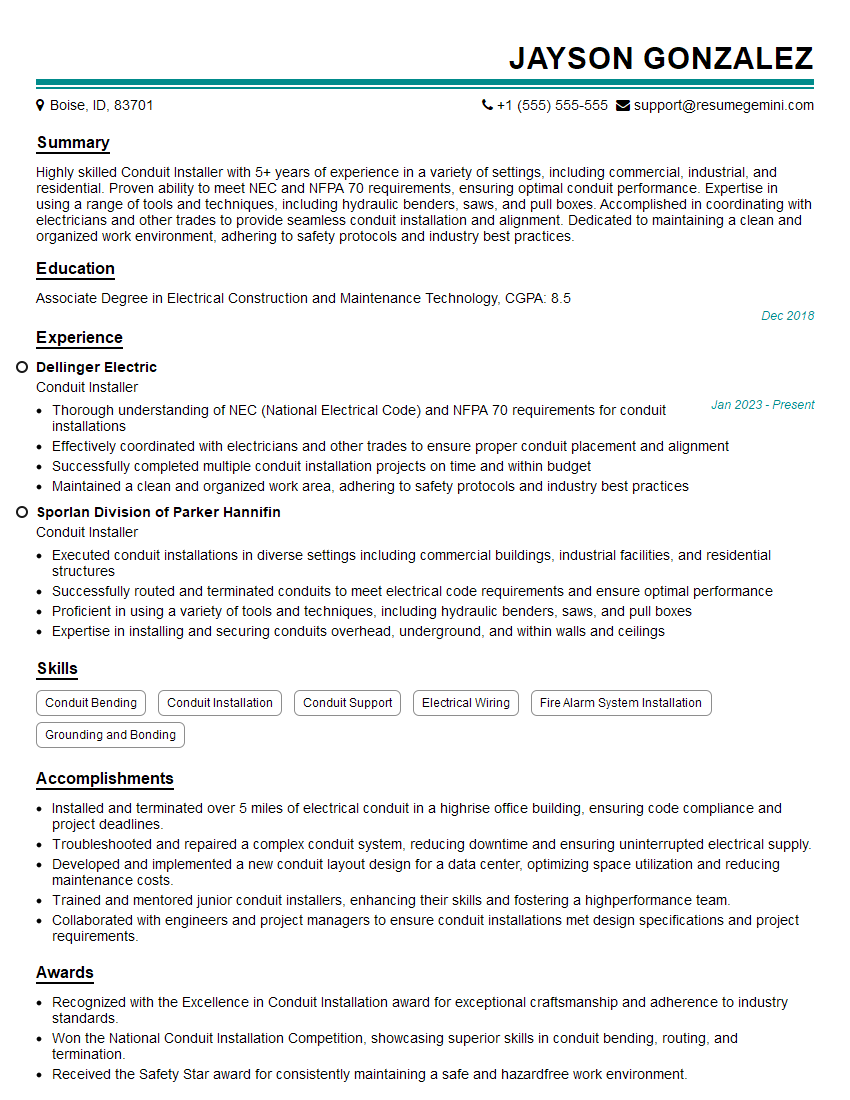
Conduit Installer Resume Sample

Construction Electrician Resume Sample
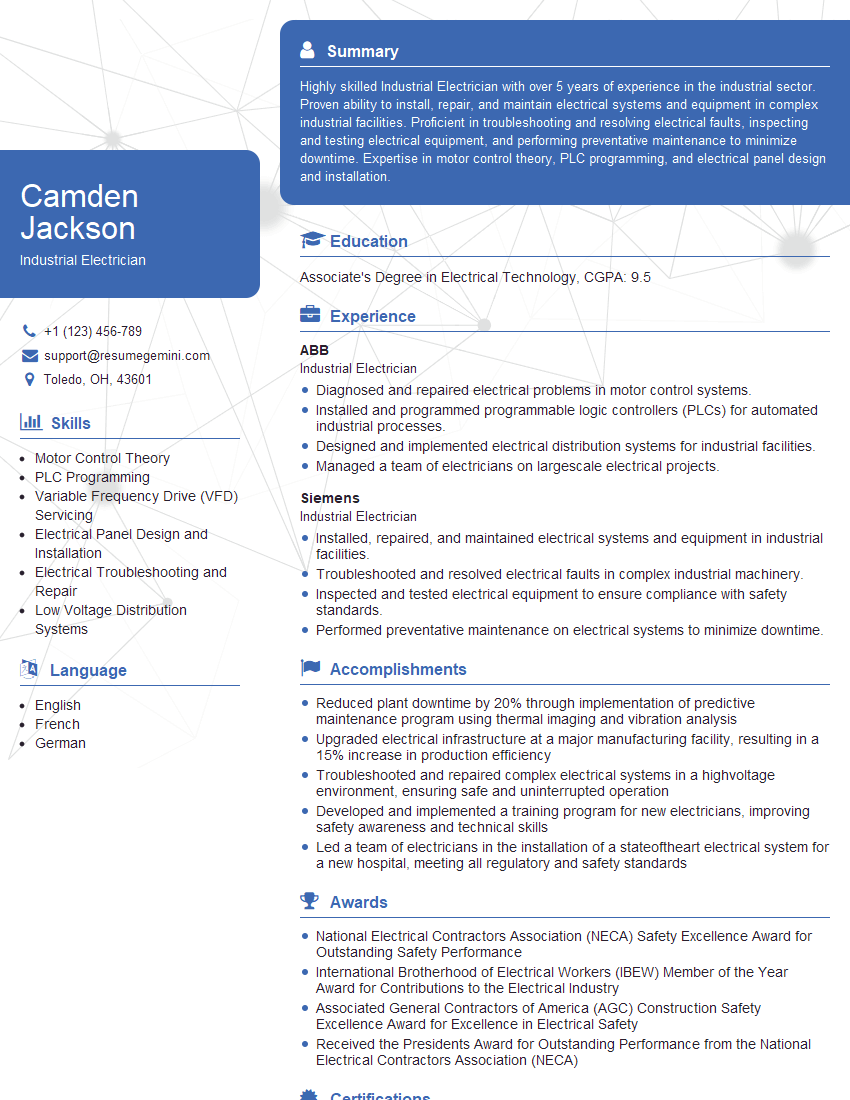
Industrial Electrician Resume Sample

Journeyman Electrician Resume Sample

Apprentice Electrician Resume Sample

Control Systems Technician Resume Sample
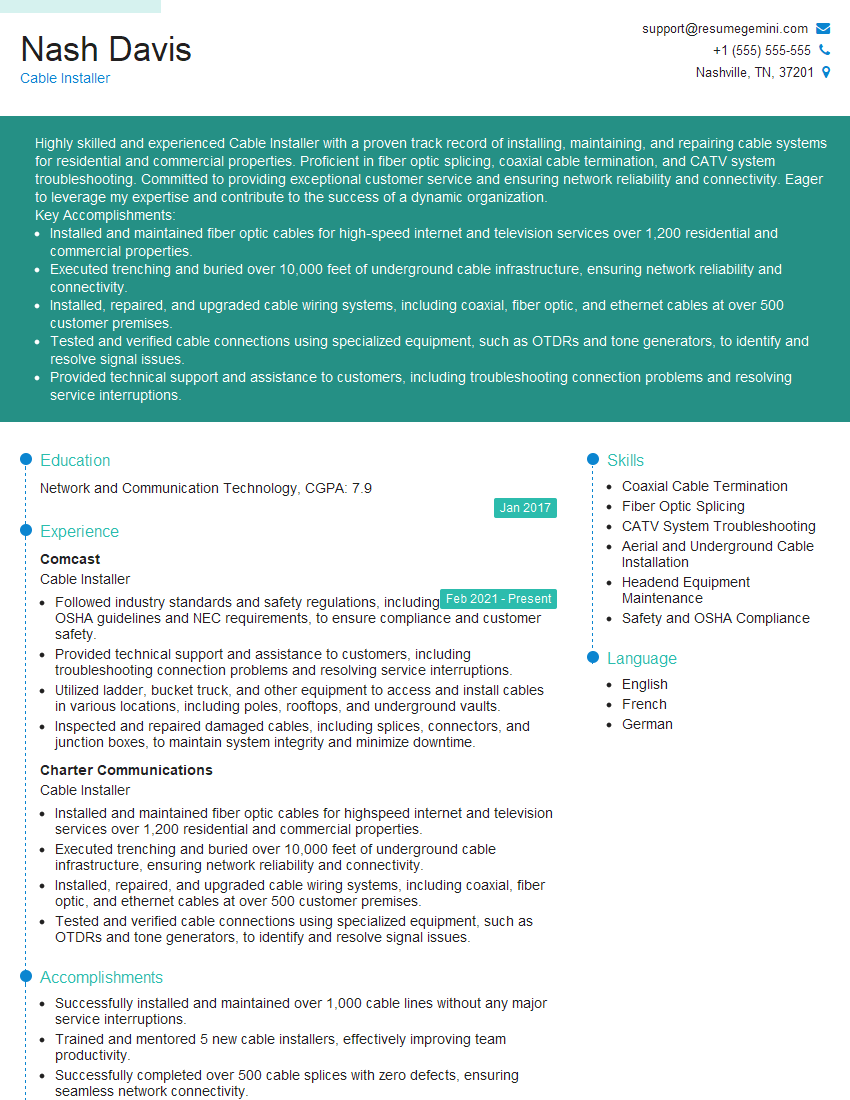
Cable Installer Resume Sample
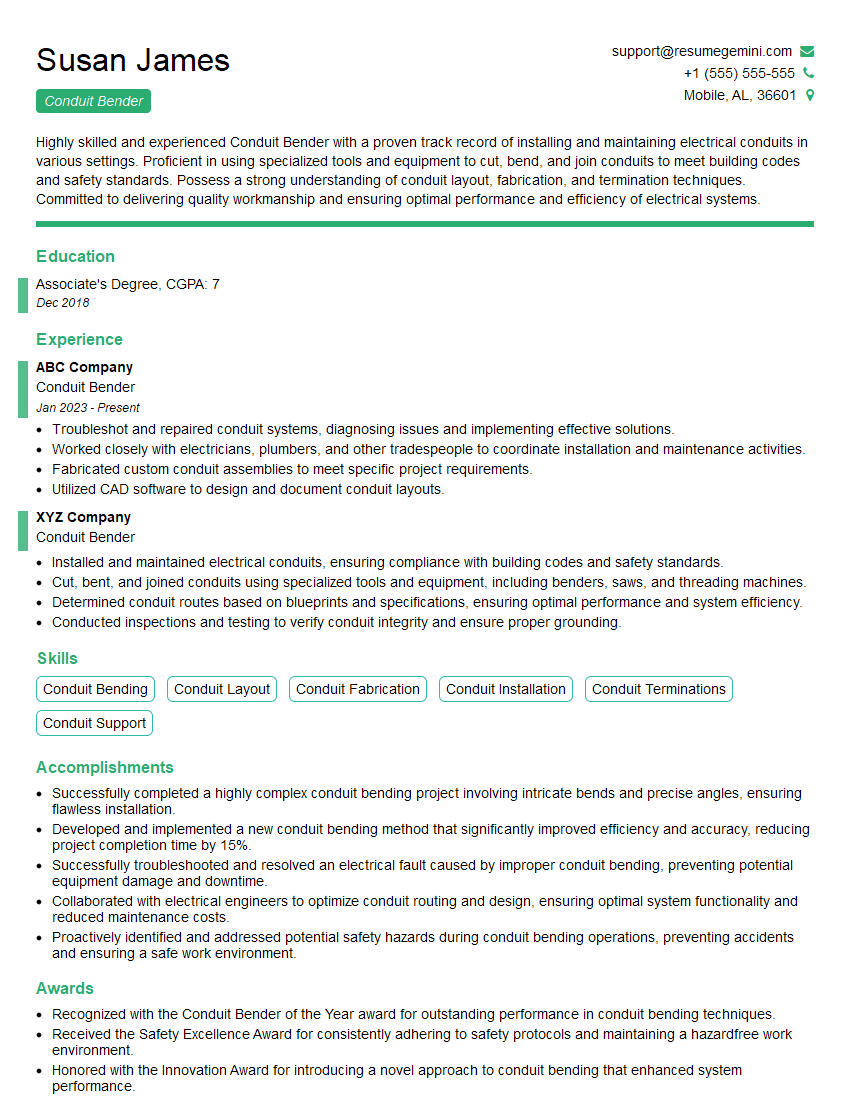
Conduit Bender Resume Sample
Explore more articles
Users Rating of Our Blogs
Share Your Experience
We value your feedback! Please rate our content and share your thoughts (optional).
What Readers Say About Our Blog
To the interviewgemini.com Webmaster.
Very helpful and content specific questions to help prepare me for my interview!
Thank you
To the interviewgemini.com Webmaster.
This was kind of a unique content I found around the specialized skills. Very helpful questions and good detailed answers.
Very Helpful blog, thank you Interviewgemini team.