The right preparation can turn an interview into an opportunity to showcase your expertise. This guide to CSM interview questions is your ultimate resource, providing key insights and tips to help you ace your responses and stand out as a top candidate.
Questions Asked in CSM Interview
Q 1. Describe your experience with customer segmentation.
Customer segmentation is the process of dividing your customer base into groups based on shared characteristics. This allows for more targeted and effective communication, support, and product development. Instead of treating every customer the same, we identify key traits to create tailored strategies.
For example, in a SaaS company, I might segment customers by:
- Company size: Small businesses, mid-market, enterprises – each have different needs and budgets.
- Industry: Healthcare, finance, education – industry-specific challenges require tailored solutions.
- Customer lifetime value (CLTV): High-value customers require more personalized attention and proactive support.
- Product usage: Power users vs. infrequent users – this influences onboarding and feature recommendations.
By understanding these segments, we can create dedicated strategies for each group. This improves customer satisfaction, increases retention, and boosts overall success.
Q 2. How do you define Customer Success?
Customer Success is a proactive, strategic approach focused on driving customer value and achieving their desired outcomes with your product or service. It’s more than just customer support; it’s about building a long-term, mutually beneficial relationship that goes beyond the initial sale. It’s about ensuring customers not only understand how to use your product, but also how to achieve their business goals *with* your product.
Think of it as a partnership – we’re invested in their success as much as they are.
Q 3. What key metrics do you track to measure customer success?
Measuring Customer Success involves tracking a variety of key metrics. These metrics should align with your business objectives and customer goals. Key metrics I focus on include:
- Customer Satisfaction (CSAT): Regular surveys to gauge overall happiness.
- Customer Health Score (CHS): A composite score reflecting various factors like product usage, engagement, and support interactions.
- Net Promoter Score (NPS): Measures customer loyalty and willingness to recommend your product.
- Customer Churn Rate: Tracks the percentage of customers who stop using your product or service.
- Customer Lifetime Value (CLTV): Predicts the total revenue a customer will generate over their relationship with your company.
- Product Adoption Rate: Measures how quickly and effectively customers are using key features of your product.
The specific metrics will vary depending on the business and the product, but the core idea is to gain a holistic view of customer health and satisfaction.
Q 4. Explain your process for identifying at-risk customers.
Identifying at-risk customers is crucial for proactive intervention. My process involves a multi-faceted approach, combining quantitative and qualitative data:
- Data Analysis: Monitor key metrics like login frequency, feature usage, support tickets, and CSAT scores. Declines in these areas can indicate potential problems.
- Customer Health Scoring: Utilize a CHS system to identify customers falling below a predefined threshold. This provides a clear, objective measure of risk.
- Regular Check-ins: Proactive calls and emails to engage with customers and identify any challenges early on. These conversations are invaluable for uncovering issues not reflected in data.
- Qualitative Feedback: Analyze customer feedback from surveys, reviews, and support interactions for patterns or recurring complaints.
Once at-risk customers are identified, we create tailored intervention plans – this could range from providing extra training to addressing specific product issues or offering dedicated support.
Q 5. How do you build strong customer relationships?
Building strong customer relationships requires a consistent and thoughtful approach focusing on empathy, understanding, and proactive engagement. I believe in:
- Personalized Communication: Addressing customers by name, understanding their individual needs and goals, and tailoring communication to their preferences.
- Proactive Engagement: Reaching out regularly, not just when there’s a problem. This could involve sharing relevant updates, offering valuable resources, or simply checking in.
- Active Listening: Truly understanding the customer’s perspective, needs, and challenges. This means asking questions, paying attention to their feedback, and responding thoughtfully.
- Empathetic Support: Responding to issues with understanding and compassion. Always strive to exceed expectations in addressing their concerns.
- Building Trust and Transparency: Being honest, keeping commitments, and providing clear and consistent communication.
By consistently demonstrating these qualities, you build rapport and foster loyalty that extends beyond a single transaction.
Q 6. Describe a time you had to manage a difficult customer situation.
In a previous role, we had a large enterprise client who experienced significant technical challenges implementing our software. They were frustrated with the downtime and felt our support team wasn’t responsive enough. This resulted in escalating tensions and threats to cancel their contract.
My approach involved:
- Active Listening and Empathy: I scheduled a series of calls to understand their frustrations and the impact of the downtime on their business.
- Collaboration and Transparency: We assembled a dedicated team to work on resolving the technical issues. We kept them updated on our progress and acknowledged their concerns.
- Problem Solving: We implemented a series of short-term fixes to minimize downtime and a long-term plan to prevent similar incidents.
- Accountability and Follow-up: We took responsibility for the problems and proactively followed up to ensure the issues were completely resolved.
Through proactive communication and a commitment to solving the issues, we were able to salvage the relationship and retain the client.
Q 7. How do you handle conflicting priorities between different customer needs?
Balancing conflicting customer needs requires a structured approach. I use a prioritization framework that combines objective data with subjective judgment:
- Data-Driven Assessment: Assess the impact of each need on key metrics like CLTV, churn risk, and overall customer health. This provides a quantitative basis for prioritization.
- Strategic Alignment: Align customer needs with overall business strategy. Prioritize needs that support key objectives and contribute to long-term success.
- Communication and Transparency: Communicate clearly with all involved customers. Explain the rationale behind prioritization decisions and manage expectations.
- Negotiation and Compromise: Where possible, seek creative solutions that address multiple needs. This might involve phased implementation or alternative solutions.
- Continuous Monitoring and Adjustment: Continuously monitor the impact of decisions and be prepared to adjust priorities based on changing circumstances.
Essentially, it’s about finding a balance between serving individual needs and ensuring the long-term health and success of the overall customer base.
Q 8. What is your experience with Customer Success platforms (e.g., Gainsight, Totango)?
My experience with Customer Success platforms like Gainsight and Totango is extensive. I’ve utilized them across multiple organizations to manage the entire customer lifecycle, from onboarding to expansion and renewal. I’m proficient in configuring workflows, building dashboards, and leveraging the platform’s reporting capabilities to gain actionable insights into customer health. For example, in a previous role, I used Gainsight to automate customer health scores, proactively identifying at-risk accounts and triggering timely interventions from our Customer Success Managers. This resulted in a significant reduction in churn and increased customer lifetime value. I understand the nuances of each platform, understanding their strengths and weaknesses, and can effectively select and implement the best platform for a given organization’s needs and size.
Beyond the technical aspects, I have a deep understanding of how these platforms integrate with other crucial systems such as CRMs (Salesforce, HubSpot), and marketing automation tools. This allows for a seamless flow of data and a holistic view of the customer journey.
Q 9. How do you measure the ROI of your Customer Success efforts?
Measuring the ROI of Customer Success efforts requires a multi-faceted approach, focusing on both qualitative and quantitative metrics. Simply put, we’re demonstrating the value of keeping our customers happy and successful.
- Increased Customer Lifetime Value (CLTV): This is a key metric, showing the total revenue generated from a customer over their relationship with us. By improving retention and driving expansion, we directly increase CLTV.
- Reduced Customer Churn: Lower churn rates translate to significant cost savings by avoiding the expense of acquiring new customers. We track churn rate closely and analyze the reasons behind it to implement preventative measures.
- Net Promoter Score (NPS): This measures customer loyalty and satisfaction. A high NPS indicates strong customer relationships and positive word-of-mouth marketing, leading to organic growth.
- Customer Satisfaction (CSAT) scores: These surveys measure customer happiness with specific interactions or features. Consistent monitoring helps pinpoint areas for improvement.
- Expansion Revenue: This metric reflects successful upselling and cross-selling efforts, showcasing the value we provide beyond the initial purchase.
To calculate a specific ROI, we compare the investment in the Customer Success team (salaries, tools, etc.) to the increase in revenue and cost savings generated through improved retention, expansion, and reduced churn. It’s crucial to track these metrics consistently and attribute improvements directly to Customer Success initiatives. For example, if we reduced churn by 10% and that translates to $500,000 in saved acquisition costs, that’s a significant portion of our ROI.
Q 10. Describe your experience with creating and implementing a Customer Success plan.
Creating and implementing a Customer Success plan is a strategic process that requires careful planning and execution. I typically follow a structured approach:
- Define Objectives and Key Results (OKRs): This sets the overall direction, focusing on measurable goals like increased customer retention or expansion revenue.
- Identify Customer Segments: Grouping customers based on their needs, size, industry, or usage allows for tailored strategies. A one-size-fits-all approach rarely works.
- Develop Customer Journey Maps: Visualizing the customer’s experience helps identify potential pain points and opportunities for intervention. This might highlight friction in onboarding, support issues, or opportunities for expansion.
- Create Playbooks and Processes: These document best practices for onboarding, engagement, and issue resolution. This ensures consistency and efficiency across the team.
- Establish Key Metrics and Reporting: Tracking progress against the OKRs and other relevant metrics is crucial for monitoring effectiveness and making data-driven adjustments.
- Build and Train a Customer Success Team: Investing in the right people and equipping them with the necessary skills and tools is paramount.
- Continuous Improvement: Regularly review and refine the plan based on data analysis and customer feedback to ensure ongoing effectiveness.
For example, in one project, we implemented a new onboarding program that included personalized training videos, dedicated onboarding calls, and proactive check-ins. This resulted in a 15% improvement in customer activation rates.
Q 11. How do you onboard new customers effectively?
Effective customer onboarding is critical for setting the stage for a successful long-term relationship. My approach is built around providing a smooth, efficient, and personalized experience.
- Pre-Onboarding: Gathering information from sales to understand the customer’s specific needs and expectations. This ensures we’re prepared to address their unique requirements.
- Initial Kick-Off Meeting: A collaborative meeting to review objectives, expectations, and a plan for successful integration.
- Personalized Training and Documentation: Providing tailored materials based on the customer’s specific use case, not a generic approach.
- Regular Check-ins and Feedback Sessions: Proactive communication helps build rapport and identify any challenges early on.
- Early Value Delivery: Focusing on demonstrating value quickly, allowing the customer to see results from their investment.
For instance, I once implemented an interactive onboarding tutorial that reduced the time to first value by 40%. Customers felt empowered and confident, leading to higher satisfaction and reduced support requests.
Q 12. What is your approach to customer retention?
My approach to customer retention centers around proactive engagement, building strong relationships, and consistently delivering value. It’s about moving beyond just reactive support.
- Regular Communication: Maintaining consistent contact through newsletters, webinars, and personalized check-ins, keeping customers informed and engaged.
- Proactive Support: Offering assistance and guidance before problems arise, anticipating needs and addressing potential issues.
- Building Relationships: Developing personal connections with key stakeholders fosters trust and loyalty.
- Continuous Improvement: Regularly soliciting feedback and using it to improve our product and services.
- Value-Added Services: Offering additional services or features to expand the customer’s usage and satisfaction.
For example, we implemented a customer advisory board to gather feedback directly from our clients, leading to several product improvements that enhanced customer satisfaction and retention.
Q 13. How do you identify and address customer churn?
Identifying and addressing customer churn requires a proactive and data-driven approach. It’s not just about reacting to cancellations but preventing them in the first place.
- Monitoring Customer Health Scores: Using data to identify at-risk customers based on usage patterns, engagement levels, and support interactions.
- Analyzing Churn Data: Investigating the reasons behind past churn to pinpoint common causes and implement preventative measures.
- Proactive Intervention: Reaching out to at-risk customers to understand their concerns and offer solutions before they cancel.
- Customer Feedback Analysis: Actively soliciting feedback through surveys, interviews, and support tickets to gain insights into areas for improvement.
- Regular Reporting and Review: Tracking churn rates and analyzing trends to identify areas needing attention.
In one case, by analyzing churn data, we identified a specific onboarding challenge that was leading to high early churn. By addressing this issue, we were able to significantly reduce churn rates within the first 30 days of onboarding.
Q 14. How do you use data to drive customer success decisions?
Data is the cornerstone of effective Customer Success. I leverage data analytics to drive strategic decisions and ensure we’re focusing on the right things. Think of it like a doctor using diagnostic tools – we need the right information to make the right decisions.
- Customer Health Scores: These scores provide a quantifiable measure of each customer’s overall health, allowing for prioritization of at-risk accounts.
- Usage Data: Analyzing product usage patterns helps identify opportunities for expansion or areas for improvement.
- Support Ticket Analysis: Examining support tickets reveals common issues and potential product defects.
- Customer Feedback Analysis: Analyzing feedback data from surveys, interviews, and reviews helps identify areas for improvement.
- Churn Prediction Modeling: Using predictive analytics to identify customers at high risk of churning and proactively address their concerns.
For example, by analyzing usage data, we identified a segment of customers who weren’t utilizing a key feature of our product. We created targeted training materials and saw a significant increase in usage and customer satisfaction.
Q 15. Describe your experience with customer feedback collection and analysis.
Customer feedback is the lifeblood of a successful Customer Success program. My approach to collection and analysis is multifaceted and data-driven. I utilize a variety of methods, including in-app surveys, post-implementation feedback forms, regular check-in calls, and Net Promoter Score (NPS) surveys to gather quantitative and qualitative data. For example, I might use a short in-app survey after a key feature launch to gauge user satisfaction and identify any immediate issues.
The analysis phase is equally crucial. I leverage tools like Qualtrics or SurveyMonkey to analyze quantitative data, looking for trends and patterns in customer satisfaction levels. For qualitative data from open-ended survey questions or call notes, I employ thematic analysis to identify recurring themes and customer sentiment. This might reveal underlying frustrations that need to be addressed, or unexpected positive feedback that could inform product development.
Finally, I present my findings in a clear, concise manner, often using dashboards and visual aids to highlight key insights. This allows stakeholders across the organization to understand customer needs and inform strategic decisions.
Career Expert Tips:
- Ace those interviews! Prepare effectively by reviewing the Top 50 Most Common Interview Questions on ResumeGemini.
- Navigate your job search with confidence! Explore a wide range of Career Tips on ResumeGemini. Learn about common challenges and recommendations to overcome them.
- Craft the perfect resume! Master the Art of Resume Writing with ResumeGemini’s guide. Showcase your unique qualifications and achievements effectively.
- Don’t miss out on holiday savings! Build your dream resume with ResumeGemini’s ATS optimized templates.
Q 16. How do you collaborate with other departments (Sales, Product, Engineering)?
Collaboration is paramount in Customer Success. I work closely with Sales, Product, and Engineering teams to ensure a seamless customer experience. With Sales, I maintain close communication to understand customer onboarding expectations and proactively address potential challenges before they arise. I often participate in sales handoff meetings to ensure a smooth transition.
My relationship with Product involves providing regular feedback on customer needs and feature requests gathered through feedback channels. This helps shape product roadmaps and ensure we’re building solutions that truly resonate with our customers. For instance, I might present a feature request based on frequent customer inquiries, complete with data supporting its demand and potential impact.
With Engineering, I act as a bridge, relaying bug reports, feature requests, and technical issues directly from customers. I also collaborate on solutions, providing customer context to help prioritize fixes and improve product stability. For example, a frequent issue reported by multiple customers might highlight a critical bug that needs immediate attention.
Q 17. How do you handle escalations from unhappy customers?
Handling escalations requires a calm, empathetic, and proactive approach. My first step is always active listening. I let the customer fully express their concerns without interruption. I then acknowledge their frustration and validate their feelings. For example, I might say something like, “I understand your frustration, and I apologize for the inconvenience this has caused.”
Next, I gather all the necessary information to understand the root cause of the problem. This might involve reviewing case history, consulting with other departments, or even performing some basic troubleshooting. Once I have a clear understanding of the situation, I work collaboratively with the relevant team to develop a solution. This might involve escalating the issue to the engineering team for a technical fix, offering a temporary workaround, or providing a credit for the inconvenience.
Throughout the process, I maintain transparent communication with the customer, keeping them updated on the progress and providing realistic timelines. Finally, I follow up to ensure the issue is resolved and the customer is satisfied. This post-resolution check-in is crucial for building trust and loyalty.
Q 18. What are your preferred communication methods for working with customers?
My preferred communication methods are diverse and tailored to the customer and situation. I prioritize using the channels the customer prefers. This might include email, phone calls, video conferencing, or even in-app chat. For instance, a younger customer might prefer quick communication via chat, while an older customer might prefer a phone call.
Beyond the channel, I focus on clear, concise, and empathetic communication. I use plain language, avoiding technical jargon, and I ensure my messages are easy to understand. I also strive to be responsive and timely, acknowledging messages promptly and providing updates regularly. Effective communication builds trust and enhances the customer experience.
Q 19. How do you prioritize your workload when dealing with multiple customers?
Prioritizing my workload requires a structured approach. I utilize a combination of techniques, including prioritization matrices, ticketing systems, and regular planning sessions. I start by assessing the urgency and impact of each customer issue. A customer experiencing a critical system failure clearly needs immediate attention, while a minor feature request can wait.
I leverage tools like Trello or Asana to manage tasks and track progress, assigning priorities based on urgency and potential impact. This ensures I’m addressing the most critical issues first. I also allocate time each day to review my tasks, readjust priorities as needed, and ensure I’m staying on track. Regularly scheduling time-blocking for focused work helps me maintain efficiency and prevent burnout.
Q 20. How do you stay up-to-date on the latest trends in Customer Success?
Staying current in the rapidly evolving Customer Success field involves a multi-pronged approach. I actively participate in online communities and forums, such as those offered by Gainsight or SuccessHacks. These platforms offer insights into best practices, new technologies, and emerging trends. I regularly attend webinars and conferences, both online and in-person, to learn from industry experts and network with other professionals.
Furthermore, I subscribe to relevant industry publications and newsletters to stay abreast of the latest research and developments. Reading industry blogs and case studies helps me understand how other organizations are approaching similar challenges. Finally, I continuously evaluate and adapt my own processes and strategies based on what I learn, always striving to improve my effectiveness and efficiency.
Q 21. Explain your understanding of the Customer Success lifecycle.
The Customer Success lifecycle is a continuous journey, not a linear process. It encompasses all interactions with a customer, from the initial onboarding phase to ongoing support and advocacy. It’s best understood as a cycle of stages, each with its own goals and priorities.
Typically, the lifecycle includes:Onboarding: This crucial stage focuses on setting up the customer for success, providing training, and ensuring proper implementation. Adoption: This involves guiding customers towards maximizing product usage and achieving desired outcomes. Expansion: This stage focuses on upselling or cross-selling to existing customers and increasing their value to the company. Retention: This involves proactively identifying and addressing potential churn risks to retain customers long-term. Advocacy: Cultivating loyal customers who become active promoters of your product or service.
Understanding this lifecycle allows for proactive engagement at each stage, leading to higher customer satisfaction, retention, and ultimately, business growth. I use this understanding to tailor my interactions and interventions to the specific stage of the customer’s journey.
Q 22. Describe your experience with developing customer success playbooks.
Developing customer success playbooks is crucial for standardizing onboarding, engagement, and support processes. A well-structured playbook acts as a guide for CSMs, ensuring consistent high-quality service across all customers. My approach involves a collaborative process, starting with identifying key customer segments and their unique needs. For example, I might segment customers by industry, company size, or product usage. Then, I create tailored playbooks for each segment, outlining the ideal customer journey, key milestones, and potential challenges. Each playbook includes:
- Onboarding procedures: Detailed steps for initial setup, training, and initial product usage.
- Communication plan: A schedule of touchpoints (email, calls, in-app messages) throughout the customer lifecycle.
- Success metrics: Clearly defined KPIs to track progress and identify at-risk accounts.
- Troubleshooting guide: Common issues, solutions, and escalation paths.
- Best practices: Tips and tricks gleaned from past successes and learnings.
For instance, in a previous role, we developed a playbook for our enterprise clients that involved a dedicated onboarding manager, weekly check-in calls, and customized training sessions, unlike our playbook for small businesses, which relied on self-service resources and monthly check-ins. This tailored approach significantly improved customer satisfaction and retention rates for both segments.
Q 23. How do you measure the effectiveness of your customer success initiatives?
Measuring the effectiveness of customer success initiatives is vital for demonstrating ROI and identifying areas for improvement. I use a multi-faceted approach, focusing on both leading and lagging indicators. Leading indicators predict future success, while lagging indicators reflect past performance.
- Leading Indicators: Customer engagement (e.g., product usage, feature adoption, active users), onboarding completion rate, customer satisfaction scores (CSAT) from regular surveys, and proactive support interactions.
- Lagging Indicators: Customer churn rate, Net Promoter Score (NPS), customer lifetime value (CLTV), and revenue retention.
I use dashboards and reporting tools to track these metrics regularly. For example, if we see a decline in product usage among a particular customer segment, we can proactively investigate the root cause and implement targeted interventions. Regular reporting allows us to track progress, identify trends, and make data-driven decisions to optimize our strategies. Moreover, correlating metrics helps to understand the relationships between different initiatives and their impact on customer success.
Q 24. How do you foster a customer-centric culture within your team?
Fostering a customer-centric culture involves embedding empathy and customer focus into every aspect of our team’s work. This is achieved through several strategies:
- Regular customer interaction: Ensuring team members regularly interact with customers through calls, surveys, and product demos to understand their needs and challenges firsthand.
- Open communication: Establishing transparent communication channels where feedback flows freely between CSMs, product development, and other departments.
- Customer journey mapping: Collaboratively mapping out the customer journey to identify pain points and areas for improvement, ensuring everyone understands the customer’s experience.
- Training and development: Investing in training programs that focus on empathy, active listening, and effective communication skills, particularly focusing on conflict resolution and relationship building.
- Recognition and reward: Recognizing and rewarding team members who consistently demonstrate exceptional customer service and contribute to positive customer outcomes.
For instance, we might organize regular “customer story” sessions where CSMs share successes and challenges, promoting shared learning and empathy within the team.
Q 25. What strategies do you use to improve customer engagement?
Improving customer engagement involves creating a proactive and personalized experience. This goes beyond just reacting to problems; it’s about anticipating needs and fostering a strong relationship. My strategies include:
- Personalized communication: Tailoring communication to each customer’s specific needs and preferences, using their name, referencing past interactions, and addressing their unique challenges.
- Proactive outreach: Reaching out to customers regularly, not just when there’s a problem. This might include celebrating milestones, providing helpful tips, or sharing relevant updates.
- In-app guidance: Utilizing in-app messages and tutorials to guide users toward optimal product usage and feature discovery.
- Community building: Creating a forum or online community where customers can connect with each other and share their experiences. This fosters peer-to-peer support and a sense of belonging.
- Feedback mechanisms: Implementing easy-to-use feedback mechanisms, such as in-app surveys and feedback forms, to gather valuable insights and demonstrate that we are listening.
For example, we launched a customer success community forum that saw increased engagement, which fostered a better understanding of user behavior and also helped in identifying new feature requests.
Q 26. Describe a time you had to adapt your approach to a specific customer’s needs.
One client, a large multinational corporation, had very specific security and compliance requirements. Their standard onboarding process was inadequate for their needs. Initially, we tried to force-fit them into our existing playbook, but it became clear that this wasn’t working. We were facing delays and increased friction. I adapted by:
- Collaborating closely with their IT team: We scheduled meetings to understand their specific requirements and address their concerns.
- Customizing the onboarding process: We created a tailored onboarding plan that incorporated their security protocols and compliance requirements. This involved additional documentation, security checks, and training sessions.
- Establishing a dedicated point of contact: We assigned a senior CSM to work exclusively with this client to ensure smooth communication and rapid issue resolution.
This adaptation, though initially more time-consuming, ultimately resulted in a successful launch, fostering a strong long-term relationship built on trust and mutual understanding. It showcased the importance of flexibility and responsiveness to individual customer needs.
Q 27. How do you utilize customer feedback to improve product development?
Customer feedback is invaluable for product development. I actively solicit and analyze feedback through multiple channels, including:
- Surveys: Regular satisfaction surveys to gauge overall happiness and identify areas for improvement.
- Feedback forms: In-app or website feedback forms that allow customers to provide specific suggestions or report issues.
- Direct interaction: Regularly interacting with customers to gather qualitative feedback and understand their pain points.
- User testing: Conducting user testing sessions to observe how customers interact with the product and identify usability issues.
This feedback is then analyzed and prioritized based on its impact on the customer and the feasibility of implementation. I use a system to track and categorize feedback. For example, a feature request might be prioritized based on the number of customers who requested it and its alignment with the product roadmap. This ensures that our product development roadmap aligns with the needs and priorities of our customers, leading to a product that better meets their expectations and improves their overall experience.
Q 28. Describe your experience with building and maintaining a customer success knowledge base.
A well-maintained customer success knowledge base is essential for efficient support and self-service. My approach to building and maintaining a knowledge base involves:
- Content organization: Organizing the knowledge base using a logical structure that allows users to easily find the information they need. This might involve categorizing articles by product, feature, or customer segment.
- Content creation: Developing high-quality, accurate, and easy-to-understand articles, videos, and other resources. This requires using clear and concise language, avoiding technical jargon where possible.
- Regular updates: Keeping the knowledge base up-to-date with the latest product information, features, and best practices. This ensures that customers always have access to the most accurate information.
- Search optimization: Optimizing the knowledge base for search to ensure that customers can easily find the information they need using keywords and phrases they are likely to search for.
- Feedback mechanism: Incorporating a feedback mechanism to allow users to provide feedback on the articles and suggest improvements. This allows for continuous improvement of the knowledge base’s quality and usefulness.
I utilize a platform like Zendesk, Salesforce Knowledge, or similar tools to manage and host the knowledge base. Regular monitoring of user engagement metrics, such as search queries and article views, allows me to identify gaps and areas for improvement. This ensures that the knowledge base evolves to meet the ongoing needs of our customers and reduces the need for direct support interactions.
Key Topics to Learn for CSM Interview
- Customer Relationship Management (CRM) Systems: Understanding different CRM platforms (Salesforce, HubSpot, etc.) and their functionalities. This includes data entry, reporting, and customization.
- Customer Journey Mapping: Developing a deep understanding of the customer lifecycle and identifying key touchpoints for improving the customer experience. Practical application involves analyzing data to pinpoint areas for improvement.
- Metrics and Reporting: Knowing key CSM metrics (e.g., customer satisfaction, churn rate, Net Promoter Score) and how to interpret data to drive strategic decisions. This includes creating compelling reports and presentations.
- Communication and Collaboration: Mastering effective communication techniques with internal teams and external clients. This includes active listening, conflict resolution, and building strong relationships.
- Onboarding and Training: Understanding the processes involved in onboarding new customers and providing ongoing training and support. Practical application includes developing effective training materials and presentations.
- Customer Segmentation and Targeting: Identifying different customer segments and tailoring strategies to meet their specific needs. This includes utilizing CRM data for effective segmentation.
- Problem-Solving and Critical Thinking: Demonstrating the ability to analyze complex customer issues, identify root causes, and develop effective solutions. This includes proactive problem anticipation and preventative measures.
- Account Management Strategies: Developing and implementing strategies to retain and grow existing accounts. This includes identifying upselling and cross-selling opportunities.
Next Steps
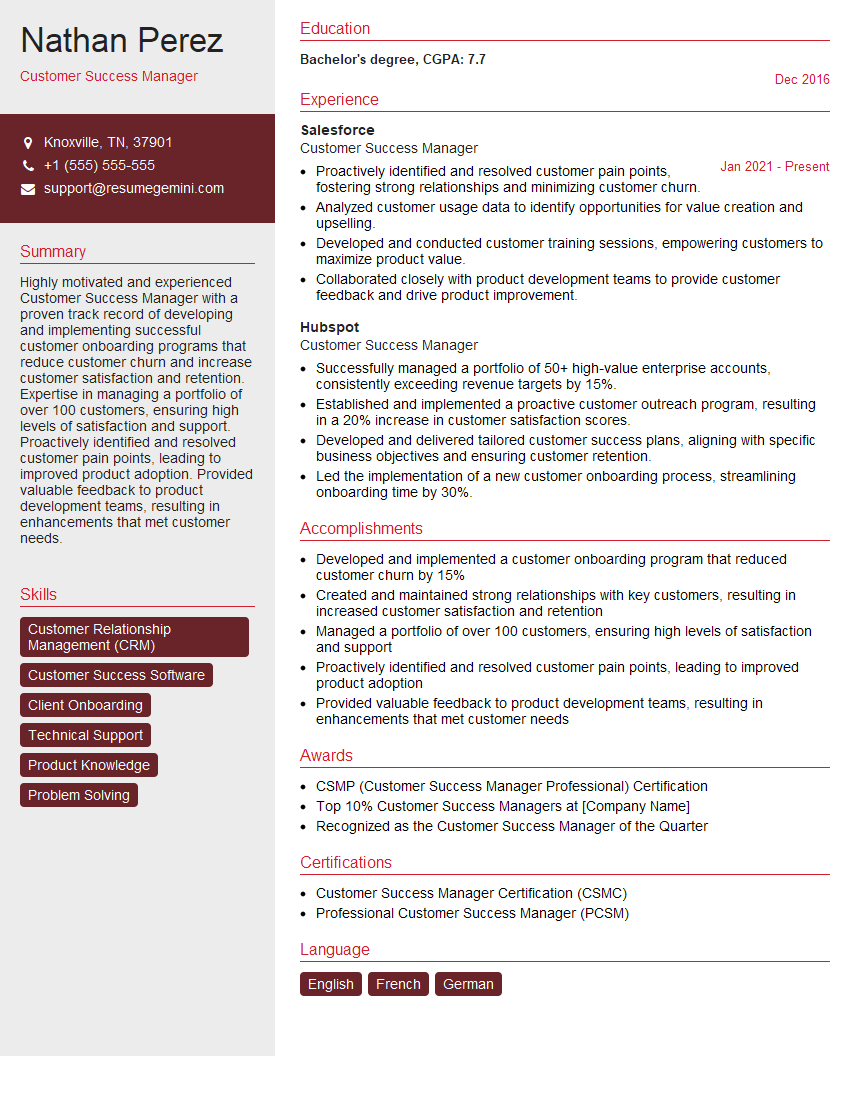
Mastering CSM opens doors to exciting and rewarding career paths, offering significant growth potential in a constantly evolving field. To maximize your job prospects, crafting a compelling and ATS-friendly resume is crucial. ResumeGemini can help you build a professional and effective resume tailored to showcase your CSM skills and experience. Examples of resumes specifically designed for CSM roles are available to help guide you. Take the next step towards your dream CSM career today!
Explore more articles
Users Rating of Our Blogs
Share Your Experience
We value your feedback! Please rate our content and share your thoughts (optional).
What Readers Say About Our Blog
To the interviewgemini.com Webmaster.
Very helpful and content specific questions to help prepare me for my interview!
Thank you
To the interviewgemini.com Webmaster.
This was kind of a unique content I found around the specialized skills. Very helpful questions and good detailed answers.
Very Helpful blog, thank you Interviewgemini team.