The thought of an interview can be nerve-wracking, but the right preparation can make all the difference. Explore this comprehensive guide to Develop and Implement Electrical Maintenance Plans interview questions and gain the confidence you need to showcase your abilities and secure the role.
Questions Asked in Develop and Implement Electrical Maintenance Plans Interview
Q 1. Explain the difference between preventive and predictive maintenance.
Preventive and predictive maintenance are both crucial for keeping electrical systems running smoothly, but they differ significantly in their approach. Preventive maintenance is scheduled maintenance performed at predetermined intervals, regardless of the equipment’s current condition. Think of it like changing your car’s oil every 3,000 miles – you do it proactively to prevent future problems, even if the engine seems fine. Predictive maintenance, on the other hand, uses data and technology to predict when maintenance is actually needed. Instead of relying on a fixed schedule, it uses sensors, vibration analysis, or thermal imaging to detect anomalies and potential failures before they occur. Imagine having sensors in your car that detect wear and tear on your brakes, notifying you when they need replacing rather than waiting until they completely fail.
In short: Preventive maintenance is scheduled and proactive, while predictive maintenance is data-driven and focuses on preventing failures before they happen. A good electrical maintenance plan often incorporates both strategies for optimal efficiency and reliability.
Q 2. Describe your experience developing an electrical maintenance plan.
In my previous role at a large manufacturing facility, I was responsible for developing and implementing a comprehensive electrical maintenance plan. The process began with a thorough assessment of the facility’s electrical infrastructure, including all equipment, wiring, and safety systems. This involved creating detailed drawings and documenting the location and specifications of every piece of equipment. Next, I collaborated with operations and engineering teams to identify critical equipment and potential failure points. Based on this analysis, I developed a maintenance schedule encompassing both preventive (e.g., regular inspections, cleaning, lubrication) and predictive maintenance (e.g., infrared thermography scans, motor current signature analysis) tasks. I also established detailed procedures for each task, including safety protocols, necessary tools, and acceptance criteria. Finally, the plan was implemented, and I monitored its effectiveness, making adjustments based on real-world data and feedback.
The outcome was a significant reduction in unplanned downtime, improved equipment reliability, and enhanced overall safety. This experience highlighted the importance of a data-driven, collaborative approach in creating effective maintenance plans.
Q 3. How do you prioritize maintenance tasks?
Prioritizing maintenance tasks is crucial for maximizing efficiency and minimizing downtime. My approach involves a multi-faceted strategy, combining risk assessment with a criticality analysis of equipment. I use a prioritization matrix that considers several factors:
- Criticality: How essential is the equipment to the overall operation? A critical piece of equipment, such as a main power transformer, receives higher priority than a less essential one.
- Risk of Failure: What is the likelihood of the equipment failing, and what are the consequences of that failure? Equipment with a high probability of failure and severe consequences gets top priority.
- Cost of Repair: A costly repair might justify more frequent preventive maintenance.
- Past Performance: Equipment with a history of frequent failures requires more attention.
By evaluating these factors, I can create a ranked list of maintenance tasks, ensuring that the most critical and risky tasks are addressed first. This allows us to allocate resources effectively and minimize the impact of potential failures.
Q 4. What CMMS systems are you familiar with?
I have extensive experience using various Computerized Maintenance Management Systems (CMMS). I’m proficient with industry-leading software such as SAP PM, IBM Maximo, and Fiix. My expertise includes data entry, work order management, inventory tracking, preventive maintenance scheduling, and generating reports for analysis and optimization. I’m comfortable adapting to new CMMS platforms as needed, and I understand the importance of selecting the right system to meet the specific needs of an organization.
Q 5. How do you handle emergency electrical repairs?
Emergency electrical repairs require a swift and decisive response. My approach prioritizes safety first. Before undertaking any repair, we ensure the power is safely isolated and locked out/tagged out (LOTO) to prevent accidental shock or electrocution. Then, I follow a structured process:
- Assessment: Quickly assess the nature and extent of the damage, identifying the root cause if possible.
- Emergency Repair: Implement temporary repairs to restore power as quickly as possible while adhering to safety regulations.
- Documentation: Thoroughly document the event, including the cause, the repairs made, and any necessary follow-up actions.
- Root Cause Analysis (RCA): Conduct a thorough RCA to determine the underlying cause of the failure and implement corrective actions to prevent recurrence.
- Permanent Repair: Schedule and execute permanent repairs using appropriate materials and procedures.
Clear communication with all stakeholders is vital throughout the process to minimize disruption and maintain transparency.
Q 6. What are your strategies for reducing electrical downtime?
Reducing electrical downtime requires a proactive and multi-pronged strategy. Key strategies include:
- Implementing a robust maintenance plan: As discussed earlier, a well-designed plan combining preventive and predictive maintenance significantly reduces the likelihood of unexpected failures.
- Investing in high-quality equipment: Reliable equipment inherently reduces downtime. Consider the long-term costs and benefits when making purchasing decisions.
- Regular inspections and testing: Preventative testing, such as insulation resistance testing, can identify potential issues before they lead to failure.
- Proper training for maintenance personnel: Well-trained technicians are more efficient and less prone to errors.
- Spare parts inventory: Keeping a strategic inventory of commonly needed parts minimizes repair time.
- Continuous improvement: Regularly review and update the maintenance plan based on data and feedback to continuously optimize performance.
A holistic approach focusing on prevention and efficient response is key to minimizing downtime.
Q 7. Explain your experience with root cause analysis in electrical systems.
Root cause analysis (RCA) is critical for preventing recurring electrical failures. I typically employ the 5 Whys technique, combined with fault tree analysis. For example, if a motor burned out, the 5 Whys might go like this:
- Why did the motor burn out? – Because it overheated.
- Why did it overheat? – Because the bearings were seized.
- Why were the bearings seized? – Due to insufficient lubrication.
- Why was there insufficient lubrication? – Because the lubrication system malfunctioned.
- Why did the lubrication system malfunction? – Because of a faulty sensor.
This helps identify the root cause (faulty sensor), not just the symptom (burnt-out motor). Fault tree analysis allows a visual representation of the potential failure modes and their contributing factors. By systematically investigating failures, we can implement targeted improvements to prevent similar events from happening again. This might involve replacing the faulty sensor, improving lubrication procedures, or upgrading the entire lubrication system for greater reliability. Proper documentation is critical in tracking RCA findings and informing future maintenance strategies.
Q 8. Describe your experience with electrical safety regulations and procedures.
Electrical safety is paramount in my work. My experience encompasses a deep understanding of regulations like OSHA’s standards for electrical safety in the workplace (29 CFR 1910 Subpart S), NEC (National Electrical Code), and any other regionally specific codes. I’m proficient in applying these regulations to various scenarios, from initial project design to ongoing maintenance. This includes understanding the proper use of personal protective equipment (PPE), such as insulated tools, arc flash suits, and safety glasses, as well as implementing procedures for safe work practices around energized equipment.
For instance, in a previous role, we were tasked with upgrading an aging electrical system. Before commencing work, I conducted a thorough risk assessment, identifying potential hazards like arc flash and electric shock. Based on this assessment, we developed a detailed safety plan that outlined specific PPE requirements, lockout/tagout procedures, and emergency response protocols. This ensured the safety of the entire team throughout the project.
Q 9. How do you ensure compliance with relevant electrical codes and standards?
Compliance is achieved through a multi-faceted approach. It starts with specifying the relevant codes and standards during the design phase of any electrical system. Then, meticulous documentation is key. We maintain detailed records of all electrical equipment, including its specifications, installation dates, and maintenance history. Regular inspections and testing are performed according to the manufacturer’s recommendations and relevant codes, ensuring that all equipment is functioning within safety parameters. Discrepancies are documented, and corrective actions are immediately implemented and tracked. We utilize a computerized maintenance management system (CMMS) to efficiently manage these tasks, automatically generating alerts and reminders for upcoming inspections.
For example, to ensure compliance with NEC Article 250 (Grounding), we conduct regular ground resistance testing using a calibrated earth ground tester, meticulously documenting each test result. Any readings outside the acceptable range trigger immediate investigation and remediation, preventing potential safety hazards.
Q 10. How do you manage and track maintenance costs?
Managing maintenance costs requires a strategic approach. We use a CMMS (Computerized Maintenance Management System) to track all maintenance activities, including labor costs, material costs, and outsourced services. This system allows us to generate detailed reports, analyzing trends in maintenance expenses and identifying areas for potential cost savings. Preventive maintenance plays a crucial role in reducing overall costs by preventing major failures that can lead to costly downtime and repairs.
One strategy I’ve successfully implemented involves analyzing historical maintenance data to identify equipment prone to frequent failures. This allows us to prioritize preventive maintenance on these critical components, minimizing unexpected breakdowns and associated repair costs. We also negotiate contracts with suppliers to secure favorable pricing on commonly used parts and materials, further controlling costs.
Q 11. What key performance indicators (KPIs) do you use to measure the effectiveness of your maintenance plans?
Several KPIs are essential to gauge the effectiveness of our maintenance plans. These include:
- Mean Time Between Failures (MTBF): This metric reflects the average time between equipment failures. A higher MTBF indicates improved equipment reliability.
- Mean Time To Repair (MTTR): This measures the average time it takes to repair a failed piece of equipment. A lower MTTR demonstrates efficient repair processes.
- Preventive Maintenance Completion Rate: This tracks the percentage of scheduled preventive maintenance tasks completed on time. High completion rates show adherence to the plan.
- Downtime: Minimizing unplanned downtime is critical. Tracking downtime directly shows the effectiveness in preventing unexpected outages.
- Maintenance Cost per Unit of Production: This relates maintenance expenditure to output, providing valuable insights into cost-effectiveness.
By regularly monitoring these KPIs, we can identify areas for improvement and make data-driven decisions to optimize our maintenance strategies.
Q 12. Describe your experience with electrical testing and inspection procedures.
My experience includes a wide range of electrical testing and inspection procedures. This includes visual inspections for signs of damage or wear, insulation resistance testing (using a megohmmeter), continuity testing, ground resistance testing, and thermal imaging to identify potential overheating issues. We use calibrated testing equipment and adhere to established safety procedures throughout the process. Comprehensive documentation of all test results is crucial for maintaining a record of equipment health and compliance.
For example, before commissioning a new electrical panel, we conduct rigorous testing. This includes verifying the correct wiring, checking for proper grounding, measuring insulation resistance, and verifying the functionality of overcurrent protection devices. All test results are documented, and only after successful completion of these tests is the panel put into service.
Q 13. How do you communicate maintenance plans and schedules to your team?
Clear and effective communication is vital. We utilize a combination of methods to communicate maintenance plans and schedules. The CMMS plays a crucial role, providing each team member with their assigned tasks, deadlines, and any relevant instructions. Regular team meetings are held to discuss upcoming maintenance activities, address any concerns, and ensure everyone is on the same page. We also use visual aids, such as schedules posted in prominent locations and email reminders to ensure transparency and accountability.
For instance, before a major shutdown for scheduled maintenance, we hold a pre-job briefing. This session outlines the tasks, timelines, safety precautions, and any specific challenges anticipated. This proactive approach minimizes confusion and maximizes team efficiency during the maintenance period.
Q 14. What is your experience with lockout/tagout procedures?
Lockout/Tagout (LOTO) procedures are crucial for preventing accidental energization of equipment during maintenance. I have extensive experience in implementing and enforcing LOTO procedures, ensuring that all energized equipment is properly de-energized, locked out, and tagged out before any maintenance work commences. This involves training team members on proper LOTO techniques, regularly auditing LOTO procedures to ensure compliance, and addressing any identified deficiencies promptly.
In one instance, a team member attempted to bypass the LOTO procedure. This was immediately addressed through retraining and a review of our safety protocols. Reinforcing the importance of safety and adherence to the LOTO procedures through regular training, audits, and prompt corrective actions is a cornerstone of our safety program.
Q 15. How do you handle conflicts or disagreements among maintenance team members?
Conflict resolution within a team is crucial for efficient maintenance. My approach is proactive and focuses on open communication and mutual respect. I start by creating a safe space for team members to express their concerns without fear of judgment. This often involves a facilitated discussion where I actively listen to each perspective, ensuring everyone feels heard.
If the conflict involves differing technical opinions, I encourage a collaborative problem-solving approach. We might review relevant documentation, conduct tests, or even consult external experts if necessary. The goal isn’t to prove someone right or wrong, but to find the best solution for the situation. For example, if two electricians have different methods for troubleshooting a faulty circuit breaker, I’d guide them through a structured comparison of their approaches, highlighting the pros and cons of each method based on safety regulations and efficiency. Ultimately, the decision will be based on the most effective and safest approach. Finally, I document the resolution, including any lessons learned, to prevent similar conflicts in the future.
In more serious cases, involving personality clashes or repeated issues, I might employ conflict mediation techniques, or if necessary, involve HR for support.
Career Expert Tips:
- Ace those interviews! Prepare effectively by reviewing the Top 50 Most Common Interview Questions on ResumeGemini.
- Navigate your job search with confidence! Explore a wide range of Career Tips on ResumeGemini. Learn about common challenges and recommendations to overcome them.
- Craft the perfect resume! Master the Art of Resume Writing with ResumeGemini’s guide. Showcase your unique qualifications and achievements effectively.
- Don’t miss out on holiday savings! Build your dream resume with ResumeGemini’s ATS optimized templates.
Q 16. Describe your experience with budgeting and resource allocation for electrical maintenance.
Budgeting and resource allocation are critical for effective electrical maintenance. My experience involves developing detailed budgets based on historical data, projected needs, and anticipated equipment failures. I use predictive maintenance techniques to estimate the likelihood of equipment failure and allocate resources accordingly, prioritizing critical equipment. For instance, a vital motor driving a production line needs more preventative maintenance resources than a less critical lighting system.
I utilize software tools to track expenses, monitor resource utilization, and forecast future needs. This allows for proactive adjustment of the budget based on real-time data. I also incorporate contingency planning into the budget, accounting for unexpected repairs or equipment failures. It’s like having a savings account for unforeseen electrical emergencies.
Resource allocation isn’t solely about money; it encompasses personnel, tools, and parts. I ensure sufficient skilled personnel are assigned to tasks based on their expertise and the complexity of the work. I also manage inventory levels, ensuring the right parts are available when needed to minimize downtime. Regular audits and reviews help optimize resource allocation and improve efficiency.
Q 17. Explain your approach to training and development for electrical maintenance personnel.
Training and development are fundamental for maintaining a skilled and competent electrical maintenance team. My approach is multi-faceted and encompasses on-the-job training, classroom instruction, and online courses tailored to individual skill levels and specific job roles. For example, new technicians receive comprehensive training on safety procedures, basic electrical theory, and common troubleshooting techniques. Experienced technicians may participate in advanced training on specialized equipment or new technologies.
I leverage apprenticeships and mentorship programs where experienced technicians guide and train newer team members. This fosters a culture of continuous learning and knowledge sharing within the team. We also regularly conduct safety training and refresher courses to ensure compliance with regulations and best practices. Furthermore, I incorporate simulation-based training for complex tasks, allowing technicians to practice in a safe environment before tackling real-world scenarios. This could involve using virtual reality or specialized training software to simulate equipment malfunctions.
Performance evaluations are integrated into the training process to identify areas for improvement and tailor further training accordingly. The goal is to equip the team with the knowledge and skills to effectively handle all aspects of electrical maintenance.
Q 18. How do you stay current with new technologies and best practices in electrical maintenance?
Staying current in electrical maintenance requires continuous learning. I actively participate in professional organizations like IEEE (Institute of Electrical and Electronics Engineers) to stay abreast of the latest industry trends and technological advancements. I regularly attend conferences and workshops to learn about new techniques and best practices. I subscribe to industry publications and online journals to keep up with emerging technologies.
I also actively seek out online learning resources, such as webinars and online courses, to broaden my knowledge base. For example, I recently completed a course on the latest advancements in predictive maintenance using IoT sensors and AI-powered analytics. This allows me to integrate cutting-edge technologies into our maintenance strategies for improved efficiency and reduced downtime.
Furthermore, I encourage my team to engage in continuous learning through similar methods. We hold regular internal knowledge-sharing sessions where team members present on topics of interest, fostering a culture of collaboration and continuous improvement.
Q 19. Describe a time you had to troubleshoot a complex electrical problem.
During a recent plant-wide power outage, we faced a complex electrical problem involving a malfunctioning transformer. Initial diagnostics pointed towards a simple fuse issue, but replacing the fuse didn’t resolve the problem. The plant was shut down and production was halted, creating a time-sensitive situation.
My team and I systematically investigated the problem. We meticulously checked all wiring, connections, and protective devices using advanced diagnostic tools, including infrared thermography to detect any overheating components. After hours of careful investigation, we discovered a damaged winding within the transformer, causing an internal short circuit, which wasn’t detectable through traditional means. The infrared imaging clearly revealed the problem area.
We collaborated with the transformer manufacturer to expedite a repair or replacement. In the meantime, we implemented temporary measures to restore power to critical areas of the plant, minimizing production losses. The experience highlighted the importance of thorough diagnostics, collaboration with external experts, and effective crisis management in high-pressure situations.
Q 20. How do you determine the appropriate maintenance intervals for different electrical equipment?
Determining appropriate maintenance intervals involves considering various factors specific to each piece of electrical equipment. These factors include the equipment’s manufacturer’s recommendations, operating conditions, environmental factors, and historical maintenance data. For example, a motor operating in a dusty environment might require more frequent maintenance compared to a similar motor in a clean environment.
I use a combination of preventive, predictive, and condition-based maintenance strategies. Preventive maintenance involves scheduled inspections and servicing at predetermined intervals, minimizing the risk of failure. Predictive maintenance uses technologies like vibration analysis and thermal imaging to predict potential equipment failure before it occurs, enabling proactive maintenance. Condition-based maintenance relies on real-time data monitoring to trigger maintenance only when needed.
The maintenance intervals are documented and regularly reviewed. We analyze historical data on equipment failures and maintenance performed to fine-tune the intervals based on actual performance. This data-driven approach ensures that maintenance schedules are optimized for both equipment reliability and cost-effectiveness.
Q 21. What is your experience with developing and implementing a maintenance management system?
I have extensive experience developing and implementing Computerized Maintenance Management Systems (CMMS). My experience involves selecting appropriate software, customizing it to meet our specific needs, and integrating it with other systems within the organization. The selection process involves evaluating different CMMS solutions considering factors like cost, functionality, scalability, and ease of use. We consider the specific needs of the electrical maintenance team, such as work order management, inventory tracking, preventative maintenance scheduling, and reporting capabilities.
Implementing a CMMS involves several stages, starting with data migration from existing systems. This includes transferring historical maintenance records, equipment data, and personnel information into the new system. User training is critical to ensure that all team members understand how to use the system effectively. I’ve found that hands-on training sessions are very effective, followed by ongoing support. We continuously monitor the system’s performance and make necessary adjustments to optimize its use.
The implementation process must also consider the integration with other business systems, such as enterprise resource planning (ERP) systems, for seamless data flow. A well-implemented CMMS provides real-time insights into maintenance activities, enabling data-driven decision making and improved efficiency. For example, we can track key performance indicators (KPIs) such as equipment downtime, maintenance costs, and mean time to repair (MTTR), which directly influence strategic decision-making.
Q 22. How do you identify and address potential electrical hazards?
Identifying and addressing electrical hazards requires a proactive and systematic approach. It begins with regular inspections using established checklists covering all aspects of the electrical system, from power distribution to individual equipment. This includes visual checks for frayed wiring, loose connections, overloaded circuits, damaged insulation, and signs of arcing or overheating. Beyond visual inspection, we utilize specialized testing equipment such as insulation resistance testers (meggers) and thermal cameras to detect hidden problems.
Once a hazard is identified, the severity and urgency are assessed based on factors like potential for injury, impact on operations, and regulatory compliance. Immediate hazards are addressed immediately, often involving lockout/tagout procedures to isolate the affected area and prevent accidental energization. Less urgent issues are scheduled for repairs during planned maintenance downtime. Detailed documentation is crucial, recording the hazard, corrective actions, and the responsible personnel. Regular training for personnel on hazard recognition, safe work practices, and emergency procedures is also key. For example, during a recent inspection, we discovered a loose connection in a high-voltage panel. Immediate lockout/tagout procedures were implemented, and the connection was secured before re-energizing the panel, followed by a comprehensive report detailing the incident.
Q 23. What is your experience with reliability centered maintenance (RCM)?
Reliability-centered maintenance (RCM) is a structured process for determining the optimal maintenance strategy for each asset based on its failure modes and their consequences. My experience with RCM involves leading its implementation for large industrial electrical systems. We begin by identifying critical equipment, defining potential failure modes, and analyzing their effects on safety, production, and cost. This analysis typically utilizes Failure Modes and Effects Analysis (FMEA) and Fault Tree Analysis (FTA). From there, we determine appropriate preventive maintenance tasks, predictive maintenance techniques, or even run-to-failure strategies based on the risk profile of each failure mode. The goal is to maximize reliability and minimize maintenance costs by focusing resources on the most critical aspects of the system. For instance, in a previous role, using RCM, we prioritized predictive maintenance on critical motor bearing using vibration analysis, reducing unexpected failures by over 70%.
Q 24. Explain your approach to inventory management for electrical parts and supplies.
Effective inventory management for electrical parts is crucial for minimizing downtime and maintenance costs. My approach involves a combination of strategies: First, we maintain a detailed database of all parts, including specifications, suppliers, and criticality levels. This database is integrated with our CMMS (Computerized Maintenance Management System) to track inventory levels and automatically generate purchase orders when stock falls below pre-defined thresholds. We use ABC analysis to classify parts based on their cost and criticality, focusing our attention on the high-value, critical items. Regular stock audits are conducted to ensure accuracy, and we employ techniques such as cycle counting to minimize disruption to operations. We also utilize just-in-time (JIT) inventory for less critical items to minimize storage costs and obsolescence. Furthermore, establishing strong relationships with reliable suppliers and negotiating favorable contracts are critical to ensure timely delivery of necessary parts.
Q 25. How do you ensure the accuracy of maintenance records and documentation?
Accuracy in maintenance records is essential for tracking performance, identifying trends, and complying with regulations. We use a CMMS to store and manage all electrical maintenance data. This system incorporates features like automated work order generation, electronic signatures, and version control for documents. Regular data validation and reconciliation procedures are implemented, and personnel are trained on proper data entry and reporting practices. Each task completed includes clear documentation of the work performed, parts used, and the technician’s observations. The CMMS generates reports that highlight inconsistencies or missing data, allowing for prompt correction. For instance, we might use data analytics from the CMMS to identify patterns of equipment failures, allowing us to proactively adjust maintenance schedules and prevent future outages. This ensures data integrity and supports informed decision-making.
Q 26. Describe your experience with working with contractors or external service providers for electrical maintenance.
Working effectively with contractors requires a structured and transparent approach. Before engaging a contractor, a thorough pre-qualification process is conducted to assess their experience, qualifications, insurance coverage, and safety records. A detailed scope of work is defined, including deliverables, timelines, and acceptance criteria. Regular communication channels are established for updates, and a designated point of contact is assigned for each project. On-site supervision and quality checks are carried out to ensure compliance with safety standards and project specifications. A robust contract that clearly outlines responsibilities, payment terms, and dispute resolution mechanisms is crucial. For example, when engaging a contractor for a large-scale substation upgrade, we conducted thorough pre-qualification and held regular meetings to manage expectations and provide clear direction which ensured a safe and successful project completion.
Q 27. How do you measure the effectiveness of your electrical maintenance programs?
Measuring the effectiveness of an electrical maintenance program relies on Key Performance Indicators (KPIs). These include metrics such as Mean Time Between Failures (MTBF), Mean Time To Repair (MTTR), equipment uptime, maintenance costs per unit of production, and safety incident rates. Regularly analyzing these KPIs allows us to identify areas for improvement. We use data from the CMMS to track these metrics over time, and any deviation from established baselines triggers an investigation to identify root causes. For example, if the MTBF for a specific piece of equipment is decreasing, we might investigate the maintenance procedures, the quality of parts used, or the operating conditions to identify improvements.
Q 28. Describe a situation where you had to make a difficult decision related to electrical maintenance.
In one instance, we faced a critical failure of a main power transformer during peak production. The immediate concern was restoring power quickly to minimize production losses. However, the initial assessment indicated the extent of the damage was uncertain. A quick repair might risk further damage and a costly failure in the future. Therefore, we faced the decision between a rapid, potentially risky fix versus a more thorough but time-consuming repair. We opted for a thorough diagnostic process, involving advanced testing and consultation with a specialist. This delayed the restart, but it ensured a permanent fix, avoiding a more serious and costly failure down the line. This decision, while delaying production initially, ultimately proved to be the most cost-effective and safe solution in the long run, teaching the importance of a thorough assessment over quick fixes.
Key Topics to Learn for Develop and Implement Electrical Maintenance Plans Interview
- Preventive Maintenance Strategies: Understanding different preventive maintenance schedules (e.g., time-based, condition-based), their implementation, and the selection of appropriate strategies for various electrical systems.
- Predictive Maintenance Techniques: Exploring methods like vibration analysis, thermal imaging, and motor current signature analysis to predict potential failures and schedule maintenance proactively. This includes understanding the practical application of data analysis in maintenance planning.
- Corrective Maintenance Procedures: Familiarizing yourself with troubleshooting techniques, safe work practices, and the documentation required for effective corrective maintenance, including root cause analysis.
- Electrical Safety Regulations and Codes: Demonstrating knowledge of relevant safety standards (e.g., NFPA 70E) and their application in developing and implementing safe maintenance procedures.
- Budgeting and Resource Allocation: Understanding how to estimate maintenance costs, allocate resources effectively, and justify maintenance spending to stakeholders.
- Maintenance Documentation and Reporting: Knowing how to create and maintain accurate records of maintenance activities, including work orders, inspection reports, and performance metrics. This includes understanding the importance of clear and concise reporting.
- CMMS Software Applications: Familiarity with Computerized Maintenance Management Systems (CMMS) and their role in optimizing maintenance planning and execution. This could involve discussing specific CMMS software or general knowledge of their functions.
- Risk Assessment and Mitigation: Understanding how to identify potential electrical hazards, assess their risks, and develop mitigation strategies to ensure workplace safety.
- Equipment Life Cycle Management: Understanding the various stages of equipment life and how to plan maintenance activities to extend equipment lifespan and optimize performance.
Next Steps
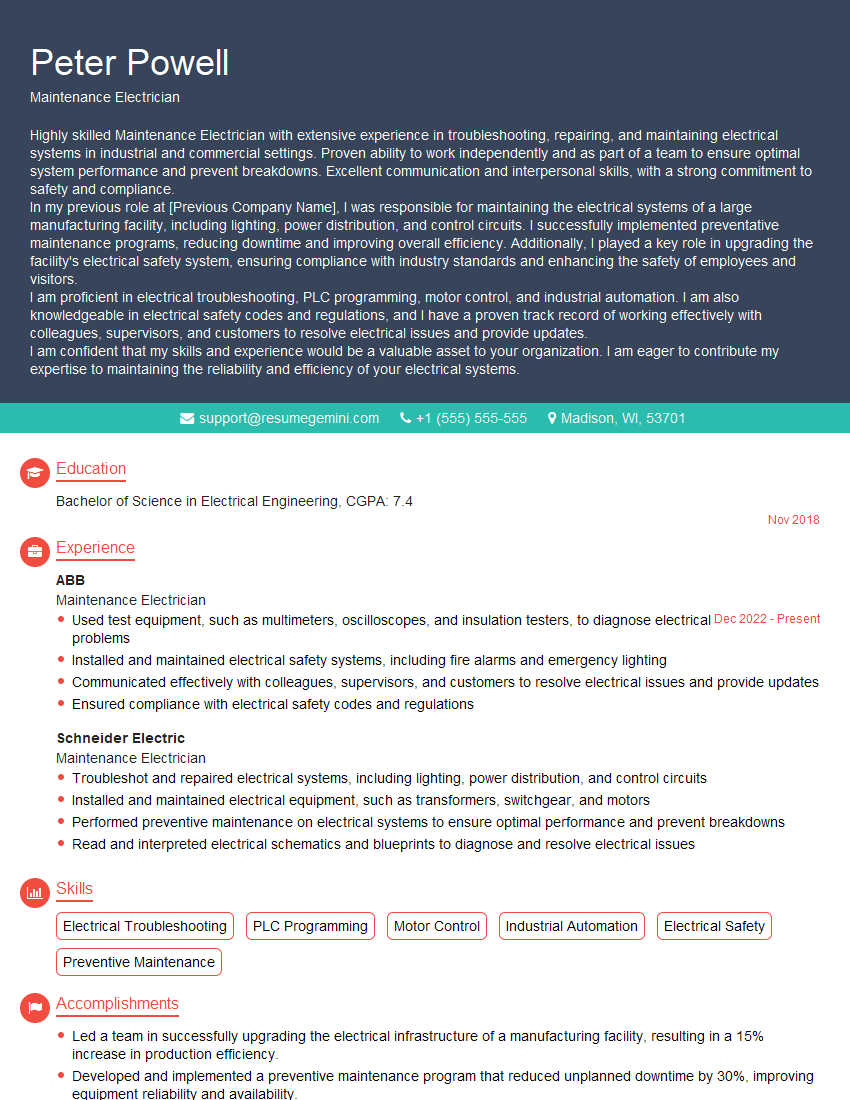
Mastering the development and implementation of electrical maintenance plans is crucial for career advancement in the electrical field. It demonstrates your ability to ensure safe and efficient operations, minimize downtime, and contribute to a cost-effective maintenance strategy. To significantly increase your job prospects, create an ATS-friendly resume that highlights your relevant skills and experience. ResumeGemini is a trusted resource to help you build a professional and impactful resume that stands out to recruiters. Examples of resumes tailored to Develop and Implement Electrical Maintenance Plans are available, showcasing how to present your qualifications effectively. Investing time in crafting a strong resume will significantly improve your chances of landing your dream job.

Explore more articles
Users Rating of Our Blogs
Share Your Experience
We value your feedback! Please rate our content and share your thoughts (optional).
What Readers Say About Our Blog
To the interviewgemini.com Webmaster.
Very helpful and content specific questions to help prepare me for my interview!
Thank you
To the interviewgemini.com Webmaster.
This was kind of a unique content I found around the specialized skills. Very helpful questions and good detailed answers.
Very Helpful blog, thank you Interviewgemini team.