Interviews are opportunities to demonstrate your expertise, and this guide is here to help you shine. Explore the essential Electrical Code Compliance (NEC and CEC) interview questions that employers frequently ask, paired with strategies for crafting responses that set you apart from the competition.
Questions Asked in Electrical Code Compliance (NEC and CEC) Interview
Q 1. Explain the difference between NEC and CEC.
The NEC (National Electrical Code) and CEC (Canadian Electrical Code) are both sets of nationally recognized standards for electrical safety, but they apply to different countries and have some key differences. The NEC is used in the United States, while the CEC is used in Canada. While their overarching goals are the same – to ensure safe electrical installations – specific rules, terminology, and even numbering systems can vary. For example, the article numbers for a similar requirement might be different, and some specific requirements might exist in one code but not the other. Think of it like this: both codes are recipes for safe electrical systems, but the ingredients and instructions might differ slightly based on local conditions and preferences.
A practical example: The requirements for grounding might differ slightly in their specifics, such as the type of grounding electrode or the allowable resistance. Understanding these differences is crucial for electricians working across the border or dealing with projects involving both U.S. and Canadian components.
Q 2. Describe the process for obtaining an electrical permit.
Obtaining an electrical permit is a crucial first step in any electrical project. The process generally involves submitting detailed plans and specifications to the local authority having jurisdiction (AHJ), which is often the building department or a similar agency. These plans should clearly illustrate the proposed electrical work, including circuit diagrams, load calculations, and equipment specifications. The AHJ reviews the submission to ensure it meets all applicable code requirements. Once approved, a permit is issued allowing the work to commence. Regular inspections are usually scheduled during the process to verify compliance. Failing an inspection often means stopping work until the necessary corrections are made. After the work is completed and passes a final inspection, the permit is closed.
An example would be a homeowner adding a new circuit for an appliance. They’d need to submit plans showing the circuit layout, breaker size, wire gauge, and receptacle locations. The AHJ would check these plans to ensure they comply with the local code, such as the NEC or CEC, before granting a permit.
Q 3. What are the requirements for grounding in NEC/CEC?
Grounding is a critical safety feature designed to protect people and equipment from electrical hazards. Both the NEC and CEC mandate effective grounding systems. The fundamental principle is to provide a low-resistance path for fault currents to flow to the earth, preventing dangerous voltage buildup on exposed conductive surfaces. This typically involves connecting the non-current-carrying metallic parts of electrical systems, like equipment enclosures and conduits, to a grounding electrode system, usually a ground rod driven into the earth.
- Grounding Electrodes: Common electrodes include ground rods, metal water pipes, and concrete-encased electrodes. The specific requirements for electrode types and resistance vary depending on the code and local soil conditions.
- Grounding Conductors: Grounding wires, typically bare copper or copper-clad steel, connect equipment and the grounding electrode system. Their size must be sufficient to handle fault currents.
- Grounding Connections: Connections must be secure and corrosion-resistant. Proper bonding of metallic enclosures and equipment is essential.
For instance, a faulty appliance might have a short circuit that exposes a dangerous voltage to its metal casing. A properly grounded system would divert the fault current to the earth through the grounding wire, preventing a shock hazard to anyone touching the casing.
Q 4. How do you determine the appropriate size of wire for a given circuit?
Determining the appropriate wire size involves several factors, primarily the current carrying capacity (amperage) and the voltage drop. The NEC and CEC provide tables listing ampacity ratings for different wire sizes and insulation types. You start by calculating the total load (in amps) for the circuit. Then, you consult the appropriate code tables to find a wire size that can safely carry that load without overheating. Additionally, voltage drop needs to be considered; excessively long runs of undersized wire can result in significant voltage loss, impacting the performance of connected equipment.
Example: Let’s say you need to install a 20-amp circuit for a kitchen appliance. Using the NEC tables, you’d find the appropriate wire size based on the ampacity rating (20 amps or more) and any applicable derating factors (due to ambient temperature, number of conductors in a conduit, etc.). You also need to account for voltage drop using formulas or online calculators. This calculation considers the length of the wire run and the current to determine whether the wire size is sufficient to maintain an acceptable voltage level at the appliance.
Q 5. Explain the requirements for arc-fault circuit interrupters (AFCIs).
Arc-fault circuit interrupters (AFCIs) are designed to detect and interrupt potentially dangerous arcing faults in branch circuits. These faults, often caused by loose connections or damaged insulation, can lead to fires. The NEC and CEC require AFCIs in specific locations to mitigate this risk, most notably in bedrooms and other areas with high fire risk. AFCIs work by monitoring the current waveform for anomalies indicative of arcing. When an arc fault is detected, the AFCI trips, cutting off the power to the circuit.
Requirements vary somewhat between the NEC and CEC, but the general principle is the same: protection of the occupants and the property from arc-fault fires. Installing the correct AFCI type for the specific application and ensuring proper installation are vital for effective protection. For example, some AFCIs are designed for use with standard branch circuits, while others are for use with multi-wire branch circuits. Incorrect installation could result in nuisance tripping or failure to protect.
Q 6. What are the common violations you encounter during inspections?
Common violations encountered during electrical inspections vary, but some frequently observed issues include:
- Improper Grounding: Missing or inadequate grounding is a significant safety concern. This could be due to improperly installed ground rods, loose connections, or missing grounding wires.
- Overloaded Circuits: Circuits carrying more current than their rating can lead to overheating and fire hazards. This often results from too many appliances plugged into one circuit or using undersized wire.
- Incorrect Wiring Methods: Failure to follow proper wiring techniques, such as using incorrect wire types, improper wire connections, or lack of proper strain relief can lead to shorts or loose connections.
- Lack of AFCIs or GFCIs: Failure to install AFCIs or ground-fault circuit interrupters (GFCIs) where required by code poses a serious risk of fire or electric shock.
- Unprotected Conductors: Running wires through unapproved locations, like directly under carpet or through walls without proper conduit, is a major safety hazard.
Addressing these violations is vital for ensuring safety and bringing the installation up to code. Each situation requires careful evaluation and appropriate corrective actions.
Q 7. How do you handle disagreements with contractors regarding code compliance?
Disagreements with contractors regarding code compliance should be addressed professionally and systematically. My approach would be to first clearly and thoroughly explain the specific code violations, referencing the relevant code sections. I would use clear language and avoid technical jargon where possible to ensure mutual understanding. This is usually done by citing specific code sections and providing evidence, such as photographs or measurements. Documentation is key here. If the explanation and evidence aren’t enough to resolve the issue, the next step would be to involve the AHJ. The AHJ has the authority to resolve disputes, conducting their own inspection to determine code compliance and direct any necessary corrections.
A collaborative approach is preferable; open communication and a willingness to find a mutually acceptable solution is paramount. This often involves a combination of explanations, supporting documents, and potentially seeking a third-party opinion from a qualified professional. Ultimately, safety is the priority, and ensuring compliance is non-negotiable.
Q 8. What are the requirements for electrical installations in hazardous locations?
Electrical installations in hazardous locations, classified by the NEC (National Electrical Code) and CEC (Canadian Electrical Code) as Class I, II, III, or Division 1 and 2 areas, demand specialized equipment and installation techniques to prevent ignition of flammable gases, vapors, dusts, or fibers. The codes dictate specific requirements for wiring methods, enclosure types, and equipment ratings based on the classification of the hazardous location.
- Class I: Flammable gases or vapors.
- Class II: Combustible dusts.
- Class III: Easily ignitable fibers or flyings.
- Division 1: Locations where a hazardous atmosphere is likely to exist under normal operating conditions.
- Division 2: Locations where a hazardous atmosphere is not likely to exist under normal operating conditions, but might exist due to equipment failure.
For instance, a Class I, Division 1 location, such as an oil refinery’s processing area, requires intrinsically safe equipment or explosion-proof enclosures to prevent sparks or heat from igniting the flammable gases. The choice of conduit, wiring, and fittings must also meet specific standards for these hazardous environments. Incorrect installation in a hazardous location can lead to fires or explosions with devastating consequences.
Q 9. Explain the requirements for GFCIs and their applications.
Ground Fault Circuit Interrupters (GFCIs) are life-saving devices designed to protect people from electrical shock. They work by continuously monitoring the current flowing in the hot and neutral conductors. If there’s an imbalance (indicating a ground fault, where current leaks to ground), the GFCI rapidly interrupts the circuit, preventing the potentially lethal current from flowing through a person.
The NEC and CEC mandate GFCIs for various applications, including:
- Bathrooms: To prevent shocks from accidental contact with water and electrical fixtures.
- Kitchens: To minimize the risk of shocks near sinks and appliances.
- Garages: To protect against shocks from damp or wet conditions.
- Outdoor receptacles: To safeguard against shocks due to rain or ground contact.
- Basements: Often required due to potential moisture.
GFCIs are typically identified by a test and reset button on the receptacle. Regular testing is crucial to ensure they’re functioning correctly. The sensitivity of GFCIs is typically 5mA or 6mA, meaning they trip when a current leakage of this level is detected. Improper installation or bypassing a GFCI could result in serious injury or death.
Q 10. Describe the different types of electrical panels and their applications.
Electrical panels, also known as service panels or breaker boxes, are the central distribution points for electrical power in a building. Several types exist, each suited to different applications:
- Fuse Panels: Older installations often utilize fuse panels, where fuses melt to interrupt the circuit in case of overload or short circuit. These are less common now due to the greater convenience and protection offered by circuit breakers.
- Circuit Breaker Panels: The most prevalent type today. Circuit breakers automatically trip (interrupt the circuit) when excessive current flows, offering better protection than fuses and the ability to reset without replacing the device.
- Load Centers: Similar to circuit breaker panels but sometimes with more advanced features like surge protection or monitoring capabilities.
The choice of panel type depends on factors like the building’s size, power requirements, and the level of protection desired. A larger building will usually require a higher amperage main breaker and a panel with a greater number of circuits. Proper sizing and installation are critical for safety and efficient energy distribution; undersized panels can lead to overheating and fire hazards.
Q 11. What are the requirements for service entrances?
Service entrances are the point where utility power enters a building. The NEC and CEC have stringent requirements for service entrances to ensure safety and reliability. Key aspects include:
- Service conductors: The wires carrying power from the utility lines to the service panel must be properly sized to handle the building’s electrical load, considering future expansions.
- Service equipment: This includes the meter, main disconnect (breaker or switch), and service panel. These must be properly grounded and installed according to code.
- Clearances: Sufficient clearance must be maintained around the service equipment to prevent accidental contact and to ensure easy access for maintenance.
- Grounding: A reliable grounding system is essential for protecting against electrical shocks and overvoltage events. This usually involves a grounding rod driven into the earth and connecting it to the service panel.
Incorrect service entrance installation can lead to power outages, electrical fires, and serious injury. Regular inspections are essential to ensure the service entrance remains in compliance with code and operational safety.
Q 12. How do you interpret electrical drawings and schematics?
Interpreting electrical drawings and schematics is a fundamental skill for electricians. These diagrams illustrate the layout and connections of electrical systems. Understanding these drawings is crucial for planning, installation, troubleshooting, and maintenance.
Key elements to understand include:
- Symbols: Familiarize yourself with the standard symbols used for components such as switches, outlets, lights, circuit breakers, etc. These symbols are consistent across various drawings.
- Wiring diagrams: These show the path of wires between components. Following the lines and understanding the connection points is essential for tracing circuits.
- Panel schedules: These provide a detailed list of the circuit breakers and their corresponding circuits. They help identify which breaker controls which part of the building.
- Load calculations: These calculations are needed to determine the appropriate size of conductors, and protection devices.
Understanding these aspects allows for efficient troubleshooting, identification of potential hazards, and planning future upgrades or modifications to the electrical system. Without this ability, electricians would be severely handicapped in their work.
Q 13. Explain the requirements for lighting fixture installations.
Lighting fixture installations must adhere to specific safety regulations to prevent shocks, fires, and injuries. The NEC and CEC outline several critical requirements:
- Wiring methods: Fixtures must be wired using appropriate wiring methods, such as armored cable (BX), non-metallic sheathed cable (NM), or conduit, depending on the location and environment. Proper wire connections are paramount.
- Support and mounting: Fixtures need to be securely mounted to the designated structure to prevent them from falling. The mounting method must be suitable for the fixture’s weight and the structural type.
- Grounding: Metal fixtures must be properly grounded to protect against electrical shocks. This often involves grounding wires connected to the fixture’s metal parts and the electrical box.
- Accessibility: Fixtures must be installed in a way that allows for easy access for maintenance and bulb replacement, without compromising safety.
- Specific location requirements: Different locations (e.g., damp, wet, hazardous) require fixtures with specific ratings.
For example, a bathroom light fixture requires a damp or wet location rating, and a garage may need a fixture rated for higher ambient temperatures. Improper installation can lead to electrical hazards. Always refer to the manufacturer’s instructions and the relevant electrical code for specific details and requirements.
Q 14. What are the requirements for electrical work in wet locations?
Electrical work in wet locations, such as bathrooms, kitchens, outdoors, and near pools, requires special precautions to prevent electrical shocks and hazards. The NEC and CEC dictate that all electrical equipment and wiring in wet locations must have appropriate weatherproof and watertight protection.
Key considerations include:
- Weatherproof enclosures: Receptacles, switches, and junction boxes must have appropriate weatherproof ratings (e.g., NEMA 4, NEMA 4X) to protect against water ingress. The enclosure type depends on the level of exposure to water.
- Water-resistant cable: The type of cable used should be suitable for wet locations, often with an outer jacket to repel moisture.
- Ground Fault Circuit Interrupters (GFCIs): These are crucial for protecting against shocks in wet locations. They are usually mandatory for receptacles and other outlets in wet areas.
- Proper sealing and bonding: All connections and penetrations through enclosures must be properly sealed to prevent water from entering and causing electrical hazards.
Improper installation in wet locations significantly increases the risk of electric shock, which could have fatal consequences. Compliance with code is vital in these environments.
Q 15. Describe the requirements for installing electrical equipment in commercial buildings.
Installing electrical equipment in commercial buildings requires strict adherence to the National Electrical Code (NEC) or Canadian Electrical Code (CEC), depending on the location. These codes dictate safety standards for everything from wiring methods and overcurrent protection to grounding and equipment installation. The specifics depend on the building’s occupancy, the type of equipment, and the power demands.
- Wiring Methods: Commercial buildings often utilize conduit systems (rigid metal conduit, EMT, etc.) for protection and durability. Cable tray systems are also common for larger installations. The choice depends on factors such as environmental conditions and the number of conductors.
- Overcurrent Protection: Circuit breakers and fuses are essential for protecting circuits from overload and short circuits. The correct amperage rating must be selected based on load calculations. This is crucial to prevent fires and equipment damage.
- Grounding: Proper grounding is paramount to ensure electrical safety and prevent shocks. The grounding system must be effectively bonded throughout the building and connected to the earth.
- Equipment Installation: Specific requirements exist for installing various types of equipment, such as lighting fixtures, motors, and switchgear. These requirements address factors like spacing, clearances, and accessibility for maintenance.
- Demand Load Calculations: Accurate load calculations are critical to determine the size of the service entrance and the capacity of individual circuits. Overloading circuits is a major safety hazard.
For example, a large commercial kitchen would require specialized circuits for high-power appliances like ovens and fryers, with dedicated overcurrent protection and appropriate conduit sizing. Ignoring these requirements could result in code violations, equipment failure, and potential fire hazards. A thorough understanding of the NEC/CEC and relevant local regulations is essential.
Career Expert Tips:
- Ace those interviews! Prepare effectively by reviewing the Top 50 Most Common Interview Questions on ResumeGemini.
- Navigate your job search with confidence! Explore a wide range of Career Tips on ResumeGemini. Learn about common challenges and recommendations to overcome them.
- Craft the perfect resume! Master the Art of Resume Writing with ResumeGemini’s guide. Showcase your unique qualifications and achievements effectively.
- Don’t miss out on holiday savings! Build your dream resume with ResumeGemini’s ATS optimized templates.
Q 16. What are the requirements for installing solar photovoltaic systems?
Installing solar photovoltaic (PV) systems involves a blend of electrical and structural considerations, guided by the NEC/CEC. Key aspects include:
- System Design and Sizing: Accurate load calculations are necessary to determine the system’s capacity and ensure it meets the building’s energy needs.
- Mounting and Support Structures: The system’s structural integrity is crucial. The mounting system must be robust enough to withstand wind loads and other environmental factors, often requiring structural engineering calculations.
- Wiring and Conductors: Appropriate wire types and sizes must be used to handle the DC voltage generated by the PV panels and the AC voltage after inversion. Careful routing and protection are required to prevent damage and potential hazards.
- Grounding and Bonding: The entire PV system, including panels, inverters, and wiring, must be properly grounded to prevent electrical shocks and ensure safety.
- Overcurrent Protection: Circuit breakers, fuses, and other overcurrent protection devices are critical to protect against faults and potential fire hazards. These need to be specifically selected for both DC and AC components of the system.
- Inverter Installation: Inverters convert the DC power from the PV panels into AC power for use in the building. Their installation must comply with NEC/CEC requirements related to ventilation, clearances, and grounding.
- Disconnects: Accessible and clearly labeled disconnects are mandatory for both the DC and AC sides of the system to allow safe isolation during maintenance or emergencies.
For instance, a grid-tied PV system needs a specific interconnection agreement with the utility company, and the system must be designed to meet the utility’s requirements for anti-islanding protection, ensuring the safety of utility workers. Failure to follow these regulations can result in system failure, safety hazards, and non-compliance penalties.
Q 17. How do you ensure compliance with the latest NEC/CEC amendments?
Staying current with NEC/CEC amendments is crucial for maintaining compliance and ensuring safety. I utilize several methods:
- Subscription to Code Updates: I subscribe to relevant publications and online resources that provide timely updates and notifications on code changes.
- Professional Development: I actively participate in continuing education courses and seminars offered by industry organizations like NFPA (National Fire Protection Association) or industry-specific training programs to stay abreast of the latest interpretations and best practices.
- Review of Published Code Books: I regularly review the latest editions of the NEC/CEC code books and associated handbooks for updates and changes in requirements.
- Networking with Other Professionals: Engaging with other electrical professionals, attending industry events, and participating in online forums helps to stay informed about current issues and interpretations of the code.
- Use of Online Resources: Many reputable websites and online databases provide access to the latest code interpretations and updates.
Ignoring code changes can lead to unsafe installations, potential liabilities, and costly rework. Proactive monitoring of these updates is fundamental to professional practice.
Q 18. Explain the importance of proper documentation in electrical installations.
Proper documentation is paramount in electrical installations, providing a verifiable record of the work performed and ensuring compliance with codes and standards. This includes:
- Detailed Drawings: Accurate schematics and diagrams showing the layout of the entire electrical system.
- Calculations: Documentation of all load calculations, showing the basis for sizing conductors, overcurrent protection devices, and equipment.
- Material Lists: A complete list of all materials used, including manufacturer names, model numbers, and certifications.
- Test Results: Records of all tests performed, including ground resistance, insulation resistance, and continuity tests.
- Inspection Records: Documentation of all inspections and approvals from authorized personnel.
- As-Built Drawings: Final drawings reflecting any changes made during construction.
Thorough documentation helps to prevent future problems, simplifies maintenance and repairs, and protects both the installer and the client in case of disputes. For example, if a problem arises years later, the documentation provides valuable information to diagnose and rectify the issue quickly and safely.
Q 19. What are the penalties for non-compliance with electrical codes?
Penalties for non-compliance with electrical codes can be severe and vary depending on the jurisdiction and the severity of the violation. They can include:
- Fines: Significant monetary penalties can be levied for each violation found.
- Stop-Work Orders: Construction may be halted until violations are corrected.
- Corrective Actions: The installer may be required to rectify all violations at their own expense.
- License Suspension or Revocation: Repeated or serious violations can lead to the suspension or revocation of professional licenses.
- Legal Liability: Non-compliance can expose installers and building owners to significant legal liability in case of accidents or injuries resulting from electrical faults.
The consequences of non-compliance extend beyond financial penalties; it directly impacts public safety and can result in serious harm or fatalities. Therefore, adhering strictly to the NEC/CEC is not just a legal requirement but also an ethical responsibility.
Q 20. How do you calculate the amperage for a circuit?
Calculating the amperage for a circuit involves determining the total load and applying appropriate safety factors. The formula is based on Ohm’s Law (Power (Watts) = Voltage (Volts) x Current (Amperes), or P = V x I). However, to calculate amperage (I), we rearrange it: I = P / V.
Here’s a step-by-step process:
- Identify all loads: List all electrical devices and appliances that will be connected to the circuit, noting their wattage ratings.
- Calculate total wattage: Sum the wattage of all loads on the circuit. Example: A circuit with a 1500-watt microwave and a 100-watt light bulb has a total wattage of 1600W.
- Apply demand factor (where applicable): Demand factors account for the fact that not all loads will operate simultaneously. The NEC/CEC provides tables and guidelines for determining appropriate demand factors. In our example, we might use a demand factor of 0.8 if the microwave and light are not likely to operate together. Total load becomes: 1600W x 0.8 = 1280W.
- Determine voltage: Determine the circuit voltage (typically 120V in North America for most household circuits, or 240V for large appliances).
- Calculate amperage: Divide the total wattage by the voltage to obtain the required amperage. Using our example with a 120V circuit:
I = 1280W / 120V = 10.67A - Select appropriate overcurrent protection: Choose a circuit breaker or fuse with an amperage rating greater than the calculated amperage, usually with a safety margin. For our example, a 15A breaker would be appropriate.
Always consult the NEC/CEC for specific requirements and guidelines related to load calculations and circuit sizing.
Q 21. Describe the different types of overcurrent protection devices.
Overcurrent protection devices prevent damage to circuits and equipment by interrupting the flow of current when it exceeds safe levels. Common types include:
- Circuit Breakers: These devices use a bimetallic strip or a magnetic coil to trip when an overcurrent occurs. They are reusable and provide protection against overloads and short circuits. There are different types, including thermal-magnetic, arc-fault circuit interrupters (AFCIs), and ground-fault circuit interrupters (GFCIs).
- Fuses: Fuses contain a thin wire that melts and breaks the circuit when excessive current flows. They are one-time-use devices that require replacement after they blow. There are different types, such as slow-blow and fast-blow, each with its own characteristics.
- Ground Fault Circuit Interrupters (GFCIs): These devices detect small imbalances in the current flowing to and from an electrical circuit and shut off power instantly. They provide protection against electrical shocks, particularly near water sources or in damp locations.
- Arc Fault Circuit Interrupters (AFCIs): These devices detect abnormal electrical arcing in a circuit that could potentially lead to fires. They are commonly used in bedrooms and other high-risk areas.
The choice of overcurrent protection device depends on several factors, including the type of circuit, load requirements, and safety considerations. For example, GFCIs are required in bathrooms and kitchens, while AFCIs are required in bedrooms. Proper selection and installation of overcurrent protection devices are essential for preventing electrical hazards.
Q 22. What are the requirements for working on energized electrical equipment?
Working on energized electrical equipment is inherently dangerous and should only be undertaken by qualified individuals who understand the risks and have the appropriate safety measures in place. The NEC and CEC both strongly emphasize de-energizing equipment before working on it whenever possible. However, sometimes working on energized equipment is unavoidable, for instance, during troubleshooting a live system. In such cases, strict adherence to safety procedures is paramount. This includes, but isn’t limited to:
- Using appropriate personal protective equipment (PPE): This includes insulated tools, rubber gloves, safety glasses, and arc flash protective clothing as determined by a risk assessment. The specific PPE requirements depend on the voltage level and the potential hazards involved.
- Employing proper lockout/tagout procedures: This ensures that the power cannot be unexpectedly restored while work is being conducted. Lockout/tagout procedures should follow established company and industry best practices.
- Utilizing insulated tools and equipment: Tools must be rated for the voltage levels being worked on. Regular inspection of these tools for damage is critical.
- Working with a qualified partner: A second person should always be present to observe and assist, providing immediate help in case of an emergency.
- Following established safety rules and procedures: These may include specific company policies or procedures, in addition to the requirements of the NEC and CEC.
Remember, even with these precautions, working on energized equipment carries significant risk. Prioritizing de-energization whenever feasible is always the safest approach.
Q 23. Explain the concept of voltage drop and its implications.
Voltage drop is the reduction in voltage between the source and the load in an electrical circuit. It’s caused by the resistance of the conductors carrying the current. Imagine a water pipe – the longer the pipe and the smaller its diameter, the more pressure (voltage) is lost as the water (current) flows. This loss of voltage has several implications:
- Reduced equipment performance: Insufficient voltage can cause motors to run slower, lights to dim, and other equipment to malfunction or fail to operate correctly.
- Overheating of conductors: High voltage drop can increase the current flowing through the conductors, leading to excessive heat and potential fire hazards.
- Safety concerns: Lower voltage at the equipment might not provide adequate power for proper operation, leading to malfunction and potential safety hazards.
Calculating voltage drop is essential for proper circuit design. The NEC and CEC provide formulas and tables to assist in these calculations. For instance, we might use the following formula:
Voltage Drop = (2 * K * L * I) / AWhere:
- K = Resistance constant of the conductor material (e.g., copper or aluminum)
- L = Length of the conductor
By carefully calculating and managing voltage drop, engineers ensure the safe and efficient operation of electrical systems.
Q 24. How do you handle emergency situations related to electrical safety?
Handling electrical emergencies requires a calm, decisive approach. The first priority is always safety—both for yourself and others. My response would follow these steps:
- Assess the situation: Quickly determine the nature and extent of the emergency. Is someone injured? Is there a fire? Is there a risk of electrocution?
- Secure the area: If possible and safe to do so, isolate the area and prevent others from approaching the hazard. This might involve turning off power at the breaker or calling for emergency personnel.
- Provide first aid (if qualified): If someone is injured, provide appropriate first aid while waiting for emergency medical services. Never attempt to handle someone who is still in contact with energized equipment.
- Call emergency services: Immediately call your company’s emergency response team or 911/the equivalent emergency number in your region. Provide accurate and concise information regarding the location and nature of the emergency.
- Document the incident: Once the situation is under control, document the event thoroughly, including any injuries, damage, and the steps taken to resolve the emergency. This is crucial for investigation and future prevention.
I have completed training in first aid and CPR and am familiar with emergency response procedures. It’s essential to be prepared for emergencies and to know your company’s protocol. Regular safety training and practice drills are vital for efficient emergency responses.
Q 25. What is your experience with electrical testing and inspection equipment?
I have extensive experience using various electrical testing and inspection equipment. This includes:
- Multimeters: For measuring voltage, current, and resistance.
- Clamp meters: For measuring current without disconnecting the circuit.
- Megohmmeters (Meggers): For testing insulation resistance.
- Ground testers: For verifying proper grounding.
- Arc flash calculators: For assessing the potential arc flash hazards in a given system.
- Thermal imagers: To detect overheating in electrical components and wiring.
I am proficient in using this equipment according to manufacturer’s instructions and applicable safety regulations. I understand the limitations of each device and how to interpret the test results accurately. Regular calibration and maintenance of this equipment are critical for ensuring accurate measurements and safe operation. I’m also familiar with using software for managing and analyzing test data.
Q 26. Describe a time you had to resolve a complex code compliance issue.
During a recent renovation project, we encountered a situation where the existing wiring system didn’t comply with current NEC requirements for arc fault circuit interrupters (AFCIs) in bedroom circuits. The building was older and lacked AFCIs, posing a significant fire hazard. Simply installing AFCIs wouldn’t resolve the underlying problem because existing wiring couldn’t reliably handle the demand of AFCIs with no grounding wire in the original branch circuits.
The solution required a comprehensive assessment of the existing wiring system, including testing for ground faults. We determined that a complete rewiring of the affected circuits was necessary to bring the system into compliance. This wasn’t only about adding AFCIs; it involved installing new, properly grounded wiring to meet contemporary safety standards and ensure the reliable operation of the AFCIs. We meticulously documented the process, obtained all necessary permits, and scheduled the work to minimize disruption to the occupants. The successful completion of this project involved careful planning, accurate assessment, and commitment to code compliance.
Q 27. Explain your understanding of the National Electrical Code (NEC) Article 210 (Branch Circuits).
NEC Article 210 covers branch circuits, which are the final circuits that supply power to lighting fixtures, receptacles, and appliances in a building. This article details critical requirements, including:
- Branch-circuit ratings: The article specifies various standard ampacity ratings (e.g., 15A, 20A, 30A, 40A, 50A) for branch circuits, based on the load and the type of equipment being supplied.
- Wiring methods and materials: It details acceptable wiring methods (e.g., conduit, cable, raceways) and materials for branch circuits, ensuring safe and proper installation.
- Overcurrent protection: Each branch circuit must be protected by a suitable overcurrent protective device (circuit breaker or fuse) with a rating not exceeding the branch circuit ampacity. This prevents overheating and potential fire hazards.
- Receptacle requirements: The article mandates the number and types of receptacles required in various locations, such as dwelling units and workplaces.
- Grounding: Proper grounding is crucial for safety, and this article outlines specific grounding requirements for branch circuits.
- Specific requirements for different locations: This includes details for kitchens, bathrooms, garages, and outdoor locations, reflecting the different safety considerations and potential hazards in each.
Understanding Article 210 is fundamental for designing and installing safe and compliant electrical systems. Failure to adhere to its provisions can result in safety hazards and potential code violations.
Q 28. How familiar are you with the Canadian Electrical Code (CEC) Part 1?
I am very familiar with the Canadian Electrical Code (CEC) Part 1, the primary standard for electrical installations in Canada. My knowledge encompasses its various sections, including:
- Wiring methods and materials: Similar to the NEC, the CEC specifies acceptable wiring methods and materials, considering the unique environmental conditions of Canada.
- Grounding and bonding: The CEC places significant emphasis on grounding and bonding for safety, reflecting the specific requirements for the Canadian climate and electrical infrastructure.
- Overcurrent protection: Similar to NEC, CEC mandates appropriate overcurrent protection devices for various types of circuits and loads.
- Service entrance requirements: The CEC details the requirements for service entrances, considering factors like service capacity, protective equipment, and grounding.
- Specific requirements for various occupancies: The CEC has separate requirements for residential, commercial, and industrial occupancies.
I understand that the CEC and NEC share many similarities but also have significant differences, particularly regarding grounding and bonding requirements, grounding electrode conductor sizing, and specific installation methods. I am careful to differentiate between the requirements of the two codes when working on projects in different jurisdictions.
Key Topics to Learn for Electrical Code Compliance (NEC and CEC) Interview
- Wiring Methods and Materials: Understanding different wiring types (e.g., NM, BX, conduit), their applications, and compliance with NEC/CEC requirements for various installations.
- Overcurrent Protection: Mastering the selection and application of fuses, circuit breakers, and ground fault protection devices (GFCIs/AFCI) based on load calculations and code requirements.
- Grounding and Bonding: Thorough knowledge of grounding techniques, equipment grounding conductors, and bonding requirements to ensure safety and compliance.
- Branch Circuits and Feeders: Understanding the calculations, sizing, and protection of branch circuits and feeders according to NEC/CEC regulations.
- Service Entrance and Metering: Familiarity with service entrance requirements, including disconnects, overcurrent protection, and metering configurations.
- Lighting and Appliances: Understanding the specific code requirements for different lighting types, appliance installations, and their associated wiring and protection.
- Motors and Motor Controls: Knowledge of motor control circuits, overload protection, and the specific NEC/CEC requirements for motor installations.
- Special Occupancies: Understanding the unique code requirements for specific building types (e.g., healthcare facilities, industrial settings) and hazardous locations.
- Code Interpretation and Application: Developing strong skills in interpreting and applying the NEC/CEC to practical scenarios and problem-solving.
- Code Changes and Updates: Staying current with recent revisions and amendments to the NEC and CEC codes.
Next Steps
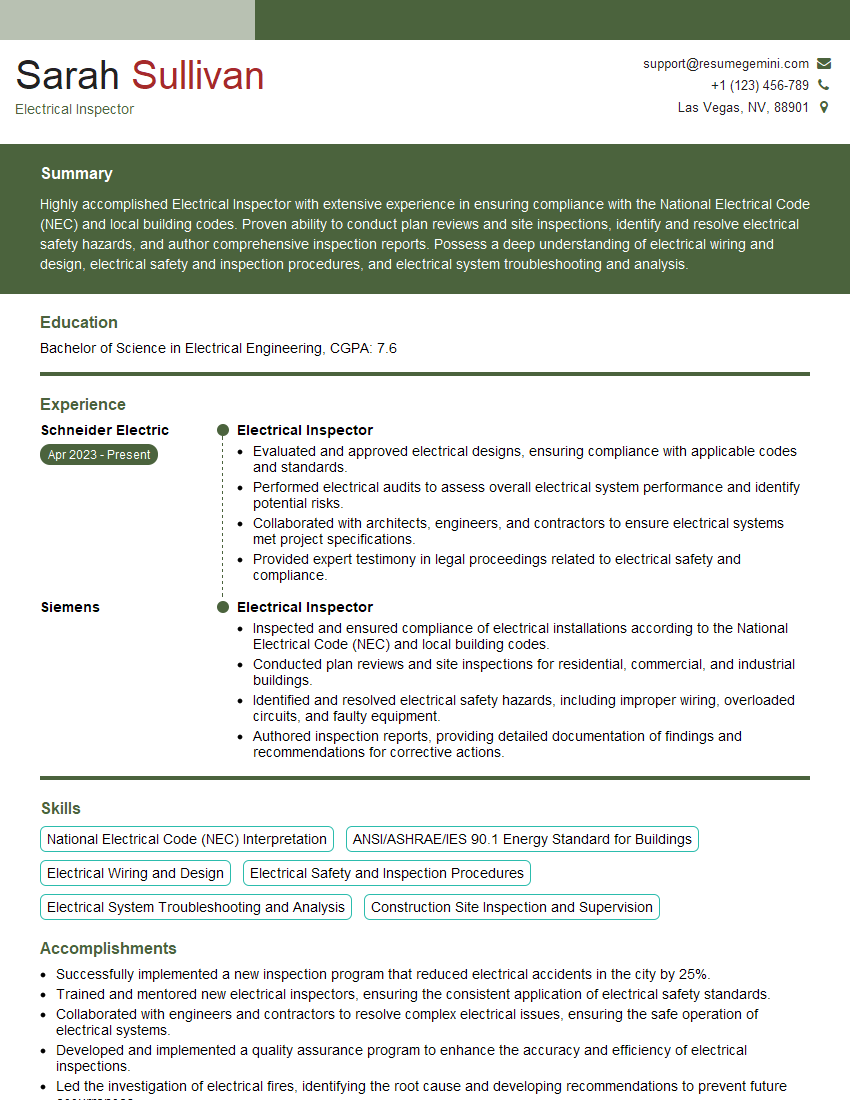
Mastering Electrical Code Compliance (NEC and CEC) is crucial for career advancement in the electrical field, opening doors to more challenging and rewarding opportunities. A strong understanding of these codes demonstrates your commitment to safety and professionalism, making you a highly desirable candidate. To maximize your job prospects, it’s essential to create an ATS-friendly resume that effectively highlights your skills and experience. ResumeGemini is a trusted resource to help you build a professional and impactful resume that gets noticed. We offer examples of resumes tailored to Electrical Code Compliance (NEC and CEC) roles to guide you in creating your own.
Explore more articles
Users Rating of Our Blogs
Share Your Experience
We value your feedback! Please rate our content and share your thoughts (optional).
What Readers Say About Our Blog
To the interviewgemini.com Webmaster.
Very helpful and content specific questions to help prepare me for my interview!
Thank you
To the interviewgemini.com Webmaster.
This was kind of a unique content I found around the specialized skills. Very helpful questions and good detailed answers.
Very Helpful blog, thank you Interviewgemini team.