Unlock your full potential by mastering the most common Expertise in science education and outreach interview questions. This blog offers a deep dive into the critical topics, ensuring you’re not only prepared to answer but to excel. With these insights, you’ll approach your interview with clarity and confidence.
Questions Asked in Expertise in science education and outreach Interview
Q 1. Describe your experience developing and implementing science education programs for diverse audiences.
Developing and implementing science education programs for diverse audiences requires a deep understanding of different learning styles, cultural backgrounds, and accessibility needs. My approach involves a thorough needs assessment to identify the specific interests and prior knowledge of the target audience. This assessment informs the design of engaging and inclusive learning experiences. For example, when working with underserved communities, I prioritize hands-on activities and culturally relevant examples to make science relatable and accessible. I’ve developed programs for K-12 students, university undergraduates, and adult learners, each tailored to their unique needs and learning goals. For instance, a program for elementary school students might focus on interactive experiments and storytelling, while a program for university students might involve more complex research projects and discussions. I have successfully implemented programs that incorporate bilingual instruction and utilize assistive technologies to ensure inclusivity for students with disabilities.
- Example 1: Developed a summer science camp for underprivileged youth, incorporating STEM activities using readily available household materials to address economic barriers.
- Example 2: Created a citizen science project engaging local communities in ecological monitoring, promoting community involvement and scientific literacy.
Q 2. Explain your approach to creating engaging and effective science communication materials.
Creating engaging and effective science communication materials requires a multi-faceted approach. I start by identifying the key message and target audience, then choose the most appropriate communication channel (e.g., videos, interactive websites, hands-on activities, infographics). Simplicity and clarity are paramount; I avoid jargon and complex language, opting for plain language and visuals that convey the message effectively. Storytelling is a powerful tool; I weave narratives into my materials to make complex scientific concepts relatable and memorable. For example, I might use analogies or metaphors to explain difficult concepts. I also incorporate interactive elements and opportunities for audience participation to enhance engagement and retention. Finally, I always test my materials with the target audience to ensure effectiveness and obtain valuable feedback.
- Example: When explaining the concept of photosynthesis, I use an analogy to a solar panel transforming sunlight into energy.
Q 3. How do you assess the effectiveness of your science education programs or outreach initiatives?
Assessing the effectiveness of science education programs requires a combination of quantitative and qualitative methods. Quantitative methods involve using surveys, pre- and post-tests, and attendance data to measure learning outcomes and audience engagement. Qualitative methods, such as focus groups, interviews, and observations, provide insights into participant experiences and perceptions. For example, I might use pre- and post-tests to assess changes in knowledge and understanding, and surveys to gather feedback on the program’s overall effectiveness and identify areas for improvement. Observations during program delivery can reveal how participants are interacting with the materials and each other. Analyzing both types of data provides a comprehensive understanding of program impact. Feedback is critical; I regularly seek feedback from participants, teachers, and other stakeholders to inform program refinement and future development.
Q 4. What strategies do you use to foster a positive and inclusive learning environment in your science education programs?
Fostering a positive and inclusive learning environment is crucial for effective science education. I create a safe and welcoming space where all participants feel comfortable asking questions and sharing their ideas. This involves establishing clear expectations for respectful communication and collaboration. I actively incorporate diverse perspectives and examples into the curriculum, ensuring representation from various cultural backgrounds and genders. I encourage active participation from all learners, paying special attention to the needs of students who may require additional support. This might involve providing differentiated instruction or utilizing assistive technologies. Creating opportunities for peer-to-peer learning, through group projects or discussions, promotes a sense of community and shared learning. Celebrating successes and acknowledging challenges helps to build confidence and motivation.
Q 5. Describe your experience working with different stakeholders in science education initiatives (e.g., teachers, students, community partners).
Working with diverse stakeholders is essential for the success of any science education initiative. My experience involves building strong relationships with teachers, students, community partners, and administrators. I actively seek input from all stakeholders to ensure program relevance and alignment with their needs and priorities. Effective communication and collaboration are key; I utilize regular meetings, email updates, and feedback mechanisms to maintain open lines of communication. For example, I work closely with teachers to integrate my programs into their existing curriculum, and with community partners to secure funding and resources. By fostering collaborative relationships, I can create more impactful and sustainable programs.
Q 6. How do you adapt your science education approaches for different age groups and learning styles?
Adapting science education approaches for different age groups and learning styles is paramount. Younger children benefit from hands-on activities, storytelling, and visual aids. As students get older, the curriculum can incorporate more complex concepts, abstract reasoning, and independent research. Understanding different learning styles (visual, auditory, kinesthetic) is crucial. For example, visual learners benefit from diagrams and videos; auditory learners from discussions and lectures; and kinesthetic learners from hands-on activities. I use a variety of teaching methods to cater to diverse learning styles, ensuring all students have opportunities to engage with the material in ways that resonate with them. Differentiated instruction, providing varied activities and levels of support, is a key strategy.
Q 7. What technologies or tools do you utilize to enhance science learning and engagement?
Technology plays an increasingly important role in enhancing science learning and engagement. I utilize various technologies, including interactive simulations, virtual labs, online learning platforms, and educational videos to make science more accessible and engaging. For example, virtual reality (VR) can immerse students in scientific environments they might not otherwise experience. Data analysis software allows students to work with real-world datasets and develop data literacy skills. Educational games and apps can make learning fun and interactive. I also incorporate social media and online communities to facilitate communication and collaboration among learners. Careful selection and integration of technology are key to ensuring its effective use in the classroom or outreach setting.
Q 8. How do you address misconceptions and build accurate understanding of science concepts among learners?
Addressing misconceptions in science requires a multifaceted approach that goes beyond simply presenting the correct information. It starts with identifying the root of the misconception. Often, these are deeply ingrained intuitive beliefs or result from prior learning experiences. I employ several strategies:
- Pre-assessment and formative assessment: I begin by assessing learners’ prior knowledge through quizzes, discussions, or drawings. This helps pinpoint existing misconceptions. For example, a pre-test might reveal a common misunderstanding about the nature of gravity (e.g., believing it only affects falling objects).
- Conceptual change pedagogy: This approach acknowledges that learning science involves altering existing beliefs. I use activities and discussions that challenge misconceptions directly, presenting evidence and reasoning that contradict them. For example, to address the gravity misconception, we might conduct experiments with objects moving horizontally on different surfaces, showcasing gravity’s constant pull.
- Analogies and metaphors: Making connections to learners’ everyday experiences can help build understanding. If explaining photosynthesis, I might compare it to a factory using sunlight to produce food (sugars).
- Inquiry-based activities: Hands-on experiments and investigations allow learners to actively construct knowledge and discover the errors in their prior thinking. For instance, building circuits allows learners to directly experience the concepts of electrical flow and resistance, correcting misconceptions about electricity’s nature.
- Reflective questioning: Encouraging learners to reflect on their thinking and articulate their understanding helps them identify and resolve inconsistencies in their beliefs. This might involve asking, “What did you expect to happen? What actually happened? Why do you think this happened?”.
By combining these strategies, I aim to create a supportive learning environment where learners feel comfortable revising their understanding and embracing a more accurate scientific perspective.
Q 9. Explain your understanding of current trends and best practices in science education.
Current trends in science education emphasize student-centered learning, emphasizing active learning and engagement rather than passive knowledge reception. Best practices include:
- Inquiry-based learning: Students design investigations, collect data, and draw conclusions, fostering critical thinking and problem-solving skills.
- Project-based learning: Complex, real-world problems serve as the context for learning, allowing students to apply scientific concepts and develop collaboration skills.
- STEM integration: Combining science, technology, engineering, and mathematics allows for a holistic approach to problem-solving and enhances engagement.
- Technology integration: Using simulations, virtual labs, and online resources provides immersive learning experiences and access to diverse data sets.
- Assessment for learning: Focusing on formative assessment allows for timely feedback, supporting student learning and adjusting instruction accordingly.
- Culturally relevant pedagogy: Incorporating students’ cultural backgrounds and experiences into science education increases engagement and inclusivity.
- Focus on scientific practices: Emphasizing the processes of science (observation, experimentation, data analysis, communication) as much as the content knowledge itself.
These practices move away from rote memorization and toward deep conceptual understanding and application of scientific principles.
Q 10. How do you integrate inquiry-based learning into your science education programs?
Inquiry-based learning is at the heart of my science education programs. It’s not about simply giving students a procedure to follow; it’s about empowering them to ask questions, design investigations, and draw conclusions based on evidence.
I structure inquiry-based learning in several ways:
- Generating questions: I start by engaging students in discussions that lead to formulating questions related to a specific science concept. For instance, when studying weather, students might question why certain areas experience more rain than others.
- Designing investigations: Students then design experiments or investigations to test their hypotheses, including choosing materials, developing procedures, and predicting outcomes. They learn to consider variables and controls, a crucial aspect of scientific method.
- Collecting and analyzing data: Students gather data through observation, measurement, and experimentation. They then analyze this data, using charts, graphs, and statistical tools, to look for patterns and trends.
- Drawing conclusions and communicating results: Finally, students interpret their findings and draw conclusions, relating them to their initial hypotheses. They learn to communicate their results effectively through presentations, reports, or posters, developing their communication skills.
For example, in a lesson on plant growth, students might design experiments comparing the growth of plants under different lighting conditions, measuring height and leaf production over time to draw conclusions about the importance of light for plant growth. This hands-on approach fosters deeper understanding and critical thinking skills.
Q 11. Describe your experience in designing and facilitating science workshops or events.
I have extensive experience designing and facilitating science workshops and events for diverse audiences, from elementary school students to adult learners. My approach focuses on making science engaging and accessible.
In designing workshops, I consider:
- Audience needs and interests: I tailor the content and activities to the specific age group and background of the participants.
- Hands-on activities: I incorporate interactive experiments and demonstrations that allow participants to actively engage with scientific concepts.
- Storytelling and real-world applications: I use storytelling and examples from everyday life to make science relevant and relatable.
- Assessment and feedback: I include opportunities for participants to share their learning and provide feedback.
For example, a workshop for elementary school students on the solar system might include building models of planets, conducting experiments demonstrating gravity, and watching a planetarium show. For adult learners, a workshop on climate change could include a discussion of climate science data, an analysis of policy implications, and a brainstorming session on potential solutions. In each case, I aim to create a dynamic and informative learning experience.
Q 12. How do you ensure accessibility and inclusivity in your science outreach activities?
Accessibility and inclusivity are paramount in my science outreach activities. I ensure that all learners, regardless of their background or abilities, have equal opportunities to participate and learn.
Strategies I employ include:
- Universal Design for Learning (UDL): This framework guides me in designing activities that are flexible and cater to diverse learning styles and needs. This could involve offering multiple ways to access information (visual, auditory, kinesthetic), to express understanding (writing, drawing, presenting), and to engage in the learning process (individual work, group work, collaborative projects).
- Multilingual support: Providing materials and instruction in multiple languages ensures that learners whose first language isn’t English can fully participate.
- Accessibility accommodations: I make reasonable adjustments for learners with disabilities, such as providing large-print materials, alternative formats for information, or assistive technologies.
- Culturally responsive teaching: I incorporate diverse perspectives and examples into my teaching to ensure that all learners feel represented and valued.
- Creating welcoming and supportive environments: I foster inclusive learning environments where all participants feel comfortable asking questions, sharing their ideas, and contributing to the learning community.
For example, when conducting a science fair, I ensure that the rules are clearly explained in multiple languages and that accommodations are made for students with disabilities who may need extra time or alternative ways to present their projects. My aim is to create a genuinely inclusive and equitable learning experience for everyone.
Q 13. What are some ethical considerations you address in science education and outreach?
Ethical considerations are central to my work in science education and outreach. I address several key areas:
- Accuracy and objectivity: I prioritize presenting scientific information accurately and objectively, avoiding bias or misinformation. This includes clearly distinguishing between scientific facts and opinions, and critically evaluating sources of information.
- Data integrity and responsible conduct of research: If involving students in research projects, even simple ones, I emphasize the importance of honesty, accuracy, and responsible data handling. This includes discussing plagiarism, data manipulation, and appropriate citation.
- Equity and social justice: I strive to address societal biases and inequities that might affect access to science education and opportunities. I actively seek to promote diversity and inclusion within my programs.
- Environmental responsibility: I consider the environmental impact of our activities and strive to minimize waste and promote sustainable practices.
- Informed consent: When working with human participants (especially in research or outreach involving personal data), I obtain informed consent, ensuring they understand the purpose and procedures involved.
- Intellectual property: I respect the intellectual property rights of others and ensure that materials are used ethically and appropriately.
Ethical considerations are not separate from science education; they are interwoven within the process, ensuring responsible and equitable access to science for all.
Q 14. Describe your experience in evaluating and improving your science education programs.
Evaluating and improving my science education programs is an ongoing process. I use a variety of methods to assess their effectiveness and identify areas for improvement:
- Pre- and post-tests: These measure changes in learners’ understanding and knowledge of specific science concepts.
- Observations: I observe learners during activities to assess their engagement, understanding, and problem-solving skills. This could involve using checklists or rating scales.
- Feedback forms: These gather feedback from participants on their experiences, the effectiveness of the activities, and suggestions for improvement.
- Focus groups: These discussions provide deeper insights into learners’ perceptions and experiences, enabling me to identify challenges or areas requiring attention.
- Data analysis: I analyze quantitative data (e.g., test scores) and qualitative data (e.g., feedback) to draw conclusions about the strengths and weaknesses of my programs.
Based on this evaluation, I make adjustments to improve the effectiveness of my programs. This could involve revising materials, modifying activities, or changing the instructional approach. Continuous evaluation is key to ensuring my programs are engaging, effective, and responsive to the evolving needs of learners.
Q 15. How do you measure the impact of your science outreach efforts on learners?
Measuring the impact of science outreach is crucial for demonstrating effectiveness and securing future funding. It’s not just about attendance numbers; we need to assess actual learning and changes in attitudes. My approach is multifaceted and involves a combination of quantitative and qualitative methods.
Pre- and post-tests: These assess changes in knowledge and understanding before and after an outreach event. For example, a pre-test might assess prior knowledge of the water cycle, followed by a post-test after a hands-on activity demonstrating evaporation and condensation. Analyzing the difference shows learning gains.
Surveys and questionnaires: These gauge participant satisfaction, engagement, and changes in attitudes toward science. We might ask questions like, “How confident are you in your understanding of this topic now?” or “Would you recommend this program to others?” The responses help tailor future programs.
Observations and focus groups: These provide qualitative data about engagement levels, understanding, and participant interactions. Observing group dynamics during an experiment helps assess the effectiveness of teaching methods and identify areas for improvement.
Social media engagement: Analyzing likes, shares, and comments on social media posts related to outreach events can offer insights into audience reach and interest. The number of shares reflects the reach beyond the immediate participants.
By combining these methods, we get a holistic view of our impact, allowing us to refine our strategies and maximize our effectiveness.
Career Expert Tips:
- Ace those interviews! Prepare effectively by reviewing the Top 50 Most Common Interview Questions on ResumeGemini.
- Navigate your job search with confidence! Explore a wide range of Career Tips on ResumeGemini. Learn about common challenges and recommendations to overcome them.
- Craft the perfect resume! Master the Art of Resume Writing with ResumeGemini’s guide. Showcase your unique qualifications and achievements effectively.
- Don’t miss out on holiday savings! Build your dream resume with ResumeGemini’s ATS optimized templates.
Q 16. How do you use data and assessment to inform your science education practices?
Data and assessment are fundamental to improving science education. It’s a continuous cycle of planning, implementing, evaluating, and refining. I use data in several ways:
Formative assessment: This involves ongoing monitoring of student understanding during instruction. Examples include quick quizzes, observation of group work, and informal questioning. This allows for immediate adjustments to teaching methods, ensuring students are grasping concepts.
Summative assessment: This involves formal evaluation of learning at the end of a unit or program. Tests, projects, and presentations provide a comprehensive assessment of knowledge and skills. This data helps determine overall program effectiveness.
Data analysis: I use statistical tools to analyze assessment data, identifying areas of strength and weakness in both teaching and student learning. For example, if many students struggle with a specific concept, it indicates a need for revised instruction or supplementary materials.
Curriculum development: Assessment data informs the design and revision of curricula. If data reveals persistent misconceptions, the curriculum can be revised to address these directly, improving learning outcomes.
Essentially, data-driven decision-making allows for continuous improvement, ensuring that science education is effective and engaging for all learners.
Q 17. Describe a time you had to adapt your approach to science education due to unexpected challenges.
During a hands-on science workshop for elementary school children on the properties of matter, we faced an unexpected challenge. We planned a series of experiments involving various materials, including slime-making. Unfortunately, due to a supplier issue, we received the wrong type of glue, rendering the slime-making activity impossible.
Instead of abandoning the activity, we used the situation as a teachable moment. We discussed the importance of precise measurements and the impact of using the wrong materials in scientific experiments. We then adapted the lesson plan by introducing a different hands-on activity using readily available materials like water, oil, and food coloring to demonstrate density and layering. The children were fascinated by the impromptu experiment, which highlighted the unexpected nature of scientific investigation and the importance of problem-solving.
This experience taught me the importance of flexibility and adaptability in science education. Having backup plans and being prepared to improvise based on unexpected challenges is essential for effective teaching and maintaining student engagement.
Q 18. What are your thoughts on the role of technology in science education and outreach?
Technology plays a transformative role in science education and outreach. It offers exciting opportunities to make learning more engaging and accessible.
Interactive simulations and virtual labs: These provide safe and cost-effective ways to explore complex scientific phenomena. Students can conduct virtual experiments that might be too expensive, dangerous, or time-consuming in a traditional classroom setting.
Educational apps and games: These make learning fun and interactive. Gamification can significantly increase engagement and motivation, particularly for younger learners.
Online resources and platforms: These allow for access to a wealth of information, including videos, animations, and interactive tutorials. They extend learning beyond the classroom, creating opportunities for personalized learning.
Virtual reality (VR) and augmented reality (AR): These immersive technologies provide unparalleled opportunities for experiential learning. Students can explore the human body, the solar system, or microscopic organisms in ways never before possible.
However, it’s crucial to use technology thoughtfully. We need to balance the use of technology with hands-on activities and human interaction to ensure a well-rounded learning experience. Digital literacy is also paramount, ensuring that students can critically evaluate online information.
Q 19. How do you promote scientific literacy among the general public?
Promoting scientific literacy among the general public involves making science relevant, accessible, and engaging to a broad audience. My strategies include:
Public lectures and workshops: These provide opportunities to share scientific knowledge in a conversational and engaging manner, focusing on relatable examples.
Science festivals and outreach events: These interactive events allow the public to participate in hands-on science activities, fostering a sense of wonder and curiosity.
Utilizing social media and online platforms: Sharing engaging science content through visually appealing posts, videos, and infographics can reach a wide audience.
Collaborating with museums and science centers: Partnering with established institutions enhances reach and credibility.
Citizen science projects: These allow the public to participate directly in scientific research, contributing to real-world projects and gaining a deeper understanding of the scientific process.
The key is to communicate complex scientific concepts in simple, understandable language, focusing on the relevance and impact of science on people’s lives.
Q 20. What are your strategies for engaging underrepresented groups in science and technology?
Engaging underrepresented groups in science and technology requires a multifaceted approach that addresses systemic barriers and promotes inclusivity.
Targeted outreach programs: These programs reach out specifically to communities that are traditionally underrepresented, such as girls, minorities, and individuals from low-income backgrounds.
Mentorship and role models: Providing access to mentors and role models from similar backgrounds can inspire and encourage students to pursue STEM careers.
Culturally relevant teaching methods: Incorporating culturally relevant examples and contexts into science lessons can increase engagement and relevance for diverse learners.
Addressing implicit bias: Educators need to be aware of and actively address their own implicit biases to create a more inclusive learning environment.
Promoting equity and access: Ensuring equal access to resources, opportunities, and support for all students is paramount.
Creating a welcoming and inclusive environment where everyone feels valued and empowered is essential for fostering participation in science and technology.
Q 21. How do you effectively communicate complex scientific information to a non-scientific audience?
Communicating complex scientific information to a non-scientific audience requires careful planning and skillful execution. The key is to translate complex concepts into simple, relatable terms, avoiding jargon whenever possible.
Use analogies and metaphors: Comparing complex concepts to familiar everyday experiences makes them easier to grasp. For instance, explaining the concept of an atom using the analogy of a solar system.
Focus on storytelling: Narratives make information more memorable and engaging. Instead of simply stating facts, weave them into a compelling story that captures attention.
Use visuals: Graphs, charts, diagrams, and images can significantly enhance understanding, especially for complex data or processes. A well-designed infographic can communicate information more effectively than a lengthy text.
Keep it concise and focused: Avoid overwhelming the audience with too much information. Focus on the most essential concepts and avoid unnecessary detail.
Engage with the audience: Encourage questions and discussions to ensure understanding and address any misconceptions.
Effective communication involves understanding your audience and tailoring your message to their level of knowledge and interests. It’s about connecting with people on a human level and making science relevant and exciting for everyone.
Q 22. How do you incorporate hands-on activities into your science education programs?
Hands-on activities are crucial for effective science education because they transform abstract concepts into tangible experiences. I incorporate them by designing programs that prioritize active learning. This involves moving away from passive lectures and towards activities that encourage exploration and discovery.
- Inquiry-based investigations: Students design their own experiments to answer questions, fostering critical thinking and problem-solving skills. For example, in a lesson on density, students might design experiments to compare the density of different liquids using various materials.
- Model building: Constructing models (e.g., a DNA double helix, a volcano, a solar system) helps students visualize complex structures and processes. This is particularly beneficial for younger learners or when dealing with abstract concepts.
- STEM challenges/competitions: These collaborative activities engage students in problem-solving and teamwork. A challenge might involve building a bridge using limited materials, or designing a mechanism to transport something from point A to B.
- Field trips and outdoor learning: Experiential learning in natural settings connects classroom concepts to real-world contexts. For instance, a field trip to a nature reserve could reinforce lessons on ecosystems and biodiversity.
The key is to choose activities appropriate to the age and learning level of the students, while always ensuring safety and effective supervision.
Q 23. How do you evaluate and select appropriate educational resources for your programs?
Selecting appropriate educational resources is a multi-step process that ensures alignment with learning objectives, accuracy of information, and engagement for learners. I prioritize resources that are:
- Curriculum-aligned: The resources must directly support the learning objectives of the program. I carefully examine the curriculum standards and ensure the selected resources address the relevant concepts and skills.
- Age and developmentally appropriate: The complexity of the information and the methods of presentation should be suitable for the age group and developmental stage of the students.
- Culturally responsive: Resources should reflect the diversity of the student population and avoid perpetuating stereotypes or biases.
- Engaging and accessible: The materials should use varied modalities (visual, auditory, kinesthetic), making learning accessible to all students, including those with disabilities. I consider interactive elements, multimedia components, and hands-on activities.
- Accurate and up-to-date: I verify information from reputable sources such as peer-reviewed journals, government agencies, and established educational organizations, ensuring the information is current and free from misinformation.
I typically use a combination of approaches including reviewing teacher resources, consulting with colleagues, and conducting pilot tests of materials before widespread implementation to gauge effectiveness and make necessary adjustments.
Q 24. Describe your experience with grant writing or securing funding for science education projects.
Securing funding for science education projects is a vital skill for maximizing impact. My experience encompasses identifying funding opportunities, developing compelling grant proposals, and managing awarded grants.
- Identifying funding opportunities: I meticulously research funding agencies (e.g., NSF, NIH, private foundations) that align with my project goals. I examine their grant guidelines carefully, paying close attention to eligibility criteria and application deadlines.
- Developing compelling grant proposals: I focus on articulating a clear project need, describing innovative approaches, defining measurable outcomes, and demonstrating the project’s potential impact. A strong narrative that connects the project to broader societal needs is crucial.
- Budget development: I create detailed and justified budgets that account for all project expenses (personnel, materials, equipment, travel etc.). A well-structured budget demonstrates fiscal responsibility and strengthens the proposal’s credibility.
- Grant management: After securing funding, I diligently manage the budget, track progress towards goals, submit timely reports, and maintain transparent communication with the funding agency.
For instance, I successfully secured a grant from a local foundation to develop a mobile science lab for under-resourced schools. The proposal highlighted the need for equitable access to science education and provided a detailed plan for implementation, evaluation, and sustainability.
Q 25. How do you stay up-to-date with current developments in science and science education?
Staying current in science and science education is critical for maintaining relevance and effectiveness. I utilize various strategies to keep my knowledge updated:
- Professional development: I actively participate in workshops, conferences, and webinars related to science and science education. These events provide opportunities to learn about new research, pedagogical approaches, and best practices.
- Reading professional journals: I regularly read peer-reviewed journals such as Science, Nature, and journals dedicated to science education research (e.g., Journal of Research in Science Teaching). This allows me to stay informed about current scientific breakthroughs and pedagogical advancements.
- Online resources: I utilize online platforms such as professional organizations’ websites, online courses (MOOCs), and reputable science news sources to access up-to-date information.
- Networking with colleagues: Engaging in discussions with colleagues, attending professional meetings, and participating in online forums enables me to share insights, learn from others’ experiences, and remain abreast of current trends.
Continuous learning is essential, allowing me to adapt my teaching methods, incorporate cutting-edge scientific discoveries, and maintain a strong foundation in the field.
Q 26. What are your professional goals in science education and outreach?
My professional goals center around expanding access to high-quality science education and fostering a lifelong love of learning. I aim to:
- Develop innovative science education programs: I want to create engaging and impactful programs that cater to diverse learners and address critical societal needs, focusing on areas like environmental sustainability, climate change, and public health.
- Promote science literacy: I aspire to equip students with the scientific knowledge and critical thinking skills needed to navigate an increasingly complex world. This includes fostering an understanding of the scientific method and the importance of evidence-based decision-making.
- Mentorship and leadership: I aim to mentor aspiring science educators, sharing my expertise and fostering a collaborative environment that promotes professional growth and innovation within the field.
- Broadening participation in STEM: I am deeply committed to addressing equity and access issues in STEM education. My goal is to create inclusive learning environments that encourage the participation of underrepresented groups and remove barriers to success.
Ultimately, I strive to make a lasting impact on the next generation of scientists, critical thinkers, and informed citizens.
Q 27. How do you collaborate with other educators and professionals in the field?
Collaboration is fundamental to effective science education and outreach. I actively engage with educators and professionals in the field through various methods:
- Professional organizations: I actively participate in professional organizations such as NSTA (National Science Teachers Association) and similar groups. This provides opportunities for networking, collaboration on projects, and access to shared resources.
- Joint workshops and events: I collaborate with colleagues to design and deliver workshops, conferences, and outreach events, leveraging each other’s expertise to provide a richer and more comprehensive learning experience.
- Curriculum development: I engage in collaborative curriculum development, drawing upon the collective knowledge and experience of a team to create high-quality, standards-aligned materials.
- Sharing resources and best practices: I actively share resources, lesson plans, and best practices with colleagues through informal networks, professional organizations, and online platforms.
For example, I recently collaborated with a local museum curator to develop a hands-on exhibit on the life cycle of butterflies, combining my science education expertise with their knowledge of natural history. This collaborative approach created an engaging and educational experience for the public.
Q 28. Describe your experience working within a team to achieve science education goals.
Teamwork is essential for achieving ambitious science education goals. My experience working in teams involves:
- Shared vision and goals: I believe in establishing a clear, shared vision and defining specific, measurable, achievable, relevant, and time-bound (SMART) goals. This ensures everyone understands the direction and purpose of the project.
- Role definition and delegation: I work to clarify each team member’s roles and responsibilities, ensuring clear accountability and efficient task allocation. This utilizes the strengths of each individual effectively.
- Open communication and feedback: Maintaining open communication channels and actively soliciting feedback are vital. Regular meetings, discussions, and constructive criticism ensure the project remains on track.
- Conflict resolution: Addressing conflicts promptly and constructively is crucial for a positive team dynamic. Focusing on problem-solving rather than assigning blame helps to maintain momentum.
- Celebrating successes: Acknowledging and celebrating milestones along the way boosts team morale and reinforces positive collaboration.
In one project, our team successfully developed a new after-school science program for underserved youth. Effective communication, clear division of labor, and a supportive team environment allowed us to overcome challenges and achieve our goals. We celebrated the successful completion and were able to secure additional funding for future expansion.
Key Topics to Learn for Expertise in Science Education and Outreach Interview
- Curriculum Development & Design: Understanding principles of effective science curriculum design, aligning with learning objectives and diverse learner needs. Consider the application of different pedagogical approaches (inquiry-based learning, project-based learning, etc.).
- Science Communication Strategies: Mastering techniques for translating complex scientific concepts into accessible and engaging formats for various audiences (children, adults, general public). Explore different communication mediums (presentations, workshops, social media, informal settings).
- Assessment & Evaluation: Developing and implementing methods for assessing learning outcomes in science education programs, and evaluating the effectiveness of outreach initiatives. This includes both formative and summative assessment strategies.
- Educational Technologies & Resources: Familiarity with educational technologies and online resources for science education and outreach, and the ability to integrate them effectively into teaching and outreach programs.
- Diversity, Equity, and Inclusion (DEI) in STEM: Understanding and addressing issues of diversity, equity, and inclusion in science education and outreach. This includes culturally responsive teaching and creating inclusive learning environments.
- Program Management & Evaluation: Experience in planning, implementing, and evaluating science education and outreach programs. This includes budgeting, scheduling, and reporting.
- Stakeholder Engagement & Collaboration: Building and maintaining relationships with various stakeholders (teachers, students, community members, funders) to support science education and outreach initiatives.
- Problem-solving in Science Education: Applying critical thinking and problem-solving skills to address challenges in science education, such as engaging disengaged learners or adapting to diverse learning styles.
Next Steps
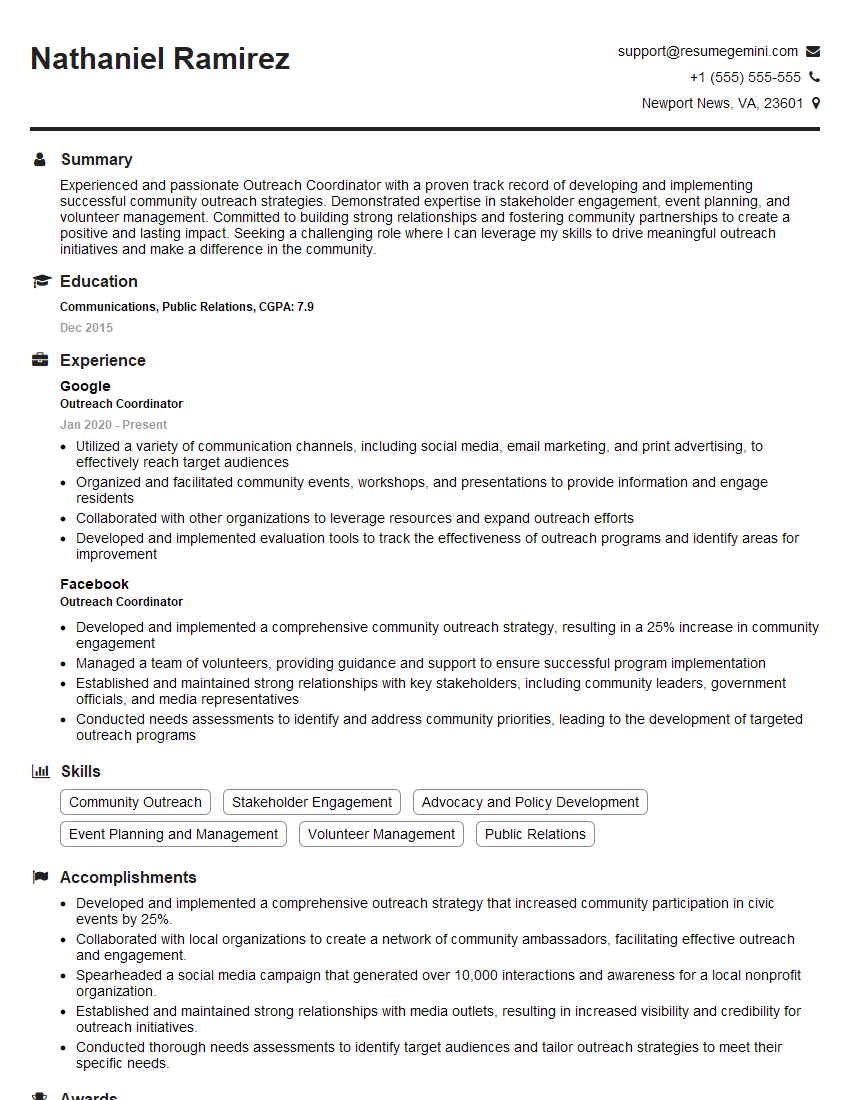
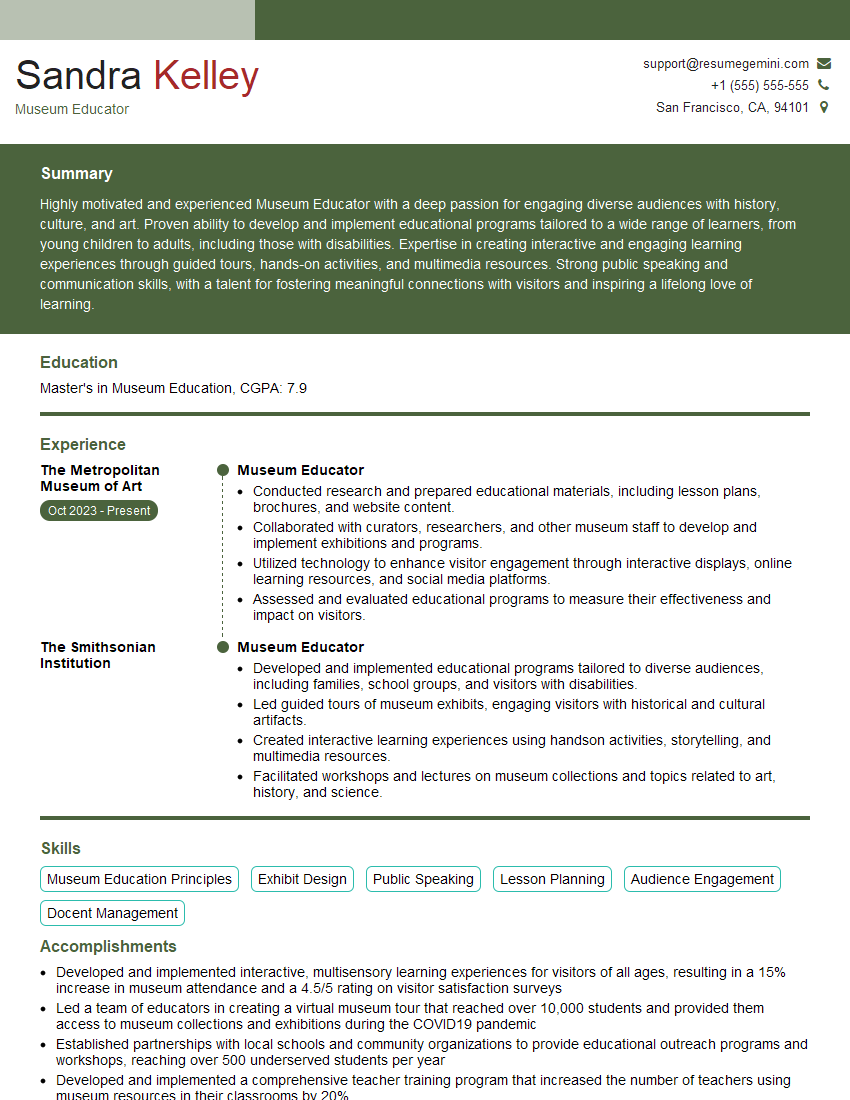
Mastering Expertise in science education and outreach opens doors to rewarding careers with significant impact. A strong resume is crucial for showcasing your skills and experience to potential employers. Building an ATS-friendly resume significantly increases your chances of getting your application noticed. We highly recommend using ResumeGemini to craft a professional and impactful resume tailored to your experience. ResumeGemini provides examples of resumes specifically designed for candidates with Expertise in science education and outreach, helping you present your qualifications effectively. Take the next step towards your dream career today!
Explore more articles
Users Rating of Our Blogs
Share Your Experience
We value your feedback! Please rate our content and share your thoughts (optional).
What Readers Say About Our Blog
To the interviewgemini.com Webmaster.
Very helpful and content specific questions to help prepare me for my interview!
Thank you
To the interviewgemini.com Webmaster.
This was kind of a unique content I found around the specialized skills. Very helpful questions and good detailed answers.
Very Helpful blog, thank you Interviewgemini team.