Unlock your full potential by mastering the most common Gallery Education interview questions. This blog offers a deep dive into the critical topics, ensuring you’re not only prepared to answer but to excel. With these insights, you’ll approach your interview with clarity and confidence.
Questions Asked in Gallery Education Interview
Q 1. Describe your experience developing and implementing educational programs for diverse audiences.
Developing and implementing educational programs for diverse audiences requires a deep understanding of different learning styles, cultural backgrounds, and accessibility needs. My approach begins with thorough needs assessments to understand the specific interests and prior knowledge of the target audience. For example, when designing a program for school children, I consider age-appropriateness, curriculum alignment, and the inclusion of interactive elements to maintain engagement. For adult audiences, I might focus on providing in-depth analyses of artwork, fostering critical thinking discussions, or offering opportunities for creative expression. I’ve successfully created programs for K-12 students, university students, senior citizens, and families, adapting content and methodology to meet each group’s unique requirements. This includes incorporating visual aids, storytelling techniques, and hands-on activities to accommodate various learning preferences.
For instance, in a program about Impressionism, I would use age-appropriate language and activities for younger audiences, perhaps focusing on the artists’ use of color and light through a painting activity. For adults, I might delve deeper into the historical context, artistic movements, and the social impact of Impressionism, incorporating more complex discussions and critical analysis.
Q 2. How do you adapt your teaching style to cater to different learning styles and age groups?
Catering to different learning styles and age groups is crucial for effective gallery education. My teaching style is highly adaptable and incorporates diverse methodologies. I utilize a multi-sensory approach, understanding that individuals learn best through different channels – visual, auditory, kinesthetic, and reading/writing. For younger children, I rely heavily on hands-on activities, storytelling, and interactive games. For older students and adults, I incorporate more formal lectures, discussions, and critical analysis, encouraging active participation through question-and-answer sessions and group projects.
For example, when teaching about ancient Egyptian art, I would engage younger children with a mummy-making activity using craft materials, while I might use a lecture format supplemented with artifact analysis and scholarly discussions for university students.
- Visual learners benefit from images, videos, and demonstrations.
- Auditory learners respond well to lectures, discussions, and audio recordings.
- Kinesthetic learners thrive through hands-on activities, role-playing, and movement.
- Reading/writing learners appreciate detailed handouts, research tasks, and reflective writing exercises.
Q 3. Explain your approach to creating engaging and interactive gallery experiences.
Creating engaging and interactive gallery experiences requires a blend of thoughtful planning and creative execution. My approach involves several key strategies: First, I aim to connect the artwork to the visitors’ lives and experiences, making the content relevant and relatable. I achieve this through storytelling, open-ended questions, and activities that encourage personal reflection and interpretation. Second, I incorporate diverse interactive elements, such as hands-on activities, scavenger hunts, guided tours, and technology-based experiences, catering to different learning styles and fostering active participation. Finally, I strive to create a welcoming and inclusive environment where visitors feel comfortable exploring, asking questions, and sharing their perspectives.
For instance, a program on contemporary photography could include a photo-walk around the gallery to encourage observation, followed by a discussion on the photographers’ artistic choices and a digital storytelling workshop using provided images.
Q 4. How do you assess the effectiveness of your educational programs?
Assessing the effectiveness of educational programs is essential for continuous improvement. I employ a multi-faceted approach, combining quantitative and qualitative data collection methods. Quantitative methods include pre- and post-program assessments (quizzes, surveys) to measure knowledge gain and changes in attitudes. Qualitative methods involve observations during program delivery, informal feedback sessions, and focus groups to gain insights into visitor engagement and learning experiences.
For example, pre- and post-program surveys might assess visitors’ understanding of a specific artistic movement. Observations during a tour would provide insights into the effectiveness of engagement strategies. Post-program feedback sessions could offer valuable qualitative information on the visitors’ overall experience and suggestions for improvement.
Q 5. Describe your experience working with docents or volunteers in an educational setting.
Working with docents and volunteers is crucial for successful gallery education. My approach focuses on building strong collaborative relationships, providing comprehensive training, and fostering a shared commitment to high-quality educational experiences. I offer training sessions covering topics such as art historical context, effective communication strategies, audience engagement techniques, and handling difficult questions. I also provide ongoing support through regular meetings, mentorship opportunities, and collaborative planning sessions. This collaborative approach ensures consistency in program delivery and enhances the overall learning experience for visitors.
For example, I would collaborate with docents to co-develop new tours and workshops, leveraging their expertise and insights into visitor interests. Regular feedback sessions ensure that they feel supported and valued within the program.
Q 6. How familiar are you with various pedagogical approaches in museum education?
I am highly familiar with various pedagogical approaches in museum education, including inquiry-based learning, collaborative learning, project-based learning, and experiential learning. These approaches emphasize active participation, critical thinking, and meaningful engagement with the artwork. I believe that the most effective gallery education programs leverage a combination of these approaches to cater to diverse learning styles and needs.
For example, an inquiry-based approach would encourage visitors to formulate their own questions and explore the artwork independently, while a project-based approach would involve visitors in creating their own artworks inspired by gallery pieces.
Q 7. How do you incorporate technology into your gallery education programs?
Technology plays an increasingly important role in gallery education, enhancing engagement and accessibility. I incorporate technology in several ways: interactive kiosks providing detailed information about artworks, augmented reality apps overlaying digital content onto physical objects, virtual tours allowing access to remote audiences, and online resources offering supplementary learning materials. I also utilize digital tools for program evaluation, collecting data through online surveys and feedback forms.
For instance, an augmented reality app could allow visitors to view 3D models of sculptures or listen to audio commentary by curators. An online resource library could provide images, articles, and videos related to the exhibition’s themes.
Q 8. How would you handle a disruptive visitor during a gallery tour?
Handling a disruptive visitor during a gallery tour requires a calm and proactive approach. My priority is to ensure the learning experience isn’t negatively impacted for the other participants. I’d first attempt to subtly redirect the behavior. For instance, if someone is speaking loudly, I might quietly adjust my own volume and pace, hoping they’ll follow suit. If the disruptive behavior continues, I’d engage directly, using a polite but firm tone. I might say something like, ‘I understand you’re excited, but let’s keep our voices down so everyone can hear.’ If the disruption is severe or involves inappropriate behavior, I wouldn’t hesitate to ask the individual to leave, offering assistance if needed, perhaps suggesting another visit when they can be more respectful of the shared space and learning environment. It’s vital to document the incident for future reference and to ensure visitor safety. In some cases, collaborating with security staff would be necessary.
Q 9. What strategies do you use to promote inclusivity and accessibility in your programs?
Promoting inclusivity and accessibility is paramount. My strategies include offering tours in multiple languages, providing audio guides with visual descriptions for visually impaired visitors, and creating tactile experiences for those with visual impairments using 3D printed models or textured reproductions. We also incorporate sign language interpretation for deaf and hard-of-hearing individuals and ensure our venues are physically accessible with ramps, elevators, and appropriate seating. Additionally, we develop programs that cater to diverse learning styles and abilities. This might include interactive workshops, sensory-focused activities, and age-appropriate content that considers varied attention spans. For instance, a program designed for children might incorporate games and hands-on activities, while one for adults could involve deeper discussions and critical analysis of the artwork. We also actively recruit and train staff who reflect the diversity of our community. We regularly review our accessibility policies and programs to ensure they meet current best practices and remain relevant to the evolving needs of our visitors.
Q 10. How do you evaluate the impact of your educational initiatives?
Evaluating the impact of our educational initiatives is an ongoing process. We use a multi-faceted approach. Pre- and post-tour questionnaires gauge visitor knowledge and understanding. We also track attendance figures, visitor feedback through comment cards and online surveys, and social media engagement. For more in-depth analysis, we might conduct focus groups or individual interviews to understand visitors’ experiences and identify areas for improvement. We analyze the data to identify trends, measure learning gains, and assess the effectiveness of different program formats and delivery methods. This data helps us refine existing programs and inform the development of new initiatives. For example, a low score on a post-tour question about the historical context of a specific artwork might indicate a need to revise that section of the tour script or provide additional resources. The ultimate goal is to demonstrate the value of our programs to our stakeholders and continually improve our impact.
Q 11. Describe your experience creating educational materials, such as brochures or handouts.
I have extensive experience creating educational materials. My approach always begins with identifying the target audience and learning objectives. For example, a brochure for families might use bright colors, simple language, and engaging visuals, whereas a handout for a university-level art history class would utilize more academic language and in-depth analysis. I prioritize clarity, accuracy, and visual appeal. I ensure all materials are visually engaging, accessible, and aligned with the museum’s branding. I use a variety of tools, from Adobe InDesign and Photoshop for layout and graphic design to accessibility checkers to ensure compatibility for various needs. For instance, when designing a brochure, I’d create large, easy-to-read text with clear headings and subheadings. I’d also include relevant images and illustrations that complement the text and enhance comprehension. Before finalizing any material, I always conduct thorough proofreading and editing to ensure accuracy and clarity.
Q 12. Explain your understanding of different learning theories and their application in museums.
My understanding of learning theories is crucial to my work. I apply principles from various theories, including constructivism, where learning is viewed as an active process of constructing knowledge, and experiential learning, emphasizing hands-on activities and reflection. For instance, a constructivist approach in a gallery setting might involve encouraging visitors to actively interpret artwork through guided discussions and open-ended questions rather than simply presenting facts. Experiential learning might be implemented through workshops where visitors create their own art inspired by the gallery’s collection. I also consider behaviorism, focusing on positive reinforcement and rewarding engagement with the materials. For example, providing small, interactive quizzes after a tour or offering small gifts at the end of a program helps enhance learning. By combining these approaches, I create engaging and effective learning experiences that cater to diverse learning styles.
Q 13. How do you ensure that your programs align with the museum’s mission and collection?
Aligning programs with the museum’s mission and collection is fundamental. I start by thoroughly understanding the museum’s overarching goals and the specific themes and narratives present in the collection. I then design educational programs that directly support these objectives. For example, if the museum’s mission is to promote understanding of a particular historical period, I would develop programs that explore relevant artworks from the collection, potentially incorporating historical documents, letters, and other primary sources. If the collection has a strong focus on a specific artistic movement, I would design educational materials that explore the movement’s key characteristics, significant artists, and historical context. This integrated approach ensures that the educational programs not only enhance visitor understanding but also contribute to the museum’s overall goals. Regular review and collaboration with curatorial staff are vital to maintaining this alignment.
Q 14. Describe your experience managing budgets and resources for educational programs.
Managing budgets and resources for educational programs requires careful planning and prioritization. I begin by developing a detailed budget that outlines all anticipated expenses, including staff salaries, materials, marketing, and venue rental (if applicable). I then secure funding through grants, sponsorships, and institutional support. I meticulously track expenses and ensure that funds are used efficiently and effectively. I prioritize program needs based on their alignment with the museum’s mission and their potential impact on visitors. I also explore cost-effective solutions, such as utilizing volunteer docents or partnering with community organizations for resource sharing. Regular monitoring of the budget and flexible adjustment based on changing needs and priorities are crucial for successful financial management. This involves carefully evaluating the return on investment for different programs and ensuring that resources are allocated to the most impactful initiatives.
Q 15. How do you collaborate with other departments within a museum setting?
Collaboration is crucial in a museum setting. In my experience, effective gallery education relies heavily on interdepartmental partnerships. For instance, I frequently collaborate with the curatorial department to ensure educational programs align with current exhibitions. We work together to interpret complex themes and develop accessible narratives for diverse audiences. I also closely collaborate with marketing and communications to promote programs effectively, reaching the intended demographic. With the development department, we discuss program funding and resource allocation. Finally, I work with the visitor services team to ensure smooth program logistics and positive visitor experiences. This collaborative approach ensures a cohesive and impactful visitor experience.
- Example: For a recent exhibition on Impressionism, I worked with the curator to identify key themes and artworks, then designed workshops and tours incorporating those elements. Marketing then promoted these programs, ensuring we reached individuals interested in Impressionism.
Career Expert Tips:
- Ace those interviews! Prepare effectively by reviewing the Top 50 Most Common Interview Questions on ResumeGemini.
- Navigate your job search with confidence! Explore a wide range of Career Tips on ResumeGemini. Learn about common challenges and recommendations to overcome them.
- Craft the perfect resume! Master the Art of Resume Writing with ResumeGemini’s guide. Showcase your unique qualifications and achievements effectively.
- Don’t miss out on holiday savings! Build your dream resume with ResumeGemini’s ATS optimized templates.
Q 16. How do you handle challenging or sensitive topics within your educational programs?
Handling sensitive topics requires careful planning and sensitivity. Before addressing potentially controversial or challenging subjects (e.g., colonialism, war, social injustice reflected in art), I ensure the program’s framing is appropriate and contextually rich. This involves researching the topic thoroughly, consulting with relevant experts, and considering diverse perspectives. We use age-appropriate language and provide resources for further exploration. Open discussion is encouraged, but always within a respectful and moderated environment. Providing multiple entry points for engagement helps to create a safe space for learners to engage with difficult material. For example, we might use art-making activities as a non-threatening way to address the themes.
- Example: When addressing colonialism in an exhibition, we created a guided tour that used art as a primary source, presenting multiple perspectives on the historical events. We provided handouts with additional resources and encouraged visitors to engage in respectful dialogue, guided by facilitators.
Q 17. Explain your experience with curriculum development and assessment in an art museum context.
Curriculum development in an art museum context necessitates a deep understanding of both art history and pedagogical principles. I employ a backward design approach, starting with clearly defined learning objectives. For example, I might aim for visitors to understand the social context of a particular artwork or to develop their critical thinking skills. The learning activities, like interactive games or hands-on projects, then directly support these objectives. Assessment isn’t limited to traditional testing; I use observation, group discussions, and informal feedback to gauge learning. For instance, I might observe visitors’ engagement during a gallery talk or analyze the artwork they create during a workshop.
- Example: To teach about perspective in Renaissance art, I designed a lesson that involved analyzing paintings, then having visitors create their own drawings utilizing perspective techniques. Assessment involved observing students’ understanding of perspective in their drawings and their participation in class discussions.
Q 18. How do you engage visitors in meaningful dialogue and critical thinking about art?
Engaging visitors in meaningful dialogue and fostering critical thinking involves creating interactive experiences. I avoid passive lectures and instead use open-ended questions, facilitating discussions rather than dictating interpretations. We use various methods – gallery talks that invite questions, interactive displays with prompts, and collaborative art-making activities – to encourage active participation. By prompting them to make connections between the artwork, their own experiences, and the broader context, critical thinking is naturally fostered. Think-pair-share activities and small group discussions are also powerful tools.
- Example: Instead of a lecture about a particular painting, we might start a discussion by asking: “What story does this painting tell you? What emotions does it evoke? How does it relate to your own experiences?”
Q 19. What are some best practices for visitor engagement in a museum setting?
Best practices for visitor engagement prioritize accessibility and inclusivity. This includes offering diverse program formats (tours, workshops, family days), providing multilingual materials, and adapting programs for visitors with disabilities (following Universal Design for Learning principles). Using interactive technologies, creating opportunities for hands-on activities, and catering to different learning styles are also crucial. Regular evaluation through visitor surveys and feedback mechanisms helps refine programs to better suit visitor needs and preferences.
- Example: Offering audio tours in multiple languages, designing tactile displays for visually impaired visitors, and incorporating movement-based activities for kinesthetic learners are just a few examples of creating accessible programs.
Q 20. How do you incorporate Universal Design for Learning principles into your programs?
Universal Design for Learning (UDL) guides the creation of inclusive learning environments. In my programs, I employ UDL principles by offering multiple means of representation (visual, auditory, kinesthetic), multiple means of action and expression (allowing visitors to engage with the art through different modes like writing, drawing, discussion), and multiple means of engagement (catering to various levels of motivation and interests). This ensures that all learners, regardless of their abilities or learning styles, can access and participate meaningfully.
- Example: For a single exhibition, we might offer a traditional gallery tour, a hands-on art-making workshop, and a self-guided audio tour with varying levels of detail. This allows visitors to choose the learning method that best suits them.
Q 21. Describe your experience working with diverse communities and cultural groups.
Working with diverse communities is a cornerstone of my approach. I actively seek opportunities to collaborate with local cultural groups, community centers, and schools to design programs relevant to their unique experiences and perspectives. I engage community members in the program design process to ensure inclusivity and authenticity. This includes employing culturally responsive teaching methods and using diverse examples in the curriculum materials. Translation services and culturally appropriate program formats are vital for maximizing inclusivity.
- Example: When working with a local Hispanic community, I partnered with a community center to develop a bilingual program that explored the art and culture of Latin America, ensuring representation and relevance.
Q 22. How do you measure the success of your educational programs beyond attendance numbers?
Measuring the success of educational programs goes far beyond simply counting attendance. While attendance is a useful metric, it doesn’t tell the whole story. A truly effective program impacts visitor understanding, engagement, and lasting impressions. We employ a multifaceted approach incorporating qualitative and quantitative data.
- Pre- and Post-Program Assessments: These questionnaires gauge shifts in knowledge and understanding of specific artworks or themes. For example, a pre-program quiz on Impressionism might assess prior knowledge, and a post-program quiz would measure learning gains.
- Focus Groups and Interviews: We conduct in-depth interviews and focus groups with program participants to gain insights into their experiences, what resonated with them, and how the program impacted their perspective on the collection. This allows for rich qualitative data.
- Observation and Feedback Mechanisms: We actively observe program interactions and provide opportunities for participants to offer immediate feedback through surveys or suggestion boxes. This enables immediate course correction if needed and captures immediate reactions.
- Long-Term Engagement Tracking: We analyze repeat visitation, membership sign-ups, and participation in related programs to assess the long-term impact. A successful program might inspire repeat visits or deeper engagement with the museum’s offerings.
By combining these methods, we obtain a holistic understanding of program effectiveness and continually refine our approaches based on data-driven insights.
Q 23. How do you use storytelling to engage visitors with the museum’s collection?
Storytelling is fundamental to connecting visitors with our collection. We move beyond simple descriptions, aiming to create emotionally resonant experiences that foster deeper understanding and appreciation. We use several techniques:
- Object-Based Storytelling: We weave narratives around individual artworks, focusing on their creation, historical context, the artist’s life, and the cultural impact. For instance, a seemingly simple portrait might reveal untold stories of the sitter’s life, social standing, or the artist’s artistic choices.
- Thematic Narratives: We create larger narratives that connect multiple artworks and artifacts across time periods and cultures, exploring broader themes such as migration, identity, or the evolution of artistic styles. This provides context and helps visitors make connections.
- Interactive Storytelling: We incorporate interactive elements like digital displays, multimedia presentations, and hands-on activities to engage visitors actively. For example, visitors might manipulate virtual models of sculptures or listen to oral histories related to specific pieces.
- Employing Diverse Voices: We actively seek out and present narratives that incorporate diverse perspectives, acknowledging the complexities and nuances of history and culture. This ensures more inclusive and representative storytelling.
By combining these methods, we create compelling narratives that capture visitors’ imaginations, making the art more accessible and meaningful.
Q 24. What are your strategies for dealing with difficult questions or comments from visitors?
Handling challenging questions or comments requires diplomacy, knowledge, and a willingness to engage respectfully. Our strategy focuses on active listening, thoughtful responses, and acknowledging diverse perspectives.
- Active Listening: We carefully listen to the visitor’s question or comment, showing genuine interest and seeking to understand their perspective.
- Acknowledging Perspectives: Even if we disagree, we acknowledge the visitor’s point of view, demonstrating respect for their opinion. For example, “I understand your perspective on this artwork. While interpretations can vary, let me offer some context that might help you see it differently.”
- Providing Accurate Information: We respond with factual, well-researched information, basing our answers on scholarly sources and museum records.
- Redirecting to Relevant Resources: If the question is too complex or beyond our immediate expertise, we direct visitors towards appropriate resources such as scholarly articles, books, or website links.
- Seeking Collaboration with Experts: For highly specialized questions, we might involve other museum staff, including curators or conservators, to ensure accurate and thorough responses.
By responding thoughtfully and respectfully, we transform potentially negative encounters into opportunities to enhance visitor engagement and deepen understanding.
Q 25. Explain your understanding of the ethical considerations in museum education.
Ethical considerations in museum education are paramount. We are custodians of cultural heritage, and our educational programs must reflect principles of inclusivity, accuracy, and responsibility.
- Representational Accuracy: We strive for accurate and unbiased representations of history and culture, acknowledging diverse perspectives and avoiding perpetuating harmful stereotypes. We are mindful of the potential for misinterpretations and actively work to avoid them.
- Cultural Sensitivity: We treat all cultural materials with respect, acknowledging their significance within their respective communities. We actively collaborate with cultural communities to ensure respectful representation.
- Accessibility and Inclusivity: We design programs that are accessible to diverse audiences, considering factors such as age, language, ability, and learning styles. We work towards equitable access to museum experiences for all.
- Transparency and Objectivity: We strive to be transparent about the museum’s collections, their provenance, and the stories we tell. We acknowledge potential biases in existing narratives and work towards more balanced representations.
- Intellectual Property Rights: We respect and adhere to copyright laws and intellectual property rights when using materials in our educational programs.
These ethical guidelines ensure responsible stewardship of our collections and a commitment to creating meaningful and inclusive educational experiences for all visitors.
Q 26. How do you stay current with best practices in the field of museum education?
Staying current in museum education requires continuous professional development and engagement with the field’s best practices. I employ several strategies:
- Professional Organizations: I actively participate in professional organizations such as the Association of Museum Educators (AME) and attend conferences and workshops to learn about new approaches and research findings.
- Scholarly Publications: I regularly read peer-reviewed journals and books on museum education, staying abreast of current trends and best practices.
- Online Resources: I utilize online resources, such as museum blogs, podcasts, and webinars, to access information and engage in online discussions with colleagues.
- Networking: I actively network with other museum educators, attending conferences and workshops to learn from their experiences and collaborate on projects.
- Mentorship: I seek out opportunities for mentorship and engage in peer-to-peer learning.
This continuous learning ensures that our programs are innovative, effective, and align with the latest research and best practices in museum education.
Q 27. How do you manage your time effectively when balancing multiple projects and deadlines?
Effective time management is critical in balancing multiple projects and deadlines. My approach combines strategic planning, prioritization, and efficient task management techniques.
- Prioritization: I use prioritization matrices (like Eisenhower Matrix) to identify urgent and important tasks, ensuring that critical projects receive timely attention.
- Project Planning: I break down large projects into smaller, manageable tasks, creating detailed timelines and setting realistic deadlines for each.
- Time Blocking: I allocate specific time blocks in my day for focused work on particular tasks, minimizing distractions and maximizing productivity.
- Delegation: When appropriate, I delegate tasks to team members, fostering collaboration and distributing workload effectively.
- Regular Review and Adjustment: I regularly review my schedule and progress, adjusting my plans as needed to account for unforeseen challenges or changing priorities.
By employing these strategies, I can efficiently manage my workload, meet deadlines, and maintain a healthy work-life balance.
Q 28. Describe your experience with grant writing or fundraising for educational initiatives.
I have extensive experience in grant writing and fundraising for educational initiatives. I understand the intricacies of crafting compelling proposals that resonate with funders and effectively articulate the value of museum education.
- Needs Assessment and Goal Setting: I begin by conducting a thorough needs assessment to identify specific gaps in our educational offerings and define clear, measurable goals for our initiatives.
- Researching Funding Opportunities: I dedicate time to researching and identifying suitable funding opportunities from foundations, corporations, and government agencies, ensuring that our project aligns with their funding priorities.
- Compelling Proposal Development: I craft well-written, persuasive proposals that showcase the significance of our programs, their impact, and our capacity to deliver successful outcomes. This involves strong storytelling, clear budget justifications, and a thorough evaluation plan.
- Building Relationships: I cultivate relationships with potential funders, attending networking events and maintaining regular communication to foster trust and build rapport.
- Reporting and Evaluation: I provide thorough progress reports and final evaluations to demonstrate the impact of our funded initiatives and maintain strong relationships with funders.
Through a combination of strategic planning, meticulous proposal writing, and strong communication, I have successfully secured funding for several impactful educational projects that enhanced the museum’s educational reach and impact.
Key Topics to Learn for Gallery Education Interview
- Museum Pedagogy: Understand different teaching methodologies and their application within a gallery setting. Consider how to adapt approaches for diverse audiences.
- Art History & Context: Demonstrate a strong grasp of relevant art historical periods and movements. Be prepared to discuss the social, cultural, and political contexts surrounding artworks.
- Exhibition Design & Interpretation: Explore principles of effective exhibition design, including object selection, labeling, and visitor experience. Understand how to create engaging and accessible narratives.
- Curriculum Development & Implementation: Familiarize yourself with creating educational programs and lesson plans tailored to various age groups and learning styles. Consider diverse learning needs and accessibility.
- Visitor Engagement & Communication: Practice clear and concise communication skills. Understand how to engage visitors through different methods, including tours, workshops, and digital platforms.
- Assessment & Evaluation: Understand methods for evaluating the effectiveness of educational programs and exhibitions. This includes gathering feedback and using data to inform future programming.
- Community Engagement & Outreach: Explore strategies for connecting with diverse communities and building partnerships to expand the reach of gallery education programs.
- Technology in Education: Consider how technology can enhance the learning experience, including digital tools, interactive displays, and online resources.
- Diversity, Equity, Inclusion, and Accessibility (DEIA): Demonstrate an understanding of DEIA principles and how to apply them to create inclusive and accessible educational experiences for all.
Next Steps
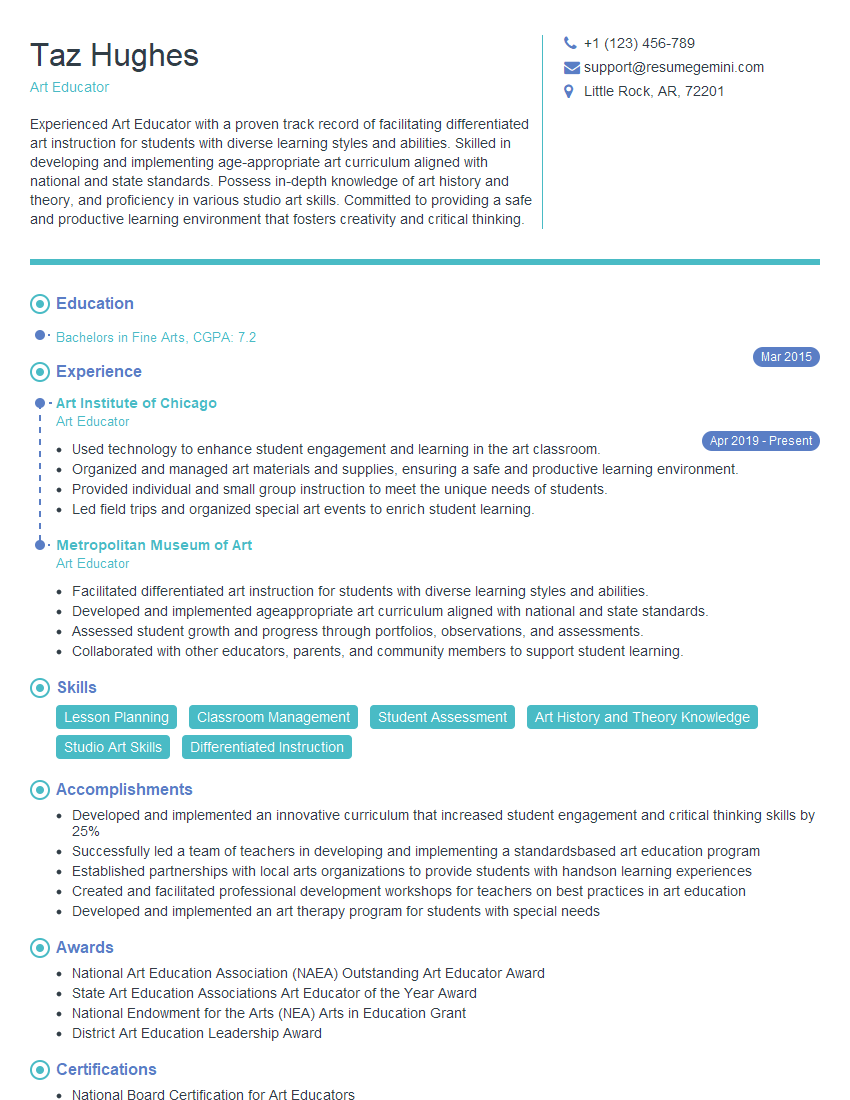
Mastering Gallery Education principles is crucial for a successful and rewarding career in the arts. A strong understanding of these concepts will significantly enhance your candidacy and open doors to exciting opportunities. To maximize your job prospects, it’s essential to create an ATS-friendly resume that highlights your skills and experience effectively. We strongly recommend using ResumeGemini to build a professional and impactful resume. ResumeGemini provides a streamlined process and offers examples of resumes tailored to Gallery Education, helping you present yourself in the best possible light. Invest the time to craft a compelling resume—it’s your first impression on potential employers.
Explore more articles
Users Rating of Our Blogs
Share Your Experience
We value your feedback! Please rate our content and share your thoughts (optional).
What Readers Say About Our Blog
To the interviewgemini.com Webmaster.
Very helpful and content specific questions to help prepare me for my interview!
Thank you
To the interviewgemini.com Webmaster.
This was kind of a unique content I found around the specialized skills. Very helpful questions and good detailed answers.
Very Helpful blog, thank you Interviewgemini team.