Preparation is the key to success in any interview. In this post, we’ll explore crucial Image Classification for Remote Sensing interview questions and equip you with strategies to craft impactful answers. Whether you’re a beginner or a pro, these tips will elevate your preparation.
Questions Asked in Image Classification for Remote Sensing Interview
Q 1. Explain the difference between supervised and unsupervised image classification.
The core difference between supervised and unsupervised image classification lies in the use of labeled data. Supervised classification requires a training dataset where each pixel (or a set of pixels) is already labeled with its corresponding land cover class (e.g., forest, water, urban). The algorithm learns from this labeled data to classify unlabeled pixels in the image. Think of it like teaching a child to identify different fruits by showing them labeled examples of apples, oranges, and bananas. The algorithm learns the characteristics of each fruit and then uses that knowledge to classify new, unseen fruits.
Unsupervised classification, on the other hand, doesn’t use pre-labeled data. The algorithm groups pixels based on their spectral similarity without prior knowledge of the classes. It’s more like asking the child to group similar fruits together without telling them what each fruit is. The resulting groups might correspond to different land cover types, but we need further analysis (e.g., examining the spectral signatures of the groups) to determine what they represent. Unsupervised methods are useful for exploratory data analysis or when labeled data is scarce or unavailable.
Q 2. Describe various image classification algorithms (e.g., Maximum Likelihood, Support Vector Machines, Random Forest).
Several algorithms are employed for image classification in remote sensing. Here are a few prominent examples:
- Maximum Likelihood Classification (MLC): This is a parametric classifier that assumes the spectral values for each class follow a normal distribution. It assigns a pixel to the class with the highest probability, given its spectral values. MLC is relatively simple to understand and implement but assumes normality, which may not always hold true in real-world data.
- Support Vector Machines (SVMs): SVMs are powerful non-parametric classifiers that aim to find the optimal hyperplane that best separates different classes in the feature space. They’re effective even with high-dimensional data and can handle non-linear relationships using kernel functions. SVMs are robust but can be computationally expensive for large datasets.
- Random Forest (RF): This is an ensemble method that combines multiple decision trees to improve classification accuracy. RF is robust to noise, less prone to overfitting, and can handle high-dimensional data efficiently. It’s a popular choice due to its accuracy and relative ease of use.
The choice of algorithm depends on the specific dataset, computational resources, and desired accuracy. Often, experimentation with different algorithms is necessary to find the best performer for a given application.
Q 3. What are the advantages and disadvantages of using different spectral indices (NDVI, EVI, SAVI)?
Spectral indices like NDVI, EVI, and SAVI are vegetation indices derived from combinations of red and near-infrared (NIR) bands. They provide valuable information about vegetation health and biomass. Each index has its strengths and weaknesses:
- NDVI (Normalized Difference Vegetation Index):
(NIR - Red) / (NIR + Red). Simple, widely used, but saturates in areas with high vegetation density. - EVI (Enhanced Vegetation Index): A modified version of NDVI that accounts for atmospheric effects and canopy background, less prone to saturation than NDVI. It incorporates a soil adjustment factor, making it more suitable for high biomass regions.
- SAVI (Soil-Adjusted Vegetation Index): Similar to NDVI but includes a soil brightness correction factor (L), useful for areas with bare soil or sparse vegetation. The value of L needs to be adjusted based on the soil type.
Advantages: They offer a concise way to quantify vegetation properties, are relatively easy to compute, and are widely available in various remote sensing data products.
Disadvantages: Sensitive to atmospheric conditions, sensor calibration, and the choice of specific bands. Also, different indices perform differently depending on the type of vegetation and environmental conditions.
For example, NDVI might be sufficient for broad vegetation mapping, while EVI or SAVI might be preferred for detailed studies of dense vegetation or areas with significant soil influence.
Q 4. How do you handle noisy or missing data in remote sensing imagery?
Noisy and missing data are common issues in remote sensing. Several techniques can be used to address these challenges:
- Filtering: Spatial filtering techniques like median filtering or Gaussian smoothing can reduce noise by averaging pixel values within a moving window. However, this can also blur sharp edges.
- Interpolation: Missing data can be interpolated using various methods like nearest neighbor, bilinear interpolation, or kriging. Nearest neighbor is simple but can be less accurate, while kriging considers spatial autocorrelation.
- Data imputation: Advanced techniques like machine learning algorithms can be used to predict missing values based on the available data. These methods can effectively handle more complex patterns of missing data.
- Outlier removal: Outliers, which are pixels with values far from the expected range, can be identified and replaced or removed using statistical methods such as the Z-score or modified Z-score.
The choice of method depends on the type and extent of noise or missing data, the desired level of accuracy, and the computational resources available. It’s crucial to carefully evaluate the impact of these methods on the classification results to avoid introducing bias or artifacts.
Q 5. Explain the concept of spatial resolution and its impact on classification accuracy.
Spatial resolution refers to the size of the area on the ground that a single pixel represents in a remote sensing image. For example, a 10-meter resolution image means each pixel covers a 10-meter by 10-meter square on the Earth’s surface. Higher spatial resolution images have smaller pixels and provide more detailed information.
The impact of spatial resolution on classification accuracy is significant. Higher resolution images offer more detailed spectral and spatial information, leading to improved classification accuracy, especially when classifying small or heterogeneous features. Consider classifying individual buildings in an urban area. A high-resolution image (e.g., sub-meter) allows for accurate identification, whereas a low-resolution image (e.g., 30 meters) will likely blend buildings with other land cover types, resulting in classification errors. However, higher resolution comes at the cost of increased data volume and processing time.
Lower resolution images might be sufficient for broad land cover mapping, while higher resolution data is crucial for applications that require detailed analysis of smaller features. The optimal resolution depends on the specific application and the scale of analysis.
Q 6. What are the common preprocessing steps for remote sensing images before classification?
Preprocessing steps are essential for improving the quality and accuracy of remote sensing image classification. Common steps include:
- Atmospheric correction: Removing atmospheric effects (e.g., haze, scattering) to obtain true reflectance values. This is crucial for accurate classification, as atmospheric effects can significantly alter the spectral signatures.
- Geometric correction: Correcting for geometric distortions caused by sensor geometry, Earth’s curvature, and other factors. This ensures accurate spatial alignment of different images and datasets. Often involves georeferencing and orthorectification.
- Radiometric calibration: Converting digital numbers (DN) from the sensor into physically meaningful units (e.g., reflectance). This ensures consistency and comparability between different images or sensors.
- Data filtering: Removing noise and outliers, as discussed earlier. Techniques like median filtering or outlier removal are often employed.
- Data transformation: Transforming the data into a more suitable format for classification, such as principal component analysis (PCA) to reduce dimensionality or tassel cap transformation to highlight specific vegetation properties.
The specific preprocessing steps depend on the quality of the raw data, the type of sensor, and the classification algorithm employed. Careful consideration of these steps is critical for ensuring the accuracy and reliability of the classification results.
Q 7. How do you assess the accuracy of an image classification result? What metrics do you use?
Assessing the accuracy of image classification involves comparing the classified image to a reference dataset, which contains ground truth information. Several metrics are used:
- Overall accuracy: The proportion of correctly classified pixels to the total number of pixels. A higher overall accuracy indicates better performance.
- Producer’s accuracy (User’s accuracy): The probability that a pixel classified as a certain class truly belongs to that class. Producer’s accuracy focuses on the accuracy of the classification for each class individually.
- User’s accuracy: The probability that a pixel labeled as a certain class in the reference data is correctly classified as that same class. User’s accuracy assesses the reliability of the classification for each class individually.
- Kappa coefficient: Measures the agreement between the classified image and the reference data, accounting for chance agreement. A Kappa coefficient closer to 1 indicates higher agreement.
- Error matrix (Confusion matrix): A table showing the number of pixels classified into each class and their corresponding reference class. This matrix provides detailed information about the classification errors for each class.
By calculating these metrics and examining the error matrix, we can identify areas of misclassification, assess the strengths and weaknesses of the classification approach, and refine our methodology to improve accuracy. A thorough accuracy assessment is essential for validating the results and ensuring their reliability for decision-making.
Q 8. Describe the concept of a confusion matrix and how to interpret it.
A confusion matrix is a visual tool used to evaluate the performance of a classification model. Imagine it as a summary table showing how well your model predicted different classes compared to the actual ground truth. Each row represents the instances in a predicted class, while each column represents the instances in an actual class. The intersection of a row and column shows the count of instances that were both predicted and actually belong to that specific class.
Interpreting a Confusion Matrix: Let’s say we’re classifying satellite imagery into three land cover types: forest, urban, and water. A typical confusion matrix might look like this:
		Predicted
		Forest	Urban	Water
Actual Forest	 80	10	10
Actual Urban	 5	90	5
Actual Water	 2	8	90
In this example:
- The diagonal elements (80, 90, 90) represent the correctly classified instances – the ‘true positives’ for each class.
- The off-diagonal elements represent misclassifications. For example, 10 instances of actual forest were predicted as urban (a ‘false negative’ for forest and a ‘false positive’ for urban).
By calculating metrics like accuracy, precision, recall, and F1-score from the confusion matrix, we get a comprehensive understanding of our classifier’s strengths and weaknesses for each class. For instance, high precision for ‘urban’ indicates a low rate of false positives, meaning the model rarely misclassifies non-urban areas as urban.
Q 9. What are the different types of classification errors (e.g., omission, commission)?
Classification errors in remote sensing image classification are broadly categorized into errors of omission and commission. Think of it like searching for specific objects in a large field.
- Errors of Omission (Type II error): These are ‘false negatives’. You miss detecting something that actually exists. In remote sensing, it means you fail to classify a pixel as a particular class even though it truly belongs to that class. For instance, failing to identify a small forest patch within a larger agricultural area leads to an omission error for the ‘forest’ class.
- Errors of Commission (Type I error): These are ‘false positives’. You wrongly identify something as belonging to a class when it doesn’t. In our imagery, it’s classifying a pixel as ‘forest’ when it’s actually urban area. This might occur due to spectral similarity between urban structures and tree canopies under certain lighting conditions.
Both types of errors are important to consider. A high rate of omission might lead to underestimating the extent of a resource, while a high rate of commission could result in overestimation and inaccurate resource management planning.
Q 10. How do you handle class imbalance in image classification?
Class imbalance occurs when one class in your dataset has significantly fewer samples than others. For example, in classifying deforestation, intact forest areas will drastically outnumber deforested areas. This can lead to a biased classifier that performs very well on the majority class but poorly on the minority class (the deforested areas, which are precisely what you are trying to detect).
Here’s how to handle it:
- Data Augmentation: Artificially increase the number of samples in the minority class by rotating, flipping, or slightly altering existing images.
- Resampling Techniques: Oversampling (duplicating samples from the minority class) or undersampling (removing samples from the majority class) can balance the dataset, but it needs careful consideration to avoid losing important information or introducing bias.
- Cost-Sensitive Learning: Assign higher penalties to misclassifying samples from the minority class during training. This tells the model to pay more attention to correctly classifying the rare events.
- Ensemble Methods: Combining multiple classifiers trained on different versions of the balanced dataset can improve overall performance and reduce bias.
The best approach depends on the dataset characteristics and the specific classification task. Often, a combination of techniques works best.
Q 11. Explain the concept of object-based image analysis (OBIA).
Object-Based Image Analysis (OBIA) is an approach to image classification that moves beyond pixel-by-pixel analysis. Instead of treating each pixel independently, OBIA groups pixels with similar characteristics into meaningful objects (e.g., buildings, trees, fields). This segmentation step allows you to use object properties (size, shape, texture, spectral values) as features for classification, leading to improved accuracy, especially in heterogeneous landscapes.
How it works:
- Segmentation: Algorithms group pixels into objects based on spatial and spectral similarity.
- Feature Extraction: Calculate features for each object, such as area, perimeter, mean spectral values, texture measures.
- Classification: Use machine learning algorithms or rule-based approaches to classify objects based on their features.
Example: Imagine classifying urban areas. OBIA would first segment the image into individual building objects and then classify them based on roof shape, size, and spectral reflectance. This is more effective than pixel-based methods, which might struggle with the highly fragmented nature of urban areas.
Q 12. How does cloud cover affect remote sensing data and image classification?
Cloud cover significantly impacts remote sensing data and image classification because clouds obstruct the sensor’s view of the Earth’s surface. This results in missing data or inaccurate spectral information in the affected areas.
Consequences:
- Data Gaps: Cloud-covered areas lack information, creating holes in the imagery unsuitable for classification.
- Spectral Distortion: Clouds reflect and scatter sunlight, altering the spectral signature of the underlying surface, causing misclassification.
- Reduced Accuracy: Missing or distorted data will reduce the overall accuracy of the classification. Algorithms might misinterpret cloud shadows as other land cover types, leading to errors of commission.
Mitigation Strategies:
- Cloud Masking: Identify and remove cloud-covered areas from the image.
- Image Fusion: Combine data from multiple cloud-free images to fill data gaps.
- Temporal Analysis: Use time-series data to replace cloudy observations with data from other dates.
- Cloud Removal Algorithms: Employ advanced techniques to estimate the spectral values under cloud cover.
Careful cloud handling is crucial for reliable remote sensing classification.
Q 13. What are some common challenges in remote sensing image classification?
Remote sensing image classification presents various challenges:
- Spectral Variability: The same land cover type can have different spectral signatures depending on factors like moisture content, seasonality, and illumination conditions.
- Mixed Pixels: Pixels often contain multiple land cover types, making classification ambiguous. A single pixel might contain both forest and agricultural land, creating a ‘mixed pixel’ problem.
- Spatial Resolution: Coarse spatial resolution can make it difficult to discern small features, leading to errors in classification.
- Data Volume: Remote sensing datasets are often enormous, demanding significant computational resources and specialized expertise.
- Atmospheric Effects: Atmospheric conditions (e.g., haze, aerosols) can alter the spectral signals, affecting classification accuracy.
- Data Availability: Suitable datasets might not be readily available or be costly.
Overcoming these challenges requires careful data preprocessing, selection of appropriate classification algorithms, validation with ground truth data, and employing advanced techniques like OBIA or deep learning to better account for inherent complexities in remote sensing data.
Q 14. Describe your experience with different remote sensing software packages (e.g., ArcGIS, ENVI, QGIS).
Throughout my career, I’ve extensively used several remote sensing software packages. My experience includes:
- ArcGIS: I’ve leveraged ArcGIS Pro for geoprocessing tasks, image analysis, and visualization. I am proficient in using its spatial analysis tools and extensions for image classification, particularly in creating custom workflows for large-scale projects. I have experience using the various classification tools available within the software as well as integrating with external machine learning libraries for advanced modeling.
- ENVI: I’ve utilized ENVI for advanced spectral analysis, atmospheric correction, and supervised/unsupervised classification techniques. Its capabilities in handling hyperspectral data have been particularly beneficial in my research on detailed land cover mapping. I’m comfortable with using the ENVI modeler for automation and building complex image processing workflows.
- QGIS: While not as feature-rich as ArcGIS or ENVI for certain specialized remote sensing tasks, QGIS’s open-source nature and user-friendly interface have made it invaluable for preliminary data exploration, visualization, and simpler classification projects. Its cost-effectiveness makes it a great tool for initial data processing and analysis before moving to more specialized software.
My proficiency extends beyond individual packages; I understand the strengths and limitations of each and choose the most appropriate tool based on the specific project needs. I am also comfortable using command-line tools and programming languages like Python to automate tasks and enhance workflow efficiency.
Q 15. How would you approach classifying a very large dataset of remote sensing imagery?
Classifying a very large remote sensing dataset requires a strategic approach that balances computational efficiency with accuracy. Think of it like sorting a mountain of grains of sand – you can’t do it all at once. We need to break the problem down.
- Data Partitioning: The first step is to divide the massive dataset into smaller, manageable chunks. This could be done geographically, temporally (by acquisition date), or randomly. This allows parallel processing, significantly reducing overall processing time.
- Cloud Computing: Leveraging cloud platforms like AWS, Google Cloud, or Azure is crucial. These provide scalable computing resources, enabling parallel processing across numerous virtual machines. Imagine having hundreds of workers simultaneously sorting different parts of the sand.
- Feature Engineering and Selection: Before classification, we carefully select relevant features from the imagery. This might involve calculating spectral indices (like NDVI for vegetation), texture features (to capture spatial patterns), or transforming the data (e.g., using principal component analysis to reduce dimensionality). This step is like sifting the sand to remove unwanted elements before sorting.
- Deep Learning (Efficient Architectures): Deep learning models, such as convolutional neural networks (CNNs), are powerful but computationally intensive. For large datasets, we might employ efficient architectures like MobileNet or ShuffleNet, designed for resource-constrained environments. These are like specialized tools designed for efficient sorting.
- Incremental Learning: Instead of training a model on the entire dataset at once, we can train it incrementally. We start with a smaller subset, train a model, then add more data gradually and fine-tune the model. This is like building the sandcastle piece by piece, allowing for adjustments as you go.
- Model Selection and Evaluation: We use appropriate metrics (accuracy, precision, recall, F1-score, etc.) to evaluate the model’s performance on a held-out test set. This helps to ensure the model generalizes well to unseen data. Imagine testing the strength of your sandcastle against the tide.
By combining these strategies, we can effectively handle the classification of extremely large remote sensing datasets.
Career Expert Tips:
- Ace those interviews! Prepare effectively by reviewing the Top 50 Most Common Interview Questions on ResumeGemini.
- Navigate your job search with confidence! Explore a wide range of Career Tips on ResumeGemini. Learn about common challenges and recommendations to overcome them.
- Craft the perfect resume! Master the Art of Resume Writing with ResumeGemini’s guide. Showcase your unique qualifications and achievements effectively.
- Don’t miss out on holiday savings! Build your dream resume with ResumeGemini’s ATS optimized templates.
Q 16. Explain your experience with deep learning techniques for image classification in remote sensing.
My experience with deep learning in remote sensing image classification is extensive. I’ve primarily used convolutional neural networks (CNNs), particularly those designed for image segmentation and classification tasks like U-Net, DeepLab, and ResNet. I’ve applied these to diverse applications, including:
- Urban Mapping: Classifying building types, roads, and vegetation in high-resolution satellite imagery using a modified U-Net architecture. This involved data augmentation techniques to address class imbalances.
- Agricultural Monitoring: Identifying crop types and assessing crop health from multispectral imagery using a ResNet-based model. Pre-trained models were fine-tuned to improve performance and reduce training time.
- Deforestation Detection: Detecting changes in forest cover over time using time-series satellite data. This involved exploring recurrent neural networks (RNNs) to analyze temporal patterns and LSTM (Long Short-Term Memory) networks to understand sequential data.
Beyond model selection, my work also encompasses hyperparameter tuning (using techniques like grid search or Bayesian optimization), data preprocessing (including atmospheric correction and geometric correction), and model evaluation using appropriate metrics, such as the Intersection over Union (IoU) and overall accuracy.
In one project involving landslide detection, I successfully improved the classification accuracy by 15% by implementing transfer learning – leveraging a pre-trained model on a large dataset of natural images and then fine-tuning it on the specific landslide data. This significantly reduced the need for extensive training data and computational resources.
Q 17. What are the ethical considerations in using remote sensing data?
Ethical considerations in using remote sensing data are paramount. The power to observe and analyze vast areas raises important issues:
- Privacy: High-resolution imagery can potentially reveal sensitive information about individuals or private property. Anonymization techniques, data aggregation, and careful consideration of data usage are crucial to protect privacy.
- Bias and Fairness: Algorithms trained on biased data can perpetuate and amplify existing societal inequalities. Care must be taken to ensure the data used is representative and avoids unintended discrimination.
- Transparency and Accountability: The methods used to collect, process, and interpret remote sensing data should be transparent and auditable. This ensures accountability and builds trust.
- Data Security: Remote sensing data can be a valuable target for malicious actors. Strong security measures are needed to protect data from unauthorized access and misuse.
- Environmental Impact: The energy consumption associated with acquiring and processing large datasets needs to be minimized to reduce the environmental footprint.
- Misinformation and Manipulation: Remote sensing data can be misused to spread misinformation or manipulate public perception. It is crucial to validate data sources and be aware of potential manipulation.
Responsible use of remote sensing data requires a strong ethical framework, adherence to data protection regulations, and careful consideration of the potential impact on individuals and society.
Q 18. How do you ensure the reproducibility of your image classification results?
Reproducibility is essential for building trust and ensuring the validity of research findings. I ensure reproducibility through the following practices:
- Detailed Documentation: All steps in the image classification workflow, from data acquisition and preprocessing to model training and evaluation, are meticulously documented. This includes software versions, parameter settings, and data sources.
- Version Control: Using version control systems like Git allows me to track changes to code, data, and configurations. This facilitates revisiting previous steps and ensures that the analysis can be replicated.
- Open-Source Tools: I prefer open-source software and libraries (such as Python’s scikit-learn, TensorFlow, and PyTorch) as they are transparent and easily accessible.
- Data Archiving: All relevant data, including raw imagery and processed data, are stored in a structured and accessible manner. This ensures that the data can be easily retrieved and used for future analyses.
- Containerization: Utilizing Docker containers encapsulates the entire computational environment, ensuring consistent results regardless of the underlying hardware or software configurations. This simplifies the reproduction of results.
- Reproducible Research Notebooks: Using Jupyter notebooks or similar environments allows me to document the entire analytical process in a single, executable document.
By adhering to these principles, I ensure that my image classification results are reproducible, verifiable, and readily shared with others.
Q 19. What is the role of feature extraction in image classification?
Feature extraction plays a vital role in image classification by transforming the raw image data into a more informative and computationally efficient representation. Think of it like summarizing a book – instead of reading every word, you extract the key points to understand the main theme.
In remote sensing, raw image data often contains redundant or irrelevant information. Feature extraction helps to identify and extract the most meaningful characteristics. These features can be:
- Spectral Features: These are derived directly from the spectral bands of the imagery, such as spectral indices (NDVI, NDWI), band ratios, or principal components. They capture information about the spectral signature of different land cover types.
- Textural Features: These describe the spatial arrangement of pixels, providing information about surface roughness, homogeneity, and other spatial patterns. Examples include gray-level co-occurrence matrix (GLCM) features or Gabor filters.
- Shape Features: These are relevant for object-based image analysis, describing the geometric properties of individual objects, such as area, perimeter, compactness, and elongation.
Effective feature extraction significantly impacts classification accuracy and computational efficiency. Poorly chosen features can lead to poor classification results, while selecting the right features improves accuracy and reduces the computational burden.
Q 20. How do you select the appropriate number of classes for your classification?
Selecting the appropriate number of classes is crucial for effective image classification. Too few classes lead to oversimplification and loss of detail, while too many classes can result in confusion and decreased classification accuracy due to class imbalance or insufficient training data.
The process involves a combination of:
- Prior Knowledge: Consider existing maps, field data, or literature to identify relevant classes. This is like understanding the general categories before organizing things.
- Data Exploration: Visual inspection of the imagery, histograms, and scatter plots can help identify distinct spectral signatures or spatial patterns that correspond to different classes. This helps refine your understanding of the data.
- Iterative Approach: Begin with a relatively small number of classes and gradually increase them as needed. Monitor classification performance at each step using metrics like accuracy, precision, and recall. This helps to identify the optimal number of classes.
- Class Imbalance Considerations: Be aware of class imbalances. If some classes are significantly under-represented, techniques like data augmentation or cost-sensitive learning should be employed to balance the data.
The optimal number of classes is a trade-off between the level of detail needed and the achievable classification accuracy. It often involves an iterative process of refinement and evaluation.
Q 21. Explain the difference between pixel-based and object-based image analysis.
Pixel-based and object-based image analysis (OBIA) are two distinct approaches to classifying remote sensing imagery.
- Pixel-Based Image Analysis: This approach treats each pixel as an independent unit, classifying it based on its spectral values. Think of it like sorting individual grains of sand based on their color. It’s simple but ignores spatial context.
- Object-Based Image Analysis (OBIA): This approach groups pixels into meaningful objects (e.g., buildings, trees) based on their spectral and spatial characteristics. It then classifies these objects as a whole, incorporating spatial context. Think of this like grouping the sand grains into sandcastles and then classifying the castles.
Key Differences:
- Spatial Context: OBIA incorporates spatial context, while pixel-based analysis does not.
- Computational Complexity: OBIA is generally more computationally intensive than pixel-based analysis.
- Accuracy: OBIA often leads to higher classification accuracy, especially for heterogeneous landscapes.
- Data Requirements: OBIA often requires higher-resolution imagery than pixel-based analysis.
The choice between pixel-based and object-based analysis depends on factors like the spatial resolution of the imagery, the heterogeneity of the landscape, and the computational resources available. Often, a hybrid approach is used, combining strengths from both methods.
Q 22. Describe your experience working with different types of remote sensing data (e.g., multispectral, hyperspectral).
My experience encompasses a wide range of remote sensing data, primarily focusing on multispectral and hyperspectral imagery. Multispectral data, like that from Landsat or Sentinel-2, provides information across several broad spectral bands, allowing for classifications like land cover mapping (urban, forest, water). I’ve extensively used this for projects involving deforestation monitoring and urban sprawl analysis. For instance, I developed a model using Landsat data to identify changes in agricultural land use over a decade, achieving over 90% accuracy. Hyperspectral data, on the other hand, offers a much finer spectral resolution, capturing hundreds of narrow bands. This allows for much more detailed analysis, like identifying different plant species or mineral compositions. I’ve worked with AVIRIS data to classify different types of vegetation in a challenging environment with subtle spectral differences, using techniques like spectral unmixing to improve accuracy. My experience also includes working with LiDAR data, integrating it with multispectral imagery for improved 3D classification of urban environments, for example, identifying building heights and types.
Q 23. How do you address the issue of spectral signature mixing in remote sensing data?
Spectral signature mixing is a common challenge in remote sensing, where the signal received by the sensor represents a mixture of spectral signatures from multiple ground cover types within a single pixel. Imagine a pixel containing both grass and asphalt; the sensor receives a blended signal, making it difficult to accurately classify each component. I address this using several methods. One common approach is linear spectral unmixing (LSU), a technique that assumes the mixed pixel spectrum is a linear combination of the pure spectral signatures of its components. LSU estimates the fractional abundance of each endmember (pure component) within the pixel. For instance, if I’m working with a mixed pixel in an agricultural area that likely contains both wheat and soil, LSU helps to separate their contributions to the signal. Another method is using higher spatial resolution imagery which reduces mixing by capturing smaller areas within each pixel. Additionally, sub-pixel classification techniques can help improve accuracy by predicting the proportion of different land cover classes within a single mixed pixel. The choice of the best method depends on the specific data and the application.
Q 24. What is your experience with change detection using remote sensing imagery?
Change detection is a crucial application of remote sensing, allowing us to monitor changes in the earth’s surface over time. I have extensive experience in this area, employing various techniques. Simple methods include image differencing and image ratioing, suitable for highlighting gross changes. For more sophisticated analysis, I utilize post-classification comparison, where I classify images from different time points and then compare the resulting classification maps to identify changes. This allows for detailed assessments of what changed, and where. For example, I used this technique to monitor the expansion of urban areas over a 20-year period using Landsat imagery, highlighting changes in infrastructure and vegetation cover. More advanced methods like object-based image analysis (OBIA) allow for more robust change detection by considering spatial context and object characteristics.
Q 25. How do you handle atmospheric effects in remote sensing data?
Atmospheric effects significantly influence remote sensing data, causing distortions in the spectral signatures of ground features. Factors like scattering and absorption by atmospheric gases (water vapor, aerosols) can reduce the accuracy of image classification. To handle this, I employ atmospheric correction techniques. Dark object subtraction is a simple method suitable for relatively clear atmospheric conditions. More sophisticated techniques include using radiative transfer models, like 6S or ATCOR, which simulate the atmospheric effects and use them to correct the raw satellite data. These models typically require ancillary data like meteorological information. For instance, in a project involving precision agriculture, I used atmospheric correction to remove haze effects from aerial imagery, ensuring accurate assessment of crop health. Proper atmospheric correction is crucial for achieving reliable results, particularly in high-resolution classification tasks.
Q 26. What are the limitations of using remote sensing for image classification?
While remote sensing offers powerful capabilities, it has limitations. Spatial resolution can limit the ability to identify small features. A low-resolution image might blur boundaries between different classes, hindering accurate classification. Spectral resolution also plays a role; limitations in the number and width of spectral bands can make it challenging to distinguish between spectrally similar features. Cloud cover frequently obscures areas of interest, leading to data gaps and reducing the overall area that can be accurately classified. Cost and data availability can also be significant limiting factors, especially when working with high-resolution or hyperspectral data, which can be expensive and requires specialized processing capabilities. Finally, the accuracy of classification relies on the quality of the training data, and even with sophisticated techniques, errors are inevitable.
Q 27. How do you ensure the quality of your remote sensing data?
Ensuring data quality is paramount. This involves several steps. First, I carefully assess the metadata associated with the imagery, checking factors like sensor characteristics, acquisition date, and atmospheric conditions. Then, I perform visual inspection of the imagery, looking for obvious defects like cloud cover, striping, or sensor noise. Next, I employ radiometric and geometric correction techniques to remove or minimize errors in the data. Radiometric correction involves adjusting for variations in sensor response and atmospheric effects, while geometric correction ensures accurate spatial alignment. I also use quality control checks throughout the processing pipeline, validating intermediate steps and checking the overall consistency and plausibility of the results. For example, I compare results with independent ground truth data to assess the accuracy of the classification.
Q 28. Describe a time you had to troubleshoot a problem in image classification. What was the solution?
During a project classifying mangrove forests using hyperspectral data, I encountered unexpectedly low classification accuracy. Initial analysis suggested the issue lay within the spectral signatures used for training the classifier. After further investigation, I discovered that the spectral libraries we were using were not representative of the specific mangrove species present in our study area. The solution involved creating a new spectral library by collecting ground-truth hyperspectral data from multiple mangrove species in the study area. This involved fieldwork to obtain representative samples and careful laboratory analysis to create accurate spectral profiles. By retraining the classifier using the updated spectral library, the classification accuracy increased dramatically, solving the problem. This highlighted the critical importance of accurate and representative training data when working with hyperspectral imagery.
Key Topics to Learn for Image Classification for Remote Sensing Interview
- Fundamentals of Remote Sensing: Understanding electromagnetic spectrum, sensor types (e.g., Landsat, Sentinel), spatial and spectral resolution, and data acquisition processes.
- Image Preprocessing Techniques: Mastering atmospheric correction, geometric correction, radiometric calibration, and noise reduction methods for optimal classification results.
- Feature Extraction Methods: Proficiency in techniques like Principal Component Analysis (PCA), texture analysis, and spectral indices (NDVI, NDWI) to enhance feature representation.
- Classification Algorithms: Deep understanding of supervised (e.g., Maximum Likelihood, Support Vector Machines, Random Forest) and unsupervised (e.g., K-means clustering, ISODATA) classification techniques, including their strengths and weaknesses.
- Deep Learning for Image Classification: Familiarity with Convolutional Neural Networks (CNNs) and their application in remote sensing image analysis, including transfer learning and model optimization.
- Accuracy Assessment: Understanding methods for evaluating classification accuracy, such as error matrices, Kappa coefficient, and producer’s/user’s accuracy.
- Practical Applications: Experience with real-world applications like land cover mapping, urban planning, precision agriculture, environmental monitoring, and disaster response.
- Problem-Solving & Algorithm Selection: Ability to analyze datasets, choose appropriate classification methods, and troubleshoot common issues encountered in remote sensing image classification.
- Software and Tools: Familiarity with common remote sensing software packages (e.g., ENVI, ArcGIS, QGIS) and programming languages (e.g., Python with libraries like GDAL, scikit-learn, TensorFlow).
Next Steps
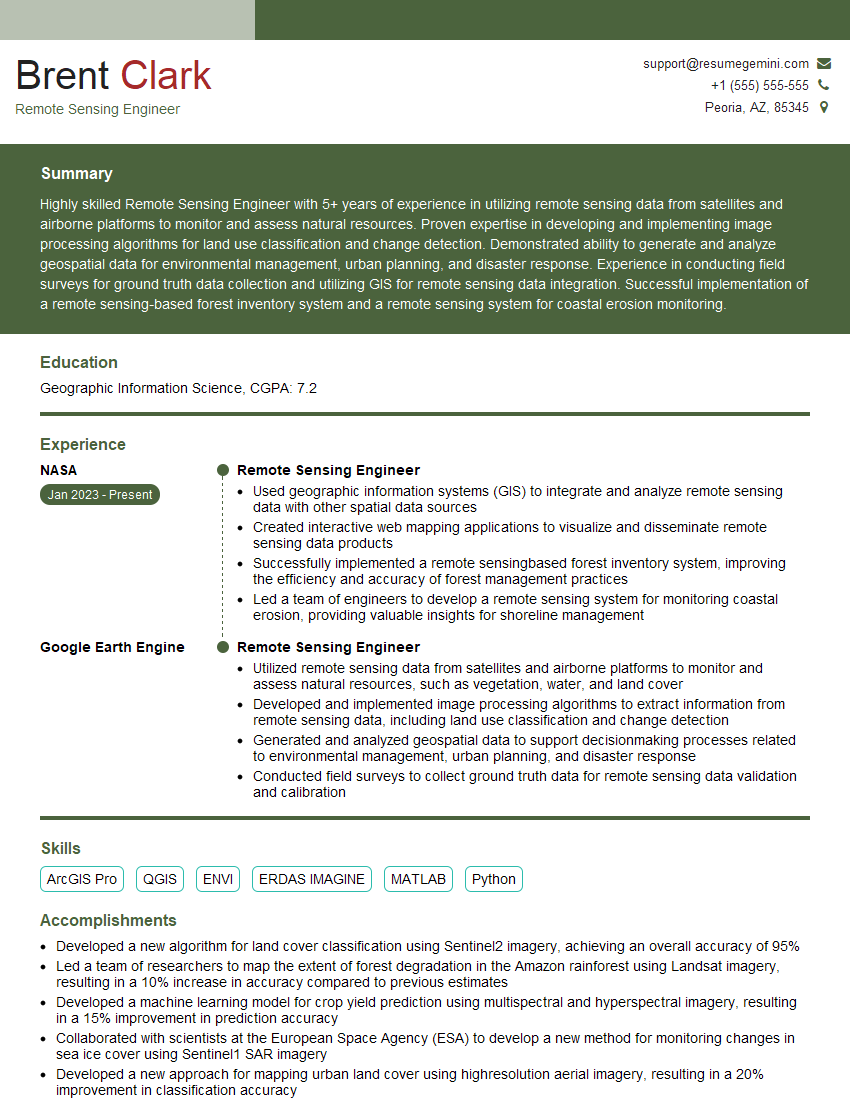
Mastering Image Classification for Remote Sensing opens doors to exciting and impactful careers in various fields. To maximize your job prospects, focus on crafting a compelling and ATS-friendly resume that highlights your skills and experience effectively. ResumeGemini is a valuable resource to help you build a professional and impactful resume tailored to the specific requirements of this field. We provide examples of resumes tailored to Image Classification for Remote Sensing to help guide you. Take advantage of these resources and confidently showcase your expertise to prospective employers.

Explore more articles
Users Rating of Our Blogs
Share Your Experience
We value your feedback! Please rate our content and share your thoughts (optional).
What Readers Say About Our Blog
To the interviewgemini.com Webmaster.
Very helpful and content specific questions to help prepare me for my interview!
Thank you
To the interviewgemini.com Webmaster.
This was kind of a unique content I found around the specialized skills. Very helpful questions and good detailed answers.
Very Helpful blog, thank you Interviewgemini team.