Feeling uncertain about what to expect in your upcoming interview? We’ve got you covered! This blog highlights the most important Music Improvisation and Composition interview questions and provides actionable advice to help you stand out as the ideal candidate. Let’s pave the way for your success.
Questions Asked in Music Improvisation and Composition Interview
Q 1. Explain your approach to melodic improvisation.
My approach to melodic improvisation is deeply rooted in a combination of theoretical understanding and intuitive exploration. It’s not about randomly playing notes; it’s about crafting a compelling narrative through sound.
Firstly, I establish a harmonic foundation. This could be a chord progression I’ve pre-planned, or it could emerge organically from the initial notes I play. Then, I focus on melodic contour – the rise and fall of the pitch. I might start with a simple motif and develop it through repetition, variation, or sequence.
For example, if I’m improvising over a simple I-IV-V-I progression in C major, I might start with a stepwise ascending line on the I chord (C-D-E), then leap to the dominant (G) on the V chord, perhaps incorporating a bluesy inflection before resolving back to the tonic (C).
I also consider phrasing and articulation. Think of it like storytelling – you need pauses, accents, and dynamics to create interest and emotion. Improvisation isn’t just about notes; it’s about shaping the musical line to convey meaning.
Finally, I constantly listen to myself and adjust accordingly. Improvisation is a conversation, a dialogue between myself and the instrument. I respond to what I’ve already played, adapting and developing the ideas organically.
Q 2. Describe your process for harmonizing a given melody.
Harmonizing a given melody involves creating a harmonic accompaniment that supports and enhances the melodic line. It’s a process of finding the underlying chords that best complement the melody’s intervals, rhythms, and overall shape.
I start by analyzing the melody’s contour and identifying key notes or turning points. These often suggest the underlying chord progression. For instance, if a melody consistently uses notes from a particular scale, I’ll use chords built from that scale.
Then, I consider the melodic intervals. A large leap might suggest a change in harmony, while stepwise motion might indicate continued movement within a chord. I also look for cadences, which often signal a change of harmony.
Let’s say I have a melody: C-D-E-G-F-E-D-C. This simple melody strongly suggests a progression in C major: I-II-III-V-IV-III-II-I. I might add 7th chords or alterations for more interest, depending on the style I am aiming for. It’s about creating a harmonic context that supports the melody’s emotional trajectory.
Finally, voice leading is crucial. The bass line and inner voices should move smoothly between chords, creating a pleasing and coherent harmonic texture.
Q 3. How do you develop thematic material in a composition?
Developing thematic material is the cornerstone of composition. It’s about creating a musical idea – a theme – and transforming it throughout the piece to create unity and interest. This is done through a variety of techniques.
- Repetition: Repeating the theme allows the listener to become familiar with it. However, simple repetition can be monotonous, so variation is key.
- Sequence: Transposing the theme to a different pitch level creates a sense of forward motion.
- Variation: Altering the rhythm, melody, harmony, or instrumentation of the theme adds diversity and keeps the piece engaging. This can involve changing the articulation, adding ornaments, or altering the rhythm.
- Development: This involves fragmenting the theme, recombining its parts in new ways, or creating new ideas based on its melodic or rhythmic characteristics. It often involves modulation to new keys.
- Imitation: The theme, or fragments of it, are repeated in different voices or instruments, either immediately or delayed.
For example, a simple theme in a sonata form might be developed through a series of variations in the development section, before being presented again in a more elaborate form in the recapitulation.
Q 4. Discuss your understanding of different musical forms (e.g., sonata form, rondo).
Musical forms provide a structural framework for organizing musical ideas. They provide a roadmap for the composer, ensuring coherence and direction.
Sonata Form: A three-part structure (Exposition, Development, Recapitulation) characterized by the presentation of two contrasting themes, their development, and eventual return to the primary theme. This form is common in Classical and Romantic music. Think of Beethoven’s sonatas.
Rondo Form: A form featuring a recurring main theme (A) interspersed with contrasting episodes (B, C, etc.). The return of the main theme provides a sense of unity and stability. Mozart frequently used rondo form in his works.
Other common forms include ternary (ABA), binary (AB), and variation form. The choice of form depends on the overall shape and direction the composer wants to give the piece.
Understanding these forms allows for a clear and effective presentation of musical ideas and gives the listener a sense of structure and anticipation.
Q 5. Explain your experience with different compositional techniques (e.g., serialism, aleatoric music).
My experience with different compositional techniques encompasses a broad range of approaches, from traditional tonality to more experimental methods.
Serialism: This technique involves arranging a series of notes (a tone row) in a specific order and then using that series as the basis for the entire composition. It creates a highly organized, often atonal texture. I’ve used serial techniques to explore non-tonal harmonies and structures, finding it challenging but rewarding for its precision and control.
Aleatoric Music: This involves incorporating chance or randomness into the composition. Elements such as pitch, rhythm, or instrumentation can be left to chance, often through the use of dice or other randomizing methods. I’ve found aleatoric techniques useful for creating spontaneous and unpredictable musical landscapes, adding a sense of immediacy and unpredictability.
Beyond these, I’m also proficient in using microtonal music, incorporating extended techniques on instruments, and exploring various forms of electronic music composition. The choice of technique depends entirely on the desired outcome and aesthetic.
Q 6. How do you incorporate rhythmic complexity into your improvisations?
Incorporating rhythmic complexity into improvisation adds dynamism and interest. Simple rhythmic patterns can become repetitive, whereas intricate rhythms keep the listener engaged. I achieve this through several methods.
Polyrhythms: Layering different rhythmic patterns simultaneously creates a complex, almost hypnotic effect. For example, improvising with a 3/4 feel over a underlying 4/4 groove generates rhythmic interplay.
Syncopation: Accenting off-beats creates a sense of surprise and excitement. By placing accents on unexpected beats, the rhythm becomes more unpredictable and engaging.
Metric Modulation: Gradually changing the time signature during improvisation adds an element of surprise and creates a sense of transformation. This can be subtle or dramatic, shifting the rhythmic feel from a steady pulse to a more free-flowing approach.
Rhythmic Motifs: Developing short rhythmic patterns and using them repeatedly, but with variations, can generate complex rhythmic textures without being overly overwhelming.
Q 7. Describe your experience with different improvisational styles (e.g., free improvisation, structured improvisation).
My experience encompasses both free and structured improvisation. Each offers unique creative possibilities.
Free Improvisation: This is characterized by a lack of predetermined structure or harmonic framework. It’s a spontaneous exploration of sound, often emphasizing the textures and timbres created. While seemingly uncontrolled, it requires intense listening and responsiveness to one’s fellow musicians.
Structured Improvisation: This involves a pre-defined framework, such as a chord progression, rhythmic pattern, or melodic motif. This allows for more focused exploration within a set of boundaries, leading to a more cohesive and structured musical outcome. A solo jazz improvisation over a standard blues progression is a great example.
My improvisational style often blends these approaches. I might start with a structured framework, but then allow myself to stray from it, creating a balance between controlled exploration and spontaneous creativity. Context is key; the style I adopt depends greatly on the context and collaborators.
Q 8. How do you approach composing for different ensembles or instruments?
Composing for different ensembles requires a deep understanding of each instrument’s unique timbre, range, and technical capabilities. It’s like painting with different colors – a solo violin piece will have a vastly different texture and emotional impact than a piece for a full orchestra. My approach involves a three-step process:
- Instrument-Specific Analysis: I begin by studying the instruments involved. What are their strengths? Their weaknesses? For example, a string quartet will excel at legato lines and intricate harmonies, while a brass band is ideal for powerful, bold statements.
- Conceptualization: Next, I brainstorm ideas that complement the instrumentation. If I’m writing for a flute and harp, I might envision airy, ethereal melodies that utilize the flute’s breathy tone and the harp’s shimmering harmonies. For a rock band, the conceptualization might involve powerful riffs and driving rhythms.
- Compositional Adaptation: Finally, I tailor the melodic, harmonic, and rhythmic elements to suit the specific instruments. This often involves careful voice leading (how melodies move between instruments), dynamic shaping, and articulation choices. For instance, I might avoid writing overly wide intervals for a trombone, considering its comfortable range.
For example, a piece for solo cello would likely feature a rich melodic line with opportunities for expressive rubato, while a piece for a brass quintet might emphasize contrapuntal textures and powerful dynamics.
Q 9. How do you ensure harmonic coherence in a complex improvisation?
Maintaining harmonic coherence in complex improvisation requires a strong foundation in music theory and a keen sense of listening. Think of it as building a house – you need a solid framework (harmonic progression) to support the improvisation (the rooms and details). Here’s how I approach it:
- Establishing a Harmonic Foundation: Before improvising, I often establish a clear tonal center and a series of chord progressions that will guide the improvisation. This serves as a roadmap, ensuring that the improvisation remains within a coherent harmonic context. This could be a simple I-IV-V-I progression or a more complex sequence.
- Targeted Chord Voicings: I pay close attention to the voicings (how the notes of a chord are arranged) I choose during improvisation. Specific voicings can highlight certain notes and create smoother transitions between chords.
- Active Listening: Constant listening is paramount! I carefully listen to the previous phrases and the harmonic context to plan the subsequent phrase. This keeps the improvisation flowing logically.
- Chromaticism and Modal Interchange: I sometimes use chromaticism or modal interchange to add spice and interest while maintaining harmonic coherence. However, these techniques should be used thoughtfully and sparingly to prevent the harmonic structure from falling apart. It’s like adding a carefully planned surprise twist to a story, rather than throwing everything in randomly.
It’s a process that develops with practice and deep listening – a constant dialogue between intention and response.
Q 10. Explain your understanding of counterpoint and its application in composition.
Counterpoint is the art of combining independent melodic lines to create a harmonious and interesting texture. Imagine a conversation between two equally important voices – each has its own ideas, but together they create a beautiful whole. In composition, I use counterpoint to achieve several effects:
- Textural Interest: Multiple independent melodies create a richer, more complex texture than a single melody.
- Harmonic Depth: The interaction between the melodic lines produces complex harmonies, adding depth and richness to the piece.
- Structural Unity: Well-crafted counterpoint can help unify a piece of music, providing a sense of coherence and continuity across different sections.
Several types of counterpoint exist, from simple two-part counterpoint to more complex techniques like double counterpoint or imitation. For example, in a fugue, a single theme (subject) is presented in different voices, creating a complex and interwoven texture. In simpler forms, I might use two-part counterpoint to create a pleasing interplay between two melodies, ensuring that the voices move smoothly and harmoniously together while avoiding parallel fifths or octaves.
Q 11. Describe your workflow for composing a piece of music.
My workflow varies depending on the project, but generally follows these steps:
- Conceptualization: This involves brainstorming ideas, developing a narrative or emotional arc, and sketching initial musical ideas. I might use a variety of methods like free association, exploring harmonic progressions, or listening to other music for inspiration.
- Sketching: Once I have a basic concept, I start sketching musical ideas. This often happens at the piano or by quickly notating ideas on paper. It’s a free-flowing phase where I’m not worried about making it perfect – I’m exploring.
- Formalization: Here, I organize the sketches into a coherent structure. I determine the form (e.g., sonata form, rondo, theme and variations), refine the melodies and harmonies, and add details like dynamics and articulation.
- Revision and Refinement: This is a crucial stage where I constantly listen to the piece and make revisions. I might adjust melodies, harmonies, rhythms, or even the overall structure to improve clarity, flow, and overall impact.
- Notation: Finally, I notate the piece using software (see next question). This helps me solidify my ideas and allows for easier sharing and performance.
Throughout this entire process, I often revisit earlier stages to ensure the piece stays cohesive and fulfills my initial vision.
Q 12. How do you handle creative blocks during composition or improvisation?
Creative blocks are a common challenge for any composer or improviser. My approach to overcoming them involves a combination of techniques:
- Step Away: Sometimes the best thing to do is simply step away from the project for a while. Go for a walk, listen to different music, or engage in a different activity to clear your head.
- Change Your Environment: If I’m working in the same space, I’ll try a different setting. A change of scenery can spark new ideas.
- Try Different Approaches: If I’m stuck on a particular melody or harmony, I’ll try experimenting with a different approach. For example, if I’m struggling with a melody, I might try improvising a different melody in a different style or key.
- Collaborate: If I’m feeling stuck, bouncing ideas off a colleague can be incredibly helpful. Their perspective might bring fresh insights.
- Embrace Imperfection: Often, the pressure to create a perfect piece is what causes the block. Accepting imperfection and simply letting myself explore can be a surprising solution.
Overcoming creative blocks is a skill that grows with experience and self-awareness. I’ve learned that it’s okay to have periods of less productivity and that persistence and flexibility are crucial.
Q 13. What software or tools do you use for music composition and notation?
For music composition and notation, I primarily use Sibelius and Logic Pro X. Sibelius is excellent for creating precise scores with professional-level notation. It offers powerful tools for engraving, editing, and publishing musical scores. Logic Pro X is my primary DAW (Digital Audio Workstation) which provides me with a complete environment for recording, editing, arranging, and mixing audio. I use it for composing and for recording and manipulating audio to support the composition process.
In addition, I often use a digital piano or keyboard for composing and improvising. The immediacy of a physical instrument is often crucial for generating ideas.
Q 14. How do you incorporate technology into your improvisational process?
Technology plays a significant role in my improvisational process. I frequently use software instruments, effects, and loopers to expand my creative possibilities:
- Software Instruments: I use virtual synthesizers and samplers to access a vast palette of sounds, creating sonic textures that would be impossible to achieve with acoustic instruments alone. This allows me to explore new timbres and harmonies beyond what is conventionally possible.
- Effects Processors: Real-time effects such as reverb, delay, and distortion add depth and color to my improvisations. They can transform simple melodic ideas into complex and evocative soundscapes.
- Loopers: Loopers are incredibly useful tools for building improvisations. I can record a short musical phrase, loop it, and then build upon it with layers of improvisation, creating dense and intricate textures.
- MIDI Controllers: Using MIDI controllers, I can control software instruments and effects in real-time, creating dynamic and expressive performances.
Technology doesn’t replace musicality; it expands it. It allows for a more dynamic, experimental approach to improvisation while still requiring a firm understanding of musical principles. The technology acts as a powerful tool, but the artistry still comes from the musician.
Q 15. Explain your understanding of musical texture and how you manipulate it.
Musical texture refers to the way different musical sounds are combined to create a particular sonic effect. Think of it like the fabric of a piece of music – is it smooth and simple, or rough and complex? It’s determined by factors like the number of melodic lines, their rhythmic interplay, and the overall harmonic density.
I manipulate texture by varying these elements. For instance, I might start with a sparse texture – a single melodic line accompanied by a simple bassline – and gradually build to a thicker texture by adding layers of harmony, countermelody, or rhythmic complexity. Conversely, I can start with a dense orchestral texture and gradually thin it out to create a feeling of release or introspection. A specific example might be starting a piece with a solo cello, adding a piano accompaniment, then bringing in strings for a climactic section, before returning to just cello at the end. This creates a dynamic arc in the texture itself, mirroring the emotional journey of the piece.
- Monophony: A single melodic line, like a Gregorian chant.
- Homophony: A melody with harmonic accompaniment, typical of many pop songs.
- Polyphony: Multiple independent melodic lines occurring simultaneously, such as in a fugue or certain jazz improvisations.
Understanding and controlling texture is crucial for shaping the listener’s experience, guiding their attention, and creating a sense of unity or contrast within a composition.
Career Expert Tips:
- Ace those interviews! Prepare effectively by reviewing the Top 50 Most Common Interview Questions on ResumeGemini.
- Navigate your job search with confidence! Explore a wide range of Career Tips on ResumeGemini. Learn about common challenges and recommendations to overcome them.
- Craft the perfect resume! Master the Art of Resume Writing with ResumeGemini’s guide. Showcase your unique qualifications and achievements effectively.
- Don’t miss out on holiday savings! Build your dream resume with ResumeGemini’s ATS optimized templates.
Q 16. Describe your approach to developing a strong musical narrative.
Developing a strong musical narrative involves creating a compelling journey for the listener through the use of musical elements. It’s not just about playing notes; it’s about telling a story, evoking emotions, and creating a sense of dramatic arc.
My approach involves outlining a basic narrative structure – much like writing a short story. I might identify key emotional moments or plot points, and then translate those into musical themes and motifs. For instance, a quiet, introspective melody might represent the protagonist’s solitude, while a driving, rhythmic passage could symbolize a conflict or challenge. The harmonic language also plays a crucial role; a shift from major to minor keys can signify a change in mood, while a gradual progression of chords can build tension.
Dynamic contrast is another key tool. I might start with a soft, lyrical section, gradually increasing the intensity to a powerful climax, and then returning to a quieter resolution. This creates a sense of ebb and flow, mirroring the natural rise and fall of a narrative.
Imagine a piece about a journey. The beginning might feature a simple, wandering melody representing the departure, followed by a more adventurous section with changing rhythms and harmonies as the journey unfolds. The climax could be a powerful, triumphant moment, and the resolution a peaceful return to the initial theme.
Q 17. How do you balance creativity with technical proficiency in your music?
The balance between creativity and technical proficiency is crucial. Creativity is the spark, the initial idea, the raw emotion. Technical proficiency is the fuel that allows that spark to ignite and burn brightly. They are interdependent; one cannot exist without the other.
I view technical proficiency as a toolset for creativity. A strong foundation in music theory, harmony, and improvisation techniques provides me with the vocabulary and tools to express my creative ideas effectively. It’s like a painter who needs to understand color theory, brushstrokes, and composition before they can create a masterpiece.
I often start with improvisational explorations, letting my creativity flow freely without overly focusing on technical perfection. This allows me to discover unexpected ideas and musical pathways. Once I’ve captured those initial sparks of inspiration, I then refine and polish them, applying my technical skills to create a well-structured and polished piece.
For example, a creative improvisation session might yield a beautiful melody with unique harmonic choices. Subsequently, I would analyze it, understand the underlying chord progressions and theoretical framework, then craft a more sophisticated arrangement based on the initial concept, possibly incorporating counterpoint, intricate rhythms, or orchestrational elements.
Q 18. How do you evaluate the effectiveness of your own compositions or improvisations?
Evaluating my compositions and improvisations involves a multifaceted approach. It’s not just about personal satisfaction; it requires objective analysis and feedback.
Initially, I listen back critically, focusing on different aspects. Does the narrative flow logically? Are the dynamics effective in conveying the intended emotions? Is the texture engaging and varied? Do the melodies and harmonies work well together? I might even transcribe sections of my improvisation to analyze the melodic and harmonic choices I made.
Seeking feedback is crucial. I share my work with trusted colleagues, mentors, and sometimes even audiences, gathering constructive criticism. This external perspective offers valuable insights I might miss in self-evaluation. It’s about understanding how my music affects others – what resonates, what doesn’t, and why.
Finally, I revisit my work over time, listening with fresh ears. This allows for a more objective assessment, highlighting potential areas for improvement or refinement. The process is iterative. The initial composition or improvisation is often just a starting point for a more refined and polished version.
Q 19. Discuss your understanding of musical dynamics and their expressive potential.
Musical dynamics refer to the volume or intensity of sound. They are a powerful tool for shaping the expressive potential of music, conveying a wide range of emotions and creating dramatic effects.
I utilize dynamics to create contrast and emphasis. A sudden crescendo (increase in volume) can build tension, while a gradual diminuendo (decrease in volume) can create a sense of calmness or reflection. The subtle use of pianissimo (very soft) and fortissimo (very loud) can add nuance and intimacy to a piece.
Beyond simple volume changes, I consider the dynamics in relation to the musical texture and harmonic language. For example, a soft passage with a sparse texture might be deeply intimate, while a loud passage with a dense texture could be overwhelming and powerful. The interplay between these elements is crucial for creating a cohesive and expressive experience.
Think of a dramatic scene in a film: A quiet whisper followed by a sudden, loud explosion. This drastic dynamic contrast is exactly what I aim to achieve through careful manipulation of musical volume and intensity in my compositions.
Q 20. How do you incorporate elements of other musical genres into your work?
Incorporating elements from different genres enriches my musical vocabulary and allows me to create unique and unexpected soundscapes. This is not about simply blending genres; it’s about thoughtfully selecting and integrating specific elements to enhance the overall aesthetic and emotional impact.
For example, I might borrow rhythmic patterns from Afro-Cuban music to add a sense of energy and syncopation to a classical composition. Or I might incorporate harmonic progressions from jazz to create a sense of improvisation and spontaneity within a more structured piece. I might also adapt melodic phrasing from folk music to achieve a specific emotional resonance.
The key is to integrate these elements organically, ensuring they complement the overall style and narrative of the piece. It’s a process of careful selection and transformation, not simply a superficial overlay of different sounds. The goal is not to create a genre mashup, but rather a unique and expressive fusion that enhances the artistic statement.
For instance, I might use the pentatonic scales common in blues to create a melancholic melody within a classical framework. The listener might hear the blues influence, but the overall character of the piece remains firmly rooted in the chosen style, enriched by this subtle borrowing.
Q 21. Explain your experience with music theory and its application to composition and improvisation.
Music theory is the bedrock of my compositional and improvisational practices. It provides a framework for understanding how music works, allowing me to create and manipulate musical ideas with precision and intention.
My understanding of harmony allows me to construct functional chord progressions that support and enhance the emotional content of my music. Knowledge of counterpoint helps me create complex and interesting melodic lines that interweave harmoniously. Understanding rhythm and meter allows me to create compelling rhythmic patterns and grooves.
In improvisation, theory acts as a guide. It helps me to make informed choices about melody, harmony, and rhythm, ensuring that my improvisations are coherent and structurally sound. I use music theory not to restrict creativity, but to expand its possibilities. A deep understanding of scales and modes empowers me to explore a greater range of musical possibilities, while a thorough understanding of chord progressions allows me to build rich harmonic contexts during improvisation.
For example, in a jazz improvisation, I might use my knowledge of extended harmonies and altered dominant chords to create unexpected and exciting harmonic twists, while adhering to the structural framework established by the underlying chord progression. Similarly, in composition, understanding functional harmony helps me to craft structurally sound compositions and develop compelling musical arguments.
Q 22. How do you handle feedback on your music?
Feedback is crucial for growth, and I approach it with a mindset of constructive criticism. I don’t take it personally; instead, I analyze the feedback objectively, separating subjective opinions from objective observations about the music’s technical aspects. For instance, if someone says my melody is ‘too repetitive,’ I examine the melodic structure to see if there’s a pattern I can break or vary. If the feedback is about the emotional impact, I consider if the phrasing or dynamics need adjustment to better convey the intended feeling. I actively seek diverse feedback from various sources – fellow musicians, trusted mentors, and even casual listeners – to gain a wider perspective.
I also keep a log of feedback received, noting the source and the specific points made. This helps me track recurring issues and understand my strengths and weaknesses better. Over time, this process has significantly improved my composition and improvisation skills by refining my ability to respond effectively to critique.
Q 23. Describe your experience with collaborating with other musicians.
Collaboration is at the heart of music creation for me. I’ve had the privilege of working with musicians from diverse backgrounds and skill sets, and each experience has been unique and enriching. For example, working on a jazz fusion project involved collaborating with a drummer who was exceptionally skilled in complex polyrhythms. This pushed me to explore new rhythmic ideas in my improvisations. In another instance, collaborating with a classical guitarist led me to explore more melodic and harmonic structures than I would typically employ in my own compositions.
Successful collaborations rely on effective communication and mutual respect. We need a shared understanding of the creative vision and the willingness to compromise and adapt. I always enter a collaboration with a sense of openness, ready to be surprised and inspired by my collaborators’ contributions. The process involves actively listening to each other’s ideas and finding ways to weave them together seamlessly. This collaborative spirit is indispensable to pushing creative boundaries and creating something truly unique.
Q 24. How do you stay updated on current trends in music composition and improvisation?
Staying updated in the dynamic world of music requires a multi-faceted approach. I regularly attend concerts and festivals to experience live performances and witness first-hand the latest trends. I also actively engage with online platforms and publications dedicated to music theory, composition, and improvisation – reading articles, reviews, and analysis of current works.
Furthermore, I actively listen to a wide range of music, from different genres and eras. This exposure to diverse styles helps to broaden my musical vocabulary and inspire new ideas. I also actively engage with online communities and forums to connect with other composers and improvisers, sharing ideas and learning from their experiences. It is a constant learning process – listening, attending events, and actively seeking out the latest publications and online resources.
Q 25. Describe a challenging compositional or improvisational project and how you overcame the challenges.
One challenging project involved composing a piece for a string quartet that incorporated elements of both microtonal and atonal music. This was challenging because microtonal music requires precise tuning beyond the standard 12-tone system, while atonal music lacks the traditional harmonic relationships that provide a sense of structure and resolution. The challenge lay in finding a way to make these elements work together cohesively while creating a piece that was both engaging and aesthetically pleasing.
To overcome these challenges, I employed a step-by-step approach. First, I carefully studied the theoretical foundations of both microtonal and atonal music, focusing on techniques for creating coherence and structure despite the lack of traditional harmony. Then, I experimented with various compositional techniques, such as using microtonal clusters to create textural effects and building the piece based on carefully constructed motivic transformations. I also iteratively tested the piece by playing the parts and constantly revising the material to resolve any discrepancies. The final result was a more unique and nuanced work than I could have imagined, demonstrating the strength of working through a challenge rather than avoiding it.
Q 26. What are your strengths and weaknesses as a composer/improviser?
My strengths lie in my ability to weave together diverse musical ideas and styles into a cohesive whole. I also excel at improvisation, quickly responding to musical prompts and creating spontaneous and engaging musical phrases. I am strong in melodic development and creating expressive dynamics in my compositions and improvisations.
However, I’m aware that I sometimes get caught up in complex technical details, potentially sacrificing the emotional impact of my music. To address this, I’m actively working on prioritizing the emotional aspect of my creative work while not letting go of my focus on the more technical aspects of my compositions and improvisations.
Q 27. What are your long-term career goals in music?
My long-term goals involve establishing myself as a recognized composer and improviser, performing my work internationally, and collaborating with a diverse range of artists. I aspire to push creative boundaries within my chosen styles, experiment with new technologies in music creation, and contribute to the broader musical landscape through innovative and engaging works. Ultimately, I want to leave a lasting impact on the music world, inspiring others and enriching lives through my creative endeavors.
Q 28. What is your preferred style of music?
While I enjoy exploring various styles, my preferred style leans towards contemporary classical and jazz fusion. I appreciate the intellectual rigor and formal experimentation of contemporary classical music while also valuing the spontaneous creativity and improvisational freedom offered by jazz. This blend allows me to create works that combine intricate compositional structures with improvisational energy, resulting in a unique musical voice.
Key Topics to Learn for Your Music Improvisation and Composition Interview
Ace your upcoming interview by mastering these key areas. Remember, demonstrating a deep understanding of both the theoretical and practical aspects will set you apart.
- Harmonic Analysis and Application: Understand chord progressions, voice leading, and applying theoretical knowledge to spontaneous improvisation. Consider discussing different harmonic styles and their impact on improvisation.
- Melodic Construction and Development: Explore melodic phrasing, motif development, and the creation of compelling melodic lines in both composed and improvised settings. Be prepared to discuss your approach to generating unique and memorable melodies.
- Rhythmic Complexity and Syncopation: Discuss your understanding of rhythmic variations, syncopation, and how these elements contribute to both the compositional and improvisational process. Prepare examples of how you’ve used rhythm to create dynamic musical expression.
- Form and Structure in Composition: Demonstrate your understanding of various musical forms (e.g., sonata form, rondo, theme and variations) and how to effectively structure a composition. Be ready to discuss how formal structures inform your improvisational choices.
- Improvisational Techniques and Approaches: Discuss different approaches to improvisation, such as call and response, soloing over chord changes, and using scales and modes as improvisational frameworks. Explain your personal improvisational philosophy.
- Aural Skills and Sight-Reading: Highlight your proficiency in recognizing intervals, chords, and melodies by ear. Emphasize your ability to quickly and accurately sight-read musical notation.
- Technology and Composition Tools: Discuss your familiarity with music notation software (Sibelius, Finale, etc.), Digital Audio Workstations (DAWs), and other relevant technologies used in composition and music production.
- Musical Style and Influence: Be prepared to discuss your preferred musical styles and the composers or musicians who have influenced your work. Articulate your unique creative voice.
Next Steps
Mastering Music Improvisation and Composition opens doors to exciting career opportunities in performance, composition, teaching, and music technology. To maximize your job prospects, create a compelling resume that showcases your skills and experience effectively. An ATS-friendly resume is crucial for getting your application noticed. ResumeGemini is a trusted resource to help you build a professional resume that stands out. They offer examples of resumes tailored specifically to Music Improvisation and Composition to help guide you. Take the next step in your career journey – build your best resume with ResumeGemini.
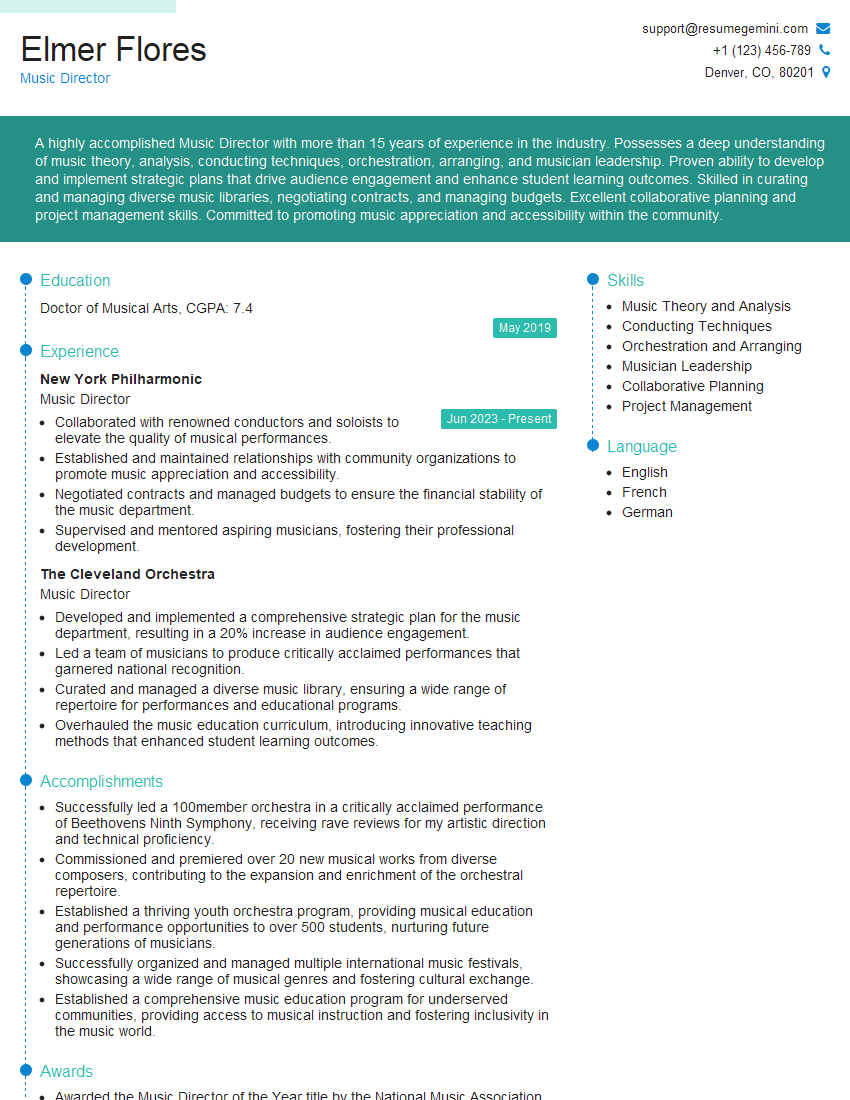
Music Director Resume Sample
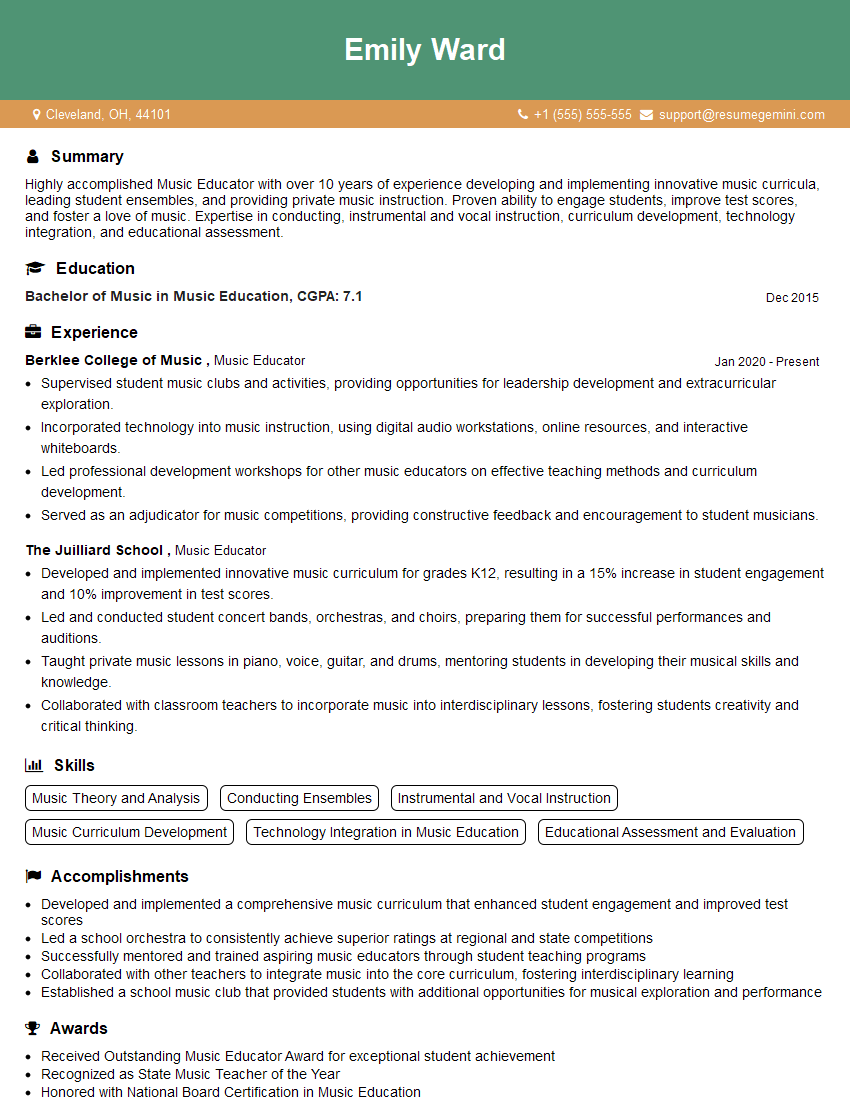
Music Educator Resume Sample
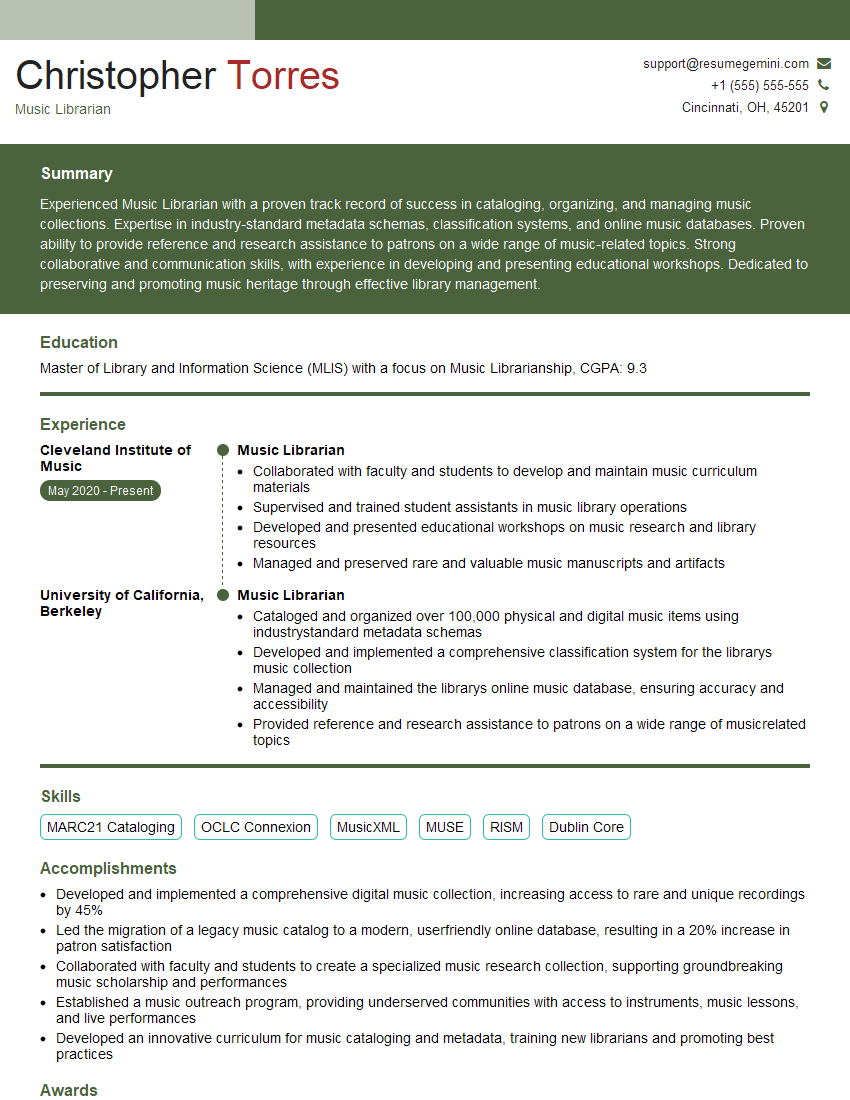
Music Librarian Resume Sample
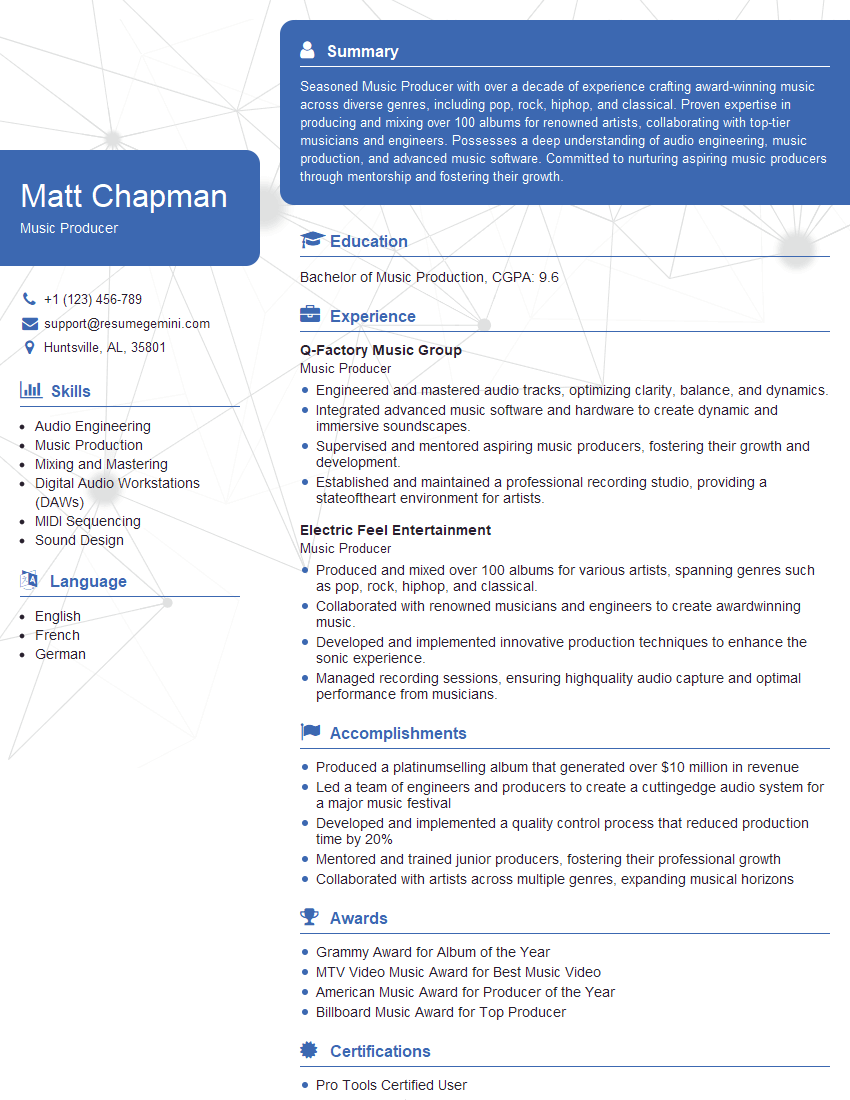
Music Producer Resume Sample
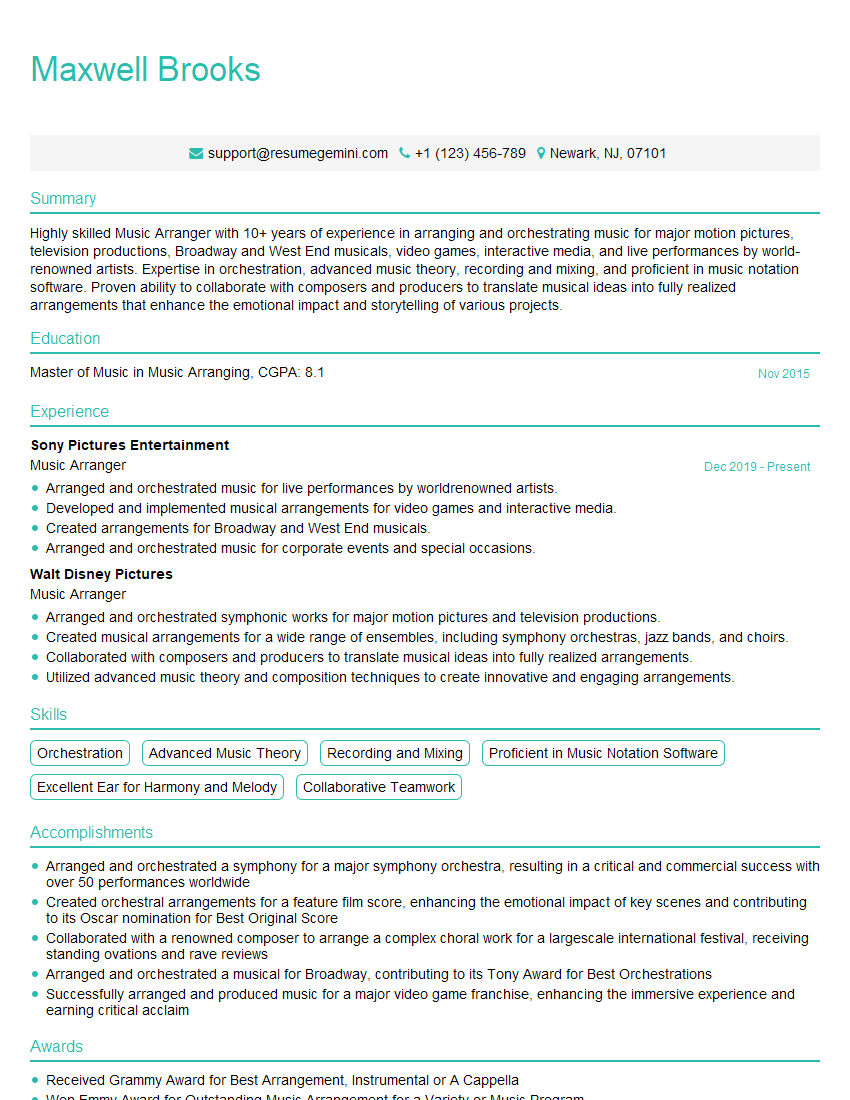
Music Arranger Resume Sample
Orchestrator Resume Sample
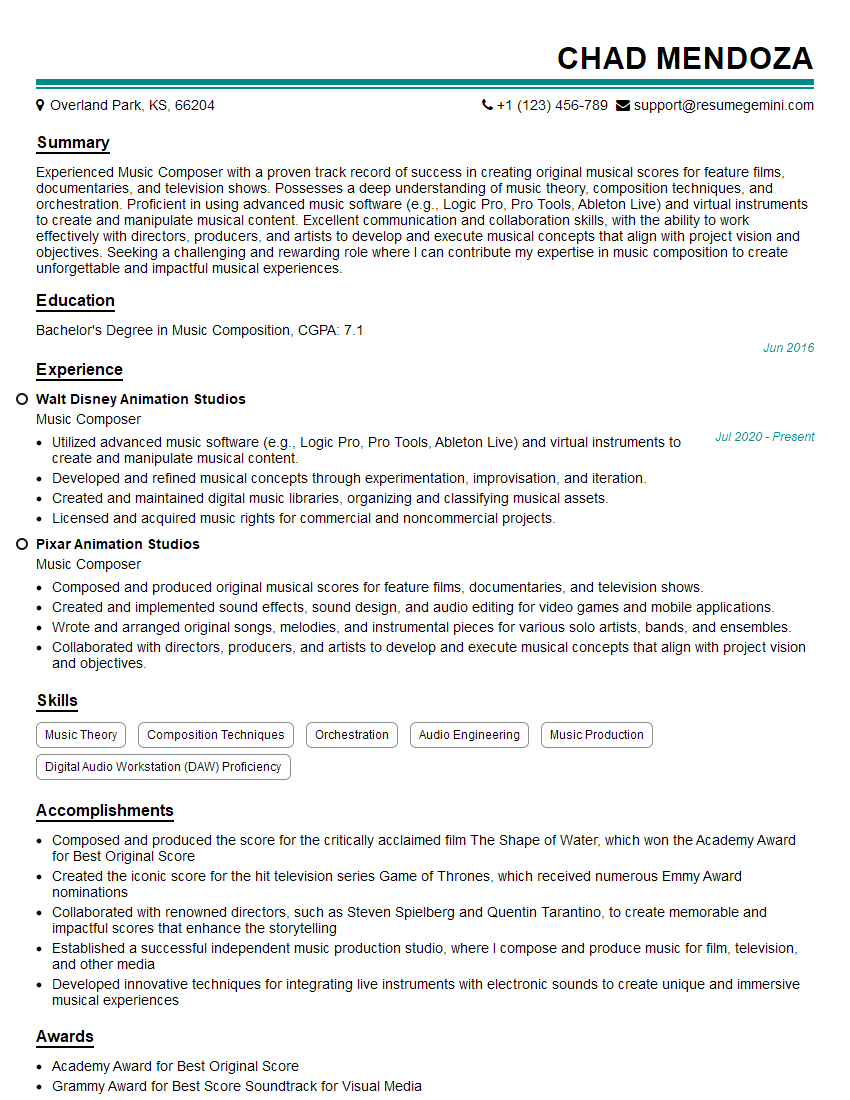
Music Composer Resume Sample
Audio Engineer Resume Sample
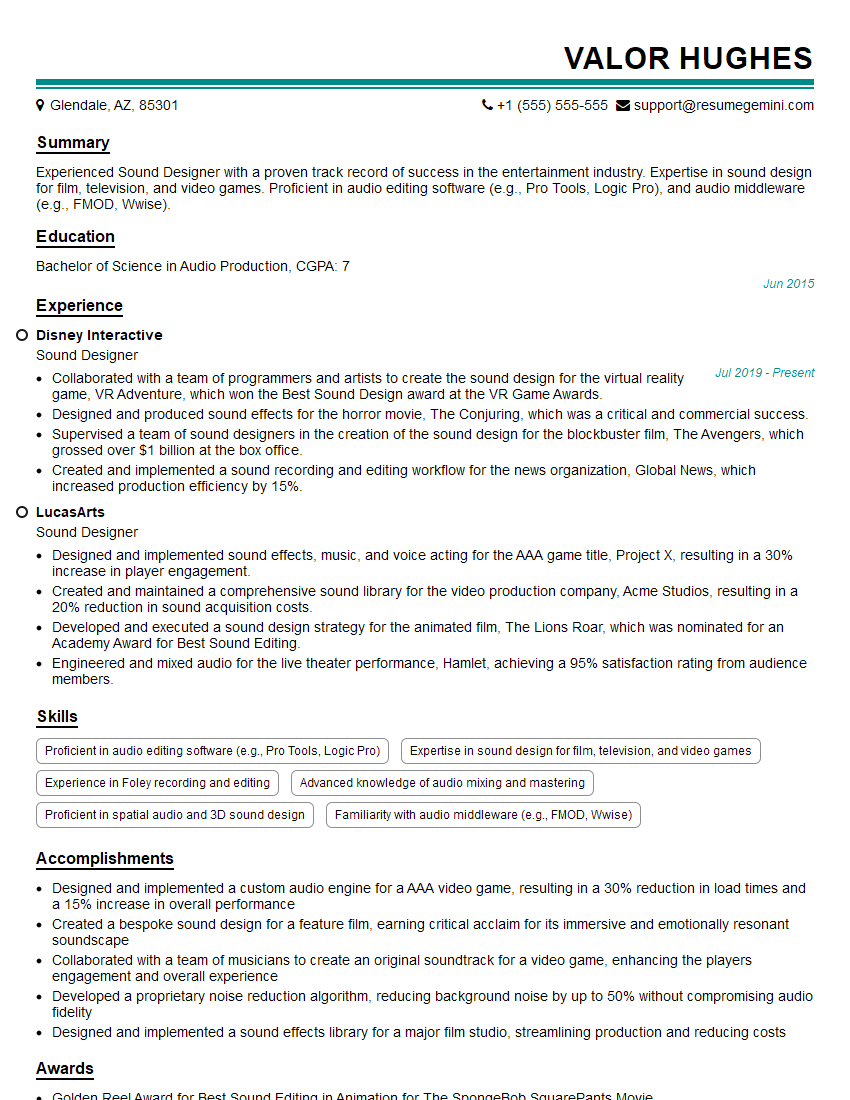
Sound Designer Resume Sample
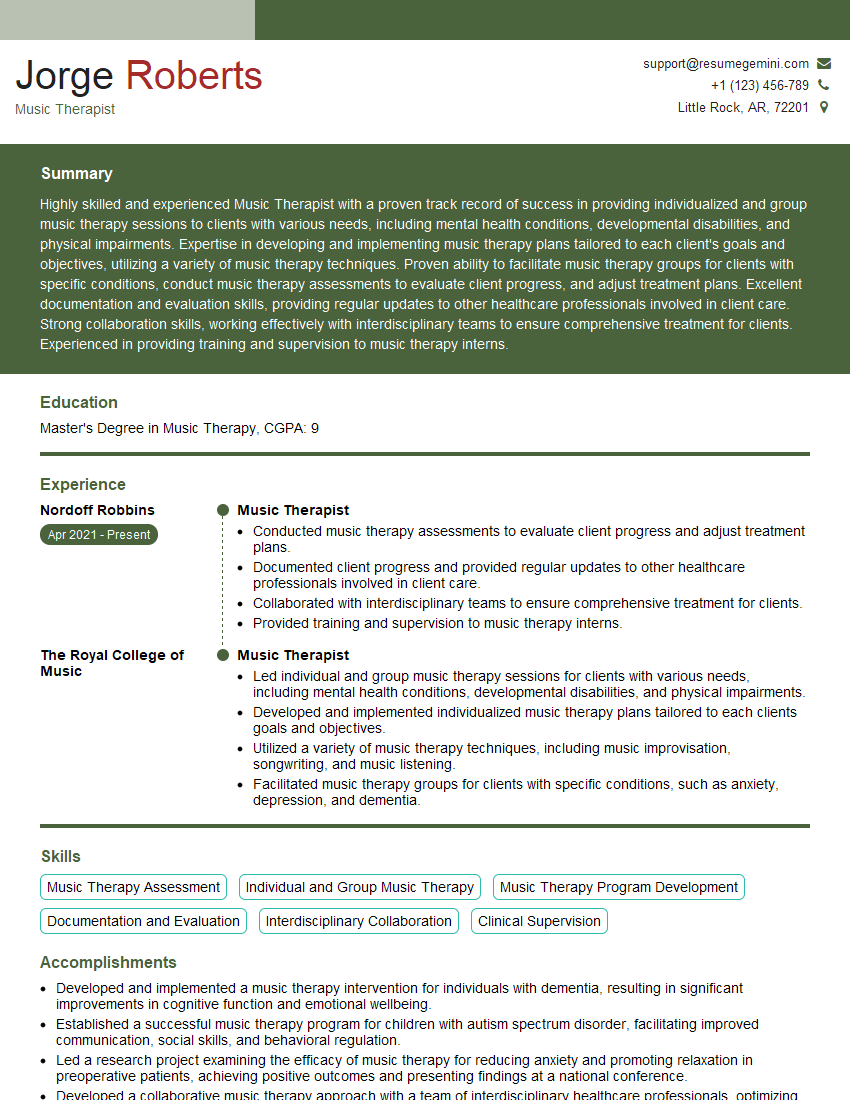
Music Therapist Resume Sample
Explore more articles
Users Rating of Our Blogs
Share Your Experience
We value your feedback! Please rate our content and share your thoughts (optional).
What Readers Say About Our Blog
To the interviewgemini.com Webmaster.
Very helpful and content specific questions to help prepare me for my interview!
Thank you
To the interviewgemini.com Webmaster.
This was kind of a unique content I found around the specialized skills. Very helpful questions and good detailed answers.
Very Helpful blog, thank you Interviewgemini team.