The thought of an interview can be nerve-wracking, but the right preparation can make all the difference. Explore this comprehensive guide to Solar Electric/Photovoltaic (PV) System Installation interview questions and gain the confidence you need to showcase your abilities and secure the role.
Questions Asked in Solar Electric/Photovoltaic (PV) System Installation Interview
Q 1. Explain the different types of solar panels and their applications.
Solar panels, also known as photovoltaic (PV) modules, come in various types, each with specific applications. The most common are monocrystalline, polycrystalline, and thin-film.
- Monocrystalline silicon panels are made from a single silicon crystal, resulting in higher efficiency (typically 18-22%) and a sleek, black appearance. They are ideal for space-constrained installations where maximizing energy output is crucial, such as rooftops in urban areas.
- Polycrystalline silicon panels use multiple silicon crystals, leading to slightly lower efficiency (15-17%) and a characteristic blueish appearance. They are generally more affordable than monocrystalline panels and suitable for larger projects where cost-effectiveness is a priority.
- Thin-film solar panels, including amorphous silicon, cadmium telluride (CdTe), and copper indium gallium selenide (CIGS), are made by depositing thin layers of photovoltaic material onto a substrate. They are flexible and lightweight, making them suitable for integrating into building materials or curved surfaces. They offer lower efficiency (8-13%) than crystalline silicon panels, but their lightweight nature and ability to handle lower light intensity make them useful in specific applications like building-integrated photovoltaics (BIPV).
The choice of panel type depends on factors like budget, available space, aesthetic preferences, and the specific energy needs of the application.
Q 2. Describe the process of designing a residential PV system.
Designing a residential PV system involves a systematic process that ensures optimal performance and safety. It begins with a thorough site assessment, including analyzing roof orientation, shading, and available space. We use specialized software to model the system’s performance under various conditions.
- Site Assessment and Energy Audit: We evaluate the homeowner’s energy consumption, roof conditions, shading profiles (from trees, buildings, etc.), and local climate data. This helps determine the appropriate system size.
- System Sizing and Design: Based on the energy audit, we determine the number of solar panels needed, inverter capacity, and other crucial components. This involves software simulation to optimize energy production and minimize losses.
- Component Selection: Choosing high-quality, reliable components such as panels, inverters, mounting hardware, and wiring is paramount for long-term system performance. This also involves considering warranty and manufacturer reputation.
- Permitting and Inspections: Obtaining necessary permits from local authorities and ensuring compliance with building codes and safety regulations is a crucial step.
- System Layout and Mounting Design: Creating a detailed layout for panel placement and determining the best mounting system (e.g., roof-mount, ground-mount) based on the roof structure and other factors. We need to consider optimal south-facing orientation and minimal shading.
The entire process requires careful consideration of both technical and aesthetic factors to ensure a functional and visually appealing system.
Q 3. How do you calculate the energy output of a PV system?
Calculating the energy output of a PV system requires considering several factors. It’s not just a simple calculation, but a complex estimation. A simplified calculation uses the following formula:
Annual Energy Output (kWh) ≈ (Panel Power (Wp) * Number of Panels) * Derate Factor * Annual Sun HoursWhere:
- Panel Power (Wp): The peak power output of a single solar panel in Watts.
- Number of Panels: The total number of panels in the system.
- Derate Factor: A factor (typically 0.75 – 0.85) that accounts for losses due to various factors like temperature, shading, wiring, and inverter efficiency.
- Annual Sun Hours: The average number of sunlight hours per day in a year for a specific location.
More accurate estimations utilize specialized software that incorporates detailed meteorological data, panel performance curves, and system losses. These sophisticated tools allow for more precise projections of energy generation, taking into account complex shading patterns and weather variations throughout the year. It is important to note this is an estimation. Actual energy output can vary based on unforeseen environmental conditions.
Q 4. What are the key components of a solar PV system?
A typical solar PV system consists of several key components working together to generate and deliver electricity:
- Solar Panels (PV Modules): These convert sunlight into direct current (DC) electricity.
- Solar Inverter: Converts the DC electricity from the panels into alternating current (AC) electricity compatible with household appliances.
- Mounting System: Holds the solar panels securely on a roof or ground.
- Wiring and Conduits: Connects all system components safely and efficiently.
- Disconnects: Provide safe means to isolate parts of the system for maintenance or emergencies.
- Meters and Monitoring System (Optional): Track the system’s performance and energy production.
- Grounding System: Protects the system and occupants from electrical shocks.
Each component plays a critical role in the system’s overall efficiency and safety. Careful selection and installation of these components are essential for optimal performance and longevity.
Q 5. Explain the function of a solar inverter and its types.
The solar inverter is a crucial component that transforms the direct current (DC) electricity generated by solar panels into alternating current (AC) electricity used in homes and businesses. There are several types of inverters, each with its own advantages and disadvantages:
- String Inverters: These are the most common and cost-effective type, connecting multiple solar panels in series (a string). A single string inverter serves a string of panels. If one panel in the string malfunctions, it can impact the entire string’s output.
- Microinverters: Each panel has its own microinverter, converting DC to AC individually. This offers improved performance as a malfunctioning panel won’t affect others. They are generally more expensive but offer higher energy yield and system-level monitoring capabilities.
- Power Optimizers: These sit between the panels and the string inverter, maximizing the output of individual panels by optimizing their voltage and current. This results in higher overall system efficiency and performance, especially in partially shaded conditions.
The choice of inverter type depends on factors like system size, budget, desired performance, and shading conditions. A well-chosen inverter ensures maximum energy harvest and optimal system operation.
Q 6. Describe the process of grounding a solar PV system.
Grounding a solar PV system is a critical safety measure that protects against electrical shocks and equipment damage. It creates a low-resistance path to the earth for fault currents, preventing voltage build-up and ensuring rapid dissipation of any electrical surges. The process involves:
- Connecting the system ground: This typically involves connecting the grounding electrode conductor (GEC) to a metal grounding rod driven deep into the earth, meeting local electrical codes.
- Grounding the array: Connecting the metal frames of the PV modules and mounting hardware to the GEC provides a path for fault currents.
- Grounding the inverter: The inverter’s chassis needs to be reliably connected to the grounding system to ensure the safety of the AC side of the system.
- Grounding the combiner box: Combiner boxes are grounded to provide a low impedance path to earth.
- Regular inspection and maintenance: Ensuring all grounding connections remain tight and free from corrosion is crucial for maintaining safety.
Proper grounding is non-negotiable for a safe and compliant solar PV system. Improper grounding can lead to serious electrical hazards.
Q 7. What are the safety precautions involved in solar panel installation?
Solar panel installation involves working with high voltages and potentially hazardous conditions, requiring strict adherence to safety precautions:
- Lockout/Tagout Procedures: Always disconnect and lock out the power supply to the system before performing any maintenance or installation work.
- Personal Protective Equipment (PPE): Use appropriate PPE including safety glasses, gloves, and insulated tools to prevent electrical shock and injury.
- Working at Heights: If working on a roof, use fall protection equipment and follow safe work practices.
- Electrical Safety Training: Installers must receive proper training in electrical safety practices and understand the risks associated with working on electrical systems.
- Weather Conditions: Never work on a solar PV system during inclement weather (rain, snow, high winds).
- Fire Safety: Be aware of potential fire hazards associated with electrical work and ensure appropriate fire extinguishers are available.
- Tools and Equipment: Use properly insulated tools and equipment designed for working with electricity.
Ignoring safety precautions can lead to serious injury or even death. Safety should always be the top priority in solar panel installation.
Q 8. How do you troubleshoot a malfunctioning solar PV system?
Troubleshooting a malfunctioning solar PV system requires a systematic approach. Think of it like diagnosing a car problem – you wouldn’t just start replacing parts randomly! We start with the basics and work our way through progressively complex checks.
- Visual Inspection: Begin with a thorough visual inspection of the entire system. Look for obvious issues like loose connections, damaged wires, shading on panels, or debris buildup. A quick glance often reveals the culprit.
- Check the Inverter: The inverter is the brain of the system, converting DC power from the panels to AC power for your home. Check for error codes displayed on the inverter’s screen. These codes often pinpoint the problem area. Consult the inverter’s manual for decoding these messages.
- Measure Voltage and Current: Use a multimeter to measure voltage and current at various points in the system. Compare these readings to the expected values. Significant discrepancies suggest problems with the panels, wiring, or other components. For example, low voltage at the panel level indicates potential issues with the panels themselves or the wiring to the inverter.
- Check the Array’s Performance: Use a solar panel monitoring system (if installed) or a portable device to individually measure the performance of each panel. This allows you to identify underperforming or faulty panels.
- Examine the Circuit Breakers and Fuses: Check if any circuit breakers or fuses have tripped. If so, reset them (carefully!). If they trip immediately again, there’s a short circuit somewhere in the system that requires professional attention.
- Review System Logs (if available): Sophisticated inverters and monitoring systems record performance data. Analyzing these logs can reveal intermittent issues or patterns that might otherwise go unnoticed.
Remember, safety is paramount. Always disconnect the system from the grid and turn off the inverter before performing any hands-on troubleshooting. If you’re not comfortable working with electricity, call a qualified solar technician.
Q 9. Explain the different types of mounting systems for solar panels.
Solar panel mounting systems are chosen based on factors like roof type, panel orientation, and structural integrity. The primary types are:
- Roof-Mounted Systems: These are the most common.
- Racking Systems: These use metal rails and clamps to secure panels to the roof. They’re versatile and suitable for various roof types. Think of them as a sturdy framework holding your panels.
- Integrated Systems: These systems are integrated directly into the roof structure during construction, offering a more streamlined aesthetic. It’s like the panels become a part of the roof itself.
- Ground-Mounted Systems: These systems are suitable for large-scale installations or locations with limited roof space.
- Pole-Mounted Systems: Panels are mounted on poles, often with adjustable angles for optimal sunlight capture.
- Ground-Mount Racking Systems: Similar to roof-mounted racking, these secure panels to a concrete base. The choice depends on available space and system size.
- Building-Integrated Photovoltaics (BIPV): These systems are incorporated directly into building materials like roof tiles or façade panels, seamlessly integrating solar energy generation into the building’s design.
The choice of mounting system significantly impacts the system’s cost, efficiency, and longevity. Careful consideration of all factors is critical for optimal performance and safety.
Q 10. What are the NEC (National Electrical Code) requirements for solar PV installations?
The National Electrical Code (NEC) provides stringent guidelines for solar PV installations to ensure safety and reliability. Key requirements include:
- Grounding and Bonding: The system must be properly grounded to prevent electrical shock hazards. All metal components need to be effectively bonded together.
- Overcurrent Protection: Circuit breakers or fuses must be installed to protect the system from overloads and short circuits.
- Wiring Methods and Protection: Wiring must meet specific requirements regarding insulation, size, and routing to prevent damage and ensure proper functionality. Conduits are often used for protection.
- Disconnects: Easily accessible disconnects must be provided to allow safe isolation of the system for maintenance or emergencies.
- Rapid Shutdown Systems: For fire safety, rapid shutdown systems are often required, allowing firefighters to quickly de-energize the array during emergencies. Think of it as a safety switch that cuts power quickly in case of a fire.
- System Sizing and Design: The NEC outlines requirements for sizing the system components, including inverters, conductors, and overcurrent protection devices, to ensure they can handle the expected loads.
- Inspections and Permits: Permits are needed for most installations, and inspections are mandatory to ensure compliance with the NEC.
Compliance with the NEC is not merely a formality; it’s essential for the safety of the occupants and the longevity of the system. Failing to comply can lead to serious consequences, including fines, system failure, and even injuries.
Q 11. Describe the process of connecting a solar PV system to the grid.
Connecting a solar PV system to the grid is a complex process that must be handled by qualified electricians. It involves several key steps:
- Permitting and Inspections: Obtain the necessary permits from your local authorities. Inspections are often required at various stages of the installation process.
- System Installation: The solar array, inverter, and other components are installed and wired according to the NEC and manufacturer’s specifications.
- Grid Connection: A qualified electrician connects the system to the electrical grid through a certified interconnection point. This involves careful coordination with the utility company.
- Metering: A bi-directional meter is installed to measure both the energy produced by the solar system and the energy drawn from the grid. This meter tracks the net energy flow.
- Interconnection Agreement: A formal interconnection agreement is established with the utility company outlining the terms and conditions of the grid connection. This agreement also stipulates the conditions under which your system feeds excess power back into the grid.
- System Testing and Commissioning: Rigorous testing is conducted to ensure the system operates correctly and meets safety standards. This often includes verifying functionality of the metering system and interoperability with the grid.
The grid connection process is critical for ensuring the safety and proper functioning of both the solar PV system and the electrical grid. Improper connection can cause serious problems and potentially endanger lives.
Q 12. How do you perform a performance test on a solar PV system?
Performance testing of a solar PV system ensures it’s operating efficiently and producing the expected amount of energy. This involves several steps:
- Visual Inspection: Begin by checking for any obvious issues like shading, debris buildup, or damaged panels.
- Monitoring System Data: If a monitoring system is installed, review the data for any anomalies in energy production, voltage, or current. This gives a broader picture of the system’s historical performance.
- Measuring Panel Output: Use a clamp meter or other specialized tools to measure the output voltage and current of individual panels. This helps you to isolate underperforming or faulty panels.
- Inverter Performance Check: Examine inverter efficiency and look for any error codes. Check if the inverter is operating within its specified parameters. Inverters are susceptible to overheating, so ensure adequate ventilation.
- String Voltage and Current Measurements: Measure the voltage and current of each string of panels to assess the overall performance of the array. This gives an indication of the efficiency of the wiring and connections.
- Power Output Measurement: Measure the total power output of the system, comparing this to the expected output based on the system’s specifications and solar irradiance. This gives an overall assessment of the system’s performance.
- IR Thermography: This advanced technique uses infrared cameras to detect thermal anomalies within the panels or wiring, helping to identify potential hotspots or faulty components.
Performance testing should be done regularly, ideally annually, to identify and address any performance degradation or potential issues before they become major problems.
Q 13. What are the different types of batteries used in solar energy storage systems?
Several battery technologies are used in solar energy storage systems, each with its own advantages and disadvantages:
- Lead-Acid Batteries: These are a mature technology, relatively inexpensive, and widely available. However, they have a shorter lifespan and lower energy density compared to other options.
- Lithium-ion Batteries: These are the most prevalent type in modern solar storage systems. They offer high energy density, long lifespan, and high efficiency, but they are more expensive.
- Flow Batteries: These are typically used in large-scale energy storage applications due to their long lifespan and scalability. They’re less common for residential systems due to higher cost and size.
- Salt-Water Batteries (Sodium-ion): Emerging technology offering a potential cost-effective and environmentally friendly alternative to Lithium-ion with similar energy density. Still relatively new to the market.
The choice of battery technology depends on factors like budget, energy storage requirements, lifespan expectations, and environmental concerns. Careful consideration is essential to select the optimal solution for a particular application.
Q 14. How do you select the appropriate size of inverter for a PV system?
Selecting the appropriate inverter size is crucial for optimal system performance. An inverter that’s too small will limit the system’s output, while one that’s too large can be inefficient and may even damage components. The process involves:
- Determine Total Panel Wattage: Calculate the total power output of all the solar panels in the system (DC power).
- Consider Inverter Efficiency: Inverter efficiency varies depending on the model and technology used. Choose an inverter with high efficiency at the expected operating range.
- Check Peak Power: The peak power rating of the inverter should be slightly larger than the total panel wattage to account for variations in sunlight intensity and other factors. A common rule of thumb is to have a slightly higher capacity than the DC power produced by the panels.
- Future Expansion: Consider whether you might expand your system in the future. If so, select an inverter with sufficient headroom for expansion.
- Check Compatibility: Ensure the inverter is compatible with the specific solar panels being used, including voltage and current ratings.
- Consult the Manufacturer’s Specifications: Always refer to the manufacturer’s specifications for detailed information on sizing and compatibility.
Proper inverter sizing is vital for maximizing energy production and ensuring the long-term reliability of the entire solar PV system. Undersizing can restrict energy production, while oversizing can lead to inefficiency and unnecessary costs.
Q 15. Explain the concept of maximum power point tracking (MPPT).
Maximum Power Point Tracking (MPPT) is a crucial function in solar PV systems. Solar panels don’t produce power at a constant rate; their output varies depending on sunlight intensity and temperature. The MPPT algorithm constantly monitors the voltage and current of the solar array to find the point where the panel produces the maximum power (the ‘maximum power point’). Think of it like finding the sweet spot on a seesaw – you need the right balance of voltage and current for optimal power generation.
The MPPT controller adjusts the input voltage from the panels to achieve this maximum power point, even when conditions like shading or temperature changes affect the array’s performance. This ensures that you’re extracting the most possible energy from your solar panels under all conditions.
For example, imagine a cloud partially shading your panels. Without MPPT, the shaded cells would reduce the overall voltage and thus reduce the power output significantly. However, an MPPT controller would adjust the voltage to maximize power despite the shading, significantly improving energy harvest.
Career Expert Tips:
- Ace those interviews! Prepare effectively by reviewing the Top 50 Most Common Interview Questions on ResumeGemini.
- Navigate your job search with confidence! Explore a wide range of Career Tips on ResumeGemini. Learn about common challenges and recommendations to overcome them.
- Craft the perfect resume! Master the Art of Resume Writing with ResumeGemini’s guide. Showcase your unique qualifications and achievements effectively.
- Don’t miss out on holiday savings! Build your dream resume with ResumeGemini’s ATS optimized templates.
Q 16. Describe the process of commissioning a newly installed solar PV system.
Commissioning a solar PV system is a vital step ensuring safety and optimal performance. It involves a series of checks and tests to verify that the system is installed correctly and operating as intended. This process typically begins with a visual inspection, examining all components for damage or improper installation. Then, detailed testing is performed.
- Wiring Continuity and Insulation Resistance Tests: These checks ensure all connections are sound and properly insulated to prevent short circuits or electrical shocks.
- Grounding Tests: We verify the system is properly grounded to protect against electrical surges and ensure safety.
- Insulation Resistance Tests: These measure the insulation’s ability to withstand high voltages, preventing current leakage.
- Leakage Current Tests: We verify that there are no undesirable current paths that can lead to electric shock.
- Performance Testing: Using monitoring equipment, we measure the voltage, current, and power output of the system under varying conditions, comparing it to the design specifications.
- Operational Checks: This includes verifying that all components, including inverters and meters, are functioning correctly.
- Safety Testing: Finally, we perform checks to ensure compliance with safety regulations such as arc flash protection and appropriate labeling.
After successfully completing all tests, we provide a commissioning report documenting the process and its results, which is crucial for insurance and warranty purposes. A well-documented commissioning ensures the longevity and safety of the solar PV system.
Q 17. What are the environmental considerations in solar PV system installations?
Environmental considerations are paramount in solar PV installations. We need to minimize the environmental impact throughout the entire lifecycle – from manufacturing to disposal.
- Habitat Disturbance: Site selection needs to consider the impact on wildlife habitats. We try to minimize land clearing and choose locations that have minimal impact on natural ecosystems.
- Water Usage: Solar panel manufacturing requires water, so selecting panels from manufacturers with sustainable water management practices is crucial. The installation process itself should minimize water consumption.
- Waste Generation: We aim to minimize construction waste by recycling materials whenever possible and properly disposing of hazardous waste such as used batteries.
- Land Use: While solar farms provide clean energy, careful consideration of land use is necessary, ensuring that valuable agricultural land is not unnecessarily converted. Rooftop installations are often preferred for minimizing land use.
- Visual Impact: The visual impact of large-scale solar installations on landscapes needs to be carefully assessed and mitigated, balancing energy production with the aesthetics of the surrounding environment.
Ultimately, sustainable practices throughout the project lifecycle minimize the environmental footprint of a solar PV system, making clean energy truly sustainable.
Q 18. What are the common causes of failures in solar PV systems?
Solar PV systems are generally robust, but failures can occur. Common causes include:
- Faulty Components: Defective solar panels, inverters, or other components can fail due to manufacturing defects or wear and tear. This highlights the importance of using high-quality components from reputable manufacturers.
- Environmental Factors: Extreme weather events like hailstorms or strong winds can damage panels or other system components. Shading can also significantly reduce energy output.
- Wiring Issues: Poorly installed wiring can lead to short circuits, open circuits, or loose connections, reducing performance or creating safety hazards.
- Grounding Problems: Improper grounding can increase the risk of electric shock and damage to equipment during lightning strikes or other electrical surges.
- Corrosion: Exposure to moisture and salt spray can cause corrosion of metal components, leading to failures.
- Overheating: Improper ventilation or shading can cause overheating, which can reduce the lifespan and performance of the system.
Regular inspections and maintenance, including visual checks and performance monitoring, are crucial to identifying and addressing potential issues before they lead to major failures. Employing qualified professionals during design and installation significantly reduces the likelihood of these problems.
Q 19. How do you interpret a solar PV system’s performance data?
Interpreting solar PV system performance data involves analyzing data from monitoring systems to assess the system’s efficiency and identify potential problems. This data usually includes:
- Energy Production: Total energy generated over a specified period (daily, monthly, annually). This is compared against predicted production based on system design and solar irradiance.
- Voltage and Current: Monitoring the voltage and current produced by individual panels and strings helps identify any underperforming panels or strings.
- Inverter Performance: Data on inverter operation, such as efficiency, uptime, and error messages, can highlight problems with the energy conversion process.
- Environmental Data: Data on solar irradiance (sunlight intensity), temperature, and wind speed provides context for evaluating the system’s performance under varying weather conditions.
We compare actual performance to the expected or projected performance based on system design and weather data. Discrepancies can indicate problems like shading, faulty components, or system issues. For example, a consistent drop in energy production despite favorable weather conditions suggests a need for investigation.
Data visualization tools, such as graphs and charts, are commonly used to facilitate analysis and identify trends or anomalies in the system’s performance.
Q 20. Describe the process of maintaining a solar PV system.
Maintaining a solar PV system involves regular checks and cleaning to ensure its continued efficient and safe operation.
- Visual Inspections: Regular visual inspections, ideally quarterly, identify any signs of damage, corrosion, or loose connections.
- Panel Cleaning: Periodic cleaning of solar panels, particularly in dusty or dirty environments, is important to maximize energy production. High-pressure water is usually sufficient, but chemical cleaning agents should be avoided unless necessary.
- Inverter Checks: Checking inverter operation, including error logs and performance indicators, helps detect potential problems early on.
- Wiring and Connection Checks: Regularly checking wiring and connections for loose terminals or corrosion is essential for ensuring safety and preventing failures.
- Performance Monitoring: Monitoring energy production over time, and comparing it to expected values, allows us to quickly detect deviations from normal performance.
A well-maintained solar PV system will not only operate efficiently but also prolong its lifespan, avoiding costly repairs and replacement of components down the line. A proactive maintenance approach ensures reliable and consistent energy generation.
Q 21. What are the different types of permits required for solar PV installations?
The permits needed for solar PV installations vary greatly depending on location, system size, and local regulations. However, common permits include:
- Building Permits: These are typically required for any structural modifications or alterations associated with the installation, such as roof mounting or ground mounting.
- Electrical Permits: Always necessary for the electrical work involved, including wiring, connection to the grid, and safety inspections.
- Interconnection Permits: Required by utility companies to connect the solar PV system to the electrical grid. These often involve detailed designs and specifications.
- Planning Permits (or Zoning Permits): May be needed for large-scale ground-mounted systems to ensure compliance with zoning regulations and land-use plans.
- Homeowner Association (HOA) Approvals (if applicable): HOAs may have regulations concerning the aesthetic appearance of solar installations, requiring prior approval before installation.
It’s crucial to consult with local authorities and utility companies early in the planning process to identify all necessary permits and avoid delays. Ignoring permit requirements can lead to fines and necessitate costly remediation.
Q 22. What are the common challenges faced during solar PV installations?
Solar PV installations, while environmentally beneficial, present several challenges. These can be broadly categorized into logistical, technical, and regulatory hurdles.
- Site-Specific Constraints: Roof condition, shading from trees or buildings, and the availability of suitable mounting points significantly impact system design and installation. For example, a sloped roof might require specialized racking systems, increasing costs and complexity. A site with significant shading could dramatically reduce energy production, necessitating mitigation strategies.
- Weather Conditions: Extreme weather events like strong winds, heavy snow, or hail can delay or damage installations. Proper planning and the use of robust materials are crucial to mitigate these risks.
- Permitting and Inspections: Navigating the permitting process can be time-consuming and complex, varying widely by location. Ensuring compliance with local building codes and electrical regulations requires meticulous attention to detail.
- Labor Shortages and Skilled Workforce: The solar industry is experiencing rapid growth, leading to a shortage of skilled installers. Finding and retaining qualified personnel is a constant challenge.
- Equipment Availability and Cost Fluctuations: The availability and pricing of solar panels, inverters, and other components can fluctuate, affecting project timelines and budgets. Careful procurement planning is essential.
Q 23. How do you ensure compliance with building codes during solar PV installations?
Compliance with building codes is paramount for safety and legal reasons. My approach involves a multi-step process:
- Pre-installation Planning: This begins with a thorough review of all applicable codes and regulations for the specific location. This includes electrical codes (NEC), building codes, and any local ordinances. We obtain necessary permits before starting any work.
- Detailed Design and Engineering: The system design must explicitly address code requirements, including structural integrity calculations for mounting systems, grounding and bonding requirements, and appropriate overcurrent protection. We often use specialized software to ensure compliance.
- Meticulous Installation: Every step of the installation process is performed according to code, using approved materials and techniques. Proper labeling, wire management, and adherence to safety protocols are strictly enforced.
- Inspections and Testing: We schedule inspections with the relevant authorities at various stages of the installation, including before and after connection to the grid. Thorough testing ensures the system operates safely and meets performance standards.
- Documentation: Complete and accurate documentation of all aspects of the installation, including permits, inspections, and testing results, is maintained for future reference.
Failure to comply with building codes can result in system rejection, costly rework, and legal liabilities. Therefore, proactive compliance is a top priority.
Q 24. Explain the difference between monocrystalline and polycrystalline solar panels.
Both monocrystalline and polycrystalline solar panels are made of silicon, but their manufacturing processes and resulting characteristics differ:
- Monocrystalline: These panels are made from a single, large silicon crystal, resulting in a uniform, dark color. They are generally more efficient (typically 18-22%) than polycrystalline panels because of the purity of their silicon structure, allowing them to generate more power from the same surface area. They’re also more durable and have a slightly longer lifespan, however they tend to be more expensive.
- Polycrystalline: These panels are made from multiple silicon crystals melted together, giving them a characteristic mottled blue appearance. Their efficiency is typically lower (around 15-17%), and they tend to be slightly less durable and have a shorter lifespan than monocrystalline panels, but their manufacturing process is simpler and thus less expensive.
The choice between monocrystalline and polycrystalline panels depends on the project’s specific requirements, budget, and available space. High-efficiency is often prioritized where space is limited, while cost-effectiveness might be the determining factor in larger projects.
Q 25. Describe the different wiring methods used in solar PV system installations.
Solar PV systems use several wiring methods, each with its advantages and disadvantages:
- Series Wiring: Panels are connected end-to-end, with the voltage adding up while the current remains the same. This method is simple but can be vulnerable to shading, as one shaded panel can significantly reduce the output of the entire string.
- Parallel Wiring: Panels are connected side-by-side, with the current adding up while the voltage remains the same. This method is more resistant to shading but requires thicker wires to handle higher currents.
- Series-Parallel Wiring: A combination of both methods. Panels are grouped into series strings, and these strings are then connected in parallel. This offers a balance between voltage and current, enhancing efficiency and resilience to shading.
- Microinverters: Each panel or a small group of panels is connected to its own microinverter, which converts DC to AC. This approach maximizes energy production even with shading issues and simplifies troubleshooting.
The choice of wiring method depends on factors such as system size, panel characteristics, shading conditions, and cost considerations. Proper wire sizing is crucial to ensure safe and efficient operation.
Q 26. What are your experiences with different types of solar trackers?
I have experience with various solar trackers, each designed to optimize energy production by maximizing sunlight exposure throughout the day.
- Single-Axis Trackers: These trackers rotate on a single axis (typically east-west), following the sun’s movement from east to west. They are relatively simple and cost-effective but less efficient than dual-axis trackers.
- Dual-Axis Trackers: These trackers rotate on two axes, following the sun’s movement in both altitude and azimuth. They offer the highest energy yield but are more complex, expensive, and require more maintenance.
- Fixed-Tilt Systems: These systems have no tracking mechanism; the panels are fixed at an optimal angle for the specific location. They are simple and cost-effective, but less efficient than tracking systems.
The choice of tracker depends on several factors: budget, available space, system size, and the desired energy yield. For example, in areas with limited space, dual-axis trackers might be preferred due to their higher energy production, despite their higher cost. In areas with low wind loads, dual-axis trackers might be the better choice even though they are more expensive and need more maintenance. In areas with high wind loads, a fixed tilt system might be a better, more cost effective choice.
Q 27. How do you deal with shading issues in solar PV system design?
Shading is a significant concern in solar PV system design, as even a small amount of shade on a single panel can drastically reduce the overall system output. My approach involves a combination of strategies:
- Careful Site Assessment: A thorough site survey identifies all potential shading sources, including trees, buildings, and other structures. We use specialized software to model shading patterns throughout the day and year.
- Optimized Panel Placement: Panels are arranged to minimize shading, taking into account the direction and intensity of sunlight at different times of the day. This may involve adjusting panel orientation or using specific mounting configurations.
- Bypass Diodes: These diodes are incorporated into panels to allow current to bypass shaded cells, preventing the entire panel from being affected. This increases the overall efficiency despite shading.
- Microinverters: As mentioned earlier, microinverters provide an effective solution, as each panel or small group operates independently, minimizing the impact of shading.
- Shading Mitigation Software: Software programs can simulate shading effects, helping to optimize panel placement and mitigate losses.
In some cases, tree trimming or other site modifications may be necessary to reduce shading. Each mitigation strategy has its associated costs and benefits, and the optimal approach depends on the specific situation.
Q 28. Explain the importance of proper grounding and bonding in solar PV systems.
Proper grounding and bonding are crucial for the safety and reliability of solar PV systems. They protect against electrical shocks, equipment damage, and fire hazards.
- Grounding: This connects the system’s metal components (e.g., racking, conduit) to the earth, providing a low-impedance path for fault currents. This protects against electrical shocks and equipment damage if a fault occurs.
- Bonding: This connects the metal components of the system together, ensuring they are at the same electrical potential. This prevents voltage differences that could cause sparks or arcing. Bonding is particularly important in preventing dangerous voltage differentials between the PV array and other metal components, such as the building’s metallic structure.
Improper grounding and bonding can create a significant safety hazard. I always ensure compliance with relevant electrical codes and best practices, using appropriate grounding electrodes and conductors, and thoroughly testing the system’s grounding and bonding integrity.
Think of it like this: grounding is like providing an escape route for electricity in case of a fault, and bonding is like ensuring all the metallic parts are ‘friends’ and don’t fight each other by creating hazardous voltage differences.
Key Topics to Learn for Solar Electric/Photovoltaic (PV) System Installation Interview
- System Design & Sizing: Understanding load calculations, energy production estimations, and choosing appropriate PV panels and inverters. Consider various factors influencing system design, such as shading and roof orientation.
- Panel Installation & Mounting: Practical knowledge of different mounting systems (roof-mounted, ground-mounted), techniques for secure and efficient panel installation, and adherence to safety regulations.
- Wiring & Electrical Connections: Familiarity with DC and AC wiring, understanding of combiner boxes, grounding techniques, and proper connection to the main electrical panel. Troubleshoot common wiring issues.
- Inverter Installation & Configuration: Knowledge of different inverter types (string, microinverters, power optimizers), installation procedures, and software configuration for optimal performance. Understand the importance of MPPT tracking.
- Safety Procedures & Regulations: Comprehensive understanding of relevant safety standards (e.g., NEC, OSHA), lock-out/tag-out procedures, and proper handling of electrical equipment.
- Troubleshooting & Diagnostics: Ability to identify and resolve common issues in PV systems, utilizing diagnostic tools and interpreting system data. Demonstrate problem-solving skills.
- Permitting & Inspections: Familiarity with the permitting process, inspection requirements, and necessary documentation for compliance.
- System Monitoring & Maintenance: Understanding the importance of system monitoring, data analysis, preventative maintenance, and common maintenance tasks.
Next Steps
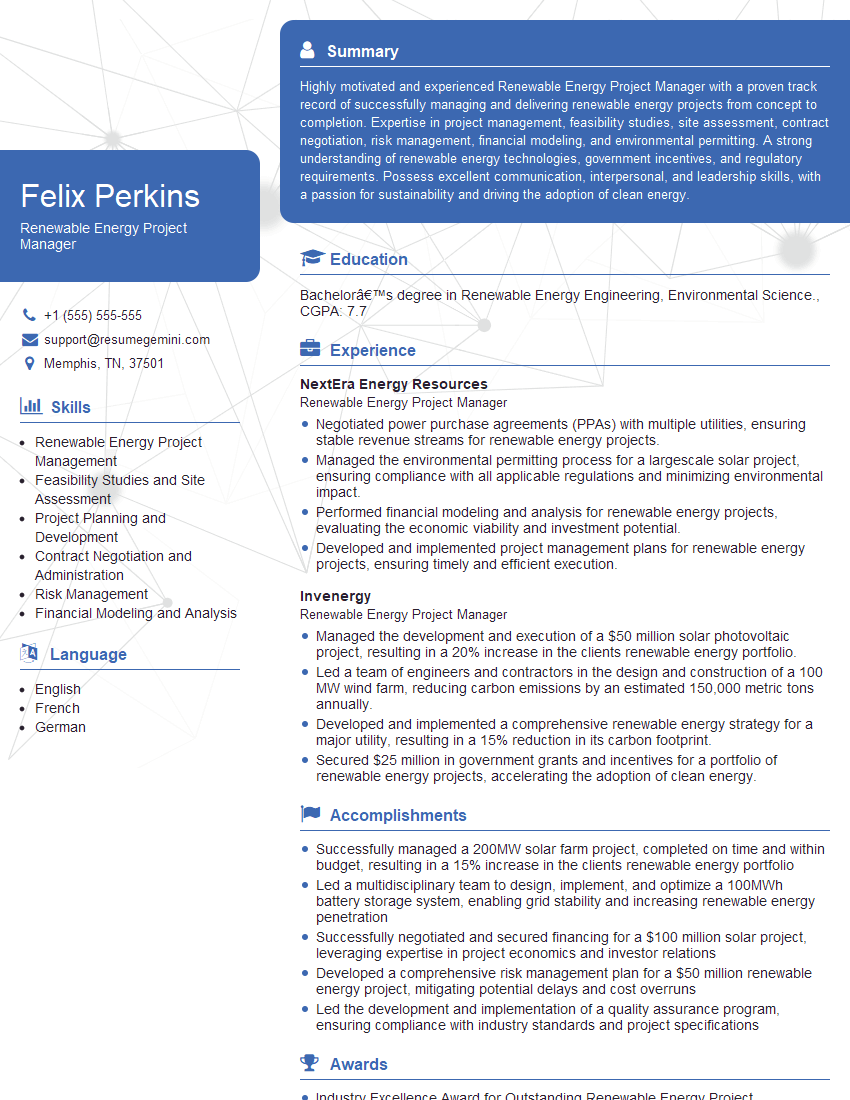
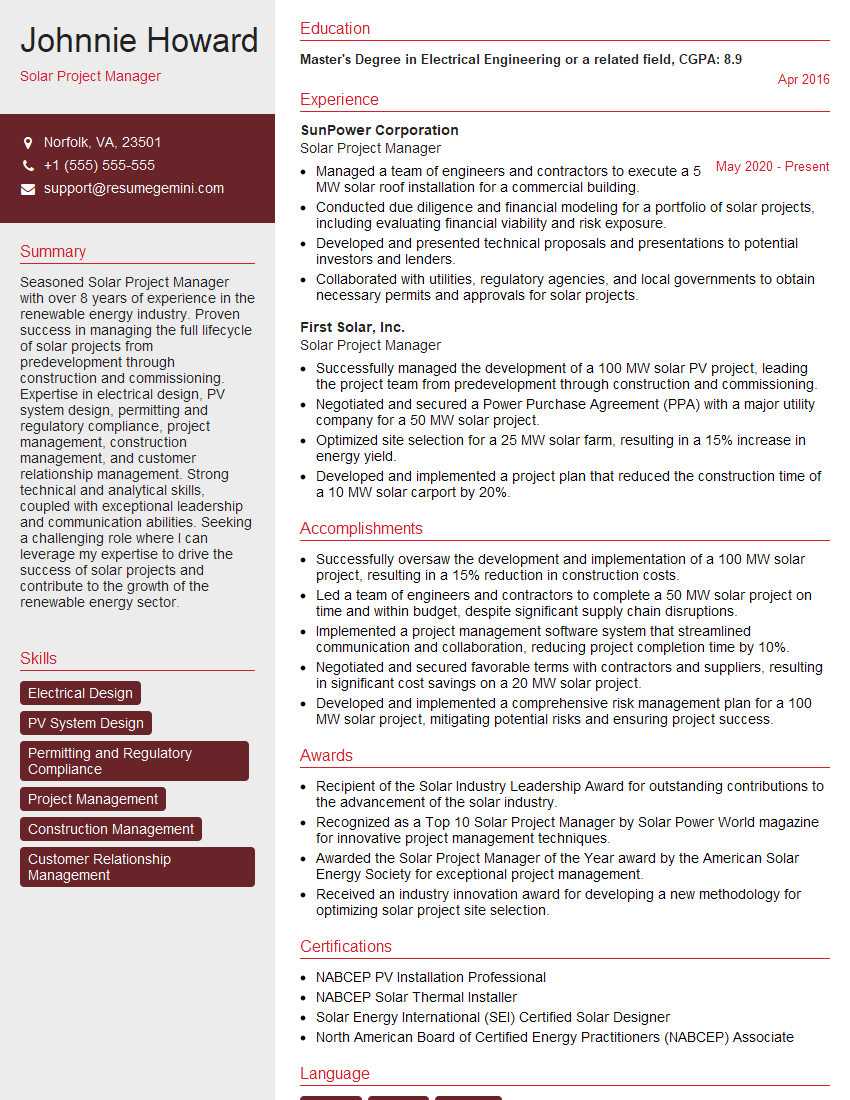
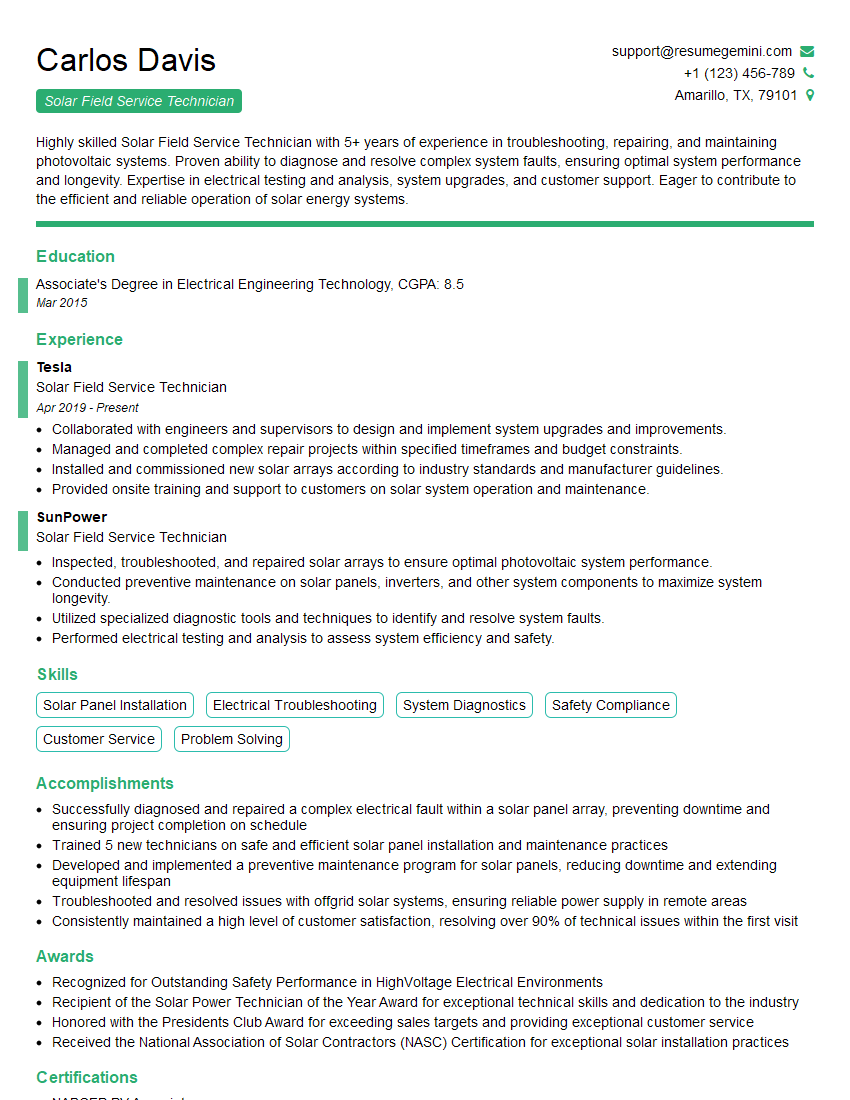
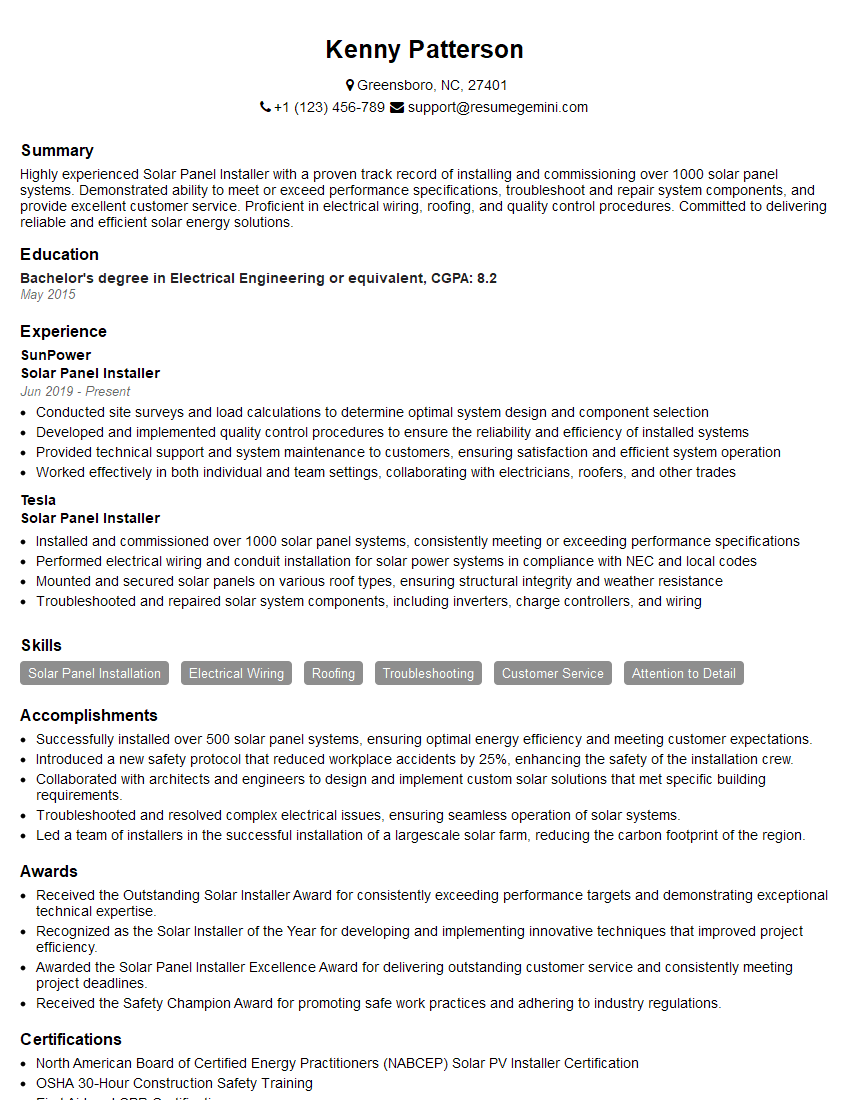
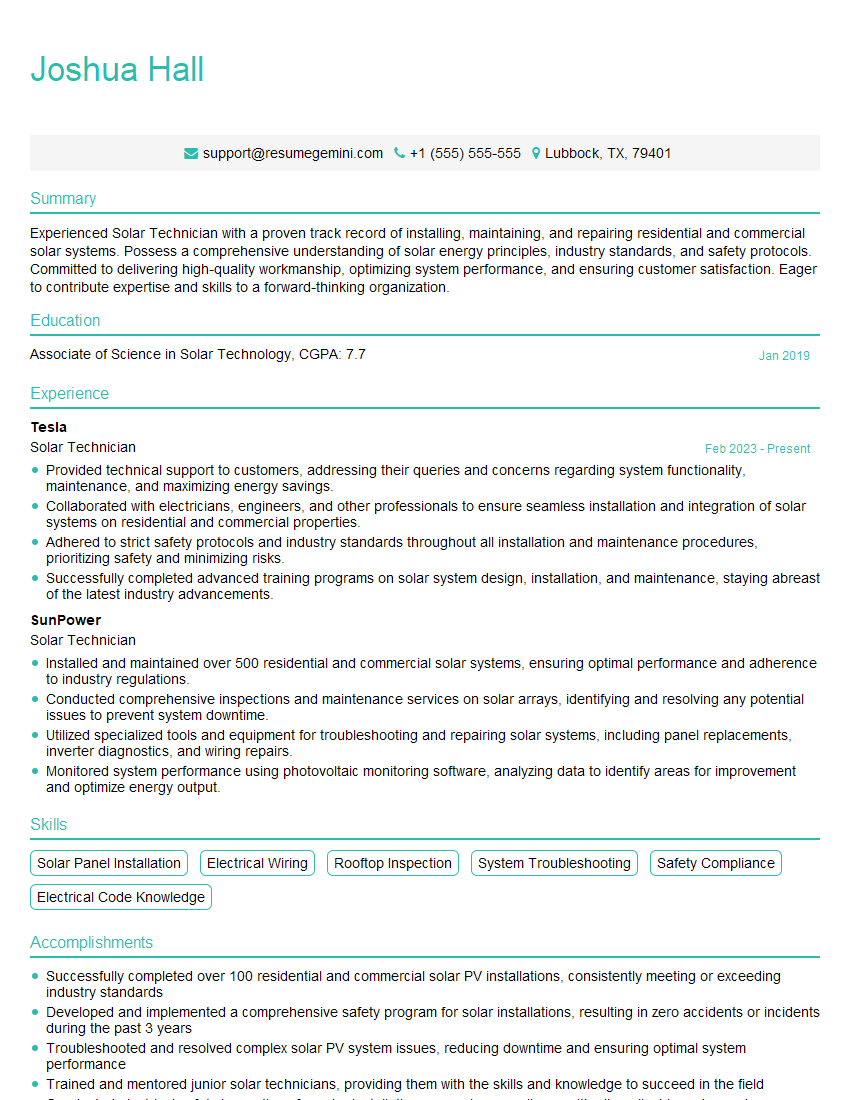
Mastering Solar Electric/Photovoltaic (PV) System Installation opens doors to a rewarding and growing career in a vital industry. To maximize your job prospects, crafting a strong, ATS-friendly resume is crucial. ResumeGemini is a trusted resource to help you build a professional and impactful resume that highlights your skills and experience effectively. Examples of resumes tailored to Solar Electric/Photovoltaic (PV) System Installation are available to guide you. Invest time in creating a compelling resume – it’s your first impression on potential employers.

Explore more articles
Users Rating of Our Blogs
Share Your Experience
We value your feedback! Please rate our content and share your thoughts (optional).
What Readers Say About Our Blog
To the interviewgemini.com Webmaster.
Very helpful and content specific questions to help prepare me for my interview!
Thank you
To the interviewgemini.com Webmaster.
This was kind of a unique content I found around the specialized skills. Very helpful questions and good detailed answers.
Very Helpful blog, thank you Interviewgemini team.