Preparation is the key to success in any interview. In this post, we’ll explore crucial Test and Inspect Electrical Systems interview questions and equip you with strategies to craft impactful answers. Whether you’re a beginner or a pro, these tips will elevate your preparation.
Questions Asked in Test and Inspect Electrical Systems Interview
Q 1. Explain the difference between a megger test and a continuity test.
Both megger and continuity tests assess the electrical characteristics of a circuit, but they do so in different ways and for different purposes. A continuity test verifies the presence of a complete, low-resistance path between two points in a circuit. Think of it like checking if a pipe is clear – if there’s a blockage (open circuit), the current won’t flow. A continuity tester typically uses a low voltage to check for this path, and usually indicates continuity with a beep or light. We use this to confirm wire connections, check for shorts in wiring harnesses, and to ensure components are properly connected before energizing.
A megger test, on the other hand, measures the insulation resistance of a cable or equipment. It applies a high voltage to check for weak spots in the insulation. A weak spot might not be obvious to a continuity test but could lead to dangerous leakage currents or even a complete failure. Imagine it like checking for cracks in the pipe itself, which could cause leaks even if the pipe isn’t completely blocked. Megger tests are crucial for maintaining the safety and reliability of electrical equipment and verifying that insulation integrity remains sufficient. The higher the megohm reading, the better the insulation quality.
In short: Continuity checks for a complete path; Megger checks insulation resistance. One is a low-voltage test for connection integrity, the other a high-voltage test for insulation quality.
Q 2. Describe the process of testing a three-phase motor.
Testing a three-phase motor involves several steps to ensure its safety and proper operation. First, visually inspect the motor for any obvious damage such as loose connections, frayed wires, or physical damage. Then:
- Insulation Resistance Test (Megger Test): Measure the insulation resistance between each winding and ground, and between windings. This helps identify any insulation degradation. Acceptable values depend on the motor’s voltage and size – consult the manufacturer’s specifications.
- Continuity Test: Verify continuity of the windings and connections within the motor, ensuring no breaks exist in the circuit. This step identifies any open circuits.
- Winding Resistance Test: This tests the resistance of each winding using an ohmmeter. This helps ensure windings are not shorted and that the resistance values are within the manufacturer’s tolerances. This gives you an idea of the winding’s physical condition.
- Grounding Test: Verify that the motor’s frame is properly grounded to ensure safety. A low resistance to ground is necessary.
- Run Test: After ensuring the motor is safely grounded and meets other criteria, a run test at rated voltage and load is vital. This checks the mechanical operation of the motor and allows for the measurement of things such as current draw and motor temperature under load. This test should be performed by a qualified professional following relevant safety procedures.
Proper documentation of all test results is crucial for record-keeping and future maintenance.
Q 3. How do you test for ground faults in an electrical system?
Ground faults occur when unintended current flows to the earth, creating a dangerous shock hazard. Testing for ground faults typically involves using a ground fault circuit interrupter (GFCI) for smaller circuits or a ground fault detector for larger systems. GFCIs are common in bathrooms and kitchens, and trip when a current imbalance is detected (indicating a fault). For larger systems, clamp-on meters or specialized ground fault detectors can be utilized to identify current leakage in the wiring system.
Techniques include:
- Using a Clamp Meter: A clamp-on ammeter can be used to measure the current flowing in the ground wire. A significant current reading indicates a ground fault.
- Ground Fault Loop Impedance Test: Measures the resistance of the ground fault path. A low resistance signifies an increased potential for ground faults. This requires specialized equipment and expertise.
- Insulation Resistance Test (Megger): As described earlier, checking insulation resistance can help identify potential ground fault paths due to compromised insulation.
The chosen method depends on the system size, complexity, and available testing equipment.
Q 4. What safety precautions are essential when testing high-voltage equipment?
Safety is paramount when working with high-voltage equipment. Never work alone; always have a qualified colleague present to assist in case of an emergency. The following precautions are essential:
- Lockout/Tagout Procedures: Before commencing any work, ensure the power is completely isolated and locked out using a lockout/tagout system. This prevents accidental energization.
- Personal Protective Equipment (PPE): Wear appropriate PPE including insulated gloves, safety glasses, arc flash protective clothing, and safety shoes. The level of protection depends on the voltage level and risk assessment.
- Voltage Verification: Before touching any equipment, use a non-contact voltage tester to verify that it is indeed de-energized. Never rely solely on visual inspection or assumptions.
- Proper Tools and Equipment: Use only insulated tools and equipment rated for the voltage being tested. Ensure equipment is regularly inspected and calibrated.
- Emergency Procedures: Be familiar with emergency procedures, including the location of emergency shutoff switches and first aid equipment.
- Training and Competence: Only qualified and trained personnel with appropriate certifications should work on high-voltage systems.
Failure to follow these precautions can lead to severe injury or death.
Q 5. What are the common causes of electrical arcing and how to prevent them?
Electrical arcing is the flow of electricity through the air between two conductors, causing a bright flash and potentially severe damage. Common causes include:
- Loose Connections: Poorly tightened connections create high resistance, leading to excessive heat and arcing.
- Overload: Exceeding the rated current of a circuit or component generates excess heat and can cause arcing.
- Insulation Failure: Damaged or deteriorated insulation can allow current to arc between conductors.
- High Voltage Spikes/Transients: Sudden surges in voltage can cause arcing, especially if equipment lacks adequate surge protection.
- Dirt and Contamination: Accumulation of dust, moisture, or other contaminants can compromise insulation and lead to arcing.
Prevention involves:
- Regular Inspections: Regularly inspect equipment for loose connections, damage, and contamination.
- Proper Wiring Practices: Use appropriate wire sizes, proper termination techniques, and ensure connections are securely made.
- Overcurrent Protection: Install and maintain circuit breakers and fuses to protect against overloads.
- Grounding: Proper grounding helps prevent voltage surges and minimizes the risk of arcing.
- Surge Protection Devices: Use surge protectors to mitigate the effects of voltage spikes.
Remember that arcing is a significant safety hazard and can lead to fires, explosions, and equipment damage. Prevention is crucial.
Q 6. Explain the importance of proper grounding in electrical systems.
Proper grounding in electrical systems is vital for safety and proper operation. It provides a low-resistance path for fault currents to flow to the earth, preventing dangerous voltages from appearing on exposed conductive surfaces. Think of it as a safety valve, providing a path for excess current to dissipate safely.
Key benefits of proper grounding include:
- Shock Protection: Grounding prevents dangerous voltages from appearing on exposed metal parts, protecting personnel from electric shock.
- Overcurrent Protection: Provides a path for fault currents, allowing protective devices like circuit breakers to operate effectively and quickly clear faults.
- Voltage Stabilization: Grounding helps stabilize the voltage levels in the system, reducing noise and improving the reliability of equipment.
- Lightning Protection: Provides a path for lightning currents to safely dissipate into the earth, protecting equipment and structures from damage.
- Equipment Protection: Helps protect sensitive equipment from voltage surges and other electrical disturbances.
Improper grounding can lead to increased risk of electric shock, equipment damage, fires, and other hazards.
Q 7. How do you interpret a circuit breaker trip curve?
A circuit breaker trip curve shows the relationship between the fault current and the time it takes for the circuit breaker to trip. It is a graphical representation of the breaker’s protection characteristics. The curve indicates how the breaker’s tripping time varies with the magnitude of the fault current. Understanding the curve is vital to ensure the breaker provides appropriate protection.
The curve typically shows different tripping regions:
- Instantaneous Trip: For very high fault currents, the breaker trips instantaneously, offering immediate protection.
- Time-Delayed Trip: For moderate fault currents, the breaker has a time delay before tripping, which is necessary to avoid unnecessary tripping for momentary current surges that may not indicate a fault. This delay can vary, hence the ‘curve’.
- Long-Time Delay: For low fault currents (generally overloads), this region typically has a longer delay before tripping, allowing for some level of tolerance for transient overloads.
Interpreting the curve helps determine if the breaker is suitable for the specific application. For example, a motor might require a curve with a time delay to allow for inrush current during startup without causing unwanted tripping. Mismatched breaker characteristics could lead to equipment damage or pose a safety risk.
Manufacturers provide these curves, and understanding them is crucial for proper system protection and safety.
Q 8. Describe your experience with various types of electrical testing equipment (e.g., multimeters, insulation testers).
My experience with electrical testing equipment is extensive, encompassing a wide range of tools crucial for thorough inspections and troubleshooting. I’m proficient with multimeters, using them for measuring voltage, current, and resistance – essential for verifying circuit integrity and identifying potential hazards. For instance, I recently used a multimeter to pinpoint a faulty wire in a residential panel, detecting a significant voltage drop indicating a high-resistance connection.
Insulation testers are another critical tool in my arsenal. These devices measure the insulation resistance of wiring, identifying potential weaknesses or damage that could lead to short circuits or electrical shocks. I regularly utilize these during preventative maintenance checks on industrial machinery, ensuring the safety of operating personnel. For example, I’ve used a Megger insulation tester to identify degraded insulation in a high-voltage motor winding before it caused a catastrophic failure.
Beyond multimeters and insulation testers, I’m also experienced with clamp meters (for measuring current without breaking the circuit), loop testers (for verifying earthing systems), and power quality analyzers (for assessing the stability and quality of the power supply). Each tool plays a specific role in ensuring a comprehensive and accurate electrical assessment.
Q 9. How do you identify and troubleshoot short circuits?
Identifying and troubleshooting short circuits requires a systematic approach combining testing and diagnostic techniques. The first step is often visual inspection, looking for any signs of overheating, burning, or physical damage to wires or connectors. Sometimes, a simple visual check reveals the problem. For example, I once found a short circuit caused by a rodent gnawing on a wire in an attic.
If a visual inspection is inconclusive, I utilize a multimeter to measure voltage and resistance. A significant drop in resistance across a circuit section or an unexpected voltage reading often points towards a short. To further pinpoint the location, I systematically isolate sections of the circuit, checking resistance between different points. A low resistance reading between two points that shouldn’t be connected confirms the short circuit location.
Finally, effective troubleshooting involves carefully tracing the circuit to the point of the short and identifying the root cause – a damaged wire, faulty connector, or compromised insulation. Once the faulty component is identified, it needs to be repaired or replaced, ensuring the circuit is properly restored before re-energizing it. Following safety protocols like lock-out/tag-out procedures is crucial throughout the entire process.
Q 10. What are the different types of electrical inspections and their purposes?
Electrical inspections vary based on the specific requirements and the type of installation. Some common types include:
- Initial Inspections: These are conducted during the construction or installation phase of an electrical system to ensure compliance with codes and standards before energization.
- Periodic Inspections: Routine checks to maintain safety and functionality, often mandated by regulations and insurance requirements. These identify potential issues before they become significant problems.
- Acceptance Tests: These verify that a newly installed system is performing according to the specifications and safety regulations. This is a critical step before commissioning a system.
- Failure Investigations: After an electrical failure, these inspections pinpoint the cause, facilitating repairs and preventing similar incidents.
- Insurance Inspections: These are required to fulfill insurance coverage stipulations, guaranteeing the safety and compliance of electrical installations.
The purpose of all these inspections is to ensure safety, compliance, and reliable operation of electrical systems, minimizing risk of fire, electric shock, and equipment failure.
Q 11. Explain the NEC (National Electrical Code) requirements for electrical inspections.
The NEC (National Electrical Code) is a comprehensive set of regulations governing electrical installations in the United States. It outlines detailed requirements for wiring methods, overcurrent protection, grounding, bonding, and equipment installation, among other critical aspects. During inspections, my primary focus is ensuring strict adherence to these guidelines. Examples include checking for proper grounding techniques, confirming correct circuit breaker sizing, and verifying appropriate wire types and gauge for different load capacities.
Specific NEC articles guide my inspection process. For example, Article 210 addresses branch circuits, requiring specific ampacity ratings based on the load. Article 250 covers grounding, mandating proper connections and grounding electrode systems. Non-compliance with these articles could result in failure of the inspection. Thorough documentation of any discrepancies found during the inspection is crucial.
Q 12. Describe your experience with documenting test results and inspection reports.
Accurate documentation is paramount in electrical testing and inspection. My approach involves creating comprehensive reports that meticulously detail the scope of work, testing procedures employed, and the results obtained. I utilize standardized forms and templates to ensure consistency and clarity. These reports include:
- Detailed test results: Numerical values for voltage, current, resistance, insulation resistance etc., presented clearly.
- Photographic evidence: Visual documentation of any observations made, including potential hazards or deficiencies.
- Schematic diagrams: Visual representations of the circuit, highlighting test points and any identified anomalies.
- Compliance summary: A concise overview of the compliance status with relevant codes and standards.
- Recommendations for corrective actions: Clear and actionable steps for addressing any deficiencies or potential hazards.
Digital record keeping is commonly used ensuring easy access and archival. I maintain organized digital files and databases.
Q 13. How do you handle discrepancies found during an electrical inspection?
Discrepancies found during an electrical inspection are addressed with a systematic and documented approach. First, I verify the discrepancy, re-checking the readings and visual observations. If the discrepancy is confirmed, I clearly document the issue, including photographic evidence and detailed descriptions of the problem. For example, a discrepancy might be a circuit breaker that’s incorrectly sized for the load it’s protecting.
Next, I assess the severity of the issue, considering its potential safety implications. Critical safety violations necessitate immediate corrective action and potential shutdown of affected circuits until repaired. Less severe issues might only require recommendations for future remediation. This determination needs clear communication with the client or stakeholders.
Following this, a detailed report is generated, clearly outlining the discrepancies, their severity, and recommendations for corrective action. This ensures clear and transparent communication about the necessary steps to resolve the problem and bring the electrical system into compliance.
Q 14. What is your experience with thermal imaging and its application in electrical inspections?
Thermal imaging is an invaluable tool in electrical inspections, allowing for the non-invasive detection of overheating components. Overheating is a common precursor to electrical failures and fire hazards. A thermal imaging camera captures infrared radiation, providing a visual representation of temperature variations. Hot spots identified in an electrical panel or wiring indicate potential problems like loose connections, overloaded circuits, or failing components.
I’ve used thermal imaging extensively to identify loose connections in electrical panels before they caused significant heat damage and potential fire hazards. For instance, during an inspection of a large commercial building, thermal imaging revealed overheating in a junction box, leading to the discovery and repair of a faulty connection. This prevented a potentially dangerous fire. The ability to identify potential issues early through thermal imaging significantly improves safety and preventative maintenance. The images provide clear documentation of issues for reporting purposes.
Q 15. How do you ensure the accuracy and reliability of your test results?
Ensuring accurate and reliable test results is paramount in electrical system testing. It’s a multi-faceted process that begins with meticulous planning and extends through to rigorous data analysis.
- Calibration of Equipment: Before any testing, I always ensure all my instruments—multimeters, clamp meters, insulation testers—are properly calibrated to traceable standards. This eliminates systematic errors introduced by faulty equipment. Think of it like using a perfectly balanced scale to weigh ingredients for a recipe; accuracy is fundamental.
- Proper Test Methodology: I strictly adhere to established testing procedures and relevant safety standards (like those from OSHA or IEC). This means selecting the right test for the job, understanding its limitations, and documenting every step. Using the wrong test is like trying to measure liquid volume with a ruler – you’ll get inaccurate results.
- Multiple Measurements and Cross-Checking: I rarely rely on a single measurement. I perform multiple readings and compare them to identify inconsistencies. Cross-checking results from different instruments also provides an additional layer of verification. This is similar to double-checking your calculations in a complex engineering problem – redundancy reduces errors.
- Environmental Considerations: Temperature, humidity, and other environmental factors can influence readings. I account for these factors and ensure consistent testing conditions whenever possible. Think of it like adjusting your oven temperature for altitude, making sure you’re working with a consistent base.
- Data Analysis and Reporting: After the testing, I analyze the data carefully, looking for trends and anomalies. The final report includes all relevant information, including the methodology, equipment used, and the results, so others can scrutinize my findings and replicate the test if necessary.
Career Expert Tips:
- Ace those interviews! Prepare effectively by reviewing the Top 50 Most Common Interview Questions on ResumeGemini.
- Navigate your job search with confidence! Explore a wide range of Career Tips on ResumeGemini. Learn about common challenges and recommendations to overcome them.
- Craft the perfect resume! Master the Art of Resume Writing with ResumeGemini’s guide. Showcase your unique qualifications and achievements effectively.
- Don’t miss out on holiday savings! Build your dream resume with ResumeGemini’s ATS optimized templates.
Q 16. Describe your experience with different types of wiring (e.g., conduit, BX, etc.).
My experience encompasses various wiring methods, each with its unique characteristics and safety considerations. I’ve worked extensively with:
- Conduit Wiring: This involves running wires inside metal or plastic pipes, providing excellent protection against physical damage and environmental factors. I’m proficient in pulling wires through conduit, ensuring proper bending radii to prevent damage, and verifying proper grounding.
- BX Cable (Armored Cable): This is a type of cable with a flexible metallic sheath offering good protection. I’m familiar with its installation, including proper grounding and terminations. It’s important to note that BX cable requires careful handling to avoid damaging the sheath and compromising the integrity of the armor.
- MC Cable (Metal-Clad Cable): Similar to BX, but with a more robust sheath. I’ve worked with both aluminum and steel sheathed MC cables, understanding the different installation requirements for each. This includes understanding the importance of proper grounding and bonding.
- Romex Cable (Non-Metallic Sheathed Cable): Commonly used in residential wiring, understanding its limitations regarding protection and proper installation practices is critical. I know the importance of avoiding staples that puncture the sheathing.
My experience extends beyond simply identifying these types of wiring. I understand the implications of each type’s suitability for different applications, considering factors like environmental conditions, voltage, and current requirements.
Q 17. How do you test for the presence of voltage in a circuit?
Testing for voltage presence requires using a non-contact voltage tester or a multimeter set to the appropriate voltage range. Safety is paramount here.
- Non-Contact Voltage Tester: This is the safest method for initial checks. Simply bring the tester near the conductor; a light will indicate the presence of voltage. This is useful for quickly determining if a circuit is energized before making contact.
- Multimeter (Voltmeter): For more precise voltage measurements, a multimeter is used. Always ensure the multimeter is set to a voltage range that exceeds the expected voltage. Improperly setting the range can damage the meter or be hazardous. For example, when testing a 120V circuit, set the multimeter to at least 200V AC.
Before using either method, always visually inspect the circuit to identify potential hazards and ensure the equipment is in good working condition. Never assume a circuit is de-energized; always test it.
Example using a Multimeter: Set your multimeter to AC voltage (200V or higher for 120V circuits). Place the probes on the appropriate conductors while ensuring no contact with other energized parts. A reading will indicate the presence and magnitude of voltage.
Q 18. What are the common causes of electrical equipment failure?
Electrical equipment failures stem from a variety of causes, often intertwined. Here are some of the most common:
- Overheating: Excessive current draw (overloads) causes overheating, leading to insulation breakdown, component failure, and even fires. This can be due to faulty components, incorrect wiring, or excessive loads on the circuit.
- Short Circuits: These occur when there’s an unintended path for current to flow, often resulting in excessive heat and component damage. Damaged insulation, loose connections, and water intrusion are common causes.
- Overvoltage or Undervoltage: Fluctuations in voltage outside the equipment’s operating range can lead to premature aging, component failure, and erratic operation.
- Mechanical Wear and Tear: Moving parts, like in motors or switches, are subject to wear over time, leading to failures if not maintained.
- Environmental Factors: Exposure to moisture, corrosive substances, extreme temperatures, and vibration can degrade components and shorten equipment lifespan.
- Poor Installation or Maintenance: Incorrect wiring, loose connections, and neglecting routine maintenance contribute significantly to failures.
Identifying the root cause of a failure requires careful investigation, often involving visual inspections, tests with specialized equipment, and analysis of operational history.
Q 19. Explain your understanding of lockout/tagout procedures.
Lockout/Tagout (LOTO) procedures are crucial safety protocols to prevent accidental energization of equipment during maintenance or repair. It’s a systematic process to isolate energy sources and ensure that the equipment cannot be accidentally re-energized.
- Step 1: Preparation: Identify all energy sources (electrical, mechanical, hydraulic, pneumatic) connected to the equipment. Gather necessary LOTO devices (locks, tags).
- Step 2: Notification: Inform others working in the vicinity about the lockout/tagout procedure.
- Step 3: Lockout/Tagout: De-energize the equipment using established procedures. Apply a lock and tag to each energy isolation device, clearly identifying the worker responsible for the lock.
- Step 4: Verification: Verify that the equipment is completely de-energized using appropriate testing methods (e.g., voltage testing).
- Step 5: Maintenance/Repair: Perform the required maintenance or repair work.
- Step 6: Removal of Lockout/Tagout: After work is completed, the worker who applied the lock and tag removes them after verifying that the equipment is safe and all other workers have cleared the area.
LOTO procedures are not optional; they are a critical safety measure. Failure to follow LOTO procedures can result in serious injury or death.
Q 20. How do you identify and mitigate electrical hazards in a workplace?
Identifying and mitigating electrical hazards requires a proactive approach that combines careful assessment, adherence to safety regulations, and ongoing monitoring.
- Visual Inspections: Regular inspections of wiring, equipment, and electrical installations identify damaged insulation, loose connections, overloaded circuits, and other potential hazards.
- Testing and Measurement: Using instruments like multimeters, insulation testers, and clamp meters helps to assess the integrity of the electrical system, identify ground faults, and verify proper voltage levels.
- Grounding and Bonding: Ensuring proper grounding and bonding minimizes the risk of electrical shock and prevents the spread of electrical faults. Regular checks of grounding systems are essential.
- Arc Flash Hazard Analysis: For high-voltage systems, arc flash hazard analysis determines the potential energy released during an arc flash event and specifies appropriate personal protective equipment (PPE).
- Safe Work Practices: Employees must be trained in safe work practices, including the proper use of PPE, LOTO procedures, and emergency response protocols.
- Regular Maintenance: Preventative maintenance is crucial for extending the life of electrical equipment and minimizing the risk of failures.
The specific mitigation strategies depend on the nature of the hazard identified. A comprehensive safety program incorporates all these aspects, ensuring a safe working environment.
Q 21. What is your experience with using diagnostic software for electrical systems?
My experience with diagnostic software for electrical systems spans various applications, from troubleshooting building automation systems to diagnosing problems in industrial control systems. I’m proficient in using software that provides:
- Data Acquisition and Logging: Software that logs electrical parameters over time, enabling the identification of trends and anomalies that might indicate impending failures.
- Fault Diagnosis: Programs that analyze data from various sensors and actuators to diagnose and pinpoint electrical faults within complex systems.
- System Monitoring and Control: Software that provides real-time monitoring of the electrical system, allowing for proactive intervention and preventing potential problems.
For example, I’ve used software to analyze data from motor control centers to detect imbalances in current, leading to the early detection of potential motor failures. In another instance, I used diagnostic software to identify a faulty sensor in a building automation system causing erratic operation of the HVAC system.
My proficiency extends beyond basic usage; I understand the underlying principles of the software and can interpret the results accurately to develop effective solutions to electrical problems.
Q 22. Explain your experience with interpreting electrical schematics and diagrams.
Interpreting electrical schematics and diagrams is fundamental to my work. I’m proficient in reading and understanding a wide variety of diagrams, from simple single-line drawings to complex three-phase power distribution schematics and control logic diagrams (ladder diagrams). My experience encompasses various notations and symbol sets, including those used in industrial automation, building management systems, and power generation.
For example, I recently worked on a project involving a malfunctioning elevator system. The schematic allowed me to trace the power flow, identify the faulty control relay, and pinpoint the root cause of the problem, which was a shorted wire in the emergency stop circuit. Being able to visually understand the complex interplay of components, such as sensors, actuators, and programmable logic controllers (PLCs), is crucial for effective troubleshooting.
I’m also adept at using software tools to create and modify schematics, further enhancing my ability to understand and communicate system designs. This ensures clear documentation, which is essential for collaborative work and future maintenance.
Q 23. Describe your troubleshooting methodology for complex electrical problems.
My troubleshooting methodology for complex electrical problems follows a systematic approach, ensuring efficiency and thoroughness. I employ a five-step process:
- Safety First: Prioritizing safety is paramount. I always de-energize circuits before working on them, using proper lockout/tagout procedures and testing for residual voltage.
- Gather Information: This involves carefully reviewing available documentation, including schematics, operational logs, and maintenance records, along with talking to operators or maintenance personnel to understand the problem’s symptoms and history.
- Visual Inspection: A thorough visual inspection of all relevant components is conducted. This includes looking for visible damage, loose connections, overheating, or other anomalies. A thermal imaging camera is often invaluable at this stage.
- Testing and Measurement: I use a variety of test equipment—multimeters, clamp meters, oscilloscopes, etc.—to make precise measurements of voltage, current, resistance, and other electrical parameters. This helps to isolate the faulty component or circuit.
- Repair and Verification: Once the problem is identified, I make the necessary repairs and then thoroughly test the system to ensure that the issue is resolved and that the system is operating safely and as intended.
For example, in a recent industrial setting, a motor failed to start. My systematic approach revealed a faulty thermal overload relay, not an issue with the motor itself. Replacing the relay immediately restored functionality.
Q 24. What is your experience with preventive maintenance for electrical systems?
Preventive maintenance is crucial for ensuring the reliability and safety of electrical systems. My experience involves developing and implementing comprehensive preventive maintenance plans tailored to specific systems. This includes:
- Regular Inspections: Conducting routine inspections to identify potential problems before they lead to failures. This involves checking for loose connections, corrosion, overheating, and signs of wear and tear.
- Cleaning and Tightening: Cleaning electrical connections and tightening loose terminal screws to improve conductivity and prevent arcing.
- Testing and Calibration: Regularly testing and calibrating electrical equipment, such as circuit breakers, relays, and protective devices, to ensure they’re functioning correctly.
- Lubrication: Lubricating moving parts in electrical equipment, such as motor bearings, to extend their lifespan.
- Documentation: Maintaining detailed records of all preventive maintenance activities to track performance and identify potential issues.
This proactive approach helps to prevent unexpected downtime, reduce repair costs, and enhance overall system safety. In a hospital setting, for instance, regular preventive maintenance of the emergency power system is critical for patient safety.
Q 25. How familiar are you with different types of transformers and their testing?
I’m very familiar with various types of transformers, including power transformers, distribution transformers, instrument transformers (current and potential), and isolation transformers. My experience encompasses both testing and maintenance procedures for these transformers. Testing methods vary depending on the transformer type and the specific concerns. Common tests include:
- Insulation Resistance Test (Megger Test): Measures the insulation resistance between windings and ground to identify insulation degradation.
- Turns Ratio Test: Checks the accuracy of the turns ratio, which determines the voltage transformation ratio.
- Polarity Test: Determines the polarity of the transformer windings.
- Short-Circuit Test and Open-Circuit Test: These tests determine the transformer’s parameters, such as impedance, resistance, and losses, allowing for efficient analysis of performance.
- Oil Analysis: For oil-filled transformers, oil analysis helps to assess the condition of the insulating oil and identify potential problems.
For example, I once diagnosed a faulty power transformer using a combination of insulation resistance and short-circuit tests, identifying a shorted winding that required repair.
Q 26. Describe your understanding of power factor correction.
Power factor correction is the process of improving the power factor of an electrical system. The power factor represents the efficiency of the electrical system in using the supplied power. A low power factor indicates that a significant portion of the supplied power is not used effectively, leading to increased energy costs and reduced system efficiency.
Reactive power, primarily from inductive loads like motors and transformers, causes a lagging power factor. To correct this, we typically use power factor correction capacitors. These capacitors supply reactive power, thereby reducing the amount of reactive power drawn from the source. The size of the capacitor bank is calculated based on the system’s load and desired power factor.
I have experience sizing and installing capacitor banks to improve the power factor in various industrial and commercial settings. This has resulted in significant cost savings for clients by reducing their electricity bills and preventing penalties imposed by utilities for low power factors.
Q 27. What is your experience with electrical safety regulations and compliance?
I have extensive experience with electrical safety regulations and compliance. I am familiar with various national and international standards, including but not limited to OSHA (Occupational Safety and Health Administration) regulations in the US, and IEC (International Electrotechnical Commission) standards. These standards cover various aspects of electrical safety, such as:
- Lockout/Tagout Procedures: Ensuring proper procedures for de-energizing equipment to prevent accidental energization during maintenance or repairs.
- Arc Flash Hazard Analysis: Assessing the risk of arc flash incidents and implementing appropriate protective measures.
- Grounding and Bonding: Ensuring proper grounding and bonding to prevent electrical shocks and equipment damage.
- Personal Protective Equipment (PPE): Using appropriate PPE, such as insulated tools, safety glasses, and arc flash suits, to minimize risk.
- Wiring Methods and Installations: Adhering to proper wiring techniques and installation standards to prevent hazards.
Compliance with these regulations is crucial to ensure the safety of workers and the public. I always prioritize safety in my work and ensure all activities are conducted in accordance with the relevant safety standards.
Key Topics to Learn for Test and Inspect Electrical Systems Interview
- Safety Regulations and Procedures: Understanding and applying relevant safety codes (e.g., NEC, OSHA) for working with electrical systems. This includes proper lockout/tagout procedures and personal protective equipment (PPE) usage.
- Testing Equipment and Instrumentation: Familiarize yourself with the operation and application of various testing instruments like multimeters, meggers, clamp meters, and insulation testers. Be prepared to discuss their limitations and appropriate usage in different scenarios.
- Electrical Circuit Analysis: Demonstrate a strong understanding of Ohm’s Law, Kirchhoff’s Laws, and basic circuit analysis techniques. Be ready to troubleshoot simple circuits and identify potential faults.
- Wiring Methods and Diagrams: Interpreting electrical schematics and wiring diagrams is crucial. Understand different wiring methods (e.g., conduit, cable tray) and their applications.
- Troubleshooting Techniques: Develop your ability to systematically diagnose electrical faults. Practice identifying common problems (shorts, opens, grounds) and using diagnostic tools effectively.
- Inspection and Reporting: Know how to conduct thorough inspections, document findings accurately, and create professional inspection reports. Understand the importance of clear and concise documentation.
- Specific Electrical System Types: Gain a working knowledge of different electrical systems (e.g., power distribution, lighting, motor control systems) and their unique testing and inspection requirements.
- Preventive Maintenance: Discuss the importance of preventative maintenance in electrical systems and how regular testing and inspections contribute to overall system reliability and safety.
Next Steps
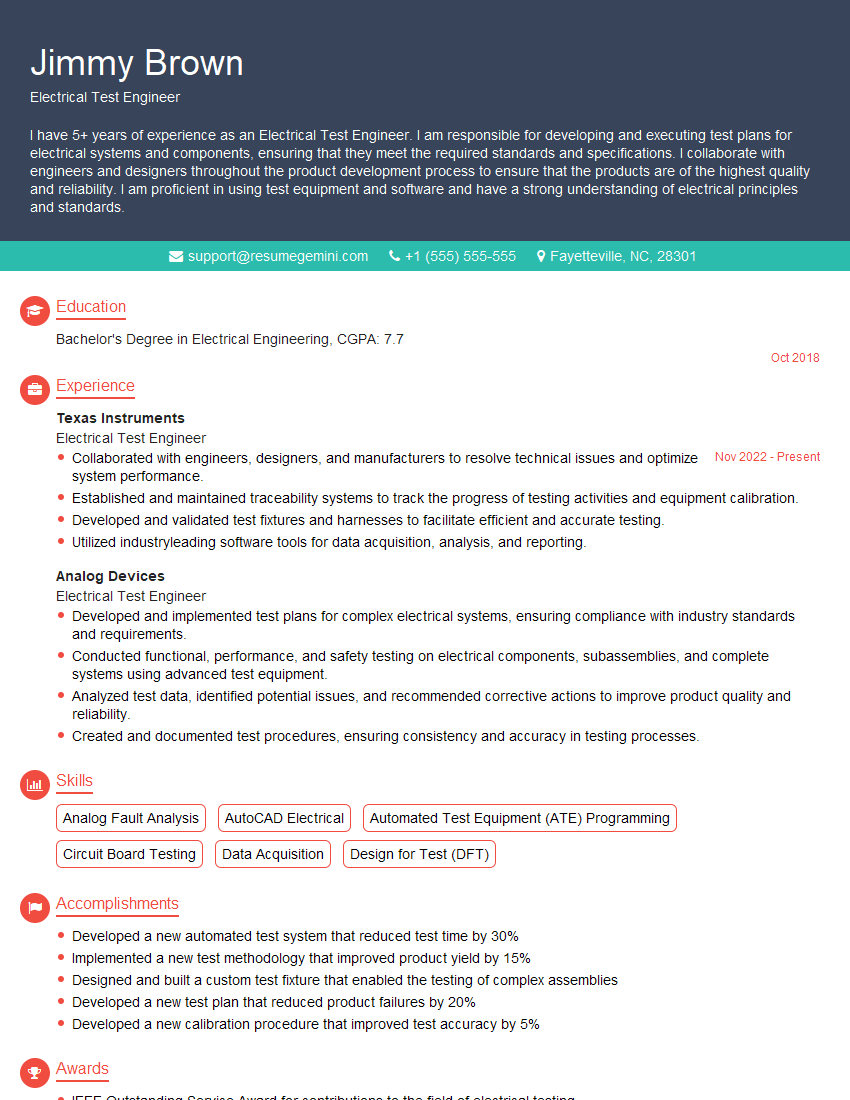
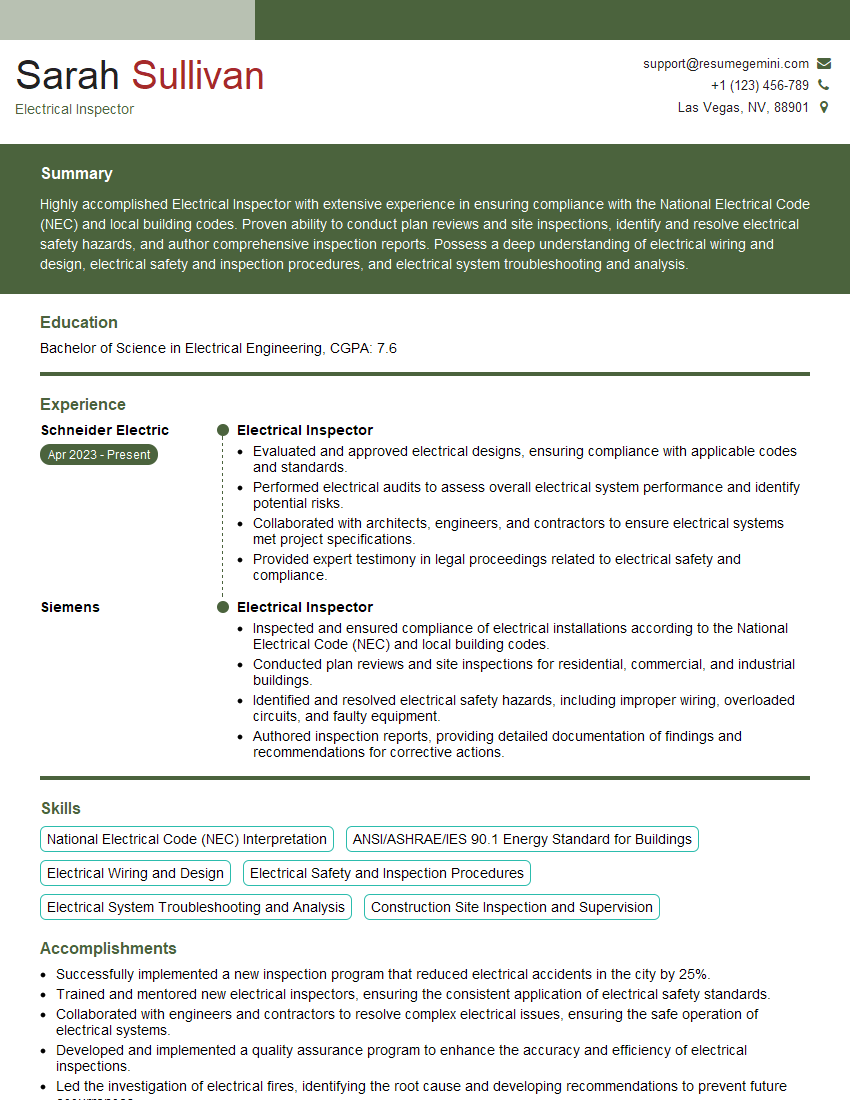
Mastering the art of testing and inspecting electrical systems is key to a successful and rewarding career in this vital field. It showcases a critical combination of technical expertise, safety consciousness, and problem-solving skills highly valued by employers. To significantly boost your job prospects, it’s essential to create a compelling and ATS-friendly resume that highlights your skills and experience effectively. ResumeGemini is a trusted resource that can help you craft a professional resume that stands out from the competition. We offer examples of resumes tailored specifically to Test and Inspect Electrical Systems roles to help you get started. Take the next step towards your dream job today!
Explore more articles
Users Rating of Our Blogs
Share Your Experience
We value your feedback! Please rate our content and share your thoughts (optional).
What Readers Say About Our Blog
To the interviewgemini.com Webmaster.
Very helpful and content specific questions to help prepare me for my interview!
Thank you
To the interviewgemini.com Webmaster.
This was kind of a unique content I found around the specialized skills. Very helpful questions and good detailed answers.
Very Helpful blog, thank you Interviewgemini team.