Feeling uncertain about what to expect in your upcoming interview? We’ve got you covered! This blog highlights the most important Transmission Line Maintenance interview questions and provides actionable advice to help you stand out as the ideal candidate. Let’s pave the way for your success.
Questions Asked in Transmission Line Maintenance Interview
Q 1. Explain the different types of transmission line conductors.
Transmission line conductors are the heart of the power system, carrying the electrical current over long distances. The choice of conductor depends on factors like voltage level, current carrying capacity, and environmental conditions. Common types include:
- Aluminum Conductor Steel-Reinforced (ACSR): This is the most widely used conductor. It combines the high conductivity of aluminum with the tensile strength of steel. The steel core provides the necessary mechanical strength to withstand wind, ice, and other environmental stresses. Think of it like a strong, flexible cable with aluminum wires for conductivity wrapped around a steel core for strength.
- All-Aluminum Conductor (AAC): Simpler and lighter than ACSR, AAC is suitable for lower voltage lines where mechanical strength requirements are less stringent. However, it’s not as strong and is used less frequently on long spans.
- Aluminum Conductor Alloy-Reinforced (ACAR): Similar to ACSR but utilizes a stronger alloy core instead of steel. This offers improved corrosion resistance compared to ACSR, although it might be more expensive.
- High-Temperature Low-Sag (HTLS) Conductors: Designed for high-voltage lines, these conductors have enhanced mechanical properties and a higher resistance to sagging under load. These conductors often utilize special alloys and designs.
The selection of a specific conductor type involves careful engineering calculations to ensure safe and efficient power transmission.
Q 2. Describe the purpose and function of insulators in transmission lines.
Insulators are critical components in transmission lines; their primary function is to electrically isolate the conductors from the supporting towers or structures, preventing current leakage to ground. Imagine them as the guardians that keep the high-voltage electricity safely contained within the conductors. They are typically made of materials with high dielectric strength, such as porcelain, glass, or composite polymers. Failure of insulators can lead to short circuits, power outages, and safety hazards.
Different insulator types exist for various voltage levels and environmental conditions. For example, string insulators, consisting of multiple disc insulators connected in series, are used for high-voltage lines to withstand the high potential difference.
Q 3. What are the common causes of transmission line faults?
Transmission line faults can arise from a variety of causes, broadly categorized as:
- Lightning Strikes: A major cause of faults, lightning can directly damage conductors or insulators, causing flashovers and short circuits. Imagine a powerful bolt of lightning striking a transmission tower – it’s a direct and powerful threat.
- Conductor Faults: These can include broken conductors, damaged joints, or conductor galloping (excessive movement due to wind). Think of a conductor snapping due to extreme weather or aging.
- Insulator Failures: Contamination, aging, or physical damage can lead to insulator flashover and ground faults. A simple crack in an insulator can create a pathway for current to leak.
- Tree and Vegetation Contact: Overgrown trees or branches contacting conductors create shorts, leading to faults. This is a frequent occurrence especially during periods of high wind or rapid growth.
- Environmental Factors: Heavy snow, ice storms, high winds, and extreme temperatures can stress the line, leading to conductor breakage or insulator failure.
Predictive maintenance strategies are crucial to mitigate these risks and ensure the continued reliable operation of transmission lines.
Q 4. How do you identify and troubleshoot a faulty insulator?
Identifying a faulty insulator involves visual inspection and specialized testing. During routine inspections, technicians visually check for cracks, flashover marks (burn marks indicating arcing), and contamination on the insulator surface. A dirty insulator is much more likely to experience flashover.
Further testing can involve using:
- Megger Test: This measures the insulation resistance of the insulator to determine if there is any leakage current. A low resistance indicates a potential fault.
- Partial Discharge Detection: This advanced technique detects partial discharges (small electrical discharges within the insulator material), which are indicators of potential future failures.
Troubleshooting involves replacing the faulty insulator with a new one of the same type and rating. This is a critical process that requires specialized training and safety measures.
Q 5. Explain the process of transmission line maintenance inspections.
Transmission line maintenance inspections are systematic procedures to assess the condition of the line and identify potential problems before they lead to failures. These inspections can be:
- Routine Inspections: Performed regularly (e.g., annually or biannually) to check the overall condition of the line, including conductors, insulators, towers, and hardware.
- Specialized Inspections: Conducted after severe weather events or when specific problems are suspected, focusing on the affected areas.
- Drone Inspections: Modern techniques employ drones equipped with high-resolution cameras to inspect the line without interrupting service, offering a safer and more efficient method of visual inspection.
Inspections involve visual observations, often supported by infrared thermography to detect hot spots indicative of potential problems. Detailed reports are prepared to document findings and recommend necessary repairs or replacements.
Q 6. What safety precautions are essential when working on energized transmission lines?
Working on energized transmission lines is extremely dangerous. Safety is paramount, and stringent procedures must be followed:
- Lockout/Tagout Procedures: Before any work, the line must be de-energized and locked out, preventing accidental energization.
- Protective Equipment: Workers must wear appropriate personal protective equipment (PPE), including insulated gloves, safety helmets, arc-flash suits, and safety harnesses.
- Grounding: Thorough grounding of the line is essential to ensure that it remains grounded even during work. This prevents accidental contact with energized parts.
- Trained Personnel: Only highly trained and qualified personnel should perform work on energized lines. These individuals possess the expertise and experience to recognize and mitigate potential hazards.
- Safety Briefings: Prior to any work, complete safety briefings must be conducted to review the specific hazards and safety procedures.
Ignoring these safety precautions can have fatal consequences.
Q 7. Describe different methods of transmission line grounding.
Transmission line grounding is crucial for protecting equipment and personnel from electrical surges, lightning strikes, and faults. Several methods are used:
- Grounding Wires: These wires are connected to the towers and run along the length of the line, providing a low-resistance path to ground for fault currents.
- Counterpoise Grounding: A network of buried conductors runs parallel to the line, providing additional grounding for the system.
- Ground Rods: These metallic rods driven deep into the earth provide a connection point for grounding wires.
- Substation Grounding: At substations, extensive grounding systems are installed to effectively dissipate fault currents.
The effectiveness of grounding depends on the resistivity of the soil. In areas with high soil resistivity, special grounding techniques may be required to achieve the necessary low impedance path to ground.
Q 8. Explain the importance of corona effect and its mitigation techniques.
The corona effect is an electrical discharge that occurs when the electric field intensity around a conductor exceeds the dielectric strength of the surrounding air. Imagine it like a tiny spark – it’s a partial discharge that ionizes the air, creating a faint glow and a hissing sound. While a small amount is unavoidable, excessive corona is detrimental.
Why is it important (and bad)? Corona causes power loss, radio interference (think static on your radio!), and can even damage the conductor over time due to ozone generation and erosion. It also reduces the efficiency of the transmission line.
Mitigation Techniques: Several methods help minimize the corona effect:
- Increasing conductor diameter: A larger conductor reduces the electric field intensity at its surface. Think of it like spreading out the charge over a wider area.
- Using corona rings: These are metal rings placed at the end of insulators or on the conductors themselves. They help to distribute the electric field more evenly, preventing high concentrations that lead to corona.
- Proper conductor spacing: Maintaining sufficient distance between conductors reduces the electric field intensity between them.
- Using bundled conductors: Instead of a single large conductor, several smaller conductors are bundled together. This increases the effective diameter and reduces the corona effect.
- Careful insulator design: Insulators with smooth surfaces and proper creepage distances help to prevent corona formation.
Example: A high-voltage transmission line operating at a high altitude might experience a greater corona effect due to lower air density. Using bundled conductors and corona rings would be essential in such a scenario.
Q 9. What are the different types of transmission line towers?
Transmission line towers are classified based on their design and the voltage level they support. Here are some common types:
- Lattice towers: These are the most common type, constructed from interconnected steel members forming a lattice structure. They’re strong, relatively easy to manufacture, and suitable for a wide range of voltages.
- Self-supporting towers: These towers are designed to withstand the forces acting on them without external guy wires. They are often used in areas where guy wires are impractical or undesirable, such as urban areas or crossing over roads.
- Suspension towers: Designed to carry the conductors, these towers support the weight and tension of the lines. These are typically part of a long line string.
- Angle towers: Used at points where the line changes direction. These need to withstand additional forces due to the angled configuration.
- Dead-end towers: Used at the end of transmission lines or at points where the line terminates, they bear the entire tension of the conductors.
- Tension towers: Similar to dead-end towers, but designed for higher tension loads, often employed where the line changes direction significantly.
The choice of tower depends on factors such as voltage level, terrain, environmental conditions, and the overall design of the transmission line. For instance, a high-voltage line crossing a river might require a self-supporting tower for stability and safety reasons.
Q 10. How do you determine the sag and tension of transmission line conductors?
Determining sag and tension is crucial for safe and efficient transmission line operation. Too much sag can lead to ground clearance issues, while excessive tension can damage the conductors.
Sag Calculation: Sag is primarily determined using the catenary equation which considers the conductor’s weight, span length, and the tensile strength. Simplified parabolic formulas are often used for approximation in many cases. The formula considers factors like temperature and wind.
Sag ≈ (wL²)/(8T) where:
Sagis the sag of the conductor (in meters)wis the weight of the conductor per unit length (in N/m)Lis the span length (in meters)Tis the conductor tension (in Newtons)
Tension Calculation: Tension is calculated using similar equations or using specialized software that accounts for various factors. The tension calculation needs to consider the desired sag and the mechanical properties of the conductors, again including considerations for temperature and wind. Measurements are often used to verify the calculated sag and tension values.
Practical Application: We use these calculations during the line design phase to determine the appropriate tower heights and conductor sizes. During maintenance, we monitor sag and tension to ensure the line remains within safe operating limits.
Q 11. Describe the process of stringing and tensioning transmission line conductors.
Stringing and tensioning transmission line conductors is a critical step in construction and maintenance. It’s a precise operation requiring skilled personnel and specialized equipment.
Process:
- Conductor pulling: Conductors are pulled from reels using specialized pulling equipment. This ensures smooth and controlled deployment, minimizing damage.
- Stringing: The conductors are carefully strung along the transmission line route, guided along the tower insulators. This is often a delicate balancing act given the potential for friction.
- Tensioning: The conductors are then tensioned to the required level using tensioning devices. This is crucial to ensure proper sag and minimize stress on the towers and conductors. Tensioning is a very controlled process.
- Sag measurement: Once tensioned, the sag is measured at multiple points to verify it meets the design specifications.
- Conductor clamping: After ensuring appropriate tension and sag, the conductors are securely clamped to the insulators on the towers.
Tensioning Devices: Various tensioning devices are used, from simple hand-operated winches to sophisticated hydraulic systems that allow for fine adjustments.
Safety Considerations: Stringing and tensioning involve working at heights and with heavy equipment, so strict safety procedures must be followed. Detailed planning and risk assessment are paramount.
Example: During a stringing operation, the team must account for the temperature and wind conditions, as these directly affect both sag and tension. Adjustments are often made to achieve the correct parameters.
Q 12. Explain the different types of transmission line protection schemes.
Transmission line protection schemes are crucial for ensuring the reliability and safety of the power system. They detect faults, isolate the affected sections, and prevent damage to equipment or injury to personnel.
Types of Protection Schemes:
- Distance protection: Measures the impedance between the relay and the fault location. It’s a very common scheme.
- Overcurrent protection: Detects excessive current flow due to faults. Simple but effective for many scenarios.
- Differential protection: Compares the current entering and leaving a protected zone. Very sensitive to internal faults.
- Pilot wire protection: Uses communication channels between the ends of a protected line to detect faults. Effective but more complex to implement.
- Pilot relay protection: An extension of pilot wire protection, using more advanced techniques.
- Busbar protection: Protects the busbars in substations.
Coordination: Different protection schemes must be coordinated to ensure that the correct protection scheme operates for a specific fault location. Miscoordination can lead to unnecessary outages or failure to clear a fault. For example, you would want overcurrent protection to back up a distance scheme.
Modern Protection: Modern transmission line protection often incorporates digital relays with advanced algorithms for faster and more accurate fault detection and isolation.
Q 13. What is the role of a substation in a transmission system?
Substations are critical components of the transmission system, acting as switching centers and voltage transformers. They manage the flow of electricity between the transmission lines and the distribution networks.
Key Roles:
- Voltage transformation: Substations use transformers to step up or step down voltage levels to match the requirements of different parts of the power system. Think of it as adjusting the water pressure in a system.
- Switching and protection: They provide switching facilities to control power flow, isolate faulty equipment, and reroute electricity around problems.
- Monitoring and control: Substations are equipped with monitoring and control systems that provide real-time information about system conditions and allow operators to manage the grid effectively.
- Energy measurement: Substations measure the amount of electricity flowing through them, enabling accurate billing and monitoring of energy usage.
Example: A high-voltage transmission line might deliver electricity at 500 kV to a substation. The substation will use step-down transformers to reduce the voltage to a lower level (e.g., 132 kV or 220 kV) for distribution to homes and businesses.
Q 14. Explain the concept of impedance and its significance in transmission lines.
Impedance is the opposition to the flow of alternating current (AC) in a transmission line. It’s a complex quantity with both resistance and reactance components.
Significance: Impedance is crucial in transmission line analysis and design. It determines the voltage drop, power loss, and stability of the transmission line.
Components:
- Resistance (R): Represents the opposition to current flow due to the conductor’s material and temperature. This is the ‘friction’ against electricity.
- Reactance (X): Represents the opposition to current flow due to the electromagnetic fields around the conductor. This depends on the conductor geometry and frequency of the current. This component can be further divided into inductive reactance (due to the magnetic field) and capacitive reactance (due to the electric field).
Calculation: Impedance (Z) is calculated as the complex sum of resistance and reactance: Z = R + jX, where ‘j’ is the imaginary unit.
Impact on Transmission Lines: Higher impedance leads to increased voltage drop and power loss. Therefore, engineers aim to minimize line impedance through appropriate conductor selection, design, and maintenance.
Example: A longer transmission line will have a higher impedance than a shorter one because of the increased resistance and reactance. This necessitates larger conductors or other compensation methods to mitigate power loss.
Q 15. How do you calculate the line loss in a transmission line?
Calculating transmission line losses involves understanding the power dissipated as heat due to the resistance of the conductors. The primary method uses the formula: Ploss = I²R, where Ploss is the power loss in Watts, I is the current in Amperes, and R is the resistance of the line in Ohms. This resistance is dependent on the conductor material, its length, cross-sectional area, and temperature.
However, this simple formula only accounts for resistive losses. In reality, other factors contribute, including:
- Skin effect: At high frequencies, current tends to flow closer to the conductor’s surface, increasing effective resistance.
- Proximity effect: The magnetic fields of adjacent conductors interact, increasing their individual resistances.
- Corona loss: At high voltages, ionization of the air surrounding the conductor leads to energy loss.
To account for these, more complex models and simulations are employed, often using specialized software that considers the line’s geometry, material properties, and operating conditions. For instance, a transmission line analysis program might use a distributed parameter model considering inductance, capacitance, and resistance along the line. The results provide a more accurate estimate of total line losses, crucial for efficient grid management and economic planning.
Example: Consider a 10 km long transmission line with a conductor resistance of 0.1 ohms/km carrying a current of 1000 A. The resistive loss would be (1000 A)² * (10 km * 0.1 ohms/km) = 1,000,000 Watts or 1 MW. This is a simplified calculation; actual loss would be higher due to skin effect, proximity effect, and corona loss.
Career Expert Tips:
- Ace those interviews! Prepare effectively by reviewing the Top 50 Most Common Interview Questions on ResumeGemini.
- Navigate your job search with confidence! Explore a wide range of Career Tips on ResumeGemini. Learn about common challenges and recommendations to overcome them.
- Craft the perfect resume! Master the Art of Resume Writing with ResumeGemini’s guide. Showcase your unique qualifications and achievements effectively.
- Don’t miss out on holiday savings! Build your dream resume with ResumeGemini’s ATS optimized templates.
Q 16. Describe the different types of transmission line terminations.
Transmission line terminations are crucial for managing power flow and preventing reflections. The type of termination depends on the line’s purpose and design. Common types include:
- Open Circuit: The line ends abruptly without a connection. This causes complete reflection of the incident wave, potentially leading to high voltages and standing waves.
- Short Circuit: The line ends with a direct connection, resulting in complete reflection with a 180-degree phase shift. This can lead to high currents.
- Matched Termination (Characteristic Impedance): This is the ideal termination, where the line is terminated with a resistor equal to its characteristic impedance (Z0). This prevents reflections, ensuring maximum power transfer and minimal signal distortion. The characteristic impedance is a function of the line’s geometry and material properties. For example, a coaxial cable might have a Z0 of 50 ohms.
- Transformer Termination: Transformers are used for impedance matching, stepping voltage up or down while minimizing reflection. This is commonly used at substations to connect transmission lines to equipment with different impedance levels.
Choosing the appropriate termination is vital for transmission line performance and reliability. Incorrect termination can lead to signal degradation, equipment damage, and system instability.
Q 17. What are the common causes of transmission line outages?
Transmission line outages can be caused by a variety of factors, broadly categorized as:
- Weather-related events: These are the most frequent causes, including lightning strikes, strong winds, ice storms, heavy snow, and extreme temperatures. Lightning can directly damage conductors or insulators, while wind and ice can cause conductor sagging, breakage, or tower collapse.
- Equipment failures: Failures in insulators, transformers, circuit breakers, and other equipment can lead to outages. Aging equipment, manufacturing defects, and lack of proper maintenance can increase the likelihood of such failures.
- Tree limbs and vegetation: Growing vegetation can make contact with conductors, causing short circuits and faults. Regular vegetation management is crucial for preventing such incidents.
- Animal interference: Birds, squirrels, and other animals can cause short circuits or ground faults by coming into contact with energized components.
- Human error: Incorrect operation of equipment, accidental damage during maintenance, and inadequate safety procedures can also contribute to outages.
- Natural disasters: Earthquakes, floods, and wildfires can cause significant damage to transmission lines, resulting in widespread outages.
Understanding these common causes is critical for effective maintenance planning, risk assessment, and outage prevention strategies.
Q 18. Explain the role of SCADA in transmission line monitoring and control.
Supervisory Control and Data Acquisition (SCADA) systems play a vital role in monitoring and controlling transmission lines. They provide real-time data on various parameters, including voltage, current, power flow, temperature, and line status. This information is crucial for efficient operation and fault detection.
Key functionalities of SCADA in transmission line management include:
- Remote monitoring: SCADA allows operators to monitor the status of transmission lines from a central control room, even those located in remote areas.
- Alarm management: The system generates alarms when critical parameters exceed predefined thresholds, alerting operators to potential problems.
- Fault detection and isolation: SCADA assists in quickly identifying the location and cause of faults, allowing for faster restoration of service.
- Remote control: Operators can remotely control various equipment, such as circuit breakers and switches, to isolate faulty sections and restore power.
- Data logging and analysis: SCADA systems record historical data, enabling engineers to analyze trends and improve maintenance strategies.
The use of SCADA significantly enhances the reliability, efficiency, and safety of transmission line operations, minimizing downtime and improving overall grid stability. For example, a sudden drop in voltage detected by SCADA can trigger an automatic response to isolate the affected section, preventing a larger cascade failure.
Q 19. How do you perform maintenance on transmission line transformers?
Maintenance of transmission line transformers is critical for ensuring their long-term reliability and efficiency. The maintenance schedule depends on the transformer’s size, age, and operating conditions, but generally includes:
- Oil analysis: Regularly testing the transformer oil for contaminants, moisture, and dissolved gases helps identify potential problems such as insulation breakdown or overheating.
- Insulation testing: Measuring the insulation resistance ensures the integrity of the windings and other insulation components.
- Visual inspection: Regular visual inspections check for signs of damage, such as leaks, corrosion, or loose connections.
- Cleaning and tightening: Removing dirt and debris and tightening connections helps prevent arcing and other problems.
- Tap changer maintenance: For transformers with tap changers (devices used to adjust voltage), regular maintenance ensures its proper operation and prevents wear.
- Overhaul/Replacement: As transformers age, major overhauls or eventual replacement may be required. This typically involves complete disassembly, cleaning, inspection, repair or replacement of components, and reassembly.
Preventive maintenance is far more cost-effective than dealing with unplanned failures. A well-maintained transformer is less likely to experience sudden catastrophic failure, minimizing costly downtime and potential safety risks.
Q 20. Describe the process of replacing a damaged transmission tower.
Replacing a damaged transmission tower is a complex and high-risk operation requiring meticulous planning and execution. The process typically involves:
- Assessment and planning: A thorough assessment determines the extent of the damage and the best approach for replacement. This includes considering the tower’s location, terrain, weather conditions, and the need for specialized equipment.
- De-energizing the line: The transmission line must be completely de-energized and grounded to ensure worker safety.
- Tower removal: The damaged tower is carefully dismantled, often using cranes and specialized rigging equipment. Safety precautions are paramount to prevent the tower from falling on nearby equipment or personnel.
- Foundation preparation: The foundation for the new tower needs to be properly prepared, ensuring it meets the required specifications.
- New tower erection: The new tower is carefully erected, using cranes and experienced crews. Precision is essential to ensure stability and correct alignment.
- Conductor re-stringing: The conductors are re-strung and connected to the new tower. This often requires the use of tensioning equipment to ensure proper sag and tension.
- Testing and commissioning: Before re-energizing the line, thorough testing ensures the new tower and connections are sound.
Replacing a transmission tower is a large-scale operation that requires coordination between engineers, technicians, and specialized contractors. Rigorous safety procedures and adherence to industry standards are crucial throughout the process to prevent accidents and ensure efficient completion.
Q 21. What are the environmental considerations in transmission line maintenance?
Environmental considerations are increasingly important in transmission line maintenance. Key aspects include:
- Wildlife protection: Transmission lines can pose risks to birds and other wildlife. Maintenance activities should be planned to minimize disruption to habitats and reduce bird collisions. This can involve using bird diverters on conductors and careful consideration of nesting seasons.
- Vegetation management: While vegetation management is necessary to prevent short circuits, it must be done sustainably. This might involve using selective pruning techniques rather than complete clearing, promoting biodiversity, and minimizing habitat destruction.
- Soil erosion and land disturbance: Construction and maintenance activities can cause soil erosion and damage to surrounding ecosystems. Erosion control measures, such as seeding and mulching, are crucial.
- Water quality protection: Avoiding spills of oil or other hazardous materials during maintenance is crucial for protecting water resources.
- Waste management: Proper disposal of hazardous waste, such as transformer oil and contaminated materials, is essential for environmental protection. Recycling and responsible waste management practices should be implemented.
- Noise pollution: Activities such as helicopter use and equipment operation can create noise pollution. Mitigation strategies should be considered to minimize noise impact on nearby communities.
By incorporating environmental considerations into all aspects of transmission line maintenance, we can minimize the environmental footprint of these essential energy infrastructure systems.
Q 22. Explain the use of aerial lifts and bucket trucks in transmission line work.
Aerial lifts, commonly known as bucket trucks, are essential for accessing and working on transmission lines safely. They provide a stable, elevated platform allowing linemen to perform maintenance, repairs, and installations on energized or de-energized lines. Imagine them as mobile, elevated work platforms that greatly reduce the risk of falls from height, a major hazard in this industry.
Their use ranges from simple tasks like inspecting insulators and conductors to complex operations involving replacing damaged components or installing new equipment. The hydraulic system allows precise positioning, while safety features like outriggers and emergency stops ensure worker security. Different sizes of aerial lifts are chosen based on the height and accessibility requirements of the transmission line.
- Inspection: A lineman might use a bucket truck to inspect a section of line for signs of wear and tear, such as broken insulators or damaged conductors.
- Repair: A damaged conductor might require splicing using specialized tools while the lineman is safely elevated in the bucket.
- Installation: New insulators or other line hardware can be safely installed using an aerial lift, minimizing the risk of injury.
Q 23. How do you handle emergency situations during transmission line maintenance?
Emergency situations during transmission line maintenance require immediate and decisive action. Prioritization is key – ensuring worker safety is always the absolute top priority. Our response follows a structured approach:
- Safety First: Immediately secure the area and evacuate personnel if necessary. This includes notifying emergency services and implementing appropriate safety procedures based on the nature of the emergency (e.g., fire, downed lines, injury).
- Assess the Situation: Quickly determine the extent of the damage and the potential risks. This might involve visual inspection, assessing the stability of the line, and identifying potential hazards.
- Implement Emergency Procedures: Our team is well-versed in established emergency response plans that outline specific steps for various situations. These plans include detailed protocols for de-energizing lines safely, addressing hazards, and providing first aid.
- Communication is Crucial: Maintaining clear and consistent communication among team members, emergency services, and control centers is critical during an emergency. We use dedicated communication channels for clear instructions and updates.
- Restoration and Repair: Once the immediate danger is mitigated, we begin the process of restoring power and making necessary repairs. This could involve temporary repairs to restore service quickly followed by more permanent solutions later.
During my time at [Previous Company Name], we handled a situation where a tree fell onto a high-voltage line during a storm. Our immediate response followed the above steps precisely – securing the area, assessing damage, contacting emergency services and power was restored within 6 hours.
Q 24. What are the different types of tools and equipment used in transmission line maintenance?
Transmission line maintenance utilizes a wide array of specialized tools and equipment. Safety is paramount, so all tools are regularly inspected and maintained.
- Aerial Lifts/Bucket Trucks: For safe access to the lines.
- Insulator Testing Equipment: To measure the insulation resistance of insulators and identify weaknesses.
- Conductor Tensioning Tools: To ensure proper tension on conductors, preventing sagging.
- Line Tools: Including various types of pliers, cutters, wrenches, and specialized tools for working with different types of connectors and hardware.
- Protective Equipment: This includes rubber gloves, safety helmets, arc flash suits, safety harnesses, and specialized eye protection. The level of protection is tailored to the voltage level being worked on.
- Grounding Equipment: To safely ground the lines before work commences, preventing electrical shock.
- Specialized Testing Equipment: For measuring various parameters of the lines, including sag, temperature, and conductor resistance.
- Communication Equipment: Two-way radios and other communication devices for efficient coordination among crew members.
Q 25. Describe the importance of proper documentation in transmission line maintenance.
Proper documentation in transmission line maintenance is critical for several reasons: safety, regulatory compliance, and efficient maintenance planning. Detailed records enable us to track the condition of the lines, predict potential issues, and maintain a history of repairs and maintenance.
- Safety: Accurate records ensure that crews are aware of past issues and potential hazards at a specific location. This helps prevent accidents by highlighting known problem areas.
- Regulatory Compliance: Detailed records are essential to demonstrate compliance with industry regulations and standards. Audits frequently require thorough documentation to verify compliance.
- Maintenance Planning: Historical data on repairs, inspections, and equipment failures assists in developing effective maintenance schedules and predicting future needs.
- Liability: Comprehensive records protect the utility company in case of accidents or disputes. They provide evidence of due diligence and proper maintenance practices.
We utilize a combination of digital and paper-based systems. Digital databases store inspection reports, repair records, and equipment information while paper records serve as backups and field records.
Q 26. Explain your experience with different types of transmission line materials.
My experience encompasses various transmission line materials, each with its own properties, advantages, and disadvantages.
- Aluminum Conductor Steel-Reinforced (ACSR): This is a very common material due to its high tensile strength and relatively low weight. It’s a good balance of cost-effectiveness and performance.
- Aluminum Conductor Alloy Reinforced (ACAR): Offers even higher conductivity than ACSR, and is increasingly used in high-capacity lines.
- High-Temperature Low-Sag (HTLS) Conductors: These conductors are designed to withstand higher temperatures and have less sag, allowing for longer spans and increased power capacity.
- Optical Ground Wires (OPGW): These combine the function of a ground wire with fiber optic cables for communication, providing a versatile solution for data transmission and electrical protection.
- Insulators: These come in various materials like porcelain, glass, and polymer composites. The choice depends on factors such as voltage level, environmental conditions, and cost.
I’ve worked on lines using all these materials, understanding their properties and how to handle them safely and effectively during maintenance and repair operations. This knowledge is crucial for selecting appropriate replacement parts and performing repairs that are both efficient and reliable.
Q 27. How do you ensure compliance with safety regulations during transmission line maintenance?
Ensuring compliance with safety regulations is a non-negotiable aspect of transmission line maintenance. It’s a cornerstone of our operations.
- Training and Certifications: All our personnel undergo rigorous safety training programs and obtain necessary certifications to work on transmission lines. This includes training on lockout/tagout procedures, arc flash protection, and working at heights.
- Permit-to-Work Systems: A strict permit-to-work system ensures that all work is properly planned, risks are assessed, and safety measures are in place before any work begins. This includes de-energizing lines appropriately and implementing all necessary safety protocols.
- Regular Inspections: Tools, equipment, and protective gear are inspected regularly to ensure they are in good working order and meet safety standards. This includes visual inspections, functional testing, and regular maintenance schedules for aerial lifts and other critical equipment.
- Safety Meetings: Regular safety meetings are conducted to review incidents, discuss safety procedures, and reinforce safety awareness among crews.
- Compliance with Regulations: We stay abreast of the latest safety regulations and standards, ensuring that our procedures and practices are always compliant.
Our commitment to safety goes beyond meeting minimum requirements; we strive to foster a safety-conscious culture where every team member is empowered to identify and address safety hazards.
Q 28. Describe a time you had to troubleshoot a complex transmission line problem.
During a routine inspection, we discovered unusually high resistance readings on a section of a 230kV line. This indicated a potential fault, but pinpointing the location was challenging due to the line’s length and the dispersed nature of the readings. Initially, we suspected a faulty insulator, but thorough testing revealed otherwise. Our systematic troubleshooting involved:
- Data Analysis: We carefully analyzed the resistance readings, noting the gradual increase over time and its correlation with specific geographic locations.
- Aerial Inspection: Using a helicopter, we performed a thorough visual inspection of the line, paying close attention to the areas flagged by the resistance readings. We found signs of slight corrosion on some conductors.
- Ground Testing: Ground-based testing with specialized equipment confirmed the presence of increased resistance and localized corrosion.
- Targeted Repair: Once the problem area was identified, we scheduled a repair crew for cleaning and treatment of the corroded conductors.
The root cause turned out to be localized corrosion, likely due to environmental factors. This case highlighted the importance of combining routine inspections with advanced data analysis techniques to quickly identify and effectively resolve complex transmission line issues. The prompt identification and repair prevented a larger, more widespread failure.
Key Topics to Learn for Transmission Line Maintenance Interview
- Transmission Line Design and Construction: Understanding different conductor types, tower structures, insulators, and grounding systems. Practical application includes analyzing design specifications for potential weaknesses.
- Safety Procedures and Regulations: Thorough knowledge of OSHA regulations, lockout/tagout procedures, and safe work practices specific to transmission line maintenance. Practical application includes developing and implementing safe work plans.
- Fault Location and Repair: Mastering techniques for identifying and rectifying faults in transmission lines, including the use of specialized equipment. Practical application includes troubleshooting line outages and performing necessary repairs.
- Maintenance Scheduling and Planning: Understanding preventative maintenance schedules, predictive maintenance techniques, and resource allocation strategies. Practical application involves creating and optimizing maintenance plans to minimize downtime.
- Line Inspection and Testing: Proficiency in various inspection methods, including visual inspections, infrared thermography, and partial discharge testing. Practical application includes identifying potential problems before they escalate into major outages.
- Troubleshooting and Problem-Solving: Developing strong analytical skills to diagnose complex problems and implement effective solutions in high-pressure situations. Practical application involves analyzing data from inspections and tests to determine appropriate corrective actions.
- Communication and Teamwork: Effective communication with colleagues, supervisors, and clients is crucial. Practical application includes collaborating effectively with teams during maintenance activities.
Next Steps
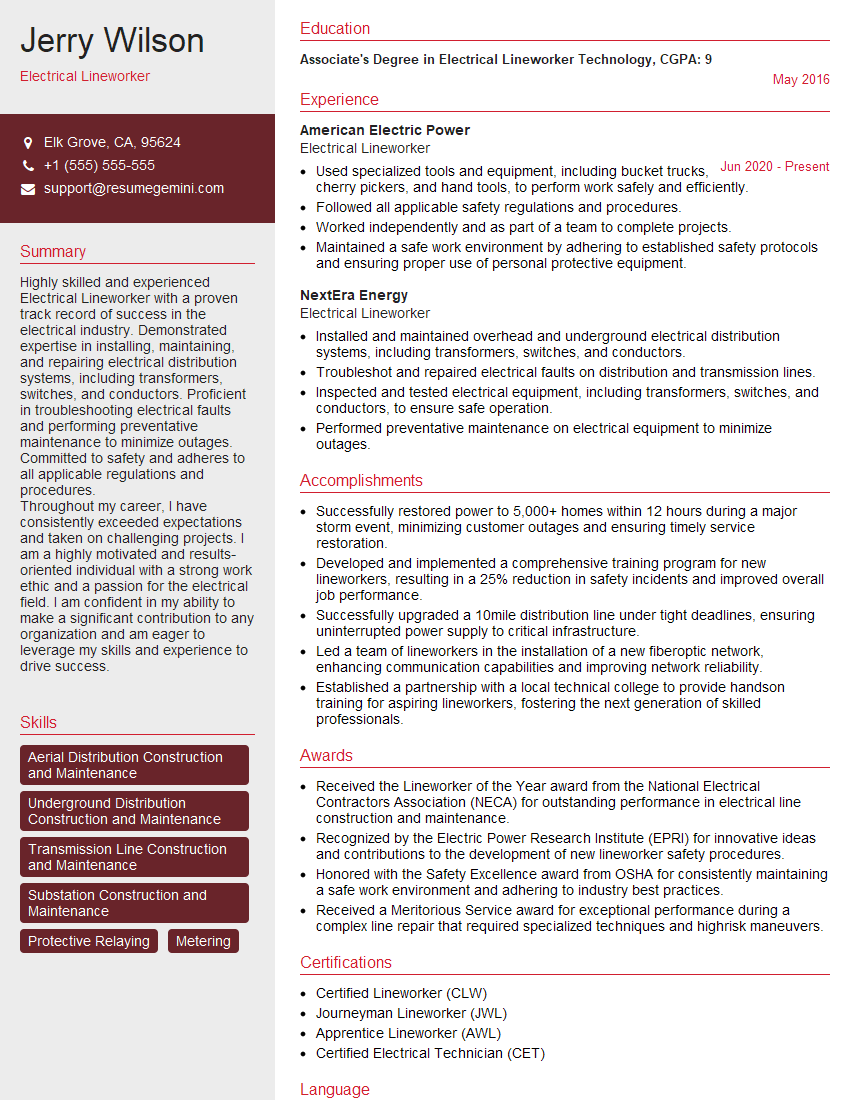
Mastering Transmission Line Maintenance opens doors to a rewarding career with excellent growth potential, offering opportunities for specialization and advancement within the energy sector. To maximize your job prospects, creating a strong, ATS-friendly resume is vital. ResumeGemini is a trusted resource that can help you build a professional and impactful resume tailored to the specific demands of this field. We provide examples of resumes tailored to Transmission Line Maintenance to guide you through the process, ensuring your skills and experience are effectively highlighted for recruiters.
Explore more articles
Users Rating of Our Blogs
Share Your Experience
We value your feedback! Please rate our content and share your thoughts (optional).
What Readers Say About Our Blog
To the interviewgemini.com Webmaster.
Very helpful and content specific questions to help prepare me for my interview!
Thank you
To the interviewgemini.com Webmaster.
This was kind of a unique content I found around the specialized skills. Very helpful questions and good detailed answers.
Very Helpful blog, thank you Interviewgemini team.